The widespread use of fluoroquinolones has led to the emergence of resistant strains, complicating the treatment of bacterial infections. This study aimed to analyze quinolone resistance in Gram-negative bacilli isolated from semen samples in Burkina Faso. A total of 311 semen samples were used in the study. The bacteria present were isolated and identified using standard methods. Antibiotic susceptibility was assessed, and isolates resistant to at least one of the quinolones tested were analyzed by conventional PCR to detect the resistance genes aac(6')-Ib, qnrA, qnrB, and qnrS. A total of 8 samples (2.58%) were culture-positive, with a predominance of Escherichia coli (62.5%) and Klebsiella pneumoniae (37.5%). All Klebsiella pneumoniae species were susceptible to antibiotics, while Escherichia coli strains showed resistance rates of 50% to ciprofloxacin, 37.5% to norfloxacin, and 12.5% to levofloxacin. Molecular analysis of the isolates revealed a high prevalence of the qnrA gene (75%), followed by the aac(6')-Ib and qnrB genes (50% each). In addition, 50% of isolates contained both the qnrA and qnrB genes, and 25% contained both aac(6')-Ib and qnrA. The detection of these plasmid resistance genes highlights the importance of monitoring the evolution of antibiotic resistance and promoting the judicious use of antibiotics in order to limit its spread.
This is an Open Access article, distributed under the terms of the Creative Commons Attribution 4.0 International License (http://creativecommons.org/licenses/by/4.0/), which permits unrestricted use, distribution and reproduction in any medium or format, provided the original work is properly cited.
Gram-negative bacilli are involved in various human infections, particularly those affecting the urinary, respiratory, and genital systems. Their ability to develop resistance to antibiotics represents a major challenge
[1]
Hooper DC, Jacoby GA. Mechanisms of drug resistance: quinolone resistance. Ann N Y Acad Sci. 2015; 1354(1): 12-31.
. Among the available therapeutic alternatives, quinolones play an essential role due to their broad spectrum of activity and efficacy. However, the increase in quinolone-resistant strains over the last few decades poses a significant risk to their clinical use
[2]
Origin of the plasmid-mediated quinolone resistance determinant QnrA | Antimicrobial agents and chemotherapy. URL
. The main factor contributing to this resistance in Gram-negative bacilli is linked to mutations in the genes responsible for gyrase (gyrA gene) and topoisomerase IV (parC)
[3]
Ruiz J. Mechanisms of resistance to quinolones: target alterations, decreased accumulation and DNA gyrase protection. J Antimicrob Chemother. 2003 May 1; 51(5): 1109-17.
In the field of male genital infections, the main pathogens identified include Escherichia coli and Klebsiella pneumoniae, both of which are associated with decreased fertility
[6]
Benhiba I. Cytobacteriological profile of semen from patients consulting for infertility in the urology-andrology department of Brazzaville University Hospital. Uro-Andro Rev Urol Androl ASU. July 2, 2015; 1(4). URL
. Screening for antibiotic-resistant bacteria in semen samples appears essential for improving the management of male genital infections. It also provides a better understanding of the role of the male genital tract as a reservoir for multidrug-resistant bacteria. While antibiotic resistance is recognized as an urgent global problem, Burkina Faso faces challenges stemming from insufficient resources for microbiological surveillance, leading to a lack of data on the prevalence of resistant strains and the molecular mechanisms contributing to these genital infections
[7]
Sanou AM, Traore H, Sagna T, Ilboudo AK, Ky S, Ouangre A, et al. Microbiological profile of lower genital tract infections in women of childbearing age in the city of Bobo-Dioulasso, Burkina Faso. Sci Tech Sci Sante. 2017; 40(2): 129-38.
[8]
World Health Organization. World health statistics 2020: monitoring health for the SDGs, sustainable development goals. World Health Organization; 2020. URL
. Therefore, this study seeks to clarify the molecular mechanisms responsible for quinolone resistance in Gram-negative bacilli derived from semen samples in Burkina Faso, with the aim of improving understanding of the dynamics of antibiotic resistance in this particular context.
2. Materials and Methods
2.1. Isolation and Identification of Bacterial Species
The semen samples analyzed in this study were collected at the microbiology laboratory of Saint-Caimille Hospital in Ouagadou from patients admitted for semen culture testing between July 2024 and January 2025. Gram-negative bacilli were obtained by inoculating each sample onto Uri Select, CLED, and EMB agar. After incubation for 24 hours at 37°C, bacterial species were identified using biochemical tests, including urease and indole, as well as the API 20E panel (BioMerieux), in accordance with the manufacturer's recommendations.
The selected colonies were then cultured on Muller-Hinton agar at 37°C for 24 hours to ensure their purification. After this process, the purified colonies were used for antibiogram analysis.
2.2. Antibiotic Sensitivity Testing
The sensitivity of bacterial strains to antibiotics was assessed by diffusion on Mueller-Hinton (MH) agar, in accordance with the protocols of the French Society for Microbiology's Antibiogram Committee (EUCAST/CA-SFM, 2024). A bacterial suspension was prepared in a tube containing 5 mL of physiological saline, the density of which was adjusted to 0.5 according to the McFarland scale. This suspension was then spread evenly over the surface of the MH agar in close streaks. Disks impregnated with ciprofloxacin (5 µg), norfloxacin (5 µg), ofloxacin (5 µg), and levofloxacin (5 µg) were then placed approximately 2 cm apart using sterile forceps. After incubation for 24 hours at 37°C, the diameters of the inhibition zones surrounding the discs were measured and compared to the reference values provided by the CA-SFM. To validate the antibiogram, a strain of Escherichia coli ATCC 25922 provided by the microbiology laboratory of the Princess Sarah Clinic was used.
2.3. Molecular Analysis
2.3.1. DNA Extraction
Genomic DNA extraction from bacterial strains was performed by boiling, as detailed by Amana MD, with a slight adjustment
[9]
Amana MD, Wend-Kuni TRY, Aminata BY, Serge S, Koudbi ZJ, et al. Detection of multidrug-resistant enterobacteria simultaneously producing extended-spectrum -lactamases of the PER and GES types isolated at Saint Camille Hospital Center, Ouagadougou, Burkina Faso. Afr J Microbiol Res. 2019 Aug 31; 13(26): 414-20.
. Pure colonies, cultured for 24 hours, were selected and suspended in 200 μL of sterile distilled water, then placed in properly labeled Eppendorf tubes. These tubes were then incubated in a water bath at 100°C for 15 minutes to promote the release of bacterial genetic material.
After the procedure, centrifugation was performed for 10 minutes at 13,000 rpm, allowing the supernatant containing the extracted DNA to be recovered, which was then transferred to a new Eppendorf tube. DNA quantification and purity assessment were performed using NanoDrop. Consequently, any sample with an A260/A280 absorbance ratio between 1.8 and 2 was considered pure.
2.3.2. Amplification of Extracts by Conventional PCR
The DNA extracts were amplified by conventional PCR (polymerase chain reaction) using the GeneAmp PCR System 9700 thermocycler (Applied Biosystems, USA). This approach enabled the detection of the aac(6)-Ib resistance gene, as well as the qnrA, qnrB, and qnrS proteins. The reaction mixture, with a total volume of 20 μL, consisted of 4 μL of Firepol® Master Mix 5X, 0.6 μL of sense primer, 0.6 μL of antisense primer, 12.8 μL of PCR water, and 2 μL of bacterial DNA from each strain
[10]
El-Badawy MF, Tawakol WM, El-Far SW, Maghrabi IA, Al-Ghamdi SA, Mansy MS, et al. Molecular Identification of Aminoglycoside-Modifying Enzymes and Plasmid-Mediated Quinolone Resistance Genes among Klebsiella pneumoniae Clinical Isolates Recovered from Egyptian Patients. Int J Microbiol. 2017; 2017: 1-12.
. A negative control comprising the elution buffer was included. The qnrA and qnrB genes were detected by multiplex PCR without loss of specificity. Optimizing the hybridization temperature and primer concentrations reduced the risk of non-specific amplification. No signal was observed in the negative controls, suggesting the absence of false positive. Table 1 presents a summary of the primer sequences used for PCR.
Table 1. Primers and amplicon sizes.
Genes
Sequences (5'-3')
Size (bp)
References
aac (6’)-Ib
F: TTGCGATGCTCTATGAGTGGCTA
R: CTCGAATGCCTGGCGTGTTT
482
[10]
El-Badawy MF, Tawakol WM, El-Far SW, Maghrabi IA, Al-Ghamdi SA, Mansy MS, et al. Molecular Identification of Aminoglycoside-Modifying Enzymes and Plasmid-Mediated Quinolone Resistance Genes among Klebsiella pneumoniae Clinical Isolates Recovered from Egyptian Patients. Int J Microbiol. 2017; 2017: 1-12.
The PCR-amplified DNA fragments were separated by electrophoresis on a 1.5% agarose gel prepared in a 1X Tris-acetate-EDTA solution with 8 μL of ethidium bromide added. A 100 bp molecular weight marker was used to estimate the size of the fragments obtained. Migration was performed at a voltage of 100 V for 35 minutes. After migration, the DNA fragments were visualized under UV light using the Vilber E-Box Transilluminator, and the images were recorded.
2.4. Statistical Analysis
The collected data were entered into Excel 2019 software. Antibiotic resistance rates and the prevalence of resistance genes were calculated using SPSS 21 software.
3. Results
3.1. Isolation and Identification
Of the 311 semen samples analyzed, 8 (2.58%) were culture positive. Of these isolates, 62.5% (5/8) were Escherichia coli and 37.5% (3/8) were Klebsiella pneumoniae.
3.2. Antibiotic Sensitivity Tests
Each Klebsiella pneumoniae isolate was found to be sensitive to all antibiotics evaluated (see Table 3). In contrast, Escherichia coli isolates showed resistance rates of 50% to ciprofloxacin, 37.5% to norfloxacin, and 12.5% to levofloxacin. However, all isolates were sensitive to ofloxacin.
Table 3. Sensitivity of isolates to antibiotics.
Germ
Ciprofloxacin
Levofloxacin
Norfloxacin
Ofloxacin
N
%
N
N
N
E. coli
S
1
12.5
4
50.0
2
25.0
8
100
R
4
50.0
1
12.5
3
37.5
0
0.0
Klebsiella
S
3
37.5
3
37.5
3
37.5
0
0.0
R
0
0.0
0
0.0
0
0.0
0
0.0
Total
8
100
8
100
8
100
8
100
S: sensitive R: resistant N: effective
3.3. Characterization of Resistance Genes
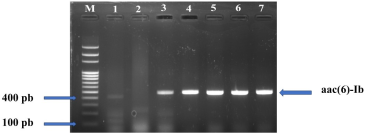
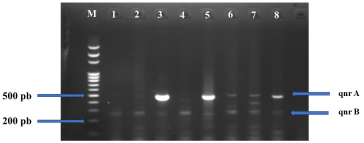
The DNA of strains resistant to at least one of the antibiotics tested was analyzed by conventional PCR to detect the presence of the aac(6')-Ib, qnrA, qnrB, and qnrS genes. As the primer pairs used were specific to the genes sought, the presence of bands measuring 482 bp, 580 bp and 264 bp was defined as characteristic of the presence of the aac(6')-Ib gene (Figure 1), qnrA and qnrB (Figure 2), respectively.
Legend: M molecular weight marker; 2: absence of the aac(6')-Ib gene; 3 to 7: presence of the aac(6')-Ib gene
Figure 2. Agarose gel of qnr A and qnr B PCR products.
3.4. Frequency of Resistance Genes
Electrophoretic analysis of the PCR products revealed a high prevalence of the qnrA gene (75%), followed by the aac(6')-Ib and qnrB genes (50% each). No isolates carried the qnrS gene (Table 4). Regarding gene coexistence, 50% of isolates carried the qnrA-qnrB genes, while 25% harbored the aac(6')-Ib-qnrA combination. No isolates carried all three detected genes simultaneously.
Table 4. Frequency of resistance genes.
Resistance gene
Present
Absent
Total
N
%
N
N
aac (6)-Ib
2
50.0
2
50.0
4
100
qnr A
3
75.0
1
25.0
4
100
qnr B
2
50.0
2
50.0
4
100
qnr S
0
0.0
4
100
4
100
qnr A-qnr B
2
50.0
2
50.0
4
100
aac (6)-Ib-qnr A
1
25.0
3
75.0
4
100
N: number of individuals aac(6’)-Ib: aminoglycoside acetyltransferase qnr: quinolone resistance protein
4. Discussion
In this study, 2.58% (8/311) of the semen samples analyzed were culture-positive, with a prevalence of Escherichia coli of 62.5% (5/8) and Klebsiella pneumoniae of 37.5% (3/8). These results are consistent with previous studies demonstrating the frequent involvement of E. coli in genital and urinary tract infections in men
[6]
Benhiba I. Cytobacteriological profile of semen from patients consulting for infertility in the urology-andrology department of Brazzaville University Hospital. Uro-Andro Rev Urol Androl ASU. July 2, 2015; 1(4). URL
. In addition, research conducted in Tunisia has highlighted the important role of Escherichia coli in these infections
[11]
swLarabi K, Masmoudi A, Fendri C. Bacteriological study and resistance phenotypes of bacteria responsible for urinary tract infections in a university hospital in Tunis: 1,930 cases. Medecine Mal Infect. July 1, 2003; 33(7): 348-52.
Our analyses revealed that all Klebsiella pneumoniae strains were sensitive to the antibiotics tested, while E. coli strains showed varying levels of resistance to fluoroquinolones. The resistance rates observed were 50% (4/8) for ciprofloxacin, 37.5% (3/8) for norfloxacin, and 12.5% (1/8) for levofloxacin. These resistance rates are consistent with the results of additional research conducted in Burkina Faso, indicating an upward trend in resistance to fluoroquinolones
[12]
Cisse H, Kagambega A, Bouda SC, Sawadogo A, Barro N. Phenotypic and Genotypic Antibiotic Resistant Diarrheagenic Escherichia coli Isolated from Patients with Diarrhea in Ouagadougou, Burkina Faso. Adv Microbiol. July 4, 2023; 13(7): 347-59.
Escherichia coli resistance to quinolone antibiotics results from a combination of chromosomal mutations, particularly in the gyrA and parC genes. These mechanisms enable the bacteria to reduce the effectiveness of certain quinolone antibiotics by modifying their target sites or limiting their accumulation in the cell
[1]
Hooper DC, Jacoby GA. Mechanisms of drug resistance: quinolone resistance. Ann N Y Acad Sci. 2015; 1354(1): 12-31.
Abdel-Rhman SH, Elbargisy RM, Rizk DE. Characterization of Integrons and Quinolone Resistance in Clinical Escherichia coli Isolates in Mansoura City, Egypt. Int J Microbiol. 2021; 2021(1): 6468942.
. However, an important finding of our research is that each isolate tested was sensitive to Ofloxacin, potentially due to differences in the mechanisms of resistance related to fluoroquinolones
[14]
Redgrave LS, Sutton SB, Webber MA, Piddock LJV. Fluoroquinolone resistance: mechanisms, impact on bacteria, and role in evolutionary success. Trends Microbiol. 2014 Aug 1; 22(8): 438–45.
Genetic analysis of antibiotic-resistant bacteria showed a significant presence of the qnrA gene, found in 75% (3/4) of isolates, as well as the aac(6')-Ib and qnrB genes, each identified in 50% (2/4) of samples. However, the qnrS gene was absent from all isolates. These results are consistent with those reported in Korea, which indicated a high prevalence of Escherichia coli isolates possessing both the qnr and aac(6')-Ib-cr genes
[15]
Seo KW, Lee YJ. Molecular characterization of fluoroquinolone-resistant
. The detection of these genes suggests a potential reduction in the effectiveness of quinolones used in the management of urogenital infections in Burkina Faso. In the absence of a thorough diagnosis, this situation exposes patients to an increased risk of treatment failure. In addition, these resistances could contribute to impaired sperm quality and lead to male infertility.
Our results showed the simultaneous presence of several resistance genes in E. coli: 50% had both qnrA and qnrB, while 25% contained a combination of aac(6')-Ib and qnrA. This accumulation of genes could increase resistance to fluoroquinolones and promote the transmission of these resistances to other bacterial species
[4]
Vetting MW, Park CH, Hegde SS, Jacoby GA, Hooper DC, Blanchard JS. Mechanistic and Structural Analysis of Aminoglycoside N-Acetyltransferase AAC(6′)-Ib and Its Bifunctional, Fluoroquinolone-Active AAC(6′)-Ib-cr Variant. Biochemistry. 2008 Sep 16; 47(37): 9825-35.
. These results highlight the importance of systematic surveillance of antibiotic resistance in bacteria responsible for male genital infections. The repeated detection of resistance genes located on plasmids indicates a significant risk of transfer of these resistances between bacterial populations. Such transmission could ly compromise the effectiveness of fluoroquinolones in the treatment of common bacterial infections
[1]
Hooper DC, Jacoby GA. Mechanisms of drug resistance: quinolone resistance. Ann N Y Acad Sci. 2015; 1354(1): 12-31.
. To address this problem, it is essential to limit the excessive use of antibiotics and promote more rigorous methods of prescribing and monitoring bacterial resistance
[16]
Davies J, Davies D. Origins and Evolution of Antibiotic Resistance. Microbiol Mol Biol Rev MMBR. Sept 2010; 74(3): 417-33.
[16]
.
However, this study has certain limitations. The small size of the Gram-negative bacilli and the limited geographical origin of the isolates do not allow the results to be generalized. In addition, the molecular analysis did not explore all possible resistance mechanisms and focused on a specific panel of quinolone resistance genes.
Despite these limitations, this study provides original and relevant data on quinolone resistance in male genital infections in Burkina Faso.
These results offer various avenues for further research. A relevant first step would be to expand the study to include a larger number of samples and to incorporate an analysis of the genetic mutations contributing to quinolone resistance. In addition, research on the transmission of these resistance genes within the Burkinabe population would enable more effective targeting of strategies to prevent and control antibiotic resistance.
5. Conclusion
This study examined the characteristics of quinolone resistance in Gram-negative bacilli isolated from semen samples at Saint Camille Hospital in Ouagadougou. Although the positive culture rate was relatively low (2.58%), the presence of Escherichiacoli and Klebsiella pneumoniae in these samples highlights the importance of microbiological surveillance of infections of the male genital tract. Analysis of antibiotic susceptibility profiles revealed a notable level of resistance to fluoroquinolones among Escherichia coli strains, particularly with regard to ciprofloxacin (50%) and norfloxacin (37.5%). Identification of resistance genes indicated a high prevalence of the qnrA gene (75%), with the aac(6')-Ib and qnrB genes each present at 50%, suggesting that the spread of resistance may be partially supported by mobile genetic elements. The coexistence of multiple resistance genes in some isolates reinforces the need for increased monitoring of quinolone resistance mechanisms in the region.
Abbreviations
Aac
Aminoglycoside Acetyltransferase
Qnr
Quinolone Resistance Protein
EMB
Eosin Methylene Blue
MH
Muller Hinton
PCR
Polymerase Chain Reaction
CLED
Cystine Lactose Electrolyte Deficient
SS
Salmonella-Shigella
DNA
Deoxyribonucleic Acid
EUCAST
European Committee on Antimicrobial Susceptibility Testing
CASFM
Antibiogram Committee of the French Society of Microbiology
Ruiz J. Mechanisms of resistance to quinolones: target alterations, decreased accumulation and DNA gyrase protection. J Antimicrob Chemother. 2003 May 1; 51(5): 1109-17.
Benhiba I. Cytobacteriological profile of semen from patients consulting for infertility in the urology-andrology department of Brazzaville University Hospital. Uro-Andro Rev Urol Androl ASU. July 2, 2015; 1(4). URL
Sanou AM, Traore H, Sagna T, Ilboudo AK, Ky S, Ouangre A, et al. Microbiological profile of lower genital tract infections in women of childbearing age in the city of Bobo-Dioulasso, Burkina Faso. Sci Tech Sci Sante. 2017; 40(2): 129-38.
[8]
World Health Organization. World health statistics 2020: monitoring health for the SDGs, sustainable development goals. World Health Organization; 2020. URL
Amana MD, Wend-Kuni TRY, Aminata BY, Serge S, Koudbi ZJ, et al. Detection of multidrug-resistant enterobacteria simultaneously producing extended-spectrum -lactamases of the PER and GES types isolated at Saint Camille Hospital Center, Ouagadougou, Burkina Faso. Afr J Microbiol Res. 2019 Aug 31; 13(26): 414-20.
swLarabi K, Masmoudi A, Fendri C. Bacteriological study and resistance phenotypes of bacteria responsible for urinary tract infections in a university hospital in Tunis: 1,930 cases. Medecine Mal Infect. July 1, 2003; 33(7): 348-52.
Cisse H, Kagambega A, Bouda SC, Sawadogo A, Barro N. Phenotypic and Genotypic Antibiotic Resistant Diarrheagenic Escherichia coli Isolated from Patients with Diarrhea in Ouagadougou, Burkina Faso. Adv Microbiol. July 4, 2023; 13(7): 347-59.
Abdel-Rhman SH, Elbargisy RM, Rizk DE. Characterization of Integrons and Quinolone Resistance in Clinical Escherichia coli Isolates in Mansoura City, Egypt. Int J Microbiol. 2021; 2021(1): 6468942.
Kouta, O. F., Dabire, A. M., Nikiema, R., Bambara, L. E. B., Simpore, J. (2026). Molecular Characterization of Plasmid-mediated Quinolone Resistance in Gram-negative Bacilli from Semen Samples in Ouagadougou. American Journal of BioScience, 14(1), 1-7. https://doi.org/10.11648/j.ajbio.20261401.11
Kouta, O. F.; Dabire, A. M.; Nikiema, R.; Bambara, L. E. B.; Simpore, J. Molecular Characterization of Plasmid-mediated Quinolone Resistance in Gram-negative Bacilli from Semen Samples in Ouagadougou. Am. J. BioScience2026, 14(1), 1-7. doi: 10.11648/j.ajbio.20261401.11
Kouta OF, Dabire AM, Nikiema R, Bambara LEB, Simpore J. Molecular Characterization of Plasmid-mediated Quinolone Resistance in Gram-negative Bacilli from Semen Samples in Ouagadougou. Am J BioScience. 2026;14(1):1-7. doi: 10.11648/j.ajbio.20261401.11
@article{10.11648/j.ajbio.20261401.11,
  author = {Olawoumi Fabrice Kouta and Amana Metuor Dabire and Rabietou Nikiema and Lionel Eliada Benoit Bambara and Jacques Simpore},
  title = {Molecular Characterization of Plasmid-mediated Quinolone Resistance in Gram-negative Bacilli from Semen Samples in Ouagadougou},
  journal = {American Journal of BioScience},
  volume = {14},
  number = {1},
  pages = {1-7},
  doi = {10.11648/j.ajbio.20261401.11},
  url = {https://doi.org/10.11648/j.ajbio.20261401.11},
  eprint = {https://article.sciencepublishinggroup.com/pdf/10.11648.j.ajbio.20261401.11},
  abstract = {The widespread use of fluoroquinolones has led to the emergence of resistant strains, complicating the treatment of bacterial infections. This study aimed to analyze quinolone resistance in Gram-negative bacilli isolated from semen samples in Burkina Faso. A total of 311 semen samples were used in the study. The bacteria present were isolated and identified using standard methods. Antibiotic susceptibility was assessed, and isolates resistant to at least one of the quinolones tested were analyzed by conventional PCR to detect the resistance genes aac(6')-Ib, qnrA, qnrB, and qnrS. A total of 8 samples (2.58%) were culture-positive, with a predominance of Escherichia coli (62.5%) and Klebsiella pneumoniae (37.5%). All Klebsiella pneumoniae species were susceptible to antibiotics, while Escherichia coli strains showed resistance rates of 50% to ciprofloxacin, 37.5% to norfloxacin, and 12.5% to levofloxacin. Molecular analysis of the isolates revealed a high prevalence of the qnrA gene (75%), followed by the aac(6')-Ib and qnrB genes (50% each). In addition, 50% of isolates contained both the qnrA and qnrB genes, and 25% contained both aac(6')-Ib and qnrA. The detection of these plasmid resistance genes highlights the importance of monitoring the evolution of antibiotic resistance and promoting the judicious use of antibiotics in order to limit its spread.},
 year = {2026}
}
TY  - JOUR
T1  - Molecular Characterization of Plasmid-mediated Quinolone Resistance in Gram-negative Bacilli from Semen Samples in Ouagadougou
AU  - Olawoumi Fabrice Kouta
AU  - Amana Metuor Dabire
AU  - Rabietou Nikiema
AU  - Lionel Eliada Benoit Bambara
AU  - Jacques Simpore
Y1  - 2026/01/19
PY  - 2026
N1  - https://doi.org/10.11648/j.ajbio.20261401.11
DO  - 10.11648/j.ajbio.20261401.11
T2  - American Journal of BioScience
JF  - American Journal of BioScience
JO  - American Journal of BioScience
SP  - 1
EP  - 7
PB  - Science Publishing Group
SN  - 2330-0167
UR  - https://doi.org/10.11648/j.ajbio.20261401.11
AB  - The widespread use of fluoroquinolones has led to the emergence of resistant strains, complicating the treatment of bacterial infections. This study aimed to analyze quinolone resistance in Gram-negative bacilli isolated from semen samples in Burkina Faso. A total of 311 semen samples were used in the study. The bacteria present were isolated and identified using standard methods. Antibiotic susceptibility was assessed, and isolates resistant to at least one of the quinolones tested were analyzed by conventional PCR to detect the resistance genes aac(6')-Ib, qnrA, qnrB, and qnrS. A total of 8 samples (2.58%) were culture-positive, with a predominance of Escherichia coli (62.5%) and Klebsiella pneumoniae (37.5%). All Klebsiella pneumoniae species were susceptible to antibiotics, while Escherichia coli strains showed resistance rates of 50% to ciprofloxacin, 37.5% to norfloxacin, and 12.5% to levofloxacin. Molecular analysis of the isolates revealed a high prevalence of the qnrA gene (75%), followed by the aac(6')-Ib and qnrB genes (50% each). In addition, 50% of isolates contained both the qnrA and qnrB genes, and 25% contained both aac(6')-Ib and qnrA. The detection of these plasmid resistance genes highlights the importance of monitoring the evolution of antibiotic resistance and promoting the judicious use of antibiotics in order to limit its spread.
VL  - 14
IS  - 1
ER  -
Laboratory of Molecular Biology and Genetics (LABIOGENE), Joseph Ki-Zerbo University, Ouagadougou, Burkina, Faso;Department of Biochemistry-Microbiology, Daniel Ouezzin Coulibaly University, Dédougou, Burkina Faso
Kouta, O. F., Dabire, A. M., Nikiema, R., Bambara, L. E. B., Simpore, J. (2026). Molecular Characterization of Plasmid-mediated Quinolone Resistance in Gram-negative Bacilli from Semen Samples in Ouagadougou. American Journal of BioScience, 14(1), 1-7. https://doi.org/10.11648/j.ajbio.20261401.11
Kouta, O. F.; Dabire, A. M.; Nikiema, R.; Bambara, L. E. B.; Simpore, J. Molecular Characterization of Plasmid-mediated Quinolone Resistance in Gram-negative Bacilli from Semen Samples in Ouagadougou. Am. J. BioScience2026, 14(1), 1-7. doi: 10.11648/j.ajbio.20261401.11
Kouta OF, Dabire AM, Nikiema R, Bambara LEB, Simpore J. Molecular Characterization of Plasmid-mediated Quinolone Resistance in Gram-negative Bacilli from Semen Samples in Ouagadougou. Am J BioScience. 2026;14(1):1-7. doi: 10.11648/j.ajbio.20261401.11
@article{10.11648/j.ajbio.20261401.11,
  author = {Olawoumi Fabrice Kouta and Amana Metuor Dabire and Rabietou Nikiema and Lionel Eliada Benoit Bambara and Jacques Simpore},
  title = {Molecular Characterization of Plasmid-mediated Quinolone Resistance in Gram-negative Bacilli from Semen Samples in Ouagadougou},
  journal = {American Journal of BioScience},
  volume = {14},
  number = {1},
  pages = {1-7},
  doi = {10.11648/j.ajbio.20261401.11},
  url = {https://doi.org/10.11648/j.ajbio.20261401.11},
  eprint = {https://article.sciencepublishinggroup.com/pdf/10.11648.j.ajbio.20261401.11},
  abstract = {The widespread use of fluoroquinolones has led to the emergence of resistant strains, complicating the treatment of bacterial infections. This study aimed to analyze quinolone resistance in Gram-negative bacilli isolated from semen samples in Burkina Faso. A total of 311 semen samples were used in the study. The bacteria present were isolated and identified using standard methods. Antibiotic susceptibility was assessed, and isolates resistant to at least one of the quinolones tested were analyzed by conventional PCR to detect the resistance genes aac(6')-Ib, qnrA, qnrB, and qnrS. A total of 8 samples (2.58%) were culture-positive, with a predominance of Escherichia coli (62.5%) and Klebsiella pneumoniae (37.5%). All Klebsiella pneumoniae species were susceptible to antibiotics, while Escherichia coli strains showed resistance rates of 50% to ciprofloxacin, 37.5% to norfloxacin, and 12.5% to levofloxacin. Molecular analysis of the isolates revealed a high prevalence of the qnrA gene (75%), followed by the aac(6')-Ib and qnrB genes (50% each). In addition, 50% of isolates contained both the qnrA and qnrB genes, and 25% contained both aac(6')-Ib and qnrA. The detection of these plasmid resistance genes highlights the importance of monitoring the evolution of antibiotic resistance and promoting the judicious use of antibiotics in order to limit its spread.},
 year = {2026}
}
TY  - JOUR
T1  - Molecular Characterization of Plasmid-mediated Quinolone Resistance in Gram-negative Bacilli from Semen Samples in Ouagadougou
AU  - Olawoumi Fabrice Kouta
AU  - Amana Metuor Dabire
AU  - Rabietou Nikiema
AU  - Lionel Eliada Benoit Bambara
AU  - Jacques Simpore
Y1  - 2026/01/19
PY  - 2026
N1  - https://doi.org/10.11648/j.ajbio.20261401.11
DO  - 10.11648/j.ajbio.20261401.11
T2  - American Journal of BioScience
JF  - American Journal of BioScience
JO  - American Journal of BioScience
SP  - 1
EP  - 7
PB  - Science Publishing Group
SN  - 2330-0167
UR  - https://doi.org/10.11648/j.ajbio.20261401.11
AB  - The widespread use of fluoroquinolones has led to the emergence of resistant strains, complicating the treatment of bacterial infections. This study aimed to analyze quinolone resistance in Gram-negative bacilli isolated from semen samples in Burkina Faso. A total of 311 semen samples were used in the study. The bacteria present were isolated and identified using standard methods. Antibiotic susceptibility was assessed, and isolates resistant to at least one of the quinolones tested were analyzed by conventional PCR to detect the resistance genes aac(6')-Ib, qnrA, qnrB, and qnrS. A total of 8 samples (2.58%) were culture-positive, with a predominance of Escherichia coli (62.5%) and Klebsiella pneumoniae (37.5%). All Klebsiella pneumoniae species were susceptible to antibiotics, while Escherichia coli strains showed resistance rates of 50% to ciprofloxacin, 37.5% to norfloxacin, and 12.5% to levofloxacin. Molecular analysis of the isolates revealed a high prevalence of the qnrA gene (75%), followed by the aac(6')-Ib and qnrB genes (50% each). In addition, 50% of isolates contained both the qnrA and qnrB genes, and 25% contained both aac(6')-Ib and qnrA. The detection of these plasmid resistance genes highlights the importance of monitoring the evolution of antibiotic resistance and promoting the judicious use of antibiotics in order to limit its spread.
VL  - 14
IS  - 1
ER  -





 Share This Article
 Twitter
 Linked In
 Facebook
 Copy
Copy Download