
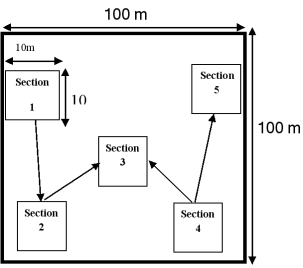
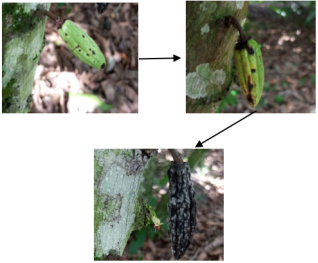
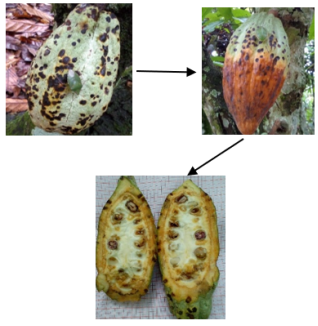
The main known pests affecting cocoa in Côte d'Ivoire are mirids, defoliating caterpillars and stem borers. However, a study conducted in the sub-prefecture of Gnagbodougnoa in the region of Gagnoa following complaints from farmers identified the green bug, Bathycoelia thalassina, and the brown bug, Pseudotheraptus devastans, as pests of cocoa pods. The overall objective of this study is to assess the impact of attacks by these two bugs on cocoa production. The study consisted of delimiting one (1) sampling plot of one (1) hectare in three different plantations and, in each plot, five (5) 100 m² sections arranged in a W shape. In each section, all pods and cherries attacked by bugs were counted and the attack rates determined. Losses were assessed by monitoring newly pierced cherries and pods during their maturation, determining their abortion rates and the loss of mass of beans that reached maturity after the attacks. The average attack rates were 66.66% for cherries and 62% for pods. Attacked pods abort completely after two months and only fifteen (15) out of 50 attacked pods reach maturity. The attacks led to a 36.38% loss in bean mass. The impact of green and brown bug attacks on cocoa is very significant. Better management of these factors will reduce their impact on production for optimal yield.
| Published in | American Journal of BioScience (Volume 14, Issue 2) |
| DOI | 10.11648/j.ajbio.20261402.12 |
| Page(s) | 29-35 |
| Creative Commons |
This is an Open Access article, distributed under the terms of the Creative Commons Attribution 4.0 International License (http://creativecommons.org/licenses/by/4.0/), which permits unrestricted use, distribution and reproduction in any medium or format, provided the original work is properly cited. |
| Copyright |
Copyright © The Author(s), 2026. Published by Science Publishing Group |
Côte d’Ivoire, Cocoa, Bug, Attack Rate, Mass Loss
Min-Max | Mean±SD | CV (%) | p-value | |
|---|---|---|---|---|
Pods | 30 – 100 | 62 ±16,56 | 26.7 | 0.499 |
Cherries | 20 – 100 | 66.66 ±25.54 | 38.3 |
Min-Max | Mean±SD | CV (%) | p-value | |
|---|---|---|---|---|
Plot 1 | 20 - 70 | 52±16.19b | 31.1% | < 0.0001 |
Plot 2 | 30 – 70 | 55±13.54b | 24.6% | |
Plot 3 | 70 – 100 | 86±15.05a | 17.5% |
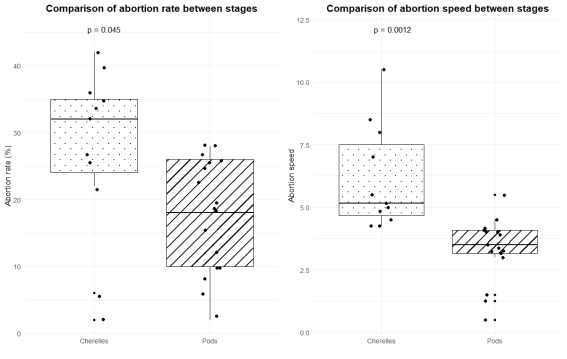
Rate of Aborted Cherries (%) | Rate of Aborted Pods (%) | Speed of Aborted Cherries (Number of cherries/Unit of time) | Speed of Aborted Pods (Number of pods/Unit of time) | |
|---|---|---|---|---|
2_Weeks | 36±0.053 a | 13,9±0.141 | 9±1.323 a | 3.118±3.536 |
1_Month | 36,7±0.031 a | 16±0.087 | 4,583±0.382 b | 2±1.25 |
1,5_Months | 24.7±0.023 ab | 26,7±0.012 | 5,889±0.977 b | 3,556±0.822 |
2_Months | 11.8±0.028 b | 18±0.092 | 5,073±0.412 b | 3,792±0.361 |
2,5_Months | - | 16±0.092 | - | - |
3_Months | - | 15,3±0.064 | - | - |
Pr > F(Model) | 0.004 | 0.477 | 0.000 | 0.421 |
Number of Pods Reaching Maturity after Attacks | Average Weight of Beans per Pod (g) | Loss of Mass of Beans (%) | |
|---|---|---|---|
Pods Heathy (Control) | - | 40 | - |
Plot 1 | 07 | 32.38 | 19.05% |
Plot 2 | 18 | 22.57 | 43.57% |
Plot 3 | 22 | 21.77 | 45.58% |
Average | 15.67±7.767 | 25.57±5.908 | 36.38%±14.77 |
GDP | Gross Domestic Product |
| [1] | Babin, R. Contribution à l’amélioration de la lutte contre les mirides du cacaoyer Sahlbergella singularis Hagl. (Hemiptera: Miriadae). Influence des facteurs agro-écologiques sur la dynamique des populations du ravageur. [Contribution to improving the control of cocoa mirids Sahlbergella singularis Hagl. (Hemiptera: Miriadae). Influence of agro-ecological factors on the pest's population dynamics. Thesis, University] Thèse, Université [Montpelier III – PAUL VALERIY, 2009. |
| [2] | IDEF. Lacunes et infractions majeures dans la filière du cacao en Côte d’Ivoire. [Gaps and major violations in the cocoa sector in Côte d'Ivoire. Report of independent observations.] Rapport d’observations indépendantes. 2021, 28p. |
| [3] | Assiri, A. A., Konan, A., N’guessan, K. F., Kébé, B. I., Kassin, K. E., Couloud, J. Y., Yapo, A. R., Yoro, G. R., Yao-Kouamé A. Comparaison de deux techniques de replantation cacaoyère sur antécédents culturaux non-forestiers en Côte d’Ivoire. [Comparison of two cocoa replanting techniques based on non-forest crop history in Côte d’Ivoire] African Crop Science Journal. 2015, 23(4), 365-378. |
| [4] | Bocket, L., Ouedraogo S. A., Auguste, K. A., Gopal P. Analyse prospective de la filière cacao en Côte d’Ivoire 2020-2030 vers une politique commune de marché de cacao en Afrique de l’Ouest. [Prospective analysis of the cocoa sector in Côte d’Ivoire 2020-2030 towards a common cocoa market policy in West Africa] Accra, Fao. 2021. |
| [5] | Kouadio, Y. D. M., Kouassi, K. H., Bahan, F. M., Keli, Z. J. Impact de l’association Hevea-Cafeier sur la production sur la production des deux spéculations. [Impact of the Hevea-Cafeier association on production on the production of both speculations] Journal of Animal & Plant Sciences. 2021, 47(3), 8497-8505. |
| [6] | N’Guessan, W. P., N’Guessan, K. F., Aka A. R., Assiri, A. A., Kébé, B. I., Tahi, G. M. Bien lutter contre les insectes nuisibles du cacaoyer en Côte d’Ivoire. [Well fight against cocoa insect pests in Côte d’Ivoire] CNRA. 2016. 4 p. |
| [7] | Asogwa, E. U, Kingsley, U. E. B., Otuonye, A. H. Assessment of the incidence and intensity of major cocoa insect pest and Disease in southwest region of Nigeria. Journal of Entomology and Zoology Studies. 2022; 10(2): |
| [8] | Asitoakor, B. K., Ræbild, A., Asare, R., Vaast, P., Howe A. G. The potential of selected shade tree species for managing mirids and black pod disease infection in cocoa agroforestry systems in Ghana. Crop Protection. 2024, 184, pp. 106810. |
| [9] | Tavera, M. A. A., Criselda, M., Cruz V. D, Santos, K. L. T., Amalin, D. M., Janairo, J. I. B. β-caryophyllene as an attractant for the cacao mirid bug, Helopeltis bakeri Poppius (Hemiptera: Miridae), and hemodiversity of its host plant volatiles. Frontiers in Agronomy. 2023, 5, |
| [10] | Coulibaly, T., Doh, F., N’goran, K. S. Identification de nouvelles punaises dévastatrices de cherelles et de cabosses de cacao (Theobroma cacao L.) dans la Sous-Préfecture de Gnagbodougnoa (Centre-Ouest de la Côte d’Ivoire) et description de leurs dégâts. 2ème conférence entomologique de Côte d’Ivoire: contribution de l’entomologie à la sécurité alimentaire, à la conservation de la biodiversité et au bien-être (santé humaine et animale), [Identification of new devastating cocoa pod and bean bugs (Theobroma cacao L.) in the Gnagbodougnoa Sub-Prefecture (Central-West Côte d'Ivoire) and description of the damage they cause. 2nd Entomological Conference of Côte d'Ivoire: Contribution of entomology to food security, biodiversity conservation, and well-being (human and animal health)]. Abidjan, Côte d’Ivoire, 2024. |
| [11] | FAO. Gestion intégrée de la chenille légionnaire d’automne sur le maïs. Un guide pour les champs écoles des producteurs en Afrique. [Integrated management of fall armyworm on maize. A guide for farmer field schools in Africa] Rome (Italie). 2018, 147 p. |
| [12] | Boyombe, l. l., Nguo, E., Malaisse, F., Monzenga, J-C. Incidence de la chenille légionnaire d’automne (Spodoptera frugiperda J. E. Smith) et niveau de connaissance de ce ravageur par les agriculteurs de Kisangani et ses environs, R. D. Congo. [Incidence of fall armyworm (Spodoptera frugiperda J. E. Smith) and level of knowledge of this pest by farmers in Kisangani and its surroundings, R. D. Congo] Géo-Eco-Trop. 2021, 45(1), 103-111. |
| [13] | Yédé, Y., Babin, R., Lordon-Djieto, C., Cilas, C., Dibog, L., Mahob, R. J., Bilong, C. Félix. B. Impact des insectes piqueurs de cabosses sur la production du cacaoyer dans la région du Centre du Cameroun. [Impact of cocoa pod-eating insects on cocoa production in the Central Region of Cameroon] In: 16th International Cocoa Resarch Conference, Towards rational cocoa production and efficient use for a sustainable word coca economy, Bali, Indonésie, 16-21 novembre 2009; pp. 1167-1171. |
| [14] | Pearce, A. W., Slaton, N. A., Lyons, S. E., Bolster, C. H., Bruulsema, T. W., Grove, J. H., Jones, J. D., McGrath, J. M., Miguez, F. E., Nelson, N. O., Osmond, D. L., Parvej, M. R., Pena-Yewtukhiw, E. M., Spargo, J. T. Defining relative yield for soil test correlation and calibration trials in the Fertilizer Recommendation Support Tool. Soil Science Society of America Journal. 2022, 86(5), 1338-1353. |
| [15] | Vanhove, W., Toussaint, L. A. N., Kaminski, A., Van Damme, P. Evaluation of cocoa mirid (Distantiella theobroma dist. and Sahlbergella singularis hagl.) control practices in Côte dIvoire. African Journal of Agricultural Research 2019, 14, 2006–2016. |
| [16] | Doh, F., Yao, S. D. M., Issali, E. A., Kouassi A. Incidence des attaques de la punaise Pseudotheraptus Devastans (Distant) (Heteroptera: Coreidae) sur trois variétés hybrides de cocotier, PB 113+, PB 121+ ET NVS x GVT en Côte d’Ivoire. [Incidence of attacks by the stink bug Pseudotheraptus Devastans (Distant) (Heteroptera: Coreidae) on three hybrid varieties of coconut, PB 113+, PB 121+ AND NVS x GVT in Côte d’Ivoire] International Journal of Biological and Chemical Sciences. 2014, 8(6), 2650-2658. |
| [17] | Conseil Café-Cacao. Outils de vulgarisation de la cacaoculture durable bases sur le manuel harmonisé: récolte et opérations post récolte. [Coffee-Cocoa Council. Sustainable cocoa extension tools based on the harmonized manual: harvest and post-harvest operations] 2018, 20 p. |
| [18] | Mitchelle P. L. Heteroptera as vector of plant pathogens. Neotropical Entomology. (2004), 33(5), 519-545. |
APA Style
Franceline, D., Tenon, C., Siela, K., Simeon, N. K. (2026). Impact of Green and Brown Bug Attacks on Cocoa Production in Gnagbodougnoa in Central-Western Côte d'Ivoire. American Journal of BioScience, 14(2), 29-35. https://doi.org/10.11648/j.ajbio.20261402.12
ACS Style
Franceline, D.; Tenon, C.; Siela, K.; Simeon, N. K. Impact of Green and Brown Bug Attacks on Cocoa Production in Gnagbodougnoa in Central-Western Côte d'Ivoire. Am. J. BioScience 2026, 14(2), 29-35. doi: 10.11648/j.ajbio.20261402.12
@article{10.11648/j.ajbio.20261402.12,
  author = {Doh Franceline and Coulibaly Tenon and Kone Siela and N’Goran Konan Simeon},
  title = {Impact of Green and Brown Bug Attacks on Cocoa Production in Gnagbodougnoa in Central-Western Côte d'Ivoire},
  journal = {American Journal of BioScience},
  volume = {14},
  number = {2},
  pages = {29-35},
  doi = {10.11648/j.ajbio.20261402.12},
  url = {https://doi.org/10.11648/j.ajbio.20261402.12},
  eprint = {https://article.sciencepublishinggroup.com/pdf/10.11648.j.ajbio.20261402.12},
  abstract = {The main known pests affecting cocoa in Côte d'Ivoire are mirids, defoliating caterpillars and stem borers. However, a study conducted in the sub-prefecture of Gnagbodougnoa in the region of Gagnoa following complaints from farmers identified the green bug, Bathycoelia thalassina, and the brown bug, Pseudotheraptus devastans, as pests of cocoa pods. The overall objective of this study is to assess the impact of attacks by these two bugs on cocoa production. The study consisted of delimiting one (1) sampling plot of one (1) hectare in three different plantations and, in each plot, five (5) 100 m² sections arranged in a W shape. In each section, all pods and cherries attacked by bugs were counted and the attack rates determined. Losses were assessed by monitoring newly pierced cherries and pods during their maturation, determining their abortion rates and the loss of mass of beans that reached maturity after the attacks. The average attack rates were 66.66% for cherries and 62% for pods. Attacked pods abort completely after two months and only fifteen (15) out of 50 attacked pods reach maturity. The attacks led to a 36.38% loss in bean mass. The impact of green and brown bug attacks on cocoa is very significant. Better management of these factors will reduce their impact on production for optimal yield.},
 year = {2026}
}
TY  - JOUR
T1  - Impact of Green and Brown Bug Attacks on Cocoa Production in Gnagbodougnoa in Central-Western Côte d'Ivoire
AU  - Doh Franceline
AU  - Coulibaly Tenon
AU  - Kone Siela
AU  - N’Goran Konan Simeon
Y1  - 2026/04/07
PY  - 2026
N1  - https://doi.org/10.11648/j.ajbio.20261402.12
DO  - 10.11648/j.ajbio.20261402.12
T2  - American Journal of BioScience
JF  - American Journal of BioScience
JO  - American Journal of BioScience
SP  - 29
EP  - 35
PB  - Science Publishing Group
SN  - 2330-0167
UR  - https://doi.org/10.11648/j.ajbio.20261402.12
AB  - The main known pests affecting cocoa in Côte d'Ivoire are mirids, defoliating caterpillars and stem borers. However, a study conducted in the sub-prefecture of Gnagbodougnoa in the region of Gagnoa following complaints from farmers identified the green bug, Bathycoelia thalassina, and the brown bug, Pseudotheraptus devastans, as pests of cocoa pods. The overall objective of this study is to assess the impact of attacks by these two bugs on cocoa production. The study consisted of delimiting one (1) sampling plot of one (1) hectare in three different plantations and, in each plot, five (5) 100 m² sections arranged in a W shape. In each section, all pods and cherries attacked by bugs were counted and the attack rates determined. Losses were assessed by monitoring newly pierced cherries and pods during their maturation, determining their abortion rates and the loss of mass of beans that reached maturity after the attacks. The average attack rates were 66.66% for cherries and 62% for pods. Attacked pods abort completely after two months and only fifteen (15) out of 50 attacked pods reach maturity. The attacks led to a 36.38% loss in bean mass. The impact of green and brown bug attacks on cocoa is very significant. Better management of these factors will reduce their impact on production for optimal yield.
VL  - 14
IS  - 2
ER  -
Laboratory of Environment, Climate, Health, Engineering and Sustainable Development, Peleforo Gon Coulibaly University, Korhogo, Côte d’Ivoire
Biography: Doh Franceline holds a Ph.D. in Biology and Plant Protection with a specialization in Applied Entomology. She is an Assistant Professor at Peleforo Gon Coulibaly University (UPGC) in Korhogo, Côte d’Ivoire. Dr. Franceline DOH is a member of the shea sub-project within the Competitive Value Chains for Employment and Economic Transformation Project and a researcher at the African Center for Research and Applications on Shea (CRAK), contributing to studies on insects associated with shea trees and training initiatives for women and youth. As a consultant for the Agro Sustainable Development Cabinet, Dr. DOH supports GLOBAL G.A.P and GRASP certification audits for fruts export companies. Her earlier research at the National Center for Agronomic Research (CNRA) focused on pest management and biopesticides, particularly Pseudotheraptus devastans and Oryctes monoceros. She has authored and co-authored several technical reports and publications in the fields of entomology, pest management, and sustainable agricultural practices.
Research Fields: Pest management, Plant extracts with insecticidal effects, Edible insects, Insects in the circular economy, biological control with predators

Laboratory of Environment, Climate, Health, Engineering and Sustainable Development, Peleforo Gon Coulibaly University, Korhogo, Côte d’Ivoire
Biography: Coulibaly Tenon is a teacher and researcher in the Department of Animal Biology, from the Training and Research Unit in Biological Sciences at the Peleforo Gon Coulibaly University. He obtained his PhD in Tropical Ecology at the University Félix Houphouët Boigny in 2014. Recognized for his exceptional contributions, today Master of Conferences of the Universities of CAMES since 2022. In recent years, he has been an international consultant. In recent years, he has been an international consultant on sustainable agriculture standards (Rainforest Alliance, Better Cotton, Cacao Promise...). It conducts research on current topics related to integrated pest management of crops and dwellings, agroecological systems, circular energy and insect production for animal feed
Research Fields: integrated pest management of crops, agroecological systems, circular energy and insect production, Biological control with predators, Sustainability of agricultural systems, Improvement of sustainable agricultural practices.

Laboratory of Environment, Climate, Health, Engineering and Sustainable Development, Peleforo Gon Coulibaly University, Korhogo, Côte d’Ivoire
Biography: Kone Siela is a professor and researcher in the animal biology department of the Biological Sciences Unit at Peleforo Gon Coulibaly University in Korhogo (Côte d’Ivoire). He obtained his doctorate (specialty: agricultural entomology) at the Nagui Abrogoua University of Abidjan (Ivory Coast) in 2019. Then, he was recruited in 2023 as an Assistant at Peleforo Gon Coulibaly University of Korhogo.. He is the author of various scientific publications, notably on cashew tree pests. His research work, although addressing crop pests, is mainly focused on borers and other insects of the trunk of species. He is a member of the Société Entomologie Côte d'Ivoire (SECI) with participation in various scientific symposiums.
Research Fields: Natural predators of insect pests, Interactions in agricultural and forest ecosystems, Essential oils with insecticidal properties, Taxonomy of insects, agricultural and forest ecosystems
Laboratory of Environment, Climate, Health, Engineering and Sustainable Development, Peleforo Gon Coulibaly University, Korhogo, Côte d’Ivoire
Biography: N’Goran Konan Simeon holds a master’s degree in applied Zoology and Sustainable Development, specializing in Applied Entomology and Sustainable Development, from the Peleforo Gon Coulibaly University of Korhogo. He has three years of experience in the agricultural sector. He currently serves as a Group Administrator within a cooperative society. His responsibilities include data supervision and analysis, technical support for producers, and mentoring of farmer field schools.
Research Fields: Sustainability of agricultural systems, Improvement of sustainable agricultural practices, Valorization of biological resources


Information



 Share This Article
 Twitter
 Linked In
 Facebook
 Copy
Copy Download