
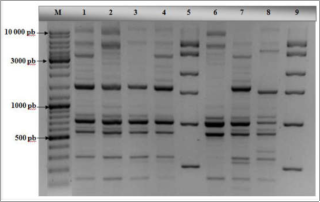
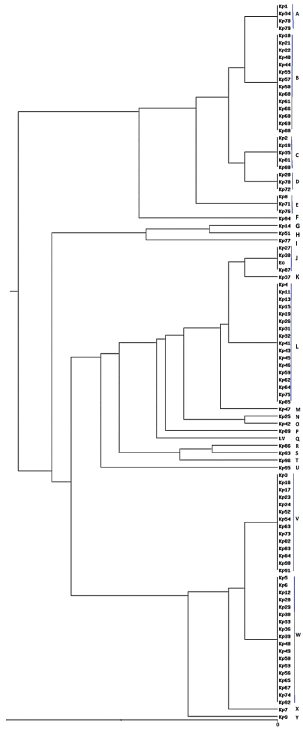
Klebsiella pneumoniae is a major opportunistic pathogen responsible for multidrug-resistant infections in both hospital and community settings. The emergence and spread of extended-spectrum β-lactamase (ESBL)-producing strains have become a major public health concern due to limited treatment options and their potential spread among human, animal, and food reservoirs. This study aimed to assess the genetic relatedness of ESBL-producing K. pneumoniae isolates collected from human clinical samples, ready-to-eat foods, and animal sources using ERIC-PCR profiling. A total of 98 ESBL-producing K. pneumoniae isolates were included, comprising 96 clinical isolates from hospitalized (n = 91) and non-hospitalized (n = 5) patients at Bouaké University Hospital, one isolate from ready-to-eat food, and one isolate from raw cow’s milk. Identification was performed using conventional bacteriological methods, and ESBL production was confirmed using CHROMagar ESBL medium and the double-disk synergy test. ERIC-PCR analysis revealed a high level of genetic diversity, with 25 distinct ERIC profiles identified, including nine common types and 16 unique types. Several dominant clonal lineages were observed among the clinical isolates, distributed across different hospital departments and outpatient settings. One foodborne isolate shared an ERIC profile identical to that of three clinical isolates, while the animal-derived isolate exhibited a unique genotype. Overall, most isolates showed genetic heterogeneity, although clonal dissemination was observed among hospital strains. These results indicate a predominance of ESBL-producing K. pneumoniae in the hospital setting and suggest limited genetic relatedness between human and non-human isolates. However, the interpretation of relationships involving food and animal isolates remains limited by their low representation in the study. These results underscore the importance of strengthening infection prevention and control measures and confirm the need for ongoing molecular surveillance of multidrug-resistant K. pneumoniae.
| Published in | American Journal of BioScience (Volume 14, Issue 5) |
| DOI | 10.11648/j.ajbio.20261405.11 |
| Page(s) | 105-110 |
| Creative Commons |
This is an Open Access article, distributed under the terms of the Creative Commons Attribution 4.0 International License (http://creativecommons.org/licenses/by/4.0/), which permits unrestricted use, distribution and reproduction in any medium or format, provided the original work is properly cited. |
| Copyright |
Copyright © The Author(s), 2026. Published by Science Publishing Group |
Animal, Human, Ready-to-Eat Food, ESBL, Klebsiella pneumoniae, ERIC-PCR
E. coli | Escherichia Coli |
ERIC-PCR | Enterobacterial Repetitive Intergenic Consensus Polymerase Chain Reaction |
ESBL | Extended-Spectrum Beta-Lactamase |
K. pneumoniae | Klebsiella Pneumoniae |
| [1] | Morales-Lopez, S., Yepes, J. A., Prada-Herrera, J. C., Torres-Jiménez, A. Enterobacteria in the 21st century: a review focused on taxonomic changes. The Journal of Infection of Developing Countries. 2019, 13: 265-273. |
| [2] | Janda, J. M., Abbott, S. L. 2021. The Changing Face of the Family Enterobacteriaceae (Order: “Enterobacterales”): New Members, Taxonomic Issues, Geographic Expansion, and New Diseases and Disease Syndromes. Clinical Microbiology Reviews 34: 10.1128/cmr.00174-20. |
| [3] | De Angelis, G., Del Giacomo, P., Posteraro, B., Sanguinetti, M., & Tumbarello, M. Molecular Mechanisms, Epidemiology, and Clinical Importance of β-Lactam Resistance in Enterobacteriaceae. International Journal of Molecular Sciences. 2020, 21: 5090. |
| [4] | Hadi, H. A., Al-Hail, H., Aboidris, L. E., Al-Orphaly, M., Ahmed, M. A. S., Samuel, B. G., Mohamed, H. A., Sultan, A. A., Skariah, S. Prevalence and genetic characterization of clinically relevant extended-spectrum β-lactamase-producing Enterobacterales in the Gulf Cooperation Council countries. Frontiers in Antibiotics. 2023, 2: 1177954. |
| [5] | Khadka, C., Shyaula, M., Syangtan, G., Bista, S., Tuladhar, R., Singh, A., Joshi, D. R., Pokhrel, L. R., Dawadi, P. Extended-spectrum β-lactamases producing Enterobacteriaceae (ESBL-PE) prevalence in Nepal: A systematic review and meta-analysis. Sci Total Environ. 2023, 901: 166164. |
| [6] | Beaumont, A., Danjean, M., Jacquier, H., Boyd, A., Jaspard, M., Royer, G., Surgers, L., Woerther, P. 0. Dissemination of ESBL-producing Escherichia coli and carriage in the community worldwide: epidemiology, transmission pathways, molecular insights, and practical aspects. Clinical Microbiology Reviews 0: e00274-25. |
| [7] | Karami-Zarandi, M., Rahdar, H. A., Esmaeili, H., Ranjbar, R. Klebsiella pneumoniae: an update on antibiotic resistance mechanisms. Future Microbiology. 2023: 65-81. |
| [8] | Li, D., Huang, X., Rao, H., Yu, H., Long, S., Li, Y., Zhang, J. Klebsiella pneumoniae bacteremia mortality: a systematic review and meta-analysis. Frontiers in Cellular and Infection Microbiology. 2023, 13: 1157010. |
| [9] | Xu, Q., Xie, M., Liu, X., Heng, H., Wang, H., Chan, W-C. E., Zhang R., Yang, G., Chen S. Molecular mechanisms underlying the high mortality of hypervirulent Klebsiella pneumoniae and its effective therapy development. Signal Transduction and Targeted Therapy. 2023, 8: 221. |
| [10] | Wareth, G., Neubauer, H. The Animal-foods-environment interface of Klebsiella pneumoniae in Germany: an observational study on pathogenicity, resistance development and the current situation. Veterinary Research. 2021, 52: 16. |
| [11] | Giri, S.; Kudva, V.; Shetty, K.; Shetty, V. Prevalence and Characterization of Extended-Spectrum β-Lactamase-Producing Antibiotic-Resistant Escherichia coli and Klebsiella pneumoniae in Ready-to-Eat Street Foods. Antibiotics. 2021, 10, 850. |
| [12] | Kujat, C. S., Neumann, E. M., Romero-Barrios, P., Tamber, S. Contribution of Food to the Human Health Burden of Antimicrobial Resistance. Foodborne Pathogens Disease. 2024, 21: 71-82. |
| [13] | Diaz-Amigo, C., Bartolomé, D. P. L., Lejeune, J., Pinto, F. J., Bessy, C. Antimicrobial resistance and the human gut microbiome-a food safety perspective. Critical Revieuws in Food Science and Nutrition. 2026, 66: 4819-4847. |
| [14] | Zinno, P., Perozzi, G., Devirgiliis, C. Foodborne Microbial Communities as Potential Reservoirs of Antimicrobial Resistance Genes for Pathogens: A Critical Review of the Recent Literature. Microorganisms. 2023, 11: 1696. |
| [15] | European Committee on Antimicrobial Susceptibility Testing (EUCAST), Version 7.1. Breakpoint tables for interpretation of MICs and zone diameters. 2017. |
| [16] | Allouch, P-Y., Pangon, B., Ghnassia, J-C. Antibiogramme des entérobactéries. Revue Française des Laboratoires. 1995, 279: 25-30. |
| [17] | Zaniani, F. R., Meshkat, Z., Naderi, N. M., Khaje-Karamadini, M., Ghazvini, K., Rezaee, A., Esmaily, H., Nabavinia, M. S., Darban, H. M. The Prevalence of TEM and SHV Genes among Extended-Spectrum Beta-Lactamases Producing Escherichia Coli and Klebsiella Pneumoniae. Iranian Journal Basic Medical Sciences. 2012, 15: 654-660. |
| [18] | Coudron, P. E., Moland, E. S., Thomson, K. S. Occurrence and detection of AmpC beta-lactamases among Escherichia coli, Klebsiella pneumoniae, and Proteus mirabilis isolates at a veterans medical center. Journal of Clinical Microbiology. 2000, 38: 1791-1796. |
| [19] | Zarei, O., Shokoohizadeh, L., Hossainpour, H., Alikhani, M. Y. Molecular analysis of Pseudomonas aeruginosa isolated from clinical, environmental and cockroach sources by ERIC-PCR. BMC Research Notes. 2018, 11: 668. |
| [20] | Abe, I., N’Djetchi, M., Traore, M., Yao, F., Konan, T., Sokouri, P., Konate, I., Koffi, M. Impact of Genetic Diversity of Uropathogenic Escherichia coli and Klebsiella pneumoniae Strains on the Dissemination of Extended Spectrum Beta-Lactam Resistance Genes in Côte d’Ivoire. American Journal of Molecular Biology. 2024, 14: 230-244. |
| [21] | Moosavian, M., Emam, N. The first report of emerging mobilized colistinresistance (mcr) genes and ERIC-PCR typing in Escherichia coli and Klebsiella pneumoniae clinical isolates in southwest Iran. Infection of Drug Resistance. 2019, 12: 1001-1010. |
| [22] | Firmo, E. F., Beltrão, E. M. B., da Silva, F. R. F., Alves, L. C., Brayner, F. A., Veras, D. L., Lopes, A., C. Association of blaNDM-1 with blaKPC-2 and aminoglycosidemodifying enzyme genes among Klebsiella pneumoniae, Proteus mirabilis and Serratia marcescens clinical isolates in Brazil. Journal of Global Antimicrobial Resistance. 2020, 21: 255-261. |
| [23] | Kundu, J., Kansal, S., Rathore, S., Kaundal, M., Angrup, A., Biswal, M., Walia, K., Ray, P. Evaluation of ERIC-PCR and MALDI-TOF as typing tools for multidrug resistant Klebsiella pneumoniae clinical isolates from a tertiary care center in India. PLoS One. 2022, 17: e0271652. |
| [24] | Ikhimiukor, O. O., Zac Soligno, N. I., Akintayo, I. J., Zac Soligno, N. I., Akintayo, I. J., Marcovici, M. M., Souza, S. S. R., Workman, A., Martin I. W., Andam C. P. Clonal background and routes of plasmid transmission underlie antimicrobial resistance features of bloodstream Klebsiella pneumoniae. Nature Communications. 2024, 15: 6969. |
| [25] | Tang, F., Chen, Z., Zhu, H., Xi, L., Li, C., Luo, W., Genetic relatedness, antibiotic resistance, and virulence of Klebsiella pneumoniae isolated from health care and food sources in Wuhan, China, American Journal of Infection Control. 2024, 52: 1043-1051. |
| [26] | Bray, A. S., Zafar, M. A. Deciphering the gastrointestinal carriage of Klebsiella pneumoniae. Infection and Immunity. 2024, 92: e00482-23. |
| [27] | Calbo, E., Freixas, N., Xercavins, M., Riera, M., Nicolás, C., Monistrol, O., Solé, M. D. L., Sala, M. R., Vila, J., Rarau, G. Foodborne nosocomial outbreak of SHV1 and CTX-M-15–producing Klebsiella pneumoniae: epidemiology and control. Clinical Infectious Diseases. 2011, 52: 743-749. |
| [28] | Parmar, N., Singh, R., Kaur, S., Tyagi, A., Malik, H., Aulakh, R. S., Gill J. P. S., Unraveling genetic similarities of Klebsiella pneumoniae from poultry and poultry handlers in Punjab, India, Gene Reports. 2025, 38: 102101. |
| [29] | Iulietto, M. F., Evers, E. G. Cross-contamination in the kitchen: A model for quantitative microbiological risk assessment. Risk Analysis. 2024, 44: 1156-1175. |
| [30] | Calland, J. K., Haukka, K., Kpordze S. W., Brusah, A., Corbella, M., Merla, C., Samuelsen, Ø., Feil, E. J., Sassera, D., Karikari, A. B., Saba, C. K. S., Thorpe H. A., Corander J. Population structure and antimicrobial resistance among Klebsiella isolates sampled from human, animal, and environmental sources in Ghana: a cross-sectional genomic One Health study, The Lancet Microbe. 2023, 4: e943-e952. |
| [31] | Menezes, J., Frosini, S-M., Weese, S., Perreten, V., Schwarz, S., Amaral, A. J., Loeffler, A., Pomba, C. Transmission dynamics of ESBL/AmpC and carbapenemase-producing Enterobacterales between companion animals and humans. Frontiers in Microbiology. 2024, 15: 1432240. |
| [32] | Mourão, J., Magalhães, M., Ribeiro-Almeida, M., Rebelo, A., Novais, C., Peixe, L. Novais  and Antunes P (2024) Decoding Klebsiella pneumoniae in poultry chain: unveiling genetic landscape, antibiotic resistance, and biocide tolerance in non-clinical reservoirs. Frontiers in Microbiology. 2024, 15: 1365011. |
APA Style
Tuo, N. M., Wognin, G. M., Diarrassouba, A., Akoua-Koffi, C. (2026). Genetic Diversity and Clonal Dissemination of ESBL-Producing Klebsiella pneumoniae from Clinical, Food, and Animal Sources in Bouaké, Côte d’Ivoire. American Journal of BioScience, 14(5), 105-110. https://doi.org/10.11648/j.ajbio.20261405.11
ACS Style
Tuo, N. M.; Wognin, G. M.; Diarrassouba, A.; Akoua-Koffi, C. Genetic Diversity and Clonal Dissemination of ESBL-Producing Klebsiella pneumoniae from Clinical, Food, and Animal Sources in Bouaké, Côte d’Ivoire. Am. J. BioScience 2026, 14(5), 105-110. doi: 10.11648/j.ajbio.20261405.11
@article{10.11648/j.ajbio.20261405.11,
  author = {Nonfra Marie Tuo and Gnagra Marie-Thérèse Wognin and Abdoulaye Diarrassouba and Chantal Akoua-Koffi},
  title = {Genetic Diversity and Clonal Dissemination of
ESBL-Producing Klebsiella pneumoniae from Clinical, Food, and Animal Sources in Bouaké, Côte d’Ivoire},
  journal = {American Journal of BioScience},
  volume = {14},
  number = {5},
  pages = {105-110},
  doi = {10.11648/j.ajbio.20261405.11},
  url = {https://doi.org/10.11648/j.ajbio.20261405.11},
  eprint = {https://article.sciencepublishinggroup.com/pdf/10.11648.j.ajbio.20261405.11},
  abstract = {Klebsiella pneumoniae is a major opportunistic pathogen responsible for multidrug-resistant infections in both hospital and community settings. The emergence and spread of extended-spectrum β-lactamase (ESBL)-producing strains have become a major public health concern due to limited treatment options and their potential spread among human, animal, and food reservoirs. This study aimed to assess the genetic relatedness of ESBL-producing K. pneumoniae isolates collected from human clinical samples, ready-to-eat foods, and animal sources using ERIC-PCR profiling. A total of 98 ESBL-producing K. pneumoniae isolates were included, comprising 96 clinical isolates from hospitalized (n = 91) and non-hospitalized (n = 5) patients at Bouaké University Hospital, one isolate from ready-to-eat food, and one isolate from raw cow’s milk. Identification was performed using conventional bacteriological methods, and ESBL production was confirmed using CHROMagar ESBL medium and the double-disk synergy test. ERIC-PCR analysis revealed a high level of genetic diversity, with 25 distinct ERIC profiles identified, including nine common types and 16 unique types. Several dominant clonal lineages were observed among the clinical isolates, distributed across different hospital departments and outpatient settings. One foodborne isolate shared an ERIC profile identical to that of three clinical isolates, while the animal-derived isolate exhibited a unique genotype. Overall, most isolates showed genetic heterogeneity, although clonal dissemination was observed among hospital strains. These results indicate a predominance of ESBL-producing K. pneumoniae in the hospital setting and suggest limited genetic relatedness between human and non-human isolates. However, the interpretation of relationships involving food and animal isolates remains limited by their low representation in the study. These results underscore the importance of strengthening infection prevention and control measures and confirm the need for ongoing molecular surveillance of multidrug-resistant K. pneumoniae.},
 year = {2026}
}
TY  - JOUR
T1  - Genetic Diversity and Clonal Dissemination of
ESBL-Producing Klebsiella pneumoniae from Clinical, Food, and Animal Sources in Bouaké, Côte d’Ivoire
AU  - Nonfra Marie Tuo
AU  - Gnagra Marie-Thérèse Wognin
AU  - Abdoulaye Diarrassouba
AU  - Chantal Akoua-Koffi
Y1  - 2026/10/09
PY  - 2026
N1  - https://doi.org/10.11648/j.ajbio.20261405.11
DO  - 10.11648/j.ajbio.20261405.11
T2  - American Journal of BioScience
JF  - American Journal of BioScience
JO  - American Journal of BioScience
SP  - 105
EP  - 110
PB  - Science Publishing Group
SN  - 2330-0167
UR  - https://doi.org/10.11648/j.ajbio.20261405.11
AB  - Klebsiella pneumoniae is a major opportunistic pathogen responsible for multidrug-resistant infections in both hospital and community settings. The emergence and spread of extended-spectrum β-lactamase (ESBL)-producing strains have become a major public health concern due to limited treatment options and their potential spread among human, animal, and food reservoirs. This study aimed to assess the genetic relatedness of ESBL-producing K. pneumoniae isolates collected from human clinical samples, ready-to-eat foods, and animal sources using ERIC-PCR profiling. A total of 98 ESBL-producing K. pneumoniae isolates were included, comprising 96 clinical isolates from hospitalized (n = 91) and non-hospitalized (n = 5) patients at Bouaké University Hospital, one isolate from ready-to-eat food, and one isolate from raw cow’s milk. Identification was performed using conventional bacteriological methods, and ESBL production was confirmed using CHROMagar ESBL medium and the double-disk synergy test. ERIC-PCR analysis revealed a high level of genetic diversity, with 25 distinct ERIC profiles identified, including nine common types and 16 unique types. Several dominant clonal lineages were observed among the clinical isolates, distributed across different hospital departments and outpatient settings. One foodborne isolate shared an ERIC profile identical to that of three clinical isolates, while the animal-derived isolate exhibited a unique genotype. Overall, most isolates showed genetic heterogeneity, although clonal dissemination was observed among hospital strains. These results indicate a predominance of ESBL-producing K. pneumoniae in the hospital setting and suggest limited genetic relatedness between human and non-human isolates. However, the interpretation of relationships involving food and animal isolates remains limited by their low representation in the study. These results underscore the importance of strengthening infection prevention and control measures and confirm the need for ongoing molecular surveillance of multidrug-resistant K. pneumoniae.
VL  - 14
IS  - 5
ER  -
Department of Biotechnology and Food Safety, Felix Houphouet-Boigny University, Abidjan, Côte d’Ivoire
Department of Genetics and Breeding, National Center for Agronomic Research (CNRA), Bouaké, Côte d’Ivoire
Department of Basic and Bioclinical Sciences, Alassane Ouattara University, Bouaké, Côte d’Ivoire;Laboratory of Bacteriology-Virology, University Hospital, Bouaké, Côte d’Ivoire
Department of Basic and Bioclinical Sciences, Alassane Ouattara University, Bouaké, Côte d’Ivoire;Laboratory of Bacteriology-Virology, University Hospital, Bouaké, Côte d’Ivoire

Information



 Share This Article
 Twitter
 Linked In
 Facebook
 Copy
Copy Download