
Small-scale household livestock farming (poultry, rabbits, sheep) plays a significant role in the economy and food security of Ivorian households, but the empirical use of antibiotics in these informal farms potentially promotes the emergence and spread of resistant bacteria. This descriptive cross-sectional study, conducted at the Pasteur Institute of Côte d’Ivoire, aimed to characterize the antibiotic resistance profile of enterobacteria isolated from animals raised in family backyards in Yopougon and Bingerville. Sixty-seven rectal and cloacal swabs were collected between November 2024 and January 2025 from sheep, rabbits, and chickens. Standard bacteriological analyses were performed, and a standardized antibiotic susceptibility testing protocol was carried out in accordance with the 2023 recommendations of the Antibiogram Committee of the French Society of Microbiology (CA-SFM/EUCAST, 2024). Twenty-seven strains of Enterobacteriaceae were isolated, including Escherichia coli (66.7%), Klebsiella pneumoniae (22.2%), and Enterobacter cloacae (11.1%). Statistical analysis using R (RStudio) revealed a particularly high resistance rate to colistin (70.4%), followed by tetracycline and chloramphenicol (29.6% each) and nalidixic acid (22.2%). Cephalosporinase production was detected in two strains (7.4). These results reflect significant antibiotic pressure in household farming systems, particularly regarding colistin, which is used as a last resort in the treatment of severe infections caused by multidrug-resistant Gram-negative bacteria. These findings highlight the need for regulation of veterinary antibiotic use.
| Published in | American Journal of BioScience (Volume 14, Issue 6) |
| DOI | 10.11648/j.ajbio.20261406.11 |
| Page(s) | 140-145 |
| Creative Commons |
This is an Open Access article, distributed under the terms of the Creative Commons Attribution 4.0 International License (http://creativecommons.org/licenses/by/4.0/), which permits unrestricted use, distribution and reproduction in any medium or format, provided the original work is properly cited. |
| Copyright |
Copyright © The Author(s), 2026. Published by Science Publishing Group |
Antibiotic Resistance, Enterobacteria, Small-scale Family Farming Farms, Abidjan District, Côte d’Ivoire
CA-SFM/EUCAST | Comite de l’Antibiogramme de la Societe Française de Microbiologie (French National/ European Committee on Antimicrobial Susceptibility Testing) |
NRC/AMR | National Reference Center for Antimicrobial Resistance |
ATB | Antibiogram |
CeReB | Biological Resources Center |
ATCC | American Type Culture Collection |
WHO | World Health Organization |
| [1] | FAO. (2011). L’elevage dans le monde en 2011 – Contribution de l’elevage à la securite alimentaire. |
| [2] | Palle, J. N., Udoamaka, G. N., Ako-Achere, J. F., Chichom, A. M., Eko, S., & Njouendou, A. J. (2021). Current antibiotic susceptibility pattern of bacteria implicated in surgical wound infections in the Buea Health District, Cameroon. Revue de Medecine et de Pharmacie, 11(3), 1271–1277. |
| [3] | FAO, UNEP, WHO, & WOAH. (2022). One Health Joint Plan of Action, 2022–2026. FAO; UNEP. |
| [4] | Van Boeckel, T. P., Pires, J., Silvester, R., Zhao, C., Song, J., Criscuolo, N. G., Gilbert, M., Bonhoeffer, S., & Laxminarayan, R. (2019). Global trends in antimicrobial resistance in animals in low- and middle-income countries. Science, 365(6459), eaaw1944. |
| [5] | WHO. (2024). WHO bacterial priority pathogens list, 2024: Bacterial pathogens of public health importance to guide research, development and strategies to prevent and control antimicrobial resistance. |
| [6] | WHO, FAO, UNEP, & WOAH. (2026). Implementing the global action plan on antimicrobial resistance: Second quadripartite biennial report. WOAH - World Organisation for Animal Health. |
| [7] | Founou, L. L., Founou, R. C., & Essack, S. Y. (2016). Antibiotic Resistance in the Food Chain: A Developing Country-Perspective. Frontiers in Microbiology, 7. |
| [8] | Hedman, H. D., Vasco, K. A., & Zhang, L. (2020). A Review of Antimicrobial Resistance in Poultry Farming within Low-Resource Settings. Animals: An Open Access Journal from MDPI, 10(8), 1264. |
| [9] | Kariuki, S., Kering, K., Wairimu, C., Onsare, R., & Mbae, C. (2022). Antimicrobial Resistance Rates and Surveillance in Sub-Saharan Africa: Where Are We Now? Infection and Drug Resistance, 15, 3589–3609. |
| [10] | MIRAH. (2022). Programme Strategique de Transformation de l’Aquaculture en Côte d’Ivoire | PSTACI. |
| [11] | Arnold, K. E., Laing, G., McMahon, B. J., Fanning, S., Stekel, D. J., Pahl, O., Coyne, L., Latham, S. M., & McIntyre, K. M. (2024). The need for One Health systems-thinking approaches to understand multiscale dissemination of antimicrobial resistance. The Lancet. Planetary Health, 8(2), e124–e133. |
| [12] | Saraka, N. D., Money, M., Doumbia, S., Cisse, S., Odi, N., Faye, K. H., & Dosso, M. (2015). The effects of storage conditions on the viability of enteropathogenics bacteria in biobanking of human stools: Cases of Yersinia enterocolitica, Salmonella enterica Typhimurium and Vibrio cholerae O: 1. African Journal of Biotechnology, 14(1), 38–41. |
| [13] | Abdullahi, I. N., & Trabelsi, I. (2025). Guts of healthy humans, livestock, and pets harbor critical-priority and high-risk Escherichia coli clones. Epidemiology and Health, 47, e2025013. |
| [14] | Miftode, I.-L., Vâţă, A., Miftode, R.-Ş., Oancea, A. F., Pasăre, M.-A., Parângă, T. G., Miftode, E. G., Mititiuc, I. L., & Radu, V. D. (2025). The Gut Microbiome and Colistin Resistance: A Hidden Driver of Antimicrobial Failure. International Journal of Molecular Sciences, 26(18), 8899. |
| [15] | Poirel, L., Madec, J.-Y., Lupo, A., Schink, A.-K., Kieffer, N., Nordmann, P., & Schwarz, S. (2018). Antimicrobial Resistance in Escherichia coli. Microbiology Spectrum, 6(4), |
| [16] | Garcias, B., Flores, M. A., Fernández, M., Monteith, W., Pascoe, B., Sheppard, S. K., Martín, M., Cortey, M., & Darwich, L. (2024). Global Variation in Escherichia coli mcr-1 Genes and Plasmids from Animal and Human Genomes Following Colistin Usage Restrictions in Livestock. Antibiotics, 13(8), 759. |
| [17] | Liu, J.-H., Liu, Y.-Y., Shen, Y.-B., Yang, J., Walsh, T. R., Wang, Y., & Shen, J. (2024). Plasmid-mediated colistin-resistance genes: Mcr. Trends in Microbiology, 32(4), 365–378. |
| [18] | Wang, Q., Wang, W., Zhu, Q., Shoaib, M., Chengye, W., Zhu, Z., Wei, X., Bai, Y., & Zhang, J. (2024). The prevalent dynamic and genetic characterization of mcr-1 encoding multidrug resistant Escherichia coli strains recovered from poultry in Hebei, China. Journal of Global Antimicrobial Resistance, 38, 354–362. |
| [19] | WHO. (2025). Global antibiotic resistance surveillance report 2025. |
| [20] | African Union – InterAfrican Bureau for Animal Resources (AU-IBAR). (2023). Continental Animal Health Yearbook 2022: Antimicrobial resistance surveillance and use of veterinary antimicrobials in Africa. Nairobi, Kenya : AU-IBAR. Disponible sur |
| [21] | Nordmann, P., & Poirel, L. (2019). Epidemiology and Diagnostics of Carbapenem Resistance in Gram-negative Bacteria. Clinical Infectious Diseases: An Official Publication of the Infectious Diseases Society of America, 69(Suppl 7), S521–S528. |
| [22] | Zamudio, R., Boerlin, P., Mulvey, M. R., Haenni, M., Beyrouthy, R., Madec, J.-Y., Schwarz, S., Cormier, A., Chalmers, G., Bonnet, R., Zhanel, G. G., Kaspar, H., & Mather, A. E. (2024). Global transmission of extended-spectrum cephalosporin resistance in Escherichia coli driven by epidemic plasmids. eBioMedicine, 103, 105097. |
APA Style
Felicite, B., Monnet, E. M., Danielle, O. K., Paul, N. N. J., Arlette, A. S., et al. (2026). Antibiotic Resistance in Enterobacteria Isolated from Animals on Small-scale Family Farming Systems in Yopougon and Bingerville (Abidjan, Côte d’Ivoire). American Journal of BioScience, 14(6), 140-145. https://doi.org/10.11648/j.ajbio.20261406.11
ACS Style
Felicite, B.; Monnet, E. M.; Danielle, O. K.; Paul, N. N. J.; Arlette, A. S., et al. Antibiotic Resistance in Enterobacteria Isolated from Animals on Small-scale Family Farming Systems in Yopougon and Bingerville (Abidjan, Côte d’Ivoire). Am. J. BioScience 2026, 14(6), 140-145. doi: 10.11648/j.ajbio.20261406.11
AMA Style
Felicite B, Monnet EM, Danielle OK, Paul NNJ, Arlette AS, et al. Antibiotic Resistance in Enterobacteria Isolated from Animals on Small-scale Family Farming Systems in Yopougon and Bingerville (Abidjan, Côte d’Ivoire). Am J BioScience. 2026;14(6):140-145. doi: 10.11648/j.ajbio.20261406.11
@article{10.11648/j.ajbio.20261406.11,
  author = {Beudje Felicite and Ettien Marcelle Monnet and Odegue Kpadraux Danielle and N’Gbesso N’Gbesso Jean Paul and Afran Sidje Arlette and Tiekoura Bertin and Konan Fernique and Toty Abale Anatole and M’Bengue Valerie Carole and Guessennd Nathalie},
  title = {Antibiotic Resistance in Enterobacteria Isolated from Animals on Small-scale Family Farming Systems in Yopougon and Bingerville (Abidjan, Côte d’Ivoire)},
  journal = {American Journal of BioScience},
  volume = {14},
  number = {6},
  pages = {140-145},
  doi = {10.11648/j.ajbio.20261406.11},
  url = {https://doi.org/10.11648/j.ajbio.20261406.11},
  eprint = {https://article.sciencepublishinggroup.com/pdf/10.11648.j.ajbio.20261406.11},
  abstract = {Small-scale household livestock farming (poultry, rabbits, sheep) plays a significant role in the economy and food security of Ivorian households, but the empirical use of antibiotics in these informal farms potentially promotes the emergence and spread of resistant bacteria. This descriptive cross-sectional study, conducted at the Pasteur Institute of Côte d’Ivoire, aimed to characterize the antibiotic resistance profile of enterobacteria isolated from animals raised in family backyards in Yopougon and Bingerville. Sixty-seven rectal and cloacal swabs were collected between November 2024 and January 2025 from sheep, rabbits, and chickens. Standard bacteriological analyses were performed, and a standardized antibiotic susceptibility testing protocol was carried out in accordance with the 2023 recommendations of the Antibiogram Committee of the French Society of Microbiology (CA-SFM/EUCAST, 2024). Twenty-seven strains of Enterobacteriaceae were isolated, including Escherichia coli (66.7%), Klebsiella pneumoniae (22.2%), and Enterobacter cloacae (11.1%). Statistical analysis using R (RStudio) revealed a particularly high resistance rate to colistin (70.4%), followed by tetracycline and chloramphenicol (29.6% each) and nalidixic acid (22.2%). Cephalosporinase production was detected in two strains (7.4). These results reflect significant antibiotic pressure in household farming systems, particularly regarding colistin, which is used as a last resort in the treatment of severe infections caused by multidrug-resistant Gram-negative bacteria. These findings highlight the need for regulation of veterinary antibiotic use.},
 year = {2026}
}
TY  - JOUR
T1  - Antibiotic Resistance in Enterobacteria Isolated from Animals on Small-scale Family Farming Systems in Yopougon and Bingerville (Abidjan, Côte d’Ivoire)
AU  - Beudje Felicite
AU  - Ettien Marcelle Monnet
AU  - Odegue Kpadraux Danielle
AU  - N’Gbesso N’Gbesso Jean Paul
AU  - Afran Sidje Arlette
AU  - Tiekoura Bertin
AU  - Konan Fernique
AU  - Toty Abale Anatole
AU  - M’Bengue Valerie Carole
AU  - Guessennd Nathalie
Y1  - 2026/11/03
PY  - 2026
N1  - https://doi.org/10.11648/j.ajbio.20261406.11
DO  - 10.11648/j.ajbio.20261406.11
T2  - American Journal of BioScience
JF  - American Journal of BioScience
JO  - American Journal of BioScience
SP  - 140
EP  - 145
PB  - Science Publishing Group
SN  - 2330-0167
UR  - https://doi.org/10.11648/j.ajbio.20261406.11
AB  - Small-scale household livestock farming (poultry, rabbits, sheep) plays a significant role in the economy and food security of Ivorian households, but the empirical use of antibiotics in these informal farms potentially promotes the emergence and spread of resistant bacteria. This descriptive cross-sectional study, conducted at the Pasteur Institute of Côte d’Ivoire, aimed to characterize the antibiotic resistance profile of enterobacteria isolated from animals raised in family backyards in Yopougon and Bingerville. Sixty-seven rectal and cloacal swabs were collected between November 2024 and January 2025 from sheep, rabbits, and chickens. Standard bacteriological analyses were performed, and a standardized antibiotic susceptibility testing protocol was carried out in accordance with the 2023 recommendations of the Antibiogram Committee of the French Society of Microbiology (CA-SFM/EUCAST, 2024). Twenty-seven strains of Enterobacteriaceae were isolated, including Escherichia coli (66.7%), Klebsiella pneumoniae (22.2%), and Enterobacter cloacae (11.1%). Statistical analysis using R (RStudio) revealed a particularly high resistance rate to colistin (70.4%), followed by tetracycline and chloramphenicol (29.6% each) and nalidixic acid (22.2%). Cephalosporinase production was detected in two strains (7.4). These results reflect significant antibiotic pressure in household farming systems, particularly regarding colistin, which is used as a last resort in the treatment of severe infections caused by multidrug-resistant Gram-negative bacteria. These findings highlight the need for regulation of veterinary antibiotic use.
VL  - 14
IS  - 6
ER  -
Department of Bacteriology and Virology, Pasteur Institute of Côte d’Ivoire (IPCI), Abidjan, Côte d’Ivoire
Biological Resource Center/Biobank, Pasteur Institute of Côte d’Ivoire (IPCI), Abidjan, Côte d’Ivoire
Department of Technical and Technological Sciences, Pasteur Institute of Côte d’Ivoire (IPCI), Abidjan, Côte d’Ivoire
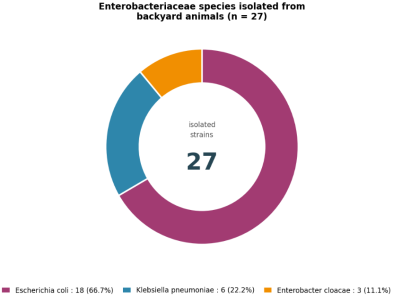
Figure 1. Ring plot showing the distribution of Enterobacteriaceae species isolated from backyard animals, with the total number shown in the center (n = 27).
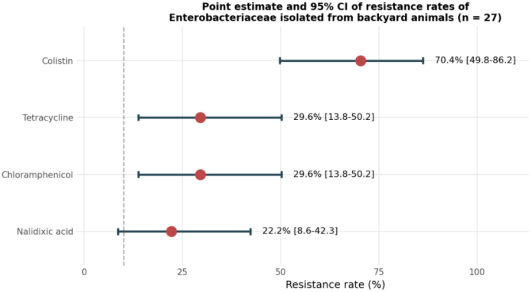
Figure 2. Estimation points and 95% confidence interval for the resistance rates of enterobacteriaceae isolated from animals on family farms by antibiotic (n = 27).

Information



 Share This Article
 Twitter
 Linked In
 Facebook

 Copy
 Download