Abstract
Introduction. Regarded as one of the five pillars of Islam, Ramadan fasting requires healthy believers to refrain completely from food and fluid intake from dawn until sunset. Whilst its effects on physical performance have been studied in various contexts, there is a paucity of research simultaneously examining its impact on both performance and cardiovascular risk markers in sub-Saharan African athletes, particularly in team sports such as handball. Objective. This prospective controlled study aimed to determine the effects of Ramadan fasting on maximal aerobic speed (MAS), anthropometric parameters, and biochemical markers associated with atherogenic risk in Division 1 handball players from Porto-Novo, Benin. Methods. Twenty handball players (mean age 24.5 ± 4.4 years) strictly observing Ramadan fasting were assigned to an experimental group (EG, n = 13) who continued training, and a control group (CG, n = 7) who did not train during the fasting period. Anthropometric measurements (body mass index, abdominal circumference, sum of skinfolds), serum lipid profiles (total cholesterol, HDL-cholesterol, LDL-cholesterol, triglycerides), and maximal aerobic speed (VAMEVAL test) were assessed three days prior to the onset and on the 28th day of Ramadan. Results. Body mass index (−4.1%), abdominal circumference (−3.6%), and sum of skinfolds (−16.8%) decreased significantly in the EG (p < 0.05). Total cholesterol (+21.4%) and LDL-cholesterol (+120%) increased significantly in the EG (p < 0.05), whilst HDL-cholesterol (−16.6%) and triglycerides (−54.5%) decreased (p < 0.05). The atherogenic index of plasma increased by 50% in the EG. MAS remained stable in the EG (12.5 ± 1.8 vs. 12.5 ± 1.5 km·h-1, p > 0.05) but decreased by 7.4% in the CG (p < 0.05). Conclusion. Ramadan fasting reduced adiposity indices in all fasting individuals but did not impair maximal aerobic performance in handball players who maintained training. Nevertheless, the deterioration in the atherogenic lipid profile raises concerns regarding dietary quality during Ramadan and highlights the need for nutritional support for athletes observing the fast.
|
Published in
|
American Journal of BioScience (Volume 14, Issue 6)
|
|
DOI
|
10.11648/j.ajbio.20261406.12
|
|
Page(s)
|
146-154 |
|
Creative Commons
|

This is an Open Access article, distributed under the terms of the Creative Commons Attribution 4.0 International License (http://creativecommons.org/licenses/by/4.0/), which permits unrestricted use, distribution and reproduction in any medium or format, provided the original work is properly cited.
|
|
Copyright
|
Copyright © The Author(s), 2026. Published by Science Publishing Group
|
Keywords
Ramadan, Intermittent Fasting, Atherogenic Risk, Handball, MAS, Benin
1. Introduction
Ramadan, characterised by adherence to a set of religious obligations and, above all, by the celebration of the revelation of the Holy Qur’an, constitutes a central event in the life of the Muslim believer (The Holy Qur’an, Surah 2, Verse 185). Regarded as one of the five pillars of Islam, Ramadan fasting is observed every year by Muslims, who represent approximately 43.1% of the African population, or 553 million individuals
. During Ramadan fasting, healthy believers are required to observe complete abstinence from food and fluids from dawn until sunset
| [2] | Fall A, Sarr M, Mandengue S, Badji L, Samb A, Gueye L, et al. Effets d’une restriction hydrique et alimentaire prolongée (Ramadan) sur la performance et les réponses cardiovasculaires au cours d’un exercice incrémental en milieu tropical chaud. Science & Sports. 2007; 22: 50-3.
https://doi.org/10.5281/zenodo.18722391 |
[2]
.
In Benin, a West African country with a subtropical climate (temperatures ranging from 32 to 35°C and relative humidity of 65 to 80%), Ramadan fasting is observed by 24.4% of the population
. Each year, the start of the fast shifts chronologically by around ten days, causing it to progressively drift from one season to another
| [4] | Aloui A, Briki W, Chalabi H, Chamari K. Comprendre le jeûne du Ramadan et ses contraintes sur les athlètes: présentation Générale [Understanding Ramadan Fasting and Its Constraints on Athletes: An Overview]. La Tunisie Médicale. 2025; 103(7): 859-61. https://doi.org/10.62438/tunismed.v103i7.5766 |
[4]
. As a result, it sometimes coincides with periods of intense heat, posing a genuine thermoregulation problem owing to fluid and electrolyte losses that are difficult to compensate for while fasting, particularly during sporting activity
| [4] | Aloui A, Briki W, Chalabi H, Chamari K. Comprendre le jeûne du Ramadan et ses contraintes sur les athlètes: présentation Générale [Understanding Ramadan Fasting and Its Constraints on Athletes: An Overview]. La Tunisie Médicale. 2025; 103(7): 859-61. https://doi.org/10.62438/tunismed.v103i7.5766 |
[4]
. The physiological consequences of Ramadan fasting are multifaceted and extend beyond simple caloric restriction. The altered timing of food and fluid intake disrupts normal circadian rhythms, affects sleep architecture, and induces metabolic and hormonal changes that can influence both health and athletic performance
| [5] | Ceylan Hİ, Morgans R, Oliveira R, Rhodes D, Orme P, González-Fernández FT. Sleep and circadian rhythm disturbances during Ramadan intermittent fasting in athletes: A narrative review. Science Progress. 2023; 106(4): 1-20.
https://doi.org/10.1177/00368504231206265 |
| [6] | Washif JA, Aziz AR, Chamari K. The impact of Ramadan intermittent fasting on Muslim and non-Muslim athletes: A global perspective. Tunisia Medica. 2024; 102(6): 321-323. https://doi.org/10.62438/tunismed.v102i6.5014 |
[5, 6]
. Ramadan fasting also disrupts the circadian rhythm through changes to the sleep-wake cycle, which may lead to incomplete recovery in athletes
| [5] | Ceylan Hİ, Morgans R, Oliveira R, Rhodes D, Orme P, González-Fernández FT. Sleep and circadian rhythm disturbances during Ramadan intermittent fasting in athletes: A narrative review. Science Progress. 2023; 106(4): 1-20.
https://doi.org/10.1177/00368504231206265 |
| [6] | Washif JA, Aziz AR, Chamari K. The impact of Ramadan intermittent fasting on Muslim and non-Muslim athletes: A global perspective. Tunisia Medica. 2024; 102(6): 321-323. https://doi.org/10.62438/tunismed.v102i6.5014 |
[5, 6]
. To this are added the lack of hydration during exertion and hypoglycaemia that may result from the early depletion of glycogen stores. The combination of all these phenomena during the month of Ramadan fasting can impair physical and/or sporting performance
| [7] | Lawani M, Akplogan B, Bio Nigan I, Bakari M. Éducation physique et sportive, masse corporelle et jeûne du mois de Ramadan [Physical Education and Sports, Body Mass, and Ramadan Fasting]. Journal de Recherche de l’Université de Lomé (Togo). 2000; 4: 75-80. |
[7]
.
When fasting is prolonged over several weeks, as is the case with Ramadan, dietary restriction places the body in a state of energy deficit that can affect its cardiovascular capacity to adapt to exertion. Although the effects of Ramadan fasting on physical and/or sporting performance have attracted considerable interest, little data has addressed cardiovascular parameters
| [2] | Fall A, Sarr M, Mandengue S, Badji L, Samb A, Gueye L, et al. Effets d’une restriction hydrique et alimentaire prolongée (Ramadan) sur la performance et les réponses cardiovasculaires au cours d’un exercice incrémental en milieu tropical chaud. Science & Sports. 2007; 22: 50-3.
https://doi.org/10.5281/zenodo.18722391 |
[2]
. In Benin, athletes, particularly handball players, take part in competitions even while fasting, without always taking into account the associated risks, notably cardiovascular ones. Despite the prevalence of intensive sporting practices among Beninese athletes, very few studies have addressed the risks associated with sporting activity during Ramadan fasting. One of the few studies conducted in Benin on Ramadan fasting
| [7] | Lawani M, Akplogan B, Bio Nigan I, Bakari M. Éducation physique et sportive, masse corporelle et jeûne du mois de Ramadan [Physical Education and Sports, Body Mass, and Ramadan Fasting]. Journal de Recherche de l’Université de Lomé (Togo). 2000; 4: 75-80. |
[7]
examined the performance of pupils during physical education classes. No other study has examined the effects of Ramadan fasting on both performance and atherogenic risk factors in athletes in this country.
The present study, which aims to fill this gap, seeks to determine, in Division 1 handball players residing in Porto-Novo, the changes induced by Ramadan fasting in maximal aerobic speed (MAS), and in anthropometric and biochemical parameters associated with atherogenic risk.
2. Materials and Methods
2.1. Study Population
This was a prospective controlled study conducted in the city of Porto-Novo (Republic of Benin) from August to September 2020. The study was carried out on a sample of 20 volunteer Division 1 handball players from the ASO Modèle club of Porto-Novo, 13 of whom belonged to the experimental group (EG) and 7 to the control group (CG). All participants strictly observed Ramadan fasting. The EG subjects trained in preparation for the final phases of the national Division 1 handball championship, with a training volume of four to six hours per week. The CG subjects did not engage in any structured physical exercise during the study period but continued their usual daily activities. Subjects who were ill, receiving antihypertensive, antimalarial, or antihyperglycaemic drug treatment, or any other treatment likely to influence atherogenic risk parameters, were excluded from the study.
2.2. Measurements
Body mass, height, and skinfold thickness (biceps, triceps, subscapular, suprailiac, quadriceps, and calf) were measured using, respectively, a scale (Seca) accurate to within 0.5 kg, a two-meters stadiometer, and a skinfold caliper (Holtain Caliper) accurate to within 0.2 mm, according to the method described by Maton
| [8] | Maton F. Méthode de mesure des plis cutanés chez le sportif [Skinfold Measurement Method in Athletes]. Médecine du Sport. 2008: 1-9. |
[8]
. Body mass index (BMI) was calculated as body mass (kg) divided by height squared (m²). Abdominal circumference (AC) was measured at the midpoint between the lower costal margin and the iliac crest at the end of a normal expiration. The sum of skinfolds (SSF) was calculated as the sum of the six measured skinfold sites. Heart rate (HR) was measured using RS800sd™ heart rate monitors (Polar, Finland), and blood pressure was measured with an AND UA 767 electronic sphygmomanometer (A&D Medical, Australia). Blood lipids—namely total cholesterol (TC), HDL-cholesterol (HDL-C), LDL-cholesterol (LDL-C), and triglycerides (TG)—as well as glucose and uric acid, were assayed using an enzymatic colorimetric method with a Chem 7 spectrophotometer (Mannheim Erba, Germany). Blood samples were drawn from the antecubital fold of the left elbow at 3:30 p.m., i.e., at least 10 hours after the morning meal, to standardize the postprandial state. The atherogenic index of plasma (AIP) was calculated as log (TG/HDL-C) according to the method described by Akplogan et al.
| [9] | Akplogan B, Bigou-Lare A, Kpazaï G, Tonouhewa A. L’indice biologique d’athérogénicité: définition et intérêt en médecine du sport [The Biological Atherogenic Index: Definition and Relevance in Sports Medicine]. Science & Sports. 2006; 21(4): 220-223. |
[9]
. Maximal aerobic speed (MAS) was assessed indirectly in all subjects from the results of the VAMEVAL track running test
| [10] | Cazorla G, Léger L. Comment évaluer et développer vos capacités aérobies: épreuve de course navette et épreuve VAMEVAL [How to Assess and Develop Your Aerobic Capacity: The Shuttle Run Test and the VAMEVAL Test]. Cestas: Éditions AREAPS, 1993. |
[10]
. The VAMEVAL test is a continuous incremental running test performed on a 200-metre track, with speed increasing by 0.5 km·h
-1 every minute until exhaustion. MAS was defined as the speed corresponding to the last completed stage. All tests were performed at the same time of day (between 4:00 p.m. and 6:00 p.m.) to minimize circadian variation. A portable multifunction Météo-star device was used to record ambient temperature and hygrometry (relative humidity) throughout the study. The atherogenic index of plasma (AIP)
| [9] | Akplogan B, Bigou-Lare A, Kpazaï G, Tonouhewa A. L’indice biologique d’athérogénicité: définition et intérêt en médecine du sport [The Biological Atherogenic Index: Definition and Relevance in Sports Medicine]. Science & Sports. 2006; 21(4): 220-223. |
[9]
and body mass index (BMI) were calculated from the raw data.
2.3. Experimental Protocol
Ten days before the start of Ramadan fasting, information on dietary habits, tobacco and alcohol consumption, and personal and family history of cardiovascular disease was collected from each participant. Dietary habits were assessed using a standardized questionnaire that recorded the frequency and type of meals consumed, with particular attention to meal variety. Meal variety was classified into three categories: non-varied (single food item or beverage only), slightly varied (two to three food items), and varied (four or more food items from different food groups). Three days before the start of the fast and on the 28th day of fasting, anthropometric and cardiovascular measurements, blood sampling, and the VAMEVAL test were carried out.
Three successive measurements were taken for each anthropometric and cardiovascular parameter, and the mean value was retained. Blood pressure measurements were taken with subjects seated and at rest for at least 15 minutes. Blood samples were drawn from the antecubital fold of the left elbow at 3:30 p.m., i.e. at least 10 hours after the morning meal.
2.4. Statistical Analysis
The recorded data were processed using Statistica software (Stat Soft Inc., version 7.1). For each variable, descriptive statistics in the form of the mean (M) and standard deviation (s) were calculated after checking the normality of the distribution of variables using the Kolmogorov-Smirnov test. The Wilcoxon signed-rank test for paired samples was used to compare pre- and post-fasting measurements within the same group. Comparisons between the EG and CG groups were performed using the Mann-Whitney U test. The significance level for statistical tests was set at p < 0.05.
3. Results
3.1. Characteristics of the Study Population
Participants in this study had a mean age of 24.5 ± 4.4 years, a height of 171.9 ± 10.3 cm, and a weight of 69.3 ± 12.6 kg (
Table 1). Before Ramadan fasting, body mass index (BMI) and abdominal circumference (AC) were, on average, higher in the EG than in the CG (24.2 ± 2.7 vs. 21.5 ± 1.2 kg/m² and 81.6 ± 8.6 vs. 72.2 ± 3.9 cm, respectively; p < 0.05).
Table 1. biometric characteristics of the studied subjects (n = 20).
| Experimental group (EG; n = 13) | Control group (CG; n = 7) | Hole sample (HS; n = 20) |
m ± s | m ± s | m ± s |
Age (years) | 25.5 ± 4.9 | 22.7 ± 2.5 | 24.5 ± 4.4 |
Height (cm) | 172.2 ± 10.8 | 171.4 ± 10.2 | 171.9 ± 10.3 |
Weight (kg) | 72.5 ± 13.3 | 63.6 ± 9.6 | 69.3 ± 12.6 |
Body mass index (kg/m²) | 24.2 ± 2.7 | 21.5 ± 1.2 * | 23.3 ± 2.6 |
Waist circumference (cm) | 81.6 ± 8.6 | 72.2 ± 3.9 * | 78.3 ± 8.5 |
Sum of the skinfolds (mm) | 69.5 ± 27.7 | 52.1 ± 20.6 | 63.4 ± 26.3 |
n: sample size; m: mean value; s: standard deviation; *: difference between EG and CG groups, significant at p < 0,05.
3.2. Changes in Adiposity Indices and Aerobic Performance
In the EG, mean adiposity indices—namely BMI, AC, and sum of skinfolds (SSF)—were reduced by 4.1%, 3.6%, and 16.8% respectively (p < 0.05) by the end of fasting, with these reductions not differing from those recorded in the CG (
Table 2). MAS, on the other hand, did not vary significantly in the EG (12.5 ± 1.8 vs. 12.5 ± 1.5 km·h
-1; p > 0.05), whereas it decreased by 7.4% (13.4 ± 1.8 vs. 12.4 ± 1.6 km·h
-1; p < 0.05) in the CG between the start and end of fasting—this decrease in the CG being, moreover, significantly different from the change observed in the EG.
Table 2. Changes in adiposity indexes and biochemical parameters after the Ramadan fasting period in handball players of Republic of Benin.
| Experimental group (EG; n = 13) | Control group (CG; n = 7) |
Prior to fasting | End of fasting | ∆ (%) | Prior to fasting | End of fasting | ∆ (%) |
BMI (kg/m²) | 24.2 ± 2.7 | 23.2 ± 2.2 * | - 4.1 | 21.5 ± 1.2 | 20.7 ± 1.2 * | - 3.2 |
WC (cm) | 81.6 ± 8.6 | 78.6 ± 8.2 * | - 3.6 | 72.2 ± 3.9 | 70.5 ± 4.3 * | - 2.3 |
SF (mm) | 69.5 ± 27.7 | 57.8 ± 21.4* | - 16.8 | 52.1 ± 20.6 | 45.3 ± 13.4 | - 13.0 |
BAI | 1.8 ± 2.4 | 2.7 ± 1.5 * | 50.0 | 2.3 ± 2.1 | 2.9 ± 1.7 | 26.0 |
TC (g.L-1) | 1.4 ± 0.3 | 1.7 ± 0.5 * | + 21.4 | 1.6 ± 0.4 | 1.6 ± 0.1 | 0.0 |
HDL-C (g.L-1) | 0.6 ± 0.1 | 0.5 ± 0.1 * | 16.6 | 0.6 ± 0.2 | 0.4 ± 0.1 | 33.3 |
LDL-C (g.L-1) | 0.5 ± 0.3 | 1.1 ± 0.5 * | + 120 | 0.8 ± 0.5 | 1.0 ± 0.2 | 25.0 |
TG (g.L-1) | 1.1 ± 0.4 | 0.5 ± 0.2 * | 54.5 | 0.6 ± 0.2 | 0.4 ± 0.1 | 33.3 |
BMI: body mass index; WC: waist circumference; SF: skinfolds; BAI: biological atherogenous index; CT: total cholesterol; HDL-C: HDL-cholesterol; LDL-C: LDL-cholesterol; TG: triglycerides; N: sample size; ∆: difference between the mean values recorded prior to the Ramadan fasting and that of the end of the fasting period; *: difference between the mean values recorded prior to the Ramadan fasting and that of the end of the fasting period, significant at p < 0.05.
3.3. Cardiovascular Parameters, Glycaemia, and Uricaemia
Cardiovascular parameters, glycaemia, and uricaemia did not vary significantly in either group between the start and end of fasting (p > 0.05) (
Table 3).
Table 3. Modifications in the atherogenous risk factors values after the Ramadan intermittent fasting in handball players of Republic of Benin.
| Experimental group (EG; n = 13) | Control group (CG; n = 7) |
Prior to fasting | At the end of the fasting | ∆ (%) | Prior to fasting | At the end of the fasting | ∆ (%) |
Resting HR (bpm) | 60 ± 6 | 61 ± 9 | + 1 | 65 ± 9 | 65 ± 13 | 0.0 |
HRmax (bpm) | 177 ± 16 | 185 ± 11 | + 4 | 179 ± 34 | 187 ± 5 | + 4 |
SBP (mm Hg) | 122.3 ± 7.2 | 116.9 ± 6.3 | - 4.4 | 121.4 ± 8.9 | 121.4 ± 6.9 | 0.0 |
DBP (mm Hg) | 82.3 ± 5.9 | 81.5 ± 5.5 | - 0.9 | 81.4 ± 6.9 | 77.1 ± 4.8 | - 5.2 |
MAS (km.h-1) | 12.5 ± 1.8 | 12.5 ± 1.5 | 0.0 | 13.4 ± 1.8 | 12.4 ± 1.6 * | - 7.4 † |
Fasting glycemia (g.L-1) | 0.6 ± 0.0 | 0.7 ± 0.2 | + 16.6 | 0.7 ± 0.0 | 0.7 ± 0.1 | 0.0 |
Uricemia (mg.L-1) | 51.3 ± 15.7 | 54.0 ± 19.3 | + 5.2 | 48.9 ± 18.7 | 50.4 ± 12,2 | + 3.0 |
EG: experimental group; CG: control group; Resting HR: resting heart rate; SBP: systolic blood pressure; DBP: diastolic blood pressure; MAS: maximal aerobic speed; HRmax: maximal heart rate; Glycaemia: occasional fasting glycaemia; N: sample size; ∆: difference between the mean values recorded prior to fasting and that of the end of the fasting period; *: difference between the EG and CG groups, significant at < 0.05; †: difference between the ∆ of the EG group and that of the CG group, significant at p < 0.05.
3.4. Quality of Meals Consumed During Ramadan
The quality of meals consumed in the morning and evening was also reported by the fasting subjects (
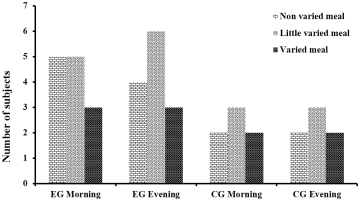
Figure 1). In the EG, the majority of morning meals were non-varied (5/13, i.e. 38.5%) or slightly varied (5/13, i.e. 38.5%), with only 3 of the 13 subjects (23.1%) reporting a varied meal. In the evening, the trend remained comparable: 4/13 (30.8%) non-varied, 6/13 (46.2%) slightly varied, and 3/13 (23.1%) varied. In the CG, the distribution was similar both in the morning and evening (2/7 non-varied, 3/7 slightly varied, 2/7 varied, i.e. 28.6%, 42.9%, and 28.6% respectively). Thus, in both groups and at both times of day, approximately three-quarters of reported meals were non-varied or slightly varied, compared with only a quarter that were varied.
Figure 1. Quality of morning and evening meals consumed by the studied fasters during Ramadan (n = 20).
EG Morning: experimental group surveyed early in the morning; EG Evening: experimental group after they have prayed in the evening; CG Morning: control group surveyed early in the morning; CG Evening: control group surveyed after they have prayed in the evening.
4. Discussion
4.1. Methodological Validity and Sample Characteristics
The population selected for this study consisted of senior players from the Association Sportive Omnisports Modèle of Porto-Novo, who have competed in Benin’s Division 1 handball league for five years. This choice was guided by the fact that almost all of these young players are Muslim and observe Ramadan fasting. The results obtained therefore remain valid for this non-probabilistic sample, which is not representative of all Muslim athletes in the city. Every effort was made to ensure the quality of the results, which we consider reproducible as a result: this included minimizing systematic error and seeking measurement precision, with the same assessors performing the measurements, repeated three times in succession when necessary, with the mean value retained.
With regard to BMI and abdominal circumference, the handball players were more heavily built and fatter than the relatively inactive subjects who served as controls—a discrepancy consistent with the observations of Gouthon et al.
| [11] | Gouthon P, Aremou M, Ahanhanzo Glele G, Dohou Alahassa P, Agboton H. Comparaison des facteurs de risque athérogène entre des joueuses de handball et des non sportives [Comparing Atherogenic Risk Factors in Female Handball Players versus Non-Sporting Women]. Cardiologie Tropicale. 2005; 31: 35-9. |
[11]
, who had already reported more pronounced anthropometric profiles and atherogenic risk in female handball players compared with non-athletes. The high-carbohydrate diet based on cereals and tubers (maize, millet, yams, cassava, rice, bread, etc.), consumed in large quantities by the players to meet the body’s energy requirements, constitutes the most plausible explanatory hypothesis for their excess body fat. Indeed, unused surplus carbohydrates can follow the lipogenesis pathway and accumulate as fat in subcutaneous adipose tissue. It should be noted that the reduced weekly training volume of these amateur-level players (four to six hours per week) is far from the 14 to 24 hours observed at the highest level. It is well established that body fat tends to accumulate in subjects whose daily energy intake exceeds their expenditure.
4.2. Reduction in Adiposity Indices During Fasting
The handball players in this study had a low training level while consuming large daily quantities of high-carbohydrate, and therefore high-energy, foods; the surplus unspent energy may have been converted into subcutaneous fat in these players. Ramadan fasting and the training followed by the handball players do not appear to have exerted a cumulative effect on their adiposity indices, since the reductions recorded in this group did not differ from those observed in the control group. It should be noted, however, that the reduction in energy intake resulting from the decrease in the quantity and frequency of meals during Ramadan could explain the observed decreases
| [12] | Bouhlel E, Salhi Z, Bouhlel H, Mdella S, Amamou A, Zaouali M, et al. Effect of Ramadan fasting on fuel oxidation during exercises in trained male rugby players. Diabetes & Metabolism. 2006; 32: 617-24. |
| [13] | Ramadan J, Telahoun G, Al-Zaid NS, Barac-Nieto M. Responses to exercise, fluid, and energy balance during Ramadan in sedentary and active males. Nutrition. 1999; 15: 735-9. |
[12, 13]
. Believers are advised, during this period, to consume a non-varied meal (tea or milky coffee accompanied by cheese or buttered bread) before sunrise, and a varied meal in the evening after prayer
| [14] | Finch G, Day J, Razak, Welch D, Rogers P. Appetite changes under free-living conditions during Ramadan fasting. Appetite. 1998; 2: 159-70. |
| [15] | Sweileh N, Schnitzier A, Hunter GR, Davis B. Body composition and energy metabolism in resting and exercising Muslims during Ramadan fast. Journal of Sports Medicine and Physical Fitness. 1992; 32: 156-63. |
[14, 15]
. However, our data on meal quality show that this recommendation was only partially followed by our subjects: approximately three-quarters of the evening meals reported by the EG remained non-varied or slightly varied, suggesting that the caloric restriction observed during Ramadan was not offset by sufficient nutritional diversification in the evening, despite the absence of any time restriction at that point in the day.
These results thus tend to highlight the positive effects of Ramadan fasting on the body composition of believers who observe it, even though abstaining from drinking water all day
| [16] | Al-Hourani HM, Atoum MF. Body composition, nutrient intake and physical activity patterns in young women during Ramadan. Singapore Medical Journal. 2007; 48: 906-10. |
[16]
repeatedly exposes the believer to a risk of dehydration in this hot and humid environment. Although a decrease in fat mass and BMI was observed in the various subjects in the present study, this finding is not, however, the subject of absolute consensus in the literature, since substantial increases in fat mass have been reported among believers from Islamic Arab countries at the end of Ramadan fasting
| [15] | Sweileh N, Schnitzier A, Hunter GR, Davis B. Body composition and energy metabolism in resting and exercising Muslims during Ramadan fast. Journal of Sports Medicine and Physical Fitness. 1992; 32: 156-63. |
| [17] | Rahman M, Rashid M, Basher S, Sultana S, Nomani MZ. Improved serum HDL cholesterol profile among Bangladeshi male students during Ramadan fasting. East Mediterranean Health Journal. 2004; 10: 131-7. |
| [18] | El Ati J, Kallal Z, Beji C, Danguir J. Comportement alimentaire durant le Ramadan: répercussion sur les paramètres métaboliques, énergétiques et hormonaux [Dietary Behavior During Ramadan: Impact on Metabolic, Energetic, and Hormonal Parameters]. In: Actes du 1er Congrès international sur la « Santé et le Ramadan ». Casablanca, Maroc, 1994. [In Proceedings of the 1st International Congress on "Health and Ramadan". Casablanca, Morocco, 1994]. |
[15, 17, 18]
. The differences between these findings and ours could be attributed to dietary habits specific to Islamic Arab countries, as well as to the level of physical activity maintained by our subjects during the month of fasting.
4.3. Deterioration of the Lipid Profile and Atherogenic Risk: An Apparent Paradox
Total cholesterol, LDL-cholesterol, and, quite naturally, the atherogenic index of plasma rose by the end of fasting in the experimental group, while mean HDL-cholesterol and triglyceride levels fell. These findings reveal an apparent paradox worth highlighting: while adiposity indices improved (decreases in BMI, abdominal circumference, and sum of skinfolds), the lipid profile deteriorated in the direction of increased atherogenic risk. This decoupling between fat mass loss and deterioration of the lipid profile suggests that it is not so much the quantity of food consumed that is at issue, but rather its nature and nutritional quality—a hypothesis consistent with our observations on the low dietary variety reported by the majority of subjects.
The primary factor to associate with the increase in atherogenic lipids, particularly LDL-cholesterol, is these players’ diet, probably rich in hypercholesterolaemic foods, a strong correlation between lipid profile and dietary habits having already been reported
| [19] | Afrasiabi A, Hassanzadeh S, Sattarivand R, Mahboob S. Effects of Ramadan fasting on serum lipid profiles on two hyperlipidemic groups with or without diet pattern. Saudi Medical Journal. 2003; 24: 23-6. |
| [20] | Tsai A, Sandretto A, Chung Y. Dieting is more effective in reducing weight but exercise is more effective in reducing fat during the early phase of a weight-reducing program in healthy humans. Journal of Nutritional Biochemistry. 2003; 14: 541-549. |
[19, 20]
, particularly with regard to eggs, meat, and milk. These findings also align with those of Lamine et al. (2006)
| [21] | Lamine F, Bouguerra R, Jabrane J, Marrakchi Z, Ben Rayana MC, Ben Slama C. Food intake and high density lipoprotein cholesterol levels changes during ramadan fasting in healthy young subjects. La Tunisie Médicale. 2006; 84(10): 647-650. |
[21]
, who observed unfavourable changes in HDL-cholesterol linked to the composition of food intake during Ramadan. The reduction in HDL-cholesterol can be regarded as a consequence of the rise in LDL-cholesterol. Although strongly associable with the dietary pattern characterized by fluid and food restriction
| [22] | Schonfeld G, Weidmann R, Witztum S. Alteration in levels and interrelations of plasma apolipoproteins induced by diet. Metabolism. 1976; 25: 261. |
[22]
, the reduction in mean triglyceride levels may be related to heredity. It is also quite possible that our subjects’ high-carbohydrate diet contributed to the decrease in HDL-cholesterol, by reversing the normal relationship between triglycerides and HDL-cholesterol
| [23] | Faye J, Fall A, Badji L, Cisse F, Stephan H, Tine P. Effet du Ramadan sur le poids, la performance et la glycémie au cours d’un entraînement à la resistance [Effect of Ramadan Fasting on Body Weight, Performance, and Blood Glucose Levels During Resistance Training]. Dakar Médical. 2005; 50: 146-151. |
[23]
.
It should be noted that, in the control group, the decrease in HDL-cholesterol (−33.3%) and triglycerides (−33.3%) was numerically greater than in the experimental group, without, however, reaching the threshold of statistical significance, which could be explained by the small size of this group (n = 7), limiting the statistical power of the tests in this group rather than reflecting a genuine absence of effect. This limitation calls for caution in interpreting the comparisons between the two groups and would justify replicating this study with a larger control group.
4.4. Stability of Cardiovascular, Glycaemic, and Uricaemic Parameters
Ramadan fasting and the training followed by the handball players do not appear to have exerted a cumulative effect on cardiovascular parameters, uricaemia, or fasting glycaemia, since the mean values obtained did not vary significantly in either group between the start and end of fasting. It should nevertheless be recalled that severe hypoglycaemia 10 hours after the last meal and a significant increase in uricaemia resulting from dehydration are often observed in athletes and sedentary individuals undertaking moderate-intensity exercise during the month of Ramadan
| [24] | Ramadan JM, Barac-Nieto M. Cardiorespiratory responses to moderately heavy aerobic exercise during the Ramadan fasts. Saudi Medical Journal. 2000; 21: 238-244. |
| [25] | Ramadan J. Effect of Ramadan fasting on physical performance, blood and body composition. In: Proc First International Congress on Ramadan and Health. Casablanca, 1994. |
| [26] | Gumaa KA, Mustafa KY, Mahmoud NA, Gader AM. The effects of fasting in Ramadan. 1. Serum uric acid and lipid concentrations. British Journal of Nutrition. 1978; 40: 573-81. |
[24-26]
. Indeed, the most significant change observed during Ramadan fasting is the rise in uricaemia during exercise
| [27] | Nomani M, Hallak MH, Siddiqui IP. Effect of Ramadan fasting on plasma uric acid and body weight in healthy men. Journal of the American Dietetic Association. 1990; 90: 1435-6. |
[27]
, an observation also reported by Nomani et al. (1990)
| [28] | Ba A, Samb A, Seck D, Kane MO, Seck MB, Sarr FB, et al. Étude comparative de l’effet du Jeûne du Ramadan sur la glycémie au repos chez des sportifs et des sédentaires. [Comparative Study of the Effect of Ramadan Fasting on Resting Blood Glucose in Athletes and Sedentary Individuals]. Dakar Médical. 2005; 50: 22-7. |
[28]
in healthy men during Ramadan. Significant decreases in heart rate and glycaemia have also been reported in athletic and sedentary subjects during moderate-intensity exercise, i.e. < 75%
O₂max
| [29] | Ramadan J. Does fasting during Ramadan alter body composition, blood constituents and physical performance? Medical Principles and Practice. 2002; (Suppl 2): 41-6. |
[29]
, wkmlfdan intensity that our subjects, trained for high-level competition, likely exceeded, which could explain the absence of significant variation observed here.
4.5. Maximal Aerobic Performance (MAS): A Protective Effect of Training
In the control group, maximal aerobic speed (MAS) decreased by the end of fasting. This finding can be associated not only with the lack of training and the energy deficit resulting from fluid and food restriction, but also with a change in these young players’ sleep cycle during this period
| [26] | Gumaa KA, Mustafa KY, Mahmoud NA, Gader AM. The effects of fasting in Ramadan. 1. Serum uric acid and lipid concentrations. British Journal of Nutrition. 1978; 40: 573-81. |
| [30] | Kordi R, Abdollahi M, Memari AH, Najafabadi MG. Investigating two different training time frames during Ramadan fasting. Asian Journal of Sports Medicine. 2011; 2(3): 205-10. |
[26, 30]
. This hypothesis will, however, need to be confirmed by further research, since stable physical performance during the month of Ramadan has been recorded in athletes in Africa and elsewhere
| [31] | Kirkendall T, Leiper B, Bartagi Z, Dvorak J, Zerguini Y. The influence of Ramadan on physical performance measures in young Muslim footballers. Journal of Sports Sciences. 2008; 26: 15-27. |
| [32] | Shephard RJ. Physical performance and training response during Ramadan observance, with particular reference to protein metabolism. British Journal of Sports Medicine. 2012; 46(7): 477-84. |
[31, 32]
. While failing to improve maximal aerobic speed in the EG handball players, the training they undertook during the fasting period had the merit of preventing a decline in this physiological capacity—a protective effect of training also highlighted by Shephard
| [33] | Bigard AX, Boussif M, Chalabi H, Guezennec CY. Alterations in muscle performance and orthostatic tolerance during Ramadan. Aviation Space and Environmental Medicine. 1998; 69: 341-6. |
[33]
and by Bigard et al.
| [34] | Meckel Y, Ismaeel A, Eliakim A. The effect of the Ramadan fast on physical performance and dietary habits in adolescent soccer players. European Journal of Applied Physiology. 2008; 102: 651-657. |
[34]
, who reported better preservation of neuromuscular performance in athletes trained during Ramadan. However, a reduction in maximal aerobic power has indeed been reported in 100 m and 800 m runners and in footballers who fasted
| [13] | Ramadan J, Telahoun G, Al-Zaid NS, Barac-Nieto M. Responses to exercise, fluid, and energy balance during Ramadan in sedentary and active males. Nutrition. 1999; 15: 735-9. |
| [35] | Zerguini Y, Dvorak J, Maughan RJ, Leiper JB, Bartagi Z, Kirkendall DT, et al. Influence of Ramadan fasting on physiological and performance variables in football players: summary of the F-MARC 2006 Ramadan fasting study. Journal of Sports Sciences. 2008; 26: 3-6. |
[13, 35]
, which underscores that the protective effect of training may depend on the sporting discipline and the intensity of the efforts required.
5. Study Limitations
The main limitations of this study include the relatively small sample size (n = 20), particularly that of the control group (n = 7), which limits the statistical power of between-group comparisons and could explain certain numerically substantial but non-significant variations (for example, for HDL-cholesterol and triglycerides in the CG). Further limitations include the non-probabilistic sampling method and the lack of precise quantification of dietary intake: only meal variety was recorded (
Figure 1), without weighing or detailed nutritional composition analysis, which limits the interpretation of the observed lipid profile alterations. In addition, the study did not assess hydration status or sleep quality, two factors that could influence the results observed. Finally, the absence of biomechanical analysis of handball-specific movements (jumps, shots, changes of direction) represents an avenue for improvement in future research.
6. Conclusion
At the conclusion of this work, it emerged that Ramadan fasting induced a significant reduction in adiposity indices across all fasting individuals. Unlike non-practising athletes during the fasting period, the decrease in adiposity indices in handball players was not accompanied by a decrease in aerobic performance, thereby revealing the positive effect of handball training during Ramadan fasting. The increase in atherogenic blood lipid values, even among handball players, together with the reduction in HDL-cholesterol and triglycerides, raises concerns regarding the quality of food consumed during Ramadan fasting—a hypothesis reinforced by the finding that nearly three-quarters of the meals reported by our subjects were slightly or not varied.
It appears necessary not only to extend the study to other populations of practitioners, with a larger control group, but also to incorporate into future protocols a dietary survey using a quantitative approach (weighing and nutritional value of foods). Furthermore, biomechanical analysis of handball-specific movements (analysis of shooting technique, footwork, and changes of direction) during the fasting period would provide valuable insight into the effects of fasting on movement efficiency and injury risk. In light of these findings, it is necessary to propose to athletes in Benin in particular, and in sub-Saharan Africa in general, dietary and hydration strategies enabling them to best benefit from the effects of Ramadan fasting, especially during training and competition periods.
Abbreviations
AC | Abdominal Circumference |
AIP | Atherogenic Index of Plasma |
BMI | Body Mass Index |
CG | Control Group |
DBP | Diastolic Blood Pressure |
EG | Experimental Group |
HDL-C | High Density Lipoprotein Cholesterol |
HR | Heart Rate |
HRmax | Maximum Heart Rate |
LDL-C | Low Density Lipoprotein Cholesterol |
MAS | Maximal Aerobic Speed |
SBP | Systolic Blood Pressure |
SSF | Sum of Skinfolds |
TC | Total Cholesterol |
TG | Triglycerides |
Acknowledgments
The team wishes to express its thanks and deep gratitude to all the young Muslim athletes who voluntarily and spontaneously agreed to take part in this study, as well as to the management of ASO Modèle de Porto-Novo.
Author Contributions
Falola Stève Marjelin Donan: Conceptualization, Investigation, Methodology, Writing – original draft
Sinh Josi Noelline: Data curation, Formal Analysis, Writing – review & editing
Kouassi Jean-Paul: Conceptualization, Methodology, Supervision, Writing – review & editing
Dossou Sémako Gérard: Investigation, Resources, Validation
Quenum Coffi: Data curation, Investigation, Visualization
Agbodjogbé Kpèdétin Wilfrid: Formal Analysis, Software, Visualization
Kouamé N’Guessan: Project administration, Supervision, Validation
Conflicts of Interest
The authors declare no conflicts of interest.
References
| [1] |
Kaba AJ. The numbers and percentages of Christians and Muslims in Africa, 2020. International Journal of African Catholicism (IJAC). 2022; 12: 18-40.
https://shu.elsevierpure.com/en/publications/the-numbers-and-percentages-of-christians-and-muslims-in-africa-2
|
| [2] |
Fall A, Sarr M, Mandengue S, Badji L, Samb A, Gueye L, et al. Effets d’une restriction hydrique et alimentaire prolongée (Ramadan) sur la performance et les réponses cardiovasculaires au cours d’un exercice incrémental en milieu tropical chaud. Science & Sports. 2007; 22: 50-3.
https://doi.org/10.5281/zenodo.18722391
|
| [3] |
Central Intelligence Agency. (2009). The World Factbook 2009. July 2009 population data: An analysis of the Muslim population by country and region; [Accessed 27 October 2026]. Available at
https://www.pewresearch.org/religion/2009/10/07/mapping-the-global-muslim-population/
|
| [4] |
Aloui A, Briki W, Chalabi H, Chamari K. Comprendre le jeûne du Ramadan et ses contraintes sur les athlètes: présentation Générale [Understanding Ramadan Fasting and Its Constraints on Athletes: An Overview]. La Tunisie Médicale. 2025; 103(7): 859-61.
https://doi.org/10.62438/tunismed.v103i7.5766
|
| [5] |
Ceylan Hİ, Morgans R, Oliveira R, Rhodes D, Orme P, González-Fernández FT. Sleep and circadian rhythm disturbances during Ramadan intermittent fasting in athletes: A narrative review. Science Progress. 2023; 106(4): 1-20.
https://doi.org/10.1177/00368504231206265
|
| [6] |
Washif JA, Aziz AR, Chamari K. The impact of Ramadan intermittent fasting on Muslim and non-Muslim athletes: A global perspective. Tunisia Medica. 2024; 102(6): 321-323.
https://doi.org/10.62438/tunismed.v102i6.5014
|
| [7] |
Lawani M, Akplogan B, Bio Nigan I, Bakari M. Éducation physique et sportive, masse corporelle et jeûne du mois de Ramadan [Physical Education and Sports, Body Mass, and Ramadan Fasting]. Journal de Recherche de l’Université de Lomé (Togo). 2000; 4: 75-80.
|
| [8] |
Maton F. Méthode de mesure des plis cutanés chez le sportif [Skinfold Measurement Method in Athletes]. Médecine du Sport. 2008: 1-9.
|
| [9] |
Akplogan B, Bigou-Lare A, Kpazaï G, Tonouhewa A. L’indice biologique d’athérogénicité: définition et intérêt en médecine du sport [The Biological Atherogenic Index: Definition and Relevance in Sports Medicine]. Science & Sports. 2006; 21(4): 220-223.
|
| [10] |
Cazorla G, Léger L. Comment évaluer et développer vos capacités aérobies: épreuve de course navette et épreuve VAMEVAL [How to Assess and Develop Your Aerobic Capacity: The Shuttle Run Test and the VAMEVAL Test]. Cestas: Éditions AREAPS, 1993.
|
| [11] |
Gouthon P, Aremou M, Ahanhanzo Glele G, Dohou Alahassa P, Agboton H. Comparaison des facteurs de risque athérogène entre des joueuses de handball et des non sportives [Comparing Atherogenic Risk Factors in Female Handball Players versus Non-Sporting Women]. Cardiologie Tropicale. 2005; 31: 35-9.
|
| [12] |
Bouhlel E, Salhi Z, Bouhlel H, Mdella S, Amamou A, Zaouali M, et al. Effect of Ramadan fasting on fuel oxidation during exercises in trained male rugby players. Diabetes & Metabolism. 2006; 32: 617-24.
|
| [13] |
Ramadan J, Telahoun G, Al-Zaid NS, Barac-Nieto M. Responses to exercise, fluid, and energy balance during Ramadan in sedentary and active males. Nutrition. 1999; 15: 735-9.
|
| [14] |
Finch G, Day J, Razak, Welch D, Rogers P. Appetite changes under free-living conditions during Ramadan fasting. Appetite. 1998; 2: 159-70.
|
| [15] |
Sweileh N, Schnitzier A, Hunter GR, Davis B. Body composition and energy metabolism in resting and exercising Muslims during Ramadan fast. Journal of Sports Medicine and Physical Fitness. 1992; 32: 156-63.
|
| [16] |
Al-Hourani HM, Atoum MF. Body composition, nutrient intake and physical activity patterns in young women during Ramadan. Singapore Medical Journal. 2007; 48: 906-10.
|
| [17] |
Rahman M, Rashid M, Basher S, Sultana S, Nomani MZ. Improved serum HDL cholesterol profile among Bangladeshi male students during Ramadan fasting. East Mediterranean Health Journal. 2004; 10: 131-7.
|
| [18] |
El Ati J, Kallal Z, Beji C, Danguir J. Comportement alimentaire durant le Ramadan: répercussion sur les paramètres métaboliques, énergétiques et hormonaux [Dietary Behavior During Ramadan: Impact on Metabolic, Energetic, and Hormonal Parameters]. In: Actes du 1er Congrès international sur la « Santé et le Ramadan ». Casablanca, Maroc, 1994. [In Proceedings of the 1st International Congress on "Health and Ramadan". Casablanca, Morocco, 1994].
|
| [19] |
Afrasiabi A, Hassanzadeh S, Sattarivand R, Mahboob S. Effects of Ramadan fasting on serum lipid profiles on two hyperlipidemic groups with or without diet pattern. Saudi Medical Journal. 2003; 24: 23-6.
|
| [20] |
Tsai A, Sandretto A, Chung Y. Dieting is more effective in reducing weight but exercise is more effective in reducing fat during the early phase of a weight-reducing program in healthy humans. Journal of Nutritional Biochemistry. 2003; 14: 541-549.
|
| [21] |
Lamine F, Bouguerra R, Jabrane J, Marrakchi Z, Ben Rayana MC, Ben Slama C. Food intake and high density lipoprotein cholesterol levels changes during ramadan fasting in healthy young subjects. La Tunisie Médicale. 2006; 84(10): 647-650.
|
| [22] |
Schonfeld G, Weidmann R, Witztum S. Alteration in levels and interrelations of plasma apolipoproteins induced by diet. Metabolism. 1976; 25: 261.
|
| [23] |
Faye J, Fall A, Badji L, Cisse F, Stephan H, Tine P. Effet du Ramadan sur le poids, la performance et la glycémie au cours d’un entraînement à la resistance [Effect of Ramadan Fasting on Body Weight, Performance, and Blood Glucose Levels During Resistance Training]. Dakar Médical. 2005; 50: 146-151.
|
| [24] |
Ramadan JM, Barac-Nieto M. Cardiorespiratory responses to moderately heavy aerobic exercise during the Ramadan fasts. Saudi Medical Journal. 2000; 21: 238-244.
|
| [25] |
Ramadan J. Effect of Ramadan fasting on physical performance, blood and body composition. In: Proc First International Congress on Ramadan and Health. Casablanca, 1994.
|
| [26] |
Gumaa KA, Mustafa KY, Mahmoud NA, Gader AM. The effects of fasting in Ramadan. 1. Serum uric acid and lipid concentrations. British Journal of Nutrition. 1978; 40: 573-81.
|
| [27] |
Nomani M, Hallak MH, Siddiqui IP. Effect of Ramadan fasting on plasma uric acid and body weight in healthy men. Journal of the American Dietetic Association. 1990; 90: 1435-6.
|
| [28] |
Ba A, Samb A, Seck D, Kane MO, Seck MB, Sarr FB, et al. Étude comparative de l’effet du Jeûne du Ramadan sur la glycémie au repos chez des sportifs et des sédentaires. [Comparative Study of the Effect of Ramadan Fasting on Resting Blood Glucose in Athletes and Sedentary Individuals]. Dakar Médical. 2005; 50: 22-7.
|
| [29] |
Ramadan J. Does fasting during Ramadan alter body composition, blood constituents and physical performance? Medical Principles and Practice. 2002; (Suppl 2): 41-6.
|
| [30] |
Kordi R, Abdollahi M, Memari AH, Najafabadi MG. Investigating two different training time frames during Ramadan fasting. Asian Journal of Sports Medicine. 2011; 2(3): 205-10.
|
| [31] |
Kirkendall T, Leiper B, Bartagi Z, Dvorak J, Zerguini Y. The influence of Ramadan on physical performance measures in young Muslim footballers. Journal of Sports Sciences. 2008; 26: 15-27.
|
| [32] |
Shephard RJ. Physical performance and training response during Ramadan observance, with particular reference to protein metabolism. British Journal of Sports Medicine. 2012; 46(7): 477-84.
|
| [33] |
Bigard AX, Boussif M, Chalabi H, Guezennec CY. Alterations in muscle performance and orthostatic tolerance during Ramadan. Aviation Space and Environmental Medicine. 1998; 69: 341-6.
|
| [34] |
Meckel Y, Ismaeel A, Eliakim A. The effect of the Ramadan fast on physical performance and dietary habits in adolescent soccer players. European Journal of Applied Physiology. 2008; 102: 651-657.
|
| [35] |
Zerguini Y, Dvorak J, Maughan RJ, Leiper JB, Bartagi Z, Kirkendall DT, et al. Influence of Ramadan fasting on physiological and performance variables in football players: summary of the F-MARC 2006 Ramadan fasting study. Journal of Sports Sciences. 2008; 26: 3-6.
|
Cite This Article
-
APA Style
Donan, F. S. M., Noelline, S. J., Jean-Paul, K., Gérard, D. S., Coffi, Q., et al. (2026). Effects of Ramadan Fasting on Physical Performance and Atherogenic Risk Parameters in Division 1 Handball Players from Porto-Novo (Republic of Benin). American Journal of BioScience, 14(6), 146-154. https://doi.org/10.11648/j.ajbio.20261406.12
 Copy
|
 Download
ACS Style
Donan, F. S. M.; Noelline, S. J.; Jean-Paul, K.; Gérard, D. S.; Coffi, Q., et al. Effects of Ramadan Fasting on Physical Performance and Atherogenic Risk Parameters in Division 1 Handball Players from Porto-Novo (Republic of Benin). Am. J. BioScience 2026, 14(6), 146-154. doi: 10.11648/j.ajbio.20261406.12
Copy
|
Download
AMA Style
Donan FSM, Noelline SJ, Jean-Paul K, Gérard DS, Coffi Q, et al. Effects of Ramadan Fasting on Physical Performance and Atherogenic Risk Parameters in Division 1 Handball Players from Porto-Novo (Republic of Benin). Am J BioScience. 2026;14(6):146-154. doi: 10.11648/j.ajbio.20261406.12
Copy
|
Download
-
@article{10.11648/j.ajbio.20261406.12,
  author = {Falola Stève Marjelin Donan and Sinh Josi Noelline and Kouassi Jean-Paul and Dossou Sémako Gérard and Quenum Coffi and Agbodjogbé Kpèdétin Wilfrid and Kouamé N’Guessan},
  title = {Effects of Ramadan Fasting on Physical Performance and Atherogenic Risk Parameters in Division 1 Handball Players from Porto-Novo (Republic of Benin)},
  journal = {American Journal of BioScience},
  volume = {14},
  number = {6},
  pages = {146-154},
  doi = {10.11648/j.ajbio.20261406.12},
  url = {https://doi.org/10.11648/j.ajbio.20261406.12},
  eprint = {https://article.sciencepublishinggroup.com/pdf/10.11648.j.ajbio.20261406.12},
  abstract = {Introduction. Regarded as one of the five pillars of Islam, Ramadan fasting requires healthy believers to refrain completely from food and fluid intake from dawn until sunset. Whilst its effects on physical performance have been studied in various contexts, there is a paucity of research simultaneously examining its impact on both performance and cardiovascular risk markers in sub-Saharan African athletes, particularly in team sports such as handball. Objective. This prospective controlled study aimed to determine the effects of Ramadan fasting on maximal aerobic speed (MAS), anthropometric parameters, and biochemical markers associated with atherogenic risk in Division 1 handball players from Porto-Novo, Benin. Methods. Twenty handball players (mean age 24.5 ± 4.4 years) strictly observing Ramadan fasting were assigned to an experimental group (EG, n = 13) who continued training, and a control group (CG, n = 7) who did not train during the fasting period. Anthropometric measurements (body mass index, abdominal circumference, sum of skinfolds), serum lipid profiles (total cholesterol, HDL-cholesterol, LDL-cholesterol, triglycerides), and maximal aerobic speed (VAMEVAL test) were assessed three days prior to the onset and on the 28th day of Ramadan. Results. Body mass index (−4.1%), abdominal circumference (−3.6%), and sum of skinfolds (−16.8%) decreased significantly in the EG (p -1, p > 0.05) but decreased by 7.4% in the CG (p < 0.05). Conclusion. Ramadan fasting reduced adiposity indices in all fasting individuals but did not impair maximal aerobic performance in handball players who maintained training. Nevertheless, the deterioration in the atherogenic lipid profile raises concerns regarding dietary quality during Ramadan and highlights the need for nutritional support for athletes observing the fast.},
 year = {2026}
}
Copy
|
Download
-
TY  - JOUR
T1  - Effects of Ramadan Fasting on Physical Performance and Atherogenic Risk Parameters in Division 1 Handball Players from Porto-Novo (Republic of Benin)
AU  - Falola Stève Marjelin Donan
AU  - Sinh Josi Noelline
AU  - Kouassi Jean-Paul
AU  - Dossou Sémako Gérard
AU  - Quenum Coffi
AU  - Agbodjogbé Kpèdétin Wilfrid
AU  - Kouamé N’Guessan
Y1  - 2026/11/06
PY  - 2026
N1  - https://doi.org/10.11648/j.ajbio.20261406.12
DO  - 10.11648/j.ajbio.20261406.12
T2  - American Journal of BioScience
JF  - American Journal of BioScience
JO  - American Journal of BioScience
SP  - 146
EP  - 154
PB  - Science Publishing Group
SN  - 2330-0167
UR  - https://doi.org/10.11648/j.ajbio.20261406.12
AB  - Introduction. Regarded as one of the five pillars of Islam, Ramadan fasting requires healthy believers to refrain completely from food and fluid intake from dawn until sunset. Whilst its effects on physical performance have been studied in various contexts, there is a paucity of research simultaneously examining its impact on both performance and cardiovascular risk markers in sub-Saharan African athletes, particularly in team sports such as handball. Objective. This prospective controlled study aimed to determine the effects of Ramadan fasting on maximal aerobic speed (MAS), anthropometric parameters, and biochemical markers associated with atherogenic risk in Division 1 handball players from Porto-Novo, Benin. Methods. Twenty handball players (mean age 24.5 ± 4.4 years) strictly observing Ramadan fasting were assigned to an experimental group (EG, n = 13) who continued training, and a control group (CG, n = 7) who did not train during the fasting period. Anthropometric measurements (body mass index, abdominal circumference, sum of skinfolds), serum lipid profiles (total cholesterol, HDL-cholesterol, LDL-cholesterol, triglycerides), and maximal aerobic speed (VAMEVAL test) were assessed three days prior to the onset and on the 28th day of Ramadan. Results. Body mass index (−4.1%), abdominal circumference (−3.6%), and sum of skinfolds (−16.8%) decreased significantly in the EG (p -1, p > 0.05) but decreased by 7.4% in the CG (p < 0.05). Conclusion. Ramadan fasting reduced adiposity indices in all fasting individuals but did not impair maximal aerobic performance in handball players who maintained training. Nevertheless, the deterioration in the atherogenic lipid profile raises concerns regarding dietary quality during Ramadan and highlights the need for nutritional support for athletes observing the fast.
VL  - 14
IS  - 6
ER  -
Copy
|
Download

 ,
Sinh Josi Noelline



 Share This Article
 Twitter
 Linked In
 Facebook