
House dust mites are the main source of aeroallergens worldwide. Exposure to mite allergens has been widely associated with sensitization and the development of allergic diseases. This study aimed to assess the diversity, abundance and distribution of house dust mites (HDM), as well as to analyse their relationships with microclimatic parameters in indoor environments. A total of 255 dust samples were collected from 60 domestic habitats by vacuuming sofas and bedding during December and July 2023. Indoor temperature and relative humidity were also measured. Mites were counted and identified using an optical microscope. The rate of mite presence in the indoor habitats of allergic individuals was high at 93.3%. The main family of mites was Pyroglyphidae (44.6%). Dermatophagoides pteronyssinus was the most frequent species (24.9%), followed by Dermatophagoides farinae (19.7%). The family of Echimyopodidae was represented by Blomia tropicalis (14.3%) and the Glycyphagidae family by Glycyphagus domesticus (8.1%). Temperatures were higher in December, whereas relative humidity was higher in July (p <0.001). There was a significant positive correlation between the number of mites and the physicochemical parameters (r july= 0.780; r december= 0.529; p < 0.001). These results indicate that the species of Dermatophagoides spp, Blomia tropicalis, and Glycyphagus domesticus are the most dominant mites in our region, and the increase in temperature and relative humidity were positively associated with increased mite abundance. Therefore, knowledge of the local mite fauna would improve the means of studying the link between allergen exposure and sensitisation and would provide a framework for future ecological and allergenic studies, including the development of additional mite extracts for diagnostic testing.
| Published in | American Journal of BioScience (Volume 14, Issue 6) |
| DOI | 10.11648/j.ajbio.20261406.13 |
| Page(s) | 155-163 |
| Creative Commons |
This is an Open Access article, distributed under the terms of the Creative Commons Attribution 4.0 International License (http://creativecommons.org/licenses/by/4.0/), which permits unrestricted use, distribution and reproduction in any medium or format, provided the original work is properly cited. |
| Copyright |
Copyright © The Author(s), 2026. Published by Science Publishing Group |
House Dust Mites, Indoor Habitats, Allergic Individuals, Côte D’Ivoire
Mites | Count (%) |
|---|---|
Cohort Astigmatina | 1791 |
Echimyopodidae | 327 (14,3) |
Blomia tropicalis | |
Glycyphagidae | |
Glycyphagus domesticus | 186 (8,1) |
Pyroglyphidae | 1017 (44,6) |
Dermatophagoides farinae Dermatophagoides pteronyssinus Listrosphoridae | 450 (19,7) 567 (24,9) |
Listrophorus Epidermoptidae Knemidokoptes sp | 69 (3,1) 72 (3,2) |
Sarcoptidae Sarcoptes sp | 120 (5,2) |
Orden Mesostigmata | 186 |
Dermanyssidae Dermanyssus gallinae Laelapidae Hypoaspis sp Ameroseiidae Kleemannia sp | 48 (2,1) 66 (3) 72 (3,2) |
Orden Trombidiformes | 300 |
Cheyletidae Cheyletus sp Tarsonemidae Tarsonemus sp | 204 (9) 96 (4,2) |
Total | 2277 (100) |
NaCL | Sodium Chloride |
D. pteronyssinus | Dermatophagoides Pteronyssinus |
D. farinae | Dermatophagoides Farinae |
B. tropicalis | Blomia Tropicalis |
G. domesticus | Glycyphagus Domesticus |
D. gallinae | Dermanyssus Gallinae |
| [1] | Calderón, M. A., Linneberg, A., Kleine-Tebbe, J., De Blay, F., de Rojas, D. H. F., Virchow, J. C., Demoly, P. Respiratory allergy caused by house dust mites: what do we really know? J. Allergy Clin. Immunol. 2015, 136, 38-48. |
| [2] | Bergmann, K., C. Frequency of sensitizations and allergies to house dust mites. Allergo J. Int. 2022, 31, 279‑283. |
| [3] | Vrtala, S. Allergens from house dust and storage mites. Allergo J. Int. 2022, 31, 267‑271. |
| [4] | Bergmann, K., C. Biology of house dust mites and storage mites. Allergo J. Int. 2022, 31, 272‑278. |
| [5] | Vackova, T., Pekar, S., Klimov, P., Hubert, J. Population growth and respiration in the dust mite Dermatophagoides farinae under different temperature and humidity regimes. Exp. Appl. Acarol., 2023, 89, 157‑169. |
| [6] | Sun, Y., Cui, L., Hou, J., Luo, S., Norbäck, D., Sundell, J. Role of ventilation and cleaning for controlling house dust mite allergen infestation: A study on associations of house dust mite allergen concentrations with home environment and life styles in Tianjin area, China. Indoor Air. 2022, 32. |
| [7] | Arlian, L. G., et al. Prevalence of dust mites in the homes of people with asthma living in eight different geographic areas of the United States. J. Allergy Clin. Immunol. 1992, 90, 292‑300. |
| [8] |
Custovic, A., Chapman. M. Indoor allergens as a risk factor for asthma. Asthma. 1997, 83, 103, 1997.
https://www.researchgate.net/publication/256536619_Allergens_as_a_Risk_Factor_for_Asthma |
| [9] | Korsgaard, J., Hallas, T. Tarsonemid Mites in Danish House Dust. Allergy, 1979, 34, 225-232. |
| [10] |
Platts-Mills, T. A., Chapman, M. Dust mites: immunology, allergic disease, and environmental control. J. Allergy Clin. Immunol. 1987, 80, 755-775.
https://www.sciencedirect.com/science/article/pii/S0091674987802610 |
| [11] | Tovey, E. R., Chapman, M. D., Platts-Mills, T. Mite faeces are a major source of house dust allergens. Nature. 1981, 289, 592-593. |
| [12] | Colloff, M. J. Dust mite allergens, in: Dust Mites. Springer Netherlands, Dordrecht, pp. 273-328. |
| [13] | Claire et al. House Dust Mite Awareness in the Ivorian Population from 2008 to 2021. Arch. Immunol. Allergy. 2025, 6, 1‑8. |
| [14] |
Arlian, L. G., Platts-Mills, T. The biology of dust mites and the remediation of mite allergens in allergic disease. J. Allergy Clin. Immunol. 2001, 107, S406-S413.
https://www.sciencedirect.com/science/article/pii/S009167490148153X |
| [15] |
Bessot, J.-C. Metz-Favre, F., De Blay, Pauli, G. Storage mites and pyroglyphidae mites: Similarities, differences and practical consequences. Rev. Fr. Allergol. 2011, 51, 607‑621.
https://www.sciencedirect.com/science/article/abs/pii/S1877032011001485 |
| [16] | Kablan, M. Vulnerability and Adaptation of Urban Populations to the Effects of Climate Variations (Temperature and Precipitation): An Analysis of the Situation in the Municipality of Cocody. PhD Thesis. 2016, University Félix Houphouët-Boigny, Abidjan, Côte d’Ivoire, 204 p. |
| [17] | Fain A., Guérin B., Hart B. Mites and Allergic Diseases. 179 p. In: Guérin B. (ed), Allerbio, 1990. F55270 Varennes en Argonne. |
| [18] | Colloff, M. J., Spieksma, F. 1992a. Pictorial keys for the identification of domestic mites. Clin. Exp. Allergy. 1992, 22, 823-830. |
| [19] | Colloff, M. Taxonomy and identification of dust mites. Allergy. 1998, 53, 7‑12. |
| [20] | Krantz G., W. Walter E. A Manual of Acarology. Third Edition. Texas, Texas Tech University Press, 2009. |
| [21] | Solarz K. House dust mites and storage mites (Acari: Oribatida: Astigmatina): Identification keys. Institute of Systematics and Evolution of Animals, Polish Academy of Sciences. 2012, 120 pp. ISBN 978?83?61358?48?0 |
| [22] | Volgin, V. Acarina of the family Cheyletidae of the World. Keys to the Fauna of the USSR. New Delhi: Amerind Publishing Company. 1987, 101. 532 p. |
| [23] | Solarz, K. Indoor mites and forensic acarology. Exp. Appl. Acarol. 2009, 49, 1‑2. |
| [24] | Bigliocchi, F., Maroli, M. Distribution and abundance of house-dust mites (Acarina: Pyroglycphidae) in Rome, Italy. Aerobiologia. 1995, 11, 35-40. |
| [25] | Montealegre, F., Sepulveda, A., Bayona, M., Quinones, C., Fernandez-Caldas, E. Identification of the domestic mite fauna of Puerto Rico. P. R. Health Sci. J. 2020, 16. |
| [26] | Mumcuoglu, Y. House dust mites in Switzerland I. Distribution and taxonomy. J. Med. Entomol. 1976, 13, 361-373. |
| [27] | Soltani, A., Azizi, K., Saleh, V., Dabaghmanesh, T. The fauna and distribution of house dust mites in residential homes of Bandar Abbas District, Southern Iran. Exp. Appl. Acarol. 2011, 54, 269-276. |
| [28] | Yar et al. Prevalence and Species Distribution of House Dust Mites in Household Dust Samples from Homes of Individuals with Allergic Complaints in Ordu, Turkey. JoVE J. Vis. Exp. 2026, 229, 70-402. |
| [29] | Aljohani et al. Diversity and abundance of house dust mites in Irish homes, their exoskeleton-associated bacteria and susceptibility to clinically relevant antibiotics. in Biology and Environment: Proceedings of the Royal Irish Academy, Royal Irish Academy, 2024, p. 29‑40. Disponible sur: |
| [30] | Hart, B. Life cycle and reproduction of house‐dust mites: environmental factors influencing mite populations. Allergy, 1998, 53, 13‑17. |
| [31] | Lau, A., Weber, K., Werthmann, I., et Wahn, U. Seasonal variations in house dust mite allergens-significance for children with allergy. Monatsschrift Kinderheilkd. Organ Dtsch. Ges. Kinderheilkd. 1990, 138, 58‑61, 1990. |
| [32] | Fernández‐Caldas, E., Puerta, L., Mercado, D., Lockey, R. F., Caraballo, L. Mite fauna, Der p I, Der f I and Blomia tropicalis allergen levels in a tropical environment. Clin. Exp. Allergy. 1993, 23, 292-297. |
| [33] | Arlian, L. G., Bernstein, I. L., Gallagher, J. The prevalence of house dust mites, Dermatophagoides spp, and associated environmental conditions in homes in Ohio. J. Allergy Clin. Immunol. 1982, 69, 527-532. |
| [34] | Bergmann, K., Weber, J., Sager, A. Domestic mites and their whereabouts in Germany. Allergo J. Int. 2025, 35, 45‑53, |
| [35] | Ibrahim et al. Species identification and seasonal prevalence of house dust mites in Assiut City, Egypt: A descriptive study in an urban area. Persian J. Acarol. 2022, 11, 83‑99. |
| [36] | Terra, S. A., Silva, D. A. O., Sopelete, M. C., Mendes, J., Sung, S. J., Taketomi, E. Mite allergen levels and acarologic analysis in house dust samples in Uberaba, Brazil. J Invest Allergo Clin Immunol. 2004, 14: 232-237. |
| [37] | Hubert, J., Stejskal, V., Athanassiou, C., et Throne, J. Health Hazards Associated with Arthropod Infestation of Stored Products. Annu. Rev. Entomol. 2018, 63, 553‑573. |
| [38] | Hubert, J., Nesvorna, M., Volek, V. Stored product mites (Acari: Astigmata) infesting food in various types of packaging. Exp. Appl. Acarol. 2015, 65, 237‑242. |
| [39] | Arlian, L. G., Neal, J. S., Morgan, M. S., Vyszenski-Moher, D. L., Rapp, C. M., Alexander, A. Reducing relative humidity is a practical way to control dust mites and their allergens in homes in temperate climates. J. Allergy Clin. Immunol. 2001, 107, 99-104. |
APA Style
Emilie, K. G. A., Claire, Y. C., Samuel, B., Henoc, S. A. S., Yaya, S. (2026). House Dust Mites Associated with Indoor Habitats of Allergic Individuals in Abidjan, Côte d’Ivoire. American Journal of BioScience, 14(6), 155-163. https://doi.org/10.11648/j.ajbio.20261406.13
ACS Style
Emilie, K. G. A.; Claire, Y. C.; Samuel, B.; Henoc, S. A. S.; Yaya, S. House Dust Mites Associated with Indoor Habitats of Allergic Individuals in Abidjan, Côte d’Ivoire. Am. J. BioScience 2026, 14(6), 155-163. doi: 10.11648/j.ajbio.20261406.13
@article{10.11648/j.ajbio.20261406.13,
  author = {Kouadjane Gnagoran Agnes Emilie and Yapo-Crezoit Chiaye Claire and Boahene Samuel and Sika Ake Sosthene Henoc and Soro Yaya},
  title = {House Dust Mites Associated with Indoor Habitats of Allergic Individuals in Abidjan, Côte d’Ivoire},
  journal = {American Journal of BioScience},
  volume = {14},
  number = {6},
  pages = {155-163},
  doi = {10.11648/j.ajbio.20261406.13},
  url = {https://doi.org/10.11648/j.ajbio.20261406.13},
  eprint = {https://article.sciencepublishinggroup.com/pdf/10.11648.j.ajbio.20261406.13},
  abstract = {House dust mites are the main source of aeroallergens worldwide. Exposure to mite allergens has been widely associated with sensitization and the development of allergic diseases. This study aimed to assess the diversity, abundance and distribution of house dust mites (HDM), as well as to analyse their relationships with microclimatic parameters in indoor environments. A total of 255 dust samples were collected from 60 domestic habitats by vacuuming sofas and bedding during December and July 2023. Indoor temperature and relative humidity were also measured. Mites were counted and identified using an optical microscope. The rate of mite presence in the indoor habitats of allergic individuals was high at 93.3%. The main family of mites was Pyroglyphidae (44.6%). Dermatophagoides pteronyssinus was the most frequent species (24.9%), followed by Dermatophagoides farinae (19.7%). The family of Echimyopodidae was represented by Blomia tropicalis (14.3%) and the Glycyphagidae family by Glycyphagus domesticus (8.1%). Temperatures were higher in December, whereas relative humidity was higher in July (p july= 0.780; r december= 0.529; p Dermatophagoides spp, Blomia tropicalis, and Glycyphagus domesticus are the most dominant mites in our region, and the increase in temperature and relative humidity were positively associated with increased mite abundance. Therefore, knowledge of the local mite fauna would improve the means of studying the link between allergen exposure and sensitisation and would provide a framework for future ecological and allergenic studies, including the development of additional mite extracts for diagnostic testing.},
 year = {2026}
}
TY  - JOUR
T1  - House Dust Mites Associated with Indoor Habitats of Allergic Individuals in Abidjan, Côte d’Ivoire
AU  - Kouadjane Gnagoran Agnes Emilie
AU  - Yapo-Crezoit Chiaye Claire
AU  - Boahene Samuel
AU  - Sika Ake Sosthene Henoc
AU  - Soro Yaya
Y1  - 2026/11/13
PY  - 2026
N1  - https://doi.org/10.11648/j.ajbio.20261406.13
DO  - 10.11648/j.ajbio.20261406.13
T2  - American Journal of BioScience
JF  - American Journal of BioScience
JO  - American Journal of BioScience
SP  - 155
EP  - 163
PB  - Science Publishing Group
SN  - 2330-0167
UR  - https://doi.org/10.11648/j.ajbio.20261406.13
AB  - House dust mites are the main source of aeroallergens worldwide. Exposure to mite allergens has been widely associated with sensitization and the development of allergic diseases. This study aimed to assess the diversity, abundance and distribution of house dust mites (HDM), as well as to analyse their relationships with microclimatic parameters in indoor environments. A total of 255 dust samples were collected from 60 domestic habitats by vacuuming sofas and bedding during December and July 2023. Indoor temperature and relative humidity were also measured. Mites were counted and identified using an optical microscope. The rate of mite presence in the indoor habitats of allergic individuals was high at 93.3%. The main family of mites was Pyroglyphidae (44.6%). Dermatophagoides pteronyssinus was the most frequent species (24.9%), followed by Dermatophagoides farinae (19.7%). The family of Echimyopodidae was represented by Blomia tropicalis (14.3%) and the Glycyphagidae family by Glycyphagus domesticus (8.1%). Temperatures were higher in December, whereas relative humidity was higher in July (p july= 0.780; r december= 0.529; p Dermatophagoides spp, Blomia tropicalis, and Glycyphagus domesticus are the most dominant mites in our region, and the increase in temperature and relative humidity were positively associated with increased mite abundance. Therefore, knowledge of the local mite fauna would improve the means of studying the link between allergen exposure and sensitisation and would provide a framework for future ecological and allergenic studies, including the development of additional mite extracts for diagnostic testing.
VL  - 14
IS  - 6
ER  -
Pôle de Biologie de l’Immunite, Institut Pasteur, Abidjan, Côte d’Ivoire;Laboratoire des Procedes Industriels de Synthese de l’Environnement et des Energies Nouvelles (LAPSIEN), Institut National Polytechnique Felix HOUPHOUET-BOIGNY, Yamoussoukro, Côte d’Ivoire
Pôle de Biologie de l’Immunite, Institut Pasteur, Abidjan, Côte d’Ivoire
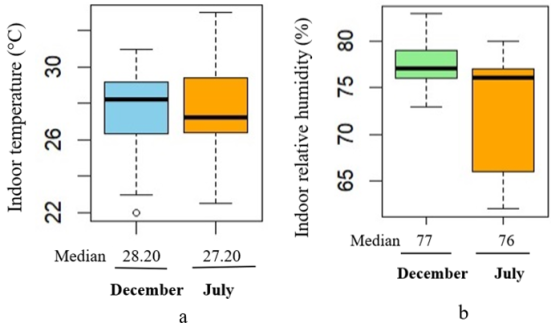
Figure 1. Temperature (a) and indoor relative humidity (b) values measured in the houses. Comparisons bet ween median values were performed using the Wilcoxon signed-rank test, p <0.00001.
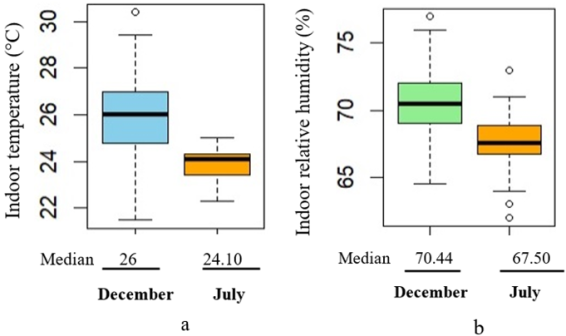
Figure 2. Temperature (a) and indoor relative humidity (b) values measured in the offices.
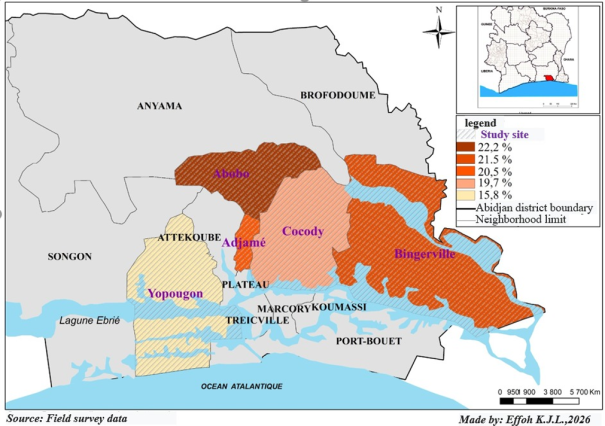
Figure 3. Spatial distribution of prevalence rates in the Abidjan district.
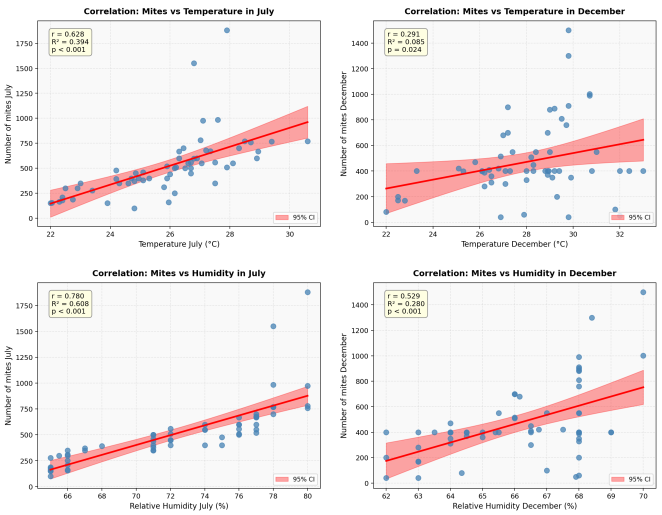
Figure 4. Correlation between physicochemical parameters and abundance of mites.

Information



 Share This Article
 Twitter
 Linked In
 Facebook

 Copy
 Download