
This study investigated the potential of utilizing Waste Plastic Bottles (WPB) as a sustainable modifier in asphalt pavement mixtures, systematically examining the characteristics of aggregates, the WPB-modified bitumen binder, and the resulting asphaltic concrete mix. Detailed analysis of the aggregate gradation revealed the coarse fraction to be a well-graded gravel, characterized by a uniformity coefficient (Cu) of 2.47 and coefficient of curvature (Cc) of 1.14, indicative of optimal packing density for structural stability. These aggregates exhibited high durability, with an Aggregate Crushing Value (ACV) of 18.3% and Aggregate Impact Value (AIV) of 16.9%, ensuring resistance to abrasion and impact under traffic loads. In contrast, the fine aggregate was poorly graded (Cc = 0.45), highlighting the need for binder modification to enhance overall mix cohesion. Modification of pure bitumen (initial penetration 69 mm) with WPB progressively induced desirable hardening effects and superior high-temperature performance. Penetration values decreased markedly from 69 mm to 33 mm at 25% WPB incorporation, while the softening point rose substantially from 52°C to 81°C, demonstrating enhanced rutting resistance and thermal stability critical for tropical climates like Nigeria's Lagos region. Additional rheological improvements included increased viscosity (up to 2984 p.a.s), flash point (289°C), and specific gravity (1.13), with minimal ductility loss, collectively affirming WPB's role in creating a more resilient binder. Marshall performance testing on the WPB-modified asphaltic concrete further validated these enhancements. The mixture achieved maximum Marshall Stability of 19.74 kN and peak Marshall Quotient of 4.32 kN/mm at 15% WPB content— a 78% stability increase and 34% quotient gain over the control mix (11.05 kN and 3.22 kN/mm). Flow values remained controlled (3.43–4.57 mm), balancing stiffness with workability. These outcomes, aligned with prior pelletized WPB concrete data showing optimal 10–15% thresholds, confirm WPB's efficacy in boosting stiffness, load-bearing capacity, and deformation resistance. Overall, WPB modification yields a mechanically superior, eco-friendly alternative to conventional asphalt, promoting waste valorization while meeting geotechnical standards for durable pavements in sustainable infrastructure projects.
| Published in | American Journal of Civil Engineering (Volume 14, Issue 1) |
| DOI | 10.11648/j.ajce.20261401.12 |
| Page(s) | 11-19 |
| Creative Commons |
This is an Open Access article, distributed under the terms of the Creative Commons Attribution 4.0 International License (http://creativecommons.org/licenses/by/4.0/), which permits unrestricted use, distribution and reproduction in any medium or format, provided the original work is properly cited. |
| Copyright |
Copyright © The Author(s), 2026. Published by Science Publishing Group |
Waste Plastic Bottle, Bitumen, Asphalt, Pavement, Aggregate
Physical Properties | Coarse Aggregates | Fine Aggregates |
|---|---|---|
D10 | 4.77 | 0.063 |
D30 | 8.0 | 0.11 |
D60 | 11.8 | 0.42 |
Coefficient of Uniformity, Cu | 2.47 | 6.67 |
Coefficient of Curvature, Cc | 1.14 | 0.45 |
Aggregate Crushing Value (ACV) | 18.3 | - |
Aggregate Impact Value (AIV) | 16.9 | - |
Flakiness Index | 23.3 | - |
Elongation Index | 24.1 | - |
Specific Gravity | 2.82 | 2.67 |
Water Absorption (%) | 0.1 | 0.45 |
Properties | % of Waste Plastic Bottles Incorporated | |||||
|---|---|---|---|---|---|---|
0% | 5% | 10% | 15% | 20% | 25% | |
Penetration (dmm) 25℃ | 69 | 67 | 61 | 49 | 37 | 33 |
Softening Point (℃) | 52 | 58 | 63 | 72 | 75 | 81 |
Ductility (cm) | 116 | 117 | 119 | 109 | 105 | 99 |
Viscosity (p.a.s) | 2700 | 2800 | 2910 | 2970 | 2977 | 2984 |
Flash Point (℃) | 255 | 262 | 274 | 281 | 284 | 289 |
Fire Point (℃) | 310 | 322 | 339 | 347 | 352 | 360 |
Loss of Heat (℃) | 0.15 | 0.18 | 0.23 | 0.25 | 0.24 | 0.23 |
Specific Gravity | 0.99 | 1.01 | 1.04 | 1.08 | 1.11 | 1.13 |
Properties | % of Waste Plastic Bottles Incorporated | |||||
|---|---|---|---|---|---|---|
0% | 5% | 10% | 15% | 20% | 25% | |
Marshall Stability (kN) | 11.05 | 13.16 | 17.39 | 19.74 | 17.45 | 16.25 |
Flow (mm) | 3.43 | 3.71 | 4.12 | 4.57 | 4.18 | 4.05 |
Marshall Quotient (kN/mm) | 3.22 | 3.55 | 4.22 | 4.32 | 4.17 | 4.01 |
WPB | Waste Plastic Bottle |
Cu | Coefficient of Uniformity |
Cc | Coefficient of Curvature |
PET | Polyethylene Terephthalate |
LDPE | Low Density Polyethylene |
D10 | Effective Diameter at 10% Finer |
D30 | Effective Diameter at 30% Finer |
D60 | Effective Diameter at 60% Finer |
USCS | Unified Soil Classification System |
GW | Well Graded Gravel |
SP | Poorly Graded Sand |
SW/SM | Gap Graded Sand |
| [1] | Dennison, M. S. Paramasivam, S. K. Wanazusi, T., Sundarrajan, K. J., Erheyovwe, B. P., and Marshal Williams, A. M. (2025). Addressing Plastic Waste Challenges in Africa: The Potential of Pyrolysis for Waste-to-Energy Conversion. Clean Technologies, 7(1), 20. |
| [2] | Macheca, A. D., Mutuma, B., Adalima, J. L., Midheme, E., Lúcas, L. H., Ochanda, V. K., and Mhlanga, S. D. (2024). Perspectives on plastic waste management: challenges and possible solutions to ensure its sustainable use. Recycling, 9(5), 77. |
| [3] | Yakubu, S., Miao, B., Hou, M., and Zhao, Y. (2024). A review of the ecotoxicological status of microplastic pollution in African freshwater systems. Science of The Total Environment, 174092. |
| [4] | Akinyemi, M. A. (2024). Analysis of Ecological Footprint for Sustainable Development in Some Selected Areas in Ibadan North, Oyo State, Nigeria (Master's thesis, Kwara State University (Nigeria). |
| [5] | Ibiyeye, A. A. (2021). An assessment of the legal framework and regulatory policies on plastic waste management in Nigeria (Doctoral dissertation, Doctoral dissertation, Faculty of Law, University of Ilorin, Ilorin). |
| [6] | Donuma, K. U., Ma, L., Bu, C., George, L. Y., Gashau, M., and Suleiman, A. O. (2024). Environmental and human health risks of indiscriminate disposal of plastic waste and sachet water bags in Maiduguri, Borno State Nigeria. Waste Management Bulletin, 2(2), 130-139. |
| [7] | Kibria, M. G., Masuk, N. I., Safayet, R., Nguyen, H. Q., and Mourshed, M. (2023). Plastic waste: challenges and opportunities to mitigate pollution and effective management. International Journal of Environmental Research, 17(1), 20. |
| [8] | Mihai, F. C., Gündoğdu, S., Markley, L. A., Olivelli, A., Khan, F. R., Gwinnett, C. and Molinos-Senante, M. (2021). Plastic pollution, waste management issues, and circular economy opportunities in rural communities. Sustainability, 14(1), 20. |
| [9] | Chikodzi, D., Dube, K., and Ngcobo, N. (2021). Rethinking harbours, beaches and urban estuaries waste management under climate-induced floods in South Africa. The increasing risk of floods and tornadoes in Southern Africa, 127-140. |
| [10] | MacAfee, E. A., and Löhr, A. J. (2024). Multi‐scalar interactions between mismanaged plastic waste and urban flooding in an era of climate change and rapid urbanization. Wiley Interdisciplinary Reviews: Water, 11(2), e1708. |
| [11] | Nweke, N. D., Agbasi, J. C., Ayejoto, D. A., Onuba, L. N., and Egbueri, J. C. (2024). Sources and Environmental Distribution of Microplastics in Nigeria. In Microplastics in African and Asian Environments: The Influencers, Challenges, and Solutions (pp. 107-130). Cham: Springer Nature Switzerland. |
| [12] | Akindele, E. O., and Alimba, C. G. (2021). Plastic pollution threat in Africa: Current status and implications for aquatic ecosystem health. Environmental Science and Pollution Research, 28, 7636-7651. |
| [13] | Al Mamun, A., Prasetya, T. A. E., Dewi, I. R., and Ahmad, M. (2023). Microplastics in human food chains: Food becoming a threat to health safety. Science of the Total Environment, 858, 159834. |
| [14] | Mazhandu, Z. S., Muzenda, E., Mamvura, T. A., Belaid, M., and Nhubu, T. (2020). Integrated and consolidated review of plastic waste management and bio-based biodegradable plastics: Challenges and opportunities. Sustainability, 12(20), 8360. |
| [15] | Onifade, V. A., Yoade, A. O., Olatunji, S. A., and Husseni, M. A. (2023). Effects of flooding on urban lives and properties in Lagos, Nigeria. International Journal of Infrastructure Research and Management Vol. 11 (2), December 2023, 11(2), 46-62. |
| [16] | Graham, R. E. (2024). Plastic policy hypocrisies: evaluating the efficacy of bans and alternatives in the Eastern Caribbean. Frontiers in Sustainability, 5, 1439958. |
| [17] | Osbert, A., Rwahwire, S., and Tusiimire, Y. (2022). Re-Engineering Plastic Waste for the Modification of Bitumen Blends. Advances in Science and Technology, 116, 15-19. |
| [18] | Choudhary, T., and Yadav, M. K. (2022, April). Utilization of Reclaimed Asphalt Pavement (RAP) and Use of Plastic Waste in Road Construction: Literature Review. In International Conference on Emerging Global Trends in Engineering and Technology (pp. 127-134). Singapore: Springer Nature Singapore. |
| [19] | Omoregbe, O., and Hart, A. (2022). Global Trends in Heavy Oil and Bitumen Recovery and In-Situ Upgrading: A Bibliometric Analysis During 1900–2020 and Future Outlook. Journal of Energy Resources Technology, 144(12), 123007. |
| [20] | Tini, N. H., Shah, M. Z., and Sultan, Z. (2018). Impact of road transportation network on socio-economic well-being: an overview of global perspective. International Journal of Scientific Research in Science Engineering and Technology, 4(9), 282-296. |
| [21] | Pichardo-Muñiz, A. (2011). The role of diseconomies of transportation and public safety problems in the measurement of urban quality of life. Applied Research in Quality of Life, 6, 363-386. |
| [22] | Caixeta-Filho, J. V., and Péra, T. G. (2018). Post-harvest losses during the transportation of grains from farms to aggregation points. International Journal of Logistics Economics and Globalisation, 7(3), 209-247. |
| [23] | Kaiser, N., and Barstow, C. K. (2022). Rural transportation infrastructure in low-and middle-income countries: a review of impacts, implications, and interventions. Sustainability, 14(4), 2149. |
| [24] | Ashish, P. K., Sreeram, A., Xu, X., Chandrasekar, P., Jagadeesh, A., Adwani, D., and Padhan, R. K. (2023). Closing the Loop: Harnessing waste plastics for sustainable asphalt mixtures–A comprehensive review. Construction and Building Materials, 400, 132858. |
| [25] | Satti, S. M., Hashmi, M., Subhan, M., Shereen, M. A., Fayad, A., Abbasi, A., Shah, A. A. and Ali, H. M. (2024). Bio-upcycling of plastic waste: a sustainable innovative approach for circular economy. Water, Air, and Soil Pollution, 235(6), p. 382. |
| [26] | Enfrin, M., and Giustozzi, F. (2022). Recent advances in the construction of sustainable asphalt roads with recycled plastic. Polymer International, 71(12), 1376-1383. |
| [27] | Ullah, S., Qabur, A., Ullah, A., Aati, K., and Abdelgiom, M. A. (2024). Enhancing High-Temperature Performance of Flexible Pavement with Plastic-Modified Asphalt. Polymers, 16(17), 2399. |
| [28] | Kumar, R., Verma, A., Shome, A., Sinha, R., Sinha, S., Jha, P. K., Kumar, R., Kumar, P., Shubham, Das, S. and Sharma, P. (2021). Impacts of plastic pollution on ecosystem services, sustainable development goals, and need to focus on circular economy and policy interventions. Sustainability, 13(17), p. 9963. |
| [29] | Evusiorho, I., Izelu, C., Anaidhuno, P. U., and Mgbemena, C. O. (2024). Development of Innovative Waste Plastic-Sand Mixer for Sustainable Paver Blocks Production. International Journal Of Industrial And Production Engineering, 2(4), 1-15. |
| [30] | Ogunmakinde, O. E., Egbelakin, T., and Sher, W. (2022). Contributions of the circular economy to the UN sustainable development goals through sustainable construction. Resources, Conservation and Recycling, 178, 106023. |
| [31] | IS 73 (2013). Bureau of Indian standard specification for paving bitumen |
| [32] | AASHTO M20 (2004). American Association of State Highway and Transportation Officials Standard specification for penetration-graded asphalt cement (AASHTO M 20). |
| [33] | ASTM C 330 (2018). Standard specification for aggregates for Structural Concrete. Annual book of ASTM standards. |
| [34] | BS 812–103 (1985). Testing aggregates—methods for determination of particle size distribution—sieve tests. London: British Standards Institution. |
| [35] | BS 812–112 (1990). Testing aggregates—methods for determination of aggregate impact value (ACV). London: British Standards Institution. |
| [36] | BS 812–105 (1989). Testing aggregates—methods for determination of particle shape - Flakiness Index and Elongation Index. London: British Standards Institution. |
| [37] | BS 1377–2. Method of test for soils for civil engineering purposes—specific gravity. British Standard Institution; 1990. |
| [38] | BS 812–110 (1990). Testing aggregates—part 110: methods for determination of aggregate crushing value (ACV). London: British Standards Institution. |
| [39] | ASTM D5–06 (2006). Standard test method for penetration of Bituminous Materials. Conshohocken: ASTM International West Conshohocken. |
| [40] | ASTM D36–06 (2002). Standard test method for softening point of Bitumen (Ring and Ball Apparatus). West Conshohocken, PA, USA: ASTM International. |
| [41] | ASTM D445–06 (2006). Standard test method for kinematic viscosity of transparent and opaque liquids (and Calculation of Dynamic Viscosity). West Conshohocken: ASTM International. |
| [42] | ASTM D92–02 (2002). Standard Test Method for Flash and Fire Points by Cleveland Open Cup. West Conshohocken, PA, USA: ASTM International; 2002. |
| [43] | BIS 1212 (1986). Methods for testing tar and bituminous materials: determination of loss on heating. New Delhi: Bureau of Indian Standards. |
| [44] | ASTM D6927 (2022). Standard test method for Marshall stability and flow of asphalt mixtures. West Conshohocken, PA, USA: ASTM International. |
APA Style
Olatunji, O. O., Oyelola, B. W., Oyebisi, O. W., Ayantola, A. K. (2026). Optimization of Asphalt Concrete Performance Using Waste Plastic Bottles (WPB) as a Sustainable Bitumen Modifier: A Comprehensive Rheological and Mechanical Assessment. American Journal of Civil Engineering, 14(1), 11-19. https://doi.org/10.11648/j.ajce.20261401.12
ACS Style
Olatunji, O. O.; Oyelola, B. W.; Oyebisi, O. W.; Ayantola, A. K. Optimization of Asphalt Concrete Performance Using Waste Plastic Bottles (WPB) as a Sustainable Bitumen Modifier: A Comprehensive Rheological and Mechanical Assessment. Am. J. Civ. Eng. 2026, 14(1), 11-19. doi: 10.11648/j.ajce.20261401.12
AMA Style
Olatunji OO, Oyelola BW, Oyebisi OW, Ayantola AK. Optimization of Asphalt Concrete Performance Using Waste Plastic Bottles (WPB) as a Sustainable Bitumen Modifier: A Comprehensive Rheological and Mechanical Assessment. Am J Civ Eng. 2026;14(1):11-19. doi: 10.11648/j.ajce.20261401.12
@article{10.11648/j.ajce.20261401.12,
  author = {Otunola Oluwaseun Olatunji and Balogun Waheed Oyelola and Oyeniyan Wasiu Oyebisi and Ajala Kabir Ayantola},
  title = {Optimization of Asphalt Concrete Performance Using Waste Plastic Bottles (WPB) as a Sustainable Bitumen Modifier:
A Comprehensive Rheological and Mechanical Assessment},
  journal = {American Journal of Civil Engineering},
  volume = {14},
  number = {1},
  pages = {11-19},
  doi = {10.11648/j.ajce.20261401.12},
  url = {https://doi.org/10.11648/j.ajce.20261401.12},
  eprint = {https://article.sciencepublishinggroup.com/pdf/10.11648.j.ajce.20261401.12},
  abstract = {This study investigated the potential of utilizing Waste Plastic Bottles (WPB) as a sustainable modifier in asphalt pavement mixtures, systematically examining the characteristics of aggregates, the WPB-modified bitumen binder, and the resulting asphaltic concrete mix. Detailed analysis of the aggregate gradation revealed the coarse fraction to be a well-graded gravel, characterized by a uniformity coefficient (Cu) of 2.47 and coefficient of curvature (Cc) of 1.14, indicative of optimal packing density for structural stability. These aggregates exhibited high durability, with an Aggregate Crushing Value (ACV) of 18.3% and Aggregate Impact Value (AIV) of 16.9%, ensuring resistance to abrasion and impact under traffic loads. In contrast, the fine aggregate was poorly graded (Cc = 0.45), highlighting the need for binder modification to enhance overall mix cohesion. Modification of pure bitumen (initial penetration 69 mm) with WPB progressively induced desirable hardening effects and superior high-temperature performance. Penetration values decreased markedly from 69 mm to 33 mm at 25% WPB incorporation, while the softening point rose substantially from 52°C to 81°C, demonstrating enhanced rutting resistance and thermal stability critical for tropical climates like Nigeria's Lagos region. Additional rheological improvements included increased viscosity (up to 2984 p.a.s), flash point (289°C), and specific gravity (1.13), with minimal ductility loss, collectively affirming WPB's role in creating a more resilient binder. Marshall performance testing on the WPB-modified asphaltic concrete further validated these enhancements. The mixture achieved maximum Marshall Stability of 19.74 kN and peak Marshall Quotient of 4.32 kN/mm at 15% WPB content— a 78% stability increase and 34% quotient gain over the control mix (11.05 kN and 3.22 kN/mm). Flow values remained controlled (3.43–4.57 mm), balancing stiffness with workability. These outcomes, aligned with prior pelletized WPB concrete data showing optimal 10–15% thresholds, confirm WPB's efficacy in boosting stiffness, load-bearing capacity, and deformation resistance. Overall, WPB modification yields a mechanically superior, eco-friendly alternative to conventional asphalt, promoting waste valorization while meeting geotechnical standards for durable pavements in sustainable infrastructure projects.},
 year = {2026}
}
TY  - JOUR
T1  - Optimization of Asphalt Concrete Performance Using Waste Plastic Bottles (WPB) as a Sustainable Bitumen Modifier:
A Comprehensive Rheological and Mechanical Assessment
AU  - Otunola Oluwaseun Olatunji
AU  - Balogun Waheed Oyelola
AU  - Oyeniyan Wasiu Oyebisi
AU  - Ajala Kabir Ayantola
Y1  - 2026/01/30
PY  - 2026
N1  - https://doi.org/10.11648/j.ajce.20261401.12
DO  - 10.11648/j.ajce.20261401.12
T2  - American Journal of Civil Engineering
JF  - American Journal of Civil Engineering
JO  - American Journal of Civil Engineering
SP  - 11
EP  - 19
PB  - Science Publishing Group
SN  - 2330-8737
UR  - https://doi.org/10.11648/j.ajce.20261401.12
AB  - This study investigated the potential of utilizing Waste Plastic Bottles (WPB) as a sustainable modifier in asphalt pavement mixtures, systematically examining the characteristics of aggregates, the WPB-modified bitumen binder, and the resulting asphaltic concrete mix. Detailed analysis of the aggregate gradation revealed the coarse fraction to be a well-graded gravel, characterized by a uniformity coefficient (Cu) of 2.47 and coefficient of curvature (Cc) of 1.14, indicative of optimal packing density for structural stability. These aggregates exhibited high durability, with an Aggregate Crushing Value (ACV) of 18.3% and Aggregate Impact Value (AIV) of 16.9%, ensuring resistance to abrasion and impact under traffic loads. In contrast, the fine aggregate was poorly graded (Cc = 0.45), highlighting the need for binder modification to enhance overall mix cohesion. Modification of pure bitumen (initial penetration 69 mm) with WPB progressively induced desirable hardening effects and superior high-temperature performance. Penetration values decreased markedly from 69 mm to 33 mm at 25% WPB incorporation, while the softening point rose substantially from 52°C to 81°C, demonstrating enhanced rutting resistance and thermal stability critical for tropical climates like Nigeria's Lagos region. Additional rheological improvements included increased viscosity (up to 2984 p.a.s), flash point (289°C), and specific gravity (1.13), with minimal ductility loss, collectively affirming WPB's role in creating a more resilient binder. Marshall performance testing on the WPB-modified asphaltic concrete further validated these enhancements. The mixture achieved maximum Marshall Stability of 19.74 kN and peak Marshall Quotient of 4.32 kN/mm at 15% WPB content— a 78% stability increase and 34% quotient gain over the control mix (11.05 kN and 3.22 kN/mm). Flow values remained controlled (3.43–4.57 mm), balancing stiffness with workability. These outcomes, aligned with prior pelletized WPB concrete data showing optimal 10–15% thresholds, confirm WPB's efficacy in boosting stiffness, load-bearing capacity, and deformation resistance. Overall, WPB modification yields a mechanically superior, eco-friendly alternative to conventional asphalt, promoting waste valorization while meeting geotechnical standards for durable pavements in sustainable infrastructure projects.
VL  - 14
IS  - 1
ER  -
Department of Civil Engineering, Federal Polytechnic, Offa, Nigeria
Department of Civil Engineering, Federal Polytechnic, Offa, Nigeria
Department of Civil Engineering, Federal Polytechnic, Offa, Nigeria
Department of Civil Engineering, Federal Polytechnic, Offa, Nigeria
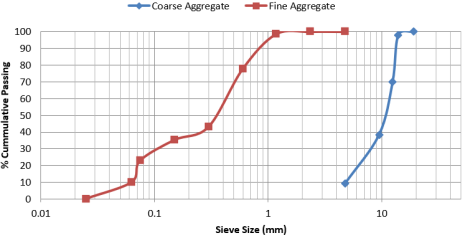
Figure 1. Particle size distribution of aggregate used.
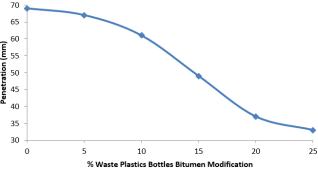
Figure 2. Effect of WPB on Penetration of Modified Bitumen.
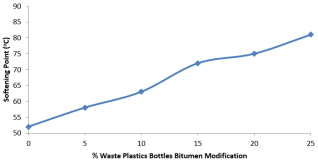
Figure 3. Effect of WPB on Softening Point of Modified Bitumen.
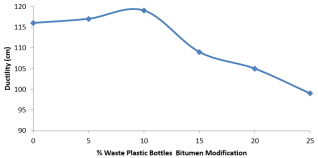
Figure 4. Effect of WPB on Ductility of Modified Bitumen.
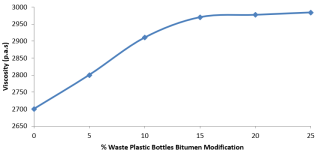
Figure 5. Effect of WPB on Viscosity of Modified Bitumen.
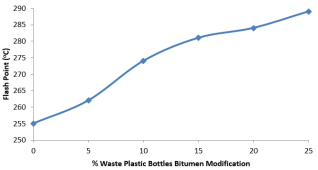
Figure 6. Effect of WPB on Flash Point of Modified Bitumen.
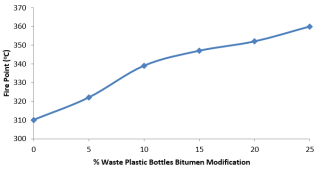
Figure 7. Effect of WPB on Fire Point of Modified Bitumen.
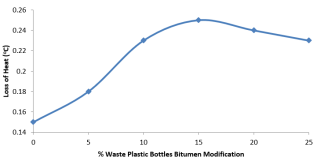
Figure 8. Effect of Loss of Heat on Ductility of Modified Bitumen.
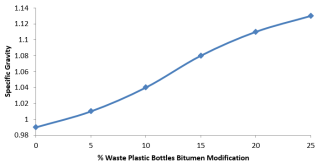
Figure 9. Effect of WPB on Specific Gravity of Modified Bitumen.
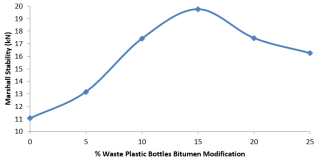
Figure 10. Marshall Stability of WPB Asphaltic Concrete.
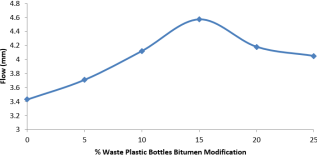
Figure 11. Flow Stability of WPB Asphaltic Concrete.
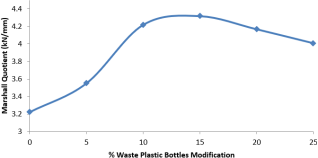
Figure 12. Marshall Quotient of WPB Asphaltic Concrete.

Information



 Share This Article
 Twitter
 Linked In
 Facebook
 Copy
Copy Download