1. Introduction
With an ever-increasing demand for power, next generation photovoltaics (PVs) have taken a central role in transitioning towards a sustainable energy solution. Traditional silicon-based solar cells, while dominant, are approaching their theoretical efficiency limit and face challenges related to resource intensity and production costs
| [1] | Di Sabatino, Marisa, Rania Hendawi, and Alfredo Sanchez Garcia. 2024. “Silicon Solar Cells: Trends, Manufacturing Challenges, and Ai Perspectives.” MDPI. Multidisciplinary Digital Publishing Institute. February 7.
https://doi.org/10.3390/cryst14020167 |
[1]
. Alternative materials and device architectures have been a subject of intensive research to overcome these limitations and enhance power conversion efficiency (PCE), economic viability, and environmental sustainability.
Cadmium telluride (CdTe) and Perovskites have emerged as strong contenders to traditional silicon based solar cells. CdTe has established itself as a leading thin-film technology due to its lower cost of electricity and superior environmental profile compared to silicon-based solar cells. However, limitations in open circuit voltage, harmful effects of cadmium mining, and diversification into niche applications persist
| [2] | Scarpulla, M. A., B. McCandless, A. B. Phillips, Y. Yan, M. J. Heben, C. Wolden, G. Xiong, W. K. Metzger, D. Mao, D. Krasikov, I. Sankin, S. Grover, A. Munshi, W. Sampath, J. R. Sites, A. Bothwell, D. Albin, M. O. Reese, A. Romeo, and M. Nardone. 2023. “CdTe-Based Thin Film Photovoltaics: Recent Advances, Current Challenges and Future Prospects.” Solar Energy Materials and Solar Cells 255: 112289.
https://doi.org/10.1016/j.solmat.2023.112289 |
[2]
. Perovskite solar cells have achieved major efficiency gains in laboratory settings, exceeding 26.7% through advancements in material composition and thin-film fabrication
| [3] | Rani, M., M. M. Khan, A. Numan, M. Khalid, S. M. Abbas, M. Iqbal, and M. A. Mansoor. 2024. “Breaking Barriers: Addressing Challenges in Perovskite Solar Cell Development.” Journal of Alloys and Compounds 1010: 177648.
https://doi.org/10.1016/j.jallcom.2024.177648 |
[3]
. However, scalability, stability and concerns regarding lead and iodine toxicity present significant hurdles to widespread adoption
| [3] | Rani, M., M. M. Khan, A. Numan, M. Khalid, S. M. Abbas, M. Iqbal, and M. A. Mansoor. 2024. “Breaking Barriers: Addressing Challenges in Perovskite Solar Cell Development.” Journal of Alloys and Compounds 1010: 177648.
https://doi.org/10.1016/j.jallcom.2024.177648 |
[3]
.
This study seeks to provide an assessment of these two promising PV materials, examining their technological, economic and environmental impacts by showcasing advancements in data science, particularly machine learning.
When assessing the viability of these PV technologies, PCE is one of the main metrics to assess performance in converting sunlight to electricity. The United States Department of Energy emphasizes that improving PCE is a key research goal to make PV technologies cost competitive with conventional energy sources
. Additionally, stability of the material is a critical metric referring to how stable the material is in producing constant power in diverse environments, such as temperature, humidity, etc. While achieving high efficiency in laboratory settings is significant, ensuring that this performance endures in diverse environmental conditions is essential for practical applications
| [5] | Kore, B. P., M. Jamshidi, and James Michael Gardner. 2024. “The Impact of Moisture on the Stability and Degradation of Perovskites in Solar Cells.” Materials Advances.
https://doi.org/10.1039/d3ma00828b |
[5]
. Degradability is the propensity of the absorber’s material to break down under constant irradiation of sunlight and is yet another important metric of consideration when assessing material performance. Understanding degradation mechanisms is vital for predicting a panel's long-term performance and managing end-of-life disposal
| [6] | Anusuya, K., K. Vijayakumar, and S. Manikandan. 2023. “From Efficiency to Eternity: A Holistic Review of Photovoltaic Panel Degradation and End-of-Life Management.” Solar Energy 265: 112135.
https://doi.org/10.1016/j.solener.2023.112135 |
[6]
. These three concepts serve as key factors in determining the overall viability of these two PV devices from a scientific and engineering point of view.
Economic viability is a crucial factor when analyzing a given PV technology. A key metric for assessing this viability is the price per watt (PPW), which is determined by dividing the total system cost-typically the solar module by its power output capacity. Measuring PPW allows for the comparison of one system to another regardless of size; it also simplifies what is being paid for in solar generation capacity and what the estimated solar payback period is
. Additionally, the levelized cost of energy (LCOE) serves as a vital metric for evaluating a technology’s feasibility from a production cost perspective. LCOE is a metric used to compare different electricity generation technologies by calculating the average cost per unit of electricity over the lifetime of a project
.
The third and final method examined in this investigation involves analysing the given PV technologies through a lens of ELSI (ethical, legal, and social implication).
. This framework helps assess a technology’s feasibility by considering critical factors, such as material sourcing during device fabrication- for instance whether a material originates from a conflict region- as well as health and environmental concerns such as potential toxicity. Evaluating these aspects is essential, as certain materials may pose inherent risks to both public health and the environment, particularly during use and disposal.
The research landscape on next-generation photovoltaic reveals several persisting gaps. Many studies address CdTe and perovskite solar cells independently but rarely compare within a consistent, multidimensional framework that includes both technical and socio-economic aspects. In addition, previous work often emphasizes laboratory efficiency rather than scalability, lifecycle costs or ethical sourcing. This study addresses the deficiencies by combining scientific, economic, and ELSI metrics to guide sustainable material selection for tandem PV applications.
The key contributions of this paper are summarized as follows:
1) Establishing a multi-criteria evaluation framework for CdTe and perovskite PV materials using crystalline silicon (c-Si) as a benchmark.
2) Quantitatively comparing device efficiency, stability, and degradability through normalized scoring methods.
3) Integrating economic and ELSI assessments to create a holistic approach for photovoltaic material selection.
4) Discussing the role of artificial intelligence (AI) and machine learning (ML) in accelerating PV material discovery and sustainable optimization.
While many studies explore CdTe and perovskite technologies individually, few provide a direct, comparative evaluation that includes both materials and situates them against (crystalline silicon) c-Si using a consistent, multi-dimensional framework. Moreover, existing literature often lacks integration of ethical, legal, and social implications (ELSI), and rarely provides quantifiable, normalized comparisons to guide material selection. To address these gaps, CdTe and perovskites will be analysed in this study through a set of scientific and engineering, economic viability and ELSI based metrics. An approach such as this is essential in making sure the Clean Energy sector develops in a responsible and sustainable way. Both CdTe and Perovskite will be compared against the current industry standard of c-Si, as well against each other.
2. Methodology
This investigation employs a structured, comparative framework to assess the viability of CdTe and perovskites materials in next-generation (PV) technologies, using c-Si as a baseline. The study incorporates a multi-dimensional evaluation across three primary categories, scientific and engineering, economic viability, and ethical, legal, and social implications. Scientific and engineering metrics focus on power conversion efficiency, stability, and material degradability. While some PV studies include grain size analysis as part of microstructural evaluation, this investigation did not perform or rely on grain size measurements. Such analysis was deemed beyond the scope of this work, which focuses on broader material-level performance metrics derived from literature. The economic metrics are focused on LCOE, which represents the average cost per kilowatt-hour of electricity generated over a system’s lifetime, considering capital, operational, maintenance, and fuel costs. PPW represents the upfront system cost divided by its rated power output, providing a normalized metric to compare technologies on a cost-per-capacity basis. These are widely used as indicators of cost competitiveness and return on investment. ELSI metrics focus on environmental footprint, human health risk (toxicity), and ethical considerations regarding material sourcing and supply chain transparency. The study relies exclusively on secondary data obtained from peer-reviewed literature and industry reports. To ensure consistency and comparability, a multi-criteria decision-making approach was adopted. A normalized scoring system was developed, in which each PV material was rated on a scale from 1 (least favorable) to 5 (most favorable) for each metric. The benchmark values for c-Si were set at the maximum score of 5 in all categories, reflecting its established role in the PV industry. Comparative analysis with respect to the benchmark. For quantitative metrics (e.g., PCE, LCOE, PPW), scores were assigned based on relative values compared to c-Si using the following formula:
Score = 5 × (Metric value of material / Metric value of c-Si)(1)
In cases where metrics were qualitative (e.g., toxicity concerns or stability under environmental stress), scoring was based on ordinal rankings derived from the strength of evidence in peer-reviewed studies. For instance, degradability was scored based on the reported lifespan and rate of performance loss under standard testing conditions. Quantitative results were rounded to the nearest hundredth and compiled to allow for direct side-by-side comparison. Qualitative results were rounded to the nearest whole number. This approach balances quantitative precision with interpretability and ensures that scores reflect meaningful differences between technologies, not marginal performance variations.
3. Results
3.1. Cadmium Telluride (CdTe)
3.1.1. Science and Engineering
The key to CdTe’s success lies in its superior absorption properties, allowing efficient energy conversion with a thin material layer. The current highest certified CdTe cell efficiency stands at 23.1% and was set using a .45cm
2 cell area, while the highest certified c-Si cell efficiency sat at 27.3% and was set on a 243cm
2 cell area
. Thin-film technology like that of CdTe offers an array of benefits, from low cost to high efficiency.
CdTe modules are currently lacking in two critical areas: bifaciality and tandem integration. While tandem cell architecture is quite common in the roadmaps for most PV manufacturers, CdTe bifaciality is beginning to emerge but at a significantly slower rate. Zinc or magnesium doping has been incorporated to form cadmium zinc telluride (CdZnTe) and cadmium magnesium telluride (CdMgTe) as a possible way to move the band gap into a viable regime for tandem incorporation. However, these materials introduce processing challenges that have prevented their use in high throughput manufacturing
. On the module front, a shift in doping of copper (Cu) to arsenic (As) has shown promising results for the module stability. The goal for this technology is to achieve a device PCE of over 25%. However, integrating these innovations into a scalable manufacturing process remains a challenge
| [2] | Scarpulla, M. A., B. McCandless, A. B. Phillips, Y. Yan, M. J. Heben, C. Wolden, G. Xiong, W. K. Metzger, D. Mao, D. Krasikov, I. Sankin, S. Grover, A. Munshi, W. Sampath, J. R. Sites, A. Bothwell, D. Albin, M. O. Reese, A. Romeo, and M. Nardone. 2023. “CdTe-Based Thin Film Photovoltaics: Recent Advances, Current Challenges and Future Prospects.” Solar Energy Materials and Solar Cells 255: 112289.
https://doi.org/10.1016/j.solmat.2023.112289 |
[2]
.
Silicon coated CdTe solar cells have resulted in a significant enhancement in their photovoltaic properties. A 40 nm coating improves electrical conductivity by 10x10
-3 S/cm, reduces the Hall coefficient to 4.4x10
-3 cm
2/C, and increases quantum efficiency to 89%. The carrier concentration doubles from 1x1019cm
-3 to 2x1019cm
-3. Additionally, CdTe’s high absorption coefficient and 1.45 eV band gap enable efficient solar spectrum utilization
| [11] | Venkatesh, R., P. K. Singh, M. N. Bashir, J. S. Lee, K. K. Yaswanth, M. Elahi, I. Hossain, S. A. Obaid, and S. A. Alharbi. 2024. “Performance Study of Cadmium Telluride Solar Cell Featured with Silicon Thin Film Made by Sol-Gel Route.” Silicon. https://doi.org/10.1007/s12633-024-03179-2 |
[11]
.
The supply of Te (tellurium) is of high concern, as it is a rare element found in Earth’s crust at only 1-5 parts per billion. It requires approximately 93 metric tons of Te to produce one gigawatt of CdTe PV modules
.
New innovations in building-integrated photovoltaics (BIPV) have started using ultra-thin semi-transparent CdTe solar cells, due to their low-temperature coefficient, excellent performance underwear conditions, short energy payback time, and stability in high-temperatures
| [13] | Tai, Y., X. Zhang, J. Li, Y. Zheng, G. Liu, J. Zhang, G. Zeng, K. Yakubov, and C. Alla. 2024. “Research on Ultra-Thin Cadmium Telluride Heterojunction Thin Film Solar Cells.” Renewable and Sustainable Energy Reviews 207: 114996.
https://doi.org/10.1016/j.rser.2024.114996 |
[13]
. As a result, companies like A-Grade Energy, CSG PV Technology, Hiitio, JSKYE, Just Solar, Lucintech, Polysolar, Solar Motion, Solar Scape, Tengying New Energy, and Shanxi Yangtailongyan Energy Technology have all taken an interest in this technology. BIPV’s technology combines photovoltaic power generation with buildings by integrating solar cells into building elements such as walls, roofs, and windows
| [13] | Tai, Y., X. Zhang, J. Li, Y. Zheng, G. Liu, J. Zhang, G. Zeng, K. Yakubov, and C. Alla. 2024. “Research on Ultra-Thin Cadmium Telluride Heterojunction Thin Film Solar Cells.” Renewable and Sustainable Energy Reviews 207: 114996.
https://doi.org/10.1016/j.rser.2024.114996 |
[13]
. This growing interest and adoption of ultra-thin, semi-transparent CdTe solar cells in BIPV applications will significantly enhance the usage and relevance of CdTe photovoltaics. CdTe technology is positioned to expand beyond traditional solar farms, driving wider implementation and reinforcing its role in the future of a sustainable living infrastructure.
3.1.2. Economic Viability
Economic viability is a key factor in CdTe’s widespread adoption, as it offers a competitively priced alternative to c-Si while maintaining impressive performance and scalability. CdTe PV devices are the second most common PV technology after c-Si, representing 21% of the U.S market and 4% of the global market in 2022
. In 2020, the National Renewable Energy Laboratory (NREL) estimated the minimum sustainable price (MSP) of CdTe solar modules at $0.28 per watt
| [15] | Smith, B., M. Woodhouse, K. Horowitz, T. Silverman, J. Zuboy, and R. Margolis. 2021. Photovoltaic (PV) Module Technologies: 2020 Benchmark Costs and Technology Evolution Framework Results. https://www.nrel.gov/docs/fy22osti/78173.pdf |
[15]
. To drive costs even lower, the U. S Department of Energy (DOE) launched the Cadmium Telluride Accelerator Consortium, aiming to reduce the price to below $0.20 per watt by 2025 and further to $0.15 per watt while boosting efficiencies above 26% by 2030
| [15] | Smith, B., M. Woodhouse, K. Horowitz, T. Silverman, J. Zuboy, and R. Margolis. 2021. Photovoltaic (PV) Module Technologies: 2020 Benchmark Costs and Technology Evolution Framework Results. https://www.nrel.gov/docs/fy22osti/78173.pdf |
[15]
.
CdTe solar modules remain economically viable in the U.S due to a strong domestic supply chain, competitive production costs, and supportive trade policies. The cost of materials, particularly TCO-coated glass, contributes to a significant portion of the total module cost. However, suppliers like Nippon Sheet Glass and Vitro architectural glass help stabilize pricing
.
The most recent LCOE for CdTe is yet to be disclosed. However, past research shows that the LCOE of CdTe is estimated to be approximately $0.03 to $0.06 per kWh
. More recent statements from First Solar suggest that the current LCOE is even lower, also stating that they were able to lower the price per watt to $0.46.
3.1.3. ELSI
The main reasons why CdTe is still limited in its production compared to c-Si are due to its shortcomings in the area of ELSI. Cd (cadmium) is a highly toxic heavy metal, usually found as a mineral combined with oxygen (cadmium oxide), chlorine (cadmium chloride), or sulfur (cadmium sulfide or cadmium sulfate). Most Cd used in the U.S is extracted during the production of other metals, like zinc, lead, and copper
. Companies like First Solar have claimed to take a very strict approach to responsible sourcing and supply chain due diligence to identify, prevent, mitigate and count for potential adverse human rights and environmental impacts. According to First Solar, the company screens all new suppliers, conducts annual risk assessments to identify potential high-risk suppliers, and all suppliers are required to comply with Responsible Business Alliance (RBA) code of conduct. First Solar also claims to audit new and high-risk suppliers on quality as well as environmental management, health and safety, labor, human rights, and ethics by leveraging the RBA code as a framework
. The second element in the CdTe material, Te (tellurium), is a byproduct of copper refining, with the primary country producing Te being China
. A major issue in China is the human rights abuse of the Uyghur community, where almost everything produced in Xiangying, China is produced by Uyghur slaves, including the refinement of Te
.
Misinformation about CdTe PV can hinder the adoption of this technology by influencing public opinion and legislative decisions. For instance, during discussions about a proposed solar farm in Patrick County, Virginia, concerns were raised about the presence of CdTe in the panels with residents stating they would gain nothing by using solar panels with toxic chemicals
. However, experts clarify that CdTe panels are designed so that the material is encapsulated between two layers of glass, preventing toxic substances from being exposed
. Through materials like CdTe, exists a paradox where the benefits of renewable energy solutions could be undermined by the harmful effects of their components, leading to skepticism among communities about how sustainable solar energy truly is.
The intricate nature of these technologies, often on a micro or even nanoscale, highlights the need for regulatory bodies to establish clear guidelines and protect intellectual property while ensuring fair market competition. Oftentimes companies are encouraged to take a more aggressive stance in enforcing their patents
.
Concerns about the end-of-life impact of CdTe solar cells often arise due to the presence of Cd. However, companies like First Solar address this issue with an industry-leading recycling program. They claim to achieve a 90% recovery rate of glass, metals, and semiconductor materials with their closed- loop process which ensures minimal waste and environmental impact, easing public concerns about sustainability
. However, if not disposed of properly, this process could lead to soil and water contamination, adversely affecting ecosystems and communities.
3.2. Perovskite
3.2.1. Science and Engineering
First discovered in 1839 by Gustav Rose, a naturally occurring mineral with the chemical formula CaTiO3 (calcium titanate) was named “Perovskite.” The term “Perovskite” now refers more broadly to a class of materials with the same crystal structure (ABX3), where “A” is an organic cation, “B” are metal cations, and “X” are halide anions. The use of Perovskite materials in solar cells started in 2009, when they were used as light absorbers in dye-sensitized solar cells.
Current single junction Perovskite PVs have reached peak efficiencies of up to 26.7%, with a theoretical efficiency of 33%. This progress is due to advancements in film formation techniques, evolution of material composition, interface passivation strategies and optimization of charge transport layers
| [23] | Blakesley, J. C., R. S. Bonilla, M. Freitag, A. M. Ganose, N. Gasparini, K. Pascal Kaienburg, G. Koutsourakis, J. D. Major, J. Nelson, N. K. Noel, B. Roose, J. S. Yun, S. Aliwell, P. P. Altermatt, T. Ameri, V. Andrei, A. Armin, D. Bagnis, J. Baker, and H. Beath. 2024. “Roadmap on Established and Emerging Photovoltaics for Sustainable Energy Conversion.” Journal of Physics Energy 6(4): 041501.
https://doi.org/10.1088/2515-7655/ad7404 |
[23]
. These improvements have enhanced the overall performance of Perovskite photovoltaics, making them one of the most promising emerging solar technologies.
However, even with these achievements, major challenges remain in scalability and stability. A core manufacturing challenge lies in understanding how the crystallization process of Perovskite materials influences nanoscale compositional uniformity and the formation of defects at grain boundaries and interfaces. Reducing defect density and effectively passivating structural defects is essential for improving the long-term stability of the material
| [23] | Blakesley, J. C., R. S. Bonilla, M. Freitag, A. M. Ganose, N. Gasparini, K. Pascal Kaienburg, G. Koutsourakis, J. D. Major, J. Nelson, N. K. Noel, B. Roose, J. S. Yun, S. Aliwell, P. P. Altermatt, T. Ameri, V. Andrei, A. Armin, D. Bagnis, J. Baker, and H. Beath. 2024. “Roadmap on Established and Emerging Photovoltaics for Sustainable Energy Conversion.” Journal of Physics Energy 6(4): 041501.
https://doi.org/10.1088/2515-7655/ad7404 |
[23]
. Transitioning to large-scale industrial production without significant performance losses is a critical hurdle. Stability concerns are another pressing issue, as long-term operation without PCE degradation is necessary for commercial viability. Increased efforts are being made to understand thin-film crystallization processes and defect formation, particularly at grain boundaries and material interfaces to develop methods for minimizing and neutralizing defects
| [23] | Blakesley, J. C., R. S. Bonilla, M. Freitag, A. M. Ganose, N. Gasparini, K. Pascal Kaienburg, G. Koutsourakis, J. D. Major, J. Nelson, N. K. Noel, B. Roose, J. S. Yun, S. Aliwell, P. P. Altermatt, T. Ameri, V. Andrei, A. Armin, D. Bagnis, J. Baker, and H. Beath. 2024. “Roadmap on Established and Emerging Photovoltaics for Sustainable Energy Conversion.” Journal of Physics Energy 6(4): 041501.
https://doi.org/10.1088/2515-7655/ad7404 |
[23]
.
Current focus in Perovskite research has also been drawn towards multi junction or tandem configurations. Advancements in c-Si bottom cells have resulted in 33.9% certified 2-junction tandem device PCE, with a theoretical value of 45% on such devices
| [23] | Blakesley, J. C., R. S. Bonilla, M. Freitag, A. M. Ganose, N. Gasparini, K. Pascal Kaienburg, G. Koutsourakis, J. D. Major, J. Nelson, N. K. Noel, B. Roose, J. S. Yun, S. Aliwell, P. P. Altermatt, T. Ameri, V. Andrei, A. Armin, D. Bagnis, J. Baker, and H. Beath. 2024. “Roadmap on Established and Emerging Photovoltaics for Sustainable Energy Conversion.” Journal of Physics Energy 6(4): 041501.
https://doi.org/10.1088/2515-7655/ad7404 |
[23]
. A recent 3-terminal (3T) tandem was reported to be less susceptible to spectral variations compared to a 2T tandem. The PCE was also reported to be 24.9% which could be increased to over 30% with moderately improved sub-cells
| [23] | Blakesley, J. C., R. S. Bonilla, M. Freitag, A. M. Ganose, N. Gasparini, K. Pascal Kaienburg, G. Koutsourakis, J. D. Major, J. Nelson, N. K. Noel, B. Roose, J. S. Yun, S. Aliwell, P. P. Altermatt, T. Ameri, V. Andrei, A. Armin, D. Bagnis, J. Baker, and H. Beath. 2024. “Roadmap on Established and Emerging Photovoltaics for Sustainable Energy Conversion.” Journal of Physics Energy 6(4): 041501.
https://doi.org/10.1088/2515-7655/ad7404 |
[23]
.
Recent advancements in compositional engineering have shown a significant potential to influence band structure of Perovskite materials. This tuning can be used to align the bandgap with the solar energy spectrum, offering not only better perforce metrics but also stability in PV applications
| [24] | Miah, Md. H., M. U. Khandaker, Md. B. Rahman, M. Nur-E-Alam, and M. A. Islam. 2024. “Band Gap Tuning of Perovskite Solar Cells for Enhancing the Efficiency and Stability: Issues and Prospects.” RSC Advances 14(23): 15876–15906.
https://doi.org/10.1039/d4ra01640h |
[24]
. Dimensional approaches are also being used to improve stability and performance of Perovskite solar cells, by reducing dimension and mixing dimensional strategies. While pressure-induced bandgap tailoring does modify the bandgap of Perovskite materials, issues arise connected with maintaining a constant pressure during device applications in obtaining optimal performance levels, raising concerns on the practicality and the long-term stability of devices that are entirely dependent on this method
| [24] | Miah, Md. H., M. U. Khandaker, Md. B. Rahman, M. Nur-E-Alam, and M. A. Islam. 2024. “Band Gap Tuning of Perovskite Solar Cells for Enhancing the Efficiency and Stability: Issues and Prospects.” RSC Advances 14(23): 15876–15906.
https://doi.org/10.1039/d4ra01640h |
[24]
.
Perovskite PV technology has made tremendous strides towards commercialization, driven largely by innovations in production techniques and advancements in efficiency and scalability. Companies like Oxford PV and Swift Solar have set up pilot production facilities to optimize manufacturing processes and scale up production. Additionally, other companies like Microquanta Semiconductors and Wuxi Utmost Light Technology are leading in producing certified high efficiency, large-area Perovskite modules. These modules range from a. 72 m
2 standard module with an efficiency of 18.2% to a .1935 m
2 minimodule with a 21.8% efficiency
| [25] | Luo, T., L. Liu, M. Du, K. Wang, and S. Liu. 2025. “Vacuum Preparation of Charge Transport Layers for Perovskite Solar Cells and Modules.” Journal of Materials Chemistry A 13(3): 1669–1710. https://doi.org/10.1039/d4ta06502f |
[25]
. Oxford PV and Tandem PV have been actively developing Perovskite-on-c-Si tandem solar devices, both reaching 30% PCE values
. Both companies are focused on accelerating commercialization of these high-efficiency low-cost solar cells. Companies like Cubic PV have been focusing on 4T Perovskite-on-c-Si tandem devices to increase efficiency rates even further and thereby decrease the LCOE. Swift Solar has additionally been pursuing ultra-light weight Perovskite-on-c-Si tandem devices in niche markets such as aerospace and mobile energy.
The current largest challenge toward commercialization remains Perovskites’ long-term stability capabilities alongside maximum efficiency in large-area modules. However, with the advancement in encapsulation techniques, significant progress has been made in improving stability
| [25] | Luo, T., L. Liu, M. Du, K. Wang, and S. Liu. 2025. “Vacuum Preparation of Charge Transport Layers for Perovskite Solar Cells and Modules.” Journal of Materials Chemistry A 13(3): 1669–1710. https://doi.org/10.1039/d4ta06502f |
[25]
.
Researchers at Linkoping have developed a breakthrough technology that uses water as a solvent to dismantle degraded high-quality Perovskites solar cells. This advancement allows the complete recycling of PV components, including glass encapsulation and the various electrodes, Perovskite layers and charge transport layers. While this method is still in development and not yet ready for large scale industrial processes, it demonstrates that it can play a key role in the Perovskites technology’s PV future
.
3.2.2. Economic Viability
Perovskite materials demonstrate significant promise; however, their success will depend on key factors such as material costs, scalability of production, long term stability, and integration into existing solar markets
| [28] | You, F., X. Tian, S. D. Stranks, J. Huang, Vasilis Fthenakis, and Y. Yang. 2024. “Perspectives for Sustainability Analysis of Scalable Perovskite Photovoltaics.” Energy & Environmental Science. https://doi.org/10.1039/d4ee03956d |
[28]
. Further development in a circular solar economy for Perovskite PVs through recycling and remanufacturing components could accelerate the market entry of Perovskite tandem cells
| [28] | You, F., X. Tian, S. D. Stranks, J. Huang, Vasilis Fthenakis, and Y. Yang. 2024. “Perspectives for Sustainability Analysis of Scalable Perovskite Photovoltaics.” Energy & Environmental Science. https://doi.org/10.1039/d4ee03956d |
[28]
.
Currently Perovskite solar cell markets are valued at approximately $923.3 million in the US and are projected to hit a market valuation of $8,944.3 million by 2033. Pacific Asia currently has the largest Perovskite solar cell market share of 56% and is projected to have the highest growth rate of 31.6% by 2033
.
The levelized cost of energy (LCOE) of Perovskite recently hit a low value of $0.045 and $0.061 per kWh in 2021
| [30] | Bastiani, M. D., V. Larini, R. Montecucco, and G. Grancini. 2023. “The Levelized Cost of Electricity from Perovskite Photovoltaics.” Energy & Environmental Science 16(2): 421–429. https://doi.org/10.1039/D2EE03136A |
[30]
. Perovskites also has a PPW of $0.428 to $0.306 per watt for 2T cells, and $0.423 to $0.302 for 4T cells
. These numbers indicate strong economic viability for the technology.
3.2.3. ELSI
The environmental impact of Perovskite on silicon modules ranges from 6% to 18% less than traditional silicon modules. These numbers were based on several categories including global warming potential, human and marine toxicity, water consumption, and metals usage
. However, leached lead concentration from Perovskite films exceeds the Federal Resource and Conservation Act (RCRA) limit of 5 mgL
-1, making them unfit to be sent directly to landfills
| [28] | You, F., X. Tian, S. D. Stranks, J. Huang, Vasilis Fthenakis, and Y. Yang. 2024. “Perspectives for Sustainability Analysis of Scalable Perovskite Photovoltaics.” Energy & Environmental Science. https://doi.org/10.1039/d4ee03956d |
[28]
. Current research in holistic recycling has reduced resource depletion by 96.6% and human toxicity (cancer effects) by 68.8% compared to landfill treatments
| [33] | Xiao, X., N. Xu, X. Tian, T. Zhang, B. Wang, X. Wang, Y. Xian, C. Lu, X. Ou, Y. Yan, L. Sun, F. You, and F. Gao. 2025. “Aqueous-Based Recycling of Perovskite Photovoltaics.” Nature. https://doi.org/10.1038/s41586-024-08408-7 |
[33]
. Further research successes in these technologies would decrease the need to purchase materials from foreign countries, while also decreasing the health and environmental risks associated with landfilling.
Large scale installation of lead-based Perovskite PVs are subject to lead leakage over a prolonged period, causing environmental damage. Local organisms can additionally be subjected to an increase in lead and that can be a method by which this toxic element enters the food cycle for humans. Development in chemical encapsulation will be key in preventing lead from leaking out after modules are damaged
| [34] | Yang, C., W. Hu, J. Liu, C. Han, Q. Gao, A. Mei, Y. Zhou, F. Guo, and H. Han. 2024. “Achievements, Challenges, and Future Prospects for Industrialization of Perovskite Solar Cells.” Light Science & Applications 13(1).
https://doi.org/10.1038/s41377-024-01461-x |
[34]
.
Perovskite PV technology currently relies on international supply chains, which are often vulnerable to disruptions. Localized production will mitigate risks associated with global supply chain vulnerabilities, and bolster community resilience ensuring a more reliable energy supply
.
4. Comparative Assessments of PV Technologies
4.1. Science and Engineering
c-Si remains the benchmark for photovoltaic performance due to its exceptional PCE and long-term stability. Current tandem configurations (with a top layer such as CdTe or Perovskite over a bottom c-Si layer) are demonstrating promising progress, with reported efficiencies already surpassing 28.1% and 23.2% in 4-terminal and 2-terminal designs respectively.
| [35] | Machín, A., and F. Márquez. 2024. “Advancements in Photovoltaic Cell Materials: Silicon, Organic, and Perovskite Solar Cells.” Materials 17(5): 1165.
https://doi.org/10.3390/ma17051165 |
[35]
.
Building on the findings from earlier sections, each technology, c-Si, Perovskite, and CdTe PV technologies were evaulted on three key metrics: efficiency, stability and degradability.
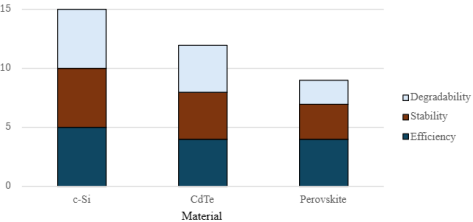
Figure 1 summarizes these results using qualitative scale (least ideal) to 5 most promising), with c-Si serving as the reference standard assigned a perfect 5 in all categories.
CdTe received scores of 4 for efficiency, stability, and degradability. While its 23.1% efficiency is strong, it remains slightly below c-Si 27.3%. CdTe’s robust stability, which are enhanced by encapsulation and doping strategies, positions it as durable thin-film material, though its slower progress in bifacial and tandem integration limits top-tier performance. Its low degradation rates and established recycling practices further justify the high degradability score, even as resource scarcity and toxicity concerns surrounding cadmium and tellurium prevent a perfect ranking.
Perovskite achieved a 4 for efficiency, 3 for stability, and 2 for degradability. Although its certified efficiencies of 26.7% nearly match c-Si, recurring issues with environmental and thermal degradation continue to challenge scalability and reliability. Degradability scored the lowest due to lead leaching risks and rapid breakdown in uncontrolled environments, despite promising early-stage recycling developments. Degradability remains the lowest-scoring metric, reflecting the ongoing risk or leakage and limited end of life handling options, despite encouraging advancements in recycling and encapsulation of research.
Table 1 represents the summarized science and engineering comparison, while
Figure 1 illustrates the corresponding performance metrics.
Figure 1. Efficiency, Stability, and Degradability Metrics.
Table 1. Science and Engineering.
Technology | PCE (%) | Stability/Degradation | Notable Findings |
c-Si | 27.3 | Very stable (>25 years) | Mature technology, high manufacturing consistency, and reliability. |
Cdte | 23.1 | Stable over 25 years | Strong absorption and durability limited tandem adoption. |
Perovskite | 26.7 | Unstable (<5 years) | Excellent lab efficiency suffers from humidity and heat degradation. |
These findings are visually reinforced in
Figure 1, which illustrates efficiency, stability, and degradability metrics side-by-side. Together, the data confirm that while perovskites excel in early efficiency gains, CdTe maintains stronger durability and reliability under long-term conditions.
Figure 1 shows that while perovskites rival c-Si in initial efficiency, CdTe’s long-term reliability provides a more consistent overall performance. The visualization reinforces that CdTe currently offers the best balance between efficiency and durability for next-generation PV integration. It's important to recognize that perovskite technology is still in its early stages of development. With continued research into material composition, encapsulation methods and interface engineering, perovskite solar cells could eventually surpass CdTe in both performance and durability. The rapid pace of innovation in this field suggests that its current limitations may not persist long-term.
4.2. Economic Viability
From an economic perspective, c-Si continues to dominate global markets due to its mature production base and cost stability. Its LCOE remains around $0.03 per kWh, and despite a modest 1% increase in PPW, it still maintains record lows at $0.10 per watt.
.
Applying Equation (
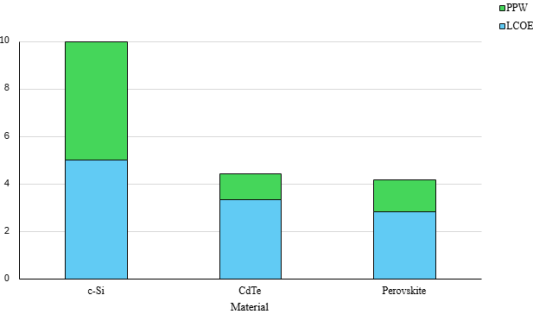
1), from Section 2, normalized scores for CdTe and perovskite were derived relative to c-Si. CdTe scored 3.33 for LCOE and 1.09 for PPW, indicating strong competitiveness and scalability with lightly higher production cost. Perovskite, by contrast, performed better in both categories, scoring 2.83 for LCOE and 1.36 for PPW. These results underscore perovskite’s cost-advantage potential largely due to low temperature processing and inexpensive precursors but also its dependance on stability improvements to fully realize those benefits.
Table 2 summarizes these economic results for all three photovoltaic technologies.
Figure 2. Economic Viability Weighted Metrics.
Table 2. Economic Viability.
Technology | LCOE ($/kWh) | PPW ($/W) | Market Status | Notable Findings |
c-Si | .03 | .10 | Global Leader | Mature technology, high manufacturing consistency, and reliability. |
Cdte | .03-.06 | .28-.46 | 21% U.S Market Share | Strong absorption and durability limited tandem adoption. |
Perovskite | .045-.061 | .30-.43 | Emerging | Excellent lab efficiency suffers from humidity and heat degradation. |
As shown in
Table 2, perovskite demonstrates the lowest overall costs, whereas CdTe benefits from greater market stability. These findings confirm that both emerging materials are economically viable alternatives to c-Si, but they occupy different positions on the cost-maturity spectrum. To illustrate these cost relationships,
Figure 2 compares the weighted LCOE and PPW metrics across the three PV types.
Figure 2 shows that perovskite offers the greatest near-term potential for cost reduction, while CdTe’s established infrastructure provides a more reliable pathway for large-scale deployment. Together, these results highlight that perovskite promises aggressive price competitiveness, whereas CdTe ensures dependable, scalable production in the current energy market. CdTe economic position is constrained by the rarity of tellurium, which increases material cost and limits scalability. As mining resources tighten, perovskite’s inexpensive raw material and simpler manufacturing process could provide a stronger long-term economic-advantage.
4.3. ELSI
In evaluating ethical, legal, and social implications, the three PV technologies were again compared using c-Si as a baseline. Overall, as shown in
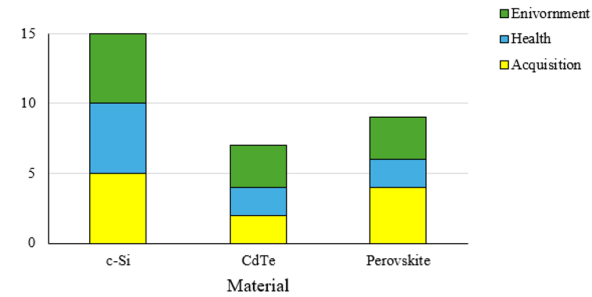
Figure 3, c-Si maintains the most favorable ELSI performance due to its non-toxic nature and well-established supply networks, while CdTe and perovskite represent more ethically complex yet increasingly manageable options.
CdTe scored 2 for acquisition, 2 for health, and 3 for environmental impact. Although CdTe modules benefit from robust recycling programs and encapsulation that limits toxic exposure. CdTes reliance on cadmium and tellurium introduces significant sourcing concerns, including geopolitical risks and ethical issues such as forced labor in tellurium supply chains. These issues justify its lower acquisition and health scores, despite its relatively strong environmental performance in use.
Perovskite received a 4 for acquisition, 2 for health, and 3 for environmental impact. Its broader material flexibility reduces dependence on rare or region-specific elements, supporting a higher acquisition score. However, the presence of lead in its structure results in similar health concerns to CdTe, and environmental impacts remain moderate due to potential leaching. Ongoing research into recycling and encapsulation methods could further improve its sustainability profile.
Table 3 provides a qualitative summary of the ELSI comparison across these three categories.
Figure 3. ELSI Comparison Weighted Metrics.
Table 3. ELSI.
Technology | Environmental Concern | Health/Toxicity | Sourcing/Ethical Issues | Key Observations |
c-Si | Moderate energy use in wafer production | Non-toxic | High electricity consumption in full processing cycle. | Established recycling reduces waste; energy-intensive production phase. |
Cdte | Low emissions are under use. Closed loop recycling. | Cadmium is toxic if released. Low in | Mining-related risks. Supplier auditing under RBA framework. | Encapsulation minimizes exposure. Reports 90% of material recovery. |
Perovskite | Lead leaching potential. | Lead Toxicity. | Limited recycling capacity. | Recycling reduces toxicity by 69%. |
As seen in
Table 3, c-Si maintains the highest overall ranking, benefiting from non-toxic materials and well-developed recycling programs. Perovskite performed similarly, due to its flexible composition but continued dependence on lead-based compounds.
Figure 3 illustrates these ELSI scores to highlight each technology’s ethical and environmental balance.
Figure 3 shows that while both CdTe and perovskite fall behind c-Si in health-related metrics, their performance is improving through enhanced recycling methods and supply-chain oversight. Continued research into non-toxic alternatives and transparent sourcing could narrow this gap and make both materials viable candidates for sustainable large-scale deployment. Safer encapsulation methods for perovskite could minimize lead leakage, while more robust circular recycling systems could reduce environmental impact making perovskite a far more viable option in the future.
6. Discussion
This study presents comparative analysis of CdTe and perovskite PV technologies against the established benchmark of crystalline silicon (c-Si). CdTe demonstrated superior scientific and engineering metrics overall, particularly in terms of stability and resistance to degradation. While both CdTe and perovskites are comparable to c-Si in terms of power conversion efficiency, CdTe ranked higher in material robustness. Perovskite materials, despite their rapid efficiency gains in laboratory settings, remained hampered by environmental degradation, with device failure often accelerated under heat and moisture exposure. These results align with existing literature, which emphasizes stability as a key bottleneck in perovskite commercialization.
In contrast to the engineering perspective, perovskite PVs outperformed CdTe in economic assessments. As illustrated in
Figure 2, perovskite devices achieved lower LCOE and PPW values, owing to their low-cost precursors and compatibility with scalable, low temperature manufacturing techniques. These advantages are largely theoretical until perovskites overcome current challenges in long term durability and operational lifespan.
ELSI consideration revealed a more complex risk landscape.
Figure 3 indicates that perovskites rank higher in acquisition concerns, while sharing similar results across environmental and health. Although cadmium toxicity remains a valid issue, particularly during mining and end of life disposal, CdTe benefits from established recycling protocols and safer encapsulation. Conversely, perovskites continue to raise red flags due to the presence of lead compounds and their potential for leaking into the environment during degradation. Moreover, the social regulatory challenges tied to large-scale adoption of perovskites remain unresolved particularly in regions with stricter material use regulations.
While CdTe currently demonstrates superior performance in several key metrics such as stability and manufacturability, perovskite materials present a uniquely promising avenue for next-generation photovoltaics. Despite some current limitations, the rapid progress in perovskite research and their high theoretical efficiency potential suggest that they may surpass existing technologies as development continues. Thus, increased research focus on perovskite is warranted to fully realize their long-term potential.
Additionally, practical applications of this research can be observed in real-world project such comprehensive design of a 100-kW solar power plant in Iran. This project highlights the integration of simulation optimization and bifacial panel design to maximize efficiency under local environmental conditions. Including such case studies strengthening the connection between theoretical analysis and practical implementation, demonstrating how CdTe or perovskite technologies could perform under diverse geographic and operational contexts.
| [38] | Parhamfar, M., & Zabihi, A. (2025). Comprehensive design of a 100-kilowatt solar power plant with bifacial technology in PVsyst for Arak, Iran. Solar Energy Advances, 5, 100092.
https://doi.org/10.1016/j.seja.2025.100092 |
[38]
.
Building on the current analysis, future research should apply predictive machine-learning algorithms to optimize compositional engineering and defect passivation in CdTe and perovskite layers. Additionally, integrating life-cycle assessment (LCA) with ethical sourcing frameworks could strengthen the sustainability and social accountability of next-generation PV technologies. Establishing standardized datasets would further enhance reproducibility and AI-driven discovery in this field.





 Share This Article
 Twitter
 Linked In
 Facebook
 Copy
Copy Download