1. Introduction
Urbanisation is changing the way food is produced, distributed and consumed. The United Nations estimates that cities currently accommodate about 45% of the world's population, with urban growth expected to continue through 2050
| [16] | United Nations, Department of Economic and Social Affairs, Population Division. (2025). World urbanization prospects 2025: Summary of results. United Nations. |
[16]
. The increasing concentration of people in cities has created growing demand for fresh and affordable food, while also placing pressure on land, water and other resources needed for food production. Urban agriculture has consequently become an important component of urban food systems, particularly in developing regions where it contributes to food availability, household income and access to fresh produce. Studies have shown that urban agriculture can improve food availability and dietary diversity and provide economic benefits to participating households, although its contribution varies with local conditions, production systems and access to resources
| [13] | Poulsen, M. N., McNab, P. R., Clayton, M. L., & Neff, R. A. (2015). A systematic review of urban agriculture and food security impacts in low-income countries. Food Policy, 55, 131–146. https://doi.org/10.1016/j.foodpol.2015.07.002 |
| [18] | Warren, E., Hawkesworth, S., & Knai, C. (2015). Investigating the association between urban agriculture and food security, dietary diversity, and nutritional status: A systematic literature review. Food Policy, 53, 54–66.
https://doi.org/10.1016/j.foodpol.2015.03.004 |
[13, 18]
.
Vegetable production constitutes an important part of urban agriculture because vegetables have relatively short production cycles, can be cultivated on small parcels of land and can be marketed close to areas of consumption. Urban vegetable farming therefore provides fresh food to urban populations while creating employment and income opportunities for producers and other actors within local food chains. In sub-Saharan Africa, horticultural production forms a major component of urban farming and contributes to food supply, employment, income generation and access to fresh foods
| [9] | Kiribou, R., Bedadi, B., Dimobe, K., Ndemere, J., Neya, T., Ouedraogo, V., & Dejene, S. W. (2024). Urban farming system and food security in sub-Saharan Africa: Analysis of the current status and challenges. Urban Agriculture & Regional Food Systems, 9(1), e70007. https://doi.org/10.1002/uar2.70007 |
[9]
. The broader literature also shows that urban agriculture provides benefits extending beyond food production, including livelihood support, health, green infrastructure, biodiversity and ecosystem services
| [14] | Pradhan, P., Callaghan, M., Hu, Y., Dahal, K., Hunecke, C., Reusswig, F., Lotze-Campen, H., & Kropp, J. P. (2023). A systematic review highlights that there are multiple benefits of urban agriculture besides food. Global Food Security, 38, 100700. https://doi.org/10.1016/j.gfs.2023.100700 |
[14]
. However, the sustainability of these benefits depends partly on the availability and quality of land and water resources and on how agricultural activities are integrated into the wider urban system
| [19] | Weidner, T., Yang, A., & Hamm, M. W. (2019). Consolidating the current knowledge on urban agriculture in productive urban food systems: Learnings, gaps and outlook. Journal of Cleaner Production, 209, 1637–1655.
https://doi.org/10.1016/j.jclepro.2018.11.004 |
[19]
.
The expansion of cities can also create difficulties for urban vegetable production. Agricultural land may be converted to residential, commercial and industrial uses, while farming is increasingly pushed towards urban fringes. A review of urban and peri-urban agriculture across 83 cities found that agricultural land conversion and peripheralisation were among the most frequently reported effects of urban growth, while changes in the availability of water, organic fertilisers and labour influenced the capacity of farmers to maintain or intensify production
| [7] | Güneralp, B., et al. (2022). As the city grows, what do farmers do? A systematic review of urban and peri-urban agriculture under rapid urban growth across the Global South. Landscape and Urban Planning. |
[7]
. Water is particularly important because vegetable cultivation requires a regular supply throughout the growing season. Where freshwater is scarce, expensive or inaccessible, farmers may rely on surface water, shallow groundwater, drainage channels, urban streams and wastewater for irrigation. Although wastewater can provide both water and nutrients, the practice may introduce environmental and food-safety concerns where the water is inadequately treated.
The quality of irrigation water is therefore an important consideration in urban vegetable production. Irrigation water can receive contaminants from domestic sewage, industrial activities, solid-waste disposal, agricultural inputs, stormwater and other urban activities. A systematic review of irrigation water in Ghana reported bacterial contamination, parasites, pesticides, potentially toxic elements and emerging contaminants in water used for vegetable production, with implications for crop quality and public health
| [20] | Yahans Amuah, E. E., Amanin-Ennin, P., & Antwi, K. (2022). Irrigation water quality in Ghana and associated implications on vegetables and public health: A systematic review. Journal of Hydrology, 604, 127211.
https://doi.org/10.1016/j.jhydrol.2021.127211 |
[20]
. Field evidence from the Vea Irrigation Dam in Ghana has similarly linked the physicochemical and microbiological quality of irrigation water with contamination of vegetables produced under market-gardening systems
| [6] | Douti, N. B., Yahans Amuah, E. E., Abanyie, S. K., & Amanin-Ennin, P. (2021). Irrigation water quality and its impact on the physicochemical and microbiological contamination of vegetables produced from market gardening: A case of the Vea Irrigation Dam, U. E. R., Ghana. Journal of Water and Health, 19(2), 203–215. https://doi.org/10.2166/wh.2021.274 |
[6]
. These findings demonstrate that irrigation water is not simply a source of moisture for crop production; its quality can influence the environmental and health conditions associated with urban vegetable farming.
The problem, however, is not limited to irrigation water. Urban soils may receive contaminants from atmospheric deposition, traffic emissions, industrial activities, waste disposal and other urban processes. Where vegetables are cultivated on contaminated land, contaminants already present in the soil may interact with irrigation-water inputs and agricultural practices. The resulting soil–water–plant relationship provides several possible pathways through which contaminants can accumulate in agricultural soils and subsequently become available for crop uptake. The extent of contaminant transfer depends on factors such as contaminant concentration, soil properties, irrigation frequency, pH, organic matter, crop species and management practices. Consequently, the environmental quality of urban vegetable production cannot be adequately understood by examining irrigation water or soil in isolation.
Potentially toxic elements have received considerable attention within this area of research. Studies of vegetables produced with wastewater irrigation have reported the occurrence of elements such as iron, zinc, copper, chromium, lead, nickel and cadmium, with the concentrations and associated risks varying among crops and production environments. In a global synthesis of wastewater-irrigated onion and tomato,
| [4] | Atamaleki, A., Yazdanbakhsh, A., Fakhri, Y., Mahdipour, F., Khodakarim, S., & Mousavi Khaneghah, A. (2019). The concentration of potentially toxic elements (PTEs) in the onion and tomato irrigated by wastewater: A systematic review, meta-analysis and health risk assessment. Food Research International, 125, 108518.
https://doi.org/10.1016/j.foodres.2019.108518 |
[4]
reported measurable concentrations of several potentially toxic elements and identified non-carcinogenic health risks for some consumer exposure scenarios. Such findings illustrate the importance of understanding the pathways connecting irrigation water, soil, vegetables and human exposure. Alongside chemical contaminants, microbiological hazards, pesticide residues and other emerging contaminants have also become important areas of investigation in urban and peri-urban vegetable production
| [20] | Yahans Amuah, E. E., Amanin-Ennin, P., & Antwi, K. (2022). Irrigation water quality in Ghana and associated implications on vegetables and public health: A systematic review. Journal of Hydrology, 604, 127211.
https://doi.org/10.1016/j.jhydrol.2021.127211 |
[20]
.
Food safety is consequently closely connected with the environmental quality of urban vegetable farming. Vegetables are often consumed fresh or after limited processing, creating opportunities for contaminants present on or within produce to reach consumers. Chemical contaminants such as potentially toxic elements and pesticide residues may enter the food chain through soil, irrigation water and production practices, while pathogenic microorganisms may be introduced through contaminated irrigation water, manure and other sources. The concern is particularly important in cities where farmers may operate under limited access to safe water, uncontaminated land and adequate environmental-management facilities. Urban agriculture should therefore not be considered only in terms of its contribution to food production; the quality of the resources used for cultivation is equally important to its long-term sustainability and contribution to healthy food systems.
Research on these issues has expanded across different regions and disciplines, but the literature remains widely distributed. Some studies have concentrated on the contribution of urban agriculture to food security and livelihoods
| [13] | Poulsen, M. N., McNab, P. R., Clayton, M. L., & Neff, R. A. (2015). A systematic review of urban agriculture and food security impacts in low-income countries. Food Policy, 55, 131–146. https://doi.org/10.1016/j.foodpol.2015.07.002 |
| [18] | Warren, E., Hawkesworth, S., & Knai, C. (2015). Investigating the association between urban agriculture and food security, dietary diversity, and nutritional status: A systematic literature review. Food Policy, 53, 54–66.
https://doi.org/10.1016/j.foodpol.2015.03.004 |
[13, 18]
, while others have examined urban growth and agricultural land dynamics
| [7] | Güneralp, B., et al. (2022). As the city grows, what do farmers do? A systematic review of urban and peri-urban agriculture under rapid urban growth across the Global South. Landscape and Urban Planning. |
[7]
, the wider functions of urban agriculture
| [14] | Pradhan, P., Callaghan, M., Hu, Y., Dahal, K., Hunecke, C., Reusswig, F., Lotze-Campen, H., & Kropp, J. P. (2023). A systematic review highlights that there are multiple benefits of urban agriculture besides food. Global Food Security, 38, 100700. https://doi.org/10.1016/j.gfs.2023.100700 |
[14]
, irrigation-water quality
| [20] | Yahans Amuah, E. E., Amanin-Ennin, P., & Antwi, K. (2022). Irrigation water quality in Ghana and associated implications on vegetables and public health: A systematic review. Journal of Hydrology, 604, 127211.
https://doi.org/10.1016/j.jhydrol.2021.127211 |
[20]
, or contaminant accumulation and health risks in vegetables
| [4] | Atamaleki, A., Yazdanbakhsh, A., Fakhri, Y., Mahdipour, F., Khodakarim, S., & Mousavi Khaneghah, A. (2019). The concentration of potentially toxic elements (PTEs) in the onion and tomato irrigated by wastewater: A systematic review, meta-analysis and health risk assessment. Food Research International, 125, 108518.
https://doi.org/10.1016/j.foodres.2019.108518 |
[4]
. These studies provide important evidence, but they address different components of a broader research field. As a result, it is difficult to determine how research on urban vegetable irrigation, soil and water quality has developed globally, which countries and institutions have contributed most strongly, which studies have shaped the field, how researchers collaborate, and how research themes have changed over time.
Bibliometric analysis offers an appropriate approach for examining the structure and development of such a dispersed research field. It can reveal publication growth, geographical patterns, leading authors and institutions, influential journals and publications, citation relationships, collaboration networks and changes in research themes. Bibliometric mapping also makes it possible to examine relationships among keywords and identify established as well as emerging areas of research
| [2] | Aria, M., & Cuccurullo, C. (2017). bibliometrix: An R-tool for comprehensive science mapping analysis. Journal of Informetrics, 11(4), 959–975. https://doi.org/10.1016/j.joi.2017.08.007 |
| [17] | van Eck, N. J., & Waltman, L. (2010). Software survey: VOSviewer, a computer program for bibliometric mapping. Scientometrics, 84(2), 523–538.
https://doi.org/10.1007/s11192-009-0146-3 |
[2, 17]
. This is particularly useful for urban vegetable irrigation research because the field cuts across environmental science, agriculture, public health, food safety, water resources and urban studies.
Despite the growing number of studies on urban agriculture, irrigation-water quality, soil contamination and food safety, a global assessment of how these research themes have developed and become connected is still limited. Existing reviews have examined particular dimensions of the subject, but they do not provide a comprehensive bibliometric picture of the research landscape linking urban vegetable irrigation with soil and water quality, contamination pathways, environmental risks and food safety. This study therefore examines the global research evolution and emerging frontiers in urban vegetable irrigation, soil and water quality. It focuses on publication trends, geographical and institutional contributions, influential authors and journals, citation patterns, collaboration networks, keyword relationships and thematic evolution, with particular attention to contamination pathways, environmental risks and food safety concerns. The findings provide a clearer picture of the development, structure and emerging directions of research in this field and help identify areas requiring greater research attention.
2. Materials and Methods
2.1. Study Design
This review employed an integrated evidence-synthesis design combining bibliometric analysis, systematic review and meta-analysis. The bibliometric component was used to characterise the development, structure and intellectual composition of research on soil and water quality implications of urban vegetable irrigation farming. The systematic review component identified, screened, critically appraised and synthesised empirical studies addressing irrigation-water quality, soil contamination, vegetable contamination, environmental risks and food-safety outcomes. Where a sufficient number of studies report comparable quantitative outcomes, meta-analysis was subsequently undertaken to estimate pooled effects and investigate between-study heterogeneity.
The bibliometric analysis preceded the systematic evidence synthesis and provided an overview of the research landscape, including publication growth, geographical distribution, institutional and author productivity, influential journals and publications, collaboration structures, research hotspots and thematic development. This sequencing allowed the review to distinguish the development of the research field from the substantive environmental evidence reported within that field. Bibliometric analysis followed established science-mapping procedures described by
| [2] | Aria, M., & Cuccurullo, C. (2017). bibliometrix: An R-tool for comprehensive science mapping analysis. Journal of Informetrics, 11(4), 959–975. https://doi.org/10.1016/j.joi.2017.08.007 |
| [5] | Chen, C. (2006). CiteSpace II: Detecting and visualizing emerging trends and transient patterns in scientific literature. Journal of the American Society for Information Science and Technology, 57(3), 359–377. https://doi.org/10.1002/asi.20317 |
| [17] | van Eck, N. J., & Waltman, L. (2010). Software survey: VOSviewer, a computer program for bibliometric mapping. Scientometrics, 84(2), 523–538.
https://doi.org/10.1007/s11192-009-0146-3 |
[2, 5, 17]
.
The systematic-review component was reported in accordance with the PRISMA 2020 statement, including transparent reporting of information sources, complete search strategies, study-selection procedures and data-collection processes
| [12] | Page, M. J., McKenzie, J. E., Bossuyt, P. M., Boutron, I., Hoffmann, T. C., Mulrow, C. D., Shamseer, L., Tetzlaff, J. M., Akl, E. A., Brennan, S. E., Chou, R., Glanville, J., Grimshaw, J. M., Hróbjartsson, A., Lalu, M. M., Li, T., Loder, E. W., Mayo-Wilson, E., McDonald, S., McGuinness, L. A., Stewart, L. A., Thomas, J., Tricco, A. C., Welch, V. A., Whiting, P., & Moher, D. (2021). The PRISMA 2020 statement: An updated guideline for reporting systematic reviews. BMJ, 372, n71.
https://doi.org/10.1136/bmj.n71 |
[12]
.
2.2. Data Sources
Bibliometric records were primarily retrieved from Scopus and the Web of Science Core Collection (WoSCC). These databases were selected because they provide extensive multidisciplinary coverage of peer-reviewed scholarly literature and structured bibliographic information required for citation, collaboration, keyword and science-mapping analyses. Using both databases also reduces dependence on the coverage and indexing practices of a single bibliographic platform.
The search covered records available from the earliest indexed year to the final search date, without imposing an arbitrary starting year. The final search date was recorded explicitly in the manuscript and supplementary material to ensure reproducibility. Searches focused on scholarly publications relevant to urban or peri-urban vegetable production, irrigation, water and soil quality, contamination and associated environmental or food-safety concerns.
For the bibliometric analysis, records classified as research articles and review articles constituted the principal analytical corpus. Conference papers, editorials, letters, corrections, notes, book chapters and other document types were excluded unless a subsequent sensitivity analysis indicates that their inclusion materially affects the structure of the literature. Records were retained in their original publication year for temporal analysis.
The bibliographic fields retrieved from each database includes, where available, author names, author affiliations, publication year, article title, abstract, author keywords, indexed keywords, source title, DOI, document type, cited references, citation counts, funding information and corresponding-author country. The use of comprehensive bibliographic metadata is necessary because bibliometric analyses depend not only on publication counts but also on citation relationships, authorship and textual information
.
2.3. Search Strategy
The bibliometric search strategy was constructed around four conceptual blocks: urban/peri-urban agriculture, vegetable production, irrigation/water sources, and soil/water quality and contamination. Synonymous terms were connected with the Boolean operator OR, while the four conceptual blocks were connected using AND. Truncation and phrase searching was applied according to the syntax requirements of each database.
The principal Scopus search string include:
TITLE-ABS-KEY(
(
"urban agriculture" OR
"urban farming" OR
"urban horticulture" OR
"urban vegetable farming" OR
"urban vegetable production" OR
"urban agriculture system" OR
"peri-urban agriculture" OR
"periurban agriculture" OR
"peri-urban farming" OR
"periurban farming" OR
"peri-urban horticulture" OR
"periurban horticulture"
)
AND
(
vegetable OR
horticultur OR
"leafy vegetable" OR
"leaf vegetable" OR
"vegetable crop" OR
"edible crop"
)
AND
(
irrigat OR
"irrigation water" OR
wastewater OR
"waste water" OR
"wastewater irrigation" OR
"treated wastewater" OR
"untreated wastewater" OR
"reclaimed water" OR
"recycled water" OR
"surface water" OR
"groundwater" OR
"urban water" OR
"drainage water" OR
"sewage water"
)
AND
(
"soil quality" OR
"water quality" OR
contamination OR
contaminant OR
pollut OR
"heavy metal" OR
"potentially toxic element" OR
"trace element" OR
pathogen OR
microbiological OR
"microbial contamination" OR
pesticide OR
"food safety" OR
"health risk" OR
"human health"
)
)
The corresponding Web of Science Core Collection search was adapted to the platform's Topic field:
TS=(
(
"urban agriculture" OR
"urban farming" OR
"urban horticulture" OR
"urban vegetable farming" OR
"urban vegetable production" OR
"urban agriculture system*" OR
"peri-urban agriculture" OR
"periurban agriculture" OR
"peri-urban farming" OR
"periurban farming" OR
"peri-urban horticulture" OR
"periurban horticulture"
)
AND
(
vegetable OR
horticultur OR
"leafy vegetable" OR
"leaf vegetable" OR
"vegetable crop" OR
"edible crop"
)
AND
(
irrigat OR
"irrigation water" OR
wastewater OR
"waste water" OR
"wastewater irrigation" OR
"treated wastewater" OR
"untreated wastewater" OR
"reclaimed water" OR
"recycled water" OR
"surface water" OR
"groundwater" OR
"urban water" OR
"drainage water" OR
"sewage water"
)
AND
(
"soil quality" OR
"water quality" OR
contamination OR
contaminant OR
pollut OR
"heavy metal" OR
"potentially toxic element*" OR
"trace element" OR
pathogen OR
microbiological OR
"microbial contamination" OR
pesticide OR
"food safety" OR
"health risk" OR
"human health"
)
)
The search was initially conducted across the entire available publication period. No language restriction was applied during the initial bibliometric retrieval where the database permits comprehensive retrieval. The records were subsequently examined during the systematic-review screening stage for eligibility based on the predefined criteria.
Because database indexing differs between Scopus and Web of Science, the search syntax was adapted to the respective platform rather than copying one query verbatim between databases. The complete database-specific search strings, search dates, filters and numbers of records retrieved were reported in the supplementary material. This approach follows PRISMA 2020 guidance, which recommends reporting complete search strategies for each information source to facilitate reproducibility and future updating
| [12] | Page, M. J., McKenzie, J. E., Bossuyt, P. M., Boutron, I., Hoffmann, T. C., Mulrow, C. D., Shamseer, L., Tetzlaff, J. M., Akl, E. A., Brennan, S. E., Chou, R., Glanville, J., Grimshaw, J. M., Hróbjartsson, A., Lalu, M. M., Li, T., Loder, E. W., Mayo-Wilson, E., McDonald, S., McGuinness, L. A., Stewart, L. A., Thomas, J., Tricco, A. C., Welch, V. A., Whiting, P., & Moher, D. (2021). The PRISMA 2020 statement: An updated guideline for reporting systematic reviews. BMJ, 372, n71.
https://doi.org/10.1136/bmj.n71 |
[12]
.
A secondary sensitivity search was also considered using a broader combination of urban/peri-urban agriculture, vegetable production and irrigation terms without requiring an explicit contamination term. This helped to determine whether studies relevant to the review are excluded merely because contamination, soil quality or water quality is not mentioned in their titles, abstracts or indexed keywords. Records retrieved through the broader search were screened against the same eligibility criteria rather than automatically included.
2.4. Data Export and Cleaning
Search results from Scopus and Web of Science were exported after completion of the respective database searches. The exported results include complete bibliographic metadata, abstracts, author keywords, indexed keywords, citation information, cited references, author affiliations and other fields required for bibliometric mapping.
Records retrieved from Scopus were exported in a format compatible with bibliometric analysis, preferably CSV and/or RIS, while Web of Science records were exported in plain-text or tab-delimited format with full records and cited references. Separate database files were initially retained to preserve the original records and facilitate auditing of the search process.
The retrieved datasets were firstly imported into EndNote and/or Zotero for reference management and preliminary duplicate detection. Microsoft Excel was subsequently used for structured record inspection, data verification, coding and documentation of decisions. Automated duplicate detection was also followed by manual verification because the same publication may appear with minor differences in author names, article titles, journal abbreviations, DOI formatting or database metadata.
The datasets from Scopus and Web of Science were then merged using bibliographic identifiers, particularly DOI, supplemented by combinations of title, first author, publication year and source title where DOI information is absent. Duplicate records were removed while preserving the most complete bibliographic record. Author names and institutional names were also standardised where necessary to minimise artificial fragmentation of authorship and institutional networks.
Additional data cleaning involved standardising country names, author keywords, institutional names, journal titles and synonymous terminology. For example, variations such as peri-urban, periurban and peri urban were harmonised where they refer to the same concept. Similarly, obvious spelling variants and singular/plural forms of keywords were standardised when such changes do not alter their scientific meaning.
A master bibliometric dataset was subsequently generated and archived before analysis. A separate screening dataset was maintained for the systematic-review component so that bibliometric records and systematic-review eligibility decisions remain traceable. The number of records retrieved from each database, duplicates removed, records retained after cleaning and records subsequently screened were documented and reported in accordance with PRISMA 2020
| [12] | Page, M. J., McKenzie, J. E., Bossuyt, P. M., Boutron, I., Hoffmann, T. C., Mulrow, C. D., Shamseer, L., Tetzlaff, J. M., Akl, E. A., Brennan, S. E., Chou, R., Glanville, J., Grimshaw, J. M., Hróbjartsson, A., Lalu, M. M., Li, T., Loder, E. W., Mayo-Wilson, E., McDonald, S., McGuinness, L. A., Stewart, L. A., Thomas, J., Tricco, A. C., Welch, V. A., Whiting, P., & Moher, D. (2021). The PRISMA 2020 statement: An updated guideline for reporting systematic reviews. BMJ, 372, n71.
https://doi.org/10.1136/bmj.n71 |
[12]
.
2.5. Bibliometric Analysis
The cleaned bibliographic dataset was analysed using descriptive bibliometric indicators and science-mapping techniques. The analysis examined both the productivity of the research system and the intellectual and collaborative relationships among publications, researchers and research topics. Bibliometric analysis follows the science-mapping framework proposed by
, with network visualisation supported by VOSviewer
and temporal research-front analysis supported by CiteSpace
| [5] | Chen, C. (2006). CiteSpace II: Detecting and visualizing emerging trends and transient patterns in scientific literature. Journal of the American Society for Information Science and Technology, 57(3), 359–377. https://doi.org/10.1002/asi.20317 |
[5]
.
2.5.1. Publication Trends
Annual publication output was calculated as the number of eligible publications indexed in each calendar year. The analysis identified changes in publication volume over time and calculated annual growth where appropriate. The temporal distribution was presented graphically to identify periods of increasing, declining or rapidly accelerating research activity.
Where appropriate, the annual publication trend was complemented by the annual citation trajectory to distinguish increasing research productivity from increasing scientific influence.
2.5.2. Country Productivity
Country-level productivity was assessed using the country affiliations of authors. The number of publications attributable to each country was calculated and ranked. Both single-country publications (SCP) and multiple-country publications (MCP) were examined where the metadata permit, allowing the analysis to distinguish domestic research production from international collaboration.
A geographic distribution map was produced to visualise the spatial concentration of research. Country-level citation performance and collaboration links was also be examined where sufficient data are available.
2.5.3. Institutional Productivity
Institutional productivity was assessed using author-affiliation information. Institutions were standardised before analysis to account for variations in naming conventions, abbreviations and institutional subdivisions. The analysis identified institutions with the highest number of publications and examine their citation performance and collaborative relationships.
Institutional rankings were interpreted as measures of research output within the retrieved corpus, rather than as general rankings of institutional research quality.
2.5.4. Author Productivity
Author productivity was evaluated using the number of publications contributed to the retrieved literature. The analysis identified the most productive authors and examined their citation impact, co-authorship relationships and contributions to major thematic clusters.
Author-name variants were harmonised where sufficient evidence exists to confirm that different database entries refer to the same researcher. Where author identity cannot be reliably resolved, records were retained separately rather than assigning publications to an author based solely on name similarity.
2.5.5. Journal Analysis
Source journals were examined according to publication productivity, citation impact and thematic contribution. The analysis identified journals that publish the largest number of studies within the retrieved field and journals that have attracted substantial citation attention.
Journal-level indicators include publication count, total citations and, where available, average citations per publication. Journal productivity were not interpreted as equivalent to journal quality, since citation performance is influenced by publication year, disciplinary differences, article type and other factors.
2.5.6. Citation Analysis
Citation analysis was carried out to identify the publications receiving the greatest number of citations within the retrieved dataset and examined the intellectual works that have exerted substantial influence on the field.
Both global citation counts reported by the database and local citation counts calculated within the retrieved corpus was considered where supported by the software and metadata. Local citation analysis was particularly useful for identifying publications that are influential specifically within research on urban vegetable irrigation, soil and water quality rather than across the wider scientific literature.
Highly cited publications were examined in relation to publication year, research location, contaminant type, irrigation source and research theme to determine the scientific topics that have attracted sustained attention.
2.5.7. Keyword Co-occurrence
Keyword co-occurrence analysis was used to identify major research themes and conceptual clusters within the literature. Author keywords and indexed keywords were cleaned and harmonised before analysis. Terms occurring with sufficient frequency was included according to a predefined minimum-occurrence threshold, with the threshold adjusted according to the size of the final dataset.
The analysis examined the frequency and co-occurrence relationships among terms such as urban agriculture, wastewater irrigation, heavy metals, soil contamination, water quality, vegetables, food safety, pathogens and health risk. Network maps displayed terms as nodes and their co-occurrence relationships as links, while cluster structures were used to identify major research themes. VOSviewer is particularly suited to such network visualisation and text-based co-occurrence mapping
.
2.5.8. Co-authorship Networks
Co-authorship analysis was used to assess collaboration among researchers, institutions and countries. Author-level networks identified groups of researchers who frequently publish together, while country-level networks also revealed patterns of international collaboration.
Network nodes represents authors, institutions or countries, with links representing co-authorship relationships. The strength of a collaboration was represented by the number of joint publications between connected nodes. Network density, cluster structure and central nodes was examined to identify major collaborative groups and the degree of integration within the research field.
2.5.9. Bibliographic Coupling
Bibliographic coupling was used to identify publications that share references and therefore draw on similar intellectual foundations. Two publications were considered bibliographically coupled when they cite one or more common references, with the strength of the relationship increasing as the number of shared references increases.
Bibliographic-coupling analysis helped to identify groups of publications addressing similar research problems even where the publications do not directly cite one another. This is particularly useful for identifying relatively recent research fronts whose citation relationships may not yet have had sufficient time to develop. Bibliographic coupling is one of the science-mapping techniques supported by bibliometrix and VOSviewer
| [2] | Aria, M., & Cuccurullo, C. (2017). bibliometrix: An R-tool for comprehensive science mapping analysis. Journal of Informetrics, 11(4), 959–975. https://doi.org/10.1016/j.joi.2017.08.007 |
| [17] | van Eck, N. J., & Waltman, L. (2010). Software survey: VOSviewer, a computer program for bibliometric mapping. Scientometrics, 84(2), 523–538.
https://doi.org/10.1007/s11192-009-0146-3 |
[2, 17]
.
2.5.10. Thematic Evolution
Thematic evolution analysis was undertaken to examine how major research themes have changed over time. The analysis divided the publication period into scientifically meaningful time intervals based on publication volume and major changes in the literature. Keyword-based thematic mapping was then used to identify persistent themes, emerging themes, declining themes and themes that have changed conceptual position over time.
Thematic evolution was also complemented by temporal analysis of research-front indicators using CiteSpace where the dataset is sufficiently large. CiteSpace was developed specifically for detecting and visualising emerging trends, transient patterns and research fronts within scientific literature
| [5] | Chen, C. (2006). CiteSpace II: Detecting and visualizing emerging trends and transient patterns in scientific literature. Journal of the American Society for Information Science and Technology, 57(3), 359–377. https://doi.org/10.1002/asi.20317 |
[5]
.
Thematic evolution therefore provided evidence on whether the field has shifted, for example, from early emphasis on urban agriculture and food production toward wastewater irrigation, contaminant accumulation, food safety, health-risk assessment and environmental sustainability. Such interpretations were based on the observed bibliometric structure rather than imposed conceptually before analysis.
2.6. Bibliometric Software
Three principal software environments were used for bibliometric analysis: Bibliometrix/Biblioshiny in R, VOSviewer and CiteSpace.
Bibliometrix/Biblioshiny provided the principal analytical framework for importing bibliographic data, descriptive bibliometric analysis, source and author productivity, citation analysis, collaboration analysis, keyword analysis, conceptual structure analysis and thematic evolution. Bibliometrix was specifically developed as an R-based framework for comprehensive science mapping and can integrate bibliometric analysis with the broader R statistical environment
.
VOSviewer was used primarily for constructing and visualising bibliometric networks, including co-authorship, keyword co-occurrence, citation, bibliographic-coupling and related networks. Its visualisation capabilities make it particularly suitable for presenting large network structures in a form that can be interpreted spatially
.
CiteSpace was used as a complementary tool for temporal analysis, particularly the identification of emerging research fronts, citation bursts and changes in the intellectual structure of the field. CiteSpace provides methods for detecting transient patterns and emerging trends in scientific literature
| [5] | Chen, C. (2006). CiteSpace II: Detecting and visualizing emerging trends and transient patterns in scientific literature. Journal of the American Society for Information Science and Technology, 57(3), 359–377. https://doi.org/10.1002/asi.20317 |
[5]
.
Microsoft Excel was used for supplementary data checking, coding and preparation of tables and figures, while EndNote and/or Zotero supported reference management and duplicate checking. The use of multiple software packages did not imply independent datasets or competing results; rather, each platform was assigned specific analytical functions, with the final results cross-checked against the master bibliographic dataset.
3. Results
3.1. Search Output
The evidence inventory as shown in
Table 1 comprised 90 unique records, spanning the period from 1994 to 2026. Of these, 33 records (36.7%) were primary empirical studies, while 62 (68.9%) contained DOI information. The quantitative evidence was distributed unevenly across the environmental matrices, with complete mean, standard deviation and sample-size information available for 67 water observations and 12 soil observations. No vegetable observation contained a complete mean/SD/N combination in the standardized extraction, while 30 observations contained complete mean/SD/N information in the dataset prepared for meta-analysis.
The publication records also varied in the completeness of author information, with 61 records containing abbreviated author strings. The bibliographic corpus nevertheless provided sufficient information to examine publication growth, study-location patterns, institutional participation, author contributions, journal distribution, citation patterns and collaboration structures.
Table 1. Descriptive Characteristics and Data Completeness of the Evidence Inventory.
Metric | Value |
Evidence inventory records | 90 |
Unique study IDs | 90 |
Earliest publication year | 1994 |
Latest publication year | 2026 |
Primary empirical records | 33 |
Records with DOI | 62 |
Records with abbreviated author strings | 61 |
Water observations with complete Mean/SD/N | 67 |
Soil observations with complete Mean/SD/N | 12 |
Vegetable observations with complete Mean/SD/N | 0 |
Meta-analysis-eligible observations with complete Mean/SD/N | 30 |
3.2. Annual Publication Trends
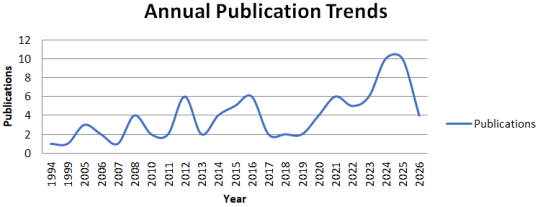
Figure 1 shows the annual publication trend from 1994 to 2026. Publication activity was limited during the early years, with one publication in 1994 and one in 1999. Output increased during the 2000s, reaching three publications in 2005, two in 2006, four in 2008 and six in 2012. A further increase occurred during the second half of the 2010s, with five publications in 2015 and six in 2016.
Publication activity became particularly pronounced after 2020. The number of publications increased from four in 2020 to six in 2021, five in 2022 and six in 2023, before reaching 10 publications in both 2024 and 2025. These two years represent the highest annual publication output in the inventory, with each accounting for 11.1% of all records. Four publications were recorded for 2026. The overall pattern shows a substantial expansion of research activity in the field, particularly during the most recent decade.
Figure 1. Annual Publication Trends.
3.3. Geographic Distribution and Leading Study-Location Countries
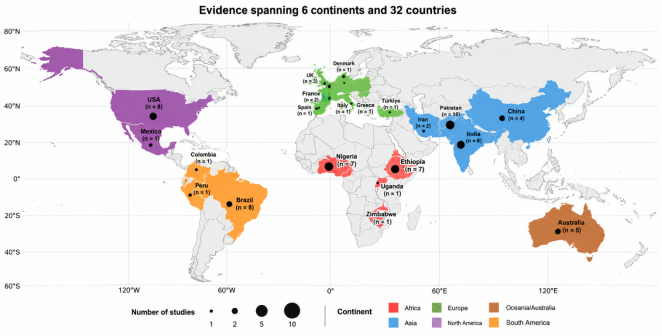
Figure 2 illustrates the geographic distribution of the studies represented in the evidence inventory. The studies covered 32 countries across Africa, Asia, Europe, North America, South America and Oceania/Australia. Africa contributed 23 study records from 10 countries, Asia contributed 19 records from four countries, and Europe contributed 18 records from 11 countries. North America accounted for seven records from two countries, South America for seven records from three countries, and Oceania/Australia for three records from one country.
The geographical pattern shows strong representation from Africa and Asia, together accounting for a substantial proportion of the literature, alongside an established body of research from Europe and the Americas. The presence of studies from Australia further extends the geographical scope of the field. The distribution also shows considerable variation among countries, with a small group contributing several records while many countries are represented by individual studies.
Figure 2. Geographic Distribution of Studies.
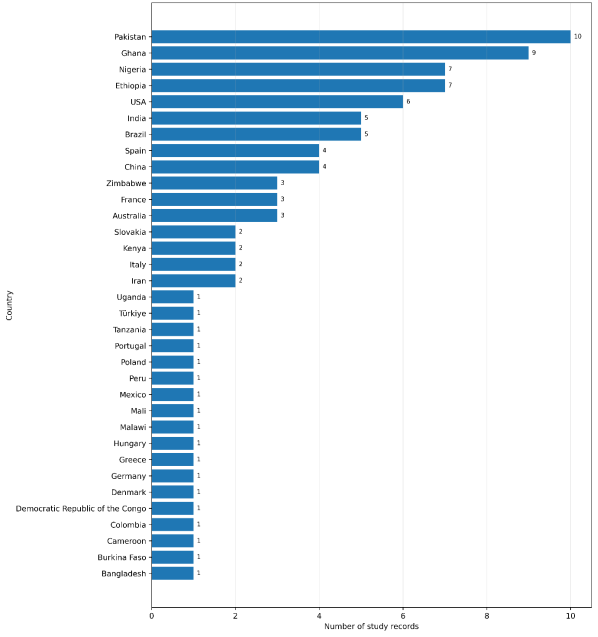
Figure 3 presents the distribution of studies by study-location country. Pakistan had the largest number of records, with 10 studies, followed by Ghana with nine, Nigeria and Ethiopia with seven each, and the United States with six. India and Brazil contributed five records each, while China and Spain contributed four each. Australia, Zimbabwe and France each contributed three records.
The concentration of studies in Pakistan, Ghana, Nigeria and Ethiopia gives South Asia and Africa a prominent position within the literature. Research from these countries commonly addresses urban and peri-urban vegetable production, wastewater or alternative-water irrigation, soil contamination and contaminant accumulation in edible crops. At the same time, the representation of the United States, Brazil, India, China, Spain and Australia demonstrates that the research question has developed across markedly different agricultural, climatic and regulatory settings.
Figure 3. Leading Study Countries.
3.4. Leading Institutions
Table 2 shows the institutions occurring most frequently in the verified affiliation records. Ahmadu Bello University, Haramaya University, the University of Copenhagen, the International Water Management Institute and the University of Namibia each occurred in two records. Other institutions occurred once within the verified affiliation data.
Table 2. Leading Institutions.
Rank | Institution | Records |
1 | Ahmadu Bello University, Zaria, Nigeria | 2 |
2 | Haramaya University, Ethiopia | 2 |
3 | University of Copenhagen, Denmark | 2 |
4 | International Water Management Institute, Colombo, Sri Lanka | 2 |
5 | University of Namibia, Namibia | 2 |
The institutional distribution reflects the international and multidisciplinary character of the research. The recurring institutions span universities and research organisations located in Africa, Europe and Asia, with several appearing in studies involving researchers from more than one country. The International Water Management Institute and the University of Copenhagen, for example, occur alongside African universities in research addressing wastewater irrigation and urban agriculture.
3.5. Most Productive Authors
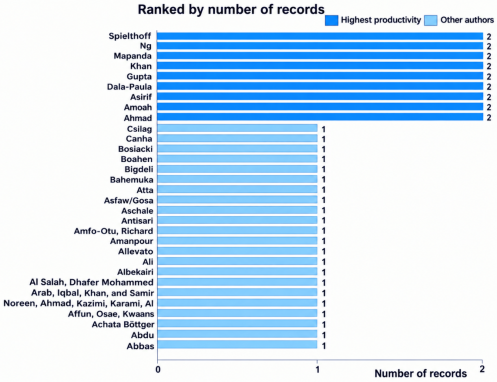
Table 3 presents the authors with the highest number of contributions in the verified author records. John O. Agbenin, Fisseha Itanna, Bernard Keraita, Pay Drechsel, Desta Woldetsadik, Heluf Gebrekidan, Habu and Khan each occurred in two records. The remaining authors occurred once in the verified author dataset.
The recurring authors are associated with research spanning heavy-metal contamination, wastewater irrigation, urban agriculture, soil quality, vegetable contamination and health-risk assessment. The repeated contributions of researchers such as Desta Woldetsadik, Pay Drechsel, Bernard Keraita, Fisseha Itanna and Heluf Gebrekidan are particularly evident in studies from Ethiopia addressing wastewater-irrigated urban vegetable production and associated contamination.
Figure 4. Most Productive Authors.
3.6. Most Represented Journals
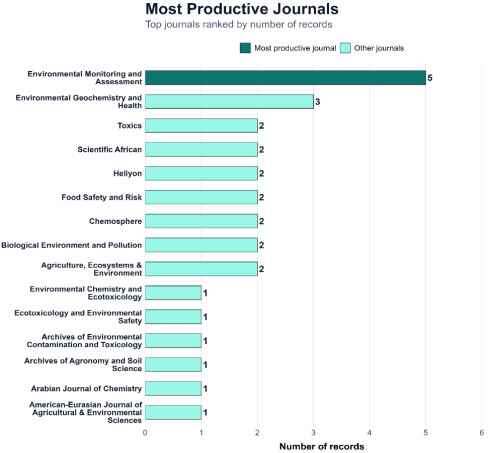
Table 4 presents the journals with the largest number of records in the evidence inventory. Environmental Monitoring and Assessment was the most represented journal, with five records, followed by Environmental Geochemistry and Health with three records. Nine journals contributed two records each: Agriculture, Ecosystems & Environment, Biological Environment and Pollution, Chemosphere, Food Safety and Risk, Heliyon, Scientific African and Toxics are among the journals represented at this level.
Figure 5. Most Productive Journals.
Figure 6. Most Cited Studies.
The journal distribution spans environmental monitoring, agricultural systems, toxicology, food safety and environmental health. The wide spread of publication outlets reflects the multidisciplinary nature of urban vegetable irrigation research, in which contamination is considered from environmental, agricultural, toxicological and food-safety perspectives.
3.7. Citation Analysis
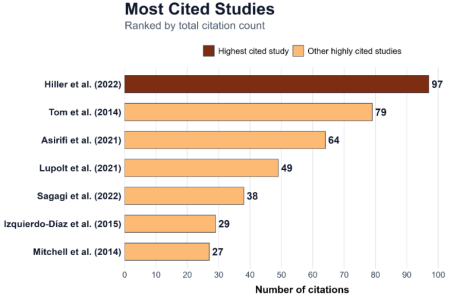
Table 5 presents the citation counts available for the records for which citation data had been frozen in OpenAlex on 23 September 2026. Hiller et al. (2022) had the highest citation count, with 97 citations, followed by Tom et al. (2014) with 79, Asirifi et al. (2021) with 64, and Lupolt et al. (2021) with 49. Sagagi et al. (2022) recorded 38 citations, while Izquierdo-Díaz et al. (2015) and Mitchell et al. (2014) recorded 29 and 27 citations, respectively.
The cited studies cover different geographical and thematic areas, including urban garden soils and vegetables, urban agroecosystems, heavy-metal contamination and health-risk assessment. The citation pattern also shows the influence of publication age, with earlier studies having a longer period in which citations could accumulate.
3.8. Keyword Co-occurrence Network
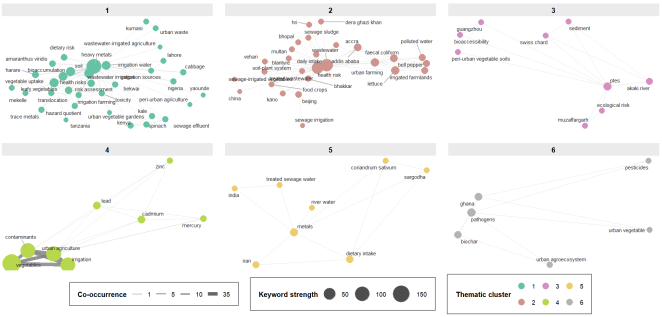
Figure 3 shows the keyword co-occurrence network generated from the bibliometric records. The network is centred on urban agriculture, vegetables, irrigation and contaminants, which form the strongest interconnected group of terms. The highest co-occurrence was recorded between urban agriculture and vegetables (37 occurrences), followed by irrigation and vegetables (35), irrigation and urban agriculture (35), and the three pairings linking contaminants with vegetables, urban agriculture and irrigation (35 occurrences each).
Heavy metals form another prominent component of the network, occurring with vegetables 14 times and with wastewater nine times. The terms health risk and wastewater occurred together 11 times, while health risk was associated with vegetables 10 times and heavy metals seven times. Heavy metals also showed recurrent associations with wastewater irrigation, irrigation water and leafy vegetables.
The network structure therefore places urban food production, irrigation and contaminant exposure at the centre of the research field. The strong association between health-risk terminology and wastewater, vegetables and heavy metals further demonstrates the close relationship between environmental contamination studies and food-safety assessment.
Figure 7. Keyword Co-occurrence Networ.
3.9. Co-authorship Network
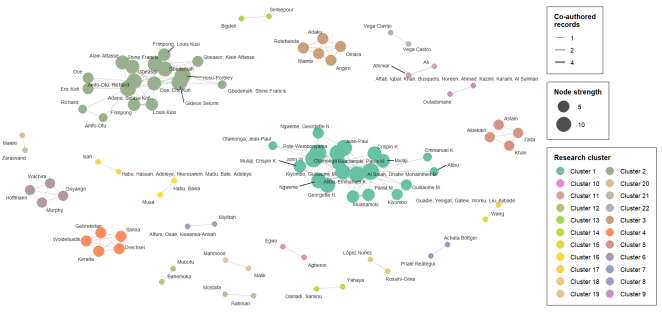
Figure 4 maps the co-authorship relationships within the reviewed literature. What stands out immediately is how fragmented the field is. Rather than one connected research community, the network breaks into a handful of tight clusters surrounded by many isolated pairs of authors who appear to have collaborated only once.
Two groups dominate the picture. One is a Ghanaian team made up of Adanu, Amfo-Otu, Doe, Frimpong, Gbeasor, Gbedemah and Hosu-Porbley, who have published together repeatedly on urban vegetable production and related health concerns. The other is a Congolese team including Al Salah, Atibu, Kiyombo, Muanamoki, Mulaji, Ngweme, Otamonga and Pote-Wembonyama, whose work centres on heavy-metal and trace-element contamination in urban agricultural systems. In both cases, almost every member of the group has co-authored with every other member, which is why they form such dense clusters in the figure. These are clearly established research teams rather than loose collaborations.
The rest of the network tells a different story. Most authors appear only once, usually as part of a two-person team or a small group of three to five researchers. The Gebrekidan, Woldetsadik, Drechsel, Keraita and Itanna group, for instance, reflects a single multi-country study, as does the Hoffmann, Murphy, Wachira and Onyango collaboration. Pairs such as Agbenin and Egwu, Bahemuka and Mubofu, Mahmood and Malik, or Danladi and Yahaya represent one-off partnerships that did not develop into ongoing research programmes.
Node size in the figure reflects how often each author appears across the corpus. The largest nodes belong to members of the two main consortia, confirming that a small number of researchers have contributed disproportionately to this body of work. The smaller nodes, scattered across the periphery, belong to authors who made a single contribution.
Taken together, the figure suggests that research on urban vegetable irrigation has been carried forward mainly by a few committed teams working within their own countries, with international collaborations occurring but remaining the exception rather than the rule. The themes these teams work on, including wastewater reuse, contaminant accumulation, and the safety of vegetables grown in and around cities, mirror the keyword patterns seen in
Figure 3, reinforcing the sense that this is a field shaped by a relatively small group of specialists.
Figure 8. Co-authorship Network of the Bibliometric Corpus.
3.10. Thematic Evolution
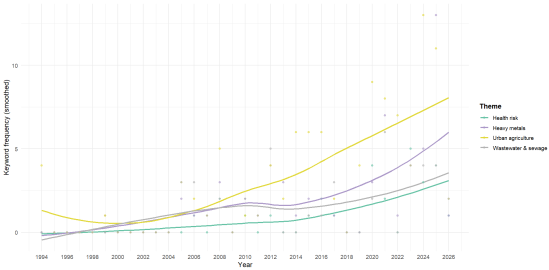
Figure 5 tracks how the four main research themes have evolved across the publication period. Rather than one theme replacing another, all four show a steady upward trajectory, suggesting a research field that has expanded in parallel across multiple fronts rather than shifting from one focus to another.
Urban agriculture is by far the most prominent theme throughout the period. It appears weakly around the mid-1990s and early 2000s, then rises steadily from roughly 2010 onwards, climbing sharply after 2020 to reach its highest levels in 2024 and 2025. This reflects the growing attention paid to vegetable production in and around cities as a distinct area of study.
Heavy metals is the second strongest and fastest-rising theme. It begins near zero in the early 1990s, grows gradually through the 2000s, and accelerates noticeably after 2015, ending the period at around six keyword appearances per year. Its steep rise closely tracks the urban agriculture curve, which fits with the observation that much of the heavy-metal work is conducted on vegetables grown in urban and peri-urban settings.
Wastewater & sewage follows a similar but more moderate path. It rises slowly from the early 1990s, plateaus around 2010–2015, and then begins to climb again after 2020, ending around three appearances per year. The theme is consistently present but never dominates, suggesting that wastewater is treated more as a context or driver of contamination than as a research subject in its own right.
Health risk is the most recent theme to emerge. It remains almost flat until about 2015, then begins a steady rise that continues through 2025. Its late but rapid growth indicates that the food-safety dimension of urban vegetable irrigation has only recently become a central research concern, even though contamination itself has been studied for much longer.
Taken together, the trends point to a research agenda that has broadened rather than shifted. The early emphasis on contaminant occurrence has been absorbed into a wider programme of work that now includes irrigation practices, contaminant transfer into crops, and the potential consequences for human health. The parallel rise of health-risk and wastewater-related research in the later years reflects the increasing integration of environmental contamination studies with food-safety assessment.
Figure 9. Thematic Trends.





 Share This Article
 Twitter
 Linked In
 Facebook

 Copy
 Download