1. Introduction
It would not be off the mark to say that the basic functions of today's AI are based on the accumulation of text search and combination processing. However, from the perspective of animal evolution, the essence of intelligence is even deeper than the function of AI. It is known from many ruins that we humans built magnificent buildings, made elaborate pottery, and carried out goods in a wide area even in an era when there was no writing. Of course, by mastering the use of letters, civilization has further developed to this day, but it cannot be said that the evolution of our brain structure was essential to the use of letters. In other words, it cannot be said that humans in the era when they did not have letters did not have the intelligence to master letters because their brains were underdeveloped. The essential evolution of the structure of the brain may have begun before 30,000 years, when there were no letters or paintings in the caves at that time, and only hand shapes were drawn
| [1] | Patricia Schneier, Agustina Ponce, Carlos Aschero Rock art (cave painting), Ethnography and collective memory. Case of study: Cueva de las manos, Patagonia, ArgentinaPublished 2021-07-07 https://doi.org/10.29112/ruae.v6i1.1242 |
[1]
. The apes that drew it were at the forefront of evolution.
For survive, all animals recognize dangers, enemies, and food sources in the environment and act accordingly. They learned these vital skills, mainly by imitating the behavior of their parents, but advanced apes were able to express the content and significance of the skills in language, spread them to their peers, and inherit them. A group that has acquired such skills has the characteristics of "society". For the life of apes to reach this stage, it is essential to communicate with each other through language. It must have been necessary to significantly increase the capacity of the brain along with the acquisition of language ability
| [2] | Oldest cave art found in Sulawesi
https://www.science.org/doi/10.1126/sciadv.abd4648 |
| [3] | Dan Dediu Are languages really independent from genes? If not, what would a genetic bias affecting language diversity look like? Human biology,
https://doi.org/10.3378/027.083.0208 |
| [4] | Wilkins, A. S., Wrangham, R. W., & Fitch, W. T. (2014). The "Domestication Syndrome" in Mammals: A Unified Explanation Based on Neural Crest Cell Behavior and Genetics July 2014 Genetics 197(3): 795-808. |
| [5] | Walter J. Freeman How Brains Make Up Their Minds (Maps of the Mind), Columbia University Press, February 15, 2001, ISBN-10: 0231120087, ISBN-13: 978-0231120081. |
[2-5]
.
As mentioned above, language is necessary for a human group to make a society and exchange goods in a wide area. Moreover, they must talk not only about what is in front of them, but also talk about goods that have been in the past and goods that come from afar. Then trade can be established. When humans are born, they first acquire the minimum skills to live by imitating the behavior of their parents, but after learning the language, they learn the skills to live in society. Like wild animals, they don't just recognize dangers, enemies, and food sources in the environment. Children grow up while gaining knowledge from their peers, keeping promises, communicating their intentions, and being recognized for their ingenuity. From the next chapter onwards, the function of the cerebrum, which played a major role in human evolution, is explained as part of the general learning behavior.
The processing flow of language described in this paper is consistent with the functions of the left and right hemispheres of the cerebrum. The cerebrum receives text information from the sensory organs to the left hemisphere, and the figure of the speaker is projected into the right hemisphere. Both make the situation of language understanding. We judge by facial expressions whether the person in the face-to-face understands the content of the conversation well. In addition, we will proceed dialogues while evaluating the gesture, tone of voice, intimacy, etc.
2. The Graffiti in the Cave May Be Trigger of Language
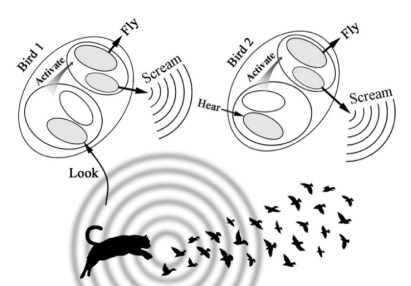
Figure 1. Knowing the danger from the screams of companion.
Figure 1 shows the function of the brain when animals such as birds recognize danger (in this case, animals) and run away. The bird 1 on the left visually recognizes the beast, activates the motor organs, and flies away while screaming. Some birds that listen to the screams do not see the beast (for example, birds 2), but those birds learn to sense danger from the screams of their companions and learn to fly away. More generally, a path is created from a certain area within the sensory organ to a certain area within the motor organ. Abstractly, it can be said that the symbol of the appearance of the beast is the screams of their companions.
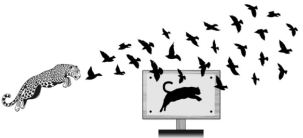
Figure 2. Warnings drawn by humans are not conveyed to animals. Caption.
If bird lovers place a picture of a beast in a place where birds gather, it is an object that makes no sense to birds (
Figure 2). They don't understand the intention of the author of the painting. Maybe it's because birds can't draw pictures. It is possible that there is a lack of basic cognitive ability. The following is a consideration from the neural network side of these problems. It is the entrance to new functions that are added to the brain model. Before the time when apes painted shapes like cave murals, they sprayed paint-like liquids from the top of their hands and drew hand-shaped patterns on the surface of the rocks. Similar shapes in cave are widely distributed. The shapes drawn in the cave become more complex as the times progress and appears mural like shapes. We can imagine their lives from the shapes such as apes killing animals with tools.
It can be considered that the ape's brain has gained a new cognitive ability between the era when only the shape of the hand was drawn and the era when shapes close to murals were drawn. With the acquisition of new cognitive abilities, all events, including tools used in daily life, are named. In other words, it is the symbolization of events. And to enable colleagues to cooperate, the work name and work rules would be established. Many apes who saw the "hand shape" in the cave for the first time would have only seen it as one of the patterns produced by rain or bat droppings. However, the person who drew the "hand shape" can immediately remember drawing situation (many of them may be drawn for fun) It means he recognized that it was himself who drew the shape because he had operating memories of his sensory organs and motor organs. On the other hand, if it is determined that the shape was drawn by someone else, he guesses who (first, close friends such as family members) drew it with what intention.
In addition, in the case of more complex shapes (which should be called symbols more philosophically), the more evolved apes guess who drew the shape for what purpose. If the result of the guess is not got, meet the person who drew the shape and ask questions, or as reply draw shape asking for more explanation, and in some cases, repeat multiple exchanges until both sides are satisfied. This way may be beginning of the era of using letters.
The important thing in the above recognition process is that the events or objects indicated by the symbols using by both are not necessary to exist in front of both. In some cases, things that are far away, things that have been in the past, and things that can be obtained future are include. These become subjects of dialogue on both parties. As mentioned on beginning in this section that even if a bird lover raises a picture of a beast to a bird gathering as a warning, the picture does not act as a warning because the bird cannot recognize the picture as a beast. Animals can tell their peers about the existence of dangerous events, but they are limited to the events that are happening in front of them. Some birds can imitate human conversations, but they are not meaningful to humans. By learning the language, humans have become more intelligent. In addition, by using letters, our knowledge and technology have spread to the world and created history.
In human dialogue, it is essential to move on to the next topic after confirming that the explanation is understood by the recipient. At the beginning of the dialogue, the images in the brains of both sides are created from their respective experiences, but they change and resemble each other through questions and answers. In the literature
| [6] | Veronica O'Keane, How We Make Memories and Memories Make Us. Penguin Books LtdFebruary 3, 2022, ISBN-10: 0141991011, ISBN-13: 978-0141991016 |
[6]
, the process is called the internalization of the human world, and the following is stated.
The internalization of the world in a human being is transmitted through the Big5-sight, sound, touch, taste, and smell- that are being fed continually into memory networks. Sensation from the world, such as touch or sight, allows you to learn different shapes, forming relatively simple knowledge upon which more complex information gets built. There is also the often ignored but constant feed of sensor information from the body to the brain that gives rise to feelings from simple emotions to complex feeling states. Sensation is the fundamental raw ingredient that feeds the brain: the substrate upon which the pervasive connectivity in the brain is based. Memory is, in its essence the infinitely complex neural representation of sensory information that has been carried to the brain.
This psychiatrist's explanation may contain phenomena that cannot be expressed in the field of neural networks, but it seems to express the reality of memory well. For example, the questioner asks, "Which do you prefer, pears or apples?" When asked, the first thing that comes to mind for the listener is the appearance and texture of both fruits. Next, listeners may remember many things, such as who recommended it for the first time, and the pear garden near the house. These topics are in the listener's mind, so the questioner doesn't care if the listener speaks. Even if there is something uncertain in your memory, if it is only a question that asks your preferences, the problem will not arise. However, if it is a dialogue that involves promises such as lending and borrowing goods, the memories of both parties must match as much as possible. Therefore, if there is an incomprehensible or incorrect part of the content of the conversation, ask the other party for an explanation or correction. It is not to say that sentences with interrogative words represented by 5W1H in English are very helpful for mutual understanding. With the repetition of the exchange, both parties accept the situation and move on to the execution of what should be done. Our society has been organized and established for many years of such exchanges.
3. Neural Networks That Gain Common Understanding Through Dialogues
The brain model shown in
Figure 1 in the previous chapter learns the time series data obtained from the sensory organs and outputs the time series data to the motor organs to protect their own survival. It can be considered that almost all animals are alive by learning this input and output relationship.
The time series data obtained from the sensory organs can symbolize the sense of reality by learning, as demonstrated in the correspondence between the screams of beasts and birds in the previous chapter. Trained livestock act according to the owner's commands, that is, learned symbols, search for illegal items such as drugs, and guide flocks of sheep, etc. However, they cannot send a message to humans such as "Today's work is done, the rest will be done tomorrow". The problem before the problem that there is no vocal cord that sends a message is that the only event, they can recognize is the event in front of them. It is impossible to have a dialogue about events in different time and space, such as the breakdown of the remaining work and the schedule of the next day.
For a dialogue to take place, it is necessary to understand the meaning of the words in the sentence. In other words, both parties are aware that the image corresponding to the symbol is consistent. As mentioned in the example of "Choose of Apples and Pears" in the previous chapter, one symbol activates the symbols of various related events, and their time series is structured as a story according to experience and prediction. The story creates more stories, and they even express space-time events that are far from the situation in front of them. They are images of events generated by a row of symbols, not generated by sensory organs on the spot, but they can be expressed and understood as if they were there.
In the previous chapter, it is stated that dialogue is necessary for apes to become a social group, and brain development is essential for this. It is the cerebrum that has played a leading role in brain development. There are animals that are alive just by learning the input and output relationship between the sensory organs and the motor organs, but it is the cerebrum that has grown to cover the upper part of their brains. The fact that symbols and images began to be supported here led to the dramatic development of intelligence after the apes.
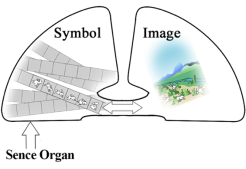
Figure 3. The movement of animals captured by eyes activate the image of the past landscape in the image area.
Figure 3 shows how the symbols and images behave in the cerebrum. It is the result of the cerebrum science that the left hemisphere of the cerebrum is responsible for language ability and the right hemisphere is responsible for spatial recognition. The neural network side may be able to consider the results as follows.
1. Symbols react in the left hemisphere because of the strong connection between the left hemisphere and the sensory organs.
2. Symbols are learned in time series, so recognition involves a delay in the length of the time series. On the other hand, the image needs to react immediately to avoid danger. Therefore, the image information is transmitted to the right Cerebrum through the brain beam while the symbol is being processed.
3. Since the learning of symbols must be maintained for a long time, it exists in parts that are far from the motor organs and visceral-related sensory nerves.
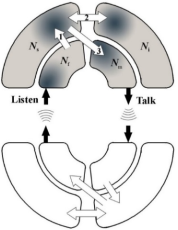
The behavior of the two regions
Nf and
Nm in
Figure 4 indicates the sensory and motor organs. It behaves in a manner like the brain of an animal, which learns and acts on the input-output correspondence shown in
Figure 1. The upper part of the cerebrum is divided into an area that processes symbols and an area that processes images, which are designated
Ns and
Ni, respectively. In this paper, symbols refer to expressions such as shapes, gestures, and shouts that correspond to events that include sounds that predict danger. The correspondence between events and symbols is mainly acquired because of learning and is stored in
Ns. Symbol activation affects the entire cerebrum. In
Ni, a new image that includes past experiences is activated, and this image then activates another symbol, creating a cycle. The activation flow is shown by arrows 1-3 in
Figure 4. The lower half of this figure shows the brain of the person interacting with, and the same activation flow as above occurs.
Figure 4. Brain movements during dialogue.
Sentences are generated by symbols related to the time series data of symbols and syntax rules. Even if the other person is not in front of us, we can use letters to explain each other's situation and exchange intentions. The image of the other person is not an image activated by sensory organs such as vision and touch, but an image created by the words received and knowledge of the other person. In short, it is thought that there is an image Ni* that guesses the behavior of the other person in the cerebrum image Ni.
This phenomenon may be confirmed by MRI (Magnetic Resonance Imaging) examination of the cerebrum during a conversation.
The behavior of the activity of the neural network shown here will vary in a variety of ways depending on the part of the brain and the processing object. Not only language, but also limb movements are shown in time series data, which includes a context structure. At the beginning of the processing of time series data, the areas of the brain, which were widely activated, narrowed as the processing progressed. Changes in activity in areas of the brain and their effects on other areas can be summarized using category theory. There, the object is defined based on the Hebb law of neuroscience, and the effect of activation on other areas is expressed using functor
| [7] | Seisuke Yanagawa Knowledge Exchange Between Neural Network Toward Dawn of Language American Journal of Neural Networks and Applications 2024-11-26
https://doi.org/10.11648/j.ajnna.20241002.12 |
| [8] | Seisuke Yanagawa Communication Between Neural Networks and Beginning of Language American Journal of Neural Networks and Applications 2021
https://doi.org/10.11648/j.ajnna.20210702.13 |
| [9] | Saunders Mac Lane Categories for the Working Mathematician Graduate Texts in Mathematics Springer Nature 1978. |
[7-9]
.
The same goes for the recognition of natural phenomena. Even animals that have no knowledge of celestial bodies live by predicting that it will be dark and cold when the sun tilts to the west. However, the activated area of the brain must be rough, even if it is time series processing. The same goes for the recognition of natural phenomena. Even animals that have no knowledge of celestial bodies live by predicting that it will be dark and cold when the sun tilts to the west. However, the activated area of the brain must be rough, even if it is time series processing. On the other hand, the appearance of the activated areas of the brain of those who are inspired by the sunset scenery and trying to create works of art such as paintings and music, and those who appreciate their works, must be completely different.
Following dialogue is between A and B in e-mail.
As an example of understanding by imaging.
A: "It's getting a comfortable season, are the cherry blossoms blooming over there?"
B: "No, here is the beginning of autumn, and eventually the cosmos blossoms will bloom."
A: "Sorry, I forgot that you are living in the southern hemisphere."
During this dialogue, images such as two types of flower shapes, a diagram depicting sunlight shining diagonally into the spherical earth, and world maps will be moving in the Cerebrums of both sides. All of these are not necessary knowledge for dialogue, but without this knowledge in the background, the dialogue will not proceed smoothly.
An important point in the above dialogue process is that if the correspondence between the symbol and the image is different, the speaker and the listener need to be close to each other's perception. In other words, it is to tell the story of the change in perception until the doubts disappear in the consciousness of both sides. Even human infants do not have this ability immediately after birth and acquire it through learning. The image corresponding to the symbol grow while combining with the memory of each life during the dialogue and are stored as time sequence. The measures obtained from this dialogue will be useful in various situations of life from now on. Currently, the trigger of the activation that evokes the experience is created from both the image side and the symbol side.
The most elementary trigger that hinders the flow of dialogue is that there are words in the sentence that the listener does not understand. In addition, it may become incomprehensible due to grammatically incomplete wording. In these cases, the listener can resume the dialogue by communicating what he did not understand.
However, for conversations about what happened in an unknown land or actions that have never been experienced, it is necessary to explore the memory of experience with similar symbols as a clue. Corresponding areas of the speaker's and listener's brains are activated together. As a result of the search, if there is an element that leads to the understanding of the sentence in those areas, it will be added to the new correspondence of the symbols and images in the sentence heard. In other words, a new item has been added to the dictionary. It can be said that learning in inexperienced fields such as language studies progresses in this way. If the listener's understanding is not sufficient, the listener will repeat the question and try to get a clearer picture. However, half-baked understanding and misunderstandings lead to confusion. Of course, these processes apply to both parties in the dialogue.
However, even if they reach the stage where they can have a conversation, their understanding of what is being said may not be sufficient. In our case, our impression of the other person changes every moment, depending on the knowledge and experience of both parties, as well as their respective positions in the group. Various emotions such as gratitude, antipathy, respect, and disgust are reflected in the image area activated by dialogue and can also affect the entire body through the nerves connected to the internal organs. Deep questions lie ahead as to how these situations can be simulated between humans, between humans and robots, and between robots, and whether there is any significance in doing so.





 Share This Article
 Twitter
 Linked In
 Facebook
 Copy
Copy Download