
 ,
Mpandzou Ghislain Armel,
Diatewa Euberma Josue,
Ngassaki Saurel,
Ossou-Nguiet Paul Macaire
Introduction: Psychological distress (PD) is a negative emotional state resulting from prolonged exposure to a stressor or an accumulation of environmental stressors. Objective: To identify factors associated with PD among general medicine students in Brazzaville. Patients and methods: This was a cross-sectional analytical study. It was carried out over a period of 4 months at the FSSA. It focused on general medicine student (GMSs) from the first to the seventh year of medicine who consented to participate in the study. The variables studied were sociodemographic, academic, related to lifestyle and the medical educational environment, related to psychological distress and related to the need for psychological help and stress management. Results: The prevalence of psychological distress among medical students was 63.4%. The mean age of medical students was 21.5±2.8 years and the sex ratio was 0.6. Both parents were alive in 88.7%. The main source of funding was the parents in 47.5% and 70.3% of the GMSs who completed the internship had PD. In multivariate analysis, female gender (OR = 1.60; p = 0.015) and having at least one deceased parent (OR = 0.25; p = 0.036) were predictors of PD. Conclusion: PD is a concern for general medicine students in Brazzaville. Among the factors studied, female gender and poor perception of the educational environment are predictors of PD.
| Published in | Clinical Neurology and Neuroscience (Volume 9, Issue 4) |
| DOI | 10.11648/j.cnn.20250904.12 |
| Page(s) | 62-68 |
| Creative Commons |
This is an Open Access article, distributed under the terms of the Creative Commons Attribution 4.0 International License (http://creativecommons.org/licenses/by/4.0/), which permits unrestricted use, distribution and reproduction in any medium or format, provided the original work is properly cited. |
| Copyright |
Copyright © The Author(s), 2025. Published by Science Publishing Group |
Psychological Distress, Students, General Medicine, Congo
Effective | Percentage (%) | |
|---|---|---|
Level of study (year of medicine) | ||
1 | 153 | 23.4 |
2 | 108 | 16.5 |
3 | 96 | 14.7 |
4 | 109 | 16.7 |
5 | 95 | 14.6 |
6 | 52 | 8.0 |
7 | 40 | 6.1 |
Effective | Percentage (%) | |
|---|---|---|
Vital status | ||
The two living | 579 | 88.7 |
One of the two died | 57 | 8.7 |
The two deceased | 17 | 2.6 |
Marital status | ||
Married | 455 | 69.7 |
Divorced | 141 | 21.6 |
Widowers | 57 | 8.7 |
Absence of DP n (%) | DP n (%) | OR [95% CI] | p-value | |
|---|---|---|---|---|
Age groups (year) | ||||
[15, 20[ | 55 (23.0) | 107 (25.9) | Reference | |
[20, 25[ | 144 (60.3) | 251 (60.8) | 0.90 [0.61-1.32] | 0.579 |
[25, 30[ | 39 (16.3) | 54 (13.1) | 0.71 [0.42-1.20] | 0.208 |
[30, 35] | 1 (0.4) | 1 (0.2) | 0.51 [0.03-8.38] | 0.683 |
Gender | ||||
Male | 110 (46.0) | 134 (32.4) | Reference | |
Female | 129 (54.0) | 280 (67.6) | 1.78 [1.28-2.47] | 0.001 |
Marital status | ||||
Bachelor | 198 (82.8) | 326 (78.7) | Reference | |
As a couple | 39 (16.3) | 87 (21.0) | 1.35 [0.90-2.07] | 0.153 |
Married | 2 (0.8) | 1 (0.2) | 0.30 [0.01-3.19] | 0.332 |
Absence of DP n (%) | DP n (%) | OR [95% CI] | p-value | |
|---|---|---|---|---|
Level of study (year of study) | ||||
1 | 47 (19.7) | 106 (25.6) | Reference | |
2 | 40 (16.7) | 68 (16.4) | 0.75 [0.45-1.27] | 0.287 |
3 | 34 (14.2) | 62 (15.0) | 0.81 [0.47-1.39] | 0.442 |
4 | 44 (18.4) | 65 (15.7) | 0.66 [0.39-1.10] | 0.107 |
5 | 34 (14.2) | 61 (14.7) | 0.80 [0.46-1.37] | 0.408 |
6 | 18 (7.5) | 34 (8.2) | 0.84 [0.43-1.63] | 0.602 |
7 | 22 (9.21) | 18 (4.4) | 0.36 [0.18-0.74] | 0.005 |
Internship | ||||
Yes | 196 (82.0) | 291 (70.3) | Reference | |
No | 43 (18.0) | 123 (29.7) | 1.93 [1.31-2.87] | 0.001 |
absence of DP n (%) | DP n (%) | OR [95% CI] | p-value | |
|---|---|---|---|---|
Vital status of parents | ||||
The two living | 199 (83.3) | 380 (91.8) | Reference | |
One of the two died | 11 (4.6) | 6 (1.4) | 0.29 [0.10-0.78] | 0.015 |
The two deceased | 29 (12.1) | 28 (6.8) | 0.51 [0.29-0.87] | 0.015 |
Marital status of parents | ||||
Married | 149 (62.3) | 306 (73.9) | Reference | |
Divorce | 63 (26.4) | 78 (18.8) | 0.60 [0.41-0.89] | 0.010 |
Widower | 27 (11.3) | 30 (7.3) | 0.54 [0.31-0.94] | 0.030 |
Absence of DP n (%) | DP n (%) | OR [95% CI] | p-value | |
|---|---|---|---|---|
Source of funding | ||||
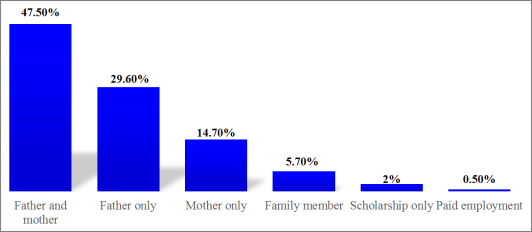
Father and mother | 110 (46.0) | 200 (48.3) | Reference | |
Father only | 74 (31.0) | 119 (28.7) | 0.88 [0.61-1.28] | 0.519 |
Mother only | 30 (12.6) | 66 (15.9) | 1.21 [0.74-1.98] | 0.451 |
Paid activity | 2 (0.8) | 1 (0.2) | 0.28 [0.02-3.07] | 0.337 |
Scholarship only | 4 (1.7) | 9 (2.2) | 1.24 [0.37-4.11] | 0.756 |
Family member | 19 (8.0) | 19 (4.6) | 0.55 [0.28-1.08] | 0.088 |
absence of DP n (%) | DP n (%) | OR [95% CI] | p-value | |
|---|---|---|---|---|
DREEM global | ||||
Good perception | 185 (39.8) | 280 (60.2) | Reference | |
Bad perception | 54 (28.7) | 134 (71.3) | 1.64 [1.14-2.38] | <0.008 |
absence of DP n (%) | DP n (%) | OR [95% CI] | p-value | |
|---|---|---|---|---|
Sex | ||||
Male | 110 (46.0) | 134 (32.4) | Reference | |
Female | 129 (54.0) | 280 (67.6) | 1.60 [1.09-2.35] | 0.015 |
Vital status of parents | ||||
Living | 199 (83.3) | 380 (91.8) | Reference | |
One of the two died | 11 (4.6) | 6 (1.4) | 0.25 [0.06-0.86] | 0.036 |
The two deceased | 29 (12.1) | 28 (6.8) | - | - |
PD | Psychological Distress |
GMS | General Medicine Students |
FSSA | Health Sciences |
UMNG | Marien NGOUABI University |
DREEM | Dundee Ready Education Environment Measure |
K6 | Kessler Psychological Distress Scale-6 |
| [1] | Ogunsemi OO, Afe T, Odusan O, Oguntona SA, Adefuye BO, Oyelekan AAA. Psychological well-being of medical students in a state university, Nigeria. Res J Health Sci 2013; 1(1): 90-8. |
| [2] | Horwitz AV. Distinguishing distress from disorder as psychological outcomes of stressful social arrangements. Health (N Y) 2007; 11(3): 273-89. |
| [3] | Marchand A, Durand P, Demers A. Work and mental health: The experience of the Quebec workforce between 1987 and 1998. Work J Prev Assess Rehabil 2005; 25(2): 135-42. |
| [4] | Ridner SH. Psychological distress: concept analysis. J Adv Nurs 2004; 45(5): 536-45. |
| [5] | Kuznetsova LM, Kuznetsov VD, Timoshenko KT. Mental health indices in senior schoolchildren and students. Gig Sanit 2008; (3): 59-63. |
| [6] | Dyrbye LN, Thomas MR, Shanafelt TD. Medical student distress: causes, consequences, and proposed solutions. In: Mayo Clinic Proceedings. Elsevier; 2005; 80(12): 1613-22. |
| [7] | Farajpour A, Raisolsadat SMA, Moghadam SS, Mostafavian Z. Perception of educational environment among undergraduate students of health disciplines in an Iranian university. Int J Med Educ 2017; 8: 300. |
| [8] | Hammond SM, O’Rourke M, Kelly M, Bennett D, O’Flynn S. A psychometric appraisal of the DREEM. BMC Med Educ 2012; 12(2): 2-4. |
| [9] | Cacouault-Bitaud M. La féminisation d’une profession est-elle le signe d’une baisse de prestige? Trav Genre Sociétés 2001; (1): 91-115. |
| [10] | Backović DV, Ilić Živojinović J, Maksimović J, Maksimović M. Gender differences in academic stress and burnout among medical students in final years of education. Psychiatr Danub 2012; 24(2): 175-81. |
| [11] | Ossou-Nguiet PM, Mpandzou GA, Aloba KO, Latou DHM, Diatewa J, Bandzouzi EPS, et al. Facteurs prédictifs de l’oubli lacunaire «Effet gommage» chez l’étudiant en médecine à Brazzaville. Ann Sci Santé 2019; 18(2): 2-4. |
| [12] | Guèye M, Moreira PM, Dia DA, Ndiaye-Guèye MD, Kane-Guèye SM, Mbaye M, et al. Le syndrome d’épuisement professionnel chez les étudiants en spécialisation au Centre hospitalier universitaire de Dakar (Sénégal). Ann Méd-Psychol Rev Psychiatr 2016; 174(7): 551-6. |
| [13] | Favez N. Le couple comme vecteur de soutien social. PSY-Emot Interv Sante 2013; 205-31. |
| [14] | Boujut E, Koleck M, Bruchon-Schweitzer M, Bourgeois M-L. La santé mentale chez les étudiants: suivi d’une cohorte en première année d’université. In: Annales Médico-psychologiques, revue psychiatrique. Elsevier; 2009. p. 662-8. |
| [15] | Wouango J. L’accès des filles à l’enseignement supérieur au Burkina Faso: choix parentaux, parcours d’étudiantes et défis. Int Rev Educ 2017; 63(2): 213-33. |
| [16] | Verger P, Combes J-B, Kovess-Masfety V, Choquet M, Guagliardo V, Rouillon F, et al. Psychological distress in first year university students: socioeconomic and academic stressors, mastery and social support in young men and women. Soc Psychiatry Psychiatr Epidemiol 2009; 44(8): 643-50. |
| [17] | Yusoff MSB. Impact of summative assessment on first year medical students’ mental health. Int Med J 2011; 18(3): 172-5. |
APA Style
Galieni, S. B. P. E., Armel, M. G., Jessica, N. R., Happia, M. D., Josue, D. E., et al. (2025). Factors Associated with Psychological Distress Among General Medicine Students in Congo. Clinical Neurology and Neuroscience, 9(4), 62-68. https://doi.org/10.11648/j.cnn.20250904.12
ACS Style
Galieni, S. B. P. E.; Armel, M. G.; Jessica, N. R.; Happia, M. D.; Josue, D. E., et al. Factors Associated with Psychological Distress Among General Medicine Students in Congo. Clin. Neurol. Neurosci. 2025, 9(4), 62-68. doi: 10.11648/j.cnn.20250904.12
AMA Style
Galieni SBPE, Armel MG, Jessica NR, Happia MD, Josue DE, et al. Factors Associated with Psychological Distress Among General Medicine Students in Congo. Clin Neurol Neurosci. 2025;9(4):62-68. doi: 10.11648/j.cnn.20250904.12
@article{10.11648/j.cnn.20250904.12,
  author = {Sounga Bandzouzi Prince Eliot Galieni and Mpandzou Ghislain Armel and Ndingossoka Rosly Jessica and Motoula-Latou Dina Happia and Diatewa Euberma Josue and Gandou Paul and Ngassaki Saurel and Mialoudama Carl Harvey and Ossou-Nguiet Paul Macaire},
  title = {Factors Associated with Psychological Distress Among General Medicine Students in Congo},
  journal = {Clinical Neurology and Neuroscience},
  volume = {9},
  number = {4},
  pages = {62-68},
  doi = {10.11648/j.cnn.20250904.12},
  url = {https://doi.org/10.11648/j.cnn.20250904.12},
  eprint = {https://article.sciencepublishinggroup.com/pdf/10.11648.j.cnn.20250904.12},
  abstract = {Introduction: Psychological distress (PD) is a negative emotional state resulting from prolonged exposure to a stressor or an accumulation of environmental stressors. Objective: To identify factors associated with PD among general medicine students in Brazzaville. Patients and methods: This was a cross-sectional analytical study. It was carried out over a period of 4 months at the FSSA. It focused on general medicine student (GMSs) from the first to the seventh year of medicine who consented to participate in the study. The variables studied were sociodemographic, academic, related to lifestyle and the medical educational environment, related to psychological distress and related to the need for psychological help and stress management. Results: The prevalence of psychological distress among medical students was 63.4%. The mean age of medical students was 21.5±2.8 years and the sex ratio was 0.6. Both parents were alive in 88.7%. The main source of funding was the parents in 47.5% and 70.3% of the GMSs who completed the internship had PD. In multivariate analysis, female gender (OR = 1.60; p = 0.015) and having at least one deceased parent (OR = 0.25; p = 0.036) were predictors of PD. Conclusion: PD is a concern for general medicine students in Brazzaville. Among the factors studied, female gender and poor perception of the educational environment are predictors of PD.},
 year = {2025}
}
TY  - JOUR
T1  - Factors Associated with Psychological Distress Among General Medicine Students in Congo
AU  - Sounga Bandzouzi Prince Eliot Galieni
AU  - Mpandzou Ghislain Armel
AU  - Ndingossoka Rosly Jessica
AU  - Motoula-Latou Dina Happia
AU  - Diatewa Euberma Josue
AU  - Gandou Paul
AU  - Ngassaki Saurel
AU  - Mialoudama Carl Harvey
AU  - Ossou-Nguiet Paul Macaire
Y1  - 2025/12/09
PY  - 2025
N1  - https://doi.org/10.11648/j.cnn.20250904.12
DO  - 10.11648/j.cnn.20250904.12
T2  - Clinical Neurology and Neuroscience
JF  - Clinical Neurology and Neuroscience
JO  - Clinical Neurology and Neuroscience
SP  - 62
EP  - 68
PB  - Science Publishing Group
SN  - 2578-8930
UR  - https://doi.org/10.11648/j.cnn.20250904.12
AB  - Introduction: Psychological distress (PD) is a negative emotional state resulting from prolonged exposure to a stressor or an accumulation of environmental stressors. Objective: To identify factors associated with PD among general medicine students in Brazzaville. Patients and methods: This was a cross-sectional analytical study. It was carried out over a period of 4 months at the FSSA. It focused on general medicine student (GMSs) from the first to the seventh year of medicine who consented to participate in the study. The variables studied were sociodemographic, academic, related to lifestyle and the medical educational environment, related to psychological distress and related to the need for psychological help and stress management. Results: The prevalence of psychological distress among medical students was 63.4%. The mean age of medical students was 21.5±2.8 years and the sex ratio was 0.6. Both parents were alive in 88.7%. The main source of funding was the parents in 47.5% and 70.3% of the GMSs who completed the internship had PD. In multivariate analysis, female gender (OR = 1.60; p = 0.015) and having at least one deceased parent (OR = 0.25; p = 0.036) were predictors of PD. Conclusion: PD is a concern for general medicine students in Brazzaville. Among the factors studied, female gender and poor perception of the educational environment are predictors of PD.
VL  - 9
IS  - 4
ER  -
Faculty of Health Sciences, Marien N'GOUABI University, Brazzaville, Republic of Congo;Neurology Department, Loandjili General Hospital, Pointe-Noire, Republic of Congo
Faculty of Health Sciences, Marien N'GOUABI University, Brazzaville, Republic of Congo;Neurology Department, Brazzaville University Hospital, Brazzaville, Republic of Congo
Faculty of Health Sciences, Marien N'GOUABI University, Brazzaville, Republic of Congo;Neurology Department, Brazzaville University Hospital, Brazzaville, Republic of Congo
Neurology Department, Loandjili General Hospital, Pointe-Noire, Republic of Congo
Faculty of Health Sciences, Marien N'GOUABI University, Brazzaville, Republic of Congo;Neurology Department, Brazzaville University Hospital, Brazzaville, Republic of Congo

Information


 Share This Article
 Twitter
 Linked In
 Facebook

 Copy
 Download