Abstract
Marine jetties form an important link between land and sea areas for the transport of oil and gas products. Mooring forces are considered a key factor in marine jetties design, which can be calculated using static or dynamic mooring analysis. In general, the dynamic mooring analysis (DMA) is considered a more complex task compared to static mooring analysis (SMA), due to the dynamic behavior of mooring lines and body motion of moored vessels. So, DMA always provides the most accurate and reliable results. Although the DMA is the ideal choice for detailed engineering projects, in feasibility studies and the FEED phase it will be time-consuming and less added value. In this paper, a methodology for calculating mooring forces using a modified SMA was implemented through the so-called dynamic mooring analysis factor (FDMA), which will take into account the dynamic response of the wave forces. For this purpose, more than 190 sea state load combinations were carried out, including different return periods, water depths, and wide range of vessel sizes. To determine the mooring forces in vessels' mooring lines, SMA is performed using the OCIMF approach, while DMA is performed by the Finite Element Model (SESAM Marine Software). The nonlinear regression concept was used to correlate the results of the SMA and DMA in conjunction with the vessel’s dead weight tonnages (DWTs). Finally, the dynamic mooring results using the modified SMA were validated against the DMA results generated by SEASM Marine Software, which gave promising results. As a conclusion; using the modified SMA approach will be as an alternative solution to the DMA approach at earlier stages of any project. This will also facilitate selection of the appropriate mooring pattern on marine jetties and the determination of the size and material of the mooring lines, thus contributing effectively to the cost estimation phase.
Keywords
Dynamic Mooring Analysis, Static Mooring Analysis, Dynamic Mooring Factor (FDMA), Marine Jetties
1. Introduction
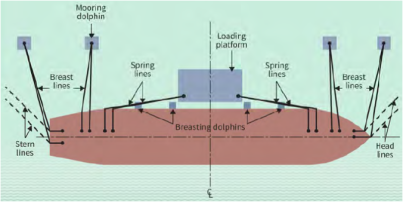
Marine terminals play a crucial role in the Oil and Gas industry, as they are the link between onshore and offshore areas through so-called marine jetties. Oil and Gas are exported and imported through marine jetties via pipelines extending over a bridge (trestle), by loading and/or unloading from ships to the storage area or vice versa. Marine jetties are special structures, consisting of a main platform (including some facilities and utilities) and a set of separate structures (i.e. mooring and breasting dolphins) to stabilize the ship to the jetty during the operation through so-called mooring lines (
Figure 1).
Generally, mooring lines and related systems should be designed to resist forces from wind, currents, waves, as well as swell from passing ships
| [1] | Papanikolaou, A., 1985. On the Evaluation of Motions and Loads of Arbitrary Bodies in Waves. In: Proc. Inc. Symp. On Ocean Space Util. 85, Tokyo pp- 75–86. |
| [2] | Lee S., 2015. A numerical study on ship-ship interaction in shallow and restricted waterway, Int. J. Nav. Archit. Ocean Eng. 7, 920–938. https://doi.org/10.1515/ijnaoe-2015-0064 |
[1, 2]
. These mooring lines are designed and arranged based on the mooring analysis. So, it can be said that mooring analysis is considered the gateway to the engineering, layout, and structural design of marine jetties.
Static Mooring Analysis (SMA) has been widely used as a proven, reliable and cost-effective approach, especially in sheltered areas where the wave impact is minimal. However, in open seas (i.e. unsheltered areas) where the share of wave in the mooring force becomes significant, Dynamic Mooring Analysis (DMA) should be performed as an economic alternative solution to physical model testing
| [4] | PIANC (2002). Guidelines for the Design of Fenders Systems. Report of Maritime Navigation Commission Working Group 33, Permanent International Association of Navigation Congresses (PIANC). |
| [5] | British Standard BS 6349-1:2000, Maritime Structures - Part 1: Code of Practice for General Criteria. |
| [6] | British Standard BS 6349-4:2014, Maritime Works - Part 4: Code of Practice for Design of Fendering and Mooring Systems. |
[4-6]
.
In fact, DMA has some complexity in the modeling process starting from building the numerical model to performing motion analysis with a large number of loading cases. It is usually performed by a third-party consultant. Therefore, this may hinder many engineers from performing such analyses in the fast-track marine projects, especially during conceptual and FEED design phases.
In this paper, the researchers attempt to enrich the Oil and Gas industry with an effective design tool by establishing a relationship between DMA and SMA analyses. Accordingly, a new mooring factor was developed to improve the traditional static mooring methods to take into account the dynamic effect resulting from wave motion. For this purpose, a wide range of variables such as tanker sizes (small, medium, large), different water depths, and wide environmental conditions (wind, current, and wave) are covered during this study. In conclusion, the curves resulting from this study can be valuable and useful to the stakeholders working in the Oil and Gas industry regarding marine terminal projects.
The study of mooring analysis has been discussed before in many literatures. Natarajan and Ganapathy derived static equilibrium equations for mooring lines when ships are subjected to wind, current, and restricted waves, and they also provided a methodology to help the designer predict mooring forces on mooring lines, bollards, etc.
.
Schelfn & Östergaard studied issues related to the safe mooring of ships in port, including the environmental forces acting on the ship, general principles regarding the distribution of these forces on mooring lines, and application of these principles to establish a good arrangement of mooring lines. These issues include an overview of the good mooring principles, guidance for berth layout and mooring equipment on board ships, as well as the prediction of wind and current loads affecting the ship
.
Molen and Moes investigated the effect of long waves on moored ships at several ports in South Africa, where ports in this region are exposed to high levels of long wave energy. These long waves are mainly generated by ocean weather systems, which are a very unfavorable condition that should be avoided in future port expansions in this region. For example, an incident was recorded at the port of Saldanha for ore carriers (250,000 dwt), which resulted in the breaking of about 12 of their mooring lines. This study presented one of the ideal solutions that can be applied in South African ports to achieve safe mooring of ships, which is the MoorMaster system. This system is an innovative mooring concept by Cavotec (Christchurch, New Zealand) including vacuum suction units installed on the quay and connected to the ship’s hull instead of the mooring lines. However, the study confirmed that there is no uniform solution to mooring problems associated with long waves, as each port is different. Finally, the most important recommendation for this study is to use numerical and physical modeling to identify the problem and the potential solutions accompanied by prototype measurements in the case of existing ports or after construction in the case of new ports
| [9] | Molen, V, W., Moes, H. General Characteristics of South African Ports and the Safe Mooring of Ships. The 28th Southern African Transport Conference (SATC 2009), 308-314.
http://hdl.handle.net/2263/12030 |
[9]
.
In light of the development of Indian ports to accommodate the Very Large Crude Carrier, Das, S. N. et al. used a quasi-static approach to predict moored ship motions, mooring rope tensions, fender compressions, and bollard pulls under moderate environmental conditions. A 200,000 DWT oil tanker was considered for mooring arrangement and simulation purposes. They confirmed that the strength of the current played an important role in the berth structure orientation. They also found that ship motions were still within the permissible limit recommended in PIANC guidelines. Finally, they concluded that the techniques they evolved would be useful in the design of Marine Oil Terminals, their orientation and the mooring arrangements of large oil tankers
.
Molen et al. investigated the best solutions to mitigate long waves and related motions of moored ships in the Port of Geraldton. This port is located on the west coast of Australia and has seven berths. Dynamic mooring models were built for different alternative solutions. They found that the best reduction of vessel motions as well as mooring line forces was achieved by installing a combination of pneumatic fenders and specific constant tension winches set to 30 tons, or nylon breast lines with a pretension of 25 tons. This solution gave a significant improvement in the long wave height threshold compared to the previous threshold
| [11] | Molen, V. W., Scott, D., Taylor, D., Elliott, T. Improvement of Mooring Configurations in Geraldton Harbour. Journal of Marine Science and Engineering. 2016, 4(3), 1-20.
https://doi.org/10.3390/jmse4010003 |
[11]
.
Stoschek et al. studied three ports to reassess safety and efficiency of pier structures against previous recommendations using static methods. The DHI MIKE 21 Mooring Analysis software was used to calculate dynamic mooring forces. In all cases, dynamic mooring analyses led to a better understanding of the processes, allowing for less conservative designs. They concluded that applying the dynamic mooring method could improve safety and reduce the construction costs for pier structures
| [12] | Stoschek, O., Leschka, S., Brüning, A., Hein, C. Optimizing Pier Structures using Dynamic Mooring Forces Modelling. The 34th PIANC-World Congress Panama City, Panama 2018. http://www.pianc2018.com/ |
[12]
.
This paper will be organized as follows; Section 2 explains methodologies for static and dynamic methods used in this work. Section 3 describes the study area and data used. Section 4 measures of accuracy are used to validate the results of this study. Section 5 shows the results and discussions. Finally, Section 6 summarizes and concludes this work.
2. Methodologies
In this study, static and dynamic methods will be used to calculate mooring analysis of marine jetty. Different cases of mooring analysis (about 192 environmental combinations including wind, waves, currents, and water levels) have been studied to include the following variables:
1) Different types and sizes of Tankers: Fuel Oil Tankers and LPG Carriers.
2) Different Environmental conditions: return periods of 1-year and 50-year.
3) Different Water Depths: 14 m and 20 m.
2.1. Static Mooring Approach
There are different approaches recommended in international standards for calculating the static mooring force (i.e. wind and current effect only) such as British Standards, Oil Companies International Marine Forums (OCIMF), etc.
| [3] | OCIMF, 2008. Mooring Equipment Guidelines -MEG3. Oil Companies International Marine Forum, 3rd Edition. |
| [6] | British Standard BS 6349-4:2014, Maritime Works - Part 4: Code of Practice for Design of Fendering and Mooring Systems. |
[3, 6]
. In this paper, the OCIMF approach will be used for calculating the static mooring force
| [3] | OCIMF, 2008. Mooring Equipment Guidelines -MEG3. Oil Companies International Marine Forum, 3rd Edition. |
| [13] | Ports Designer’s Handbook: Recommendations and Guidelines, Carl A. Thoresen, 2003. |
[3, 13]
.
The Mooring Force formula due to wind will be:
Where:
: Wind force
: Wind drag coefficient depending on the angle of wind
: Density of air (kg/)
: Wind speed at 10m above water level (m/s)
: Projected wind area ()
The Mooring Force formula due to current will be:
Where:
: Current force
: Current drag coefficient depending on the angle of current and under-keel clearance
: Density of water (kg/)
: Current speed (m/s)
: Projected underwater area of ship ()
Accordingly, the total mooring force (
) will be equal to the sum of the wind and current forces given in Equations (
1) and (
2):
2.2. Dynamic Mooring Approach
Dynamic Mooring Analysis will consider wind, waves, and currents by using DNV’s software SESAM (Finite Element Model). The SESAM is a proven solution for mooring analysis based on time domain analysis that provides comprehensive and accurate analysis of mooring systems.
The mooring analysis will be performed using the SESAM software via HYDRO-D model for hydrostatics and WADAM model for hydrodynamics
| [14] | SESAM user manual HydroD, 2011. Det Norske Veritas Software. |
| [15] | SESAM user manual Wadam, 2011. Det Norske Veritas Software. |
[14, 15]
.
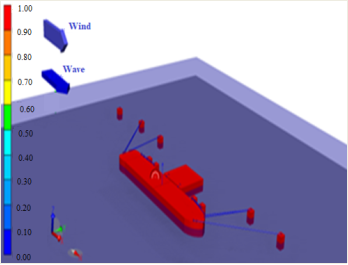
Figure 2 shows an example of a 3D simulation of an oil tanker with a capacity of 15,000 DWT (one of the vessels used in this study).
3. Study Area and Data Used
3.1. Study Area Location
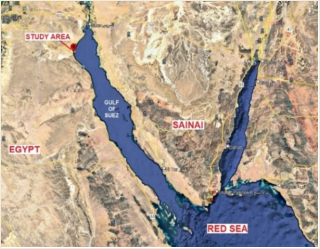
The study area is located in the Gulf of Suez, Red Sea, Egypt, as shown in
Figure 3. The marine jetty contains two berths. The first one is at 29° 35' 55" N and 32° 2’ 58” E, at water depth of 14 m, while the second is at 29° 36' 00" N and 32° 21' 30" E, at water depth of 20 m.
Due to the curvature of the coastline in the study area as shown in
Figure 3, the marine jetty is not fully affected by the northern or southern waves and is therefore considered relatively sheltered.
3.2. Wind, Wave, and Current Conditions
The wave model MIKE21 based on the Spectral Wind-wave module (SW) was used to create a 20-year continuous time-series of wave data along the study area. Furthermore, the wave climate was analyzed to provide normal wave conditions at the marine jetty site.
Table 1.
Extreme Wind and Wave conditions for 1-year return period. Return Period | Direction | Wind speed | Wave |
(º) | (knot) | Hs (m) | Tp (s) |
1-year | 0 | 32.3 | 0.9 | 4.0 |
30 | 28.2 | 0.9 | 4.0 |
60 | 24.6 | 0.8 | 3.6 |
90 | 21.0 | 0.6 | 3.4 |
120 | 22.7 | 0.7 | 3.8 |
150 | 30.4 | 1.3 | 5.3 |
180 | 34.0 | 1.0 | 4.0 |
210 | 34.0 | 0.6 | 3.1 |
240 | 34.0 | 0.4 | 2.2 |
270 | 34.0 | N/A | N/A |
300 | 34.0 | 0.3 | 2.5 |
330 | 34.0 | 0.6 | 4.0 |
Wave conditions are simulated using wind data from ECMWF to the wave modelling. The extreme wind speed commonly used in the mooring analysis is a 30-second wind gust at an elevation of 10 m.
The extreme directional winds and waves for the 1-year and 50-years return periods are presented in
Tables 1 and 2.Table 2.
Extreme Wind and Wave conditions for 50-year return period. Return Period | Direction | Wind speed | Wave |
(º) | (knot) | Hs (m) | Tp (s) |
50-year | 0 | 54.4 | 2.0 | 5.5 |
30 | 47.2 | 2.0 | 5.5 |
60 | 39.5 | 1.6 | 4.8 |
90 | 24.0 | 0.8 | 3.6 |
120 | 24.0 | 0.8 | 4.0 |
150 | 45.9 | 2.5 | 6.2 |
180 | 54.4 | 2.2 | 5.6 |
210 | 66.9 | 1.5 | 4.0 |
240 | 68.2 | 0.9 | 3.0 |
270 | 61.1 | 0.4 | 2.0 |
300 | 62.2 | 0.7 | 3.3 |
330 | 51.9 | 1.1 | 4.3 |
The results of the extreme analysis of the maximum current values at the return periods of 1-year and 50-years are shown in
Table 3. However, the current data confirmed that the prevailing currents originate from the north and south.
3.3. Vessel Characteristics Data
The marine jetty is designed to accommodate product tankers (fuel oil) and liquefied petroleum gas tankers (LPG).
Table 4 summarizes the characteristics of vessels that will use this marine jetty.
Table 3.
Extreme current conditions for 1-year and 50-year return periods. Return period | Max. Extreme Current speed (knot) |
1-year | 0.41 |
50-year | 0.84 |
Table 4.
Vessel Characteristics Data. Vessels | Volume | LOA (m) | LBP (m) | Max. Draft (m) | Beam (m) |
LPG* | 5,000m3 | 102.3 | 96.2 | 6.5 | 17.7 |
Product Tanker | 15,000 DWT | 143.0 | 134.0 | 7.4 | 22.6 |
LPG* | 82,000m3 | 225.5 | 215.0 | 12.6 | 36.6 |
Product Tanker | 160,000 DWT | 274.3 | 264.0 | 17.1 | 48.0 |
Table 5 represents Minimum, Maximum and Mean values of all forces resulted from the dynamic mooring analysis for all vessels. They will provide an important guide for the characteristics of actual (calculated) dynamic mooring forces at the return periods of 1-year and 50-years.
Table 5.
Minimum, Maximum & Mean values for the results of actual dynamic mooring forces. Vessels Size (DWT) | 1-year return period | 50-year return period |
Min. (kN) | Max. (kN) | Mean (kN) | Min. (kN) | Max. (kN) | Mean (kN) |
5,400 | 47.55 | 324.9 | 155.6 | 80.30 | 441.3 | 210.5 |
15,000 | 231.5 | 1164 | 565.3 | 290.9 | 1554 | 736.6 |
52,000 | 2380 | 6439 | 3744 | 2972 | 8043 | 4890 |
160,000 | 4882 | 14004 | 8182 | 6285 | 17032 | 10473 |
4. Measures of Accuracy
In this study, three measures were used to evaluate the accuracy of results: Correlation Coefficient (R), Mean Absolute Error (MAE) and Scatter Index (SI), which are as follows:
(4)
Where:
represents the actual dynamic mooring force value, represents the predicted dynamic mooring force value, n is the total number of dynamic mooring forces, is the mean of , is the mean of , and RMSE is the Root Mean Square Error.
5. Results and Discussions
5.1. Nonlinear Regression Method
Nonlinear regression is a statistical method used to model relationships between dependent and independent variables when the relationship is not linear, such as wave, wind and current data
| [16] | Salah, H. Prediction of wave parameters off the Nile delta coast of Egypt using nonlinear regression analysis. International Journal of Science and Research (IJSR). 2017, 6(9), 187-195.
https://doi.org/10.21275/ART20176527 |
[16]
.
In this study, the nonlinear regression method based on the exponential regression type will be used to determine the relationship between SMA and DMA results. The general form of the exponential regression equation can be formulated as:
Where: the constants “A” and “P” are equal to
and slope (m), respectively
| [16] | Salah, H. Prediction of wave parameters off the Nile delta coast of Egypt using nonlinear regression analysis. International Journal of Science and Research (IJSR). 2017, 6(9), 187-195.
https://doi.org/10.21275/ART20176527 |
[16]
.
5.2. SMA and DMA Results
The mooring forces were performed using the SMA and DMA approaches described in Section 2.
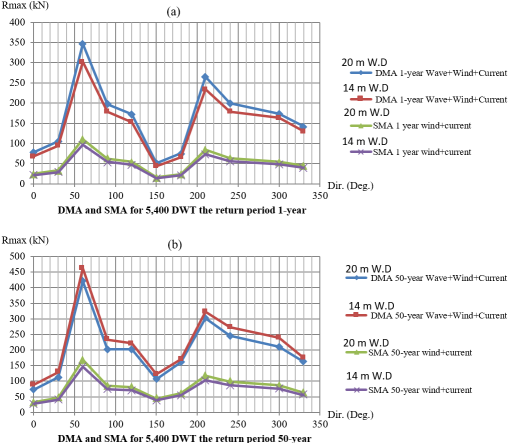
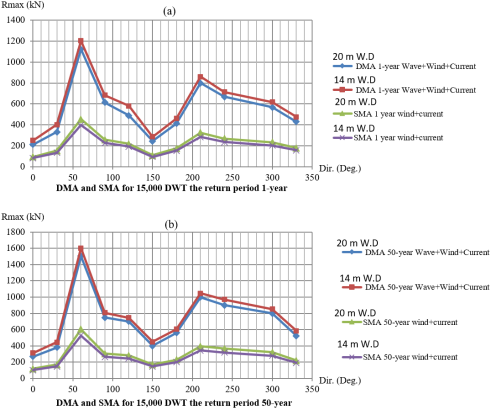
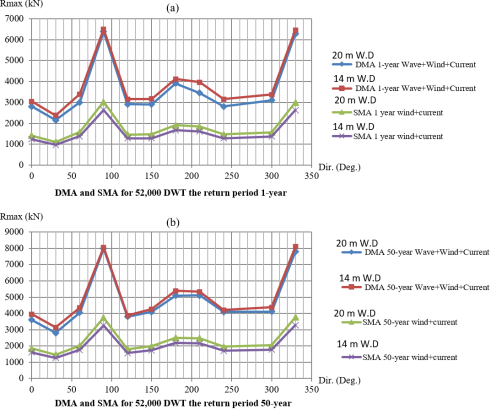
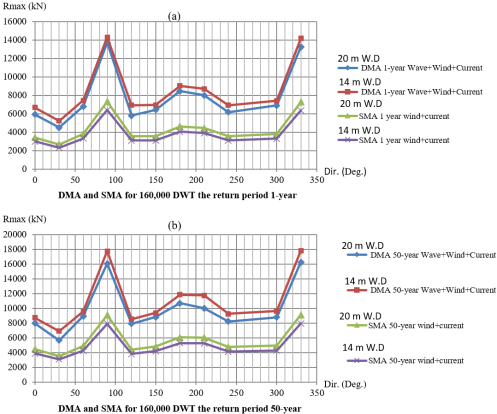
Figures 4, 5, 6 & 7 present the results of SMA and DMA for 5,400 DWT, 15,000 DWT, 52,000 DWT and 160,000 DWT, respectively, at water depths 14 m and 20 m, and at return periods of 1-year and 50-year.
It is obvious from these figures that the mooring forces depend on the directional loads of wind, waves and currents (with interval of 30 degrees). Moreover, the results showed that the maximum mooring forces for both SMA and DMA are always in the 60° and 210° directions.
These Figures also showed that the difference between the results at different depths is not very large and may appear equal in some cases, as in
Figure 6.
5.3. Dynamic Mooring Analysis Factor
Table 6.
The average at water depths 14m and 20m with return periods of 1-year and 50-year. Vessels Size (DWT) | Factor of Dynamic Mooring Analysis () |
1-year return period | 50-year return period |
Water Depth | Water Depth |
14m | 20m | 14m | 20m |
5,400 | 3.21 | 3.15 | 2.81 | 2.75 |
15,000 | 2.69 | 2.65 | 2.78 | 2.65 |
52,000 | 2.26 | 2.15 | 2.34 | 2.15 |
160,000 | 2.03 | 1.95 | 2.02 | 1.95 |
The Factor of Dynamic Mooring Analysis () is the factor required to relate static mooring forces (SMF) and dynamic mooring forces (DMF), which can be expressed as follows:
Table 6 shows the average
of mooring forces for water depths 14 m and 20 m at the return periods of 1-yaer and 50-year.
The “Y” and “X” shown in Equation (
7) will be considered equal to the Factor of Dynamic Mooring Analysis (
) and the Dead Weight Tonnage (DWT), respectively. Therefore, Equation (
7) can be formulated as follows:
Table 7.
The constants A and P for Equation (9), under 1-year and 50-year return periods. Return period | Constants of Exponential Regression Equation |
A | P |
1-year | 10.38 | -0.14 |
50-year | 7.15 | -0.11 |
Table 7 shows the constants value “A” and “P” at return periods of 1-year and 50-year for Equation (
9) in light of the concept of the nonlinear regression analysis.
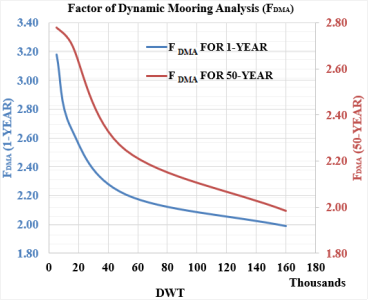
Figure 8 shows the relationship charts between the vessel's DWTs and the
at return periods of 1-year and 50-year. After that, the
factor will be multiplied by the Static Mooring Force (SMF) to predict the Dynamic Mooring Force (DMF), as shown in Equation (
8).
To evaluate the results of predicted dynamic mooring forces using Equation (
8), the statistical errors described in Section 4 will be used for this purpose.
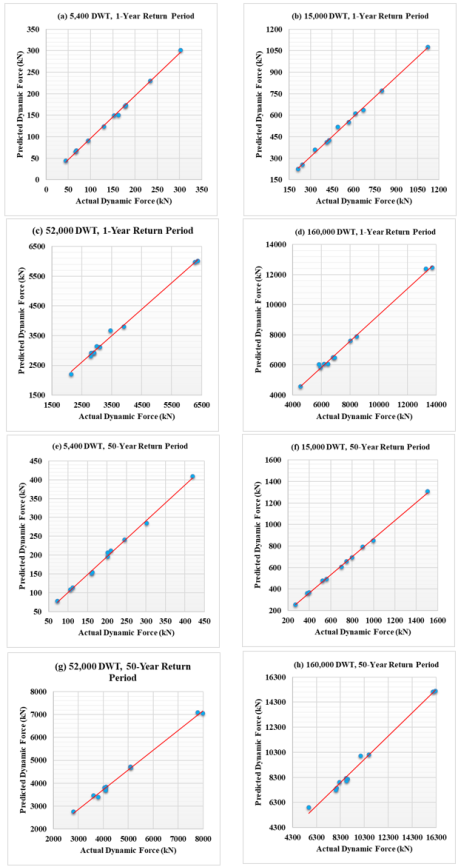
Figure 9 displays the correlation between the predicted and actual dynamic mooring forces.
Figure 9 (a), (b), (c) and (d) refer to the results with the return period 1-year, while (e), (f), (g) and (h) refer to the results of 50-year return period.
These charts generally showed that all predicted and actual DMAs were strongly correlated, indicating that the results generated by Equation (
8) have high performance and provide reliable results. Although some points deviate slightly from the correlation line, as shown in
Figure 9 (b), (c) and (h), they still have very good correlation and give satisfactory results.
Furthermore, the performance of the predicted values resulting from Equation (
8) was also evaluated using the Mean Absolute Error (MAE) and Scatter Index (SI%). The (MAE) is a measure commonly used in statistics to determine the average magnitude of errors for any set of prediction models. In this study, MAE refers to the average absolute error between the predicted and actual DMA results, in kilonewtons.
On the other hand, the SI% expresses a normalized measure of errors, which calculates the percentage deviation of the RMSE for any data set compared to the mean value of actual data. In this study, SI% refers to the percentage deviation of the RMSE for the predicted and actual DMA results relative to the mean value of actual DMA results.
Table 8 shows the statistical errors between the predicted and actual dynamic mooring forces by MAE and SI%.
The range of MAE values are from 2.74 kN to 231.44 kN for 1-year return period, while 4.34 kN to 393.78 kN for 50-year return period. These values are considered very small compared to the maximum, minimum and mean values in
Table 5, indicating high performance in the predicted DMA results by Equation (
8).
For instance, the MAE value for 160,000 DWT over the 1-year return period is 231.44 kN, which is very small relative to the maximum (14,004 kN), minimum (4,882 kN), and mean (8,182 kN) values for this vessel.
Table 8 also shows that the range of SI% values are from 2.37% to 5.25% for 1-year return period, and from 2.57% to 11.60% for 50-year return period. The smaller SI% values indicate that the predicted DMA results are consistently close to actual DMA results, meaning that the predicted DMA results by Equation (
8) are very accurate and have small errors.
Table 8.
Summary of statistical errors between actual and predicted dynamic mooring forces using Equation (8). Vessels Size (DWT) | 1-year return period | 50-year return period |
MAE (kN) | SI% | MAE (kN) | SI% |
5,400 | 2.74 | 2.37 | 4.34 | 2.57 |
15,000 | 15.90 | 3.34 | 65.61 | 11.60 |
52,000 | 173.61 | 5.25 | 212.01 | 5.54 |
160,000 | 231.44 | 3.91 | 393.78 | 4.45 |
6. Conclusions and Recommendations
In general, Static Mooring Analysis is an easier task than the Dynamic Mooring Analysis. Although Dynamic Mooring Analysis is an effective technique for calculating the mooring forces, it has some complexity in the modeling process and is usually performed by a third-party consultant. These reasons may prevent engineers from conducting good comprehensive assessment as well as estimating the effective cost of marine projects. Therefore, finding the relationship between the static and dynamic mooring forces has become extremely important.
In this study, Dynamic Mooring Analysis was performed using the Finite Element Model (SESAM marine software). The analyses were carried out at the return periods of 1-year and 50-year, and at water depths 14m and 20m. The DMA results were compared with the Static Mooring Analysis results to determine the average Factor of Dynamic Mooring Analysis (
) at different water depths and return periods. Then, nonlinear regression analysis based on the exponential equation was used to establish a relationship between the vessel's DWTs and
, which was formulated in Equation (
9). This equation represents the relationship between the static and mooring forces in light of a specific range of vessel DWTs, which we hope will be applied to other different vessel sizes to be more generalized. This Equation is also expressed in the form of charts (
Figure 8), which can be easily used to find the
at return periods of 1-year and 50-year.
Finally, the DMA prediction formula (Equation (
8)) was validated using measures of statistical error through the Correlation Coefficient (R), Mean Absolute Error (MAE), and Scatter Index (SI%).
The correlation charts (
Figure 9) confirmed that the predicted DMA results using Equation (
8) were strongly correlated with the actual DMA results. In addition, the small errors for MAE and SI% (
Table 5) also confirmed that Equation (
8) has high performance and reliable results.
In conclusion, the DMA prediction formula provided a good approach to determine dynamic mooring forces easily based on the vessel's DWT. Therefore, it can be said that the DMA prediction formula may serve as an alternative to dynamic mooring models during the feasibility studies, conceptual design and/or FEED phases of marine projects.
The authors hope that the DMA prediction methodology used in this research will encourage other researchers in the marine field to apply the same approach to other case studies in order to obtain other formulas that join SMA results with DMA results.
Abbreviations
DMA | Dynamic Mooring Analysis |
DMF | Dynamic Mooring Force |
DWT | Dead Weight Tonnage |
ECMWF | European Centre for Medium-Range Weather Forecasts |
FEED | Front-End Engineering Design |
LOA | Length Overall |
LBP | Length Between Perpendiculars |
LPG | Liquefied Petroleum Gas |
N/A | Not Applicable |
SMA | Static Mooring Analysis |
SMF | Static Mooring Force |
W.D | Water Depth |
Author Contributions
Hassan Salah: Conceptualization, Methodology, Resources, Supervision, Validation, Writing – original draft.
Walid Ali: Data curation, Formal Analysis, Visualization, Writing – review & editing.
Eslam Gamal: Investigation, Software, Writing – review & editing.
Conflicts of Interest
The authors declare no conflicts of interest.
References
| [1] |
Papanikolaou, A., 1985. On the Evaluation of Motions and Loads of Arbitrary Bodies in Waves. In: Proc. Inc. Symp. On Ocean Space Util. 85, Tokyo pp- 75–86.
|
| [2] |
Lee S., 2015. A numerical study on ship-ship interaction in shallow and restricted waterway, Int. J. Nav. Archit. Ocean Eng. 7, 920–938.
https://doi.org/10.1515/ijnaoe-2015-0064
|
| [3] |
OCIMF, 2008. Mooring Equipment Guidelines -MEG3. Oil Companies International Marine Forum, 3rd Edition.
|
| [4] |
PIANC (2002). Guidelines for the Design of Fenders Systems. Report of Maritime Navigation Commission Working Group 33, Permanent International Association of Navigation Congresses (PIANC).
|
| [5] |
British Standard BS 6349-1:2000, Maritime Structures - Part 1: Code of Practice for General Criteria.
|
| [6] |
British Standard BS 6349-4:2014, Maritime Works - Part 4: Code of Practice for Design of Fendering and Mooring Systems.
|
| [7] |
Natarajan, R., Ganapathy, C. Analysis of Moorings of a Berthed Ship. Marine Structures. 1995, 8(5), 481-499.
https://doi.org/10.1016/0951-8339(95)97305-R
|
| [8] |
Schelfn, T. E., Östergaard, C., The Vessel in Port: Mooring Problems. Marine Structures. 1995, 8(5), 451-479.
https://doi.org/10.1016/0951-8339(95)97304-Q
|
| [9] |
Molen, V, W., Moes, H. General Characteristics of South African Ports and the Safe Mooring of Ships. The 28th Southern African Transport Conference (SATC 2009), 308-314.
http://hdl.handle.net/2263/12030
|
| [10] |
Das, S. N., Kulkarni, S., Kudale, M. D. Design of Safe Mooring Arrangement for Large Oil Tankers. Procedia Engineering. 2015, (116), 528-534.
https://doi.org/10.1016/j.proeng.2015.08.322
|
| [11] |
Molen, V. W., Scott, D., Taylor, D., Elliott, T. Improvement of Mooring Configurations in Geraldton Harbour. Journal of Marine Science and Engineering. 2016, 4(3), 1-20.
https://doi.org/10.3390/jmse4010003
|
| [12] |
Stoschek, O., Leschka, S., Brüning, A., Hein, C. Optimizing Pier Structures using Dynamic Mooring Forces Modelling. The 34th PIANC-World Congress Panama City, Panama 2018.
http://www.pianc2018.com/
|
| [13] |
Ports Designer’s Handbook: Recommendations and Guidelines, Carl A. Thoresen, 2003.
|
| [14] |
SESAM user manual HydroD, 2011. Det Norske Veritas Software.
|
| [15] |
SESAM user manual Wadam, 2011. Det Norske Veritas Software.
|
| [16] |
Salah, H. Prediction of wave parameters off the Nile delta coast of Egypt using nonlinear regression analysis. International Journal of Science and Research (IJSR). 2017, 6(9), 187-195.
https://doi.org/10.21275/ART20176527
|
Cite This Article
-
ACS Style
Salah, H.; Ali, W.; Gamal, E. Modified Static Mooring Analysis of Oil and Gas Marine Jetties Compared with Dynamic Mooring Analysis. Eng. Appl. Sci. 2026, 11(1), 20-32. doi: 10.11648/j.eas.20261101.14
Copy
|
Download
AMA Style
Salah H, Ali W, Gamal E. Modified Static Mooring Analysis of Oil and Gas Marine Jetties Compared with Dynamic Mooring Analysis. Eng Appl Sci. 2026;11(1):20-32. doi: 10.11648/j.eas.20261101.14
Copy
|
Download
-
@article{10.11648/j.eas.20261101.14,
author = {Hassan Salah and Walid Ali and Eslam Gamal},
title = {Modified Static Mooring Analysis of Oil and Gas Marine Jetties Compared with Dynamic Mooring Analysis},
journal = {Engineering and Applied Sciences},
volume = {11},
number = {1},
pages = {20-32},
doi = {10.11648/j.eas.20261101.14},
url = {https://doi.org/10.11648/j.eas.20261101.14},
eprint = {https://article.sciencepublishinggroup.com/pdf/10.11648.j.eas.20261101.14},
abstract = {Marine jetties form an important link between land and sea areas for the transport of oil and gas products. Mooring forces are considered a key factor in marine jetties design, which can be calculated using static or dynamic mooring analysis. In general, the dynamic mooring analysis (DMA) is considered a more complex task compared to static mooring analysis (SMA), due to the dynamic behavior of mooring lines and body motion of moored vessels. So, DMA always provides the most accurate and reliable results. Although the DMA is the ideal choice for detailed engineering projects, in feasibility studies and the FEED phase it will be time-consuming and less added value. In this paper, a methodology for calculating mooring forces using a modified SMA was implemented through the so-called dynamic mooring analysis factor (FDMA), which will take into account the dynamic response of the wave forces. For this purpose, more than 190 sea state load combinations were carried out, including different return periods, water depths, and wide range of vessel sizes. To determine the mooring forces in vessels' mooring lines, SMA is performed using the OCIMF approach, while DMA is performed by the Finite Element Model (SESAM Marine Software). The nonlinear regression concept was used to correlate the results of the SMA and DMA in conjunction with the vessel’s dead weight tonnages (DWTs). Finally, the dynamic mooring results using the modified SMA were validated against the DMA results generated by SEASM Marine Software, which gave promising results. As a conclusion; using the modified SMA approach will be as an alternative solution to the DMA approach at earlier stages of any project. This will also facilitate selection of the appropriate mooring pattern on marine jetties and the determination of the size and material of the mooring lines, thus contributing effectively to the cost estimation phase.},
year = {2026}
}
Copy
|
Download
-
TY - JOUR
T1 - Modified Static Mooring Analysis of Oil and Gas Marine Jetties Compared with Dynamic Mooring Analysis
AU - Hassan Salah
AU - Walid Ali
AU - Eslam Gamal
Y1 - 2026/01/26
PY - 2026
N1 - https://doi.org/10.11648/j.eas.20261101.14
DO - 10.11648/j.eas.20261101.14
T2 - Engineering and Applied Sciences
JF - Engineering and Applied Sciences
JO - Engineering and Applied Sciences
SP - 20
EP - 32
PB - Science Publishing Group
SN - 2575-1468
UR - https://doi.org/10.11648/j.eas.20261101.14
AB - Marine jetties form an important link between land and sea areas for the transport of oil and gas products. Mooring forces are considered a key factor in marine jetties design, which can be calculated using static or dynamic mooring analysis. In general, the dynamic mooring analysis (DMA) is considered a more complex task compared to static mooring analysis (SMA), due to the dynamic behavior of mooring lines and body motion of moored vessels. So, DMA always provides the most accurate and reliable results. Although the DMA is the ideal choice for detailed engineering projects, in feasibility studies and the FEED phase it will be time-consuming and less added value. In this paper, a methodology for calculating mooring forces using a modified SMA was implemented through the so-called dynamic mooring analysis factor (FDMA), which will take into account the dynamic response of the wave forces. For this purpose, more than 190 sea state load combinations were carried out, including different return periods, water depths, and wide range of vessel sizes. To determine the mooring forces in vessels' mooring lines, SMA is performed using the OCIMF approach, while DMA is performed by the Finite Element Model (SESAM Marine Software). The nonlinear regression concept was used to correlate the results of the SMA and DMA in conjunction with the vessel’s dead weight tonnages (DWTs). Finally, the dynamic mooring results using the modified SMA were validated against the DMA results generated by SEASM Marine Software, which gave promising results. As a conclusion; using the modified SMA approach will be as an alternative solution to the DMA approach at earlier stages of any project. This will also facilitate selection of the appropriate mooring pattern on marine jetties and the determination of the size and material of the mooring lines, thus contributing effectively to the cost estimation phase.
VL - 11
IS - 1
ER -
Copy
|
Download