Research Article | | Peer-Reviewed

The Acquisition of Japanese Passive Sentences by Chinese Beginner Learners: A Longitudinal Study

Received: 7 January 2026     Accepted: 19 January 2026     Published: 4 February 2026
Views:       Downloads:
Abstract

The acquisition of Japanese passive sentences presents a well-documented challenge for Chinese-speaking learners. However, longitudinal research on how learners in foreign language (JFL) classrooms comprehend and process these structures remains scarce. This study addresses this gap by tracking five beginner-level learners in a Chinese high school over approximately 18 months through repeated grammaticality judgment and error correction tasks. We examined five sub-constructs: voice selection, verb conjugation, possessor passive, indirect passive, and agent selection. Results indicated that the core difficulty of learners lay in locating errors rather than correcting them. Developmental trajectories diverged significantly across sub-constructs. Verb conjugation and indirect passives improved rapidly, consistent with the role of input-driven noticing. In contrast, agent selection and voice choice remained persistently difficult, while possessor passives exhibited a U-shaped development pattern, indicating interlanguage restructuring. Crucially, learners heavily relied on a “ni + passive” form chunk as a local processing cue-a strategy explainable by Andersen’s One-to-One Principle and reinforced by textbook bias. This led to systematic overuse and omission errors. The findings underscore that JFL learners’ acquisition of passives is hindered by a bottleneck in metalinguistic error identification, uneven development across construction types, and dependence on overly simplistic processing strategies. Pedagogical implications highlight the need for instruction that enhances form-meaning mapping and contextualized practice to foster more flexible and accurate usage.

Published in Education Journal (Volume 15, Issue 1)
DOI 10.11648/j.edu.20261501.12
Page(s) 7-17
Creative Commons

This is an Open Access article, distributed under the terms of the Creative Commons Attribution 4.0 International License (http://creativecommons.org/licenses/by/4.0/), which permits unrestricted use, distribution and reproduction in any medium or format, provided the original work is properly cited.

Copyright

Copyright © The Author(s), 2026. Published by Science Publishing Group

Keywords

Japanese Passive Sentences, Second Language Acquisition, Longitudinal Study, Grammaticality Judgment, Processing Strategy

1. Introduction
The acquisition of Japanese passive sentences has long been identified as a persistent challenge for Chinese-speaking learners of Japanese . This difficulty extends beyond the level of syntactic construction, requiring consideration within the broader framework of perspective and voice interactions . Perspective refers to “the speaker’s subjective position from which an event is viewed”, while voice is a grammatical category that determines how participants in an action are mapped onto sentence constituents. Okuzu illustrates this relationship using a scene from the opera Carmen: when the audience’s perspective is placed on José, an active sentence is formed; if the perspective shifts to Carmen, a passive sentence emerges . Moreover, Japanese discourse adheres to a “principle of perspective persistence” , whereby once a subject is established, it tends to be maintained unless there is a pragmatic need to shift-a tendency that frequently motivates the use of passive constructions.
In determining acquisition targets for passive sentences, native-speaker usage provides an important reference point. However, such usage varies considerably across genres and contexts. Watabe et al. report that Japanese native speakers use passive sentences relatively frequently in personal narratives , whereas Takeda finds that in natural conversation, passives are used more sparingly than active sentences and are often concentrated around specific verbs such as iu (“to say”) . At the same time, passive constructions such as to nobe-rareteiru (“it is stated that…”) and bunseki-sareteiru (“it is analyzed that…”) are essential in academic writing , underscoring the importance of ability to use passives appropriately across different communicative contexts.
Despite its pedagogical relevance, research specifically addressing the acquisition of Japanese passive sentences remains limited. Existing studies have largely focused on error analysis and the order of acquisition. Error studies involving Chinese learners consistently point to L1 transfer effects, with commonly observed issues including: (1) omission of the passive morpheme , (2) avoidance of passives with inanimate subjects, and (3) difficulty in maintaining “perspective unity” in discourse . Research on acquisition order generally agrees that direct passives are acquired earlier than indirect passives . Watanabe further reveals that in narrative tasks, native speakers tend to maintain perspective on a single character through passive usage, whereas learners frequently switch subjects and employ active constructions-suggesting underlying challenges in mastering perspective management .
Nevertheless, several gaps persist in the current literature. First, most studies have examined learners in second language (JSL) settings, with limited attention to those learning Japanese as a foreign language in classroom-based environments. Second, research has predominantly relied on production data, offering little insight into learners’ real-time comprehension, judgment, or cognitive processing of passive structures. Third, the majority of studies are cross-sectional in design, leaving the longitudinal development of passive sentence acquisition underexplored. Although Japanese has been increasingly introduced as a formal subject in secondary schools worldwide , few studies have systematically traced the acquisition processes of beginner-level learners in such instructional contexts.
To address these gaps, the present longitudinal study is guided by the following research questions: (1) How do the abilities of learners to identify and correct errors in Japanese passive sentences develop over an extended period of classroom learning? (2) How do developmental trajectories differ across sub-constructs of the passive (e.g., direct vs. indirect passives, agent selection, voice choice)? (3) What cognitive processing strategies do learners employ when comprehending and judging passive sentences, and how might these strategies explain persistent difficulties?
By examining these questions through repeated grammaticality judgment and error correction tasks administered over approximately 18 months, this study seeks to illuminate the comprehension and processing mechanisms underlying passive sentence acquisition in a JFL setting. The findings are expected to advance theoretical understanding of key SLA processes such as noticing, interlanguage restructuring, and chunk-based processing, while also offering evidence-based implications for the teaching of Japanese passive sentences in formal classroom contexts.
2. Materials and Methods
2.1. Participants
A longitudinal study was conducted over approximately one and a half years, from March 2021 to October 2022, involving five Japanese language learners from a high school in China. The aim was to elucidate the acquisition process of passive sentences by beginner-level learners in a foreign language context. All participants had no prior experience studying in Japan and had started learning Japanese from scratch. To control for the potential effects of varying proficiency levels, participants were selected based on their SPOT90 test scores, which fell within the range of 37 to 40 points, corresponding to a beginner level. The investigation commenced immediately after the participants had received formal instruction on passive sentences. Detailed information regarding the participants is provided in Table 1.
Table 1. Participant Information.

Participant

Japanese Learning Period at Start

SPOT90 Score

Number of Tests

A

1 year 5 months

37

18

B

1 year 5 months

38

18

C

1 year 5 months

41

18

D

1 year 5 months

39

18

E

1 year 5 months

40

18

2.2. Materials and Design
In this study, a grammaticality judgment test focusing on passive sentences was administered monthly over approximately one and a half years, resulting in the collection of data from 18 testing sessions. The test structures were developed based on previous research and included erroneous sentences containing mistakes in the following five categories: (1) appropriate use of passive versus active voice, (2) verb conjugation, (3) possessor passive constructions, (4) indirect passive constructions, and (5) selection of subject and agent in passive sentences. Each erroneous sentence contained one targeted error. Every test session comprised 30 sentences (5 categories × 6 structures). The test required participants to perform two tasks: grammaticality judgment and error correction. The maximum score for each task was 30 points.
Table 2. Examples of Test Structures.

Test Items

Correctness

(1) Voice Selection (Active/Passive) Questions

日本語を英語に翻訳した。

(I/Someone) translated Japanese into English.

Correct

急に後ろから声をかけて、びっくりしました。

(Someone) suddenly called out to (me) from behind, and (I) was startled.

Incorrect

(2) Verb Conjugation Questions

残りの1分で相手チームの選手にゴールを入れされてしまった。

In the last minute, (we/I) had a goal scored (on us) by the opposing team's player.

Incorrect

(3) Possessor Passive Questions

大切な本は母に捨てられました。

My precious book was thrown away by my mother.

Incorrect

(4) Indirect Passive Questions

スーパーで子供が泣かれた。

(I) was affected by a child crying in the supermarket.

Incorrect

(5) Agent Selection Questions

教室は田中さんに掃除されたので、直接帰ってもいいです。

The classroom was cleaned by Tanaka, so you may go home directly.

Incorrect

3. Results
This chapter presents a multifaceted analysis of the learners' acquisition process of passive sentences, based on longitudinal data collected over approximately one and a half years. The analysis proceeds in three stages. First, Section 3.1 compares learner performance on the two tasks-grammaticality judgment and error correction-to elucidate the application of their explicit knowledge and identify the core difficulties in the acquisition process. Second, Section 3.2 focuses on individual sub-constructs of passive sentences, classifying their acquisition trajectories into “rapidly developing” “slowly developing” and “variable” patterns to examine the distinct acquisition mechanisms for each construct in detail. Finally, Section 3.3 investigates the persistent difficulties observed in “Voice Selection (Active/Passive)”, exploring the underlying language processing strategies employed by learners and the potential causes of their errors.
3.1. Learners' Grammaticality Judgment, Error Location, and Error Correction
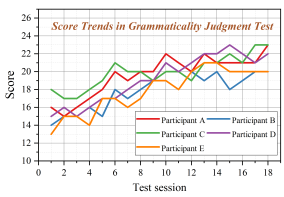
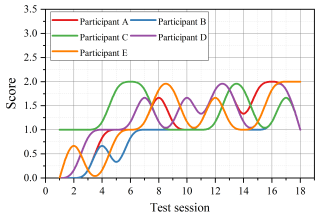
Figure 1. The results of the Grammaticality Judgment Test.
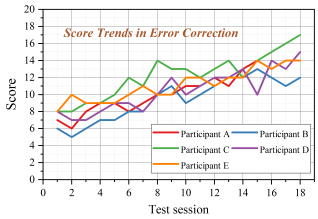
The results of the Grammaticality Judgment Test and the Error Correction Task are presented in Figures 1 and 2, respectively.
Figure 2. The results of the Error Correction Task.
The tasks of grammaticality judgment and error correction tap into different types of linguistic knowledge and cognitive operations . Specifically, they require different types of linguistic knowledge (i.e., implicit vs. explicit knowledge) and abilities, with learners showing varying degrees of mastery. Based on grammaticality judgment tests, Ellis categorized the operations required of learners into four stages: (1) discrimination between grammatical and ungrammatical sentences, (2) location of the error, (3) correction of the error, and (4) description of the error. Ellis also characterized the abilities required for operations through . (1) Operation requires comprehension and relies mainly on implicit knowledge. (2) Operation requires explicit knowledge as learners need to be consciously aware of what is wrong and how it is wrong, though no actual production is involved. (3) Operation requires production ability and relies mainly on explicit knowledge. (4) Operation requires production ability along with the metal linguistic ability to explain the error, in addition to explicit knowledge.
Therefore, this study calculated scores for correctly identified errors based on results from the Grammaticality Judgment Test and Error Correction Task, compiling learners' performance in grammaticality judgment, error location, and error correction.
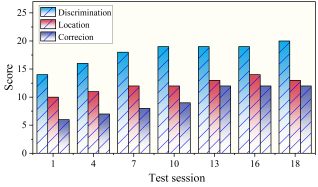
As shown in Figures 3 and 4 above, data from seven test sessions for Participants C and D were extracted, showing their correct response rates for grammaticality judgment, error location, and error correction. Examining the results from Session 1 to Session 10, it was found that both error location and error correction were challenging tasks for Participants C and D. During the approximately one-year period following grammar instruction, learners initially found it difficult to grasp the overall sentence structure. Even when they noticed the presence of an error, providing an appropriate correction remained a challenging task.
Figure 3. Participant C’s Accuracy Rates for Grammaticality Judgment, Error Location, and Error Correction Across Sessions.
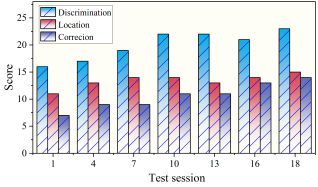
Figure 4. Participant D’s Accuracy Rates for Grammaticality Judgment, Error Location, and Error Correction Across Sessions.
However, when examining the results from Session 13 to Session 18, while error location ability of learners did not show substantial improvement, they were generally able to correct structures they could successfully locate. This indicates that during this period, the primary difficulty for learners lay in locating ungrammatical elements within sentences. This trend was also observed among other participants.
Locating errors within sentences requires learners to possess a relatively clear understanding of the relevant grammatical rules and functions. In other words, unless the connection between linguistic forms and their meaning/function becomes consciously noticed by learners, the acquisition process may stagnate and fail to progress to the production stage.
3.2. Acquisition Characteristics of Different Aspects of Passive Sentences
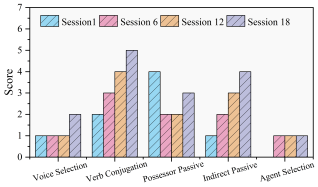
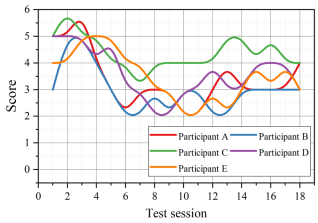
Based on learners' performance on the error correction task, this section analyzes the acquisition characteristics of various aspects of passive sentences. The score trends for different question types in the error correction task can be observed by examining the results of Participants A and B.
Figure 5. Participant A’s Error Correction Scores for Five Passive Sub-constructs Across Test Sessions.
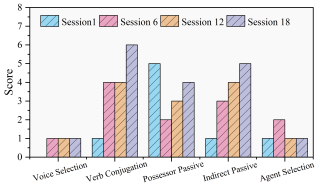
Figure 6. Participant B’s Error Correction Scores for Five Passive Sub-constructs Across Test Sessions.
As shown in Figures 5 and 6, a comprehensive analysis of the 18-session longitudinal data revealed that the acquisition of passive sentences by the five learners did not follow a monotonic progression but rather exhibited complex trajectories that varied across different constructs. The difficulties in acquisition tended to concentrate on areas requiring deeper cognitive processing, such as syntactic choice and the comprehension of semantic roles, rather than on superficial morphological aspects. Analysis of the learners' error correction results enabled a clear classification of acquisition patterns into the following three categories based on their developmental pace and trajectory.
3.2.1. Rapidly Developing Constructs
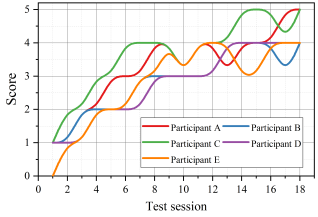
The score trends for test structures related to Verb Conjugation and Indirect Passive in the error correction task are shown below. These two constructs can be characterized as showing relatively early improvement following instruction.
Figure 7. Change in Accuracy for Verb Conjugation in Error Correction Tasks.
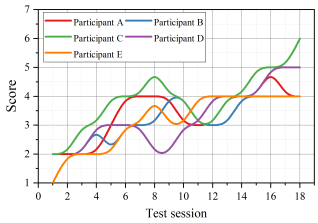
Figure 8. Change in Accuracy for Indirect Passive in Error Correction Tasks.
As shown in Figure 7, errors due to overgeneralization of the “-rareru” form (e.g., “yogorareru”, “naorareru”) were prominent immediately following instruction. This occurred because learners failed to distinguish between verb types (Ichidan/Godan) and applied the newly learned conjugation rule for Ichidan verbs to all verbs. This initial overgeneralization can be interpreted as characteristic of a stage where systematic knowledge remains underdeveloped. However, as learners gained increased exposure to Japanese input over time, their knowledge of verb classification deepened, leading to the acquisition of a separate rule system for Godan verbs (vowel-stem → a-stem + reru). In other words, accumulated language experience enabled the development of initial simplistic rules into a more refined system.
As observed in Figure 8, the accuracy rate for this construct was also low initially following instruction. Indirect passives represent a construction unique to Japanese, with virtually no equivalent in the learners’ L1 (Chinese) or prior language experience. Consequently, learners initially struggled to map the form to its meaning/function, such as expressing “adversity”. However, as overall proficiency increased and learners received repeated exposure to this form in the input (noticing), form-function mapping gradually occurred, leading to rapid deepening of understanding. As noted by Schmidt, this constitutes a typical example where noticing served as a crucial initial step in acquisition, demonstrating how both the quantity and quality of input may facilitate the acquisition process .
3.2.2. Slowly Developing Constructs
As shown in Figures 9 and 10, both Agent Selection and Voice Selection (Active/Passive) consistently demonstrated low accuracy rates throughout the investigation period, with scores remaining low even as the duration of Japanese study increased. These constructs can be considered relatively difficult for learners to acquire.
Figure 9. Persistently Low Accuracy in Agent Selection Across Sessions.
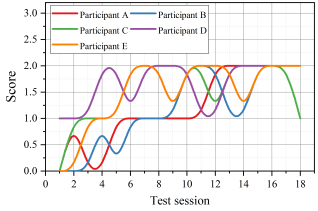
Figure 10. Persistently Low Accuracy in Voice Selection (Active/Passive) Across Sessions.
For example, learners persistently judged as “correct” ungrammatical sentences related to Agent Selection, such as “(×) Tanaka san wa watasi ni nagurareta ”. This indicates that while learners could comprehend the grammatical morphology (the marking of the agent with “ni”), they experienced significant difficulty with discourse-pragmatic judgments-determining which subject is natural from perspectives such as “speaker's viewpoint” or “recipient of benefit/adversity”. This difficulty is likely exacerbated in classroom environments where opportunities for natural contextual practice are limited.
Meanwhile, errors in Voice Selection (Active/Passive), as will be detailed later, can be categorized into “omission” and “overuse”. Both error types require complex judgments involving multiple factors-not merely grammatical rules-such as “maintenance of perspective”, “passives with inanimate subjects”, and “morphological similarity to spontaneous/potential forms”. As will be elaborated in Section 4.3, the complexity of these judgments leads learners to rely on simpler processing strategies.
3.2.3. Constructs Exhibiting U-shaped Development
Figure 11. U-shaped Development in the Acquisition of Possessor Passive.

As shown in Figure 11, the score trend for Possessor Passive exhibited a distinct pattern of U-shaped development, differing from other constructs. A relatively high accuracy rate was observed immediately after instruction, which was followed by a marked regression and subsequent stagnation at a low level.
This phenomenon can be explained as overgeneralization stemming from incomplete underlying representation. Initially, learners could provide correct answers by memorizing and imitating prototypical constructions such as “Otouto wa haha ni atama wo nagurareta”. As learning progressed and learners encountered a wider variety of sentences, their interlanguage system underwent restructuring. The distinction between Possessor Passive and Direct Passive became blurred, leading them to overapply the possessor passive in inappropriate contexts, which caused the observed regression in accuracy. As Tanaka indicates, this is not a phenomenon unique to Chinese-speaking learners but rather a universal characteristic of U-shaped development in SLA, representing a transitional phase where performance temporarily declines due to a conflict between new linguistic data and the existing interlanguage grammar.
3.3. The "ni" as a Local Cue in Passive Sentence Processing
A detailed analysis of the persistent difficulties in Voice Selection (Active/Passive) (Figure 10) reveals that errors can be categorized into two contrasting patterns: the omission of required passive sentences and the overuse of passive sentences in inappropriate contexts (Tables 3 and 4). While seemingly contradictory, these error patterns likely share a common underlying cause.
Table 3. Test Sentences Related to Omission of Passive Voice and Learner Responses.

Session

Problem Sentence

Grammaticality

Correct Responses(n=5)

Analysis / Learner Error Pattern

1

花子は電車の中で、財布を盗んだ

Hanako stole a wallet on the train.

Incorrect

0

Omission: Failed to use passive (盗まれた).

3

後ろから声をかけて、びっくりしました。

(Someone) called out from behind, and (I) was startled.

Incorrect

0

Omission: Failed to use passive (かけられて).

4

順番が来て、お名前を呼ばれたら、すぐこちらへ来てくれませんか。

When your turn comes and you are called, please come over here immediately.

Correct

1

Misjudgment: Correct passive misjudged as incorrect.

4

順番が来て、お名前を呼んで、すぐこちらへ来てくれませんか

When your turn comes and (you) call (your) name, please come over here immediately.

Incorrect

-

Active form used instead of passive.

6

(×)年齢を聞いたと、29歳と答えることにしている

When (someone) asks (my) age, (I) make it a rule to answer 29.

Incorrect

0

Omission: Failed to use passive (聞かれたと).

8

(×)ワインはぶどうから作った

(They) make wine from grapes.

Incorrect

1

Omission: Failed to use passive (作られる).

10

中国で珍しい動物が発見された。

A rare animal was discovered in China.

Correct

1/5

Misjudgment: Correct passive misjudged as incorrect.

10

中国で珍しい動物が発見した。

A rare animal discovered (something) in China.

Incorrect

-

Active form with inanimate subject.

11

(×)私は階段で背中を押して転びました。

On the stairs, (someone) pushed (my) back and (I) fell.

Incorrect

1

Omission: Failed to use passive (押されて).

12

この歌を聞くと、子供時代のことが思い出される。

When (I) hear this song, childhood memories are recalled (come to mind).

Correct

2

Misjudgment: Correct passive (spontaneous) misjudged.

12

この歌を聞くと、子供時代のことが思い出した。

When (I) hear this song, childhood memories recalled (something).

Incorrect

-

Active form used.

14

最近、色々な種類の電子辞書が売られている。

Recently, various kinds of electronic dictionaries are being sold.

Correct

1

Misjudgment: Correct passive misjudged as incorrect.

14

最近、色々な種類の電子辞書が売っている。

Recently, various kinds of electronic dictionaries are selling (something).

Incorrect

1

Active form with inanimate subject.

18

(×)下手だったので、何度も同じことを注意した。

Because (I) was unskilled, (someone) pointed out the same thing many times.

Incorrect

1

Omission: Failed to use passive (注意された).

(Partial omission)

Table 4. Problem Sentences Related to Overuse of Passive Voice.

Session

Problem Sentence

Grammaticality

Correct Responses (n=5)

Analysis / Learner Error Pattern

1

日本語を英語に翻訳した。

(I) translated Japanese into English.

Correct

0

Overuse: Correct active misjudged; passive (翻訳された) incorrectly chosen.

1

日本語を英語に翻訳された。

Japanese was translated into English (by someone).

Incorrect

-

Passive overapplied.

3

私は李さんを結婚式に招待するつもりです。

I intend to invite Ms. Li to the wedding.

Correct

0

Overuse: Correct active misjudged; passive (招待される) incorrectly chosen.

3

私は李さんを結婚式に招待されるつもりです。

I intend to be invited by Ms. Li to the wedding.

Incorrect

-

Passive overapplied, altering meaning.

4

スピーチ大会のことを誰に聞かれましたか。

By whom were you asked about the speech contest?

Incorrect

0

Overuse: Passive (聞かれましたか) used where active (聞きましたか) is required.

5

ビールを冷蔵庫に入れた。

(I) put the beer in the refrigerator.

Correct

1

Overuse: Correct active misjudged; passive (入れられた) incorrectly chosen.

ビールを冷蔵庫に入れられた。

The beer was put in the refrigerator (by someone).

Incorrect

-

Passive overapplied.

6

これから勉強に力を込められる。

From now on, (I) can put effort into studying.

Incorrect

0

Overuse/Form Confusion: Potential form (込められる) misanalyzed as passive.

8

子供は親に頼めたので、安心しました。

The child was able to rely on the parent, so (I) felt relieved.

Correct

1

Overuse: Correct active/potential misjudged; passive (頼まれた) incorrectly chosen.

子供は親に頼まれたので、安心しました。

The child was asked/relied on by the parent, so (I) felt relieved.

Incorrect

-

Passive overapplied, altering meaning.

11

レストランに帽子を忘れられました。

(I) had (my) hat forgotten at the restaurant.

Incorrect

1

Overuse: Adversity passive (忘れられる) used unnaturally for a simple action (忘れました).

13

子供にいい名前をつけるために、私は辞書を調べた。

In order to give my child a good name, I consulted a dictionary.

Correct

0

Overuse: Correct active misjudged; passive (つけられる) incorrectly chosen.

子供にいい名前をつけられるために、私は辞書を調べた。

In order to be given a good name by/for my child, I consulted a dictionary.

Incorrect

-

Passive overapplied, creating an awkward purpose clause.

15

不注意で壁にぶつかられました。

Due to carelessness, (I) was hit by the wall.

Incorrect

1

Overuse/Form Confusion: Spontaneous/adversity passive (ぶつかられる) used unnaturally for a self-agentive action (ぶつかりました).

(Partial omission)

The follow-up interviews revealed that many learners reported a tendency to select the passive form when the particle “ni” was present in a sentence, and to choose the active form when “ni” was absent. This strongly suggests that learners process “ni + passive form” as a single, chunked unit.
This type of unit-formation strategy is commonly observed in the early stages of second language acquisition. As explained by Andersen's One-to-One Principle, learners exhibit a cognitive tendency to initially map one form (in this case, “ni”) exclusively to one function (here, passive voice), creating a simplified rule to comprehend complex grammatical phenomena .
Furthermore, an external factor strongly suspected of promoting and reinforcing this strategy is transfer of training. An analysis of the textbook used by the learners revealed that out of 24 example sentences introducing the passive voice, 22 (91.7%) were direct passive sentences where the agent was marked by “ni”. This overwhelming bias towards “ni” likely led learners to form a potent yet incomplete schema-“passive sentence = ‘ni’ + ‘reru/rareru’”-which in turn makes it difficult for them to make flexible, context-appropriate choices between the active and passive voices.
4. Conclusions
This study, through a year-and-a-half-long longitudinal investigation of learners in a JFL environment at Chinese secondary institutions, has elucidated the characteristics of comprehension and processing in the acquisition of Japanese passive sentences. The main findings can be summarized as follows.
First, it was confirmed that the primary difficulty in acquisition lies in “error identification”-the task of locating ungrammatical elements within a sentence. As Ellis notes, classroom learners monitor their language using explicit knowledge . This study demonstrated that learners face significant difficulty in "discovering" errors in passive sentences even before attempting to “correct” them. This suggests that for acquisition to progress to the "production" stage, it is not sufficient to merely know the grammatical form; it is essential for the connection between linguistic forms and their meaning/function to be consciously noticed. For teaching practice, this reaffirms the importance of instruction that promotes noticing and deepens form-meaning mapping.
Second, the findings strongly suggest that learners employ a strategy reliant on a “ni + passive form” chunk as a processing unit. This strategy involves using the case particle “ni” as a primary cue for passive sentences, which in turn causes “overuse” of the passive in inappropriate contexts where “ni” is present, and “omission” of the passive in contexts where it is required but “ni” is absent. The formation of such a processing unit aligns with Andersen's One-to-One Principle, which describes learners’ cognitive tendency to initially map one form to one function . Furthermore, analysis of the textbook used revealed a significant bias towards “ni” in example sentences, suggesting that "transfer of training" likely influenced the formation of this strategy. Consequently, for effective instruction, it is necessary not only to teach grammatical forms but also to increase activities that promote noticing and form-meaning mapping, and to provide practice in making appropriate choices across diverse contexts. This will help learners move beyond simplistic chunking strategies and build more flexible and accurate language ability.
Third, it was confirmed that even within passive sentences, the difficulty of acquisition and developmental trajectories differ across constructs. While “Verb Conjugation” and “Indirect Passive” were relatively easier to acquire, persistent difficulties were observed with “Agent Selection” and “Voice Selection (Active/Passive)”. Additionally, “Possessor Passive” exhibited a complex developmental pattern of “U-shaped development”, indicating that this is a universal feature of interlanguage, not one limited to Chinese-speaking learners.
Future research should further develop the verification of the “ni + passive form” strategy. For instance, employing online processing tasks using eye-tracking equipment to directly measure how learners visually attend to and process “ni” in sentences, or utilizing a wider variety of task types to examine in detail how the usage and position of “ni” influence processing. Secondly, verifying the effects of pedagogical intervention is also crucial. Investigating how learners' processing strategies and acquisition outcomes change through instruction designed to consciously promote form-meaning mapping and through improvements in teaching materials is essential for translating the findings of this study into practical applications.
Abbreviations

JFL

Japanese as a Foreign Language

JSL

Japanese as a Second Language

SLA

Second Language Acquisition

L1

First Language/Mother Tongue

Author Contributions
Xi Chen is the sole author. The author read and approved the final manuscript.
Funding
This research received no external funding.
Data Availability Statement
The raw data supporting the conclusions of this article (i.e., individual participants’ longitudinal test scores) cannot be made publicly available due to privacy and ethical restrictions, as the data contain information that could compromise the privacy of the minor participants. Anonymized and aggregated data are available from the corresponding author upon reasonable request, subject to compliance with ethical guidelines and data protection agreements.
Conflicts of Interest
The author declares no conflicts of interest.
References
[1] Feng, F. (1993). On influences of the mother tongue-Chinese language on the learning processes of Japanese passive voice. Japanese Journal of Educationgy, 41, 388-398.
[2] Tanaka, M. (1997). Factors affecting the acquisition of point of view, voice, and complex sentences. Journal of Japanese Language Education, 92, 107–118.
[3] Okuzu, K. (1992). The perspective in ‘Carmen’: Voice and subjectivity. In Perspective and Linguistic Behavior (pp. 3–22). Hituzi Syobo.
[4] Okuzu, K. (1983). Why the passive? A case study from the perspective. Studies in the Japanese Language, 132, 65–80.
[5] Watabe, M., Brown, C., & Ueta, Y. (1991). Transfer of discourse function: Passives in the writings of ESL and JSL learners. IRAL: International Review of Applied Linguistics in Language Teaching, 29(2), 115–134.
[6] Takeda, T. (2005). How to teach natural-flowing utterances: Tips from passive use in native speakers’ natural conversations. In New Directions in Applied Linguistics of Japanese (pp. 49–60). Kuroshio Publishers.
[7] Tanaka, M. (2010). A study on the acquisition of passive voice in Japanese as a foreign/second language: Direction for future research. Acquisition of Japanese as a Second Language, 13, 114–146.
[8] Mochizuki, K. (2009). Error analysis in voice by advanced-level Chinese learners of Japanese: A comparative analysis with Chinese. Area and Culture Studies, 78, 85–106.
[9] Watanabe, A. (1995). Actual situation of the use of Japanese passive sentences by native Chinese speakers and their background: Hypothesis setting from the contrast with the mother tongue. Language, Culture and Japanese Language Education, 9, 216–228.
[10] Sawetaiyaram, T. (2008). The acquisition of passive voice in discourse functions: The case of Thai-speaking learners. Acquisition of Japanese as a Second Language, 11, 107–126.
[11] Ōfune, C. (2020). An analysis of research trends in Japanese language education at the secondary level in overseas countries: Toward a development of theory on Japanese language education for secondary school students. Journal of Japanese Language Teaching, 175, 100–114.
[12] Ellis, R. (1991). Grammaticality judgments and second language acquisition. Studies in Second Language Acquisition, 13(2), 161–186.
[13] Schmidt, R. (2001). Attention. In P. Robinson (Ed.), Cognition and Second Language Instruction (pp. 3–32). Cambridge University Press.
[14] Andersen, R. (1984). The One to One Principle of Interlanguage Construction. Language Learning, 34(4), 77–95.
[15] Ellis, R. (1993). Second language acquisition and the structural syllabus. TESOL Quarterly, 27(1), 91–113. HYPERLINK "
Cite This Article
  • APA Style

    Chen, X. (2026). The Acquisition of Japanese Passive Sentences by Chinese Beginner Learners: A Longitudinal Study. Education Journal, 15(1), 7-17. https://doi.org/10.11648/j.edu.20261501.12

    Copy | Download

    ACS Style

    Chen, X. The Acquisition of Japanese Passive Sentences by Chinese Beginner Learners: A Longitudinal Study. Educ. J. 2026, 15(1), 7-17. doi: 10.11648/j.edu.20261501.12

    Copy | Download

    AMA Style

    Chen X. The Acquisition of Japanese Passive Sentences by Chinese Beginner Learners: A Longitudinal Study. Educ J. 2026;15(1):7-17. doi: 10.11648/j.edu.20261501.12

    Copy | Download

  • @article{10.11648/j.edu.20261501.12,
      author = {Xi Chen},
      title = {The Acquisition of Japanese Passive Sentences by Chinese Beginner Learners: A Longitudinal Study},
      journal = {Education Journal},
      volume = {15},
      number = {1},
      pages = {7-17},
      doi = {10.11648/j.edu.20261501.12},
      url = {https://doi.org/10.11648/j.edu.20261501.12},
      eprint = {https://article.sciencepublishinggroup.com/pdf/10.11648.j.edu.20261501.12},
      abstract = {The acquisition of Japanese passive sentences presents a well-documented challenge for Chinese-speaking learners. However, longitudinal research on how learners in foreign language (JFL) classrooms comprehend and process these structures remains scarce. This study addresses this gap by tracking five beginner-level learners in a Chinese high school over approximately 18 months through repeated grammaticality judgment and error correction tasks. We examined five sub-constructs: voice selection, verb conjugation, possessor passive, indirect passive, and agent selection. Results indicated that the core difficulty of learners lay in locating errors rather than correcting them. Developmental trajectories diverged significantly across sub-constructs. Verb conjugation and indirect passives improved rapidly, consistent with the role of input-driven noticing. In contrast, agent selection and voice choice remained persistently difficult, while possessor passives exhibited a U-shaped development pattern, indicating interlanguage restructuring. Crucially, learners heavily relied on a “ni + passive” form chunk as a local processing cue-a strategy explainable by Andersen’s One-to-One Principle and reinforced by textbook bias. This led to systematic overuse and omission errors. The findings underscore that JFL learners’ acquisition of passives is hindered by a bottleneck in metalinguistic error identification, uneven development across construction types, and dependence on overly simplistic processing strategies. Pedagogical implications highlight the need for instruction that enhances form-meaning mapping and contextualized practice to foster more flexible and accurate usage.},
     year = {2026}
    }
    

    Copy | Download

  • TY  - JOUR
    T1  - The Acquisition of Japanese Passive Sentences by Chinese Beginner Learners: A Longitudinal Study
    AU  - Xi Chen
    Y1  - 2026/02/04
    PY  - 2026
    N1  - https://doi.org/10.11648/j.edu.20261501.12
    DO  - 10.11648/j.edu.20261501.12
    T2  - Education Journal
    JF  - Education Journal
    JO  - Education Journal
    SP  - 7
    EP  - 17
    PB  - Science Publishing Group
    SN  - 2327-2619
    UR  - https://doi.org/10.11648/j.edu.20261501.12
    AB  - The acquisition of Japanese passive sentences presents a well-documented challenge for Chinese-speaking learners. However, longitudinal research on how learners in foreign language (JFL) classrooms comprehend and process these structures remains scarce. This study addresses this gap by tracking five beginner-level learners in a Chinese high school over approximately 18 months through repeated grammaticality judgment and error correction tasks. We examined five sub-constructs: voice selection, verb conjugation, possessor passive, indirect passive, and agent selection. Results indicated that the core difficulty of learners lay in locating errors rather than correcting them. Developmental trajectories diverged significantly across sub-constructs. Verb conjugation and indirect passives improved rapidly, consistent with the role of input-driven noticing. In contrast, agent selection and voice choice remained persistently difficult, while possessor passives exhibited a U-shaped development pattern, indicating interlanguage restructuring. Crucially, learners heavily relied on a “ni + passive” form chunk as a local processing cue-a strategy explainable by Andersen’s One-to-One Principle and reinforced by textbook bias. This led to systematic overuse and omission errors. The findings underscore that JFL learners’ acquisition of passives is hindered by a bottleneck in metalinguistic error identification, uneven development across construction types, and dependence on overly simplistic processing strategies. Pedagogical implications highlight the need for instruction that enhances form-meaning mapping and contextualized practice to foster more flexible and accurate usage.
    VL  - 15
    IS  - 1
    ER  - 

    Copy | Download

Author Information