1. Introduction
In recent years, Generative Artificial Intelligence (AIGC) has rapidly emerged from AI research to become a focal point in smart education, owing to its powerful generation and interaction capabilities. Various AIGC models, particularly large language models, have attracted high expectations, driving a wave of widespread and rapid adoption in education
| [1] | Wanruo Shi, Xibin Han. The Impact of AIGC on Learning Analytics: Current Status and Future Prospects—A Review of the 2024 International Conference on Learning Analytics and Knowledge. e-Education Research. 2024, 45(12), 113-120. https://doi.org/10.13811/j.cnki.eer.2024.12.015 |
[1]
. However, the field of education currently lacks a deep understanding of AIGC and a thorough analysis of the essential needs of education. Amid this fervent adoption, the capability boundaries of AIGC in educational settings remain unclear
. This inevitably raises concerns: Is this technology-driven fervor steering education toward a new kind of predicament?
This study argues that the root cause of this potential predicament lies in the current mainstream application paradigm of "tool-oriented technological transplantation"
| [3] | Bangqi Liu, Xiaolin Nie, Yafei Wang, et al. Generative AI Empowering Education: Technical Framework, Application Field and Value——2024 Intelligent Education Development Research Report. China Educational Technology. 2025, (03), 61-70. |
[3]
, which fails to acknowledge AIGC's fundamental cognitive deficiencies in causal reasoning, contextual understanding, and symbolic grounding. These deficiencies create an irreconcilable structural contradiction between AIGC's seemingly powerful generative capabilities and the deeper goals of education, such as the development of critical thinking, metacognitive development, and meaning-making. The blind application of technology that ignores this contradiction will not only fail to enhance educational effectiveness but may also erode human agency and the core values embedded in the educational process.
In light of this, this study systematically analyzes the generative logic and internal contradictions of the aforementioned predicament and proposes a path toward reconfiguration. First, at the theoretical level, the study constructs a "human-centered three-tiered collaborative cognitive development framework for AIGC," aimed at clarifying the boundaries of AIGC's application, defining the roles and interactive relationships of "teachers, students, and AIGC" within the framework, and reshaping the distribution of responsibilities and authority between humans and machines in educational settings. Furthermore, at the technical level, addressing the three major cognitive deficiencies of AIGC, this study proposes a dual-track evolutionary approach that combines "innovations in educational methodology" with "advancements in algorithmic frameworks," to drive technology toward an "educational world model" that understands educational logic. This research goes beyond mere critique and deconstruction; its fundamental purpose is to transcend the limitations of instrumental rationality and provide a solid theoretical foundation and practical guidance for constructing a new paradigm of intelligent education that is truly centered on human development and appropriately empowered by technology.
2. The Predicament in the Educational Application of AIGC
Breakthroughs in AIGC technology, exemplified by large language models, mark a pivotal shift in AI from decision-making and analytical tasks to content generation
. This technological leap has rapidly sparked widespread enthusiasm regarding its applications in education. As a disruptive technology, AIGC appears to demonstrate tremendous potential in the areas of generativity and interactivity—areas where traditional technologies have struggled to make inroads. However, the technological foundation of this impressive "apparent capability" actually lies in the fitting and generation of complex statistical patterns within massive datasets, rather than in a genuine understanding of how the world works
| [5] | Tongtong Li, Jinyou Liu, et al. Research on Automatic Recognition Methods for Text-based Interactive Communication Levels in Online Discussions: Based on Large Language Models. Chinese Journal of ICT in Education. 2025, 31(05), 34-42. |
[5]
. This content reproduction based on statistical patterns suffers from fatal flaws at the level of cognitive understanding, including fragile causal reasoning, weak contextual understanding, and a lack of symbolic grounding.
2.1. Causal Reasoning Deficiency
First, AIGC lacks true causal reasoning ability; in this regard, it presents a complex hybrid of "apparent capability" and "fundamental deficiencies"
. Taking large language models as an example, due to their learning of statistical patterns of human causal knowledge from vast amounts of text, these models can demonstrate impressively realistic results when handling simple causal problems. However, this capability is actually based on the erroneous equating of the probability of co-occurrence between words or concepts with logical causality
| [7] | Xuesong Zhai, Shuang Ji, et al. Empirical Investigation of Human-Machine Collaboration in Solving Complex Learning Problems through a LLM-based Multi-Agent Framework. Open Education Research. 2024, 30(03), 63-73.
https://doi.org/10.13966/j.cnki.kfjyyj.2024.03.007 |
[7]
. Consequently, when faced with counterfactual reasoning or complex causal networks involving confounding factors, AIGC-generated content is highly prone to logical confusion, exposing its inherent deficiency in robust causal understanding
. Applied to the field of education, this means that AIGC tools can rely on statistical memorization to provide fluent responses to simple, common-sense, and narrative-based causal questions—but their capabilities end there. As soon as educational scenarios involve complex variable relationships, counterfactual thinking, or rigorous scientific arguments, AIGC-generated content must be viewed with extreme caution. These statements, cloaked in technical jargon, are highly likely to conceal errors in causal logic. For users lacking critical thinking training and domain knowledge—especially students—these errors pose a hidden yet profound risk of misguidance, leading them to become lost amid content where truth and falsehood are difficult to distinguish.
2.2. Contextual Understanding Deficiency
Another critical deficiency is the weakness in contextual understanding. Current AIGC models face significant challenges of generalization and superficiality in contextual understanding
. Although they can perform question-answering and content generation based on contextual cues, they struggle to dynamically integrate and internalize multidimensional information—including specific teaching scenarios, learners' prior knowledge and cognitive levels, real-time interaction states, and sociocultural contexts—to form what can truly be called "contextualized cognition." In educational practice, applications that ignore this deficiency in contextual understanding directly lead to two major problems: First, the failure to achieve personalized and appropriate instruction. True "teaching tailored to individual needs" requires deep insight into the learner's individual context, whereas AIGC continues to provide standardized content variations based on broad associations. When students rely on them to generate project proposals, speeches, or interpretations of artistic works, what they receive are "off-the-shelf" solutions stripped of specific audiences, cultural contexts, and personal experiences. This process bypasses a series of critical stages in meaning-making: understanding the context, defining the problem, and adjusting solutions through interaction. Ultimately, with AIGC support, students may produce "correct" outcomes but fail to learn how to infuse knowledge with soul and relevance in the ever-changing real world, resulting in the cultivation goal of "contextual literacy" being hollowed out amid a collage of abstract symbols. Second, the rigidity of dynamic interaction support. The teaching process is a dynamic dialogue filled with uncertainty, requiring real-time strategy adjustments based on student responses
. AIGC's seemingly fluid multi-round dialogues are, in reality, limited by its inability to truly "remember" the full context and integrate the entire interactive process at the cognitive level; moreover, AIGC cannot perceive more critical and implicit contextual information beyond the immediate context. AIGC's responses are computationally generated combinations of text that are most likely to be grammatically and logically correct, rather than based on "empathy" for a specific context
| [7] | Xuesong Zhai, Shuang Ji, et al. Empirical Investigation of Human-Machine Collaboration in Solving Complex Learning Problems through a LLM-based Multi-Agent Framework. Open Education Research. 2024, 30(03), 63-73.
https://doi.org/10.13966/j.cnki.kfjyyj.2024.03.007 |
[7]
; in real-world learning scenarios, it is difficult for AIGC to serve as a strategic instructional scaffold in the manner of a human teacher.
2.3. Symbolic Grounding Deficiency
Furthermore, AIGC also faces a fundamental deficiency in its cognitive architecture at the philosophical and cognitive science level: the lack of "symbol grounding." Algorithmic models adeptly manipulate symbols within massive datasets and establish complex statistical networks of associations among these symbols; however, the real-world experiences, physical references, and semantic connotations to which the symbols themselves point are consistently absent from the system. In other words, AIGC deals with "relationships between symbols," rather than "relationships between symbols and the world"
. In an educational context, this fundamental deficiency poses the risk of hollowing out conceptual understanding. The profound "conceptual understanding" that education seeks to foster relies on connecting abstract symbols with embodied experiences, emotional resonance, and intuitive insights. However, AIGC's fundamental lack of symbolic grounding makes it adept at manipulating symbolic logic but incapable of conveying the sense of reality and the depth of meaning behind the symbols. The learning materials it provides to teachers and students consist of highly abstract, symbolic descriptions stripped of embodied experiences and observations of phenomena. This runs counter to the core approach of constructivist learning, which emphasizes the construction of personal understanding through concrete experiences and active exploration
| [12] | Shunbi Wu, & Wenzheng Yang. Research on the Formation Mechanism and Mitigation Pathway of AI Cognitive Dependence in Education Context——A Cognitive Ecology Perspective. e-Education Research. 2025, 46(12), 63-70+128.
https://doi.org/10.13811/j.cnki.eer.2025.12.008 |
[12]
. The lack of symbolic grounding is not merely a technical characteristic but a profound challenge to the educational goal of building authentic personal understanding. This deficiency makes it difficult for AIGC to serve as an ideal tool for fostering students' deep conceptual understanding and meaning construction. Even if AIGC can provide precise definitions and complex deductions, it cannot evoke the human confusion, feelings, wonder, and "moments of insight" that accompany concept formation. Overreliance on such technologies in educational settings may cause learning to remain at the level of superficial memorization and repetition of abstract symbolic relationships, thereby weakening the critical cognitive processes required to anchor knowledge in the real world and transform it into vivid personal understanding
| [13] | Zhiyong Zheng, Qinze Fan, & Wei Jia. The Triple Illusion and Solution of Artificial Intelligence Technology Empowering Teacher Development. China Educational Technology. 2024, (07), 28-34+73. |
[13]
. The "unity of knowledge and action" that education strives for faces a serious risk of being severed in the face of AI that lacks the ability to be "grounded."
After systematically examining the cognitive deficiencies of AIGC, a fundamental question comes to the fore: What exactly is the core value of AIGC in education? What rational expectations should education have for AIGC? The most pressing task is to recognize its cognitive deficiencies, clarify the boundaries of AIGC's technical capabilities and the ethical standards it must adhere to in educational applications, and prudently define its role—these are prerequisites for achieving a deep and effective integration of education and AIGC. Currently, the education sector still fails to give sufficient attention to the aforementioned cognitive deficiencies of AIGC. In the blind pursuit of "efficiency in knowledge transfer," it is all too easy to fall into a "technology-centric" mindset focused on the mere transplantation of tools, and even to engage in uncritical technological hype
. Amid this booming trend of AIGC applications in education, their actual effectiveness still requires careful scrutiny. A broad observation reveals that while AIGC performs consistently in tasks falling within the realm of superficial cognition or automation—such as standardized testing and formulaic Q&A—it exhibits significant deficiencies in complex scenarios involving the cultivation of higher-order thinking skills, such as critical thinking, logical autonomy, and metacognitive development, which are central to the essence of education
. This is precisely a manifestation of AIGC's cognitive deficiencies: namely, AIGC's technological positioning determines that it is, by its very nature, incapable of independently fulfilling the profound educational goals of cultivating students' critical thinking, systematic logical thinking, and metacognitive abilities—key higher-order competencies
. However, the tendency to impose demands that exceed AIGC's capabilities occurs frequently. The root cause lies in the fact that current paradigms for educational applications of AIGC largely follow a simplistic model of "tool-oriented technological transplantation": that is, users embed AIGC into various educational scenarios to achieve technological integration, which generally manifests as a form of "technology porting" that lacks critical scrutiny of the technology and thoughtful consideration of education. This application paradigm faces a severe predicament: in human-AI collaboration, the human's role is supplanted or diminished by AI, creating a superficial harmony of shallow collaboration. Yet the agency of teachers and students—as key actors—and their irreplaceable core roles are eroded in this process, making it consistently difficult for the educational process to deeply address the core demands of teaching and learning—namely, the comprehensive development of students and, in particular, the cultivation of core competencies such as critical thinking
. When a profound internal tension arises between the application of technology and the ontological goal of education—namely, "cultivating well-rounded individuals"—the true, essential needs of education inevitably become difficult to address effectively.
3. Reconfiguring Pathways From the Perspective of Technological Cognitive Deficits
The current AIGC educational application paradigm—which treats technology as a mere tool—has fallen into a profound contradiction with the intrinsic values of education
| [18] | Lei Yuan, Min Lei, & Jiyuan Xu. Technology-Enabled, People-Oriented Intelligent Education Ecology: Content, Characteristics and Construction Path. Open Education Research. 2023, 29(2), 74-80. |
[18]
. To resolve this predicament and steer AIGC toward a "human-centered" path, piecemeal suggestions are insufficient; systematic reconfiguration is essential
. To this end, we first construct a value-guided theoretical model of AIGC collaborative cognition, then explore technological evolution pathways that support its realization—addressing AIGC's cognitive deficiencies and investigating its transformation from "general-purpose content generation" to an "enhanced partner" capable of understanding educational contexts and augmenting cognition.
3.1. Theoretical Reconfiguration
The root cause of this predicament is deeply embedded in systemic dilemmas, not isolated operational errors. Existing theories are inadequate: unlike transparent traditional technologies, AIGC's cognitive deficiencies make its outputs highly likely to contain critical flaws that are difficult to detect due to its powerful ability to create convincing appearances. This "cognitive double-edged sword" results in complexity and uncertainty far exceeding that of traditional technologies. Existing human-computer collaboration frameworks have proven ill-suited when confronted with AIGC as a "new actor"
. A theoretical reconfiguration is urgently needed—one that transcends current challenges and develops a new framework capable of addressing the symbiotic nature of AIGC's "powerful generative capacity" and "fundamental cognitive deficiencies." The goal is to reposition AIGC—somewhere between a "passive tool" and an "uncontrollable actor"—as a safe, effective, and student-centered "controlled collaborator," providing a solid theoretical foundation for resolving systemic crises.
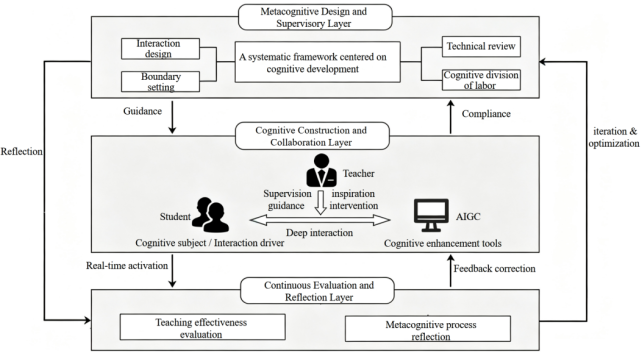
Figure 1. AIGC Three-Tiered Collaborative Cognitive Development Framework.
Human-machine collaboration must shift from "tool adaptation" to "human-centered education enhanced by technology," constructing a design framework that safeguards human cognitive development and meaning-making. The core insight is to delineate clear boundaries for AIGC's application and role through forward-looking structural design
| [21] | Haojun Li, Qinru Huang, Wei Chen, & Zhuozhuo Xu. Research on Human-AI Collaborative Iterative Symbiosis Teaching Mode——Analysis of the Integration and Practical Effect of AIGC. Modern Educational Technology. 2025, 35(01), 81-88. https://doi.org/10.3969/j.issn.1009-8097.2025.01.009 |
[21]
, ensuring educators retain control and learners' cognitive development is not lost within the technology's "black box." To this end, this study proposes a human-centered, three-tiered collaborative AIGC cognitive development framework (
Figure 1). Centered on learners' cognitive development and meaning-making, this model systematically guides technology use through a closed-loop of forward-looking design, controlled AIGC enhancement, and metacognitive reflection, thereby optimizing human-machine collaboration. The three layers interact dynamically while each fulfilling distinct functions. Its innovative essence lies in transforming AIGC's "double-edged sword" nature into structured, developmental elements that can be planned, guided, and evaluated
| [22] | Xinghan Yin, Junmin Ye, Shuang Yu, Qingtang Liu, & Sheng Luo. Research on Modeling and Analysis of Human-Intelligence Interaction Behavior in GenAI-Supported Metacognitive Regulation Learning. Modern Educational Technology. 2025, 35(10), 52-59.
https://doi.org/10.3969/j.issn.1009-8097.2025.10.006 |
[22]
through the interplay of the metacognitive design and supervision layer (top), cognitive construction and collaboration layer (middle), and continuous assessment and reflection layer (bottom).
3.2. Role Definition: Three-Part Division of Authority and Responsibility
The three-tiered model architecture entails a systematic redefinition of roles based on the principle of "human-centered education" and AIGC's technical capabilities. Specifically, core cognitive roles involving higher-order thinking, meaning generation, and value guidance must be assumed by humans (teachers and students), while AIGC's role should be strictly confined to information processing, pattern extension, and process assistance, without venturing into cognitive domains requiring genuine understanding and judgment. Based on this redefinition, the framework clearly delineates the responsibilities and authorities of the three parties.
Within the "teacher-student-AIGC" triadic relationship, the teacher's role shifts from "authoritative lecturer" to "overall designer of the educational process and architect, guide, monitor, and regulator of human-machine collaboration." This shift moves from one-way transmission to designing a top-level architecture for deep learning that integrates AIGC—designing authentic tasks that stimulate higher-order thinking, predefining AIGC's points of intervention and boundaries of action, and dynamically guiding students throughout the process. Teachers serve as the ultimate gatekeepers, responsible for determining when to introduce AIGC, setting task boundaries, and evaluating its genuine contributions to learning. This role imposes new demands on teachers' professional competence
| [23] | Manli Li, Sichen Chen, Yuchun Ma, & Huichao Bi. Connotative Expansion of Higher-Order Thinking in HI-AI Collaborative Learning. Modern Educational Technology. 2025, 35(11), 5-13. |
[23]
, shifting training focus from tool-based instruction to "AIGC educational application" competencies. At the core lies a "critical integration" meta-skill: teachers must understand AIGC's principles and limitations, scrutinize and reshape AIGC-generated content, and transform it into "objects of critique" or "scaffolding" that stimulate critical thinking. This includes mastering prompt engineering, designing human-machine collaborative activities, and dynamically assessing AIGC outputs' credibility and educational value during instruction. This competency ensures teachers maintain control over instruction and the integrity of the educational process in any technological context.
As the central actors in education, students evolve from "passive recipients" to "active constructors of knowledge and critical masters of AIGC." They must proactively plan their learning, utilizing AIGC for mechanical tasks while focusing on core cognitive processes such as critical thinking, comprehension, creativity, and integration. They must learn to pose precise questions to AIGC, critically examine its outputs, and integrate them into their personal cognitive frameworks
| [12] | Shunbi Wu, & Wenzheng Yang. Research on the Formation Mechanism and Mitigation Pathway of AI Cognitive Dependence in Education Context——A Cognitive Ecology Perspective. e-Education Research. 2025, 46(12), 63-70+128.
https://doi.org/10.13811/j.cnki.eer.2025.12.008 |
[12]
. This role evolution depends on enhanced human-computer interaction literacy, with "critical AIGC application skills" being crucial. Students should learn to identify potential misleadings and "hallucinations" in AIGC-generated content; understand AIGC's appropriate role—as a "catalyst for thinking" or "draft generator," not a "source of answers"; and master dialectical dialogue with AIGC through questioning and counterexamples, probing and pushing beyond AIGC's capabilities to deepen their understanding.
AIGC should be clearly defined as an "information-enhancing executor" and "dynamic-response collaborator," not a "cognitive agent" with autonomous intent. Its core function is to efficiently execute tasks based on statistical correlations and pattern replication, strictly serving human-defined educational objectives within preset boundaries. As an "information-enhancing executor," it frees teachers and students from tedious, repetitive, low-level cognitive tasks, serving as their "cognitive extension." As a "dynamic response collaborator," it is "invoked on demand and responds strictly" during teaching. Its intervention must be based on active instructions from teachers and students, operating within predefined task boundaries and ethical frameworks. Its value lies not in providing authoritative conclusions, but in enriching cognitive exploration options and stimulating deeper thinking and debate.
3.3. Interactions: Asymmetric Symbiosis
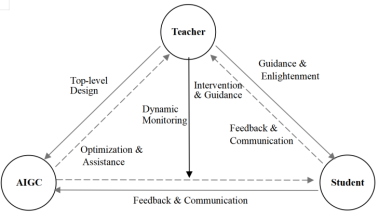
The theoretical model proposed by this study is grounded in a deep understanding of—and systematic coordination between—the capabilities and role divisions of teachers, students, and AIGC. Rather than seeking a universal simulation or replacement of human intelligence by AIGC, it advocates for a structured division of cognitive labor and a dynamic relay of functions. In this process, teachers, students, and AI form an "asymmetric dynamic symbiotic relationship" centered on students' cognitive development, underpinned by teachers' professional support, and enhanced by the strengths of AIGC (as shown in
Figure 2). Here, "asymmetric" refers to the fundamental differences and non-interchangeable division of labor between AIGC and human agents in terms of cognitive abilities, ethical responsibility, and system permissions, while "dynamic symbiosis" emphasizes flexible adjustments between humans and machines based on the dynamic learning process, thereby achieving an ideal state of mutual dependence and synergistic effectiveness.
Figure 2. The Triadic Relationship in the AIGC Collaborative Cognition Development Model
The specific interrelationships among these three are analyzed as follows:
3.3.1. The "Teacher-AIGC" Relationship
The teacher-AIGC relationship is one between a "lead designer" and a "controlled assistant." During top-level instructional design, teachers—based on objectives and understanding of AIGC's deficiencies—pre-determine the tasks, methods, and boundaries for AIGC's use. Once instruction begins, teachers must monitor student-AIGC interactions. If they detect misleading outputs or students over-relying on AIGC, teachers should intervene—either by adjusting task parameters or guiding students to critically examine and reflect on the content. AIGC's "operational capacity" thus remains under teachers' constant professional supervision and ethical scrutiny.
3.3.2. The "Student-AIGC" Relationship
The student-AIGC relationship is the model's most dynamic aspect, with the ideal state being "active mastery" and "prudent collaboration." This is by no means passive "question-and-answer" exchange, but rather a dynamic, critical symbiosis. Students should engage in complete, independent thought processes, actively conceptualizing core stages such as task analysis, problem definition, and solution planning. Based on teachers' guidance and their own cognitive needs, students independently determine the timing and depth of their interaction with AIGC tools. AIGC should respond in real time to students' specific instructions, providing timely support within its areas of expertise. As primary cognitive agents, students should critically evaluate AIGC outputs, deciding whether to adopt, modify, or reject them, and integrate the information to support decision-making and deeper understanding
| [24] | Ying Le, Yonggui Liu, Yibing Zhang, & Xingqi Gao. Research on the Construction and Practice of a Dialogue-Driven Human-Machine Collaborative Knowledge Construction Model Based on GAI. China Educational Technology. 2025, (06), 28-36. |
[24]
. This effectively transforms AIGC's "deficiencies" into "teaching opportunities" for cultivating students' critical thinking skills.
3.3.3. The "Teacher-Student" Relationship
This traditional relationship has evolved into a trust-based partnership between "professional guides" and "active thinkers." Teachers design authentic problem scenarios that stimulate higher-order thinking and monitor students' collaborative exploration with AIGC, providing indispensable support—value guidance, emotional interaction, metacognitive questioning, inspiration, and comprehensive assessment—that AIGC cannot offer. Within teachers' framework, students gain greater autonomy while assuming metacognitive responsibility for managing, monitoring, and reflecting on their learning processes. The relationship has shifted from one-way reception to active dialogue and collaboration in which students seek professional support while tackling complex learning tasks
| [25] | Yongzhi Li, Peijie Cao, Huizi Wu, Haogang Bao, Bei Cheng, & Youchao Deng. Research on Explicit Reasoning in Educational Large Language Models Based on Teaching Thinking Chain. Open Education Research. 2025, (04), 4-11.
https://doi.org/10.13966/j.cnki.kfjyyj.2025.04.001 |
[25]
.
4. Technical Reconfiguration
Given its unique educational objectives and inherent complexity, the field of education has now set forth clear and specific requirements for technological research and development: namely, to evolve toward overcoming the three core deficiencies—"fragile causal reasoning, superficial contextual understanding, and a lack of symbolic grounding"—and ultimately achieve mutual empowerment between technology and education.
4.1. Causal Reasoning
To address AIGC's causal reasoning deficiencies, technological reconfiguration should transform statistical "black-box" outputs into interpretable, intervenable educational reasoning processes. The most direct approach lies in extracting and aligning the implicit pedagogical wisdom possessed by human teachers. A prime example is the "educational thought chain" mechanism, which distills the complete chain of thought—from diagnosing student performance and identifying knowledge gaps to constructing explanatory frameworks—through high-quality instructional decision datasets, enabling fine-tuning of large language models so their outputs adhere to educational logic. This "top-down" domain alignment paradigm compensates for the model's cognitive deficiencies by injecting structured educational prior knowledge at the application layer. More fundamental innovation targets algorithmic frameworks, embedding causal reasoning's mathematical foundations within the model. Integrating causal learning frameworks—such as structured causal models and counterfactual reasoning modules
| [26] | Zhu H, Huang H, Yin K, et al. CausalNET: Unveiling causal structures on event sequences by topology-informed causal attention [C] // Proceedings of the IJCAI. 2024: 7144-7152. |
[26]
—enables the model to understand and simulate "interventions," achieving hypothetical deductions about teaching strategy effectiveness. Forward-looking explorations aim to restructure model architectures, developing causality-inspired neural network algorithms
| [27] | Tongtong Dang, & Huanjing Wang. Research on the Dimensions and Pathways of Scenario-Based Construction of Teacher-Student Emotional Communities in the Era of Human-Machine Symbiosis. China Educational Technology. 2025, (09), 63-69+78. |
[27]
that modify the Transformer mechanism to better capture causal directionality and variable independence, strengthening causal inductive bias at representation learning's root. Although at the cutting edge, these studies are key to fundamental breakthroughs.
4.2. Context Awareness
AIGC's superficial contextual understanding stems from its training being confined to textual symbols, lacking integration of multidimensional, dynamic, embodied educational information. Reconfiguration can evolve from building external contextual knowledge systems to developing algorithm-inherent context-aware capabilities. A critical step is constructing a structured "educational context knowledge base"
| [28] | Ying Chen, Yanshuang Jiang, Xiaotian Ma, & Dejian Liu. Intelligent Agent for Human-machine Collaborative Teaching: Scenario Adaptation, Value Implications and Overcoming Dilemma. China Educational Technology. 2025, (11), 26-33. |
[28]
by integrating national curriculum standards, textbook units, classic teaching cases, student cognitive trajectories and misconceptions, and classroom interaction patterns into a fine-grained educational context map. When processing problems, the model dynamically correlates teaching progress, student performance, and cognitive styles, providing highly contextualized feedback. For example, the "Shicheng Wanxiang" model anchors generated content to curriculum knowledge frameworks, equipping "context-agnostic" models with an "educational context lens." However, deep contextual understanding requires models to learn and adapt contexts through dynamic interaction, spurring the educational agent paradigm—intelligent entities with specific educational roles that invoke tools to execute tasks in real or virtual teaching processes
| [29] | Farkaš I, Vavrečka M, Wermter S.Will multimodal large language models ever achieve deep understanding of the world?[J]. Frontiers in Systems Neuroscience, 2025, 19: 1683133.
https://doi.org/10.3389/fnsys.2025.1683133 |
[29]
. Practices like DeepEdu and Zingo Smart Companion exemplify this direction, enabling AIGC to autonomously learn contextual changes through perception-action-feedback loops. Forward-looking breakthroughs point to "embodied multimodal learning" and "deep scene understanding"
| [30] | Mulan Jin, Shaochun Zhong, Lan Yang, & Lu Zhang. Generative Artificial Intelligence Empowering Digital Textbook Development: Structural Framework and Practical Pathways. e-Education Research. 2025, 46(10), 121-128.
https://doi.org/10.13811/j.cnki.eer.2025.10.015 |
[30]
, developing multimodal models that seamlessly integrate visual, auditory, and motion information—like humans do—to form unified semantic understanding of classroom atmosphere, student emotions, and group dynamics, achieving a leap from "information processing" to "situational awareness."
4.3. Symbolic Grounding
The lack of symbolic grounding reveals a fundamental structural disorder in how large language models organize knowledge—a fragmented network of statistical associations rather than a meaning system grounded in logic and experience. Reconfiguration begins with leveraging external structured knowledge to constrain and guide models, ultimately leading to paradigm fusion at the architectural level. Current application-layer solutions include "knowledge graph augmentation": combining rigorously structured, logically coherent disciplinary knowledge graphs with large language models' generative capabilities. The knowledge graph serves as the "rational brain," ensuring accuracy and logical consistency, while the language model serves as the "emotional brain," providing natural interaction and explanation. When a student asks a question, the system locates precise concept nodes and association paths, then the language model provides vivid explanation—ensuring core principles are presented within complete structural relationships to avoid isolated or contradictory statements. Educational psychology theories—such as "zone of proximal development"—can be modeled as computational frameworks, transforming AIGC's instructional decision-making from probabilistic selection to symbolic reasoning guided by educational principles. The ultimate vision lies in "neurosymbolic artificial intelligence," integrating neural networks (excelling at perception and generation) with symbolic AI (excelling at logical reasoning) to achieve "sensibility" and "rationality" within a single system
| [31] | Bhuyan B. P., Ramdane-Cherif A., Tomar R., & Singh T. P. Neuro-symbolic artificial intelligence: a survey. Neural Computing and Applications. 2024, 36(21), 12809-12844.
https://doi.org/10.1007/s00521-024-09960-z |
[31]
. In such a system, a mathematical symbol is intrinsically linked to formal definitions, theorem networks, and visual geometric representations. Although still early-stage, this represents the ultimate direction: creating educational intelligence infrastructure whose knowledge representations inherently embody logical structures and semantic associations, enabling truly understandable, principle-based reasoning and creativity.
The technological reconfiguration addressing AIGC's three cognitive deficiencies reveals a clear synergistic evolution: in causal reasoning, from "educational thought chain" data alignment to causal framework algorithmic embedding; in contextual understanding, from external context knowledge bases to embodied multimodal interaction integration; in symbolic grounding, from knowledge graph augmentation to neuro-symbolic system fusion. This marks a shift from piecemeal modifications toward designing next-generation education-specific agents with pedagogy and psychology at their core. The ultimate goal is an "educational world model" that understands instructional logic, integrates into educational contexts, and masters knowledge meaning—transforming from an auxiliary tool into a foundational environment with educational cognitive attributes, transcending the current predicament of "tool-oriented technological transplantation" and achieving deep unification of intelligent technology with education's essence.





 Share This Article
 Twitter
 Linked In
 Facebook
 Copy
Copy Download