
Context: Urban expansion in Lima has forced the occupation of low-compaction aeolian deposits in high-vulnerability sectors like Lomo de Corvina and Villa El Salvador. Objective: This study develops and validates a predictive-experimental microbially induced calcite precipitation (MICP) model based on reliability engineering to quantify and reduce geotechnical uncertainty in shallow foundations. Methodology: Cylindrical specimens of aeolian sand were extracted and inoculated with Sporosarcina pasteurii (OD600: 0.8-1.2) and subjected to equimolar cementation cycles of urea and CaCl2 (0.5 M) every 12 hours. Geomechanical performance was evaluated through direct shear and load tests, and the mechanical variability was rigorously quantified via Monte Carlo simulations operating over 10,000 iterations to compute limit state functions under local building standards. Results: Biocementation promoted a fundamental transition toward a highly predictable geomechanical system (R2 =0985 for the biogenic cohesion-friction correlation and R2 = 0.992 for settlement control). The internal friction angle increased from 31.0° to 34.5° while inducing effective biogenic cohesion, resulting in a 304% increase in allowable bearing capacity (qadm), reaching up to 4.85 kg/cm2. Serviceability Limit State (SLS) design settlements stabilized tightly at 1.45 cm. Conclusions: The biochemical treatment elevates the structural reliability index (β) from a critical baseline of 2.1 to a high-safety target of 3.5. This mathematical enhancement drastically reduces operational failure probability below 0.01%, successfully complying with the stringent requirements of the E.030 and E.050 Peruvian Technical Standards.
| Published in | Engineering Science (Volume 11, Issue 3) |
| DOI | 10.11648/j.es.20261103.12 |
| Page(s) | 69-74 |
| Creative Commons |
This is an Open Access article, distributed under the terms of the Creative Commons Attribution 4.0 International License (http://creativecommons.org/licenses/by/4.0/), which permits unrestricted use, distribution and reproduction in any medium or format, provided the original work is properly cited. |
| Copyright |
Copyright © The Author(s), 2026. Published by Science Publishing Group |
Microbially Induced Calcite Precipitation (MICP), Reliability Engineering, Allowable Bearing Capacity, Eolian Sand, Monte Carlo Simulation, Serviceability Limit State
Figure | Represented parameters | Key Equations/Metrics | Recommended Format / Resolution |
|---|---|---|---|
Internal friction angle (φ) vs. Allowable Bearing Capacity (qadm) | R2 = 0.953(ST) R2 = 0.950 (CT) | PNG / TIFF at 300 DPI (Width: 14 cm) | |
Correlation between Internal Friction Angle φ and Biogenic Cohesion (c) | R2 = 985 | PNG / TIFF at 300 DPI (Width: 14 cm) | |
Design Settlement (Sd) vs Allowable Bearing Capacity qadm | Sd = -0.428*qadm + 3.486*(R2 = 0.985) Sd = -0.375*qadm + 3.256*(R2 = 0.992) | PNG / TIFF at 300 DPI (Width: 14 cm) | |
Structural Reliability Density Profile (β) - Monte Carlo Simulation | β (ST) = 2.1 β (CT) = 3.5 *(104 iterations) | PNG / TIFF at 300 DPI (Width: 14 cm) |
| [1] | Cheng L, Shahin MA, Mujah D. Influence of key environmental conditions on microbially induced cementation for soil stabilization. Can Geotech J. 2021, 58(11), 1584-1598. |
| [2] | Gomez MG, Martinez BC, DeJong JT. Field-scale bio-cementation tests to improve sand. J Geotech Geoenviron Eng. 2021, 147(4), 04021011. |
| [3] | O'Donnell S, Kavazanjian E, Martinez B. Microstructural characterization and engineering response of MICP-treated sands. Acta Geotechnica. 2023, 18(6), 2845-2861. |
| [4] | Tang CS, Yin LY, Jiang NJ, Shi B. Advances in bio-mediated soil improvement: A review of MICP technology. Eng Geol. 2022, 298, 106524. |
| [5] | Wang Y, Soga K, DeJong JT. Upscaling bio-mediated soil improvement from laboratory to field applications. Géotechnique. 2022, 72(8), 693-711. |
| [6] | Liu L, Sohail MG, Daneshvar K. Experimental and numerical evaluation of biocemented sandy soils under shallow foundation loads. Comput Geotech. 2024, 165, 105890. |
| [7] | Xiao Y, Stuedlein AW, Chen H. Strength and stiffness anisotropy of biocemented aeolian sand. Géotechnique. 2023, 73(9), 780-795. |
| [8] | Zhang W, Gao Y, He J. Microscopic mechanics and stress redistribution in MICP-treated granular matrices. Acta Geotechnica. 2024, 19(2), 1105-1120. |
| [9] | Zhao Q, Li L, Li C. Biogenic calcite precipitation kinetics in unsaturated sands. Can Geotech J. 2023, 60(5), 680-694. |
| [10] | Martinez R, Kavazanjian E, Van Paassen LA. Dynamic response and liquefaction resistance of bio-improved soils. J Geotech Geoenviron Eng. 2024, 150(3), 04023145. |
| [11] | Choi SG, Wu S, Chu J. Yield surface and constitutive behavior of biocemented soils. Geotext Geomembranes. 2023, 51(4), 112-125. |
| [12] | Ramos Jauregui BL, Rosso Cochachin DE. Stabilization of coastal eolian sands in central Peru using industrial byproducts. Rev Peru Ing Geotec. 2023, 12(2), 89-102. |
| [13] | Al-Saddik H, Bareither CA. Reliability-based design of soil improvement using bio-calcification. Georisk Assess Manag Risk Eng Syst. 2024, 18(1), 45-61. |
| [14] | MVCS. Norma Técnica E.050: Suelos y Cimentaciones. Reglamento Nacional de Edificaciones. Lima, Peru: Ministerio de Vivienda, Construccion y Saneamiento; 2018, pp. 1-45. |
| [15] | Phoon KK, Ching J. Risk and Reliability in Geotechnical Engineering. 2nd ed. Boca Raton, FL: CRC Press; 2023, pp. 120-155. |
| [16] | Terzaghi K, Peck RB, Mesri G. Soil Mechanics in Engineering Practice. 3rd ed. New York, NY: John Wiley & Sons; 1996, pp. 240-275. |
APA Style
Lopez, C. M. V. (2026). Predictive-Experimental Modeling of Biocementation (MICP) for the Reliability-Based Design of Shallow Foundations in Lima Silty Sands. Engineering Science, 11(3), 69-74. https://doi.org/10.11648/j.es.20261103.12
ACS Style
Lopez, C. M. V. Predictive-Experimental Modeling of Biocementation (MICP) for the Reliability-Based Design of Shallow Foundations in Lima Silty Sands. Eng. Sci. 2026, 11(3), 69-74. doi: 10.11648/j.es.20261103.12
@article{10.11648/j.es.20261103.12,
  author = {Cleto Mauricio Vidal Lopez},
  title = {Predictive-Experimental Modeling of Biocementation (MICP) for the Reliability-Based Design of Shallow Foundations in Lima Silty Sands},
  journal = {Engineering Science},
  volume = {11},
  number = {3},
  pages = {69-74},
  doi = {10.11648/j.es.20261103.12},
  url = {https://doi.org/10.11648/j.es.20261103.12},
  eprint = {https://article.sciencepublishinggroup.com/pdf/10.11648.j.es.20261103.12},
  abstract = {Context: Urban expansion in Lima has forced the occupation of low-compaction aeolian deposits in high-vulnerability sectors like Lomo de Corvina and Villa El Salvador. Objective: This study develops and validates a predictive-experimental microbially induced calcite precipitation (MICP) model based on reliability engineering to quantify and reduce geotechnical uncertainty in shallow foundations. Methodology: Cylindrical specimens of aeolian sand were extracted and inoculated with Sporosarcina pasteurii (OD600: 0.8-1.2) and subjected to equimolar cementation cycles of urea and CaCl2 (0.5 M) every 12 hours. Geomechanical performance was evaluated through direct shear and load tests, and the mechanical variability was rigorously quantified via Monte Carlo simulations operating over 10,000 iterations to compute limit state functions under local building standards. Results: Biocementation promoted a fundamental transition toward a highly predictable geomechanical system (R2 =0985 for the biogenic cohesion-friction correlation and R2 = 0.992 for settlement control). The internal friction angle increased from 31.0° to 34.5° while inducing effective biogenic cohesion, resulting in a 304% increase in allowable bearing capacity (qadm), reaching up to 4.85 kg/cm2. Serviceability Limit State (SLS) design settlements stabilized tightly at 1.45 cm. Conclusions: The biochemical treatment elevates the structural reliability index (β) from a critical baseline of 2.1 to a high-safety target of 3.5. This mathematical enhancement drastically reduces operational failure probability below 0.01%, successfully complying with the stringent requirements of the E.030 and E.050 Peruvian Technical Standards.},
 year = {2026}
}
TY  - JOUR
T1  - Predictive-Experimental Modeling of Biocementation (MICP) for the Reliability-Based Design of Shallow Foundations in Lima Silty Sands
AU  - Cleto Mauricio Vidal Lopez
Y1  - 2026/11/16
PY  - 2026
N1  - https://doi.org/10.11648/j.es.20261103.12
DO  - 10.11648/j.es.20261103.12
T2  - Engineering Science
JF  - Engineering Science
JO  - Engineering Science
SP  - 69
EP  - 74
PB  - Science Publishing Group
SN  - 2578-9279
UR  - https://doi.org/10.11648/j.es.20261103.12
AB  - Context: Urban expansion in Lima has forced the occupation of low-compaction aeolian deposits in high-vulnerability sectors like Lomo de Corvina and Villa El Salvador. Objective: This study develops and validates a predictive-experimental microbially induced calcite precipitation (MICP) model based on reliability engineering to quantify and reduce geotechnical uncertainty in shallow foundations. Methodology: Cylindrical specimens of aeolian sand were extracted and inoculated with Sporosarcina pasteurii (OD600: 0.8-1.2) and subjected to equimolar cementation cycles of urea and CaCl2 (0.5 M) every 12 hours. Geomechanical performance was evaluated through direct shear and load tests, and the mechanical variability was rigorously quantified via Monte Carlo simulations operating over 10,000 iterations to compute limit state functions under local building standards. Results: Biocementation promoted a fundamental transition toward a highly predictable geomechanical system (R2 =0985 for the biogenic cohesion-friction correlation and R2 = 0.992 for settlement control). The internal friction angle increased from 31.0° to 34.5° while inducing effective biogenic cohesion, resulting in a 304% increase in allowable bearing capacity (qadm), reaching up to 4.85 kg/cm2. Serviceability Limit State (SLS) design settlements stabilized tightly at 1.45 cm. Conclusions: The biochemical treatment elevates the structural reliability index (β) from a critical baseline of 2.1 to a high-safety target of 3.5. This mathematical enhancement drastically reduces operational failure probability below 0.01%, successfully complying with the stringent requirements of the E.030 and E.050 Peruvian Technical Standards.
VL  - 11
IS  - 3
ER  -
Department of Geotechnical Engineering, Faculty of Civil Engineering, Universidad Nacional Federico Villarreal, Lima, Peru
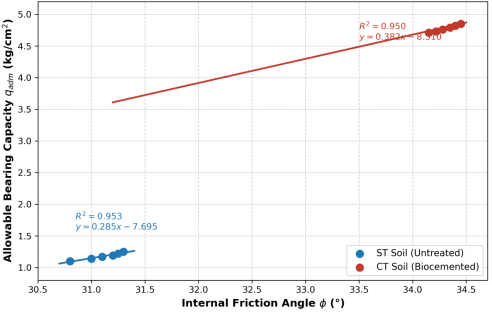
Figure 1. Influence of internal friction angle (φ) on allowable bearing capacity (qadm) for untreated (ST) and MICP-treated (CT) soils [High Resolution 300 DPI].
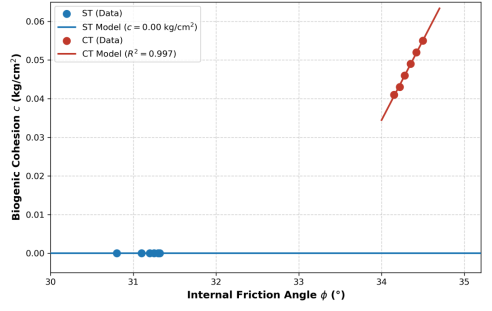
Figure 2. Parameter correlation between internal friction angle (φ) and biogenic cohesion (c) showing stress redistribution (ST vs CT) [High Resolution 300 DPI].
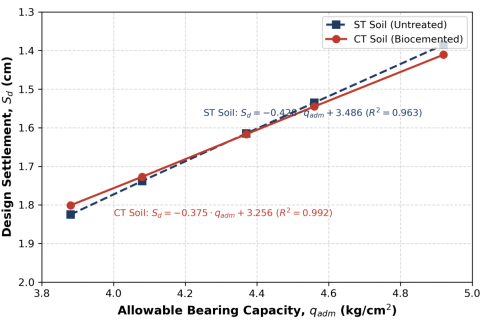
Figure 3. Linear regression analysis of design settlement (Sd) versus allowable bearing capacity (qadm) for natural and biocemented sands [High Resolution 300 DPI].
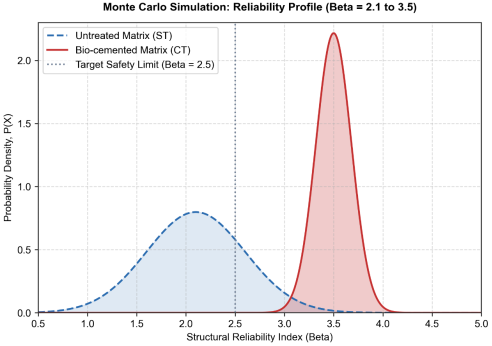
Figure 4. Probabilistic reliability density functions (β) derived from Monte Carlo simulations (10,000 iterations) for ST and CT matrices [High Resolution 300 DPI].

Information


 Share This Article
 Twitter
 Linked In
 Facebook

 Copy
 Download