Abstract
Under-five mortality remains a major public health challenge in sub-Saharan Africa, and Senegal is still far from the Sustainable Development Goal 3.2 target set for 2030. This study examines the factors associated with under-five mortality in Senegal over the period 2000-2023, using twenty-four annual observations drawn from the Demographic and Health Surveys and from official statistics of the National Agency for Statistics and Demography. A multiple linear regression model estimated by ordinary least squares is used. The explanatory variables cover malaria control (insecticide-treated net coverage), residential structure, children’s nutritional status (stunting and acute malnutrition), and maternal human capital (schooling). The model has high explanatory power (R2 = 0.964) and identifies two statistically significant factors with a negative effect on under-five mortality: insecticide-treated net use (β = −0.676; p = 0.003) and maternal schooling (β = −2.575; p < 0.001). The residuals meet the normality and homoscedasticity assumptions, and collinearity among the regressors remains moderate. Ramsey’s specification test points to possible non-linearity, and the trending nature of the series calls for cautious interpretation of the coefficients; the two main effects are nonetheless robust to Newey-West standard errors. The findings support strengthening girls’ education and vector-control programmes as central levers for reducing child mortality, together with sustained investment in health information systems for policy evaluation.
Keywords
Under-five Mortality, Senegal, Linear Regression, Ordinary Least Squares, Malaria, Maternal Schooling, Time Series
1. Introduction
Child mortality is one of the most important indicators for assessing progress in a population’s education and health. It is a component of the Human Development Index (HDI) developed by the United Nations, which is why it is closely monitored worldwide, particularly in developing countries. In the World Health Organization (WHO) African Region, infant mortality is six times higher than in the European Region
. According to the World Bank
| [2] | UNICEF, WHO, World Bank, United Nations. Levels and Trends in Child Mortality - Report 2020. New York: UNICEF; 2020. Available from: https://childmortality.org |
[2]
, deaths of children under five are concentrated mainly in sub-Saharan Africa and South Asia. Suzuki and Kashiwase
showed that, in 2018, 80% of under-five deaths occurred in this part of the world. Sub-Saharan Africa alone accounted for 54% of these deaths (2,868,000) and South Asia for 28% (1,475,000). In sub-Saharan Africa, one child in thirteen does not survive to age five
| [2] | UNICEF, WHO, World Bank, United Nations. Levels and Trends in Child Mortality - Report 2020. New York: UNICEF; 2020. Available from: https://childmortality.org |
[2]
. West and Central Africa remain the regions most affected by this excess mortality. According to the United Nations Children’s Fund (UNICEF)
| [2] | UNICEF, WHO, World Bank, United Nations. Levels and Trends in Child Mortality - Report 2020. New York: UNICEF; 2020. Available from: https://childmortality.org |
[2]
, five million children died worldwide before their fifth birthday in 2021, and about 40% of these deaths occurred in West and Central Africa, that is, 1.9 million children under five. In other words, in a region that is home to 14% of the world’s under-five population, a child under five died every 17 seconds in 2021. At an estimated 92 per 1000, this is the highest under-five mortality rate in the world. The neonatal mortality rate, at 30.5 per 1000, is declining more slowly. Despite targeted policies to improve access to care for children under five within a universal health coverage framework, most of these countries will not reach Sustainable Development Goal (SDG) 3.2 on under-five mortality by 2030, set at fewer than 25 per 1000 live births. Worldwide, meeting this target would save 6.9 million children, including more than 4.8 million aged 1 to 59 months and 2.1 million newborns.
In Senegal, despite numerous initiatives to improve access to care for vulnerable groups, under-five mortality remains a public health problem, especially neonatal mortality, notwithstanding the steady declines recorded over several years
| [4] | Republic of Senegal, Ministry of Health and Social Action (MSAS), World Health Organization. National Action Plan for the Reduction of Neonatal Mortality (2018-2022) [in French]. Dakar: MSAS; 2018. |
[4]
. With a rate of 40 per 1000 live births in 2023
| [5] | National Agency for Statistics and Demography (ANSD). Senegal Continuous Demographic and Health Survey (DHS-Continuous) 2023 [in French]. Dakar: ANSD; 2023. Available from:
https://dhsprogram.com |
[5]
, the country is still far from SDG 3.2 for 2030. Of every 1000 children born alive in Senegal, 40 will not reach their fifth birthday
| [6] | Diouf, M., Diop, M. B., Dieng, A., et al. Infant and child mortality and its risk factors in sub-Saharan Africa: the contribution of healthcare delivery. Science Journal of Public Health. 2026, 14(4), 153-164. https://doi.org/10.11648/j.sjph.20261404.11 |
[6]
. This under-five mortality shows regional disparities ranging from 20 to 77 per 1000 live births according to the most recent Demographic and Health Survey (DHS), published in 2023. Kolda is the most affected region, at 77 per 1000, followed by Sédhiou at 71 per 1000. Kédougou and Kaffrine record 63 and 62 per 1000 respectively, whereas Kaolack and Saint-Louis, at 29 and 31 per 1000, fall below the national average of 40 per 1000. Ziguinchor records the lowest rate at 20 per 1000, followed by Dakar at 25 per 1000. These wide gaps show that, in several regions, children continue to die despite free-care policies intended to improve access and equity in health services.
The factors associated with under-five mortality are varied, and some are avoidable. A review of the databases of the National Agency for Statistics and Demography (ANSD) and of studies on child mortality from 2000 to 2023 allowed us to identify the main factors associated with mortality among children aged 0 to 5 years in Senegal over the study period. These factors are related to disease (malaria, diarrhoea, acute respiratory infections). They are also socioeconomic, environmental, and maternal in nature
| [7] | Caldwell, J. C. Theory of Fertility Decline. London/New York: Academic Press; 1982. |
[7]
.
This situation raises the question of the efficiency and effectiveness of free-care policies in Senegal. In other words, has free care for vulnerable groups, particularly children under five, produced results commensurate with the resources committed? Should control strategies be revised to speed up the reduction of morbidity and mortality among children under five in Senegal? These questions lead us to examine the causes of death in the 0-to-5 age group in order to better target public programmes aimed at improving population health. In a context of increasingly scarce resources and steadily rising health needs, a stronger focus on results-based management is warranted.
This study aims to conduct an econometric analysis of the factors associated with mortality among children under five. It is intended to help decision-makers improve free-care programmes and design new mechanisms for reducing under-five mortality.
2. Materials and Methods
To analyse the factors associated with mortality among children aged 0 to 5 years in Senegal, we use an econometric model. This section presents the model, the variables, the data, and the estimation strategy.
2.1. Model Specification
To explain the factors associated with under-five mortality (U5M), we used a multiple linear regression estimated by ordinary least squares (OLS). The model describes the relationship between under-five mortality and its associated factors: the use of insecticide-treated nets (ITNs), malnutrition, schooling, residence, and stunting. Assuming that the variables satisfy this relationship, the model equation is:
U5Mt= C +α1EDSMIIt+α2RMRURt+α3MALNUTt+α4RCM5t+α5MSCOLt+εt
where t indexes the years (t = 2000, …, 2023), C is the constant, EDSMII, RMRUR, MALNUT, RCM5 and MSCOL are the explanatory variables defined in
Table 1, α
1 to α
5 are the coefficients of the explanatory variables, and εₜ is the error term, assumed independently and identically distributed (i.i.d.) with zero mean and constant variance.
2.2. Variables and Data
The model comprises five explanatory variables and one dependent variable, defined in
Table 1.
The data form a time series covering the period 2000-2023, that is, 24 annual observations. They come from Senegal’s Demographic and Health Surveys (DHS) and from the official statistics of the National Agency for Statistics and Demography (ANSD).
Table 1. Definition of the model variables.
Code | Label | Definition | Role |
U5M | Under-five mortality | Under-five mortality rate (per 1000 live births) | Dependent |
EDSMII | ITN coverage | % of children <5 who slept under an insecticide-treated net (ITN) | Explanatory |
RMRUR | Rural residence | % of children <5 living in rural areas | Explanatory |
RCM5 | Stunting | Prevalence of stunting among children <5 (%) | Explanatory |
MALNUT | Acute malnutrition | Prevalence of acute malnutrition (wasting) among children <5 (%) | Explanatory |
MSCOL | Maternal schooling | % of mothers aged 15-49 with schooling | Explanatory |
Source: compiled from DHS and ANSD data, Senegal (2000-2023).
Ethical considerations. This study relied exclusively on publicly available, aggregate secondary data from the Senegal DHS and from ANSD official statistics, which contain no individual identifiers. Ethical review and approval were therefore not required.
2.3. Econometric Strategy
The approach comprises three steps: (i) univariate and bivariate descriptive analysis (summary statistics, correlation matrix, time plots); (ii) OLS estimation of the model and analysis of the coefficients; and (iii) a set of diagnostic tests covering multicollinearity (variance inflation factor, VIF), residual normality (Shapiro-Wilk, Jarque-Bera), homoscedasticity (Breusch-Pagan, White), autocorrelation (Durbin-Watson, Breusch-Godfrey), specification (Ramsey Regression Equation Specification Error Test, RESET), and stationarity (Augmented Dickey-Fuller). Where autocorrelation or heteroscedasticity is present, re-estimation with Newey-West (heteroscedasticity and autocorrelation consistent, HAC) standard errors is used.
2.4. Preliminary Descriptive Analysis
2.4.1. Descriptive Statistics
Table 2. Descriptive statistics of the model variables (n = 24).
Variable | Mean | Std. dev. | Minimum | Maximum |
U5M | 78.79 | 35.85 | 37.00 | 145.00 |
EDSMII | 32.77 | 21.00 | 1.67 | 66.60 |
RMRUR | 64.81 | 3.13 | 51.21 | 66.10 |
RCM5 | 19.81 | 3.52 | 14.70 | 27.00 |
MALNUT | 8.68 | 1.16 | 5.90 | 10.20 |
MSCOL | 42.85 | 8.78 | 29.00 | 56.00 |
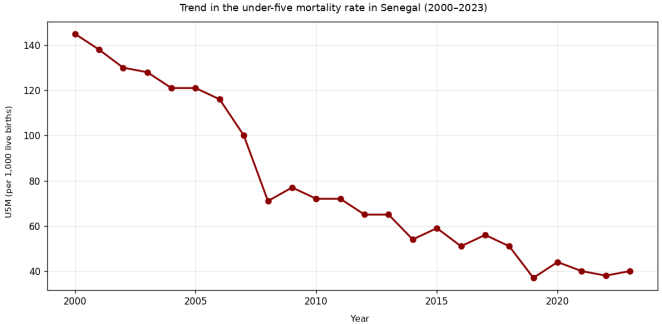
Table 2 highlights several patterns. Under-five mortality (U5M) averages 78.8 per 1000 over the period, with a wide range (37 to 145 per 1000), reflecting the decline observed since 2000. Insecticide-treated net use (EDSMII) rose from 1.67% to 66.6%, in line with the expansion of malaria-control programmes. Maternal schooling (MSCOL) increased from 29% to 56%. The nutritional indicators (RCM5, MALNUT) and residential structure (RMRUR) show more limited variability. The low dispersion of RMRUR (standard deviation 3.13) and MALNUT (standard deviation 1.16) limits from the outset their capacity to explain variation in mortality.
2.4.2. Time Trend
Figure 1 Trend in the under-five mortality rate in Senegal (2000-2023).
Figure 1. Shows the near-monotonic downward trend in the U5M rate over the period. This trend reflects the health progress achieved in Senegal, and also the need to identify the levers that contributed to this improvement.
2.4.3. Correlation Matrix
Table 3. Pearson correlation matrix.
| U5M | EDSMII | RMRUR | RCM5 | MALNUT | MSCOL |
U5M | 1.000 | -0.932 | 0.117 | 0.404 | 0.435 | -0.966 |
EDSMII | -0.932 | 1.000 | 0.067 | -0.324 | -0.492 | 0.886 |
RMRUR | 0.117 | 0.067 | 1.000 | -0.144 | -0.454 | -0.170 |
RCM5 | 0.404 | -0.324 | -0.144 | 1.000 | 0.399 | -0.424 |
MALNUT | 0.435 | -0.492 | -0.454 | 0.399 | 1.000 | -0.476 |
MSCOL | -0.966 | 0.886 | -0.170 | -0.424 | -0.476 | 1.000 |
The matrix shows a strong negative association between U5M and insecticide-treated net use (r = −0.932) and maternal schooling (r = −0.966). Stunting (RCM5, r = 0.404) and rural residence (RMRUR, r = 0.117) show positive correlations with mortality, consistent with theoretical expectations. These bivariate correlations do not prejudge the net effects, which are clarified by the multiple regression. The two main regressors are themselves strongly correlated (EDSMII-MSCOL, r = 0.886).
3. Results
3.1. Regression Estimates
Table 4 presents the OLS estimation results.
Table 4. OLS estimation results for the under-five mortality model.
Variable | Coefficient | Std. error |
ITN coverage (EDSMII) | -0.6761*** | (0.1978) |
Rural residence (RMRUR) | 0.1143 | (0.7744) |
Stunting (RCM5) | 0.3908 | (0.5427) |
Acute malnutrition (MALNUT) | -2.1967 | (2.0445) |
Maternal schooling (MSCOL) | -2.5750*** | (0.5477) |
Constant | 215.2046** | (78.5270) |
Observations (n) | 24 | |
R2 | 0.9638 | |
Adjusted R2 | 0.9538 | |
F-statistic (p-value) | 95.97 | (< 0.001) |
3.2. Goodness of Fit
The model shows a strong goodness of fit. R2 reaches 0.9638, meaning that 96.4% of the variance in under-five mortality is explained by the five variables. The adjusted R2 (0.9538), which penalises the addition of regressors, confirms the robustness of this fit.
The F-statistic (F = 95.97; p < 0.001) rejects the null hypothesis that all coefficients are jointly zero. The model is therefore globally significant at the 1% level. The Akaike (AIC = 171.22) and Schwarz (BIC = 178.29) information criteria can serve as references for comparison with alternative specifications.
3.3. Interpretation of the Coefficients
ITN coverage (EDSMII). The coefficient on insecticide-treated net use is −0.6761 and significant at the 1% level (p = 0.003). Its negative sign indicates that a one-percentage-point increase in ITN use is associated, all else equal, with a 0.68-point decrease in the under-five mortality rate.
Maternal schooling (MSCOL). The MSCOL coefficient, equal to −2.5750 and significant at the 1% level (p < 0.001), has the largest magnitude in the model. A one-percentage-point increase in maternal schooling is associated with a 2.58-point reduction in the U5M rate, all else equal.
Non-significant variables. The coefficients on rural residence (RMRUR, β = 0.1143; p = 0.884), stunting (RCM5, β = 0.3908; p = 0.481), and acute malnutrition (MALNUT, β = −2.1967; p = 0.297) are not significant at the conventional 5% level. As such, their effect cannot be statistically distinguished from zero in this model. This lack of significance may reflect the small sample size (n = 24), the correlation between these variables and the other regressors, or limited variation over time. It does not mean that there is no real effect, but that it cannot be detected within this framework.
3.4. Diagnostic Tests
OLS estimates are valid insofar as the classical assumptions of the linear model (Gauss-Markov) hold. This subsection checks these assumptions.
3.4.1. Multicollinearity
Table 5. Variance inflation factors (VIF).
Variable | VIF | 1/VIF |
EDSMII | 6.684 | 0.150 |
RMRUR | 2.282 | 0.438 |
RCM5 | 1.415 | 0.707 |
MALNUT | 2.174 | 0.460 |
MSCOL | 8.960 | 0.112 |
Table 5 shows that all VIFs are below 10. The maximum value (8.96), for MSCOL, is close to the critical threshold of 10 and indicates moderate collinearity with the other variables, without compromising the estimates. This collinearity stems from the strong correlation between MSCOL and EDSMII (r = 0.886); it inflates the standard errors of these two variables, so their significance nonetheless points to robust effects.
3.4.2. Residual Normality
Table 6. Residual normality tests.
Test | Statistic | p-value | Decision (H0: normality) |
Shapiro-Wilk | 0.9656 | 0.5615 | Not rejected |
Jarque-Bera | 0.5938 | 0.7431 | Not rejected |
Skewness | -0.3748 | — | Close to 0 |
Kurtosis | 2.8211 | — | Close to 3 |
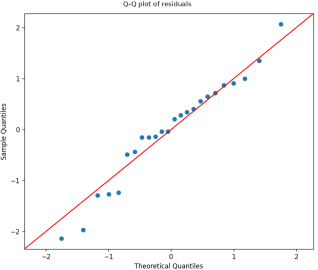
The Shapiro-Wilk (W = 0.9656; p = 0.562) and Jarque-Bera (JB = 0.5938; p = 0.743) tests do not reject residual normality. The skewness and kurtosis coefficients are close to their theoretical values (0 and 3). This supports the use of t- and F-tests for inference.
Figure 2. Quantile-Quantile (Q-Q) plot of the residuals.
3.4.3. Heteroscedasticity
Table 7. Heteroscedasticity tests.
Test | LM statistic | p-value | Decision (H0: homoscedasticity) |
Breusch-Pagan | 4.9993 | 0.4160 | Not rejected |
White | 23.8204 | 0.2503 | Not rejected |
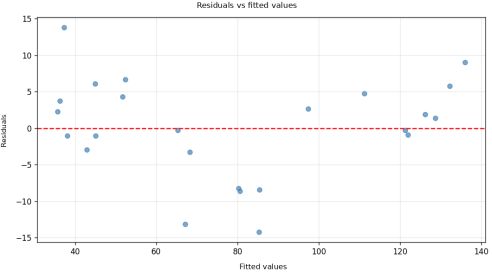
The Breusch-Pagan (Lagrange multiplier, LM = 5.00; p = 0.416) and White (LM = 23.82; p = 0.250) tests do not reject homoscedasticity. Residual variance can therefore be regarded as constant. This is corroborated by the plot of residuals against fitted values (
Figure 3), which shows no systematic pattern.
Figure 3. Residuals versus fitted values.

3.4.4. Residual Autocorrelation
Table 8. Residual autocorrelation tests.
Test | Statistic | p-value | Decision |
Durbin-Watson | 1.1302 | — | Inconclusive region (dL ≈ 0.93; dU ≈ 1.90) |
Breusch-Godfrey (2 lags) | 4.2652 | 0.1185 | Not rejected (no autocorrelation) |
For n = 24 and k = 5, the Durbin-Watson statistic (1.130) lies in the inconclusive region between the bounds dL ≈ 0.93 and dU ≈ 1.90, so the test is inconclusive. The more general Breusch-Godfrey test (LM = 4.27; p = 0.119) does not reject the null hypothesis at the 5% level. As a precaution, a re-estimation with Newey-West standard errors (robust to heteroscedasticity and autocorrelation) is reported in Section 3.5.
3.5. Re-estimation With Robust Standard Errors
Given the inconclusive result on autocorrelation (Section 3.4.4), the model is re-estimated with Newey-West (HAC) standard errors, robust to heteroscedasticity and autocorrelation.
Table 9. Model estimation with Newey-West (HAC) standard errors.
Variable | Coefficient | HAC std. error |
ITN coverage (EDSMII) | -0.6761*** | (0.1987) |
Rural residence (RMRUR) | 0.1143 | (0.4522) |
Stunting (RCM5) | 0.3908 | (0.5376) |
Acute malnutrition (MALNUT) | -2.1967 | (2.3074) |
Maternal schooling (MSCOL) | -2.5750*** | (0.3980) |
Constant | 215.2046*** | (53.5424) |
Observations (n) | 24 | |
R2 | 0.9638 | |
Adjusted R2 | 0.9538 | |
Comparing
Tables 4 and 9 shows that the main conclusions are unchanged under robust standard errors. EDSMII and MSCOL remain significant at the 1% level, with coefficients of identical magnitude. This robustness increases confidence in the results. The estimated effects of malaria control and maternal schooling on U5M are not artefacts of autocorrelation or heteroscedasticity.
4. Discussion
Two variables account for most of the model’s explanatory power: insecticide-treated net coverage and maternal schooling. The nutritional indicators and the rural population share, by contrast, are not statistically different from zero. This result is in line with the literature on child survival in sub-Saharan Africa, subject to the limitations of short and strongly trending series, discussed at the end of this section.
Maternal schooling. Maternal schooling carries the greatest weight in the model. Through the mechanism described by Caldwell
| [7] | Caldwell, J. C. Theory of Fertility Decline. London/New York: Academic Press; 1982. |
| [8] | Caldwell, J. C. Toward a restatement of demographic transition theory. Population and Development Review. 1976, 2(3-4), 321-366. https://doi.org/10.2307/1971615 |
[7, 8]
, an educated mother recognises danger signs earlier, seeks care more often, and has greater say in household decisions. Recent estimates point in the same direction. Gakidou et al.
| [9] | Gakidou, E., Cowling, K., Lozano, R., Murray, C. J. L. Increased educational attainment and its effect on child mortality in 175 countries between 1970 and 2009: a systematic analysis. The Lancet. 2010, 376(9745), 959-974.
https://doi.org/10.1016/S0140-6736(10)61257-3 |
[9]
attribute about half of the global decline in under-five mortality between 1970 and 2009 to the rise in female education alone, and Balaj et al.
| [10] | Balaj, M., York, H. W., Sripada, K., et al. Parental education and inequalities in child mortality: a global systematic review and meta-analysis. The Lancet. 2021, 398(10300), 608-620. https://doi.org/10.1016/S0140-6736(21)00534-1 |
[10]
estimate an approximately 3% reduction in the risk of death for each additional year of maternal schooling. The Senegalese coefficient is of the same order of magnitude. It is a reminder that, in Senegal as elsewhere, educating girls is also a child-survival policy.
Malaria control and insecticide-treated nets. The protective effect of insecticide-treated nets confirms the value of the malaria-control strategy pursued since the early 2000s. Lengeler’s Cochrane review
puts the reduction in all-cause mortality among children under five sleeping under a net at close to 17%, and Bhatt et al.
| [12] | Bhatt, S., Weiss, D. J., Cameron, E., et al. The effect of malaria control on Plasmodium falciparum in Africa between 2000 and 2015. Nature. 2015, 526(7572), 207-211.
https://doi.org/10.1038/nature15535 |
[12]
identify nets as the main driver of the decline in Plasmodium falciparum in Africa between 2000 and 2015. Senegal provides direct evidence: Trape et al.
| [13] | Trape, J. F., Sauvage, C., Ndiaye, O., et al. New malaria-control policies and child mortality in Senegal: reaching Millennium Development Goal 4. The Journal of Infectious Diseases. 2012, 205(4), 672-679. https://doi.org/10.1093/infdis/jir805 |
[13]
linked the new malaria-control policies to the fall in child mortality, and Thwing et al.
| [14] | Thwing, J. I., Perry, R. T., Townes, D. A., et al. Success of Senegal’s first nationwide distribution of long-lasting insecticide-treated nets to children under five: contribution toward universal coverage. Malaria Journal. 2011, 10, 86.
https://doi.org/10.1186/1475-2875-10-86 |
[14]
described the first national long-lasting insecticide-treated net (LLIN) distribution campaign. The result is also consistent with Ndiaye et al.
| [15] | Ndiaye, [initials], et al. [Full title of the 1980-2015 analysis of curative coverage and under-five mortality in Senegal — to be supplied by the authors]. [Journal]. [Year, Volume (Issue), pages]. |
[15]
, whose 1980-2015 analysis showed that greater curative coverage was not enough to reduce mortality and that prevention should be prioritised. Our model recovers this effect at the aggregate national level, whereas earlier evaluations focused mainly on households.
Non-significant variables. That nutrition and rural residence do not emerge may seem surprising, given how well established their role is elsewhere. At the individual level, undernutrition is a major cause of death: Black et al.
| [16] | Black, R. E., Victora, C. G., Walker, S. P., et al. Maternal and child undernutrition and overweight in low-income and middle-income countries. The Lancet. 2013, 382(9890), 427-451. https://doi.org/10.1016/S0140-6736(13)60937-X |
[16]
attribute nearly 45% of deaths before age five to it, and the pooled analysis by Olofin et al.
| [17] | Olofin, I., McDonald, C. M., Ezzati, M., et al. Associations of suboptimal growth with all-cause and cause-specific mortality in children under five years: a pooled analysis of ten prospective studies. PLOS ONE. 2013, 8(5), e64636.
https://doi.org/10.1371/journal.pone.0064636 |
[17]
shows a risk that rises with the severity of stunting. Our result does not contradict this link; it reflects the nature of the data. Over the period, stunting, acute malnutrition, and the rural share vary too little for a time-series model to isolate their own effect. National aggregation also masks the substantial regional gaps in the 2023 DHS, where mortality ranges from 20 to 77 per 1000. Finally, because these variables are correlated with schooling and net coverage, the latter capture part of their influence. The lack of significance is therefore a matter of statistical power and level of aggregation, not of absence of effect.
Scope and limitations. The R
2 of 0.964 is striking but should not be over-interpreted. The three key series follow marked trends, and in the absence of stationarity and cointegration tests, a very high R
2 combined with a Durbin-Watson of 1.13 leaves open the possibility of a spurious regression. The coefficients then describe long-run associations rather than strictly causal effects. The RESET test points in the same direction, indicating possible non-linearity, for instance a threshold effect as net coverage scales up. To this are added data aggregated at the national level, which cannot be transposed as such to the individual level, and a sample of twenty-four points that leaves few degrees of freedom. These reservations do not call into question the two main effects, which are robust to Newey-West standard errors; they only bound what can be concluded from them. They are consistent with recent work on the social determinants of under-five mortality in sub-Saharan Africa
| [18] | Avelino, I. C., Van-Dúnem, J., Varandas, L. Under-five mortality and social determinants in Africa: a systematic review. European Journal of Pediatrics. 2025, 184(2), 150.
https://doi.org/10.1007/s00431-024-05966-w |
[18]
.
5. Conclusions
This study examined the factors associated with under-five mortality in Senegal over 2000-2023 using a multiple linear regression model estimated by OLS. The model has a high goodness of fit (R2 = 0.964) and satisfies the assumptions of normality, homoscedasticity, and absence of severe multicollinearity; the RESET test, however, points to possible non-linearity, and the stationarity of the series remains to be established. Two variables stand out as statistically and economically significant: maternal schooling (marginal effect −2.58) and insecticide-treated net use (marginal effect −0.68). These results hold after re-estimation with robust (Newey-West) standard errors.
For public policy, these results support strengthening the schooling and literacy of girls and women, which is the main lever for reducing under-five mortality identified in this study; continuing and scaling up malaria-control programmes, in particular the distribution of insecticide-treated nets, whose effectiveness is confirmed here; and sustained investment in health information and monitoring systems, so that long and reliable series are available for policy evaluation.
Abbreviations
AIC | Akaike Information Criterion |
ANSD | National Agency for Statistics and Demography (Agence Nationale De La Statistique Et De La Démographie) |
BIC | Bayesian (Schwarz) Information Criterion |
DHS | Demographic and Health Survey |
EDSMII | Percentage of Children Under Five Who Slept Under an Insecticide-Treated Net |
HAC | Heteroscedasticity and Autocorrelation Consistent |
HDI | Human Development Index |
ITN | Insecticide-Treated Net |
LLIN | Long-Lasting Insecticide-Treated Net |
LM | Lagrange Multiplier |
MALNUT | Prevalence of Acute Malnutrition (Wasting) Among Children Under Five |
MSCOL | Percentage of Mothers Aged 15-49 Years with Schooling |
OLS | Ordinary Least Squares |
Q-Q | Quantile-Quantile |
RCM5 | Prevalence of Stunting Among Children Under Five |
RESET | Regression Equation Specification Error Test |
RMRUR | Percentage of Children Under Five Living in Rural Areas |
SDG | Sustainable Development Goal |
U5M | Under-Five Mortality (Rate Per 1000 Live Births) |
UNICEF | United Nations Children’s Fund |
VIF | Variance Inflation Factor |
WHO | World Health Organization |
Author Contributions
Meissa Diouf: Conceptualization, Methodology
Mbathio Diop: Conceptualization
Ibrahima Gaye: Formal Analysis
Amadou Dieng: Formal Analysis
Morel Aguiar: Data curation
Serigne Ndame Dieng: Writing – original draft
Cheikh Mouhamadou Mbacké Lo: Writing – review & editing
Daouda Faye: Supervision
Data Availability Statement
The data supporting the findings of this study are derived from the Senegal Demographic and Health Surveys and from ANSD official statistics, which are publicly available.
Conflicts of Interest
The authors declare no conflicts of interest.
References
| [1] |
World Health Organization. World Health Statistics 2021: monitoring health for the SDGs. Geneva: WHO; 2021. Available from:
https://www.who.int/publications/i/item/9789240027053
|
| [2] |
UNICEF, WHO, World Bank, United Nations. Levels and Trends in Child Mortality - Report 2020. New York: UNICEF; 2020. Available from:
https://childmortality.org
|
| [3] |
Suzuki, E., Kashiwase, H. Despite remarkable progress, 15,000 children and 800 women still die every day, mostly from preventable or treatable causes [Internet]. Washington, DC: World Bank Data Blog; 19 September 2019 [cited 2026 Jun 30]. Available from:
https://blogs.worldbank.org/en/opendata/despite-remarkable-progress-15000-children-and-800-women-still-die-every-day-mostly
|
| [4] |
Republic of Senegal, Ministry of Health and Social Action (MSAS), World Health Organization. National Action Plan for the Reduction of Neonatal Mortality (2018-2022) [in French]. Dakar: MSAS; 2018.
|
| [5] |
National Agency for Statistics and Demography (ANSD). Senegal Continuous Demographic and Health Survey (DHS-Continuous) 2023 [in French]. Dakar: ANSD; 2023. Available from:
https://dhsprogram.com
|
| [6] |
Diouf, M., Diop, M. B., Dieng, A., et al. Infant and child mortality and its risk factors in sub-Saharan Africa: the contribution of healthcare delivery. Science Journal of Public Health. 2026, 14(4), 153-164.
https://doi.org/10.11648/j.sjph.20261404.11
|
| [7] |
Caldwell, J. C. Theory of Fertility Decline. London/New York: Academic Press; 1982.
|
| [8] |
Caldwell, J. C. Toward a restatement of demographic transition theory. Population and Development Review. 1976, 2(3-4), 321-366.
https://doi.org/10.2307/1971615
|
| [9] |
Gakidou, E., Cowling, K., Lozano, R., Murray, C. J. L. Increased educational attainment and its effect on child mortality in 175 countries between 1970 and 2009: a systematic analysis. The Lancet. 2010, 376(9745), 959-974.
https://doi.org/10.1016/S0140-6736(10)61257-3
|
| [10] |
Balaj, M., York, H. W., Sripada, K., et al. Parental education and inequalities in child mortality: a global systematic review and meta-analysis. The Lancet. 2021, 398(10300), 608-620.
https://doi.org/10.1016/S0140-6736(21)00534-1
|
| [11] |
Lengeler, C. Insecticide-treated bed nets and curtains for preventing malaria. Cochrane Database of Systematic Reviews. 2004, (2), CD000363.
https://doi.org/10.1002/14651858.CD000363.pub2
|
| [12] |
Bhatt, S., Weiss, D. J., Cameron, E., et al. The effect of malaria control on Plasmodium falciparum in Africa between 2000 and 2015. Nature. 2015, 526(7572), 207-211.
https://doi.org/10.1038/nature15535
|
| [13] |
Trape, J. F., Sauvage, C., Ndiaye, O., et al. New malaria-control policies and child mortality in Senegal: reaching Millennium Development Goal 4. The Journal of Infectious Diseases. 2012, 205(4), 672-679.
https://doi.org/10.1093/infdis/jir805
|
| [14] |
Thwing, J. I., Perry, R. T., Townes, D. A., et al. Success of Senegal’s first nationwide distribution of long-lasting insecticide-treated nets to children under five: contribution toward universal coverage. Malaria Journal. 2011, 10, 86.
https://doi.org/10.1186/1475-2875-10-86
|
| [15] |
Ndiaye, [initials], et al. [Full title of the 1980-2015 analysis of curative coverage and under-five mortality in Senegal — to be supplied by the authors]. [Journal]. [Year, Volume (Issue), pages].
|
| [16] |
Black, R. E., Victora, C. G., Walker, S. P., et al. Maternal and child undernutrition and overweight in low-income and middle-income countries. The Lancet. 2013, 382(9890), 427-451.
https://doi.org/10.1016/S0140-6736(13)60937-X
|
| [17] |
Olofin, I., McDonald, C. M., Ezzati, M., et al. Associations of suboptimal growth with all-cause and cause-specific mortality in children under five years: a pooled analysis of ten prospective studies. PLOS ONE. 2013, 8(5), e64636.
https://doi.org/10.1371/journal.pone.0064636
|
| [18] |
Avelino, I. C., Van-Dúnem, J., Varandas, L. Under-five mortality and social determinants in Africa: a systematic review. European Journal of Pediatrics. 2025, 184(2), 150.
https://doi.org/10.1007/s00431-024-05966-w
|
Cite This Article
-
APA Style
Diouf, M., Diop, M., Gaye, I., Dieng, A., Aguiar, M., et al. (2026). Time-Series Econometric Analysis of Factors Associated with Under-Five Mortality in Senegal. International Journal of Health Economics and Policy, 11(4), 169-177. https://doi.org/10.11648/j.hep.20261104.12
Copy
|
Download
ACS Style
Diouf, M.; Diop, M.; Gaye, I.; Dieng, A.; Aguiar, M., et al. Time-Series Econometric Analysis of Factors Associated with Under-Five Mortality in Senegal. Int. J. Health Econ. Policy 2026, 11(4), 169-177. doi: 10.11648/j.hep.20261104.12
Copy
|
Download
AMA Style
Diouf M, Diop M, Gaye I, Dieng A, Aguiar M, et al. Time-Series Econometric Analysis of Factors Associated with Under-Five Mortality in Senegal. Int J Health Econ Policy. 2026;11(4):169-177. doi: 10.11648/j.hep.20261104.12
Copy
|
Download
-
@article{10.11648/j.hep.20261104.12,
author = {Meissa Diouf and Mbathio Diop and Ibrahima Gaye and Amadou Dieng and Morel Aguiar and Serigne Ndame Dieng and Cheikh Mouhamadou Mbacké Lo and Daouda Faye},
title = {Time-Series Econometric Analysis of Factors Associated with Under-Five Mortality in Senegal},
journal = {International Journal of Health Economics and Policy},
volume = {11},
number = {4},
pages = {169-177},
doi = {10.11648/j.hep.20261104.12},
url = {https://doi.org/10.11648/j.hep.20261104.12},
eprint = {https://article.sciencepublishinggroup.com/pdf/10.11648.j.hep.20261104.12},
abstract = {Under-five mortality remains a major public health challenge in sub-Saharan Africa, and Senegal is still far from the Sustainable Development Goal 3.2 target set for 2030. This study examines the factors associated with under-five mortality in Senegal over the period 2000-2023, using twenty-four annual observations drawn from the Demographic and Health Surveys and from official statistics of the National Agency for Statistics and Demography. A multiple linear regression model estimated by ordinary least squares is used. The explanatory variables cover malaria control (insecticide-treated net coverage), residential structure, children’s nutritional status (stunting and acute malnutrition), and maternal human capital (schooling). The model has high explanatory power (R2 = 0.964) and identifies two statistically significant factors with a negative effect on under-five mortality: insecticide-treated net use (β = −0.676; p = 0.003) and maternal schooling (β = −2.575; p < 0.001). The residuals meet the normality and homoscedasticity assumptions, and collinearity among the regressors remains moderate. Ramsey’s specification test points to possible non-linearity, and the trending nature of the series calls for cautious interpretation of the coefficients; the two main effects are nonetheless robust to Newey-West standard errors. The findings support strengthening girls’ education and vector-control programmes as central levers for reducing child mortality, together with sustained investment in health information systems for policy evaluation.},
year = {2026}
}
Copy
|
Download
-
TY - JOUR
T1 - Time-Series Econometric Analysis of Factors Associated with Under-Five Mortality in Senegal
AU - Meissa Diouf
AU - Mbathio Diop
AU - Ibrahima Gaye
AU - Amadou Dieng
AU - Morel Aguiar
AU - Serigne Ndame Dieng
AU - Cheikh Mouhamadou Mbacké Lo
AU - Daouda Faye
Y1 - 2026/11/11
PY - 2026
N1 - https://doi.org/10.11648/j.hep.20261104.12
DO - 10.11648/j.hep.20261104.12
T2 - International Journal of Health Economics and Policy
JF - International Journal of Health Economics and Policy
JO - International Journal of Health Economics and Policy
SP - 169
EP - 177
PB - Science Publishing Group
SN - 2578-9309
UR - https://doi.org/10.11648/j.hep.20261104.12
AB - Under-five mortality remains a major public health challenge in sub-Saharan Africa, and Senegal is still far from the Sustainable Development Goal 3.2 target set for 2030. This study examines the factors associated with under-five mortality in Senegal over the period 2000-2023, using twenty-four annual observations drawn from the Demographic and Health Surveys and from official statistics of the National Agency for Statistics and Demography. A multiple linear regression model estimated by ordinary least squares is used. The explanatory variables cover malaria control (insecticide-treated net coverage), residential structure, children’s nutritional status (stunting and acute malnutrition), and maternal human capital (schooling). The model has high explanatory power (R2 = 0.964) and identifies two statistically significant factors with a negative effect on under-five mortality: insecticide-treated net use (β = −0.676; p = 0.003) and maternal schooling (β = −2.575; p < 0.001). The residuals meet the normality and homoscedasticity assumptions, and collinearity among the regressors remains moderate. Ramsey’s specification test points to possible non-linearity, and the trending nature of the series calls for cautious interpretation of the coefficients; the two main effects are nonetheless robust to Newey-West standard errors. The findings support strengthening girls’ education and vector-control programmes as central levers for reducing child mortality, together with sustained investment in health information systems for policy evaluation.
VL - 11
IS - 4
ER -
Copy
|
Download