
 ,
Elisabet Johansson,
Wan Chi Chang,
Melinda Butsch Kovacic,
Gurjit Kaur Khurana Hershey,
Latha Satish*
,
Elisabet Johansson,
Wan Chi Chang,
Melinda Butsch Kovacic,
Gurjit Kaur Khurana Hershey,
Latha Satish*
The global decline in health science researchers underscores the need to build research capacity early, as undergraduate research participation is associated with greater research self?efficacy, development of transferable skills, and sustained interest in medical and scientific careers. However, traditional short?term, project?based summer research programs may be less accessible to students with limited prior research experience. In response to this need, a hands?on undergraduate research program was developed to provide early exposure to clinical and laboratory?based research. The Asthma Immersive Research Experience (AIRE) program was launched in Fall 2021 with the goal of delivering meaningful research training to undergraduate students interested in medical and scientific careers. AIRE provides practical experience in asthma and allergic disease research within an academic children’s hospital setting, combining laboratory work, direct engagement with research participants and families, peer and faculty mentorship, a structured seminar series, and continuous student feedback for program improvement. The program emphasizes team science and collaboration while exposing trainees to a broad range of career pathways, including physician?scientists, basic and translational researchers, biostatisticians, epidemiologists, geneticists, bioinformaticians, nurses, full-time research assistants, and clinical research coordinators. To date, 45 students have enrolled in AIRE, with 82.1% returning for multiple semesters, reflecting strong engagement and program retention. AIRE alumni are currently enrolled in medical school (45.8%) or graduate school (12.5%), employed as clinical research coordinators (8.4%), or actively pursuing admission to medical or graduate programs (33.3%). Together, these outcomes highlight AIRE as an effective and inclusive undergraduate research model that promotes sustained engagement and successful progression toward medical and scientific careers.
| Published in | Higher Education Research (Volume 11, Issue 4) |
| DOI | 10.11648/j.her.20261104.12 |
| Page(s) | 97-108 |
| Creative Commons |
This is an Open Access article, distributed under the terms of the Creative Commons Attribution 4.0 International License (http://creativecommons.org/licenses/by/4.0/), which permits unrestricted use, distribution and reproduction in any medium or format, provided the original work is properly cited. |
| Copyright |
Copyright © The Author(s), 2026. Published by Science Publishing Group |
Undergraduate Research, Health Sciences Education, Mentorship, Team Science, Career Development
Some of the quotes from the AIRE program students |
|---|
1) I have really enjoyed my time in the AIRE program and have had a great learning experience. 2) Overall, I think it has been great to watch the AIRE program grow. While I understand it is hard to get everyone together, I thought the introductory meeting was very important as it allowed all students to meet and connect. 3) I think the program is going exceptionally well. The AIRE program has made me fall in love with the lab and research. Everyone is so kind and helpful. 4) Give students an opportunity to potentially be paid if they have been working in the lab for a certain amount of time. |
AIRE | Asthma Immersive Research Experience |
| [1] | Mervis, J. Scientific workforce. Viewed from 1986, it’s mostly downhill. Science, 2003. 300, 1071. |
| [2] |
Council on Undergraduate Research.
https://www.cur.org (Accessed August 30, 2024). |
| [3] | Zhu, Y., Wang, C., Hanauer, D. I., Graham, M. J. Course-based undergraduate research experiences and student interest development: a longitudinal study. Studies in Higher Education. 2025, 50, 1039-1054. |
| [4] | Bennie, J., Zhang, K. Z., Yeh, P. Y., Gill, J. C., Crowley, L., Bauer, M., Graham, M. J. Student interest development in course-based undergraduate research experiences (CUREs): a longitudinal case study analysis. Frontiers in Education. 2025, 10: 1562677. |
| [5] | Cousin, L., Peoples, Z., Suppiah, V., Li, J., Quinn, G. P., Martinez, U., Zea, A. H., Meade, C. D., Tsien, F., Zabaleta, J., Reich, R., Simmons, V. N. Evaluation of a multi-site cancer research training program for undergraduate students. Journal of Cancer Education. 2025; 40: 171-176. |
| [6] | Hawkins, B., Heylman, C., Whitt, M, D. Building and integrating an undergraduate clinical immersion experience to expand impact. ASEE Annual Conference & Exposition Proceedings. 2025. |
| [7] | Corte, D. D., Morris, C. J., Billings, W. M., Stern, J., Jarrett, A. J., Hedelius, B., Bennion, A. Training undergraduate research assistants with an outcome-oriented and skill-based mentoring strategy. Acta Crystallographica Section D: Structural Biology. 2022, D78, 936-944. |
| [8] | Powers, J. L., Tiffany, J. S. Engaging youth in participatory research and evaluation. Journal of Public Health Management Practice. 2006, 12, S79‐S87. |
| [9] | Gee, K. L., & Popper, A. N. Improving academic mentoring relationships and environments. Acoustics Today. 2017, 13, 27–35. |
| [10] | Gee, K. L. Improving mentored research relationships. Proceedings of Meetings on Acoustics. 2019, 39, 025002. |
| [11] | Frantz, K. J., DeHaan, R. L., Demetrikopoulos, M. K., Carruth, L. L. Routes to research for novice undergraduate neuroscientists. Cell Biology Education. 2006, 5, 175–187. |
| [12] | Gum, A., Mueller, K., Flink, D., Siraj, S., Batsche, C., Boothroyd, R., Stiles, P. Evaluation of a summer research institute in behavioral health for undergraduate students. The Journal of Behavioral Health Services & Research. 2007. 34, 206–218. |
| [13] | Rees, E. L., Quinn, P. J., Davies, B., Fotheringham, V. How does peer teaching compare to faculty teaching? A systematic review and meta-analysis. Medical Teacher. 2016, 38(8), 829–837. |
| [14] | Yu, T. C., Wilson, N. C., Singh, P. P., Lemanu, D. P., Hawken, S. J., Hill, A. G. Medical students-as-teachers: a systematic review of peer-assisted teaching during medical school. Advances in Medical Education and Practice. 2011, 2, 157–172. |
| [15] | Ten Cate, O., Durning, S. Peer teaching in medical education: twelve reasons to move from theory to practice. Medical Teacher. 2007, 29(6): 591–599. |
| [16] | Edman, J., Elsabet, J. Peer teaching and social interaction. Retrieved from Sophia, the St Catherine University repository. 2016, Available from: |
| [17] | Seymour, E., Hunter, A. B., Laursen, S. L., DeAntoni, T. Establishing the benefits of research experiences for undergraduates in the sciences: first findings from a three-year study. Science Education. 2004, 88: 493-534. |
| [18] | Arif, S., Bo Massey, M. D., Klinard, N., Charbonneau, J., Jabre, L., Martins, A. B., Gailor, D., Kirton, R., Albury, C., Nanglu, K. Ten simple rules for supporting historically underrepresented students in science. PLoS Computational Biology. 2021, 17: e1009313. |
| [19] | Lopatto, D. Undergraduate research experiences support science career decisions and active learning. CBE-Life Sciences Education. 2007, 6(4), 297-306. |
APA Style
Biagini, J. M., McKinley, S., Johansson, E., Chang, W. C., Kovacic, M. B., et al. (2026). The Asthma Immersive Research Experience (AIRE) Program: Paving the Way for Future Scientists. Higher Education Research, 11(4), 97-108. https://doi.org/10.11648/j.her.20261104.12
ACS Style
Biagini, J. M.; McKinley, S.; Johansson, E.; Chang, W. C.; Kovacic, M. B., et al. The Asthma Immersive Research Experience (AIRE) Program: Paving the Way for Future Scientists. High. Educ. Res. 2026, 11(4), 97-108. doi: 10.11648/j.her.20261104.12
@article{10.11648/j.her.20261104.12,
  author = {Jocelyn Marie Biagini and Shelley McKinley and Elisabet Johansson and Wan Chi Chang and Melinda Butsch Kovacic and Gurjit Kaur Khurana Hershey and Latha Satish},
  title = {The Asthma Immersive Research Experience (AIRE) Program: Paving the Way for Future Scientists},
  journal = {Higher Education Research},
  volume = {11},
  number = {4},
  pages = {97-108},
  doi = {10.11648/j.her.20261104.12},
  url = {https://doi.org/10.11648/j.her.20261104.12},
  eprint = {https://article.sciencepublishinggroup.com/pdf/10.11648.j.her.20261104.12},
  abstract = {The global decline in health science researchers underscores the need to build research capacity early, as undergraduate research participation is associated with greater research self?efficacy, development of transferable skills, and sustained interest in medical and scientific careers. However, traditional short?term, project?based summer research programs may be less accessible to students with limited prior research experience. In response to this need, a hands?on undergraduate research program was developed to provide early exposure to clinical and laboratory?based research. The Asthma Immersive Research Experience (AIRE) program was launched in Fall 2021 with the goal of delivering meaningful research training to undergraduate students interested in medical and scientific careers. AIRE provides practical experience in asthma and allergic disease research within an academic children’s hospital setting, combining laboratory work, direct engagement with research participants and families, peer and faculty mentorship, a structured seminar series, and continuous student feedback for program improvement. The program emphasizes team science and collaboration while exposing trainees to a broad range of career pathways, including physician?scientists, basic and translational researchers, biostatisticians, epidemiologists, geneticists, bioinformaticians, nurses, full-time research assistants, and clinical research coordinators. To date, 45 students have enrolled in AIRE, with 82.1% returning for multiple semesters, reflecting strong engagement and program retention. AIRE alumni are currently enrolled in medical school (45.8%) or graduate school (12.5%), employed as clinical research coordinators (8.4%), or actively pursuing admission to medical or graduate programs (33.3%). Together, these outcomes highlight AIRE as an effective and inclusive undergraduate research model that promotes sustained engagement and successful progression toward medical and scientific careers.},
 year = {2026}
}
TY  - JOUR
T1  - The Asthma Immersive Research Experience (AIRE) Program: Paving the Way for Future Scientists
AU  - Jocelyn Marie Biagini
AU  - Shelley McKinley
AU  - Elisabet Johansson
AU  - Wan Chi Chang
AU  - Melinda Butsch Kovacic
AU  - Gurjit Kaur Khurana Hershey
AU  - Latha Satish
Y1  - 2026/07/27
PY  - 2026
N1  - https://doi.org/10.11648/j.her.20261104.12
DO  - 10.11648/j.her.20261104.12
T2  - Higher Education Research
JF  - Higher Education Research
JO  - Higher Education Research
SP  - 97
EP  - 108
PB  - Science Publishing Group
SN  - 2578-935X
UR  - https://doi.org/10.11648/j.her.20261104.12
AB  - The global decline in health science researchers underscores the need to build research capacity early, as undergraduate research participation is associated with greater research self?efficacy, development of transferable skills, and sustained interest in medical and scientific careers. However, traditional short?term, project?based summer research programs may be less accessible to students with limited prior research experience. In response to this need, a hands?on undergraduate research program was developed to provide early exposure to clinical and laboratory?based research. The Asthma Immersive Research Experience (AIRE) program was launched in Fall 2021 with the goal of delivering meaningful research training to undergraduate students interested in medical and scientific careers. AIRE provides practical experience in asthma and allergic disease research within an academic children’s hospital setting, combining laboratory work, direct engagement with research participants and families, peer and faculty mentorship, a structured seminar series, and continuous student feedback for program improvement. The program emphasizes team science and collaboration while exposing trainees to a broad range of career pathways, including physician?scientists, basic and translational researchers, biostatisticians, epidemiologists, geneticists, bioinformaticians, nurses, full-time research assistants, and clinical research coordinators. To date, 45 students have enrolled in AIRE, with 82.1% returning for multiple semesters, reflecting strong engagement and program retention. AIRE alumni are currently enrolled in medical school (45.8%) or graduate school (12.5%), employed as clinical research coordinators (8.4%), or actively pursuing admission to medical or graduate programs (33.3%). Together, these outcomes highlight AIRE as an effective and inclusive undergraduate research model that promotes sustained engagement and successful progression toward medical and scientific careers.
VL  - 11
IS  - 4
ER  -
Division of Asthma Research, Cincinnati Children’s Hospital Medical Center, Cincinnati, USA;Department of Pediatrics, University of Cincinnati College of Medicine, Cincinnati, USA
Biography: Jocelyn Marie Biagini, PhD is an Associate Professor of Pediatrics in the Division of Asthma Research at Cincinnati Children’s Hospital Medical Center. She completed her PhD in Epidemiology from the University of Cincinnati College of Medicine in 2008, and her Master of Science in Epidemiology in 2004 from the same Institution. Dr. Biagini has over 20 years experience in molecular epidemiology and cohort building in pediatric allergic disease and asthma research. She has been co-investigator on multiple national allergic disease research network grants for the last 18 years. She serves on the Editorial board for the Journal of Asthma and serves a manuscript reviewer for multiple scientific journals.

Division of Asthma Research, Cincinnati Children’s Hospital Medical Center, Cincinnati, USA
Biography: Elisabet Johansson, PhD is an associate staff scientist at Cincinnati Children’s Hospital Medical Center, Division of Asthma Research. She completed her PhD in Pure and Applied Biochemistry at the Faculty of Engineering, Lund University, in Sweden, followed by post-doctoral research at the National Institute of Environmental Health Sciences in North Carolina. Since joining the Division of Asthma Research in 2014, she has conducted basic and epidemiological research into the causes of allergic disease in children and the trajectories leading to the development of asthma and atopic dermatitis.

Division of Asthma Research, Cincinnati Children’s Hospital Medical Center, Cincinnati, USA
Biography: Wan Chi Chang, MS, is a Biostatistician and Epidemiologist in the Division of Asthma Research at Cincinnati Children’s Hospital Medical Center. She has over five years of experience in complex statistical modeling and data visualization in research settings, with a focus on eczema and other atopic conditions including asthma and food allergy. Chang also serves as the data manager for several ongoing cohort studies, overseeing data quality, integration, and analysis. Her research has contributed to multiple publications in high?impact scientific journals and supports interdisciplinary efforts to better understand pediatric allergic diseases.
Department of Pediatrics, University of Cincinnati College of Medicine, Cincinnati, USA;Department of Rehabilitative, Exercise and Nutrition Sciences, University of Cincinnati College of Allied Health Sciences, Cincinnati, USA
Biography: Melinda Butsch Kovacic, MPH, PhD, is a community-engaged epidemiologist dedicated to reducing the burden of cancer, asthma, and other chronic diseases in under-resourced populations. Her “We Engage 4 Health” program leverages a 20+ member community-academic partnership to co-design comic-based stories and interactive learning experiences that promote health literacy and participation in research through meaningful, low-stakes discussions. As Associate Director of Community Outreach and Engagement at the University of Cincinnati Cancer Center, she leads initiatives to assess cancer burden across the service area and collaborates with community organizations to advance education and screening outreach. As Associate Dean of Research, she supports faculty career development across disciplines, with an emphasis on community-engaged research. She also mentors undergraduate trainees through her NCI R25-funded Cancer Research Scholars Program, provides research experiences to 22-24 undergraduate scholars each year.

Division of Asthma Research, Cincinnati Children’s Hospital Medical Center, Cincinnati, USA;Department of Pediatrics, University of Cincinnati College of Medicine, Cincinnati, USA
Biography: Gurjit Kaur Khurana Hershey, MD, PhD, is a Professor of Pediatrics, the Kindervelt Endowed Chair in Asthma Research, and Director of the Division of Asthma Research at Cincinnati Children’s Hospital Medical Center. She completed her MD degree and PhD in Immunology at Washington University School of Medicine in St. Louis. Dr. Hershey is a nationally and internationally recognized physician–scientist in the allergy and immunology field. Her work has been widely published in high-impact journals, and her laboratory has received continuous NIH funding for over 25 years. She also serves as Director of the Medical Scientist Training Program (MSTP) at the University of Cincinnati College of Medicine. Dr. Hershey is a principal investigator on multiple NIH-funded studies and serves on NIH study sections and journal editorial boards.
Division of Asthma Research, Cincinnati Children’s Hospital Medical Center, Cincinnati, USA;Department of Pediatrics, University of Cincinnati College of Medicine, Cincinnati, USA
Biography: Latha Satish, MSc, PhD, holds a master’s degree in Special Zoology and a PhD in Biotechnology/Zoology. She is an Assistant Professor in the Division of Asthma Research within the Department of Pediatrics at the University of Cincinnati. Dr. Satish has more than 20 years of experience in skin biology and wound healing research, with a focus on the cellular and molecular mechanisms of tissue repair. She is actively involved in undergraduate education and mentoring and is committed to fostering interest in research and science among the next generation of students. Dr. Satish serves as a manuscript reviewer for several scientific journals and as a grant reviewer for national and international funding agencies. She is also an Associate Editor for BMC Research Notes.
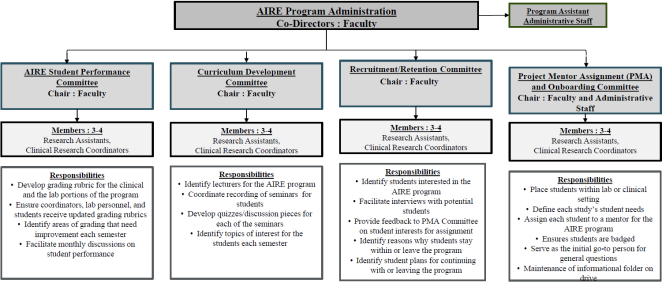
Figure 1. Flow Chart of the Administrative Structure of the AIRE Program. This flow chart outlines the administrative structure of the AIRE program, detailing the various committees and their respective responsibilities.
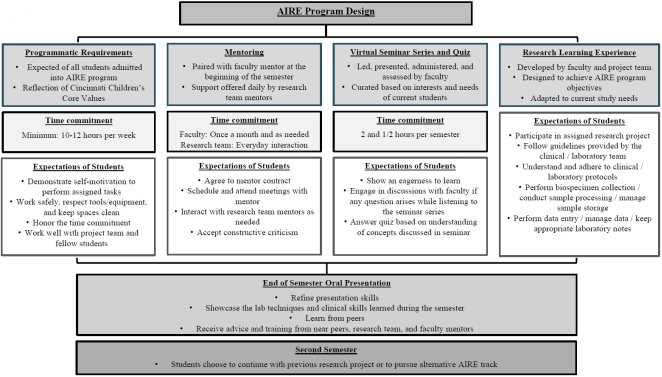
Figure 2. AIRE Program Design. The Figure outlines the programmatic requirements, including mentoring, the virtual seminar series with associated quizzes, and the research learning experience. It also enumerates student expectations within each of these categories and highlights the requirement for end-of-semester oral presentations.
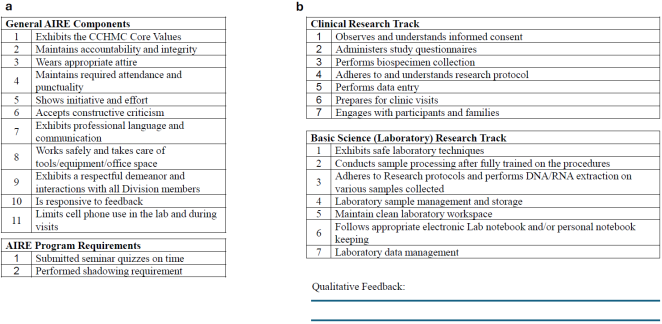
Figure 3. Grading Rubrics for the AIRE Program. (a) The general rubric used for grading students applies to both clinical and lab research courses throughout the semester. (b) The specific rubrics for grading and providing feedback to the students enrolled in the clinical research track and the basic science (laboratory) research track.
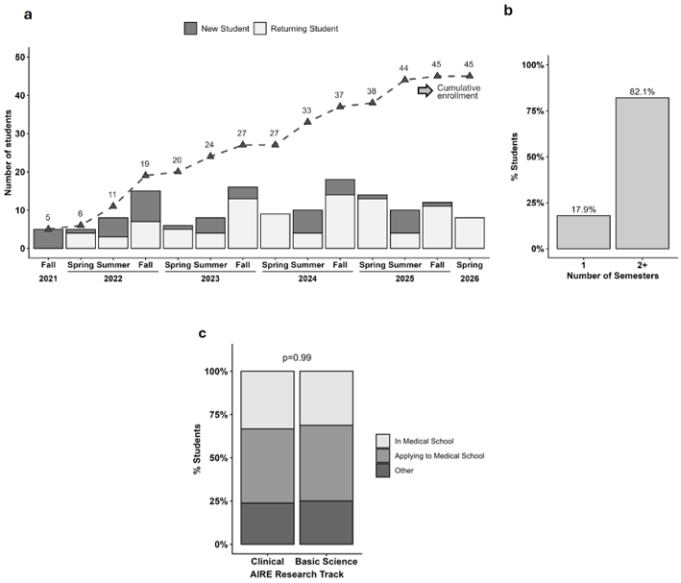
Figure 4. Student Enrollment, Retention, and Career Trajectories in the AIRE Program. (a) Student enrollment in the AIRE program over time. The consistent growth in the number of enrolled students highlights interest and engagement in the program. (b) The percentage of students based on the total semester enrolled in the AIRE program. This highlights the program’s 82.1% return rate, indicating that a significant majority of students return for more than two semesters. (c) Career trajectories by AIRE research track (Clinical and Basic Science). Career outcomes were similar across both tracks, with students from each group pursuing science-oriented career paths.
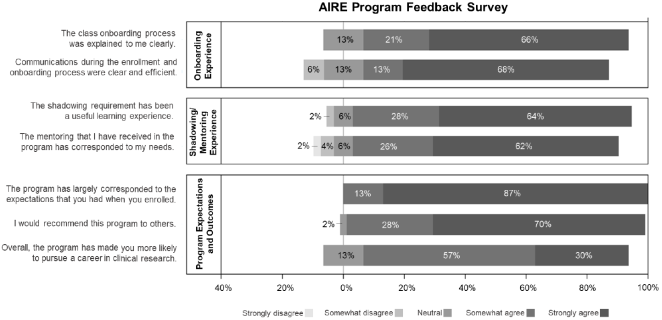
Figure 5. AIRE Student Survey Results. A survey was administered to forty-five students in the AIRE program. The results indicate that, except for shadowing/mentoring experience and onboarding experience, which received some "strongly disagree" and "somewhat disagree" responses, most students "somewhat agree" or "strongly agree" with the program's expectations and outcomes.

Information


 Share This Article
 Twitter
 Linked In
 Facebook
 Copy
Copy Download