Review Article | | Peer-Reviewed

Viewing Ethnocentrism and Ethnorelativism Through a Two-factor Lens: A Dual-spectrum Model for Intercultural Development

Received: 10 February 2026     Accepted: 24 February 2026     Published: 5 March 2026
Views:       Downloads:
Abstract

Intercultural literature often treats ethnocentrism and ethnorelativism as opposite ends of a single continuum. This paper challenges that assumption by adapting Herzberg’s two-factor theory to propose a dual-spectrum model: (1) a “hygiene” axis (ethnocentrism ↔ absence of ethnocentrism) that prevents harm, and (2) a “motivator” axis (absence of ethnorelativism ↔ ethnorelativism) that enables growth. This paper argues that reducing ethnocentrism does not automatically produce ethnorelativism, and that gains in ethnorelativism can coexist with stress-activated in-group bias which is the key concept of ethnocentrism. This dual-spectrum model can explain why bias reduction does not automatically yield adaptive collaboration and why sophisticated perspective-taking can still buckle under stress. This paper translates the model into testable propositions, a two-dimensional (2×2) typology, a portfolio of instruments for measurements, and intervention strategies. It also specifies implications for research, education, and organisational practice, especially under boundary conditions in cultural and organisational contexts, to clarify further when the axes move together, lag, or diverge. This paper also provides examples of educational program design that deliberately pair “anti-deficit” (hygiene) interventions with “growth-positive” (motivator) interventions. Hygiene secures the floor, and motivators raise the ceiling.

Published in International Journal of Education, Culture and Society (Volume 11, Issue 2)
DOI 10.11648/j.ijecs.20261102.11
Page(s) 24-33
Creative Commons

This is an Open Access article, distributed under the terms of the Creative Commons Attribution 4.0 International License (http://creativecommons.org/licenses/by/4.0/), which permits unrestricted use, distribution and reproduction in any medium or format, provided the original work is properly cited.

Copyright

Copyright © The Author(s), 2026. Published by Science Publishing Group

Keywords

Intercultural Sensitivity, Cultural Intelligence, DMIS, Dual-process, Hygiene-motivator, Nonlinearity

1. Introduction
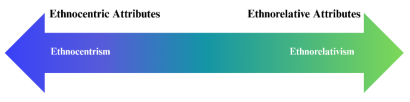
Classic frameworks for intercultural development often treat ethnocentrism (the bias toward in-group centrality and out-group devaluation) and ethnorelativism (the capacity for perspective-taking and frame-switching across cultural contexts) as opposite ends of a single continuum (see Figure 1). The intuition that ethnocentrism diminishes as ethnorelativism increases is deeply embedded in the design and evaluation of intercultural interventions. The logic appears straightforward, that is, if people come to appreciate cultural difference and to adopt others’ perspectives, they will cease to engage in cultural devaluation, stereotyping, and in-group favouritism. However, decades of studies and practices in education, healthcare, international business, and public administration reveal that the realities are more complex . Even when individuals avoid overtly ethnocentric remarks, they may still slip into culture-blind assumptions and struggle to adapt their perspective in complex interactions. Conversely, individuals capable of nuanced frame-switching can sometimes revert to defensive in-group preferences under identity threat or time pressure.
Figure 1. Classic One-Spectrum View of Ethnocentrism Versus Ethnorelativism.
To explain why declines in ethnocentrism do not reliably yield gains in ethnorelativism, and why ethnorelative orientation can coexist with stress-activated in-group bias, this paper draws on Herzberg’s two-factor theory of motivation, which explicitly separates harm prevention from growth enablement . Rather than importing managerial jargon, this paper uses Herzberg’s insight functionally: some conditions chiefly prevent things from going wrong, while others actively make things go right.
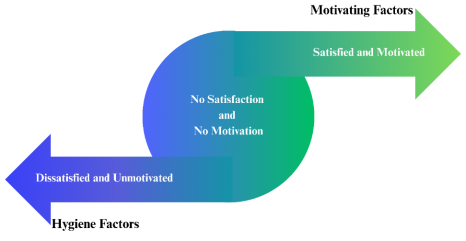
Herzberg’s two-factor theory challenges the conventional view of job satisfaction, which posits that job satisfaction and dissatisfaction are interdependent . He argues that satisfaction and dissatisfaction do not lie on a single continuum but stem from two partly independent processes (see Figure 2). “Hygiene” factors (e.g., supervision quality, pay, and clear policies) must at least meet a minimum standard to prevent dissatisfaction. Correcting shortfalls reduces complaints, but on its own, does not create intrinsic motivation. By contrast, “motivators” (e.g., recognition, autonomy, opportunities for growth) generate satisfaction and fulfilment, such that employees may feel engaged even when minor irritants remain . This structural and functional asymmetry mirrors my propositions about intercultural development, suggesting that suppressing derogation and biased construal (a prevention task) is not the same as building perspective-taking and adaptive frame coordination (a promotion task) . With that distinction in place, this paper turns to Herzberg’s two-factor theory.
Figure 2. Herzberg’s Two-Factor Theory of Motivation: Motivating and Hygiene Factors.
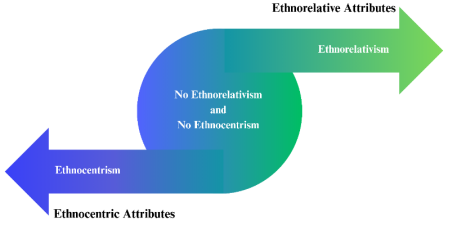
Adapting this logic to intercultural development, this theoretical paper argues that reducing ethnocentrism is functionally akin to “hygiene” (its reduction prevents harm), whereas cultivating ethnorelativism is akin to “motivators” (its cultivation enables growth). By analogy, ethnocentrism and ethnorelativism arise from partly independent antecedents: policies, norms, and accountability can suppress devaluation of out-groups (reducing ethnocentrism) without instilling the cognitive-affective skills required to take others’ perspectives (building ethnorelativism). Similarly, immersive learning and frame-switching practice can cultivate ethnorelativism without fully extinguishing latent in-group bias under stress. This perspective suggests that ethnocentrism lies on a “hygiene” spectrum, with its desirable pole being the absence of ethnocentrism (i.e., non-derogation and fair construal). In contrast, ethnorelativism belongs on a “motivator” spectrum, with its desirable pole being the presence of ethnorelative capability (i.e., perspective-taking and adaptive behaviour). On this view, the logical opposites are absences, not each other: the opposite of ethnocentrism is not ethnorelativism, but rather the absence of ethnocentrism; the opposite of ethnorelativism is not ethnocentrism, but rather the absence of ethnorelativism (see Figure 3). Treating the constructs as dual spectra rather than a single continuum preserves this asymmetry. It directs design and evaluation toward distinct yet complementary mechanisms for harm prevention and growth.
Figure 3. A Dual-Spectrum View of Ethnocentrism Versus Ethnorelativism.
This dual-spectrum conceptualisation of ethnocentrism versus ethnorelativism has three immediate theoretical payoffs. First, it explains why training programs that successfully curtail ethnocentric behaviours sometimes fail to produce adaptive perspective-taking: “hygiene” improved, but “motivators” were not engaged. Second, it clarifies why sophisticated ethnorelativism can coexist with residual ethnocentric triggers under stress: “motivators” were developed, but “hygiene” gaps remain. Third, it provides a more precise evaluation framework by directing measurement to both trajectories rather than presuming that movement along one axis implies movement along the other.
2. Theoretical Background
2.1. Herzberg’s Two-factor Theory: From Workplace Conditions to Intercultural Context
According to Herzberg’s two-factor theory, improvements in “hygiene” conditions minimise dissatisfaction but do not necessarily create satisfaction; conversely, “motivators” generate satisfaction partially independent of “hygiene” status . The theory has been debated on methodological and conceptual grounds. However, the central separation remains largely influential because it addresses an everyday conundrum, that is, removing a negative does not automatically produce a positive. Successive reviews and cross-cultural applications confirm the usefulness of this asymmetry and emphasise that the salience of specific factors should always be calibrated to local contexts . Applied beyond the workplace, the two-factor theory implies that no single lever can drive complex human development. Instead, it requires a coordinated set of interventions—some that prevent dysfunction (“hygiene” factors) and others that actively promote growth (“motivator” factors).
At the same time, this paper does not claim that only two dimensions exhaustively describe intercultural development. Additional psychological axes, such as general openness to alternative perspectives, threat sensitivity, or need for closure, likely shape developmental trajectories and outcomes. My argument is minimal rather than exclusive: at a minimum, two functionally distinct axes are necessary to avoid category errors in design and evaluation. One tracking harm prevention (reductions in ethnocentrism) and one tracking growth enablement (increases in ethnorelativism). This distinction also accommodates the well-documented human capacity to hold simultaneous, context-triggered, and even contradictory positions. From a Complex Dynamic Systems Theory (CDST ) perspective, individuals can inhabit coexisting attractor states (e.g., low overt ethnocentrism in routine settings yet stress-elicited in-group bias), which a single continuum cannot represent. A dual-axis framework, therefore, serves as a pragmatic baseline that can incorporate additional traits and moderators without collapsing prevention and growth into a single metric.
2.2. Ethnocentrism: Definition, Assessment, and Costs
Ethnocentrism, in Sumner’s classic formulation, refers to a pattern of in-group centrism accompanied by out-group derogation and devaluation . In contemporary intercultural settings, it manifests in biased attributions and premature closure in judgments. The construct can be assessed at two levels: trait measures capture relatively stable dispositions expressed across contexts (e.g., generalised attitudes and preferences), whereas situational measures capture context-dependent states that fluctuate with conditions such as time pressure, identity threat, or status dynamics (e.g., responses to vignettes, language in evaluative documents, or behaviour in simulated interactions). Neuliep and McCroskey’s Generalised Ethnocentrism (GENE) scale, together with its shorter form, the SFGENE-7 , assesses a stable dispositional orientation toward ethnocentrism across contexts. Consistent with prevailing definitions, both instruments capture the construct’s core facets, including ethnic-group self-centredness, ingroup preference, ingroup superiority, and negativity toward out-groups .
Ethnocentrism imposes demonstrable costs across sectors. In healthcare, ethnocentric assumptions can distort symptom interpretation, impair diagnostic reasoning, impede clinician-patient communication, and erode therapeutic trust . Similar dynamics are also evident in education and public institutions: ethnocentric curricula and routines narrow students’ interpretive horizons, dampen engagement, and normalise exclusion unless countered by culturally responsive pedagogy . In governance and frontline administration, interactions that convey partiality or disrespect undermine perceptions of procedural justice and institutional legitimacy, which, in turn, reduce citizens’ willingness to cooperate and comply with authorities . Beyond the public sector, ethnocentrism also carries economic and organisational consequences. In multicultural workplaces, ethnocentric climates heighten process losses, such as dysfunctional conflict, miscommunication, and social fragmentation, thereby inhibiting knowledge sharing and thwarting localisation efforts . At the macro-political level, the tension between global economic integration and ethnocentric attitudes has become a salient force in many industrialised countries; ethnocentrism-based political strategies generate direct economic costs and constrain integration . Taken together, evidence across micro-level encounters (e.g., clinical interviews, classrooms, frontline service) and macro-level systems (e.g., trade flows, organisational capability, institutional legitimacy) underscores the need for interventions that both reduce ethnocentric harm and, separately, cultivate ethnorelative competence.
2.3. Ethnorelativism, Intercultural Sensitivity, and Cultural Intelligence
Ethnorelativism refers to “a paradigm which is founded on the understanding that other cultures exist with a weight and reality equivalent to one’s own” . Bennett’s Developmental Model of Intercultural Sensitivity (DMIS) conceptualises intercultural growth as movement from ethnocentric orientations (Denial, Defence, Minimisation) toward ethnorelative orientations (Acceptance, Adaptation, Integration). The shift is not merely attitudinal but epistemic: it involves increasing the complexity with which cultural differences are perceived and interpreted, progressing from a default centrality of one’s own frames to an ability to coordinate multiple frames in interaction. Subsequent scholarship emphasises that this movement is rarely linear. Building on CDST, Liu and colleagues contend that intercultural sensitivity is an emergent property of person-environment couplings unfolding across multiple time scales. Viewed through this lens, the DMIS can be a multistable, history-dependent system. It helps explain why people do not progress uniformly, why regressions and sudden leaps occur, and why change depends as much on context as on individual dispositions. In this sense, DMIS is best read as a developmental tendency rather than an invariant sequence. This distinction becomes essential when linking the model to the design of assessment and interventions.
Hammer et al. operationalised the DMIS continuum in the Intercultural Development Inventory (IDI); since then, it has been widely used in educational and organisational settings to diagnose orientations and track change. Additionally, more instruments extend this picture: the Intercultural Sensitivity Scale (ISS ) foregrounds affective-relational dispositions (e.g., comfort with difference, respect, interactional engagement), while Cultural Intelligence (CQ; ) captures a multifaceted capability set—metacognitive monitoring of cultural assumptions, motivation to persist in culturally complex settings, and behavioural repertoire for adaptive practice. As these measures tap distinct facets, using them in combination can reveal whether change is aligned or decoupled. For example, a drop in ethnocentrism alongside flat IDI/ISS/CQ scores indicates divergence; CQ gains that precede an IDI shift indicate a lag; simultaneous improvements across measures indicate co-occurrence. Notably, these mixed patterns strain the assumption that intercultural development unfolds along a single bipolar line, and these recurring asymmetries are difficult to reconcile with a single bipolar trajectory between ethnocentrism and ethnorelativism. Accordingly, they highlight the limits of a one-dimensional model and motivate a dual-spectrum account that distinguishes between harm reduction (lower ethnocentrism) and growth enablement (higher ethnorelativism).
3. The Limits of a Single Bipolar Spectrum Between Ethnocentrism and Ethnorelativism
Although intercultural development is often portrayed as a linear progression from ethnocentrism to ethnorelativism, lived trajectories are typically non-linear, context-dependent, and multistable . Individuals may plateau, cycle, or regress, and gains achieved in one setting (e.g., professional workplace) do not necessarily transfer to another (e.g., online forum where immigration debates are heated). As mentioned above, a CDST perspective treats intercultural sensitivity as an emergent property of person-environment couplings that unfold across multiple time scales and can stabilise in different dynamic states, thereby clarifying why sharp leaps, stalls, and reversions occur . From this viewpoint, treating “less ethnocentric” as equivalent to “more ethnorelative” over-simplifies and obscures how contextual affordances, such as cultural tightness-looseness and identity threat, shape both the direction and durability of change . Measurement evidence reinforces this argument. Programme evaluations frequently reveal asymmetric change—curricula that elevate ethnorelative orientations and CQ without commensurate reductions in generalised ethnocentrism, or advanced orientations that nonetheless give way to in-group bias under pressure in diverse teams . Such decoupling is difficult to reconcile with a single bipolar continuum and instead supports a dual-spectrum account that separately tracks harm reduction (lower ethnocentrism) and growth enablement (higher ethnorelativism).
4. A Dual-spectrum Model: Hygiene for Harm Reduction, Motivators for Growth Enablement
The core claim of the dual-spectrum model is that ethnocentrism and ethnorelativism are better conceptualised as separable, partially related axes. The first axis runs from ethnocentrism to the absence of ethnocentrism and primarily captures the inhibition of devaluation, derogation, and biased construal. Its functional logic is “hygiene”, that is, as ethnocentrism decreases, interpersonal harms decline, and interactional safety rises. However, this reduction does not automatically equip individuals to perform the positive work of perspective-taking and adaptive frame-switching. The second axis runs from the absence of ethnorelativism to ethnorelativism, primarily capturing the activation of growth-oriented cognitive and affective capacities. Its logic is motivational, that is, increasing ethnorelativism enables more accurate and functional social inference across diverse contexts, richer identity work, and purpose-laden collaboration across cultural differences.
Several implications follow from conceptualising ethnocentrism and ethnorelativism as separable axes. First, the two axes tend to be negatively related, since ethnocentrism can impede ethnorelative functioning. However, the relationship can be imperfect because contextual pressures, norms, and skills can push each axis differently. For example, culturally tight environments with strong compliance norms may suppress ethnocentric expression without developing perspective-shifting, which is important for ethnorelative competencies . By contrast, environments rich in authentic intercultural collaboration can cultivate frame-switching and empathy, while residual in-group preference still re-emerges under stress . These contingencies are consistent with developmental accounts that treat intercultural sensitivity as context dependent rather than strictly linear .
Second, the design and evaluation of interventions could explicitly track both axes, recognising that movement on one dimension does not guarantee movement on the other. Interventions that primarily target “hygiene”, such as bias interruption protocols, transparent evaluation criteria, and accountability mechanisms, could reduce observed ethnocentrism and its harms, but, by themselves, could not produce sustainable ethnorelativism. This asymmetry recapitulates Herzberg’s observation that eliminating dissatisfiers does not create satisfiers. Similarly, interventions that primarily target “motivators” (e.g., sustained perspective-taking practice, frame-switching drills, identity reflection, and CQ curricula) can increase ethnorelativism and adaptive behaviour but may leave residual ethnocentric triggers under stress. Without “hygiene” scaffolds, these gains can be brittle.
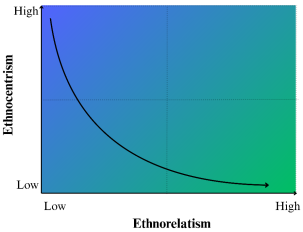
Third, measurement models that treat ethnocentrism and ethnorelativism as separate but related constructs can fit empirical data better than single-factor models. For example, locating individuals and organisations within a two-dimensional space (see Figure 4), rather than along a single bipolar line, can enable more precise distinctions among seemingly similar but functionally different attributes and outcomes (e.g., “polite minimalism” versus “durable ethnorelativism”), thereby clarifying goals, diagnostics, and success criteria.
Figure 4. Non-Linear Developmental Tendency in a Two-Dimensional Space of Ethnocentrism and Ethnorelativism.

Note. The curved arrow suggests a non-linear developmental tendency in the two-dimensional space of ethnocentrism and ethnorelativism. This developmental transition tends to be dynamic, context-sensitive, and history-dependent.
The two-dimensional space in Figure 4 suggests four broad regions defined by relative positions on the ethnocentrism and ethnorelativism axes. First, individuals high in ethnocentrism and low in ethnorelativism typically display defensive polarisation, derogating cultural differences while lacking the skills to engage constructively. Therefore, they tend to carry the greatest risk of dysfunctional outcomes in a culturally diverse context. Second, individuals high in both ethnocentrism and ethnorelativism tend to be more ambivalent, that is, they can shift frames and articulate differences while retaining strong in-group preferences that may resurface in threat or high-stakes contexts. Without targeted “hygiene” interventions that proactively reduce ethnocentrism, their apparent sophistication remains fragile. Third, individuals low in ethnocentrism but also low in ethnorelativism avoid overt devaluation yet frequently rely on culture-blind minimisation and default interpretations; they can be generally polite and non-harmful but not reliably adaptive. Finally, individuals low in ethnocentrism and high in ethnorelativism enact empathic, flexible communication, engage in adaptive frame-switching, and sustain accurate judgments in culturally mixed teams. This profile represents the primary target of intercultural programs. Consequently, the transitions among these regions are best understood as (un) joint movements in both axes rather than linear travel along one. In empirical tests, ethnocentrism and ethnorelativism are expected to show a partial negative association at the latent level. On average, lower ethnocentrism may co-occur with higher ethnorelativism, but the two constructs are not collinear. Instead, curvilinear dynamics are expected (see Figure 4). Early reductions in ethnocentrism, particularly those driven by rule compliance, may yield little immediate change in ethnorelativism until threshold levels of practice and feedback are reached, after which growth accelerates. Notably, at the state level, this developmental transition tends to be dynamic, context-sensitive, and history-dependent, consistent with CDST’s arguments in the intercultural development setting .
5. Measurement and Method: A Portfolio Approach
Operationalising the model requires simultaneous assessment of both axes using instruments aligned to their conceptual cores. For example, ethnocentrism can be indexed with the GENE scale, supplemented by domain-specific behavioural indicators (e.g., evaluative language audits, decision “choice architecture,” and vignette-based attribution tasks). Ethnorelativism can be assessed with the IDI , a structured representation of orientations from Acceptance to Integration, and the ISS , which provides affective orientation measures that bridge comfort with difference and openness to intercultural contact. CQ can be included as a capability that captures metacognitive monitoring, motivational drive, and an adaptive behavioural repertoire . Additionally, a confirmatory factor analysis can compare (a) one-factor (single continuum) with (b) two-factor (ethnocentrism vs. ethnorelativism) models. Furthermore, this paper suggests using longitudinal, person-centred methods (e.g., latent transition analysis, growth mixture modelling) to detect distinct developmental pathways, including trajectories where “hygiene” moves first (reduction in ethnocentrism precedes gains in ethnorelativism) and trajectories where “motivators” move first (gains in ethnorelativism emerge before residual ethnocentrism is fully addressed). Lastly, process tracing with diary methods and situational judgment tests can triangulate quantitative patterns with lived experiences, thereby capturing how identity threat, time pressure, or power differentials precipitate momentary reversion to ethnocentric habits even among otherwise ethnorelative actors.
6. Educational Program Design: Two-dimensional Focus
An educational program can be designed based on the asymmetry of the two-dimensional model. To avoid the common outcome of “polite minimalism”, in which overt devaluation is curtailed, but adaptive collaboration remains shallow, designers can deliberately pair hygiene-oriented interventions with motivator-oriented learning. To illustrate, consider first an undergraduate policy course in public administration. In this context, the “hygiene” architecture could consist of anti-discrimination policies, transparent assessment criteria, anonymised peer review of policy memos, and an agreed protocol for interrupting stereotyping in seminar discussions. These measures can reduce the likelihood of ethnocentric bias in shaping consequential decisions. Notably, these safeguards are most effective when integrated with “motivator” measures, such as reflective pedagogy, dialogic engagement, and scaffolded intercultural projects that require perspective-taking for success . Therefore, running alongside the “hygiene” elements, the “motivator” spine can include a semester-long mixed-culture consulting project for a municipal client, in which students rotate roles (analyst, liaison, facilitator) and submit coached perspective-taking briefs that require them to articulate stakeholder viewpoints before proposing solutions. Moreover, the evaluation should align with the function. For example, language audits of feedback and memo rubrics could index “hygiene” movement, whereas changes in IDI/ISS/CQ scores and an external performance rubric for frame coordination during client meetings could index “motivator” gains. Moreover, client satisfaction and product quality ratings can provide distal outcomes.
A similar pairing is feasible in health-profession education. “Hygiene” measures can be institutionalised through standardised interpreter-use procedures, structured social-history checklists, and pre-commitment to diagnostic criteria to reduce attribution bias under time pressure. In parallel, “motivator” elements can be cultivated through longitudinal community-engaged placements, reflective narrative-medicine seminars, and simulated cross-cultural handovers, followed by debriefs focused on reconstructing cases from patients’ cultural frames. The former set can limit potential ethnocentrism-related harm, while the latter measures can cultivate the empathic, metacognitive, and behavioural complexity on which ethnorelativism depends . Furthermore, in international business curricula, the same logic scales to team projects with real clients. For example, “hygiene” comprises explicit inclusion norms, equitable task allocation, and staged conflict-resolution procedures that reduce the likelihood of micro-exclusions and status hierarchies that potentially reintroduce ethnocentric dynamics into teams . “Motivators” comprise iterative cross-border negotiations, peer coaching on cultural hypothesis testing, and “failure analysis” assignments that treat breakdowns as data for growth. These activities can build CQ and ethnorelativism by creating repeated, consequential opportunities for achievement and recognition . Additionally, in English-as-a-foreign-language contexts, classroom routines that identify and interrupt stereotyping create a safe baseline for interaction. However, sustained gains in ethnorelativism emerge when learners practice contrastive analysis, perspective-taking, and frame-switching with feedback and escalating complexity across a semester .
All in all, the deeper rationale is that “hygiene” secures the floor and “motivators” raise the ceiling. In the absence of a secure floor, even sophisticated intercultural skills tend to collapse into defensive reactivity under pressure. In the absence of a raised ceiling, rule compliance produces civility without the competence required for collaboration across meaningful differences. Accordingly, programs could be sequenced and integrated: initiate “hygiene” reforms to prevent harm, while simultaneously or subsequently investing in long-horizon, reciprocal, and meaningful “motivator” experiences that are sufficient to reorganise habits of mind and practice.
7. Boundary Conditions and Cultural Context
Neither axis unfolds in a cultural vacuum. Herzberg’s two-factor theory itself requires adaptation across cultural settings, with cross-cultural evidence indicating that factor salience and interpretation vary with local norms and institutional histories . Macro-level values similarly shape intercultural development. For example, in high power-distance and culturally tight societies, strong compliance norms and clear sanctions may reduce the outward expression of ethnocentrism even when underlying orientations remain unchanged. Consequently, the observed relationship between ethnocentrism and ethnorelativism may be attenuated. In contrast, in low power-distance or loose societies, experimentation and dissent are more tolerated, which may facilitate the development of “motivators” through authentic intercultural collaboration, but the absence of strong norms may permit the persistence of subtle ethnocentric preferences, especially under stress .
Organisational subcultures add another layer of contingency. In safety-critical domains such as aviation and medicine, “hygiene” is often institutionalised through standardised checklists, crew resource management, and protocols that reduce variability and opportunities for discretionary bias . However, the very strength of protocolisation can unintentionally crowd out the learning structures, reflection, debriefs, and psychological safety, needed to deepen ethnorelative capacities, unless these are intentionally designed alongside the rules . In contrast, creative industries that prize fluid collaboration can generate rich “motivator” experiences (autonomy, recognition, meaningful work) but often lack guardrails that prevent exclusionary dynamics from resurfacing under competition or scarcity; inclusive climate practices are therefore needed to sustain participation across difference . Effective translation of the dual-spectrum model thus requires a diagnostic phase, mapping local cultural values, routines, and stakeholder incentives, followed by a design phase that pairs appropriately calibrated “hygiene” elements with “motivator”-rich learning experiences .
8. Research Agenda for Future Studies
Future research can proceed along four interlocking lines. Notably, in field settings, “hygiene-only,” “motivator-only,” and “integrated” conditions can be treated as analytic contrasts rather than as perfectly separable states. Practical differentiation can be achieved pragmatically through, for example, matching process measures to each function (e.g., for “hygiene”, indicators of bias expression and procedural fairness; for “motivators”, measures of frame coordination, CQ, and adaptive behaviour). These measures can then be modelled jointly using latent-variable approaches that allow cross-loadings, rather than forcing the measures to be perfectly separate. First, model testing can compare one-, two-, and, where appropriate, three-factor measurement models across diverse samples, evaluate fit indices, and examine whether the axes exhibit partial, negative associations. Second, program experimentation using randomised or quasi-experimental designs can contrast “hygiene”-only, “motivator”-only, and integrated conditions via varying emphasis (e.g., stronger policy/accountability and language-audit components versus stronger perspective-taking and coached frame-switching components). The outcomes can be assessed both proximally (changes in measured orientations and capabilities) and distally (decision quality, conflict rates, satisfaction, and performance on intercultural tasks). When “pure” conditions are infeasible in research design, factorial or micro-randomised trials can estimate the relative contribution of prevention-oriented and growth-oriented elements within blended interventions. Third, work on dynamics can employ longitudinal, person-centred analyses, such as complemented by diary and experience-sampling methods, to examine how identity threat, time pressure, and power asymmetries perturb trajectories, and how combined interventions reshape developmental landscapes. Fourth, studies of boundary conditions can use cross-cultural comparisons to test moderation by national values, organisational cultures, and regulatory environments, tracing how tightness-looseness and power distance influence the relation between the axes and the translation of program elements.
9. General Discussion
Reframing ethnocentrism and ethnorelativism as two separable spectra can clarify several persistent puzzles in training practice and research. Apparent “bias training” successes that fail to yield adaptive teamwork or better client outcomes can be understood as “hygiene” gains without corresponding “motivator” gains. Conversely, initiatives that cultivate sophisticated discourse about culture yet leave conflict and inequity unchanged likely build “motivators” without securing “hygiene”. The model also sheds light on paradoxical cases in which leaders with high CQ display in-group favouritism during crises: their ethnorelative capabilities remain intact, but situational stress exposes residual ethnocentrism that structured protocols could have contained.
For educators, practitioners, and policymakers, the design implications are concrete. Reductions in derogatory language or higher self-reported comfort with diversity are insufficient indicators of comprehensive development. Instead, a more appropriate twin-track evaluation aligned with the dual spectra, which expects assessors to ask whether dysfunctional harms are reliably prevented (“hygiene”) and, second, whether adaptive, constructive collaboration becomes the default under both routine and high-stakes conditions (“motivators”). Achieving both requires sustained attention to institutional arrangements, interpersonal routines, and individual learning experiences—sequenced and integrated to pair psychological safety with consequential opportunities for achievement, recognition, and responsibility in intercultural work. This is precisely the combination Herzberg identified as necessary to transform the absence of dissatisfaction into the presence of satisfaction.
10. Conclusion
In sum, viewing ethnocentrism and ethnorelativism through a two-factor lens reframes intercultural development as partially independent journeys: “hygiene” work that reliably prevents harm by reducing ethnocentrism, and “motivator” work that enables growth by building ethnorelativism. This paper argues that reducing ethnocentrism does not automatically produce ethnorelativism, and that gains in ethnorelativism can coexist with stress-activated in-group bias that is the key concept of ethnocentrism. This dual-spectrum model can explain why bias reduction does not automatically yield adaptive collaboration and why sophisticated perspective-taking can still buckle under stress. “Hygiene” secures the floor, and “motivators” raise the ceiling. In the absence of a secure floor, even sophisticated intercultural skills tend to collapse into defensive reactivity under pressure. In the absence of a raised ceiling, rule compliance produces civility without the competence required for meaningful, cross-cultural collaboration.
Abbreviations

CDST

Complex Dynamic Systems Theory

GENE

Generalised Ethnocentrism Scale

DMIS

Developmental Model of Intercultural Sensitivity

ISS

Intercultural Sensitivity Scale

IDI

Intercultural Development Inventory

CQ

Cultural Intelligence

Author Contributions
Hugh Jiliang Liu: Conceptualization; Visualization; Writing – original draft; Writing – review & editing.
Conflicts of Interest
The author declares no conflicts of interest. The author received no specific funding for this work.
References
[1] Acheson, K., & Schneider-Bean, S. (2019). Representing the intercultural development continuum as a pendulum: Addressing the lived experiences of intercultural competence development and maintenance. European Journal of Cross-Cultural Competence and Management, 5(1), 42-61.
[2] Liou, R.-S., Nisar, S., Lee, K., Dixon, D., & Pennington, J. (2021). Unpacking cultural intelligence: Cultivating ethnorelativism in international business education. Journal of Teaching in International Business, 32(2), 154-175.
[3] Strugielska, A., & Piątkowska, K. (2017). Turning constructionist intercultural communicative competence and complex systems theory into praxis. Journal of Intercultural Communication, 17(1), 1-13.
[4] Herzberg, F. (2003). One more time: How do you motivate employees? Harvard Business Review, 81. 87-96.
[5] Sachau, D. A. (2007). Resurrecting the motivation–hygiene theory: Herzberg and the positive psychology movement. Human Resource Development Review, 6(4), 377-393.
[6] Liu, H. J., Den Hartigh, R., & Van der Poel, M. H. (2026). Understanding the Developmental Model of Intercultural Sensitivity Through a Complex Dynamic Systems Lens. Culture & Psychology.
[7] Matei, M. C., & Abrudan, M. M. (2016). Adapting Herzberg’s two-factor theory to the cultural context of Romania. Procedia-Social and Behavioral Sciences, 221, 95-104.
[8] Alshmemri, M., Shahwan-Akl, L., & Maude, P. (2017). Herzberg’s two-factor theory. Life Science Journal, 14(5), 12-16.
[9] Larsen-Freeman, D. (1994). On the parallels between chaos theory and second language acquisition [Paper presentation]. In Second Language Research Forum, McGill University, Montreal.
[10] Larsen-Freeman, D. (2020). Complex dynamic systems theory. In Theories in Second Language Acquisition (pp. 248-270). Routledge.
[11] Sutherland, L. L. (2002). Ethnocentrism in a pluralistic society: A concept analysis. Journal of Transcultural Nursing, 13(4), 274-281.
[12] Neuliep, J. W., & McCroskey, J. C. (1997). The development of a U.S. and generalized ethnocentrism scale. Communication Research Reports, 14(4), 385-398.
[13] Neto, J. & Neto, F. (2022). Ethnocentrism: A Short Form Measure (SFGENE-7). SAGE Open. 12. 215824402210945.
[14] Bizumic, B., & Duckitt, J. (2012). What is and is not ethnocentrism? A conceptual analysis and political implications. Political Psychology, 33(6), 887-909.
[15] Betancourt, J. R., Green, A. R., Carrillo, J. E., & Park, E. R. (2005). Cultural competence and health care disparities: key perspectives and trends. Health Affairs, 24(2), 499-505.
[16] Lauwers, E. D. L., Vandecasteele, R., McMahon, M., De Maesschalck, S., & Willems, S. (2024). The patient perspective on diversity-sensitive care: a systematic review. International Journal for Equity in Health, 23(1), 117.
[17] Banks, J. A. (2015). Cultural diversity and education: Foundations, curriculum, and teaching. Routledge.
[18] Gay, G. (2018). Culturally responsive teaching: Theory, research, and practice. Teachers College Press.
[19] Bolger, P. C., & Walters, G. D. (2019). The relationship between police procedural justice, police legitimacy, and people’s willingness to cooperate with law enforcement: A meta-analysis. Journal of Criminal Justice, 60, 93-99.
[20] Yesberg, J. A., Sargeant, E., Fenn, L., Murphy, K., & Madon, N. (2024). Fairness in policing: how does internal procedural justice translate to external procedural justice? Policing: A Journal of Policy & Practice, 18, 1-9.
[21] Tyler, T. R. (2004). Enhancing police legitimacy. The Annals of the American Academy of Political and Social Science, 593(1), 84-99.
[22] Khan, M. H., & Jin, J. (2024). The Relationship between Ethnocentric Behaviour and Workforce Localisation Success: The Mediating Role of Knowledge Sharing Tendency. European Research on Management & Business Economics, 30(2).
[23] Stahl, G. K., & Maznevski, M. L. (2021). Unraveling the Effects of Cultural Diversity in Teams: A Retrospective of Research on Multicultural Work Groups and an Agenda for Future Research. Journal of International Business Studies, 52(1), 4–22.
[24] Andrews, S., Leblang, D., & Pandya, S. S. (2018). Ethnocentrism reduces foreign direct investment. The Journal of Politics, 80(2), 697-700.
[25] Greenholtz, J., & Kim, J. (2009). The cultural hybridity of Lena: A multi-method case study of a third culture kid. International Journal of Intercultural Relations, 33(5), 391-398.
[26] Bennett, M. J. (1986). A developmental approach to training for intercultural sensitivity. International Journal of Intercultural Relations, 10(2), 179-196.
[27] Bennett, M. J. (2013). Basic concepts of intercultural communication: Paradigms, principles, and practices. Hachette UK.
[28] Bennett, M. J. (2017). Constructivist approach to intercultural communication. The International Encyclopedia of Intercultural Communication, 10, 9781118783665.
[29] Liu, H. J., Den Hartigh, R., Van der Poel, M. H., & Bosma, S. (2026). A Novel Perspective on Intercultural Communication Education: Insights from Ecological Psychology and Complex Systems Theory.
[30] Hammer, M. R., Bennett, M. J., & Wiseman, R. (2003). Measuring intercultural sensitivity: The Intercultural Development Inventory. International Journal of Intercultural Relations, 27(4), 421-443.
[31] Chen, G. M., & Starosta, W. J. (2000). The development and validation of the Intercultural Sensitivity Scale. Human Communication, 3(1), 3-14.
[32] Ang, S., Van Dyne, L., Koh, C., Ng, K. Y., Templer, K. J., Tay, C., & Chandrasekar, N. A. (2007). Cultural Intelligence: Its Measurement and Effects on Cultural Judgment and Decision Making, Cultural Adaptation and Task Performance. Management and Organization Review, 3(3), 335-371.
[33] Piątkowska, K., & Strugielska, A. (2017). Unifying constructionist intercultural competence through a complex systems perspective. Theory and Practice in Language Studies, 7(12), 1171-1177.
[34] Gelfand, M. (2019). Rule makers, rule breakers: Tight and loose cultures and the secret signals that direct our lives. Scribner.
[35] Abacıoğlu, C. S., Epskamp, S., Fischer, A. H., & Volman, M. (2023). Effects of multicultural education on student engagement in low-and high-concentration classrooms: the mediating role of student relationships. Learning Environments Research, 26(3), 951-975.
[36] Franco, M. P., Bottiani, J. H., & Bradshaw, C. P. (2024). Assessing teachers’ culturally responsive classroom practice in PK-12 schools: A systematic review of teacher-, student-, and observer-report measures. Review of Educational Research, 94(5), 743-798.
[37] Chae, D., Kim, J., Kim, S., Lee, J., & Park, S. (2020). Effectiveness of cultural competence educational interventions on health professionals and patient outcomes: A systematic review. Japan Journal of Nursing Science, 17(3), e12326.
[38] Chu, W., Wippold, G., & Becker, K. D. (2022). A systematic review of cultural competence trainings for mental health providers. Professional Psychology: Research and Practice, 53(4), 362.
[39] Vandecasteele, R., Schelfhout, S., D’hondt, F., De Maesschalck, S., Derous, E., & Willems, S. (2024). Intercultural effectiveness in GPs' communication and clinical assessment: An experimental study. Patient Education and Counseling, 122, 108138.
[40] Frazier, M. L., Fainshmidt, S., Klinger, R. L., Pezeshkan, A., & Vracheva, V. (2017). Psychological Safety: A Meta-Analytic Review and Extension. Personnel Psychology, 70(1), 113-165.
[41] Shore, L. M., Cleveland, J. N., & Sanchez, D. (2018). Inclusive workplaces: A review and model. Human Resource Management Review, 28(2), 176-189.
[42] Dong, Q., Day, K. D., & Collaço, C. M. (2008). Overcoming ethnocentrism through developing intercultural communication sensitivity and multiculturalism. Human Communication, 11(1), 27-38.
[43] Rahimi, Ali & Soltani, Ali. (2011). Teachability of Intercultural Sensitivity from the Perspective of Ethnocentrism vs. Ethnorelativism: An Iranian Experience. Journal of Applied Linguistics, 14(1): 109-134.
[44] Gelfand, M. J., Raver, J. L., Nishii, L., Leslie, L. M., Lun, J., Lim, B. C.,... & Yamaguchi, S. (2011). Differences between tight and loose cultures: A 33-nation study. Science, 332(6033), 1100-1104.
[45] Hofstede, G., Hofstede, G. J., & Minkov, M. (2010). Cultures and organisations: Software of the mind (3rd ed.). New York, NY: McGraw-Hill.
[46] Bergs, J., Lambrechts, F., Simons, P., Vlayen, A., Marneffe, W., Hellings, J., Cleemput, I., & Vandijck, D. (2015). Barriers and facilitators related to the implementation of surgical safety checklists: a systematic review of the qualitative evidence. BMJ Quality & Safety, 24(12), 776-786.
[47] Gross, B., Rusin, L., Kiesewetter, J., Zottmann, J. M., Fischer, M. R., Prückner, S., & Zech, A. (2019). Crew resource management training in healthcare: a systematic review of intervention design, training conditions and evaluation. BMJ Open, 9(2), e025247.
[48] Edmondson, A. C., & Lei, Z. (2014). Psychological safety: The history, renaissance, and future of an interpersonal construct. Annual Review of Organizational Psychology and Organizational Behavior, 1(1), 23-43.
Cite This Article
  • APA Style

    Liu, H. J. (2026). Viewing Ethnocentrism and Ethnorelativism Through a Two-factor Lens: A Dual-spectrum Model for Intercultural Development. International Journal of Education, Culture and Society, 11(2), 24-33. https://doi.org/10.11648/j.ijecs.20261102.11

    Copy | Download

    ACS Style

    Liu, H. J. Viewing Ethnocentrism and Ethnorelativism Through a Two-factor Lens: A Dual-spectrum Model for Intercultural Development. Int. J. Educ. Cult. Soc. 2026, 11(2), 24-33. doi: 10.11648/j.ijecs.20261102.11

    Copy | Download

    AMA Style

    Liu HJ. Viewing Ethnocentrism and Ethnorelativism Through a Two-factor Lens: A Dual-spectrum Model for Intercultural Development. Int J Educ Cult Soc. 2026;11(2):24-33. doi: 10.11648/j.ijecs.20261102.11

    Copy | Download

  • @article{10.11648/j.ijecs.20261102.11,
      author = {Hugh Jiliang Liu},
      title = {Viewing Ethnocentrism and Ethnorelativism Through a Two-factor Lens: A Dual-spectrum Model for Intercultural Development},
      journal = {International Journal of Education, Culture and Society},
      volume = {11},
      number = {2},
      pages = {24-33},
      doi = {10.11648/j.ijecs.20261102.11},
      url = {https://doi.org/10.11648/j.ijecs.20261102.11},
      eprint = {https://article.sciencepublishinggroup.com/pdf/10.11648.j.ijecs.20261102.11},
      abstract = {Intercultural literature often treats ethnocentrism and ethnorelativism as opposite ends of a single continuum. This paper challenges that assumption by adapting Herzberg’s two-factor theory to propose a dual-spectrum model: (1) a “hygiene” axis (ethnocentrism ↔ absence of ethnocentrism) that prevents harm, and (2) a “motivator” axis (absence of ethnorelativism ↔ ethnorelativism) that enables growth. This paper argues that reducing ethnocentrism does not automatically produce ethnorelativism, and that gains in ethnorelativism can coexist with stress-activated in-group bias which is the key concept of ethnocentrism. This dual-spectrum model can explain why bias reduction does not automatically yield adaptive collaboration and why sophisticated perspective-taking can still buckle under stress. This paper translates the model into testable propositions, a two-dimensional (2×2) typology, a portfolio of instruments for measurements, and intervention strategies. It also specifies implications for research, education, and organisational practice, especially under boundary conditions in cultural and organisational contexts, to clarify further when the axes move together, lag, or diverge. This paper also provides examples of educational program design that deliberately pair “anti-deficit” (hygiene) interventions with “growth-positive” (motivator) interventions. Hygiene secures the floor, and motivators raise the ceiling.},
     year = {2026}
    }
    

    Copy | Download

  • TY  - JOUR
    T1  - Viewing Ethnocentrism and Ethnorelativism Through a Two-factor Lens: A Dual-spectrum Model for Intercultural Development
    AU  - Hugh Jiliang Liu
    Y1  - 2026/03/05
    PY  - 2026
    N1  - https://doi.org/10.11648/j.ijecs.20261102.11
    DO  - 10.11648/j.ijecs.20261102.11
    T2  - International Journal of Education, Culture and Society
    JF  - International Journal of Education, Culture and Society
    JO  - International Journal of Education, Culture and Society
    SP  - 24
    EP  - 33
    PB  - Science Publishing Group
    SN  - 2575-3363
    UR  - https://doi.org/10.11648/j.ijecs.20261102.11
    AB  - Intercultural literature often treats ethnocentrism and ethnorelativism as opposite ends of a single continuum. This paper challenges that assumption by adapting Herzberg’s two-factor theory to propose a dual-spectrum model: (1) a “hygiene” axis (ethnocentrism ↔ absence of ethnocentrism) that prevents harm, and (2) a “motivator” axis (absence of ethnorelativism ↔ ethnorelativism) that enables growth. This paper argues that reducing ethnocentrism does not automatically produce ethnorelativism, and that gains in ethnorelativism can coexist with stress-activated in-group bias which is the key concept of ethnocentrism. This dual-spectrum model can explain why bias reduction does not automatically yield adaptive collaboration and why sophisticated perspective-taking can still buckle under stress. This paper translates the model into testable propositions, a two-dimensional (2×2) typology, a portfolio of instruments for measurements, and intervention strategies. It also specifies implications for research, education, and organisational practice, especially under boundary conditions in cultural and organisational contexts, to clarify further when the axes move together, lag, or diverge. This paper also provides examples of educational program design that deliberately pair “anti-deficit” (hygiene) interventions with “growth-positive” (motivator) interventions. Hygiene secures the floor, and motivators raise the ceiling.
    VL  - 11
    IS  - 2
    ER  - 

    Copy | Download

Author Information