Abstract
Greenwashing has emerged as a significant challenge to consumer protection in the context of sustainable marketing, often misleading consumers through exaggerated or false environmental claims. While existing studies primarily examine greenwashing from a business ethics or marketing perspective, limited empirical research integrates consumer perceptions with the enforceability of legal remedies under consumer protection frameworks in developing countries. This study seeks to bridge this gap by empirically examining the awareness, trust, and behavioral responses of university students towards green marketing claims, alongside a legal analysis of consumer protection mechanisms in India. The study adopts a quantitative research design based on a questionnaire survey conducted among 53 university students in Lucknow city, Uttar Pradesh. Descriptive statistics and reliability analysis were employed to assess levels of awareness, trust in eco-labels, and perceived adequacy of legal remedies against greenwashing practices. The findings reveal moderate awareness of greenwashing concepts, low trust in environmental claims made by corporations, and limited knowledge regarding legal recourse under the Consumer Protection Act, 2019. The study highlights a significant gap between consumer awareness and the practical enforceability of consumer rights, underscoring the need for stronger regulatory oversight, consumer education, and clearer sustainability disclosure standards. By integrating empirical evidence with legal analysis, this research contributes to the emerging discourse on greenwashing regulation in India and offers policy-relevant insights for strengthening consumer protection in the sustainability domain. This study does not treat consumer rights as an independent theme but examines consumer protection mechanisms only insofar as they address misleading environmental claims arising from greenwashing practices.
Keywords
Consumer Awareness, Consumer Trust, Environmental Claims, Green Marketing, Greenwashing, Purchasing Behaviour, Survey Research, University Students
1. Introduction
In recent years, increasing awareness of climate change and environmental degradation has significantly influenced consumer behavior, with sustainability emerging as a key consideration in purchasing decisions. In response to this shift, corporations have increasingly adopted environmental narratives, and sustainability claims to appeal to environmentally conscious consumers. However, the growing use of such claims has also led to the proliferation of misleading practices, commonly referred to as greenwashing. Greenwashing involves the dissemination of false, exaggerated, or unsubstantiated environmental claims that create a deceptive impression of a product or company’s environmental performance.
Greenwashing undermines genuine sustainability efforts by distorting market transparency, eroding consumer trust, and allowing companies to derive economic benefits from deceptive environmental representations. These practices take various forms, including vague or ambiguous claims, selective disclosure of environmental attributes, the strategic use of green imagery without substantive environmental benefits, and the promotion of isolated eco-friendly aspects while concealing broader environmental harm. Such practices not only mislead consumers but also weaken regulatory and policy initiatives aimed at promoting sustainable consumption.
In the Indian context, greenwashing assumes particular significance due to pressing environmental challenges such as air pollution, water scarcity, waste mismanagement, and rapid urbanization. As sustainability discourse gains prominence in India’s consumer markets, the absence of clearly defined standards for environmental claims increases the risk of misinformation and uninformed consumer choices. Addressing greenwashing is therefore critical for ensuring corporate accountability, strengthening consumer trust, and enhancing the credibility of sustainability initiatives. The increasing use of sustainability marketing has also increased concerns regarding greenwashing practices
.
Regulatory concerns surrounding greenwashing have gained renewed attention in recent years. India’s advertising self-regulatory body, the Advertising Standards Council of India (ASCI), reported a substantial rise in complaints related to misleading environmental claims during 2024–25, prompting renewed scrutiny of green marketing practices and regulatory guidelines
| [2] | Advertising Standards Council of India (ASCI). (2024). Guidelines for environmental and green claims in advertising. ASCI Publications. |
[2]
. At the international level, developments such as the European Union’s Green Claims Directive and the United Nations’ guidelines on sustainable consumer information have further shaped global policy discourse, influencing regulatory debates in emerging economies, including India.
Against this backdrop, the present study examines awareness and perceptions of greenwashing among students enrolled in public and private universities in Lucknow city, Uttar Pradesh. University students represent an important demographic group due to their growing role as informed consumers and their exposure to sustainability narratives through education and digital media. The study also explores the role of consumer rights in addressing deceptive environmental claims, with particular emphasis on the level of legal awareness regarding available remedies under India’s consumer protection framework. By integrating empirical findings with socio-legal analysis, this research seeks to contribute to the broader discourse on sustainable consumption, consumer protection, and regulatory responses to greenwashing in the Indian market context. Greenwashing has been extensively discussed in academic literature, particularly within the domains of marketing ethics and corporate sustainability. Scholars have examined its drivers, corporate motivations, and impact on consumer trust
| [1] | Delmas, M. A., & Burbano, V. C. (2011). The drivers of greenwashing. California Management Review, 54(1), 64–87.
https://doi.org/10.1525/cmr.2011.54.1.64 |
| [12] | Micklitz, H. W., Reich, N., & Rott, P. (2014). Understanding EU consumer law. Intersentia. |
| [13] | Nyilasy, G., Gangadharbatla, H., & Paladino, A. (2014). Perceived greenwashing: The interactive effects of green advertising and corporate environmental performance on consumer reactions. Journal of Business Ethics, 125(4), 693–707.
https://doi.org/10.1007/s10551-013-1944-3 |
[1, 12, 13]
. Empirical studies have further explored consumer confusion, skepticism, and behavioral responses to misleading environmental claims
| [3] | Chen, Y. S., & Chang, C. H. (2013). Greenwash and green trust: The mediation effects of green consumer confusion and green perceived risk. Journal of Business Ethics, 114(3), 489–500.
https://doi.org/10.1007/s10551-012-1360-0 |
| [14] | Organisation for Economic Co-operation and Development. (2022). Consumer policy and greenwashing. OECD Publishing. |
[3, 14]
. Systematic reviews confirm that most greenwashing research is concentrated in developed economies and focuses predominantly on corporate disclosure and branding strategies
| [4] | de Freitas Netto, S. V., Sobral, M. F. F., Ribeiro, A. R. B., & da Luz Soares, G. R. (2020). Concepts and forms of greenwashing: A systematic review. Environmental Sciences Europe, 32(1), 1–12. https://doi.org/10.1186/s12302-020-0300-3 |
[4]
However, limited attention has been paid to the role of consumer protection laws and the enforceability of legal remedies against greenwashing, particularly in developing countries such as India
| [9] | Joshi, Y., & Rahman, Z. (2015). Factors affecting green purchase behaviour and future research directions. International Strategic Management Review, 3(1–2), 128–143.
https://doi.org/10.1016/j.ism.2015.04.001 |
| [15] | Parguel, B., Benoît-Moreau, F., & Larceneux, F. (2011). How sustainability ratings might deter greenwashing: A closer look at ethical corporate communication. Journal of Business Ethics, 102(1), 15–28. https://doi.org/10.1007/s10551-011-0901-2 |
[9, 15]
.
2. Background
The evolution of greenwashing as a concept and practice is closely tied to the global rise in environmental consciousness beginning in the 1960s. During this period, as environmental degradation gained public and political attention, corporations increasingly began to portray their operations as environmentally responsible, often without implementing substantive changes. This form of deceptive environmental marketing was formally recognized in 1986 when environmentalist Jay Westerveld coined the term "greenwashing." His critique centered around the hospitality industry's practice of urging guests to reuse towels under the pretext of environmental conservation, despite the absence of broader sustainable practices within the industry. Throughout the 1990s, environmental marketing proliferated as consumer demand for "green" products surged. However, many of these claims lacked scientific verification or transparency, prompting the United States Federal Trade Commission (FTC) to issue its first Green Guides to regulate environmental marketing claims and reduce consumer deception. In 2007, the issue of greenwashing gained further academic and policy attention with the publication of TerraChoice Environmental Marketing’s report titled The Six Sins of Greenwashing, which identified prevalent strategies used by firms to mislead consumers. These included the Sin of the Hidden Trade-off, Sin of No Proof, Sin of Vagueness, Sin of Irrelevance, Sin of Lesser of Two Evils, and Sin of Worshiping False Labels. In the 2010s, the phenomenon of greenwashing became increasingly sophisticated, facilitated by the growing prominence of Environmental, Social, and Governance (ESG) metrics. Although ESG frameworks were introduced to promote corporate accountability and sustainability, they were at times manipulated to project an environmentally responsible image without corresponding operational changes. Consequently, both regulatory scrutiny and consumer skepticism intensified during this period. The 2020s have marked a significant shift in the regulatory landscape. Governments and regulatory bodies, particularly in the European Union and the United States, have initiated stricter measures to combat misleading environmental claims. The EU’s Green Claims Directive and the U.S. Securities and Exchange Commission’s (SEC) proposed rules on climate-related disclosures represent critical efforts to institutionalize accountability in corporate environmental communication
| [5] | European Commission. (2023). Proposal for a Directive on substantiation and communication of explicit environmental claims (Green Claims Directive). |
[5]
. Additionally, a new phenomenon termed "greenhushing" has emerged, where firms deliberately underreport sustainability achievements to avoid reputational risks associated with greenwashing allegations. These developments underscore the imperative for transparent, evidence-based environmental reporting, as stakeholders increasingly demand verifiable sustainability commitments rather than superficial environmental branding. Greenwashing in India gained visibility post-2000, alongside the expansion of corporate social responsibility (CSR) and sustainability discourse. Indian companies increasingly began using environmental rhetoric in advertisements and reports, often without implementing meaningful ecological practices. After the Companies Act, 2013 mandated CSR, greenwashing shifted into corporate sustainability reports. These often-showcased superficial green initiatives, with independent reviews uncovering significant gaps.
3. Research Gap
Existing literature on greenwashing has predominantly focused on corporate sustainability reporting, marketing ethics, and consumer perception in developed economies. While these studies provide valuable insights into deceptive environmental claims, they often overlook the intersection between consumer awareness and the enforceability of legal remedies within consumer protection frameworks, particularly in developing countries.
In the Indian context, scholarly research examining greenwashing remains limited and largely doctrinal, with minimal empirical investigation into how consumers—especially young and educated consumers—perceive environmental claims and understand their legal rights under the Consumer Protection Act, 2019
| [6] | Government of India. (2019). Consumer Protection Act, 2019. Ministry of Consumer Affairs, Food and Public Distribution. |
[6]
. Furthermore, there is a paucity of socio-legal studies that integrate empirical consumer data with an analysis of regulatory and enforcement mechanisms addressing greenwashing practices.
This study addresses these gaps by empirically examining the awareness, trust, and behavioral responses of university students towards green marketing claims, while simultaneously analyzing the adequacy of existing consumer protection laws in addressing greenwashing. By adopting a socio-legal approach, the study contributes original insights into the effectiveness of consumer rights enforcement in the sustainability domain within the Indian market context.
4. Research Questions
1) What is the level of awareness among university students regarding greenwashing practices in marketing and advertising?
2) To what extent do university students trust environmental claims made by companies and brands?
3) How do green marketing claims influence the purchasing behavior of youth consumers?
4) What is the level of awareness among university students regarding legal remedies available under the Consumer Protection Act, 2019 to address greenwashing?
5) How adequate are the existing consumer protection mechanisms in addressing deceptive environmental claims from a socio-legal perspective?
5. Objectives of the Study
The objectives of the present study are:
1) To examine the level of awareness of greenwashing practices among university students in India.
2) To assess the degree of trust placed by youth consumers in environmental and sustainability claims made by companies.
3) To analyze the influence of green marketing claims on consumer purchasing behavior.
4) To evaluate the level of awareness regarding consumer rights and legal remedies under the Consumer Protection Act, 2019 in relation to greenwashing.
5) To critically assess the adequacy of existing legal and regulatory frameworks in addressing greenwashing practices through a socio-legal approach.
6. Research Methodology
The study employed a non-probability convenience sampling method and collected responses from 53 university students. The research is exploratory in nature and aims to identify trends and perceptions rather than draw population-level generalizations. Exploratory studies on consumer perception and green marketing frequently rely on relatively small sample sizes, particularly in preliminary investigations
| [14] | Organisation for Economic Co-operation and Development. (2022). Consumer policy and greenwashing. OECD Publishing. |
| [16] | Testa, F., Iraldo, F., Vaccari, A., & Ferrari, E. (2015). Why eco-labels can be effective marketing tools: Evidence from a study on Italian consumers. Business Strategy and the Environment, 24(4), 252–265. https://doi.org/10.1002/bse.1821 |
[14, 16]
. Similar empirical studies examining green consumer behavior have used sample sizes below 100 respondents
| [3] | Chen, Y. S., & Chang, C. H. (2013). Greenwash and green trust: The mediation effects of green consumer confusion and green perceived risk. Journal of Business Ethics, 114(3), 489–500.
https://doi.org/10.1007/s10551-012-1360-0 |
| [17] | United Nations Environment Programme. (2021). Guidelines for providing product sustainability information. UNEP. |
[3, 17]
. Accordingly, the sample size of 53 respondents is considered appropriate for the present exploratory socio-legal analysis.
1) Study Area and Population
The study was conducted in Lucknow city, Uttar Pradesh, focusing on university students as the target population. University students were selected due to their relatively higher exposure to sustainability discourse, digital marketing, and environmental awareness campaigns, making them a relevant and informed consumer group for examining perceptions of greenwashing and consumer rights. Additionally, youth consumers represent a significant and growing segment of the Indian market, whose purchasing decisions increasingly influence sustainable consumption patterns.
2) Sample Size and Sampling Technique
A total of 53 respondents participated in the study. The sample was selected using a non-probability convenience sampling method, primarily due to time constraints and accessibility considerations. Although the sample size is limited, it is appropriate for an exploratory empirical study aimed at identifying trends and perceptions rather than making population-level generalizations. Similar exploration studies in consumer perception research have employed comparable sample sizes, particularly in preliminary investigations within developing market contexts.
3) Data Collection Tool
Primary data were collected through a structured questionnaire comprising both closed-ended and Likert-scale questions. The questionnaire was designed to capture key variables including awareness of greenwashing, trust in environmental claims, influence of green marketing on purchasing behavior, and knowledge of legal remedies under the Consumer Protection Act, 2019. The instrument was developed after reviewing relevant literature and was subjected to a pilot review to ensure clarity and relevance of the questions.
4) Variables of the Study
The study examined the following variables:
a) Independent Variables: Awareness of greenwashing practices; exposure to green marketing claims
b) Dependent Variables: Trust in environmental claims; consumer purchasing behaviour
c) Mediating Variable: Knowledge of consumer rights and legal remedies
d) Control Variable: Demographic characteristics of respondents
5) Reliability and Validity
Internal consistency reliability of the questionnaire was assessed using Cronbach’s Alpha. The overall scale yielded a Cronbach’s Alpha value of 0.78, indicating acceptable reliability and internal consistency in accordance with established methodological standards (α ≥ 0.70).
7. Results and Discussion
This section presents a detailed analytical discussion of the data collected from university students in Lucknow regarding their awareness, perception, and behavioural response toward greenwashing and related consumer rights.
1)
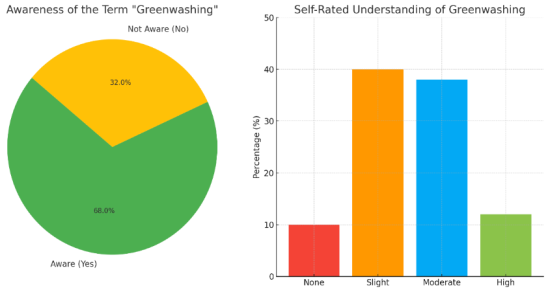
Awareness of Greenwashing: A significant proportion of the respondents (approximately 68%) reported having heard of the term greenwashing, indicating a moderate level of awareness among university students, likely due to educational exposure. However, when asked to rate their understanding, the majority described their knowledge as slight or moderate, suggesting limited conceptual clarity. This gap may hinder their ability to identify misleading environmental claims. These findings contradict the hypothesis (H₁) that awareness is low among university students in Lucknow. The relatively higher awareness could be attributed to exposure through academic sources and social media discourse. As shown in
Figure 1, the majority of students indicated that they have heard of greenwashing, though many rated their understanding as only partial.
Figure 1. Awareness and self-rated understanding of the term ‘Greenwashing’ among university students.
2)
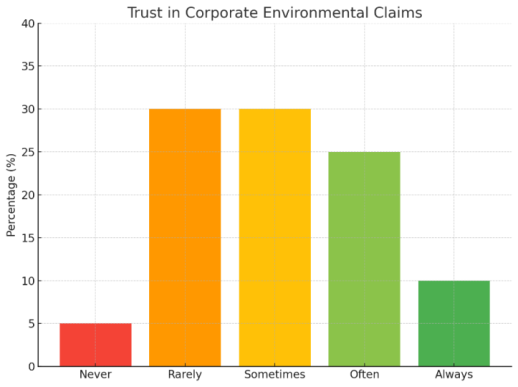
Trust in Environmental Claims by Companies: The survey reveals a notable scepticism among respondents toward corporate environmental claims. Nearly 60% of the students expressed that they “rarely” or “sometimes” trust such claims (
Figure 2). This finding is consistent with global studies suggesting rising consumer distrust due to false eco-labelling and unsubstantiated green marketing. This indicates that students are cautious and critical, but also potentially vulnerable due to a lack of tools to verify such claims. A Chi-square test of independence was conducted to determine the association between students’ awareness of greenwashing and their trust in environmental claims made by companies. The test yielded a p-value of 0.31, which is greater than the conventional alpha level of 0.05. This result indicates that there is no statistically significant relationship between awareness of greenwashing and trust in green claims. Students who had heard of greenwashing were just as likely to trust or distrust environmental marketing as those who had not. Therefore, hypothesis H₂ is not supported by statistical evidence.
Figure 2. Level of trust in corporate environmental claims among university students.
3)
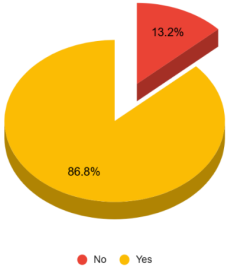
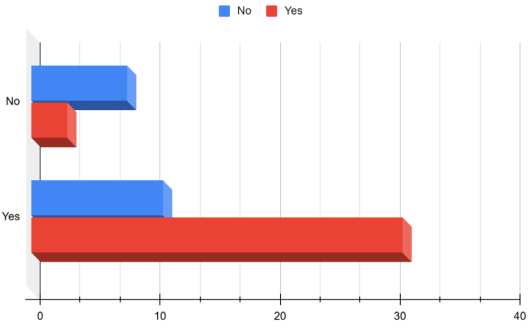
Incidence of Buying Misleading Eco-Friendly Products: Despite limited trust in green claims, approximately 87% of students acknowledged that they had purchased products labelled as “eco-friendly” at least once (
Figure 3). This reveals a striking paradox and points to a significant behavioral contradiction. While students expressed skepticism regarding the authenticity of such claims—often questioning whether the products were genuinely environmentally sustainable, their purchasing decisions did not always reflect this doubt. This suggests that the influence of green marketing remains powerful, shaping consumer behavior even in the face of mistrust. Several factors may contribute to this phenomenon, such as social pressure, the desire to make environmentally responsible choices, or a lack of accessible alternatives. It may also reflect the impact of packaging, branding, or messaging that uses eco-friendly cues—green colors, leaf symbols, or sustainability buzzwords. Students may be subconsciously persuaded by these cues, leading to purchases driven more by perceived responsibility than verified facts. The product categories most frequently mentioned in this context include cosmetics, food and beverages, and household cleaning supplies. These sectors often feature products marketed with claims of being organic, natural, biodegradable, or cruelty-free—terms that resonate with environmentally conscious consumers. However, without stringent regulations and transparent labelling, the risk of greenwashing remains high, leaving consumers in a difficult position of choosing between intention and information.
Figure 3. Students who have purchased products labelled as ‘eco-friendly’.
4)
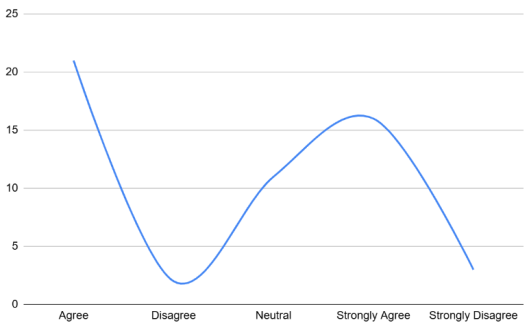
Willingness to Pay More for Genuinely Green Products: Encouragingly, a substantial majority of students—approximately 80%, expressed a willingness to pay a premium for products that are genuinely eco-friendly (
Figure 4). This finding is significant as it reflects not only an awareness of environmental issues but also a strong pro-environmental consumer attitude. It suggests that students are not merely passively absorbing green marketing messages but are actively motivated to support sustainable practices through their purchasing power. The willingness to bear additional costs underscores a latent demand for credibility, transparency, and authenticity in green product labelling
. Students appear ready to invest in sustainability, provided they are convinced of the product's actual environmental benefit. This highlights the need for trustworthy certification systems, regulatory oversight, and accurate environmental communication by companies. Moreover, this behaviour also reflects a deeper value-based decision-making process, where environmental responsibility is factored alongside price. Such an attitude, especially among the youth, signals a potential shift in market dynamics where authentic green products may find greater acceptance—even at a higher cost—than conventional alternatives. Therefore, this insight should be seen as an opportunity for both policymakers and businesses to strengthen green practices and ensure that eco-friendly products are not only available but also verifiably sustainable in the eyes of informed consumers.
Figure 4. Percentage of students willing to pay more for genuinely eco-friendly products.
5)
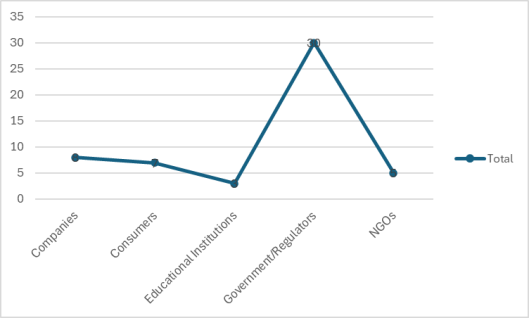
Responsibility Attribution: When asked who should be held primarily responsible for controlling greenwashing, many respondents identified government and regulatory bodies as the principal actors (
Figure 5). This was followed by a substantial group who believed that companies should shoulder responsibility by ensuring honest and transparent marketing practices. Notably, consumers placed themselves lowest in the responsibility hierarchy. This attribution pattern reflects a top-down model of accountability, in which formal institutions and corporate actors are expected to lead the fight against deceptive environmental marketing. While this perception is partially justified, governments indeed play a pivotal role in enacting and enforcing regulations, and companies have ethical obligations to market truthfully—it also points to a significant gap in consumer empowerment. By assigning themselves minimal responsibility, consumers may be underestimating their own agency and influence in shaping environmentally responsible business practices. This finding suggests the need to strengthen consumer education and advocacy, enabling individuals to critically evaluate environmental claims, identify signs of greenwashing, and make informed purchasing decisions. A more balanced and participatory framework is necessary—one that combines top-down regulation with bottom-up consumer action. Empowered consumers can drive demand for transparency and authenticity, ultimately pressuring companies and regulators to uphold higher standards of environmental integrity.
Figure 5. Respondent views on who should be primarily responsible for controlling greenwashing.
6)
Knowledge of Environmental Laws: Although students are increasingly aware of environmental challenges,
Figure 6 reveals a concerning gap in their understanding of the legal mechanisms designed to address these issues. The pie chart illustrates that only 27% of university students reported being aware of existing environmental and consumer protection laws, while a significant 73% admitted to having no knowledge in this domain. This stark disparity highlights a critical disconnect between general environmental awareness and legal literacy among students.
While interest in topics like sustainability, climate change, and ethical consumption is growing, this enthusiasm is not yet matched by awareness of legal rights, obligations, and protections. Without familiarity with the legal framework that governs green marketing and consumer protection, students are less prepared to evaluate eco-friendly claims critically or to take action when misled. This knowledge gap underscores the urgent need for targeted educational interventions. Awareness initiatives should extend beyond environmental science to include basic legal education, particularly for students outside of law faculties. Such programs would enable students to engage not just emotionally or ethically, but also legally, with environmental issues. Enhancing legal literacy among the broader student population is essential for fostering empowered, rights-conscious consumers. This, in turn, can strengthen demand for transparency and accountability in environmental marketing and contribute to building a more responsible and legally informed marketplace.
Figure 6. Student awareness of environmental and consumer protection laws.
8. Conclusion
The findings align with existing international literature on greenwashing and extend it by offering empirical socio-legal insights from the Indian consumer protection framework. Greenwashing has emerged as a significant challenge to sustainable consumption and consumer protection, particularly in markets where environmental awareness is increasing but regulatory clarity remains limited. The present study examined the awareness, trust, and behavioral responses of university students towards green marketing claims, alongside an assessment of consumer rights and legal remedies in the Indian context. The findings indicate that while youth consumers demonstrate moderate awareness of greenwashing practices, there exists a low level of trust in environmental claims and limited knowledge of available legal remedies under the Consumer Protection Act, 2019. The study further reveals a disconnect between consumer awareness and the practical enforceability of consumer rights. Although legislative provisions exist to address misleading advertisements, their effectiveness is constrained by inadequate consumer legal literacy, absence of clear standards for environmental claims, and reliance on complaint-driven enforcement mechanisms. These gaps weaken the deterrent effect of consumer protection laws and allow deceptive sustainability practices to persist in the market.
By adopting a socio-legal approach that integrates empirical data with doctrinal legal analysis, the study underscores the need for a more proactive and transparent regulatory framework to address greenwashing. Strengthening regulatory oversight and empowering consumers through legal awareness are essential to ensuring that sustainability claims contribute meaningfully to environmental protection rather than serving as tools of market deception. Based on the findings of the study, the following policy recommendations are proposed:
1) Development of Clear Green Marketing Guidelines:
Regulatory authorities should establish specific and enforceable guidelines defining permissible environmental claims, drawing inspiration from international frameworks such as the EU Green Claims Directive.
2) Mandatory Verification of Environmental Claims:
Companies should be required to substantiate environmental claims through independent third-party verification to enhance transparency and credibility.
3) Strengthening Regulatory Oversight:
Proactive monitoring mechanisms should be introduced to identify and penalize greenwashing practices without relying solely on consumer complaints. Gunningham et al. (1998) first advocated the concept of ‘smart regulation’ in a book of that title in 1998
| [7] | Gunningham, N., & Sinclair, D. (2017). Smart regulation. In Regulatory theory: Foundations and applications (pp. 133–148). Australian National University Press. |
[7]
. Subsequently, the concept has been refined in various publications by Gunningham and Sinclair (1999a, 1999b, 2002).
4) Enhancing Consumer Legal Awareness:
Targeted awareness campaigns and educational initiatives should be undertaken to inform consumers, particularly youth, about their rights and available legal remedies against misleading environmental claims
.
5) Institutional Coordination:
Greater coordination between consumer protection authorities, advertising regulators, and environmental agencies is essential to ensure effective enforcement of sustainability-related regulations.
Abbreviations
ASCI | Advertising Standards Council of India |
FTC | Federal Trade Commission |
ESG | Environmental, Social, and Governance |
SEC | Securities and Exchange Commission’s |
CSR | Corporate Social Responsibility |
Author Contributions
Prashant Kumar Varun is the sole author. The author read and approved the final manuscript.
Conflicts of Interest
The author declares no conflicts of interest.
References
| [1] |
Delmas, M. A., & Burbano, V. C. (2011). The drivers of greenwashing. California Management Review, 54(1), 64–87.
https://doi.org/10.1525/cmr.2011.54.1.64
|
| [2] |
Advertising Standards Council of India (ASCI). (2024). Guidelines for environmental and green claims in advertising. ASCI Publications.
|
| [3] |
Chen, Y. S., & Chang, C. H. (2013). Greenwash and green trust: The mediation effects of green consumer confusion and green perceived risk. Journal of Business Ethics, 114(3), 489–500.
https://doi.org/10.1007/s10551-012-1360-0
|
| [4] |
de Freitas Netto, S. V., Sobral, M. F. F., Ribeiro, A. R. B., & da Luz Soares, G. R. (2020). Concepts and forms of greenwashing: A systematic review. Environmental Sciences Europe, 32(1), 1–12.
https://doi.org/10.1186/s12302-020-0300-3
|
| [5] |
European Commission. (2023). Proposal for a Directive on substantiation and communication of explicit environmental claims (Green Claims Directive).
|
| [6] |
Government of India. (2019). Consumer Protection Act, 2019. Ministry of Consumer Affairs, Food and Public Distribution.
|
| [7] |
Gunningham, N., & Sinclair, D. (2017). Smart regulation. In Regulatory theory: Foundations and applications (pp. 133–148). Australian National University Press.
|
| [8] |
Howells, G., Ramsay, I., & Wilhelmsson, T. (2018). Handbook of research on consumer law (2nd ed.). Edward Elgar Publishing.
https://doi.org/10.4337/9781785366543
|
| [9] |
Joshi, Y., & Rahman, Z. (2015). Factors affecting green purchase behaviour and future research directions. International Strategic Management Review, 3(1–2), 128–143.
https://doi.org/10.1016/j.ism.2015.04.001
|
| [10] |
Kumar, P., & Ghodeswar, B. M. (2015). Factors affecting consumers’ green product purchase decisions. Marketing Intelligence & Planning, 33(3), 330–347.
https://doi.org/10.1108/MIP-03-2014-0068
|
| [11] |
Lyon, T. P., & Montgomery, A. W. (2015). The means and end of greenwash. Organization & Environment, 28(2), 223–249.
https://doi.org/10.1177/1086026615575332
|
| [12] |
Micklitz, H. W., Reich, N., & Rott, P. (2014). Understanding EU consumer law. Intersentia.
|
| [13] |
Nyilasy, G., Gangadharbatla, H., & Paladino, A. (2014). Perceived greenwashing: The interactive effects of green advertising and corporate environmental performance on consumer reactions. Journal of Business Ethics, 125(4), 693–707.
https://doi.org/10.1007/s10551-013-1944-3
|
| [14] |
Organisation for Economic Co-operation and Development. (2022). Consumer policy and greenwashing. OECD Publishing.
|
| [15] |
Parguel, B., Benoît-Moreau, F., & Larceneux, F. (2011). How sustainability ratings might deter greenwashing: A closer look at ethical corporate communication. Journal of Business Ethics, 102(1), 15–28.
https://doi.org/10.1007/s10551-011-0901-2
|
| [16] |
Testa, F., Iraldo, F., Vaccari, A., & Ferrari, E. (2015). Why eco-labels can be effective marketing tools: Evidence from a study on Italian consumers. Business Strategy and the Environment, 24(4), 252–265.
https://doi.org/10.1002/bse.1821
|
| [17] |
United Nations Environment Programme. (2021). Guidelines for providing product sustainability information. UNEP.
|
Cite This Article
-
APA Style
Varun, P. K. (2026). Greenwashing and Consumer Protection in India:
A Socio-legal Study of University Students’ Awareness and Trust in Environmental Claims. International Journal of Energy and Environmental Science, 11(2), 38-46. https://doi.org/10.11648/j.ijees.20261102.12
 Copy
|
Copy
|
 Download
ACS Style
Varun, P. K. Greenwashing and Consumer Protection in India:
A Socio-legal Study of University Students’ Awareness and Trust in Environmental Claims. Int. J. Energy Environ. Sci. 2026, 11(2), 38-46. doi: 10.11648/j.ijees.20261102.12
Copy
|
Download
AMA Style
Varun PK. Greenwashing and Consumer Protection in India:
A Socio-legal Study of University Students’ Awareness and Trust in Environmental Claims. Int J Energy Environ Sci. 2026;11(2):38-46. doi: 10.11648/j.ijees.20261102.12
Copy
|
Download
-
@article{10.11648/j.ijees.20261102.12,
  author = {Prashant Kumar Varun},
  title = {Greenwashing and Consumer Protection in India:
A Socio-legal Study of University Students’ Awareness and Trust in Environmental Claims},
  journal = {International Journal of Energy and Environmental Science},
  volume = {11},
  number = {2},
  pages = {38-46},
  doi = {10.11648/j.ijees.20261102.12},
  url = {https://doi.org/10.11648/j.ijees.20261102.12},
  eprint = {https://article.sciencepublishinggroup.com/pdf/10.11648.j.ijees.20261102.12},
  abstract = {Greenwashing has emerged as a significant challenge to consumer protection in the context of sustainable marketing, often misleading consumers through exaggerated or false environmental claims. While existing studies primarily examine greenwashing from a business ethics or marketing perspective, limited empirical research integrates consumer perceptions with the enforceability of legal remedies under consumer protection frameworks in developing countries. This study seeks to bridge this gap by empirically examining the awareness, trust, and behavioral responses of university students towards green marketing claims, alongside a legal analysis of consumer protection mechanisms in India. The study adopts a quantitative research design based on a questionnaire survey conducted among 53 university students in Lucknow city, Uttar Pradesh. Descriptive statistics and reliability analysis were employed to assess levels of awareness, trust in eco-labels, and perceived adequacy of legal remedies against greenwashing practices. The findings reveal moderate awareness of greenwashing concepts, low trust in environmental claims made by corporations, and limited knowledge regarding legal recourse under the Consumer Protection Act, 2019. The study highlights a significant gap between consumer awareness and the practical enforceability of consumer rights, underscoring the need for stronger regulatory oversight, consumer education, and clearer sustainability disclosure standards. By integrating empirical evidence with legal analysis, this research contributes to the emerging discourse on greenwashing regulation in India and offers policy-relevant insights for strengthening consumer protection in the sustainability domain. This study does not treat consumer rights as an independent theme but examines consumer protection mechanisms only insofar as they address misleading environmental claims arising from greenwashing practices.},
 year = {2026}
}
Copy
|
Download
-
TY  - JOUR
T1  - Greenwashing and Consumer Protection in India:
A Socio-legal Study of University Students’ Awareness and Trust in Environmental Claims
AU  - Prashant Kumar Varun
Y1  - 2026/05/28
PY  - 2026
N1  - https://doi.org/10.11648/j.ijees.20261102.12
DO  - 10.11648/j.ijees.20261102.12
T2  - International Journal of Energy and Environmental Science
JF  - International Journal of Energy and Environmental Science
JO  - International Journal of Energy and Environmental Science
SP  - 38
EP  - 46
PB  - Science Publishing Group
SN  - 2578-9546
UR  - https://doi.org/10.11648/j.ijees.20261102.12
AB  - Greenwashing has emerged as a significant challenge to consumer protection in the context of sustainable marketing, often misleading consumers through exaggerated or false environmental claims. While existing studies primarily examine greenwashing from a business ethics or marketing perspective, limited empirical research integrates consumer perceptions with the enforceability of legal remedies under consumer protection frameworks in developing countries. This study seeks to bridge this gap by empirically examining the awareness, trust, and behavioral responses of university students towards green marketing claims, alongside a legal analysis of consumer protection mechanisms in India. The study adopts a quantitative research design based on a questionnaire survey conducted among 53 university students in Lucknow city, Uttar Pradesh. Descriptive statistics and reliability analysis were employed to assess levels of awareness, trust in eco-labels, and perceived adequacy of legal remedies against greenwashing practices. The findings reveal moderate awareness of greenwashing concepts, low trust in environmental claims made by corporations, and limited knowledge regarding legal recourse under the Consumer Protection Act, 2019. The study highlights a significant gap between consumer awareness and the practical enforceability of consumer rights, underscoring the need for stronger regulatory oversight, consumer education, and clearer sustainability disclosure standards. By integrating empirical evidence with legal analysis, this research contributes to the emerging discourse on greenwashing regulation in India and offers policy-relevant insights for strengthening consumer protection in the sustainability domain. This study does not treat consumer rights as an independent theme but examines consumer protection mechanisms only insofar as they address misleading environmental claims arising from greenwashing practices.
VL  - 11
IS  - 2
ER  -
Copy
|
Download





 Share This Article
 Twitter
 Linked In
 Facebook