Abstract
The transformation and upgrading of agriculture has become an urgent need for the country's economic development, and the improvement of total factor productivity in agriculture has become a key indicator of modern agricultural development. Fujian Province is located on the southeast coast of China, and despite its diverse geographic conditions, the rapid development of the agricultural economy has led to the formation of distinctive agricultural paths, but it still faces the challenge of rough operation. The purpose of this paper is to explore the impact mechanism of digital inclusive finance on agricultural total factor productivity in Fujian Province, using the 2012-2021 Peking University Digital Inclusive Finance Index and the statistics of prefecture-level cities in Fujian Province to measure and analysis regional differences, and to empirically test its impact effect. The study finds that (1) digital financial inclusion significantly enhances agricultural total factor productivity in Fujian Province, and the results are robust. (2) Agricultural capital deepening acts as a mediator to effectively enhance agricultural total factor productivity. (3) Digital inclusive finance positively affects agricultural technological progress and efficiency, and indirectly enhances overall productivity.
Keywords
Digital Financial Inclusion, Total Factor Productivity in Agriculture, DEA-Malmquist Index Methodology, Fujian Province
1. Introduction
The efficient modern agricultural growth mode has become the transformation direction of China's agriculture, and the growth of agricultural total factor productivity is the key index of modern agriculture. Fujian Province is located in the southeast coast of China. The geographical differences in various regions of the province are large, but this has not hindered the rapid progress of Fujian's agricultural economy. Various regions have also formed a distinctive agricultural development model with regional characteristics. Although the speed of agricultural development in Fujian Province is relatively fast, it still faces the problems of low growth quality and low growth efficiency brought by extensive agricultural production.
With the rapid rise of China 's digital economy, digital inclusive finance, a financial model based on digital technology, is gradually becoming a powerful tool to solve the financing problems of agricultural development
| [1] | Hatice TEKINER-MOGULKOC, H. (2022). Using malmquist TFP index for evaluating agricultural productivity: Agriculture of Türkiye NUTS2 regions. |
[1]
. It plays an important role in promoting the improvement of agricultural total factor productivity. The "Digital Rural Development Action Plan (2022-2025)" clearly supports the introduction of digital technology into the countryside, encourages financial institutions to strengthen credit and financing support for construction projects in the fields of smart agriculture, rural e-commerce, and new rural formats, and continuously deepens rural inclusive financial services to promote the development of small farmers and modern agriculture. On April 14,2022, the Fujian Provincial Development and Reform Commission and the Provincial Digital Office issued the " Fujian Province 's Action Plan for Making the Digital Economy Bigger, Stronger and Better (2022-2025), " proposing to create an influential digital financial gathering area, improve the inclusiveness of digital finance, expand the national influence of digital inclusive financial reform and innovation, and promote digital inclusive finance to promote economic and social development. At the same time, the document also points out that there are still some problems in the development of digital finance in Fujian: First, the regional development of digital finance is not coordinated. Second, the lack of innovation in digital financial service products has failed to meet the needs of different industries.
Under the new situation, it is an inevitable choice to promote the long-term development of agricultural economy in Fujian Province by optimizing the allocation of various production factors and reducing the proportion of factor input to promote the development of agricultural economy. However, the financial institutions in our province are facing the problems of relatively insufficient coverage, limited depth of use and low degree of facilitation, as well as the difficulty of formal financial services to match the needs of agricultural economic development, resulting in obvious financial exclusion in some rural areas. The improvement of agricultural total factor productivity also needs to rely on financial services to alleviate financing difficulties and reduce the cost of technological improvement. Through empirical research, we deeply analyzed the specific impact of digital inclusive finance on agricultural total factor productivity in Fujian Province and its mechanism of action.
2. Related Work
2.1. Research on Agricultural Total Factor Productivity
There are various methods for measuring agricultural total factor productivity. With the continuous progress of research methods and technologies, these methods are also constantly improving and developing. Data envelopment analysis is a non-parametric technical efficiency analysis method, which evaluates the relative effectiveness by comparing the input-output efficiency of multiple decision-making units. Data Envelopment Analysis (DEA) method has been widely used in the measurement of agricultural total factor productivity. For example, Hatice et al. (2022) calculated the agricultural Total Factor Productivity (TFP) index of 26 NUTS2 regions in Turkey during 10 years based on the Malmquist index method of Data Envelopment Analysis (DEA), and found that technological change is the main factor affecting the change of agricultural total factor productivity
| [1] | Hatice TEKINER-MOGULKOC, H. (2022). Using malmquist TFP index for evaluating agricultural productivity: Agriculture of Türkiye NUTS2 regions. |
[1]
.Hu Y et al. (2024) used the balanced panel data of 1,503 counties and the three-stage DEA-Malmquist method to measure the total factor productivity of agriculture, and explored the impact of digital rural development on ATFP and its mechanism through fixed effect model and intermediary model
| [2] | Hu Y, Liu, Zhang S, et al.New mechanisms for increasing agricultural total factor productivity: Analysis of the regional effects of the digital economy [J]. Economic Analysis and Policy, 2024, 83766-785. |
[2]
. In addition, Li (2022) used the DEA-Malmquist index method to evaluate the agricultural total factor productivity of 30 provinces, municipalities and autonomous regions in China from 2000 to 2018, and further explored the impact mechanism of carbon emission trading policy on agricultural total factor productivity and its components. The results show that the implementation of carbon emission trading policy has a significant positive effect on improving China 's agricultural total factor productivity
| [3] | Li Binchao.The impact of carbon emission trading policy on China's agricultural total factor productivity-based on PSM-DID test [J]. Statistics and Management, 2022, 37(02). |
[3]
Ye and Hua (2024) also used the DEA method to measure the efficiency when studying the impact of rural population aging on agricultural total factor productivity
| [4] | Ye Taotao, Hua Yanling.Research on the impact of rural population aging on agricultural total factor productivity [J].Agriculture and Technology, 2024, 44(20): 159-164. |
[4]
. Zheng and Sun (2024) used the data at the prefecture-level city level to measure the total factor productivity of agriculture through the DEA-Malmquist productivity index analysis method in exploring the role of urban-rural mobility restrictions on agricultural TFP
| [5] | Zheng Jifeng, Sun Yan.The Impact of Urban-Rural Mobility Restrictions on Agricultural Total Factor Productivity under the Perspective of Household Registration System Constraints [J].Journal of Zhejiang Ocean University(Humanities Sciences), 2024, 41(05): 48-58. |
[5]
Stochastic frontier analysis is a parametric technical efficiency analysis method. It assumes that there is a stochastic frontier production function, and estimates the technical efficiency of the production unit by estimating the parameters of the function. In the measurement of agricultural total factor productivity, the Stochastic Frontier Analysis (SFA) method has also been widely used. Based on the panel data of 2098 counties in China from 2000 to 2019, Gan et al. (2022) used the Stochastic Frontier Analysis to measure the total factor productivity of county agriculture, and found that there were significant differences in the total factor productivity of regional agriculture in China
| [6] | Gan Tianqi, Du Jianguo, Li Bo.Differentiation Characteristics and Driving Factors of Agricultural Total Factor Productivity at County Level in China [J].On Economic Problems, 2022(04): 101-107. |
[6]
. Bannor et al. (2021) used the random frontier model to measure the total factor productivity of agriculture in 42 African countries from 1999 to 2019, and analyzed the impact of climate change on it. It was found that technological improvement was crucial to reduce the impact of extreme weather factors on the growth of agricultural TFP in Africa
| [7] | Bannor F, J Dikgang, Gelo D.Agricultural total factor productivity growth, technical efficiency, and climate variability in sub-Saharan Africa [J].EconStor Preprints, 2021. |
[7]
. Spolador S F H et al. (2024) used the panel data of three census years and used the stochastic production frontier method to decompose the productivity of Brazil 's agricultural sector. This method also considers the effects of rainfall, temperature and land suitability index
| [8] | SpoladorS F H, DanelonF A. New evidence of the driving forces behind Brazil's agricultural TFP growth—A stochastic frontier analysis with climatic variables and land suitability index [J].Australian Journal of Agricultural and Resource Economics, 2024, 68(2): 366-385. |
[8]
. Wang (2023) used the stochastic frontier production function method to calculate the agricultural TFP of 30 provinces in China, and empirically analyzed the impact of agricultural mechanization on agricultural green total factor productivity
| [9] | Wang Yiqiu, Xu Li, Cao Lei.Agricultural Mechanization and Agricultural GreenDevelopment Under the“Dual Carbon”Goal——A Perspective Based on Green Total Factor Productivity [J].Journal of Huazhong Agricultural University(Social Sciences Edition), 2023, (06): 56-69. |
[9]
. In order to study the impact of banks on agricultural TFP, Lu and Gao (2024) used stochastic frontier analysis to measure the growth rate of agricultural total factor productivity and conducted empirical analysis
| [10] | Lu Siwei, Gao Bo.Banking Competition and Growth of Agricultural Total Factor Productivity——Empirical Evidence Based on 278 Prefecture‐level Administrative Regions in China [J].Journal of Huazhong Agricultural University(Social Sciences Edition), 2024, (05): 95-109. |
[10]
. Zhang et al. (2025) used Solow residual and stochastic frontier method to measure the total factor productivity of agriculture in districts and counties to characterize agricultural productivity, and further studied the impact of agricultural productivity on forest coverage
| [11] | Zhang Hongliang, Yang Zihan, Wu Jian.The impact of agricultural productivity on forest cover in China [J/OL].Acta Ecologica Sinica, 2025, (05): 1-10 [2025-03-18]. |
[11]
. The production function method is to measure the total factor productivity of agriculture by constructing the production function. Muhammad et al. (2021) used Cobb Douglas and Translog production functions to measure the total factor productivity of agriculture in Pakistan from 1972 to 2020, and analyzed the impact of climate change and R & D and innovation adoption on agricultural productivity. The results show that rainfall and mild climate have a positive impact on the growth of agricultural productivity
| [12] | Muhammad Usman, Gulnaz Hameed, Abdul Saboor, Lal K. Almas, & Muhammad Hanif. (2021). R&D Innovation Adoption, Climatic Sensitivity, and Absorptive Ability Contribution for Agriculture TFP Growth in Pakistan. Agriculture, 11(1206), 1206. |
[12]
. Peng et al. (2021) used the C-D production function to measure agricultural total factor productivity and introduced intermediate consumables. The study found that agricultural total factor productivity showed an upward trend
| [13] | Peng Jiachao, Yi Ming, Fu Lina.Re-testing the Total Factor Productivity of China 's Agriculture--Analysis of Agricultural Intermediate Consumables Based on Provincial Panel Data [J].Chinese Journal of Management Science, 2021, 29(06): 223-237. |
[13]
. Based on the concept of risk management and technology synergy, Zheng and Wen (2024) established a C-D production function framework of agricultural insurance, agricultural technology innovation and agricultural total factor productivity, aiming to empirically explore the effect of agricultural insurance on agricultural total factor productivity, and reveal the intermediary transmission mechanism of agricultural technology innovation in this process
| [14] | Zheng Jun, Wen Menglong.Agricultural insurance, agricultural technology progress and agricultural total factor productivity [J].Journal of Fujian Agriculture and Forestry University(Philosophy and Social Sciences), 2024, 27(05): 21-35+83. |
[14]
. In addition to the above methods, Gong and Yuan (2024) reconstructed the evaluation framework of agricultural total factor productivity based on the traditional algorithm, variable coefficient model and new growth accounting and other advanced methods, focusing on the main line of technological innovation drive, agricultural characteristic orientation and multi-dimensional goal orientation. Taking agricultural mathematical intelligence technology as an example, the effect of the newly constructed measurement system in practical application is demonstrated
| [15] | Gong Binlei, Yuan Lingran.Agricultural Total Factor Productivity from the Perspective of New Quality Productivity : Theory, Measurement and Empirical Research [J].Issues in Agricultural Economy, 2024, (04): 68-80. |
[15]
.
On the other hand, agricultural total factor productivity is affected by many factors, which can be roughly divided into technological progress, institutional change, environmental factors and emerging factors. Technological progress is a key factor in improving agricultural total factor productivity. By introducing new varieties, improving farming techniques, and improving the level of agricultural mechanization, agricultural production efficiency can be significantly improved. For example, Toland et al. (2018) identified research funding policies, new technologies, and climate change as key determinants of agricultural total factor productivity
| [16] | Toland G D, Onyeaghala R O.Analyzing Total Factor Productivity Effects of Agricultural Policies and Climate Change Using Production Function Models [C]. 92nd Annual Conference, April 16-18, 2018, Warwick University, Coventry, UK. Agricultural Economics Society, 2018. |
[16]
. Hai L et al. (2023) found that agricultural irrigation facilities and agricultural technology have a significant positive effect on agricultural TFP
| [17] | Hai L, Hui L. Climate Change, Farm Irrigation Facilities, and Agriculture Total Factor Productivity: Evidence from China [J]. Sustainability, 2023, 15(4): 2889-2889. |
[17]
.Li et al. (2024) studied the impact of agricultural technology diffusion and market concentration on China's agricultural total factor productivity, and found that the widespread dissemination of agricultural technology and the increase of market concentration all contributed to the improvement of agricultural total factor productivity
| [18] | Li Wei, Dong Han, Shi Beibei.Impact of agricultural technology diffusion and market concen⁃tration on agricultural total factor productivity in China [J].Journal of Southern Agriculture, 2024, 55(07): 2192-2200. |
[18]
. In addition, the wide application of digital technology is also promoting the improvement of agricultural total factor productivity. For example, Ye et al. (2024) studied the mechanism and path of digital boosting China's agricultural modernization construction, and found that the application of digital technology can significantly improve the efficiency of agricultural production
| [19] | Ye Hang, Lin Xianming, Zhang Weitai.A Study on the Mechanism and Path of Digitalization in Promoting Agricultural Modernization in China———Empirical evidence based on provincial panel data [J].Price: Theory & Practice, 2024, (12): 115-121+230. |
[19]
. The adjustment and improvement of agricultural policies have an important impact on agricultural total factor productivity. Huang H et al. (2023) found that the reform of "province governing county " has a significant inhibitory effect on the TFP of agricultural-related enterprises
| [20] | Huang H, Xu Y, Sun Y, et al.Empirical Analysis of China’s Agricultural Total Factor Productivity and the Reform of “County Administrated by Province”: Insights from Agricultural Enterprise Data [J].Sustainability, 2023, 15(16). |
[20]
. Zhang et al. (2024) found that land transfer and social services have a significant effect on agricultural total factor productivity through empirical analysis
| [21] | Zhang Liguo, Leng Langping, Yang Shengsu, et al.Impact of Land Circulation and Agricultural Socialized Service on Agricultural Total Factor Productivity [J].Economic Geography, 2024, 44(04): 181-189+240. |
[21]
. The impact of environmental factors on agricultural total factor productivity has attracted increasing attention. Environmental factors such as climate change and natural disasters have an important impact on agricultural production, and the green transformation and sustainable development of agricultural production have also become an important direction to improve agricultural total factor productivity.Hu et al. (2023) studied the relationship between resource misallocation and agricultural total factor productivity, and found that resource misallocation will lead to the loss of agricultural production efficiency
| [22] | Hu Jiangfeng, Wang Zhao, Huang Qinghua.Resource Misallocation and Agricultural Total Factor Productivity : Loss and Causes [J].Journal of Agrotechnical Economics, 2023, (11): 78-98. |
[22]
.
2.2. Research on Digital Financial Inclusion
With the revolutionary evolution of information technology, the integrated application of distributed ledger technology, cloud computing system and massive data processing has spawned an innovative financial service paradigm. This inclusive financial model based on digital technology has significantly improved the coverage and penetration depth of financial services by breaking through traditional service boundaries and cost constraints. The research shows that this new financial format can not only optimize the efficiency of resource allocation, but also help to build an inclusive economic system, which has a significant role in promoting the balanced development of regional economy and improving the multidimensional poverty governance mechanism. In order to measure the development of digital inclusive finance, Guo et al. (2020) used the Peking University Digital Inclusive Finance Index to measure the development of digital inclusive finance in China, portrayed the development trend of digital inclusive finance in China, and found that the level of digital inclusive finance in China is constantly improving and showing strong regional convergence characteristics
| [23] | Guo Feng, Wang Jingyi, Wang Fang, Kong Tao, Zhang Xun, Cheng Zhiyun.Measuring China’s Digital Financial Inclusion : Index Compilation and Spatial Characterization [J].China Economic Quarterly, 2020, 19(04): 1401-1418. |
[23]
. Qin L et al. (2024), based on the data of China 's energy industry, found that digital inclusive finance has significantly improved the level of green innovation of enterprises. Its mechanism includes : digital platforms reduce the cost of green technology dissemination, accelerate industry technology spillovers, and green credit products directly ease the pressure on enterprises to invest in environmental protection
| [24] | Qin L, Chen C, Chen Y, et al.Digital financial inclusion, analyst attention, and the green innovation in energy firms [J].Finance Research Letters, 2024, 67(PB): 105947-105947. |
[24]
. Qiao et al. (2022) further confirmed that digital inclusive finance has a more significant role in promoting green innovation in high value-added industries
| [25] | Qiao Bin, Zhao Guangting, Shen Suohua.Can digital inclusive finance promote corporate green innovation ?? [J].South China Finance, 2022, (03): 14-27. |
[25]
. Tang et al. (2022) found that digital inclusive finance promotes agricultural total factor productivity (ATFP) through the' factor flow-technology adoption' path, and the depth of use (such as digital credit, insurance) has the highest contribution rate
| [26] | Tang Jianjun, Gong Jiaowei, Song Qinghua.Digital Financial Inclusion and Agricultural Total Factor Productivity: The Role of Factor Flow and Technology Diffusion [J].Chinese Rural Economy, 2022, (07): 81-102. |
[26]
. Based on the data of prefecture-level cities, Zhang (2021) pointed out that digital inclusive finance has a stronger effect on the improvement of urban innovation in the eastern and western regions, but has a limited effect on the first-tier cities (such as Beijing, Shanghai, Guangzhou and Shenzhen), reflecting the trend of the diffusion of innovative resources to second-tier cities
| [27] | Zhang Huihui, Zhang Yun, Jing Rui.How does the Digitization of Inclusive Finance Affect Urban Innovation: Evidence from Prefecture-level Cities [J].Financial Theory & Practice, 2021, (09): 62-69. |
[27]
. Nenavath S (2025) research on India shows that digital inclusive finance directly promotes GDP growth by expanding financial coverage and improving payment efficiency
| [28] | Nenavath S. Digital financial inclusion (DFI) can improve the economic growth: a study of India [J].Journal of Facilities Management, 2025, 23(1): 122-140. |
[28]
. Huang (2023) found that its contribution rate to the high-quality development of circulation economy in the eastern region is higher than that in the central and western regions
| [29] | Huang Shiwang. The impact of digital inclusive finance on the high-quality development of circulation economy - - Based on the test of provincial panel data [J].Journal of Commercial Economics, 2023, (24): 26-30. |
[29]
.
2.3. Research on the Impact of Financial Development on Total Factor Productivity in Agriculture
Based on the empirical research on the relationship between digital inclusive finance and agricultural total factor productivity (TFP) in recent years, it is found that digital inclusive finance has a significant promoting effect on agricultural TFP, but its action path and effect have multidimensional heterogeneity. The main research conclusions can be summarized into the following three aspects:
The differentiated performance of the path of action: Ren et al. (2022) believe that digital inclusive finance drives the improvement of agricultural TFP through the dual channels of technological progress and capital deepening
| [30] | Ren Jianhua, Lei Hongzhen.Digital Financial Inclusion, Capital Deepening and Total Factor Productivity in Agriculture [J].Social Scientist, 2022, (06): 86-95. |
[30]
. Guo et al. (2024) found that the depth of financial use has the most significant marginal contribution to TFP
| [31] | Guo Mengting.Research on empowering agricultural total factor productivity with digital inclusive finance in mountainous counties:taking 26 mountainous counties in Zhejiang Province of China as an example [J].Acta Agriculturae Zhejiangensis, 2024, 36(09): 2155-2169. |
[31]
. Huang et al. (2023) found that the breadth of coverage plays a fundamental supporting role by expanding service boundaries
| [32] | Huang Qing. Digital Financial Inclusion for Capital Deepening and Agricultural Total Factor Productivity Mechanism of Action Research [J].China Forestry Economics, 2023, (03): 142-146. |
[32]
. Tang et al. (2022) showed that the direct impact of digitization on TFP is relatively limited, but through collaborative innovation with financial instruments such as inclusive credit and insurance, it can produce significant combined effects
| [26] | Tang Jianjun, Gong Jiaowei, Song Qinghua.Digital Financial Inclusion and Agricultural Total Factor Productivity: The Role of Factor Flow and Technology Diffusion [J].Chinese Rural Economy, 2022, (07): 81-102. |
[26]
. Zhang et al. (2024) found that the promotion effect may be at the cost of short-term loss of technical efficiency, suggesting that attention should be paid to the temporal dynamic characteristics of resource allocation
| [33] | Zhang Shui, Zhang Yongqi.Regional Differences in the Impact of Digital Financial Inclusion on County Agricultural Total Factor Productivity and the Path to Crack [J].Journal of Financial Development Research, 2024, (02): 73-82. |
[33]
.
The multi-level presentation of spatial heterogeneity: Huang et al. (2023) regional comparative study shows that the effect of digital inclusive finance on TFP improvement in central and western counties is significantly better than that in the eastern region, which may be related to the saturation of financial penetration in the eastern region
| [32] | Huang Qing. Digital Financial Inclusion for Capital Deepening and Agricultural Total Factor Productivity Mechanism of Action Research [J].China Forestry Economics, 2023, (03): 142-146. |
[32]
. Zhang et al. (2023) used the spatial Dubin model to further reveal that the development of local digital inclusive finance has a negative spatial spillover to neighboring regions, reflecting the existence of factor competition and resource siphon effect between regions
| [34] | Zhang Qiwen, Tian Jing.Can Digital Inclusive Finance Improve Agricultural Total Factor Productivity?——Based on Perspective of Heterogeneity and Spatial Spillover Effects [J].Agricultural Economics and Management, 2023, (01): 45-56. |
[34]
. Tang et al. (2022) believed that in areas with excellent natural resource endowments and high levels of agricultural modernization, the TFP promotion effect of digital inclusive finance shows a doubling feature
| [26] | Tang Jianjun, Gong Jiaowei, Song Qinghua.Digital Financial Inclusion and Agricultural Total Factor Productivity: The Role of Factor Flow and Technology Diffusion [J].Chinese Rural Economy, 2022, (07): 81-102. |
[26]
.
The composite characteristics of influence mechanism: The mediating effect test of Ren et al. (2022) shows that agricultural capital deepening plays a partial mediating role in the impact chain of digital inclusive finance
| [30] | Ren Jianhua, Lei Hongzhen.Digital Financial Inclusion, Capital Deepening and Total Factor Productivity in Agriculture [J].Social Scientist, 2022, (06): 86-95. |
[30]
. Zhang et al. (2024) believe that the intensive allocation of production factors and the improvement of digital literacy constitute the key transmission path
| [33] | Zhang Shui, Zhang Yongqi.Regional Differences in the Impact of Digital Financial Inclusion on County Agricultural Total Factor Productivity and the Path to Crack [J].Journal of Financial Development Research, 2024, (02): 73-82. |
[33]
. Zhao et al. (2024) found that Internet penetration as a moderating variable significantly strengthened the transmission efficiency. It is worth noting that the high value-added agricultural sector and the main grain producing areas have a higher response elasticity to digital inclusive finance, revealing the adjustment effect of industrial structure differences on policy effects
| [35] | Zhao Jinchun. Can Digital Inclusive Finance Improve Agricultural Total Factor Productivity?--Empirical Evidence Based on Cross-country Panel Data [J].Modern Economic Research, 2024, (03): 109-121. |
[35]
.
In the estimation process of total factor productivity in agriculture, there are significant differences in the selection of research samples, measurement methods, and input-output indicators, which in turn lead to different final estimation results. In addition, although there is abundant literature exploring the impact of digital inclusive finance at the provincial level on agricultural total factor productivity in China, there is a lack of regional research on the unique "mountainous and coastal" terrain of Fujian Province. To reduce the interference of natural environmental differences on the evaluation of agricultural production efficiency, this article selects data from prefecture level cities in Fujian Province to measure and analyze the total factor productivity (TFP) of agriculture, in order to reduce potential bias.
3. Analysis of the Impact of Digital Inclusive Finance on Agricultural Total Factor Productivity
3.1. The Total Effect of Digital Inclusive Finance on Agricultural Total Factor Productivity
From the perspective of overall effect, digital inclusive finance directly and significantly promotes the optimal allocation of agricultural production factors and the acceleration of technological innovation by significantly reducing the threshold of financial services and improving the availability of funds. This influence mechanism not only deepens the financial support for agriculture, but also opens up a new path for the improvement of agricultural total factor productivity. The rapid development of digital inclusive finance, especially relying on modern information technologies such as mobile Internet, big data, and cloud computing, has greatly broadened the coverage of financial services in rural areas. In the past, the problem that rural areas were difficult to reach traditional financial services due to remote geographical location and weak financial infrastructure has been effectively alleviated. The digital inclusive financial platform can provide convenient and efficient online credit services, so that agricultural producers can obtain the required funds more quickly, which fundamentally alleviates the bottleneck of financial constraints in the process of agricultural production. More importantly, the timeliness and flexibility of this financial support provides the necessary financial guarantee for agricultural producers to adopt advanced agricultural technology and modern management mode. For example, agricultural producers can use the obtained credit funds to introduce intelligent irrigation systems and precision fertilization technologies. The application of these technologies can greatly improve the efficiency of agricultural production, reduce the waste of resources, and thus improve the quality and yield of agricultural products. At the same time, digital inclusive finance also supports agricultural producers to receive professional training and learn advanced farm management methods, such as precision agriculture, circular agriculture and other new agricultural development models, which are conducive to promoting the transformation and upgrading of agricultural production methods and further improving agricultural total factor productivity. In addition, digital inclusive finance also reduces the cost and risk of financial institutions providing services to the agricultural sector by means of information transparency and precise risk assessment, so as to encourage more financial resources to tilt towards agriculture and form a virtuous circle. The effective allocation of financial resources not only promotes the expansion of agricultural production scale, but also promotes the optimization and adjustment of agricultural industrial structure and enhances the sustainable development ability of agriculture.
3.2. The Decomposition Effect of Digital Inclusive Finance on Agricultural Total Factor Productivity
The digital inclusive financial platform provides convenient financial services that can effectively reduce the threshold for agricultural producers to access new technologies and information. Agricultural producers can more easily access to the latest agricultural scientific research results, efficient planting technology and intelligent management tools, thus accelerating the adoption and application of new technologies. For example, the application of intelligent agricultural equipment and precision agricultural technology has significantly improved crop yield and quality, reduced resource consumption, and directly promoted the improvement of agricultural production efficiency. In addition, digital inclusive finance also encourages agricultural producers to participate in technical training and learning through financial support, enhances their technological absorption and innovation capabilities, and further accelerates the process of agricultural technological progress. Secondly, digital inclusive finance effectively reduces the loss of technical efficiency by improving the efficiency of resource allocation and management level. In the traditional agricultural production mode, due to the problems of information asymmetry and lack of funds, the allocation of agricultural production resources is often not optimized enough, resulting in low production efficiency. The intervention of digital inclusive finance optimizes the allocation of production factors (such as land, labor, capital) and improves the efficiency of resource utilization by accurately matching the demand and supply of funds. At the same time, the construction of agricultural information platform supported by digital inclusive finance makes agricultural production management more scientific and efficient, and reduces the waste of resources and efficiency loss caused by poor management. The improvement of resource allocation efficiency not only directly promotes the reduction of agricultural production costs, but also improves the efficiency of agricultural technology and further improves the total factor productivity of agriculture.
3.3. The Mediating Effect of Agricultural Capital Deepening
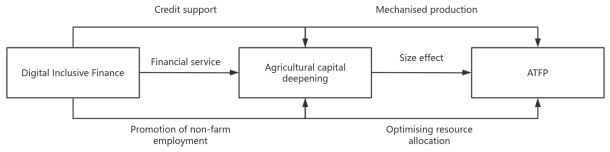
Digital Inclusive Finance uses modern information technologies such as big data and cloud computing to significantly reduce the financing costs of agricultural producers and make it easier for them to obtain credit support. This not only promotes the investment of agricultural producers in advanced agricultural machinery and intelligent management systems, but also accelerates the accumulation of agricultural capital. Through the provision of diversified financial products and services, digital inclusive finance further supports agricultural producers to adopt new technologies and management models, laying a solid foundation for the deepening of agricultural capital. On the other hand, the popularity and accessibility of digital inclusive finance have greatly relaxed the constraints of rural labor force in non-agricultural employment. In the process of rural labor force transfer to non-agricultural fields, digital inclusive finance provides the necessary financing and credit assistance for improving employment skills, and provides financial support for the diverse costs borne by workers in the process of seeking employment, thus effectively promoting the successful transformation of rural labor force to non-agricultural employment. As agricultural producers increase investment in agricultural machinery and intelligent management systems, agricultural technical efficiency has been improved, making agricultural production more efficient and accurate. Advanced agricultural machinery and intelligent management systems can optimize resource allocation, reduce waste, and improve the efficiency of production factors, thereby improving agricultural TFP. On the other hand, the accumulation of agricultural capital is conducive to the emergence of scale effect. The deepening of agricultural capital provides more financial and technical support for agricultural producers, and encourages them to carry out technological innovation and model innovation. At the same time, the deepening of agricultural capital has also promoted the close cooperation between upstream and downstream enterprises in the agricultural industry chain, accelerated the diffusion and application of agricultural technology, and provided impetus for the continuous growth of agricultural TFP.As shown in
Figure 1, digital inclusive finance promotes the deepening of agricultural capital by providing credit support, financial services and promoting non-agricultural employment. With the gradual accumulation of agricultural capital, agricultural production tends to be mechanized and large-scale, and the allocation of resources is constantly optimized to improve agricultural TFP.
Figure 1. Agricultural capital deepening intermediary mechanism diagram.
4. The Measurement of Agricultural Total Factor Productivity in Fujian Province
4.1. The Calculation Method of Agricultural Total Factor Productivity
Agricultural total factor productivity is an important indicator to measure the efficiency of agricultural production. The accuracy of its measurement method is of great significance for understanding agricultural production and formulating agricultural policies. This paper uses the DEA-Malmquist index method to measure the total factor productivity of agriculture. The change of productivity is calculated by comparing the production frontiers in different periods. Based on the previous studies, labor input, land input, fertilizer input and machinery input were selected as input indicators, agricultural GDP was selected as output indicator, and labor input was calculated by the number of employees in agriculture, forestry, animal husbandry and fishery. The input of chemical fertilizer is calculated by the amount of agricultural chemical fertilizer (pure amount). Mechanical input is calculated by the total power of agricultural machinery. In view of the DEA-Malmquist index method in calculating total factor productivity, the base period result is set to 1 for empirical analysis. The result is compared with the change rate of agricultural total factor productivity in the previous year. Therefore, by multiplying the annual calculation results year by year, the real level of agricultural total factor productivity can be obtained. The specific measurement indicators of agricultural total factor productivity, as shown in
Table 1:
Table 1. Input-output index system of agricultural total factor productivity.
Index | Variable definition | Unit |
Output indicator | economic benefit | gross agricultural production | million yuan |
Input index | labor input | The number of employees in agriculture, forestry, animal husbandry and fishery | people |
land input | sown area of crops | hectares |
fertilizer input | agricultural fertilizer application amount | t |
mechanical input | agricultural machinery total power | Million KWH |
4.2. Analysis of the Measurement Results of Agricultural Total Factor Productivity in Fujian Province
Based on the DEA-Malmquist productivity index method, this paper uses DEAP2.1 software to measure the agricultural total factor productivity and its decomposition items of agricultural technology progress and agricultural technology efficiency in Fujian Province from 2012 to 2021.
Table 2. Agricultural total factor productivity of prefecture-level cities in Fujian Province from 2012 to 2021.
City | 2012 | 2013 | 2014 | 2015 | 2016 | 2017 | 2018 | 2019 | 2020 | 2021 | Average |
Fuzhou | 1.109 | 1.037 | 1.06 | 1.023 | 1.077 | 1.121 | 1.119 | 1.083 | 1.074 | 1.079 | 1.0782 |
Longyan | 1.189 | 1.043 | 1.082 | 1.054 | 1.064 | 1.145 | 1.078 | 1.069 | 1.188 | 1.117 | 1.1029 |
Nanping | 1.199 | 0.987 | 1.028 | 1.038 | 1.057 | 1.126 | 1.006 | 1.06 | 1.091 | 1.042 | 1.0634 |
Ningde | 1.162 | 1.166 | 0.898 | 1.072 | 0.96 | 1.141 | 1.061 | 1.061 | 1.066 | 1.042 | 1.0629 |
Putian | 1.111 | 1.09 | 1.044 | 1.014 | 1.015 | 1.114 | 1.232 | 1.07 | 1.117 | 1.043 | 1.085 |
Quanzhou | 1.221 | 1.164 | 1.07 | 1.091 | 1.056 | 1.222 | 1.044 | 1.048 | 1.071 | 1.033 | 1.102 |
Sanming | 1.124 | 1.03 | 1.068 | 1.05 | 1.024 | 1.136 | 1.051 | 1.027 | 1.112 | 1.021 | 1.0643 |
Xiamen | 1.125 | 1.044 | 1.081 | 1.33 | 0.915 | 0.99 | 1.039 | 1.151 | 1.129 | 1.075 | 1.0879 |
Zhangzhou | 0.964 | 1.034 | 1.039 | 1.041 | 1.023 | 1.347 | 1.06 | 0.992 | 1.103 | 1.051 | 1.0654 |
From the data presented in
Table 2, it can be observed that the total factor productivity of agriculture in Fujian Province gradually increased from 2012 to 2021, which indicates that the progress of agricultural technology has shown an upward trend as a whole. This further confirms the continuous progress and innovation of agricultural production development in Fujian Province. However, in 2019-2021, there was a significant decline in some areas. There are differences in agricultural total factor productivity in different regions. The average agricultural total factor productivity of Longyan City is up to 1.1029, followed by Quanzhou City, which reaches 1.102. The average agricultural total factor productivity of Nanping City and Ningde City is relatively low, which is 1.0634 and 1.0629 respectively. This difference may be due to various factors such as natural conditions, agricultural technology level, agricultural policy and capital investment in various regions. In addition, the total factor productivity of agriculture in some areas fluctuates greatly in different years. For example, the productivity of Xiamen City was as high as 1.33 in 2015, but it fell to 0.915 and 0.99 in 2016 and 2017, which reflects the instability of productivity. It may be related to factors such as market conditions and policy adjustments in the year.
4.3. Analysis of Regional Differences in Agricultural Total Factor Productivity in Fujian Province
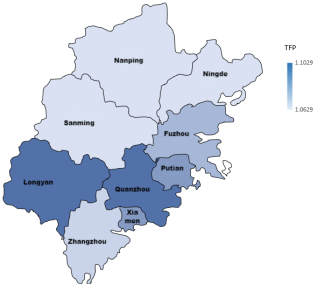
Figure 2. Spatial distribution of urban digital inclusive financial index in Fujian Province.
Combined with the spatial distribution map of agricultural total factor productivity in various prefecture-level cities in Fujian Province in
Table 2 and
Figure 2, it can be found that there are obvious regional differences in agricultural total factor productivity in Fujian Province by observing its distribution. In general, it shows a trend of ' high in the middle and low in the north and south '. Among them, Longyan City and Quanzhou City are located in the first echelon, with productivity of 1.1029 and 1.102 respectively. Putian City, Xiamen City and Fuzhou City were followed by the second echelon, with productivity of 1.085,1.0879 and 1.0782, respectively. The remaining four prefecture-level cities have low agricultural total factor productivity, of which the last city Ningde is 1.0629.
5. Empirical Research
5.1. Model Construction
Firstly, in view of the direct effect of digital inclusive finance on agricultural total factor productivity (TFP) in Fujian Province, a corresponding panel data fixed effect model is established as shown in Formula (
1):
 (1)
(1) Among them, i represents the prefecture-level city, t represents the year, LNTFP represents the total factor productivity of agriculture, DIFI is the core explanatory variable digital inclusive financial index, X is the control variable, which covers the urbanization rate, the proportion of the primary industry in the overall economic structure, the proportion of grain sown area in the total sown area and GDP, μi and νt are regional fixed effects and time fixed effects, and it represents the random error term.
In order to explore how digital inclusive finance indirectly affects the internal mechanism of agricultural total factor productivity (TFP) in Fujian Province, a two-step analysis of mediating variables is introduced. The specific mediating effect model is shown in Formula (
2):
 (2)
(2) 5.2. Data Sources
This study focuses on the panel data of 9 prefecture-level administrative regions in Fujian Province from 2012 to 2021. The data of digital inclusive finance are selected from the authoritative digital inclusive finance index released by the Digital Finance Research Center of Peking University. The relevant data of agricultural total factor productivity (TFP) in Fujian Province are derived from official publications such as ' Fujian Statistical Yearbook ', statistical yearbooks of prefecture-level cities and annual data bulletins. Next, a detailed descriptive statistical analysis of the variables involved will be performed:
Table 3. Descriptive statistic.
Variant | sample size | average | statistics | min | max |
TFP | 90 | 0.613 | 0.596 | 0.105 | 1.373 |
EF | 90 | 0.699 | 0.693 | 0.569 | 0.840 |
TE | 90 | 0.944 | 0.916 | 0.712 | 1.344 |
DIFI | 90 | 2.205 | 2.338 | 0.984 | 3.433 |
GDP | 90 | 7.975 | 7.875 | 6.903 | 9.335 |
struc | 90 | 0.201 | 0.236 | 0.034 | 0.303 |
lzb | 90 | 0.379 | 0.390 | 0.260 | 0.417 |
city | 90 | 0.626 | 0.600 | 0.494 | 0.901 |
NYZB | 90 | 2.870 | 2.362 | 1.218 | 8.788 |
5.3. Variable Declaration
1) Explanatory variables: DIFI
The index is jointly compiled by the research group of the Digital Finance Research Center of Peking University and Ant Financial to measure the development of digital inclusive finance in various prefecture-level cities. In the process of in-depth exploration of the specific impact of digital inclusive finance on the total factor productivity of agriculture in Fujian Province, it was rigorously compiled based on the principles of comprehensiveness, balance, comparability, coherence and implementation feasibility.
2) Explained variable: LNTFP
The DEA-Malmquist index method is used to measure the agricultural total factor productivity of 9 prefecture-level cities in Fujian Province from 2012 to 2021. Including agricultural technology progress (TE) and agricultural technology efficiency (EF).
3) Mediator variable
Agricultural capital deepening (NYZB): In order to verify the indirect influence mechanism of digital inclusive finance on agricultural TFP, the index of agricultural capital deepening is selected to investigate. Agricultural machinery plays a very important role in the composition of agricultural capital. Therefore, the ratio of the total power of agricultural machinery to the number of employees in agriculture, forestry, animal husbandry and fishery (kilowatts / person) is selected, and logarithm is taken as the degree of agricultural capital deepening
| [33] | Zhang Shui, Zhang Yongqi.Regional Differences in the Impact of Digital Financial Inclusion on County Agricultural Total Factor Productivity and the Path to Crack [J].Journal of Financial Development Research, 2024, (02): 73-82. |
[33]
.
4) Control variables
Urbanization level (Czh): refers to the degree of change in the proportion of urban population to population. It directly affects the development of a society. High-level urbanization can promote the adjustment and optimization of industrial structure and promote the development of modernization. Planting structure (lnlzb): refers to the proportion of grain sown area in the total sown area. Regional gross output value (lnGDP): refers to a region 's GDP, reflecting the development of the total economy. Industrial structure (lnstruc) refers to the ratio of the primary industry to the total output value in the region.
6. Regression Results Analysis
6.1. Verification of Stationarity
Table 4. Unit root test.
variable | LLC monitor | P | conclusion |
LNTFP | -13.0675 | 0.0000 | stationary |
LNEF | -6.7376 | 0.0000 | stationary |
LNTE | -12.2530 | 0.0000 | stationary |
DIFI | -9.8889 | 0.0000 | stationary |
lnstruc | -8.1922 | 0.0000 | stationary |
lnGDP | -8.2437 | 0.0000 | stationary |
Czh | -4.6987 | 0.0000 | stationary |
lnlzb | -4.7656 | 0.0000 | stationary |
After the unit root test by LLC method, it was found that the logarithm of agricultural total factor productivity (LNTFP ), the logarithm of agricultural technological progress (LNTE), the logarithm of agricultural technical efficiency (LNEF), the digital inclusive financial index (DIFI), the urbanization level (Czh), the logarithm of regional total output value (lnGDP), the logarithm of planting structure (lnlzb) and the logarithm of industrial structure (lnstruc) all had P values of 0.0000, which were significant at the 1% significance level. The results show that all variables show stability in the unit root test, which meets the requirements of regression analysis.
6.2. Analysis of Regression Results
The research uses F test and Hausman test to analyze the impact of digital inclusive finance on agricultural total factor productivity in Fujian Province. After testing, the P values of F test and Hausman test were 0.0000 and 0.0000, respectively. Therefore, the fixed effect model is selected for subsequent analysis. The relevant regression results are shown in
Table 5.
Table 5. Baseline regression results.
variable | (1) LNTFP | (2) LNTFP | (3) LNTFP | (4) LNTFP | (5) LNTFP |
DIFI | 1.232*** | 1.446*** | 1.095*** | 1.158*** | 1.102*** |
| (0.277) | (0.294) | (0.332) | (0.336) | (0.333) |
lnstruc | | 0.537** | 0.854*** | 0.890*** | 0.832*** |
| | (0.207) | (0.213) | (0.210) | (0.207) |
lnGDP | | | 0.885*** | 0.950*** | 0.756** |
| | | (0.330) | (0.348) | (0.340) |
Czh | | | | 1.627* | 2.125** |
| | | | (0.911) | (0.946) |
lnlzb | | | | | -0.199** |
| | | | | (0.087) |
_cons | -1.285*** | -2.652*** | -10.271*** | -12.018*** | -9.797*** |
| (0.350) | (0.624) | (2.622) | (2.889) | (2.843) |
Id | Y | Y | Y | Y | Y |
Year | Y | Y | Y | Y | Y |
N | 90 | 90 | 90 | 90 | 90 |
adj. R2 | 0.899 | 0.904 | 0.913 | 0.917 | 0.921 |
Ps: *, * * and * * * are significant at the levels of 10%, 5% and 1%, respectively; the robust standard error is in brackets. The same below.
By using the stepwise regression method, it can be seen from
Table 5 that under the comprehensive effect of considering various control variables, the specific impact of the digital inclusive financial index on the total factor productivity (TFP) of agriculture in Fujian Province is further analyzed, and it is found that the impact between the two is gradually weakened. This shows that in the process of analysis, when other control variables are included, the role of digital inclusive financial index in the change of agricultural total factor productivity in Fujian Province is gradually decreasing. Specifically, (1) column indicates the impact of digital inclusive finance on the total factor productivity of agriculture in Fujian Province without adding control variables. The results show that digital inclusive finance shows a significant positive driving effect at the 1% significant level, and its influence coefficient is 1.232. The control variables are gradually added from column (2) to column (5), and the results of agricultural total factor productivity in Fujian Province are still significant. In Column (5), digital inclusive finance still has a positive impact on agricultural total factor productivity in Fujian Province, with an impact coefficient of 1.102, which is significant at the 1% confidence level. In addition, from the perspective of control variables, the industrial structure shows a significant effect on the total factor productivity of agriculture in Fujian Province at the 1% confidence level, and the influence coefficient is 0.832. At the confidence level of 5%, GDP, city and lzb have a significant impact on the total factor productivity of agriculture in Fujian Province. Among them, GDP and city have a positive impact, and the impact coefficients are 0.756 and 2.125; lzb is a negative influence, and the influence coefficient is − 0.199. The comprehensive analysis shows that the control variables such as city, GDP, struc and lzb are significant in the regression model. The increase of city may promote the flow of rural labor force and the adjustment of agricultural production structure, and help to improve the total factor productivity of agriculture in Fujian Province. At the same time, higher GDP means more resources are invested in agricultural technology research and development and infrastructure construction, thus promoting the improvement of agricultural technology efficiency. The higher proportion of primary industry means that agriculture develops rapidly and provides basic conditions for improving agricultural total factor productivity. It should be noted that the higher proportion of grain sown area means that the planting structure is single and the allocation of agricultural development is unreasonable, which hinders the improvement of agricultural total factor productivity. The combined effect of these factors may be intertwined with the explanatory power of the digital inclusive financial index to the agricultural total factor productivity of Fujian Province, which makes the impact of the digital inclusive financial index in the regression analysis gradually weaken.
6.3. Robustness Test
Table 6. Robustness test results.
variable | (1) LNTFP | (2) LNTFP |
DIFI | 1.357*** | 1.205*** |
| (0.363) | (0.307) |
lnstruc | 0.722*** | 0.722*** |
| (0.230) | (0.225) |
lngdp | 0.342 | 0.629* |
| (0.383) | (0.339) |
Czh | 2.995** | 2.507** |
| (1.229) | (0.977) |
lnlzb | -0.304** | -0.206** |
| (0.121) | (0.084) |
fina | | 0.014* |
| | (0.008) |
_cons | -6.610** | -8.955*** |
| (3.081) | (2.899) |
N | 83 | 90 |
adj. R2 | 0.914 | 0.922 |
Among them, column (1) takes into account the possible outliers in the data, so the data is tailed. The results show that the influence coefficient of digital inclusive financial index on agricultural total factor productivity is 1.357, which is significant at the statistical significance level of 1%. The influence coefficient of city on agricultural total factor productivity is 2.995, which is also significant at the 5% statistical significance level. The influence coefficient of lzb on agricultural total factor productivity is-0.304, and it is significant at the statistical significance level of 5%. In addition, the coefficient of influence of struc on agricultural total factor productivity is 0.722, which is significant at the statistical significance level of 1%.
Considering that agricultural total factor productivity may also be affected by the government 's agricultural financial support, the control variable of financial support (fina) is added to the benchmark regression model. The regression results are shown in Column (2) of
Table 6. It can be seen that financial support has a significant positive effect on the improvement of agricultural total factor productivity. After controlling it, digital inclusive finance still significantly promotes agricultural total factor productivity. The influence coefficient is 1.205, indicating that the estimation results of this paper are robust.
6.4. Mediation Effect Analysis
Table 7. The intermediary effect test of agricultural capital deepening.
variable | (1) LNTFP | (2) NYZB |
DIFI | 1.102*** | 0.554*** |
| (0.333) | (0.124) |
lnstruc | 0.832*** | 0.314*** |
| (0.207) | (0.095) |
lnlzb | -0.199** | -0.022 |
| (0.087) | (0.025) |
lngdp | 0.756** | 0.422*** |
| (0.340) | (0.151) |
Czh | 2.125** | -1.900*** |
| (0.946) | (0.410) |
_cons | -9.797*** | -2.403* |
| (2.843) | (1.357) |
year | Y | Y |
id | Y | Y |
N | 90 | 90 |
adj. R2 | 0.921 | 0.997 |
Table 7 shows the role of agricultural capital deepening in the impact of digital inclusive finance on the total factor productivity of agriculture in Fujian Province. The regression results of digital inclusive finance on agricultural capital deepening are shown in
Table 7 (2). The regression coefficient is 0.554, and it is significant at the statistical level of 1%. This shows that digital inclusive finance has a significant positive impact on agricultural capital deepening. With the deepening of digital inclusive finance, its impact on the allocation of production factors in rural areas is increasingly apparent. Based on the theory of induced technological progress, when rural labor and land resources are transferred to non-agricultural fields, there will be a significant change in factor scarcity in the field of agricultural production. This change is mainly reflected in the relative scarcity of labor factors, which leads to the substitution effect of agricultural production factors. Specifically, in order to cope with the challenge of insufficient labor supply, agricultural producers will tend to adopt capital-intensive production methods, replacing traditional labor factors by increasing the input of capital factors such as agricultural machinery and intelligent equipment. This substitution process not only promotes the transformation and upgrading of agricultural production methods, but also promotes the process of deepening agricultural capital. Digital inclusive finance plays a key role in this process. By reducing the financing threshold and improving the availability of financial services, it provides convenient conditions for agricultural producers to obtain capital elements, thus accelerating the pace of agricultural capital deepening. This interaction between factor substitution and capital deepening will ultimately promote the improvement of agricultural production efficiency and the acceleration of agricultural modernization.
The research shows that the deepening of agricultural capital has a significant role in promoting the improvement of agricultural production efficiency
| [30] | Ren Jianhua, Lei Hongzhen.Digital Financial Inclusion, Capital Deepening and Total Factor Productivity in Agriculture [J].Social Scientist, 2022, (06): 86-95. |
| [31] | Guo Mengting.Research on empowering agricultural total factor productivity with digital inclusive finance in mountainous counties:taking 26 mountainous counties in Zhejiang Province of China as an example [J].Acta Agriculturae Zhejiangensis, 2024, 36(09): 2155-2169. |
| [35] | Zhao Jinchun. Can Digital Inclusive Finance Improve Agricultural Total Factor Productivity?--Empirical Evidence Based on Cross-country Panel Data [J].Modern Economic Research, 2024, (03): 109-121. |
[30, 31, 35]
. This mechanism is mainly reflected in the following aspects: First of all, with the transfer of rural labor force to non-agricultural industries, farmers have effectively improved their financial constraints by obtaining non-agricultural employment income, which provides the necessary economic basis for their investment in modern agricultural equipment. Secondly, the introduction and application of advanced agricultural machinery and equipment itself is an important manifestation of technological progress. The accumulation of these technical elements has significantly improved the efficiency of agricultural production through the transmission mechanism of capital deepening. Thirdly, the process of capital deepening has promoted the transformation and upgrading of agricultural production methods, prompting agricultural practitioners to adopt more technological innovations with the characteristics of ' labor saving ' and ' land saving '. This technology-biased choice further strengthens the effect of improving production efficiency. Finally, the technology diffusion effect and factor allocation optimization brought by capital deepening have formed a virtuous cycle mechanism to promote the growth of agricultural total factor productivity. These factors work together to achieve total factor productivity growth in agriculture.
Based on the above analysis, the development of digital inclusive finance provides important support for the improvement of agricultural production efficiency. Specifically, it has a significant positive impact on the growth of agricultural total factor productivity by promoting the accumulation and deepening of agricultural capital. This promotion effect is mainly reflected in the fact that digital financial services reduce the financing constraints of agricultural producers and create favorable conditions for their capital investment, and then through the technology diffusion effect and factor allocation optimization effect, finally achieve the continuous improvement of agricultural total factor productivity.
6.5. Dimensionality Test
In order to better understand the impact of digital inclusive finance on agricultural total factor productivity, this paper further refines the various dimensions of agricultural total factor productivity, and explores the impact of digital inclusive finance on agricultural total factor productivity and its decomposition items. The results are shown in
Table 8:
Table 8. The subentry regression of digital inclusive finance to agricultural total factor productivity.
variable | (1) LNTFP | (2) LNEF | (3) LNTE |
DIFI100 | 1.102*** | 0.328** | 0.245* |
| (0.333) | (0.161) | (0.133) |
lnstruc | 0.832*** | 0.330*** | 0.262** |
| (0.207) | (0.103) | (0.128) |
lngdp | 0.756** | 0.046 | 0.512*** |
| (0.340) | (0.160) | (0.181) |
ct | 2.125** | 1.470*** | -0.648* |
| (0.946) | (0.314) | (0.385) |
lnlzb | -0.199** | -0.027 | -0.085** |
| (0.087) | (0.038) | (0.035) |
_cons | -9.797*** | -1.667 | -3.663** |
| (2.843) | (1.428) | (1.695) |
Id | Y | Y | Y |
Year | Y | Y | Y |
N | 90 | 90 | 90 |
adj. R2 | 0.921 | 0.441 | 0.958 |
According to
Table 8, the regression coefficient of DIFI and LNEF is 0.328, and it reaches a significant level of 5%, which shows that the development of digital inclusive finance can significantly improve the efficiency of agricultural technology. This shows that the promotion and popularization of digital inclusive finance in Fujian Province is great. Agricultural producers and operators can have a good understanding of digital inclusive finance and can easily obtain financial services. Digital inclusive finance can more effectively play its role in optimizing the efficiency of resource allocation, and then promote the improvement of agricultural technical efficiency. The regression coefficient of DIFI and LNTE is 0.245, and it is significant at the level of 10%, indicating that the development of digital inclusive finance has a significant role in promoting agricultural technological progress. This may be because the development of digital inclusive finance improves financial availability, increases the funds of modern agricultural enterprises, and provides financial support for enterprise technology introduction, technological innovation and absorption of advanced agricultural technology. Secondly, the increase of economic opportunities for agricultural producers and operators can make better use of modern agricultural technology and promote agricultural technological progress.
7. Research Conclusions and Policy Suggestions
7.1. Conclusions
This study uses the DEA-Malmquist model to measure the total factor productivity of agriculture in Fujian Province, and uses the digital inclusive financial index released by the Digital Finance Research Center of Peking University, combined with the panel data of 9 prefecture-level cities in Fujian Province from 2012 to 2021. Through empirical analysis, the specific impact of digital inclusive finance on the total factor productivity of agriculture in Fujian Province was studied in depth. This paper draws the following important conclusions:
Digital inclusive finance in Fujian Province has a significant role in promoting agricultural total factor productivity. From the perspective of control variables, the level of urbanization, industrial structure and GDP in Fujian Province have a significant effect on improving agricultural total factor productivity, while the level of urbanization and GDP have no significant effect on the improvement of agricultural total factor productivity. With the continuous development of the primary industry, the optimization of industrial structure, the trend of agricultural development tends to be modernized, and more agricultural science and technology and technological innovation support the improvement of agricultural total factor productivity. In addition, the effect of GDP and urbanization level on the improvement of agricultural total factor productivity is relatively weak. This is because the regional GDP mainly reflects the growth of urban economy, while the improvement of agricultural total factor productivity requires more support from agricultural science and technology innovation, agricultural production technology upgrading and other factors. With the improvement of urbanization level and the decrease of rural population, the number of subjects engaged in agricultural activities is less than before. The reduction of manpower is replaced by agricultural machinery, and the application of agricultural science and technology has been improved, but the improvement range is limited. Therefore, the effect of urbanization level and GDP on the improvement of agricultural total factor productivity is relatively weak. It should be noted that the planting structure has a significant effect on agricultural total factor productivity, but it is indeed a negative correlation. The increase in the proportion of grain planting area will hinder the improvement of agricultural total factor productivity. This may be that the expansion of grain planting area may lead to the concentration of land resources to low value-added purposes and inhibit the overall output efficiency. At the same time, grain production often depends on traditional production factors (such as labor, fertilizer) rather than technological innovation. The increase in the proportion of land may strengthen the dependence on extensive investment, rather than improving efficiency through technological progress or management optimization.
By studying the intermediary role of agricultural capital deepening, it is found that from digital inclusive finance to agricultural capital deepening to total factor productivity improvement, this transmission path finally realizes the systematic improvement of agricultural production efficiency by reducing financing cost, promoting technology penetration and optimizing factor combination efficiency. By lowering the financing threshold, digital inclusive finance effectively alleviates the financial constraints of agricultural producers and accelerates the concentration of capital elements in the agricultural sector. By improving the availability of financial services, it provides convenience for capital investment such as agricultural machinery and intelligent equipment, thereby improving agricultural total factor productivity and promoting the transformation of traditional agriculture to modern agriculture.
Based on the analysis of the results of the comprehensive sub-dimensional test, it can be concluded that digital inclusive finance has a significant effect on the decomposition of agricultural total factor productivity, agricultural technology progress and agricultural technology efficiency, and its significant effect on the improvement of agricultural technology efficiency is higher than that of agricultural technology progress. The development of digital inclusive finance has increased farmers ' access to financial capital, alleviated poverty and increased farmers ' disposable income, promoting the purchase of agricultural production factors and the introduction of new technologies with sufficient financial support, thereby improving the efficiency of technological progress. At the same time, the income and poverty reduction function of digital inclusive finance can promote regional economic development and optimize the allocation of factors. The development of regional economy can increase the input of social funds to agricultural development, and the rational allocation of input factors is conducive to the upgrading of industrial structure, thus effectively improving technical efficiency.
7.2. Policy Recommendations
7.2.1. Speed Up the Construction of Digital Inclusive Financial System
Under the background of digital rural construction and intelligent agricultural development, the digital transformation of financial institutions has become an irreversible trend. Digital transformation not only helps to improve the service efficiency and user experience of financial institutions, but also can better meet the financial needs of the agricultural sector and promote the sustainable development of agriculture. Therefore, financial institutions need to actively promote digital transformation and innovate business models and service methods to meet the needs of digital village construction and smart agriculture development. Aiming at the innovative mode of " tea Internet of things + blockchain finance " in Ningde and Nanping mountainous areas, a new credit model is constructed through the intelligent monitoring data of tea production. Pilot ' cross-border e-commerce agricultural credit products ' in Xiamen and other coastal cities, and incorporate RCEP cross-border trade data into the credit evaluation system of farmers.
7.2.2. Optimize the Allocation of Resources Strategy, Improve the Efficiency of Agricultural Technology
The growth of agricultural total factor productivity is an important indicator to measure the improvement of agricultural production efficiency. As an important part of TFP, the improvement of technical efficiency has a decisive impact on the improvement of overall agricultural production efficiency. However, the contribution of the improvement of agricultural technical efficiency to the growth of agricultural TFP in Fujian Province is still insufficient, which requires us to manage resources more carefully in agricultural production and realize the efficient allocation of production factors. Reasonable matching of the input scale of each production factor is the basis for improving the efficiency of resource allocation. Agricultural production involves a variety of factors of production, including land, labor, fertilizers, pesticides, agricultural film and other means of production. In the agricultural production practice of Fujian Province, the input ratio of production factors should be scientifically planned according to the natural conditions, crop types, market demand and other factors in different regions, so as to avoid the waste and excessive use of resources. Through the application of precision agricultural technology, such as soil nutrient monitoring and intelligent irrigation system, the precise management of agricultural means of production can be realized and the efficiency of resource utilization can be improved. By scientifically planning the input of production factors, improving the utilization of production materials, accelerating the introduction of new technologies and optimizing management models, and using efficient management models, we can effectively promote the improvement of agricultural production efficiency in Fujian Province and realize the sustainable development of agricultural economy.
7.2.3. Pay Attention to the Difference of TFP Growth Rate and Promote the Coordinated Development of Agriculture
When discussing the balanced development path of China 's agricultural economy, we have to pay attention to a core issue: the regional differences in agricultural total factor productivity. Agricultural TFP is an important indicator to measure the efficiency of agricultural production, which reflects the growth of agricultural production capacity under a given input of production factors. In particular, for those regions where agricultural TFP growth is slower, exploring effective development strategies to achieve coordinated progress with high-growth regions has become an important issue in current agricultural policy formulation. As an important province in the southeast coast of China, the growth of agricultural TFP in Fujian Province shows significant regional differences. With its high growth rate of agricultural TFP, Longyan, Quanzhou and Xiamen show the characteristics of high efficiency of agricultural production. The relatively low input and output of agricultural production in these areas means that more agricultural products can be produced under the same resource consumption, thanks to the application of advanced production technology, the rapid optimization and upgrading of industrial structure and the acceleration of technological upgrading. These successful experiences not only improve the efficiency of agricultural production, but also set a model for agricultural modernization in Fujian Province and even the whole country. However, in sharp contrast, the growth rate of agricultural TFP in Nanping, Sanming and other cities is relatively slow, and agricultural production is facing development bottlenecks. These areas may lag behind in agricultural production mode, technology application, industrial structure and other aspects, which restricts the improvement of agricultural production efficiency. In view of this, it is particularly important to promote the exchange of agricultural production and management activities between these regions and ' growth cities '. In order to achieve this goal, Nanping, Sanming and other cities should take the initiative to strengthen cooperation with Longyan, Quanzhou, Xiamen and other high-growth areas, through the organization of field visits, technical seminars, experience sharing and other forms, in-depth study of high-growth areas of advanced agricultural production management experience and technological innovation practice. On this basis, combined with the local actual situation, adjust the agricultural production strategy according to local conditions, not only absorb the successful experience, but also pay attention to maintain and carry forward the local agricultural characteristics, avoid blind imitation lead to ' acclimatization '.At the same time, the government should increase support for agricultural technology innovation, encourage scientific research institutions to cooperate with agricultural production entities, and promote the transformation and application of agricultural scientific and technological achievements, especially in the fields of biotechnology, information technology, and intelligent equipment, to provide strong technical support for the improvement of agricultural production efficiency. In addition, optimizing the agricultural industrial structure and promoting the integrated development of primary, secondary and tertiary industries are also the key paths to improve agricultural TFP and promote the coordinated development of regional economy. In summary, by strengthening the exchange and learning of inter-regional agricultural production and operation, combining with local reality to adjust strategies, and increasing technological innovation and industrial optimization, Nanping, Sanming and other areas with slow growth of agricultural TFP are expected to get rid of the bottleneck of development as soon as possible, realize the coordinated progress with high-growth areas, and jointly promote the balanced development of agriculture in Fujian Province.
Abbreviations
DEA | Data Envelopment Analysis |
TFP | Total Factor Productivity |
SFA | Stochastic Frontier Analysis |
R&D | Research and Development |
GDP | Gross Domestic Product |
DIFI | Digital Inclusive Financial Index |
TE | Agricultural Technology Progress |
EF | Agricultural Technology Efficiency |
Acknowledgments
The study is financially supported by Overseas Research and Further Education Program for Young and Middle-aged Backbone Teachers form Universities in Fujian Province, Fujian Provincial High-level Talent and Young Excellent Talent Cultivation Funding Project, High-level Talent Scientific Research Funding Project of Quanzhou Normal University (H20011). Industry-University Cooperation and Collaborative Education Project of Ministry of Education (Grant No. 220605052121135; 220903906263309).
Conflicts of Interest
The authors declare no conflicts of interest.
References
| [1] |
Hatice TEKINER-MOGULKOC, H. (2022). Using malmquist TFP index for evaluating agricultural productivity: Agriculture of Türkiye NUTS2 regions.
|
| [2] |
Hu Y, Liu, Zhang S, et al.New mechanisms for increasing agricultural total factor productivity: Analysis of the regional effects of the digital economy [J]. Economic Analysis and Policy, 2024, 83766-785.
|
| [3] |
Li Binchao.The impact of carbon emission trading policy on China's agricultural total factor productivity-based on PSM-DID test [J]. Statistics and Management, 2022, 37(02).
|
| [4] |
Ye Taotao, Hua Yanling.Research on the impact of rural population aging on agricultural total factor productivity [J].Agriculture and Technology, 2024, 44(20): 159-164.
|
| [5] |
Zheng Jifeng, Sun Yan.The Impact of Urban-Rural Mobility Restrictions on Agricultural Total Factor Productivity under the Perspective of Household Registration System Constraints [J].Journal of Zhejiang Ocean University(Humanities Sciences), 2024, 41(05): 48-58.
|
| [6] |
Gan Tianqi, Du Jianguo, Li Bo.Differentiation Characteristics and Driving Factors of Agricultural Total Factor Productivity at County Level in China [J].On Economic Problems, 2022(04): 101-107.
|
| [7] |
Bannor F, J Dikgang, Gelo D.Agricultural total factor productivity growth, technical efficiency, and climate variability in sub-Saharan Africa [J].EconStor Preprints, 2021.
|
| [8] |
SpoladorS F H, DanelonF A. New evidence of the driving forces behind Brazil's agricultural TFP growth—A stochastic frontier analysis with climatic variables and land suitability index [J].Australian Journal of Agricultural and Resource Economics, 2024, 68(2): 366-385.
|
| [9] |
Wang Yiqiu, Xu Li, Cao Lei.Agricultural Mechanization and Agricultural GreenDevelopment Under the“Dual Carbon”Goal——A Perspective Based on Green Total Factor Productivity [J].Journal of Huazhong Agricultural University(Social Sciences Edition), 2023, (06): 56-69.
|
| [10] |
Lu Siwei, Gao Bo.Banking Competition and Growth of Agricultural Total Factor Productivity——Empirical Evidence Based on 278 Prefecture‐level Administrative Regions in China [J].Journal of Huazhong Agricultural University(Social Sciences Edition), 2024, (05): 95-109.
|
| [11] |
Zhang Hongliang, Yang Zihan, Wu Jian.The impact of agricultural productivity on forest cover in China [J/OL].Acta Ecologica Sinica, 2025, (05): 1-10 [2025-03-18].
|
| [12] |
Muhammad Usman, Gulnaz Hameed, Abdul Saboor, Lal K. Almas, & Muhammad Hanif. (2021). R&D Innovation Adoption, Climatic Sensitivity, and Absorptive Ability Contribution for Agriculture TFP Growth in Pakistan. Agriculture, 11(1206), 1206.
|
| [13] |
Peng Jiachao, Yi Ming, Fu Lina.Re-testing the Total Factor Productivity of China 's Agriculture--Analysis of Agricultural Intermediate Consumables Based on Provincial Panel Data [J].Chinese Journal of Management Science, 2021, 29(06): 223-237.
|
| [14] |
Zheng Jun, Wen Menglong.Agricultural insurance, agricultural technology progress and agricultural total factor productivity [J].Journal of Fujian Agriculture and Forestry University(Philosophy and Social Sciences), 2024, 27(05): 21-35+83.
|
| [15] |
Gong Binlei, Yuan Lingran.Agricultural Total Factor Productivity from the Perspective of New Quality Productivity : Theory, Measurement and Empirical Research [J].Issues in Agricultural Economy, 2024, (04): 68-80.
|
| [16] |
Toland G D, Onyeaghala R O.Analyzing Total Factor Productivity Effects of Agricultural Policies and Climate Change Using Production Function Models [C]. 92nd Annual Conference, April 16-18, 2018, Warwick University, Coventry, UK. Agricultural Economics Society, 2018.
|
| [17] |
Hai L, Hui L. Climate Change, Farm Irrigation Facilities, and Agriculture Total Factor Productivity: Evidence from China [J]. Sustainability, 2023, 15(4): 2889-2889.
|
| [18] |
Li Wei, Dong Han, Shi Beibei.Impact of agricultural technology diffusion and market concen⁃tration on agricultural total factor productivity in China [J].Journal of Southern Agriculture, 2024, 55(07): 2192-2200.
|
| [19] |
Ye Hang, Lin Xianming, Zhang Weitai.A Study on the Mechanism and Path of Digitalization in Promoting Agricultural Modernization in China———Empirical evidence based on provincial panel data [J].Price: Theory & Practice, 2024, (12): 115-121+230.
|
| [20] |
Huang H, Xu Y, Sun Y, et al.Empirical Analysis of China’s Agricultural Total Factor Productivity and the Reform of “County Administrated by Province”: Insights from Agricultural Enterprise Data [J].Sustainability, 2023, 15(16).
|
| [21] |
Zhang Liguo, Leng Langping, Yang Shengsu, et al.Impact of Land Circulation and Agricultural Socialized Service on Agricultural Total Factor Productivity [J].Economic Geography, 2024, 44(04): 181-189+240.
|
| [22] |
Hu Jiangfeng, Wang Zhao, Huang Qinghua.Resource Misallocation and Agricultural Total Factor Productivity : Loss and Causes [J].Journal of Agrotechnical Economics, 2023, (11): 78-98.
|
| [23] |
Guo Feng, Wang Jingyi, Wang Fang, Kong Tao, Zhang Xun, Cheng Zhiyun.Measuring China’s Digital Financial Inclusion : Index Compilation and Spatial Characterization [J].China Economic Quarterly, 2020, 19(04): 1401-1418.
|
| [24] |
Qin L, Chen C, Chen Y, et al.Digital financial inclusion, analyst attention, and the green innovation in energy firms [J].Finance Research Letters, 2024, 67(PB): 105947-105947.
|
| [25] |
Qiao Bin, Zhao Guangting, Shen Suohua.Can digital inclusive finance promote corporate green innovation ?? [J].South China Finance, 2022, (03): 14-27.
|
| [26] |
Tang Jianjun, Gong Jiaowei, Song Qinghua.Digital Financial Inclusion and Agricultural Total Factor Productivity: The Role of Factor Flow and Technology Diffusion [J].Chinese Rural Economy, 2022, (07): 81-102.
|
| [27] |
Zhang Huihui, Zhang Yun, Jing Rui.How does the Digitization of Inclusive Finance Affect Urban Innovation: Evidence from Prefecture-level Cities [J].Financial Theory & Practice, 2021, (09): 62-69.
|
| [28] |
Nenavath S. Digital financial inclusion (DFI) can improve the economic growth: a study of India [J].Journal of Facilities Management, 2025, 23(1): 122-140.
|
| [29] |
Huang Shiwang. The impact of digital inclusive finance on the high-quality development of circulation economy - - Based on the test of provincial panel data [J].Journal of Commercial Economics, 2023, (24): 26-30.
|
| [30] |
Ren Jianhua, Lei Hongzhen.Digital Financial Inclusion, Capital Deepening and Total Factor Productivity in Agriculture [J].Social Scientist, 2022, (06): 86-95.
|
| [31] |
Guo Mengting.Research on empowering agricultural total factor productivity with digital inclusive finance in mountainous counties:taking 26 mountainous counties in Zhejiang Province of China as an example [J].Acta Agriculturae Zhejiangensis, 2024, 36(09): 2155-2169.
|
| [32] |
Huang Qing. Digital Financial Inclusion for Capital Deepening and Agricultural Total Factor Productivity Mechanism of Action Research [J].China Forestry Economics, 2023, (03): 142-146.
|
| [33] |
Zhang Shui, Zhang Yongqi.Regional Differences in the Impact of Digital Financial Inclusion on County Agricultural Total Factor Productivity and the Path to Crack [J].Journal of Financial Development Research, 2024, (02): 73-82.
|
| [34] |
Zhang Qiwen, Tian Jing.Can Digital Inclusive Finance Improve Agricultural Total Factor Productivity?——Based on Perspective of Heterogeneity and Spatial Spillover Effects [J].Agricultural Economics and Management, 2023, (01): 45-56.
|
| [35] |
Zhao Jinchun. Can Digital Inclusive Finance Improve Agricultural Total Factor Productivity?--Empirical Evidence Based on Cross-country Panel Data [J].Modern Economic Research, 2024, (03): 109-121.
|
Cite This Article
-
APA Style
Huang, S., Wang, Z., Qiu, W. (2026). Impact of Digital Inclusive Finance on Agricultural Total Factor Productivity: A Case Study of Fujian Province, China. International Journal of Economics, Finance and Management Sciences, 14(1), 42-57. https://doi.org/10.11648/j.ijefm.20261401.14
 Copy
|
Copy
|
 Download
ACS Style
Huang, S.; Wang, Z.; Qiu, W. Impact of Digital Inclusive Finance on Agricultural Total Factor Productivity: A Case Study of Fujian Province, China. Int. J. Econ. Finance Manag. Sci. 2026, 14(1), 42-57. doi: 10.11648/j.ijefm.20261401.14
Copy
|
Download
AMA Style
Huang S, Wang Z, Qiu W. Impact of Digital Inclusive Finance on Agricultural Total Factor Productivity: A Case Study of Fujian Province, China. Int J Econ Finance Manag Sci. 2026;14(1):42-57. doi: 10.11648/j.ijefm.20261401.14
Copy
|
Download
-
@article{10.11648/j.ijefm.20261401.14,
  author = {Shiwang Huang and Zhichao Wang and Wenyan Qiu},
  title = {Impact of Digital Inclusive Finance on Agricultural Total Factor Productivity: A Case Study of Fujian Province, China},
  journal = {International Journal of Economics, Finance and Management Sciences},
  volume = {14},
  number = {1},
  pages = {42-57},
  doi = {10.11648/j.ijefm.20261401.14},
  url = {https://doi.org/10.11648/j.ijefm.20261401.14},
  eprint = {https://article.sciencepublishinggroup.com/pdf/10.11648.j.ijefm.20261401.14},
  abstract = {The transformation and upgrading of agriculture has become an urgent need for the country's economic development, and the improvement of total factor productivity in agriculture has become a key indicator of modern agricultural development. Fujian Province is located on the southeast coast of China, and despite its diverse geographic conditions, the rapid development of the agricultural economy has led to the formation of distinctive agricultural paths, but it still faces the challenge of rough operation. The purpose of this paper is to explore the impact mechanism of digital inclusive finance on agricultural total factor productivity in Fujian Province, using the 2012-2021 Peking University Digital Inclusive Finance Index and the statistics of prefecture-level cities in Fujian Province to measure and analysis regional differences, and to empirically test its impact effect. The study finds that (1) digital financial inclusion significantly enhances agricultural total factor productivity in Fujian Province, and the results are robust. (2) Agricultural capital deepening acts as a mediator to effectively enhance agricultural total factor productivity. (3) Digital inclusive finance positively affects agricultural technological progress and efficiency, and indirectly enhances overall productivity.},
 year = {2026}
}
Copy
|
Download
-
TY  - JOUR
T1  - Impact of Digital Inclusive Finance on Agricultural Total Factor Productivity: A Case Study of Fujian Province, China
AU  - Shiwang Huang
AU  - Zhichao Wang
AU  - Wenyan Qiu
Y1  - 2026/01/30
PY  - 2026
N1  - https://doi.org/10.11648/j.ijefm.20261401.14
DO  - 10.11648/j.ijefm.20261401.14
T2  - International Journal of Economics, Finance and Management Sciences
JF  - International Journal of Economics, Finance and Management Sciences
JO  - International Journal of Economics, Finance and Management Sciences
SP  - 42
EP  - 57
PB  - Science Publishing Group
SN  - 2326-9561
UR  - https://doi.org/10.11648/j.ijefm.20261401.14
AB  - The transformation and upgrading of agriculture has become an urgent need for the country's economic development, and the improvement of total factor productivity in agriculture has become a key indicator of modern agricultural development. Fujian Province is located on the southeast coast of China, and despite its diverse geographic conditions, the rapid development of the agricultural economy has led to the formation of distinctive agricultural paths, but it still faces the challenge of rough operation. The purpose of this paper is to explore the impact mechanism of digital inclusive finance on agricultural total factor productivity in Fujian Province, using the 2012-2021 Peking University Digital Inclusive Finance Index and the statistics of prefecture-level cities in Fujian Province to measure and analysis regional differences, and to empirically test its impact effect. The study finds that (1) digital financial inclusion significantly enhances agricultural total factor productivity in Fujian Province, and the results are robust. (2) Agricultural capital deepening acts as a mediator to effectively enhance agricultural total factor productivity. (3) Digital inclusive finance positively affects agricultural technological progress and efficiency, and indirectly enhances overall productivity.
VL  - 14
IS  - 1
ER  -
Copy
|
Download





 Share This Article
 Twitter
 Linked In
 Facebook