Review Article | | Peer-Reviewed

Optimization Model for Home Energy Management Using Demand Response Strategy

Received: 25 April 2026     Accepted: 7 May 2026     Published: 4 June 2026
Views:       Downloads:
Abstract

The energy industry faces a variety of challenges as a result of the growing demand for electricity. The emphasis is shifting to optimizing energy use in residential settings so as to achieve sustainable alternatives. The escalating demand for sustainable energy practices in residential environments gives rise to innovative approaches to home energy management. In order to significantly reduce home energy use and contribute to a more sustainable future, this paper proposes an optimization model for home energy management that combines Model Predictive Control (MPC) with Demand Response (DR) strategy to reduce energy consumption. The study used several types of data, such as the hourly load demand of a house and solar irradiance data. Load demand profile, derived from historical electricity usage records, provided hourly energy consumption over a 24-hour period, serving as essential input for predicting future energy needs using the MPC algorithm. Solar irradiance data and PV system specifications were utilized to model the power generated by PV panels, while information about the battery energy storage system, including its capacity, efficiency, and state of charge (SOC) limits, was essential for modelling the behavior of the battery in storing and discharging energy. The model encompasses mathematical models and optimization tools for the efficient usage of photovoltaic (PV) panels, battery energy storage systems (BESS), and grid power. With the aid of MATLAB/Simulink simulations, the study demonstrated that MPC effectively predicts energy demand and allocates power sources effectively, achieving a 41% reduction in energy costs compared to grid-only scenarios. Considering the results obtained, this paper suggests areas of further research work, such as integrating dynamic pricing models in countries like Nigeria and exploring hybrid renewable energy systems. This will build on the findings obtained in this work and further improve household energy efficiency and sustainability.

Published in International Journal of Energy and Power Engineering (Volume 15, Issue 3)
DOI 10.11648/j.ijepe.20261503.11
Page(s) 71-80
Creative Commons

This is an Open Access article, distributed under the terms of the Creative Commons Attribution 4.0 International License (http://creativecommons.org/licenses/by/4.0/), which permits unrestricted use, distribution and reproduction in any medium or format, provided the original work is properly cited.

Copyright

Copyright © The Author(s), 2026. Published by Science Publishing Group

Keywords

Model Predictive Control, Optimization, Demand Response, PV, Grid

1. Introduction
Building energy use accounts for between 30 and 45 percent of the world's energy use . Global energy consumption is rising at an unprecedented rate due to population growth, urbanization, and technological improvements . The increasing trend of energy consumption is putting strain on the infrastructure that is currently in place, making the shift to sustainable energy methods imperative . The increasing dependence on electricity for day-to-day activities, in conjunction with the swift rise in population, highlights the necessity of implementing more sustainable practices and models to alleviate the burden on existing energy systems and create the foundation for a future energy environment that is both resilient and ecologically conscious . This paper aims to develop a home energy management system that optimizes the utilization of available energy sources using Model Predictive Control (MPC). The goal is to achieve cost-effective and sustainable energy usage for homeowners.
This paper is quite different from existing research as it shifts the focus from scheduling household appliances, which is commonly addressed in the literature, to the scheduling of power sources, namely photovoltaic (PV) systems, battery energy storage systems (BESS), and grid power. This approach emphasizes optimizing the utilization of these energy sources to enhance efficiency and reduce costs, offering a novel perspective in the field of home energy management.
There have been various models for effective home energy management . There are two primary approaches to improving household energy efficiency and lowering bills: either by lowering overall energy consumption or by postponing the operation of specific appliances and utilizing off-peak and local production rates. This can be categorized as consumption reduction or consumption shifting . The term consumption reduction refers to lowering total energy usage, which is typically accomplished by raising consumer awareness, turning off unused appliances, investing in energy-efficient equipment, or enhancing the architecture and construction of buildings. On the other side, consumption shifting aims to gradually postpone specific loads, typically to off-peak times. Consumption shifting usually entails shifting energy consumption to period where there is a high generation. This can be done using a model predictive control (MPC)-based approach for home energy management (HEM) that incorporates demand response (DR) strategies .
This model was able to cut the electricity bill by 20% and also shift energy consumption from peak periods to support grid stability while ensuring the comfort of users. Model Predictive Control (MPC) is able to anticipate how a building will react to control demands and understand how to behave appropriately to complete the required task . MPC anticipates future energy demand using a mathematical model of the home's energy use, taking into account weather predictions, past data, and tenant behavior. In order to accomplish the intended goals, it then optimizes the control of appliances and energy sources over a few hours or possibly days . MPC algorithm is useful for scheduling appliances and energy storage systems . Although it can be difficult to create a precise and computationally effective model of a home's energy usage, and it can also be computationally taxing to run the MPC algorithm, particularly for complex systems. Also, it can be difficult to create a precise and computationally effective model of a home's energy usage, and it can be computationally taxing to run the MPC algorithm, particularly for complex systems . Model predictive control offers a promising approach for achieving optimal energy management in smart homes .
Consumption shifting could also involve using self-scheduling models in the home for appliances . Self-scheduling models enable devices or systems to automatically plan their own energy draw depending on grid stability, cost, availability of renewable energy sources, and even user preferences in order to optimize energy use . These strategies, which are used in demand response programs, microgrids, and household energy management systems, have the potential to save costs while enhancing grid stability and integrating renewable energy sources more fully .
A self-scheduling model proposed in suggests a cost-effective home energy management system that also keeps you comfortable. With the use of a discomfort index and real-time pricing, it can arrange appliances to save up to 15% on energy costs while keeping the temperature you want. This method used Mixed-integer linear programming (MILP) and holds promise for creating comfortable and sustainable smart homes, but it still requires real-world testing and user behavior consideration. Another scheduling strategy based on genetic algorithms can be used to reduce energy usage through a model created based on a scheduling algorithm for smart home gadgets. It decreased energy use by as much as 20%. It may not be expandable to larger households and is restricted to a small set of appliances .
Imagine your appliances turning to solar power automatically in the summer or during off-peak hours to save money. That is the potential of merging renewable energy with self-scheduling. This clever combination can lower energy costs, increase the use of renewable energy sources, stabilize the system, and lessen its impact on the environment. By integrating renewable energy sources and using the suggested power usage scheduling strategy, energy consumption and users' electricity bills can decrease. This can be shown in , where an energy management system for optimal power usage in smart grids with renewable energy sources was developed using an optimization algorithm to schedule power usage while minimizing cost and carbon emissions. It reduces cost, carbon emissions, and peak demand. Although this model requires data availability and real-time forecasting accuracy.
There are various ways in which consumption reduction can be implemented. They include: increasing consumer knowledge, turning off appliances when not in use, purchasing energy-efficient equipment, or improving building architecture and construction .
In terms of building architecture and construction, there are different strategies that can be used to reduce the amount of energy used in homes. This process is known as energy retrofit saving . This is the process of installing and/or replacing parts of an existing building in order to make it more energy-efficient . In order to attain energy efficiency, there is a focus on passive strategies that make use of natural phenomena rather than active energy-consuming systems like heating, ventilation, and air conditioning (HVAC) systems . These passive strategies include: insulation of walls, roofs, and windows; Natural ventilation, which minimizes the need for air conditioning systems by increasing natural circulation; daylighting; passive solar shading, which involves the use of external shade elements, like awnings or vegetation, to block excessive solar heat gain in the summer . These strategies have been proven to reduce annual energy consumption in homes by about 33% .
Studies have further shown that consumer education initiatives can be an affordable means of encouraging energy efficiency in developing nations. Adapting solutions to particular situations and requirements may increase their efficiency even further. Consumers had a visit from a qualified promoter who gave advice on how to save energy, energy-saving techniques, and energy-efficient lightbulbs . Energy literacy is important both within and outside of the home, with potential advantages for people, the environment, and society . This covers the following topics: awareness of the financial consequences of energy use, ability to make informed decisions about energy bills and tariffs, knowledge and comprehension of the energy consumption of specific appliances and electronics, and ability to recognize and adopt energy-saving behaviors in daily life . End-user behavior has a major influence on household energy consumption, which makes up a sizeable amount of total energy use . For this reason, interventions that promote energy-saving behaviors, such as information campaigns, technological solutions, feedback mechanisms, and incentives, must be effective . Encouraging sustainable energy behaviors and reducing excessive energy consumption can be achieved by funding energy literacy programs . Through the provision of appropriate education and training on energy use, stakeholders and policymakers may enable communities to make well-informed choices about their energy use habits . People are more equipped to embrace more sustainable practices, like energy-efficient technology adoption, renewable energy sources adoption, and energy optimization, when they have a deeper awareness of the subject . In the end, these initiatives help achieve the shared objectives of lessening the effects on the environment, cutting down on energy waste, and creating a more sustainable future for future generations .
Demand response (DR) is the process of adjusting grid demand for energy to match supply without compromising grid operability or customer satisfaction . It is a crucial component of the smart grid phenomenon since it deals with the grid's capacity to adjust to variations in demand while maximizing grid stability and end-user advantages . Demand-side management encompasses two main types of DR: incentive-based and price-based . Within the boundaries of the electrical grid, demand response is an affordable and environmentally beneficial program that may be used to balance supply and demand .
Incentive-based demand response refers to when consumers are offered financial incentives to allow the distribution company to control the operation of their appliances during times of peak electricity demand . It is an active type of DR in which consumers voluntarily allow the distribution company to control their energy consumption habits. By encouraging consumers to modify their patterns of electricity use to better fit the needs of the grid, incentive-based DR programs seek to reduce the burden on the grid during peak hours, improve overall system reliability, and decrease consumer and utility costs associated with electricity use . The incentive-based demand response programs include: direct load control, which is exchanged for an incentive payment, a utility or system operator remotely turns off or cycles a customer's electrical equipment on short notice to handle local or system reliability emergencies . Another program is Interruptible/curtailable service (I/C) in which customers who agree to lower load during system emergencies will receive a rate discount or bill credit. Other programs include capacity market program, demand bidding, and ancillary service markets .
Price-driven demand response (PDDR) encourages users to reduce their energy use by using electricity prices as control signals . Applying these power pricing signals aims to simultaneously lower total energy usage and move a portion of the peak demand into off-peak hours. The time-of-use (TOU), critical peak pricing (CPP), and real-time pricing programs are all included in the PDDR .
2. Materials and Methods
2.1. Model Predictive Control
The home energy system management in this paper would use Model Predictive Control (MPC) as the optimization method. This system includes photovoltaic (PV) panels, battery energy storage systems (BESS), and grid power, in which the MPC algorithm predicts future energy demand based on historical load profile data and optimizes the scheduling of available energy resources over a 24-hour period. Real-time data was utilized at each time step by the MPC model to determine the amount of energy to be drawn from the PV system, the battery, and the grid in order to meet the house's energy needs while minimizing costs. MATLAB’s 'fmincon' function was used to solve a constrained nonlinear problem in the optimization process, where the goal was to minimize the cost of grid energy consumption while ensuring the house's energy demand was met. Constraints were formed to ensure that the state of charge (SOC) of the battery stayed within operational limits and that PV power generation was only utilized during daylight hours.
This study required several types of data, such as the hourly load demand of a house and solar irradiance data. Load demand profile, derived from historical electricity usage records, provided hourly energy consumption over a 24-hour period, serving as essential input for predicting future energy needs using the MPC algorithm. Solar irradiance data and PV system specifications were utilized to model the power generated by PV panels, while information about the battery energy storage system, including its capacity, efficiency, and state of charge (SOC) limits, was essential for modelling the behavior of the battery in storing and discharging energy. The study also assumed a constant electricity price throughout the day, aligning with the pricing structure in Nigeria for cost calculations and facilitating the comparison of different energy management strategies in terms of cost savings.
An accurate definition of these variables was crucial as they formed the foundation for the predictions and optimizations of the MPC algorithm. With the data prepared, the subsequent phase entailed establishing the model in MATLAB. This step included defining all relevant system parameters, such as the PV panel capacity, battery state of charge (SOC) limits, and the initial conditions (constraint equations) for the simulation. The load profile served as the baseline energy demand, while the MPC algorithm was utilized to optimize the scheduling of energy resources like PV, battery, and grid over a 24-hour period. The optimization problem was solved using MATLAB’s fmincon function, with the objective function focused on minimizing grid energy costs and constraints ensuring the proper operation of the battery and PV system. Once the model is set up, the simulation for a chosen day can be executed. The MPC algorithm adjusted energy allocation based on real-time data, optimizing the system’s performance across the 24-hour period. The results of the simulation were then interpreted, concentrating on the energy supplied by each source, the battery’s state of charge, and overall energy costs.
2.2. Mathematical Modelling
The MPC framework involved solving this optimization problem at each time step over a 24-hour period. The optimization provided the optimal power scheduling for the next time step, and then the horizon shifts forward, and the process is repeated.
The mathematical model for this paper consists of an objective function to minimize grid costs, the optimized variables representing the power from PV, BESS, and the grid, and constraints that ensure energy balance, battery management, and operational limits.
2.2.1. Objective Function
The objective of the MPC is to minimize the total cost of energy consumption in a home over a 24-hour period.
Minimize JX= t=1NCostGrid*PGrid(t)(1)
J(x) is the cost function to be minimized
N is the prediction horizon (in this case would be 24 hours)
CostGridis the cost of electricity from the grid
PGrid(t) is the power drawn from the grid at time t
2.2.2. Optimized Variables
This identifies the power that needs to be supplied by each power source at each time step. They are:
PPV(t): power generated by the PV system at time t
PBESSt: power supplied by the battery at time t
PGrid(t): power drawn from the grid at time t
2.2.3. Constraints
Load Balance Constraint: At each time step, the total power supplied must meet the house’s energy demand.
Ploadt= PPVt+ PBESSt+PGrid(t)(2)
Where Ploadt is the load demand of the house at time, t.
Battery State of Charge Constraint: The state of charge of the battery must remain within its operational limits.
SOCmin  SOCt SOCmax(3)
Where SOC(t) is the state of charge of the battery at time, t.
For this study
SOCmin = 0.2
SOCmax = 1
When the battery is charging:
PPVt > Ploadt
SOC(t+1) = SOC(t) + (PPVt(t) -Ploadt(t)) / battery capacity(4)
When the battery is discharging:
PPVt<Ploadt
SOC(t+1) = SOC(t) -PBESSt/ battery capacity(5)
PV Generation Constraint:
Solar panel efficiency = 0.20;
Solar panel area = 2;
PPV = solar irradiance * solar panel efficiency * solar panel area * Temperature (W).
The PV is set to only provide power between 6 AM and 6 PM.
If PPVt > 0
The priority of which energy source would be used to provide power is:
PV > BESS > Grid
If PPVt > Ploadt
charge power = min (PPVt-Ploadt,PBESSt)(6)
If SOC(t)< 1
SOC(t) = SOC(t)+ charge power / batterycapacity(7)
If PBESSt = 0;
Equality constraint at time, t =PPVt-Ploadt+ charge power(8)
If SOC(t) = 1
PBESSt= charge power(9)
3. Results
Users in the simulation can choose a certain day to predict using historical data. Because of this, it is possible to analyze trends in energy usage and optimize the schedule of power sources on any given day. The best time to schedule photovoltaic (PV) panels, battery energy storage systems (BESS), and grid electricity is then predicted by the Model Predictive Control (MPC) algorithm in order to reduce energy costs and maximize efficiency over the selected 24-hour period.
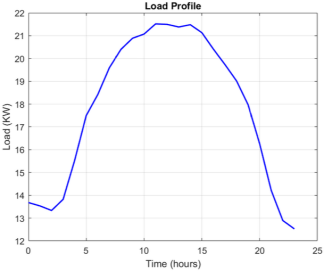
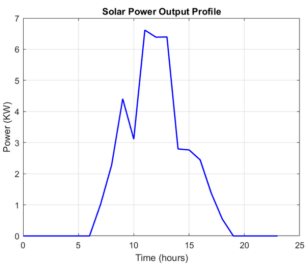
Figure 1 shows the load profile for a typical day. This graph provides the baseline energy demand that needs to be met by the combination of PV, BESS and grid power over a 24-hour period. This profile is important because it helps us to understand the energy needs of the home for a particular day and how it fluctuates and for planning the optimal use of the available power sources. Figure 2 also shows the power supplied by the PV panels based on the irradiance data gotten for the particular day.
Figure 1. Load Profile of The House.
Figure 2. Solar Power Output Profile.
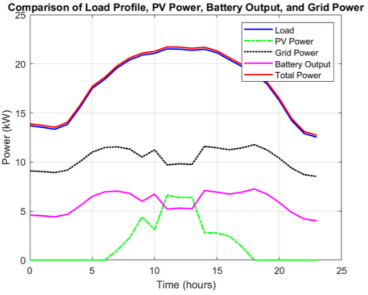
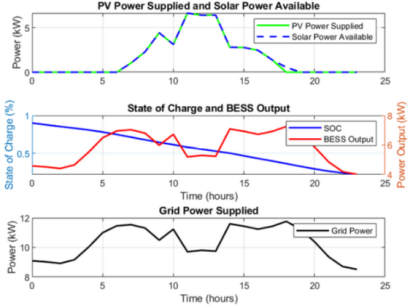
Figure 3 then compares the load profile with the power supplied by the PV system, the battery output, and the grid power. This comparison illustrates how each power source contributes to meeting the energy demand throughout the day. It highlights the interplay of several power sources. During daylight hours, PV power plays an important role in meeting the load demand, as shown in Figure 4. When PV power is insufficient, battery and grid electricity are used to make up the difference. This further shows the effectiveness in balancing power supply from various sources to meet load demand efficiently.
Figure 3. Comparison of power provided by the different power sources.
Figure 4. PV Supplied and available, BESS output and SOC, supplied Grid Power.
The energy savings achieved through the various configurations of the home energy management are significant, demonstrating Model Predictive Control’s effectiveness in optimizing energy usage. The reference configuration that would be used is just the grid power, which resulted in the energy use of 427.806kwh over a 24-hour period for a chosen date of 14th July. This energy consumption value would serve as the reference point for comparing the performance of other configurations. When photovoltaic power is introduced as the only additional power source, the total energy consumption from the grid dropped to 388.2061Kwh, representing a 9.25% reduction. This shows that PV systems can contribute to energy saving as it harnesses solar power during daylight hours.
Incorporating the battery energy storage system (BESS) into the energy management strategy yielded even more savings. If the system relies only on the BESS and the grid, the total energy from the grid decreased to 287.806Kwh, resulting in a 32.72% reduction compared to using only the grid as the power source. This shows the need for energy storage in minimizing the inconsistent nature of solar power and further ensures a consistent supply of power. The BESS stores excess energy during periods where there is low demand in the residents, which causes it to be used during peak demand time, hence resulting in the reduced need for grid power.
The most energy saving occurs when the PV and BESS are combined with the grid power in the home energy management system. In this optimal arrangement, the overall energy usage of grid power was decreased to 248.2061Kwh, showing a 41.98% reduction from the reference scenario (the grid only). This arrangement takes advantage of the strength of both renewable energy generation and storage, making best use of solar power throughout the daytime and storing energy for periods of no solar generation. The combination of PV with BESS has a combined effect that results in the best energy efficiency. Table 1 shows a clear comparison of energy saving across the different configurations.
Table 1. Summary of energy used in the house.

Power Supply Used

Energy Used From The Grid (KWh)

Energy Cost Saved

Grid Only

427.06

-

Grid + PV only

388.206

9.25%

Grid + Bess only

287.806

32.72%

PV + BESS+ GRID

248.2061

41.98%

Table 1 summarizes the added benefit of implementing renewable energy sources and storage devices into the energy management strategy. The significant energy savings achieved with the combined PV and BESS configuration highlight the value of a holistic approach to home energy management.
4. Conclusions
The system can respond to fluctuations in energy demand and supply better than static control approaches by dynamically altering the operation of PV, BESS, and grid power based on real-time data and forecasts. This adaptability guarantees that the energy system functions at optimal efficiency, reducing waste and making the most use of available resources.
Although this paper focused on a constant pricing environment, incorporating varying electricity prices like a real-time pricing system or a time-of-use pricing system, could provide additional opportunities for optimizing energy costs and improving overall system efficiency. The findings of this paper revealed that MPC is a robust and efficient approach to managing household energy resources. By predicting energy demand and optimizing the use of PV, BESS, and grid power in real-time, the system was able to significantly reduce energy costs. Specifically, a 41.98% reduction in energy costs was achieved, highlighting the potential of MPC to provide substantial financial savings for homeowners. Additionally, the paper showed that MPC could maximize the use of renewable energy sources, further contributing to the sustainability of household energy consumption.
Abbreviations

MPC

Model Predictive Control

DR

Demand Response

PV

Photovoltaic

SOC

State of Charge

Author Contributions
Osita Omeje: Conceptualization, Investigation, Project administration, Resources, Supervision, Validation, Writing – original draft, Writing – review & editing
Goziechi Orakwe: Conceptualization, Formal Analysis, Investigation, Software, Visualization, Writing – original draft
Linus Idoko: Conceptualization, Data curation, Methodology, Resources, Validation, Visualization, Writing – review & editing
Data Availability Statement
The data supporting the outcome of this research work have been reported in this manuscript.
Conflicts of Interest
The authors declares no conflicts of interest.
References
[1] S. Shan, B. Cao, and Z. Wu, “Forecasting the Short-Term Electricity Consumption of Building Using a Novel Ensemble Model,” IEEE Access, vol. 7, pp. 88093–88106, 2019,
[2] N. A. Kutty et al., “A Systematic Review of Climate Change Implications on Building Energy Consumption: Impacts and Adaptation Measures in Hot Urban Desert Climates,” Build., vol. 14, no. 1, pp. 1–34, Dec. 2023,
[3] B. A. Gyamfi, T. S. Adebayo, D. Q. Agozie, F. V. Bekun, and A. Koy, “Is sustainable energy consumption, technological advancement and urbanization fast addressing south Asia’s green energy expansion deficits?,” Environ. Dev. Sustain. 2024 278, vol. 27, no. 8, pp. 19969–19998, Mar. 2024,
[4] A. Das, S. Gupta, S. Bhattacharya, S. Johri, P. Selvakumar, and P. Satyanarayana, “Urbanization and Energy: The Nexus of Global Challenges,” in Geopolitical Landscapes of Renewable Energy and Urban Growth, IGI Global Scientific Publishing, 1AD, pp. 453–478.
[5] H. M. Saleh and A. I. Hassan, “The challenges of sustainable energy transition: A focus on renewable energy,” Appl. Chem. Eng., vol. 7, no. 2, pp. 1–24, 2024,
[6] F. Oluwadamilare, Usman, A. Adewnmi, K. Andrew, C. E. Okoli, and G. S. Usiagu, “Sustainable energy solutions and climate change: A policy review of emerging trends and global responses,” World J. Adv. Res. Rev., vol. 21, no. 2, pp. 408–420, Feb. 2023,
[7] B. Zohuri, “Navigating the Global Energy Landscape Balancing Growth, Demand, and Sustainability,” J. Mater. Sci. Appl. Eng., pp. 1–7, 2023, Accessed: Nov. 27, 2025. Available:
[8] M. Sadiq, J. P. Ou, K. D. Duong, L. Van, T. Q. Ngo, and T. X. Bui, “The influence of economic factors on the sustainable energy consumption: evidence from China,” Econ. Res. Istraz., vol. 36, no. 1, pp. 1751–1773, 2023,
[9] E. Veldman, M. Gibescu, H. J. G. Slootweg, and W. L. Kling, “Scenario-based modelling of future residential electricity demands and assessing their impact on distribution grids,” Energy Policy, vol. 56, pp. 233–247, May 2013,
[10] B. Han, Y. Zahraoui, M. Mubin, S. Mekhilef, M. Seyedmahmoudian, and A. Stojcevski, “Home Energy Management Systems: A Review of the Concept, Architecture, and Scheduling Strategies,” IEEE Access, vol. 11, pp. 19999–20025, 2023,
[11] Z. Bradac, V. Kaczmarczyk, and P. Fiedler, “Optimal scheduling of domestic appliances via MILP,” Energies, vol. 8, no. 1, pp. 217–232, 2015,
[12] R. Godina, E. M. G. Rodrigues, E. Pouresmaeil, J. C. O. Matias, and J. P. S. Catalão, “Model Predictive Control home energy management and optimization strategy with demand response,” Appl. Sci., vol. 8, no. 3, 2018,
[13] A. Al-Adaileh and S. Khaddaj, “Reduction of energy consumption using smart home techniques in the household sector,” in ICSEMEE 2020: XIV. International Conference on Smart Energy Management and Energy Efficiency - Paris - France, Aug. 2020, pp. 371–383. Accessed: Nov. 27, 2025. Available:
[14] A. Shahee, M. Abdoos, A. Aslani, and R. Zahedi, “Reducing the energy consumption of buildings by implementing insulation scenarios and using renewable energies,” Energy Informatics, vol. 7, no. 18, pp. 1–29, 2024, Accessed: Nov. 27, 2025. Available:
[15] P. Michailidis et al., “Model Predictive Control for Smart Buildings: Applications and Innovations in Energy Management,” Build., vol. 15, no. 18, pp. 1–49, Sep. 2025,
[16] L. Hern, “A review of strategies for building energy management system : Model predictive control, demand side management, optimization, and fault detect & diagnosis,” vol. 33, no. March 2020, 2021,
[17] I. Benrabia and D. Soffker, “Energy management of residential buildings based on model predictive control across varied prediction horizons, price models, and storage configurations,” 2024 IEEE Int. Conf. Commun. Control. Comput. Technol. Smart Grids, SmartGridComm 2024, pp. 123–128, 2024,
[18] O. E. Dragomir and F. Dragomir, “Application of Scheduling Techniques for Load-Shifting in Smart Homes with Renewable-Energy-Sources Integration,” Build., vol. 13, no. 1, pp. 1–14, Jan. 2023,
[19] M. S. Javadi, M. Gough, M. Lotfi, A. Esmaeel Nezhad, S. F. Santos, and J. P. S. Catalão, “Optimal self-scheduling of home energy management system in the presence of photovoltaic power generation and batteries,” Energy, vol. 210, p. 118568, Nov. 2020,
[20] J. Liu et al., “Virtual Power Plant with Renewable Energy Sources and Energy Storage Systems for Sustainable Power Grid-Formation, Control Techniques and Demand Response,” Energies, vol. 16, no. 9, Apr. 2023,
[21] M. S. Javadi et al., “Self-scheduling model for home energy management systems considering the end-users discomfort index within price-based demand response programs,” Sustain. Cities Soc., vol. 68, p. 102792, May 2021,
[22] S. A. Mansouri, A. Ahmarinejad, E. Nematbakhsh, M. S. Javadi, A. Esmaeel Nezhad, and J. P. S. Catalão, “A sustainable framework for multi-microgrids energy management in automated distribution network by considering smart homes and high penetration of renewable energy resources,” Energy, vol. 245, p. 123228, Apr. 2022,
[23] B. Chatuanramtharnghaka et al., “Reviewing Demand Response for Energy Management with Consideration of Renewable Energy Sources and Electric Vehicles,” World Electr. Veh. J., vol. 15, no. 9, pp. 1–24, Sep. 2024,
[24] O. A. Alimi and K. Ouahada, “Smart home appliances scheduling to manage energy usage,” in IEEE International Conference on Adaptive Science and Technology, ICAST, IEEE Computer Society, Oct. 2018, pp. 1–5.
[25] A. U. Rehman et al., “An Optimal Power Usage Scheduling in Smart Grid Integrated with Renewable Energy Sources for Energy Management,” IEEE Access, vol. 9, pp. 84619–84638, 2021,
[26] A. Katal, S. Dahiya, and T. Choudhury, “Energy efficiency in cloud computing data centers: a survey on software technologies,” Cluster Comput., vol. 26, no. 3, pp. 1845–1875, Aug. 2022,
[27] C. Liu, S. Sharples, H. Mohammadpourkarbasi, C. Liu, S. Sharples, and H. Mohammadpourkarbasi, “A Review of Building Energy Retrofit Measures, Passive Design Strategies and Building Regulation for the Low Carbon Development of Existing Dwellings in the Hot Summer–Cold Winter Region of China,” Energies, vol. 16, no. 10, pp. 1–25, May 2023,
[28] U. G. D. Madushika et al., “Energy Retrofitting Technologies of Buildings: A Review-Based Assessment,” Energies, vol. 16, no. 13, pp. 1–16, Jun. 2023,
[29] Z. Donglin, Y. Lijun, and W. Lizhen, “Research on Large-Scale Building Energy Efficiency Retrofit Based on Energy Consumption Investigation and Energy-Saving Potential Analysis,” J. Energy Eng., vol. 145, no. 6, p. 4019024, Dec. 2019,
[30] A. Burton, “Introduction To Passive Design - Green Choice Consulting,” Greenchoice Consulting. Accessed: Dec. 11, 2025. Available:
[31] M. Hu, K. Zhang, Q. Nguyen, and T. Tasdizen, “The effects of passive design on indoor thermal comfort and energy savings for residential buildings in hot climates: A systematic review,” Urban Clim., vol. 49, p. 101466, May 2023,
[32] Ifechukwu Gil-Ozoudeh, Obinna Iwuanyanwu, Azubuike Chukwudi Okwandu, and Chidiebere Somadina Ike, “The role of passive design strategies in enhancing energy efficiency in green buildings,” Eng. Sci. Technol. J., vol. 3, no. 2, pp. 71–91, Dec. 2022,
[33] A. O. Akinola and F. E. Amadhe, “Assessment of Passive Design Strategies for Enhancing Users’ Comfort in Academic Libraries Across Delta State, Nigeria,” Civ. Eng. Archit., vol. 13, no. 3A, pp. 2750–2768, 2025, Accessed: Dec. 11, 2025. Available:
[34] X. Liang, Y. Wang, and T. Roskilly, “Reduce Household Energy Consumption Using Passive Methods,” in The 7th International Conference on Applied Energy – ICAE2015 - Energy Procedia, Elsevier, Aug. 2015, pp. 1335–1340.
[35] O. Stojanovski, G. Leslie, F. Wolak, J. Huerta-Wong, and M. Thurber, “Promoting Energy Efficiency in Emerging Economies Through Consumer Education: Results From a Field Experiment in Mexico,” SSRN Electron. J., Jan. 2018,
[36] L. Cerović, A. Malnar, D. Sinčić, L. Cerović, A. Malnar, and D. Sinčić, “Energy Literacy of Economics Students in Rijeka: Knowledge, Attitudes, and Behavioral Approach,” Energies, vol. 17, no. 8, pp. 1–31, Apr. 2024,
[37] O. S. Santillán, K. G. Cedano, O. S. Santillán, and K. G. Cedano, “Energy Literacy: A Systematic Review of the Scientific Literature,” Energies, vol. 16, no. 21, pp. 1–19, Oct. 2023,
[38] K. L. van den Broek, “Household energy literacy: A critical review and a conceptual typology,” Energy Res. Soc. Sci., vol. 57, p. 101256, Nov. 2019,
[39] Y. Zhang, “Energy Consumption Prediction in Smart Homes Using QIO-Enhanced Regression Models,” Informatica, vol. 49, no. 33, pp. 375–396, Aug. 2025,
[40] H. Pombeiro, J. Santos, P. Carreira, and C. Silva, “Displaying data is not enough: Incorporating User Behavior Transformation in domestic reporting systems,” Sustain. Cities Soc., vol. 48, p. 101451, Jul. 2019,
[41] L. Marchi and J. Gaspari, “Energy Conservation at Home: A Critical Review on the Role of End-User Behavior,” Energies, vol. 16, no. 22, pp. 1–22, Nov. 2023,
[42] B. Gajdzik et al., “Impact of Economic Awareness on Sustainable Energy Consumption: Results of Research in a Segment of Polish Households,” Energies, vol. 17, no. 11, pp. 1–31, May 2024,
[43] M. M. Alomari, H. EL-Kanj, A. Topal, and N. I. Alshdaifat, “Exploring the impact of the COVID-19 pandemic on energy literacy and conservation behavior in academic buildings of Kuwait,” Heliyon, vol. 9, no. 11, pp. 1–21, Nov. 2023,
[44] J. I. De Larauze, “Assessing the Role of Benchmarking Requirements in Measuring and Driving Building Energy Performance for Multifamily Buildings in Greater Boston,” 2025. Accessed: Dec. 11, 2025. Available:
[45] G. Bekele, A. Lake, D. Habtu, and A. Assefa, “Energy Literacy for the Energy Transition: Forming the Next Generation of Energy Practitioners in Ethiopia,” in Community Energy and Sustainable Energy Transitions, Springer Nature, 2024, pp. 171–194.
[46] A. Erdoğdu et al., “Innovative Solutions for Combating Climate Change: Advancing Sustainable Energy and Consumption Practices for a Greener Future,” Sustainability, vol. 17, no. 6, pp. 1–39, Mar. 2025,
[47] T. S. Force and O. M. Longe, “Impact of Energy Literacy on Energy Consumption, Expenditure and Management,” Proc. 2022 IEEE Niger. 4th Int. Conf. Disruptive Technol. Sustain. Dev. NIGERCON 2022, pp. 1–5, 2022,
[48] R. Fonteijn, M. Babar, and R. Kamphuis, An assesment of the influence of demand response on demand elasticity in electricity retail market. 2015.
[49] L. Montuori, M. Alcázar-Ortega, and C. Álvarez-Bel, “Methodology for the evaluation of demand response strategies for the management of natural gas systems,” Energy, vol. 234, p. 121283, Nov. 2021,
[50] M. A. Khan, T. Khan, M. Waseem, A. M. Saleh, N. Qamar, and H. A. Muqeet, “Investigation and analysis of demand response approaches, bottlenecks, and future potential capabilities for IoT-enabled smart grid,” IET Renew. Power Gener., vol. 18, no. 15, pp. 3509–3535, Nov. 2024,
[51] M. J. B. Kabeyi and O. A. Olanrewaju, “Smart grid technologies and application in the sustainable energy transition: a review,” Int. J. Sustain. Energy, vol. 42, no. 1, pp. 685–758, Dec. 2023,
[52] A. Gharbi, M. Ayari, and A. E. Yahya, “Demand-Response Control in Smart Grids,” Appl. Sci., vol. 13, no. 4, pp. 1–24, Feb. 2023,
[53] B. Zhu, L. Xu, and Y. Chen, “A Strategy for Demand Response of Households Based on Communities,” 2020 Asia Energy Electr. Eng. Symp., pp. 983–987, 2020.
[54] X. Yan, Y. Ozturk, Z. Hu, and Y. Song, “A review on price-driven residential demand response,” Renew. Sustain. Energy Rev., vol. 96, pp. 411–419, Nov. 2018,
[55] F. Ahmed, A. Arshad, A. U. Rehman, M. H. Alqahtani, and K. Mahmoud, “Effective incentive based demand response with voltage support capability via reinforcement learning based multi-agent framework,” Energy Reports, vol. 12, pp. 568–578, Dec. 2024,
[56] I. O. Essiet and Y. Sun, “Demand response modeling with solar PV as a panacea to the Nigerian electricity distribution conundrum: A case study of Sierra Leone,” Energy Reports, vol. 8, pp. 374–380, Nov. 2022,
[57] L. Malehmirchegini and H. Farzaneh, “Incentive-based demand response modeling in a day-ahead wholesale electricity market in Japan, considering the impact of customer satisfaction on social welfare and profitability,” Sustain. Energy, Grids Networks, vol. 34, p. 101044, Jun. 2023,
[58] H. Mao, Q. Deng, Z. Zhang, and X. Yang, “Optimized economic scheduling of demand response in integrated energy systems considering dynamic energy efficiency and dynamic carbon trading,” Sci. Reports 2025 161, vol. 16, no. 1, pp. 1–27, Jan. 2026,
Cite This Article
  • APA Style

    Omeje, O., Orakwe, G., Idoko, L. (2026). Optimization Model for Home Energy Management Using Demand Response Strategy. International Journal of Energy and Power Engineering, 15(3), 71-80. https://doi.org/10.11648/j.ijepe.20261503.11

    Copy | Download

    ACS Style

    Omeje, O.; Orakwe, G.; Idoko, L. Optimization Model for Home Energy Management Using Demand Response Strategy. Int. J. Energy Power Eng. 2026, 15(3), 71-80. doi: 10.11648/j.ijepe.20261503.11

    Copy | Download

    AMA Style

    Omeje O, Orakwe G, Idoko L. Optimization Model for Home Energy Management Using Demand Response Strategy. Int J Energy Power Eng. 2026;15(3):71-80. doi: 10.11648/j.ijepe.20261503.11

    Copy | Download

  • @article{10.11648/j.ijepe.20261503.11,
      author = {Osita Omeje and Goziechi Orakwe and Linus Idoko},
      title = {Optimization Model for Home Energy Management Using Demand Response Strategy},
      journal = {International Journal of Energy and Power Engineering},
      volume = {15},
      number = {3},
      pages = {71-80},
      doi = {10.11648/j.ijepe.20261503.11},
      url = {https://doi.org/10.11648/j.ijepe.20261503.11},
      eprint = {https://article.sciencepublishinggroup.com/pdf/10.11648.j.ijepe.20261503.11},
      abstract = {The energy industry faces a variety of challenges as a result of the growing demand for electricity. The emphasis is shifting to optimizing energy use in residential settings so as to achieve sustainable alternatives. The escalating demand for sustainable energy practices in residential environments gives rise to innovative approaches to home energy management. In order to significantly reduce home energy use and contribute to a more sustainable future, this paper proposes an optimization model for home energy management that combines Model Predictive Control (MPC) with Demand Response (DR) strategy to reduce energy consumption. The study used several types of data, such as the hourly load demand of a house and solar irradiance data. Load demand profile, derived from historical electricity usage records, provided hourly energy consumption over a 24-hour period, serving as essential input for predicting future energy needs using the MPC algorithm. Solar irradiance data and PV system specifications were utilized to model the power generated by PV panels, while information about the battery energy storage system, including its capacity, efficiency, and state of charge (SOC) limits, was essential for modelling the behavior of the battery in storing and discharging energy. The model encompasses mathematical models and optimization tools for the efficient usage of photovoltaic (PV) panels, battery energy storage systems (BESS), and grid power. With the aid of MATLAB/Simulink simulations, the study demonstrated that MPC effectively predicts energy demand and allocates power sources effectively, achieving a 41% reduction in energy costs compared to grid-only scenarios. Considering the results obtained, this paper suggests areas of further research work, such as integrating dynamic pricing models in countries like Nigeria and exploring hybrid renewable energy systems. This will build on the findings obtained in this work and further improve household energy efficiency and sustainability.},
     year = {2026}
    }
    

    Copy | Download

  • TY  - JOUR
    T1  - Optimization Model for Home Energy Management Using Demand Response Strategy
    AU  - Osita Omeje
    AU  - Goziechi Orakwe
    AU  - Linus Idoko
    Y1  - 2026/06/04
    PY  - 2026
    N1  - https://doi.org/10.11648/j.ijepe.20261503.11
    DO  - 10.11648/j.ijepe.20261503.11
    T2  - International Journal of Energy and Power Engineering
    JF  - International Journal of Energy and Power Engineering
    JO  - International Journal of Energy and Power Engineering
    SP  - 71
    EP  - 80
    PB  - Science Publishing Group
    SN  - 2326-960X
    UR  - https://doi.org/10.11648/j.ijepe.20261503.11
    AB  - The energy industry faces a variety of challenges as a result of the growing demand for electricity. The emphasis is shifting to optimizing energy use in residential settings so as to achieve sustainable alternatives. The escalating demand for sustainable energy practices in residential environments gives rise to innovative approaches to home energy management. In order to significantly reduce home energy use and contribute to a more sustainable future, this paper proposes an optimization model for home energy management that combines Model Predictive Control (MPC) with Demand Response (DR) strategy to reduce energy consumption. The study used several types of data, such as the hourly load demand of a house and solar irradiance data. Load demand profile, derived from historical electricity usage records, provided hourly energy consumption over a 24-hour period, serving as essential input for predicting future energy needs using the MPC algorithm. Solar irradiance data and PV system specifications were utilized to model the power generated by PV panels, while information about the battery energy storage system, including its capacity, efficiency, and state of charge (SOC) limits, was essential for modelling the behavior of the battery in storing and discharging energy. The model encompasses mathematical models and optimization tools for the efficient usage of photovoltaic (PV) panels, battery energy storage systems (BESS), and grid power. With the aid of MATLAB/Simulink simulations, the study demonstrated that MPC effectively predicts energy demand and allocates power sources effectively, achieving a 41% reduction in energy costs compared to grid-only scenarios. Considering the results obtained, this paper suggests areas of further research work, such as integrating dynamic pricing models in countries like Nigeria and exploring hybrid renewable energy systems. This will build on the findings obtained in this work and further improve household energy efficiency and sustainability.
    VL  - 15
    IS  - 3
    ER  - 

    Copy | Download

Author Information