Research Article | | Peer-Reviewed

Artificial Lift-Assisted Production Enhancement in Mature Oil Wells: A Case Study

Received: 15 January 2022     Accepted: 26 June 2026     Published: 17 July 2026
Views:       Downloads:
Abstract

Oil production is decreasing across the world due to natural depletion of the reservoirs. During the past decades, production from large number of oil wells has been decreased due to deletion of natural energy. Some of these wells are abundant and some of these are producing at their economic limit. To lift the oil and increase the productivity an additional energy is required which can reduce the flowing bottomhole pressure and decrease the pressure drawdown. Use of latest artificial lift technology to increase the production is now the main concern of all the companies. This research work is simulation base research conducted by using commercial simulator. Four different artificial lift methods are applied on a low productivity oil well named as Well X-1. The Well X-1 is drilled to depth of 7800 ft in a sandstone formation and is naturally flowing at the rate of 179, barrels of oil per day (BOPD) with Wellhead Flowing Pressure (WHFP) of 125 psig. Using the reservoir data and wellbore data of Well X-1, continuous gas lift, electrical submersible pump, jet pump and sucker rod pump lift method models are developed in the simulator. Based on technical evaluation, electrical submersible pump (ESP) lift method is selected to increase the oil production from Well X-1. ESP method resulted maximized production of 614 BOPD compared to all other artificial lift methods. Then economic evaluation of all the lift methods is carried out using spreadsheet and the results have shown that ESP method yields maximum net cash flow for the investment. Oil production from ESP lifted Well X-1 is further increased by using well intervention techniques which includes matrix acidizing and rig-less wireline additional perforation job. Matrix acidizing can significantly increase the oil production to 1309 BOPD compared to the wireline additional perforation.

Published in International Journal of Energy and Power Engineering (Volume 15, Issue 3)
DOI 10.11648/j.ijepe.20261503.12
Page(s) 81-91
Creative Commons

This is an Open Access article, distributed under the terms of the Creative Commons Attribution 4.0 International License (http://creativecommons.org/licenses/by/4.0/), which permits unrestricted use, distribution and reproduction in any medium or format, provided the original work is properly cited.

Copyright

Copyright © The Author(s), 2026. Published by Science Publishing Group

Keywords

Artificial Lift System, Gas Lift, Sucker Rod Pump, Jet Pump, ESP, Well Intervention

1. Introduction
Oil and gas demand is increasing with time all across the world while naturally producing conventional hydrocarbon reserves are depleting due to natural depletion of existing reservoir driver mechanism. All the reservoirs have some naturally existing drive mechanisms which provide sufficient energy in terms of pressure to produce hydrocarbons at surface. Some of these drive mechanisms are water drive, gas cap drive, gravity drainage, solution gas drive etc. Sometimes more than one kind of drive mechanisms may also exist within a single reservoir, called combination drive mechanism. Most of the reservoirs don’t have additional energy support to produce hydrocarbons at surface known as volumetric reservoirs. During natural flow of the well, energy of drive mechanism decreases with time as a result of hydrocarbon production.
To meet the global requirements, oil and gas industry requires an increase in production using some other resources. Artificial lift system is now becoming most common source to increase the oil and gas production where natural energy of the reservoirs is not enough to produce hydrocarbons at surface. Artificial lift technique uses some artificial means to increase the flow of hydrocarbons by using some mechanical devices within the well or by reducing the hydrostatic head of fluid within the wellbore. It is used in the wells where natural energy of the reservoir is insufficient to produce the fluid. Some common artificial lift techniques are,
1) Gas Lift
2) Electric Submersible Pump (ESP)
3) Jet Pump
4) Sucker Rod Pump
Recent advancements in artificial lift technologies have focused on improving production efficiency, reducing operating costs, and extending the productive life of mature oil wells. Abu-Bakri et al. (2024) reported that intelligent gas-lift optimization can significantly enhance oil production through optimal gas injection management and continuous performance monitoring . Similarly, Darbandi et al. (2024) developed an Internet of Things (IoT)-based gas-lift allocation model that improved production efficiency by integrating real-time field data with advanced optimization algorithms . Rahouma (2025) evaluated the performance of various artificial lift systems in mature oil fields and concluded that proper lift-system selection based on reservoir and well conditions is critical for maximizing recovery and minimizing operational expenses . Furthermore, recent studies have highlighted the increasing use of digital surveillance, nodal analysis, and machine-learning techniques for monitoring artificial lift performance and predicting system failures before production losses occur . These developments demonstrate that artificial lift optimization has become a key strategy for sustaining production from mature reservoirs and improving field economics in the face of declining reservoir pressure. In addition to conventional optimization techniques, recent studies have emphasized the application of artificial intelligence and machine-learning approaches in artificial lift operations. Song et al. (2024) developed a data-driven diagnostic model for Electric Submersible Pump (ESP) systems using principal component analysis, demonstrating improved fault detection and predictive maintenance capabilities . Similarly, Alagoz et al. (2024) conducted a comparative analysis of gas lift, beam lift, and ESP systems in horizontal wells and highlighted the importance of well-specific optimization in maximizing production performance . Liu et al. (2024) applied interpretable machine-learning models to predict production from plunger gas lift wells and identified key operational parameters influencing production efficiency . Furthermore, Jin and Emami-Meybodi (2025) proposed an integrated machine-learning framework for predicting flowing bottom-hole pressure during dynamic gas-lift operations, improving production forecasting accuracy and operational decision-making . Recent investigations have also demonstrated the potential of machine-learning-based artificial lift selection systems, enabling engineers to identify the most suitable lift method based on reservoir, fluid, and well characteristics. These studies indicate a growing shift toward intelligent and data-driven artificial lift management, supporting enhanced production optimization, reduced downtime, and improved economic performance.
With the use of latest technology of exploration and production, crude oil reserves are being improved in Pakistan. Some of these reserves need artificial means to produce at the surface. Therefore, proper selection and optimization of artificial lift systems are essential for maximizing hydrocarbon recovery from mature wells and ensuring sustainable field development.
2. Methodology
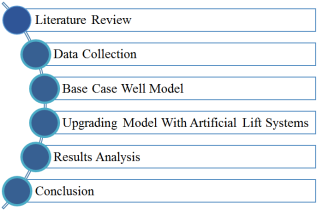
A base case simulation well model named Well X-1 is developed using commercial simulator to check the oil recovery based on natural energy of the reservoir. Reservoir and well data of Well X-1 is assumed and kept constant in each type of artificial lift method. Pressure-Volume-Temperature (PVT) data is incorporated in the model and history matched the data for selecting the best suitable correlation. Reservoir model is selected for the calculation of inflow performance relationship (IPR) based on defined reservoir parameters. Combined inflow performance relationship (IPR) and vertical lift performance (VLP) is plotted based on NODAL ANALYSIS for predicting the production behavior of well. Then simulation model is updated by incorporating the different artificial lift techniques one by one i.e. gas lift, electric submersible pump (ESP), jet pump and sucker rod pump.
Figure 1. Methodology.
Oil production from all the simulation models is then compared and analyzed. Based on technical evaluation, ESP method is selected for significant production improvement of Well X-1. Then economic analysis is made using the spreadsheet to check economical viable artificial lift technique under considerations. At the end production of ESP selected Well X-1 is further increased using well stimulation with matrix acidizing by removing the formation damage around the wellbore and by increasing the pay zone thickness using rig-less wireline additional perforations.
3. Results and Discussions
3.1. Base Case Naturally Flowing Well
Black Oil Well Model is selected for base case naturally flowing well to describe the fluid flow behavior in reservoir and well. The well is cased hole drilled to a depth of 7800 ft in a sandstone formation with single stage separation. For this research work, Petrosky et al. correlation is used for calculation of bubble point pressure (Pb), solution gas ratio (Rs), and oil formation volume factor (Bo) . While, for the calculation of oil viscosity, Beggs et al. correlation is used. Darcy Model is selected for the calculation of Inflow Performance Relationship (IPR) based on defined reservoir parameters. Geometrical and mechanical skin value is entered by hand which is 10. Wellbore data is given in Table 1. Reservoir data is given in Table 2. Node point is selected at the bottom of well for NODAL analysis.
Table 1. Wellbore Data.

Wellbore Data

SSSV (ft)

229

Tubing Size (Inches)

2.375

End of Tubing (ft)

7160

Casing Size (Inches)

7

End of Prod. Casing (ft)

7800

Table 2. Reservoir Data.

Reservoir Data

Reservoir Pressure (psig)

2794.05

Permeability (mD)

35

Thickness (ft)

40

Drainage Area (Acre)

340

Water Cut (%)

30

Reservoir Temperature (°F)

250

Skin

10

Table 3. PVT Data.

PVT Input Data

Solution GOR (SCF/STB)

400

Oil Gravity (API)

48

Gas Gravity

0.735

Water Salinity (PPM)

30000

Impurities

None

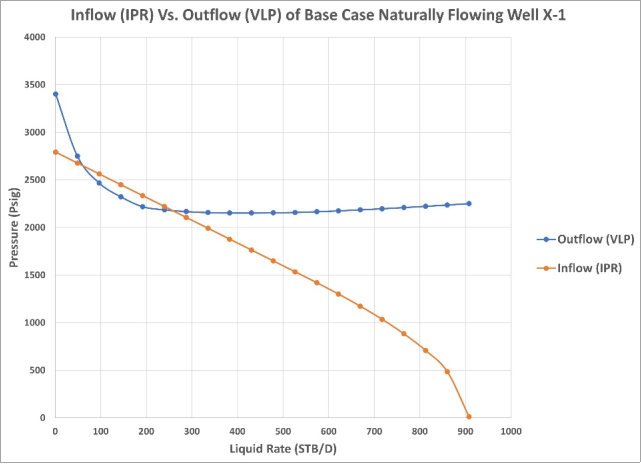
Naturally flowing Well X-1 is producing around 256 BPD at WHFP of 125 psig, out of which oil production is 179 BPD. Most of the pressure drop is due to gravity. Reservoir is having potential to produce more oil but due to pressure losses in the wellbore it contributes very less oil production. Applying some artificial lift techniques may significantly improve the oil production.
3.2. Continuous Gas Lift
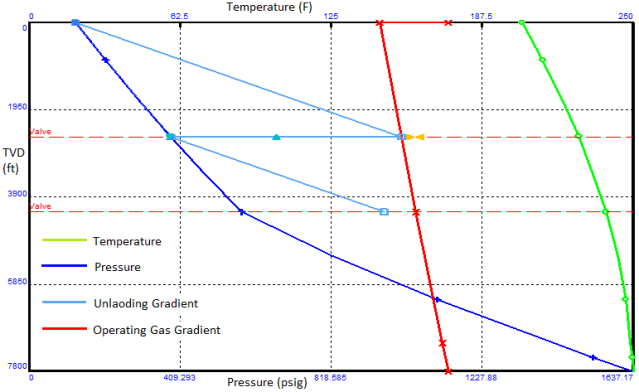
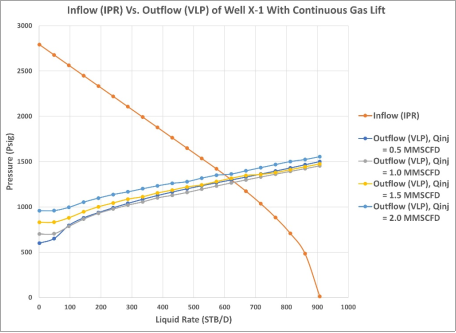
Sensitivity analysis is carried out to check the maximum production against available gas of 2 MMSCFD for injection. Results have shown that oil production is maximum when injecting the gas at the rate 1 MMSCFD. Beyond this limit oil production somehow decreased due to dominant frictional forces. Figure 3 shows gas lift valves unloading mechanism for Well X-1. Figure 4 shows that Injecting 1 MMSCFD downhole through gas lift valves can increase the oil production to 442 BPD. If we inject gas less than 1 MMSCFD, oil production will be less because injected gas is not sufficient to lift the whole fluid column. These findings are consistent with previous studies (e.g., Alagoz et al., 2024; Liu et al., 2024) , which emphasize the importance of optimizing gas injection rates to balance lifting efficiency and frictional losses for maximum production performance.
Figure 2. IPR-VLP of Well X-1 With Natural Flow.
Figure 3. Well Unloading Mechanism With Continuous Gas Lift.
Figure 4. IPR-VLP of Well X-1 With Continuous Gas Lift.
3.3. Electrical Submersible Pump
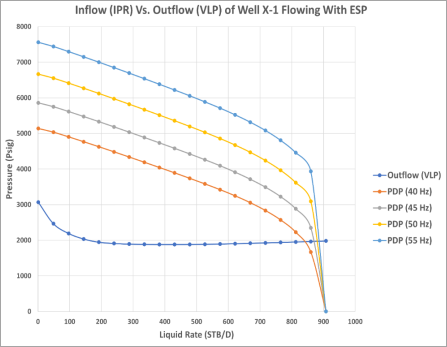
ESP can be operated at wide range of electricity frequency. Normally increasing the frequency can increase the oil production. Since electricity operating frequency in Pakistan is 50 Hz. so, in this case frequency of 50 Hz. Is chosen for operating the downhole pump. ESP can increase the oil production of Well X-1 from 179 BOPD to 614 BOPD. ESP has resulted maximum production compared to other artificial lift methods. IPR-VLP plot of Well X-1 flowing with ESP is shown in Figure 5.
Victoria A. et al. (2026) further noted that ESP systems are often the preferred lift method for medium-to-high production wells because of their ability to handle large fluid volumes and maintain stable production rates .
Figure 5. IPR-VLP of Well X-1 With ESP.
3.4. Jet Pump
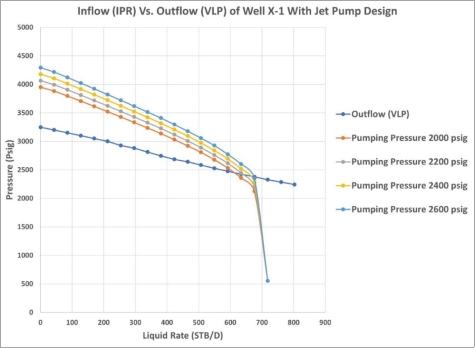
Oil production can be increased by increasing the pumping pressure of the power fluid. Sensitivity analysis have been made to check the increase in oil production by increasing the pumping pressure of the power fluid. In this case 2600 psig pumping pressure is considered for the power fluid to lift the oil. Results shows that jet pump operating with nozzle/throat combination of 11-A with pumping pressure of 2600 psig can increase the oil production of Well X-1 from 179 BOPD to 469 BOPD. IPR-VLP plot of Well X-1 flowing with jet pump is shown in Figure 6.
Figure 6. IPR-VLP of Well X-1 With Jet Pump.
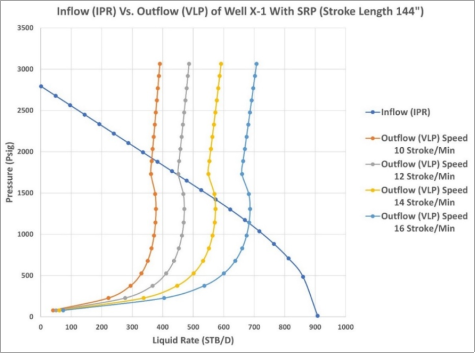
Figure 7. IPR-VLP of Well X-1 With SRP (Stroke Length 144").
3.5. Sucker Rod Pump
Sucker rod pump can be operated with different stroke speed and stroke length. Sensitivity analysis is carried out to check the increase in oil production at different pumping speed and different stroke length. Considering the pumping speed 16 strokes/minute and stroke length of 144", sucker rod pump can increase the oil production from 179 BOPD to 472 BOPD. IPR-VLP plot of Well X-1 flowing with sucker rod pump is shown in Figure 7.
3.6. Comparative Analysis of Artificial Lift Methods
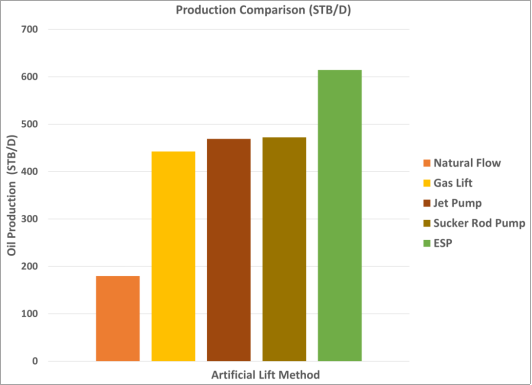
Oil production from all the artificial lift methods is compared with natural flow of Well X-1. Using ESP method to lift the oil can result maximum oil production. Based on technical evaluation, ESP method is selected to increase the oil production from Well X-1.
Figure 8. Graphical Comparison of All ALS.
Table 4. Economic Evaluation of Artificial Lift Methods.

Description

Artificial Lift Method

Gas Lift

ESP

Jet Pump

Sucker Rod

Yearly Oil Production (bbls)

161476

224220

171258

172353

Working Interest Production (bbls)

129181

179376

137006

137882

Revenue ($80/bbl)

10334464

14350048

10960512

11030592

State Tax (10%)

1033446

1435005

1096051

1103059

Operating Cost ($6/bbl)

968856

1345317

1027548

1034118

Workover Cost ($30,000/day)

450000

450000

450000

450000

Artificial Lift Assembly Cost ($)

145387

49784

144500

150210

Surface Equipment Cost ($)

57398

18555

24072

14268

Annual Electricity Cost ($)

14400

17840

12875

15940

Annual Metering Cost ($)

62000

0

0

0

Leasehold ($)

37500

37500

37500

37500

Overhead ($)

22500

22500

22500

22500

Taxable Income ($)

7542977

10973547

8145466

8202997

Corporate Income Tax (29%)

2187463

3182329

2362185

2378869

Net Cash Flow per Annum (M$)

5.35

7.79

5.78

5.82

3.7. Economic Evaluation of Artificial Lift Methods
The second objective of this research work is the economic evaluation of the artificial lift methods. Before finalizing artificial lift method, a complete economic analysis must be carried out to check the profitability of the project. The maximum potential of any oil field can be assured by increasing the oil production with less expenditures and this can be done by selecting the most economical artificial lift method. Net cash flow is the basis for all economic decisions. Prediction of the cash inflow and net cash outflow for the installation of each artificial lift method is carried out using spreadsheet that is based on CAPEX, OPEX, estimated revenue originated from the total production of respective artificial technique. Some of the assumptions made includes:
1) Crude oil price assumed is $80 per barrel of oil.
2) Royalty interest is 20%.
3) Federal corporate income tax is 29% on taxable income.
4) Operating cost assumed to be $6/bbl.
5) Workover Rig cost for installation of artificial lift assembly is $30,000/day.
6) 15 number of workover days are required to complete the well for each type of artificial lift method.
7) Leasehold charges payable to landlord for hiring of land are $3125/month.
8) Overhead cost (indirect expenses to run a business) accounting for utilities, travelling, repairing of equipment, administrative cost etc. are $1875/month.
9) Artificial lift assembly cost, surface equipment cost, metering cost .
Keeping in view of the technical evaluations, simulation results have shown that Electrical Submersible Pump (ESP) yields higher production rates compared to other artificial lift methods when applied to base case naturally flowing well. In terms of economic evaluation, ESP generated the highest net cash flow. Hence, ESP method is better than all other artificial lift methods in terms of economics and production.
3.8. ESP with Well Intervention
The third objective of this research work is to further increase the oil production from selected artificial lift technique. Since ESP is selected to increase the oil production from Well X-1. Oil production can be further increased using rig-less well intervention and remedial jobs. In this research work, two methods have been discussed and implemented to further increase the oil production from Well X-1 flowing with ESP.
3.8.1. Matrix Acidizing
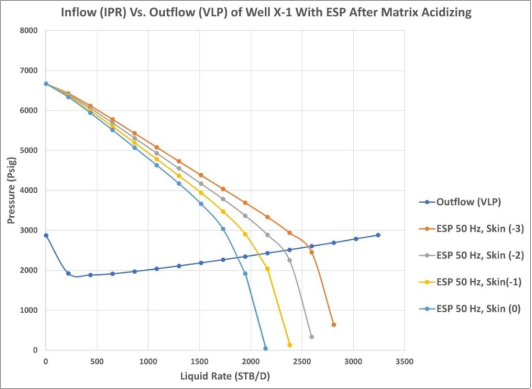
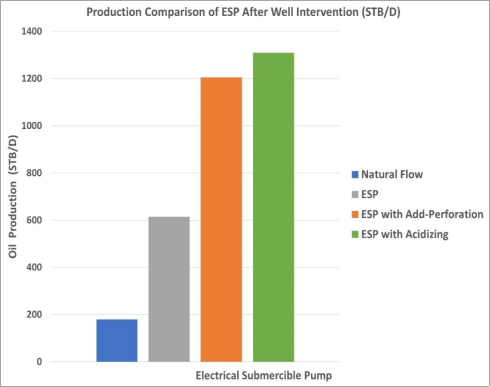
Naturally flowing well is producing oil with skin value of 10 which shoes that near wellbore formation is damaged. Matrix acidizing technique is applied to remove the formation damage. From Figure 9, it is clear that considering the zero skin, it is observed that matrix acidizing can increase the ESP production from 614 BOPD to 1309 BOPD.
3.8.2. ESP with Rig-less Perforations
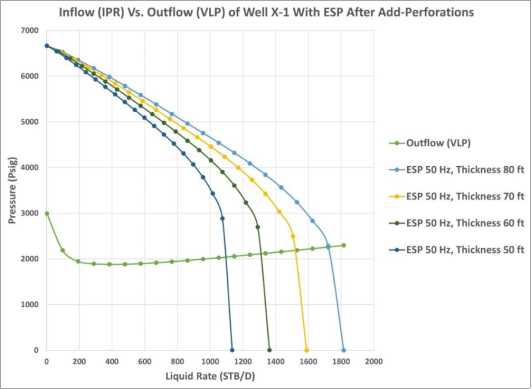
Increasing the pay zone thickness can increase the production from well. By using rig-less wireline additional perforation scheme an additional pay zone is perforated to increase the oil production. If we increase the pay zone thickness to 80 ft. which is double than base case well model, oil production can be increased from 614 BOPD to 1205 BOPD. Sensitivity analysis is carried out by increasing the pay zone thickness. Figure 10 shows the IPR-VLP plot of ESP lifted Well X-1 after wireline additional perforations.
Oil production from ESP lifted Well X-1 can be further increased by matrix acidizing technique more effectively. Comparative analysis of matrix acidizing, and wireline additional perforations job is shown in Figure 11.
Figure 9. IPR-VLP of Well X-1 with ESP After Matrix Acidizing.
Figure 10. IPR-VLP of Well X-1 With ESP After Add-Perforations.
Figure 11. Production Comparison of ESP After Well Intervention.
4. Conclusion
1) Based on technical evaluation, ESP method is selected to increase the oil production of Well X-1. ESP method increased oil production from 179 BPD to 614 BPD.
2) ESP method yields annual profit of 7.79 M$ greater than profit from other artificial lift system based on capital investment, operating cost, oil price and rate of return. Oil production is further increased from 614 BPD to 1309 BPD by using matrix acidizing in ESP lifted oil well.
3) Keeping in view of best performance results of ESP, a greater number of wells should be planned in Pakistan in near future to complete with ESP and increase the oil production.
Abbreviations

𝑃𝑤𝑓

Bottomhole Flowing Pressure

𝑃𝑏

Bubble Point Pressure

𝐵𝑜

Oil Formation Volume Factor

𝑞𝑜

Oil Flow Rate

𝑅𝑠

Solution Gas Ratio

μ0

Viscosity of Oil

AOFP

Absolute Open Flow Potential

BOPD

Barrel of Oil Per Day

CAPEX

Capital Expenditures

GOR

Gas Oil Ratio

GLR

Gas Liquid Ratio

IPR

Inflow Performance Relationship

OPEX

Operational Expenditures

PVT

Pressure Volume Temperature

SRP

Sucker Rod Pump

VLP

Vertical Lift Performance

WHFP

Wellhead Flowing Pressure

Author Contributions
Waseem Abbas: Conceptualization, Methodology, Investigation, Formal analysis, Data curation, Resources, Visualization, Writing – original draft, Writing – review & editing
Conflicts of Interest
The author declares that there are no known financial interests, personal relationships, commercial affiliations, or other circumstances that could have influenced the work reported in this manuscript or its interpretation.
References
[1] J. Abu-Bakri, A. Jafari, H. Namdar, and G. Ahmadi, “Increasing productivity by using smart gas for optimal management of the gas lift process in a cluster of wells,” Sci. Rep., vol. 14, no. 1, p. 15489, Jul. 2024,
[2] “A new gas lift allocation method in the IoT environment using a hybrid optimization algorithm | Scientific Reports.” Accessed: Jun. 22, 2026. Available:
[3] “(Performance Evaluation and Optimization of Artificial Lift Systems in Libyan Oil Fields | Al-Farooq Journal of Sciences.” Accessed: Jun. 22, 2026. Available:
[4] F. I. Syed, M. Alshamsi, A. K. Dahaghi, and S. Neghabhan, “Artificial lift system optimization using machine learning applications,” Petroleum, vol. 8, no. 2, pp. 219-226, Jun. 2022,
[5] “A Comprehensive Review of Failure Modes in Electrical Submersible Pumps: Diagnosis, Predictive Maintenance, and Engineer’s Guide | Arabian Journal for Science and Engineering | Springer Nature Link.” Accessed: Jun. 22, 2026. Available:
[6] R. Al Zadjali, M. Al Aamri, and I. Al Maskari, “Transforming Sucker Rod Pump Teardown Analysis with Artificial Intelligence and Digitalization,” Accessed: Jun. 22, 2026. Available:
[7] Q.-X. Liu et al., “Deep feature learning for anomaly detection in gas well deliquification using plunger lift: A novel CNN-based approach,” Pet. Sci., vol. 22, no. 9, pp. 3803-3816, Sep. 2025,
[8] “Reservoir Simulations: A Comparative Review of Machine Learning Approaches | IEEE Journals & Magazine | IEEE Xplore.” Accessed: Jun. 22, 2026. Available:
[9] R. Abdel-Azim, “Estimation of bubble point pressure and solution gas oil ratio using artificial neural network,” Int. J. Thermofluids, vol. 14, p. 100159, May 2022,
[10] “Production Engineering Aspects and Artificial Lift in Unconventional R.” Accessed: Jun. 22, 2026. Available:
[11] “Performance Evaluation and Economic Assessment of Electrical Submersible Pumps for Heavy Oil Production in Mature Niger Delta Oilfields | FUDMA Journal of Engineering and Technology.” Accessed: Jun. 22, 2026. Available:
[12] “Artificial-Lift Selection Strategy To Maximize Value of Unconventional Oil and Gas Assets.” Accessed: Jun. 22, 2026. Available:
Cite This Article
  • APA Style

    Abbas, W. (2026). Artificial Lift-Assisted Production Enhancement in Mature Oil Wells: A Case Study. International Journal of Energy and Power Engineering, 15(3), 81-91. https://doi.org/10.11648/j.ijepe.20261503.12

    Copy | Download

    ACS Style

    Abbas, W. Artificial Lift-Assisted Production Enhancement in Mature Oil Wells: A Case Study. Int. J. Energy Power Eng. 2026, 15(3), 81-91. doi: 10.11648/j.ijepe.20261503.12

    Copy | Download

    AMA Style

    Abbas W. Artificial Lift-Assisted Production Enhancement in Mature Oil Wells: A Case Study. Int J Energy Power Eng. 2026;15(3):81-91. doi: 10.11648/j.ijepe.20261503.12

    Copy | Download

  • @article{10.11648/j.ijepe.20261503.12,
      author = {Waseem Abbas},
      title = {Artificial Lift-Assisted Production Enhancement in Mature Oil Wells: A Case Study},
      journal = {International Journal of Energy and Power Engineering},
      volume = {15},
      number = {3},
      pages = {81-91},
      doi = {10.11648/j.ijepe.20261503.12},
      url = {https://doi.org/10.11648/j.ijepe.20261503.12},
      eprint = {https://article.sciencepublishinggroup.com/pdf/10.11648.j.ijepe.20261503.12},
      abstract = {Oil production is decreasing across the world due to natural depletion of the reservoirs. During the past decades, production from large number of oil wells has been decreased due to deletion of natural energy. Some of these wells are abundant and some of these are producing at their economic limit. To lift the oil and increase the productivity an additional energy is required which can reduce the flowing bottomhole pressure and decrease the pressure drawdown. Use of latest artificial lift technology to increase the production is now the main concern of all the companies. This research work is simulation base research conducted by using commercial simulator. Four different artificial lift methods are applied on a low productivity oil well named as Well X-1. The Well X-1 is drilled to depth of 7800 ft in a sandstone formation and is naturally flowing at the rate of 179, barrels of oil per day (BOPD) with Wellhead Flowing Pressure (WHFP) of 125 psig. Using the reservoir data and wellbore data of Well X-1, continuous gas lift, electrical submersible pump, jet pump and sucker rod pump lift method models are developed in the simulator. Based on technical evaluation, electrical submersible pump (ESP) lift method is selected to increase the oil production from Well X-1. ESP method resulted maximized production of 614 BOPD compared to all other artificial lift methods. Then economic evaluation of all the lift methods is carried out using spreadsheet and the results have shown that ESP method yields maximum net cash flow for the investment. Oil production from ESP lifted Well X-1 is further increased by using well intervention techniques which includes matrix acidizing and rig-less wireline additional perforation job. Matrix acidizing can significantly increase the oil production to 1309 BOPD compared to the wireline additional perforation.},
     year = {2026}
    }
    

    Copy | Download

  • TY  - JOUR
    T1  - Artificial Lift-Assisted Production Enhancement in Mature Oil Wells: A Case Study
    AU  - Waseem Abbas
    Y1  - 2026/07/17
    PY  - 2026
    N1  - https://doi.org/10.11648/j.ijepe.20261503.12
    DO  - 10.11648/j.ijepe.20261503.12
    T2  - International Journal of Energy and Power Engineering
    JF  - International Journal of Energy and Power Engineering
    JO  - International Journal of Energy and Power Engineering
    SP  - 81
    EP  - 91
    PB  - Science Publishing Group
    SN  - 2326-960X
    UR  - https://doi.org/10.11648/j.ijepe.20261503.12
    AB  - Oil production is decreasing across the world due to natural depletion of the reservoirs. During the past decades, production from large number of oil wells has been decreased due to deletion of natural energy. Some of these wells are abundant and some of these are producing at their economic limit. To lift the oil and increase the productivity an additional energy is required which can reduce the flowing bottomhole pressure and decrease the pressure drawdown. Use of latest artificial lift technology to increase the production is now the main concern of all the companies. This research work is simulation base research conducted by using commercial simulator. Four different artificial lift methods are applied on a low productivity oil well named as Well X-1. The Well X-1 is drilled to depth of 7800 ft in a sandstone formation and is naturally flowing at the rate of 179, barrels of oil per day (BOPD) with Wellhead Flowing Pressure (WHFP) of 125 psig. Using the reservoir data and wellbore data of Well X-1, continuous gas lift, electrical submersible pump, jet pump and sucker rod pump lift method models are developed in the simulator. Based on technical evaluation, electrical submersible pump (ESP) lift method is selected to increase the oil production from Well X-1. ESP method resulted maximized production of 614 BOPD compared to all other artificial lift methods. Then economic evaluation of all the lift methods is carried out using spreadsheet and the results have shown that ESP method yields maximum net cash flow for the investment. Oil production from ESP lifted Well X-1 is further increased by using well intervention techniques which includes matrix acidizing and rig-less wireline additional perforation job. Matrix acidizing can significantly increase the oil production to 1309 BOPD compared to the wireline additional perforation.
    VL  - 15
    IS  - 3
    ER  - 

    Copy | Download

Author Information
  • Oil and Gas Development Company Ltd. (OGDCL), Islamabad, Pakistan
  • Abstract
  • Keywords
  • Document Sections

    1. 1. Introduction
    2. 2. Methodology
    3. 3. Results and Discussions
    4. 4. Conclusion
    Show Full Outline
  • Abbreviations
  • Author Contributions
  • Conflicts of Interest
  • References
  • Cite This Article
  • Author Information