Research Article | | Peer-Reviewed

Evaluation of Good Cattle Farming and Slaughtering Practices According to the "Halal" Standard in the Vina Division (Cameroon)

Received: 16 December 2025     Accepted: 30 December 2025     Published: 20 January 2026
Views:       Downloads:
Abstract

The market for halal products is constantly growing. It is estimated to be worth approximately 2.3 million USD. With an estimated annual growth rate of 20%, the sector is expected to be valued at approximately 560 billion USD per year in 2030. The principal objective of this study was to evaluate the constraints associated with the implementation of optimal farming and slaughtering practices in accordance with the halal standard within the Vina Division of Cameroon. The study was conducted in the six largest agro-pastoral district municipalities of Vina. Interviews were conducted with religious leaders, farmers, livestock traders, and personnel involved in the slaughtering process. The results demonstrate that the majority of farmers in the Nyambaka district possess the majority of Islamic knowledge related to farming (82.9%) and are of the Fulani ethnicity (71.7%). The primary constraints to the marketing of livestock are the lack of halal bank loans (21.7%) and the inflation of feed prices for livestock (27.2%). The majority of the slaughtering process is carried out manually (91.6%), and the absence of effective hygiene measures at the livestock level (20%) was observed. At the marketing level, over half of the traders have a non-Islamic bank account (68.2%). The primary constraints to the implementation of 'halal' practices are the lack of qualified slaughterhouse personnel (47.6%) and the limited number of slaughterhouses (14.2%).

Published in International Journal of Food Science and Biotechnology (Volume 11, Issue 1)
DOI 10.11648/j.ijfsb.20261101.14
Page(s) 29-46
Creative Commons

This is an Open Access article, distributed under the terms of the Creative Commons Attribution 4.0 International License (http://creativecommons.org/licenses/by/4.0/), which permits unrestricted use, distribution and reproduction in any medium or format, provided the original work is properly cited.

Copyright

Copyright © The Author(s), 2026. Published by Science Publishing Group

Keywords

Halal, Age Group, Cameroon, Slaughtering Practices

1. Introduction
The market for halal products is constantly growing. It is estimated to be worth approximately 2.3 million USD. With an estimated annual growth rate of 20%, the sector is expected to be valued at approximately 560 billion USD per year in 2030. This is due to an increase in the Muslim population, which is estimated to reach more than 2.2 billion by 2030 . It is therefore one of the fastest-growing consumer segments in the world. Thus, there is a real need for ‘halal’ products. The products which respect the Islamic code, are called ‘halal’ (lawful or permitted) . Muslims are supposed to make an effort to obtain good-quality ‘halal’ food. It is a religious obligation for them to consume only ‘halal’ food. Additionally, Muslims are expected to follow a set of ‘halal’ rules that aim to improve their well-being .
These rules can be easily applied in Muslim countries, but in a mixed country like Cameroon, the ‘halal’ products are scarce. Cameroon is a secular country with a cosmopolitan population made up of Muslims, Christians, animists, etc. This religious diversity results in a mixture of food, clothing and cultural habits, which has an impact on the availability of ‘halal’ food and consequently on the observance of this Islamic laws by the Cameroonian Muslim community .
Beef is the most widely consumed food in all Cameroonian communities, regardless of religion. The Adamawa region is its main production area. Indeed, the production of ‘halal’ meat is not simple. The ‘halal’ concept first considers good hygienic and good manufacturing practices and then the Islamic rules, such as slaughters carried out by a practicing Muslim .
According to the halal definition, and taking into account the Cameroonian diversity context, it seems appropriate to identify the constraints to ‘halal’ beef production in the Adamawa region, where there is a high concentration of Muslim community. Hence, the general objective of this work was to assess the constraints related to the application of good farming and slaughtering practices according to the ‘halal’ standard in the Vina Division (Cameroon).
2. Materials and Methods
2.1. Geoclimatic and Sociocultural Description of the Study Area
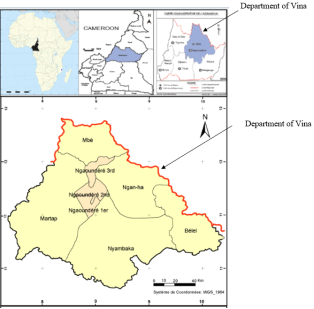
The Vina Division is located between longitudes 12.82° and 14.76° east and between latitudes 6.52° and 7.99° north. It is bounded to the north by the North Region, to the west by the Faro and Deo Division, to the south by the Mbere and Djerem Divisions, and finally to the east by the Mbere Division and part of the North Region (Figure 1). Administratively, the Vina Division is divided into eight districts: the Mbe council in the north, that of Martap in the west, Nyambaka in the south, Belel in the east, Ngan'ha in the northeast, and finally Ngaoundere I, II, and III in the center. Its population is cosmopolitan, with local populations including the Fulbe, Mboum, Mbaya, and Dii populations.
Figure 1. Map of the study area. Map of the study area.
2.2. Data Collection
Data relating to the evaluation of practices were collected using questionnaires. The questionnaire itself was mainly based on the broad recommendations and information provided by the participants, which made it possible to collect as much information as possible from the respondents. Thus, the structure of the files varied with the role of the respondents, in particular farmers, livestock traders, slaughterers-house personnel, and religious dignitaries.
The sheet included questions with open answers, questions with closed answers, and questions with multiple answers, and its structure varied according to the people surveyed. The interview took place in some cases in the local language (generally Foulfoulde), but above all in French or English, depending on the language spoken by the respondent.
2.3. Diagnosis of ‘Halal’ Requirements in the Vina Division (Cameroon)
All surveys were conducted in accordance with the standards specified by the Committee for the Purpose of Control and Supervision and were authorized ethically by the Institutional Committee of the National School of Agro-industrial Sciences. On June 10, 2022, the director signed a letter approving the distribution of the questionnaire. (Letter, additional document).
2.4. Survey of Livestock Farmers and Traders
To collect data from farmers and livestock traders, a semistructured interview survey was carried out in the different study areas. Preliminary survey data helped to identify and select meeting points with the livestock traders, which were mainly livestock markets.
As far as farmers are concerned, the main purpose of the survey was to characterize the cattle farmer’s system in relation to recommendations or Islamic precepts. The form sheet contained the following information:
1) The identification of the farmers
2) The herd structure like the age, sex and the number of breed.
3) Food and health monitoring
4) Usage of bank loan
5) The mode of sale.
To this end, a total of 461 farmers were surveyed in these different markets.
Regarding the traders, the survey form sheet consisted of two main parts:
1) The description of the sociodemographic profile of the respondent
2) The characterization of the respondent's sector of activity in relation to Islamic precepts
This survey was intended to describe the constraints and reasons for selling livestock, including financial, logistical, and even health constraints, based on the inclusion criteria, including owning a herd of cattle and agreeing to participate in this study. As a result, 428 traders were surveyed in the different markets, as mentioned above.
2.5. Survey of Fallers
The methodology used for data collection was that of an interview survey with the different slaughter personnel questioned to verify the application and compliance with the recommendations and precepts of Islam. In addition, the survey sheet was structured around questions relating to the following:
1) The identification of the head of the slaughterer house
2) The characteristics of the slaughter practice (conditions, practices, tools and utensils, etc.)
3) Post-mortem treatments of the carcass
4) The constraints or difficulties associated with said activity
The main purpose of this survey was to make a diagnosis of the different practices during the slaughter of cattle in the Vina Division and to identify related unacceptable practices and Islamic precepts, both on the part of the head of the slaughterhouse and the feller.
To do this, surveys were carried out in the slaughterhouses of each council in the districts of the Vina Division. The slaughterhouses were chosen by convenience (all those who accepted or expressed the wish to participate in the study). The survey was carried out in most of the slaughterhouses in Vina to the best of my knowledge.
2.6. Survey of Religious Leaders
A summer investigation was conducted with the religious dignitaries in the different concils of the Ngaoundere district I, II, and III, and from the district of Nyambaka, from the localities of Galdi (in the district of Nyambaka), Dibi (in the district of Nyambaka), Tello (in the district of Belel), and Likok (in the district of Martap) of the Vina Division, because of the high concentration of religious dignitaries (imam, preachers, religious trainers, etc.) in these main districts of the study area and because these are the main cattle farming and trading areas in the Vina Division.
For this, targeted nonprobability sampling was carried out among all the dignitaries, who were chosen according to their availability to provide reliable information and accessibility. To this end, 127 religious dignitaries (73 imams, 49 preachers or trainers, and 4 chiefs) were surveyed by appointment in their respective mosques, places of residence, or a location of their choice.
To do this, a survey sheet was created that comprised four main parts:
1) Sociodemographic profile of the dignitaries
2) Perception of dignitaries vis-à-vis food products in markets related to the ‘halal’ concept
3) Description of some unacceptable practices during breeding, slaughtering, and meat processing
4) Description of reasons, difficulties, or constraints associated with bad practice during these previous steps
Actually, the purpose of this survey was to find out what the Quran, Sunnah, and Fatwa say is Islamic in accordance with Islamic law, as well as to gather data on the whole process from farms to slaughterhouses. Their opinions on the customs of today were needed, as well as the reference passages from the Quran, the Hadiths (Sunnah), and all the other pertinent literature.
Statistical analyses
The questionnaires were designed, and the data was compiled and processed using Sphinx Plus2-Edition Lexica-V5. Qualitative data were analysed based on their citations frequencies. The chi-square test was used to determine the links between the variables studied.
3. Results and Discussion
3.1. Characteristics of Farming Practices in the Vina Division
3.1.1. Characteristics of Farmers in the Vina Division
The data on the characteristics of the farmers studied are shown in Table 1. These findings show that the majority of farmers in the studied districts (93.7%) possess farming-related expertise. They have been farmers for a duration ranging from 6 to 10 years (29.3%). The majority of these farmers knew about Islamic mandates related to farming (82.9%) and were regularly trained in the practice of livestock techniques (67.3%).
The possession of skills related to livestock by the majority of farmers (93.7%) is explained by the fact that the main activity taught in the study area is livestock. This argument is supported by the study of Muñoz (2014) , who asserted that Adamawa is an area with experienced cattle rearers. The low representativeness of farmers with more than 10 years of practice is explained by the fact that the majority of educated farmers are simple shepherds and not livestock owners. They work on the basis of contracts with the owners of the cattle. The large portion of the population that knows the Islamic mandates is explained by the fact that they are mostly of Fulani ethnicity and have received basic education related to the Quran and Hadiths. The majority of shepherds are trained because of the existence of a zootechnical center in each farming locality in Vina.
Table 1. Characteristics of farmers in the Department of Vina. Characteristics of farmers in the Department of Vina. Characteristics of farmers in the Department of Vina.

Characteristic

Terms

Workforce

Frequencies (%)

Possession of skills

NO

26

6.3

Yes

384

93.7

Duration in pratice

1-5

59

12.8

6-10

135

29.3

11-15

96

20.8

16-20

45

9.8

Over 20

126

27.3

Knowledge of Islamic prescriptions

No

76

17.1

Yes

369

82.9

Are you continuously trained

No

147

32.7

Yes

303

67.3

3.1.2. Livestock Feed Monitoring in the Vina Division
Data from the food monitoring of cattle in the study population are shown in Table 2. From these data, it appears that the majority of cattle rearers in the Vina Division move animals into the wild for food (79%), 13.2% have private fields for fodder, and 7.7% are able to prepare their feed composition. The highest feeding frequency was four times a day (42.3%). With regard to food monitoring, the majority of rearers monitor the feeding of cattle (95.5%).
This variation in feeding mode and feeding frequency in the Vina Division is affected by different means of access to feed by farmers. There are farmers who live in isolated locations, some are distant from watercourses, and others have weeds (Tithonia diversifolia) taking over their bush. The availability of resources dictates the particular food formulations. The challenge for farmers whose feed is invaded by weeds is to ensure rational management of grazing. These comments are in line with those made by Bayemi (2009) , who states that numerous aspects of animal feeding should be improved, including reserve structure, grazing management, and irrigation.
Table 2. Livestock monitoring in the Department of Vina. Livestock monitoring in the Department of Vina. Livestock monitoring in the Department of Vina.

Criteria

Terms

Workforce

Frequencies (%)

Livestock feed monitoring in the Department of Vina.

Travel for food

There are private fields for fodder

60

13.2

Personal/particular composition

35

7.7

I move them and they feed in nature

357

78.9

Feeding frequency per day

Two

80

17.3

Four

195

42.3

Three

178

38.6

Once

8

1.7

Food monitoring

No

20

4.4

Yes

427

95.5

Health monitoring of livestock in the Department of Vina

Animal health monitoring

No

14

3.1

Yes

435

96.8

Vaccinated

No

9

2

Yes

442

98

Listing criteria

Annuity business

329

73.6

Age

95

21.2

Illness

23

5.1

3.1.3. Major Ingredients Used in the Formulation of Livestock Feed in the Study Area
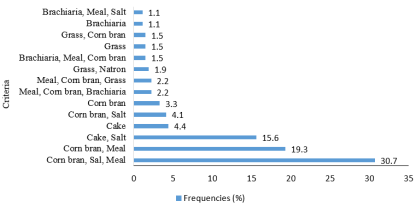
Data on the major ingredients used in the formulation of livestock feed in the Vina Division are shown in Figure 2. These data indicate that the most commonly used ingredients are soybean cake, corn bran, and salt, with some variation by farmers. Thus, 30.7% of farmers use maize bran, salt, and meal as ingredients; 19.3% use maize bran and meal as ingredients; and 15.6% use meal and salt as ingredients.
To further improve the feeding of livestock in the Vina Division, farmers use agricultural byproducts and fodder crops (Brachiaria). The purpose of fodder cultivation is to compensate for lack of pasture during drought. These arguments are in line with the remarks of Bayemi (2009) , who affirmed that grazing management also involves better use of agricultural residues and byproducts. From a halal point of view, all these different ingredients used in the formulation of livestock feeds are halal according to the clerics interviewed for the study.
Figure 2. Major ingredients for the formulation of animal feed in the Department of Vina. Major ingredients for the formulation of animal feed in the Department of Vina.
3.1.4. Status of Livestock Health Monitoring in the Study Area
Data from the health monitoring of livestock in the study area are shown in Table 2. From these results, it can be seen that 96.8% of rearers ensure the health monitoring of livestock and that 98% comply with the cattle vaccination schedules. Results from these data show that the main reason for the sale of livestock is income (73.6%).
A great chunk of farmers have health monitoring facilities and respect the vaccination schedule for livestock due to the presence of a zootechnical and veterinary center in each subdivision, which ensures the control of vaccination schedules and the health monitoring of livestock. In Senegal, farmers pay attention to the vaccination of livestock . The prime motive of sales of livestocks is to generate income which render them viable enough to meet up with social responsibilities.
Table 3. Characteristics of the sector of activity of livestock traders in the Department of Vina (n=428). Characteristics of the sector of activity of livestock traders in the Department of Vina (n=428). Characteristics of the sector of activity of livestock traders in the Department of Vina (n=428).

Characteristic

Terms

Workforce

Frequencies(%)

Payment of Zakat

No

32

7.4

Yes

396

92.5

Activity area

Informal

327

76.4

Formal

101

23.6

Possession of a bank account

No

102

22.9

Yes

330

77.1

Type of account

Islamic

105

31.7

Non-Islamic

225

68.2

Bank loans

No

336

78.5

Yes

92

21.5

Transaction mechanism

Other

11

2.5

Species

355

82.9

Payment

62

14.4

3.2. Characteristics of Livestock Trade Practices
3.2.1. Characteristics of the Sector of Activity of Livestock Traders
Data on the characteristics of the sector of activity of livestock traders are shown in Table 3. A large fraction of these falls under the informal sector (76.4%). The table shows that the vast majority of the study population pay their Zakat (92.5%). In fact, every adult, sane Muslim who has wealth above a particular threshold (known as the Nisab) is required to pay 2.5% of that wealth. In addition, more than half of traders have a bank account (77.1%). Bank loans are used by the vast majority of cattle traders (78.5%). The majority of these bank accounts (68.2%) are not Islamic; an Islamic account requires the client to neither earn nor pay interest. The majority of payment (82.9%) are cash-based.
A great fraction of participants working in the informal sector is explained by the low level of education of the actors. The majority of individuals have a primary-level education. For the individuals who pay their Zakat, their strong representation is due to the fact that the majority of livestock traders are practicing Muslims, having received at least a Quoranic education. God says in the Quoran, "Observe prayer, perform the prescribed alms" (67:20). According to Abu Bkr Djaber (2012), the purpose of these alms is to purify the human soul from avarice, greed, and covetousness; help the poor; provide for the needy and deprived; establish works of public utility; and limit the accumulation of fortunes among the rich, whether merchants or craftsmen, so that they are not only in the hands of a specific group of society. Furthermore, the small minority of traders who do not pay their Zakat in the study area may be because they do not yet own taxable goods. Holding non-Islamic bank accounts leads to usury, which is forbidden. God says in the Quran that he has permitted selling and forbidden usury (2:275). According to Abu Bkr Djaber (2012), it is illegal to barter a species against the same species of its nature in unequal quantities.
3.2.2. Sociodemographic Characteristics of the Population Studied with the Payment of Zakat
The association of the sociodemographic characteristics of the population studied with the payment of ‘Zakat’ shown in Table 4. This table suggests that there is no significant correlation for any of the analysed parameters, namely the district, age group, region of origin, level of education, and seniority. In addition, from this table that regardless of the study district, the number of individuals who pay ‘Zakat’ is greater than the number of individuals who do not pay. Therefore, the majority of people pay their ‘Zakat’. However, there is a greater majority among individuals aged 44-56 (95.9%). In addition, the number of individuals who pay ‘Zakat’ increases with age. Regarding the regions of origin, the payment of ‘Zakat’ does not differ significantly according to the region of origin of the individuals. Whatever their origins, the majority of the study population pays their ‘Zakat’ at a rate of more than 91%. Regarding the level of education and the duration in practice, the majority of individuals who have received a Quoranic, primary, secondary, and university education pay more than 87% of their ‘Zakat’, unlike 80% of those who have received no education.
These results show that educated individuals are more likely to obey the Islamic precepts. This is in line with the recommendations of religious dignitaries in the Vina which recommends knowledge of Islam to all actors in the chain. Moreover, the seniority of individuals also influences the payment of ‘Zakat’. At more than 5 years of seniority, more than 92% of individuals pay their ‘Zakats’. This show that it is necessary to participate at least five years in the study area to acquire the goods for which the payment of ‘Zakat’ is needed. The payment of ‘Zakat’, which does not differ according to the region of origin of the individuals studied, is explained by the fact that Islamic law is independent of the region.
Table 4. Association of the socio-demographic characteristics studied with the payment of Zakat. Association of the socio-demographic characteristics studied with the payment of Zakat. Association of the socio-demographic characteristics studied with the payment of Zakat.

Characteristic

Terms

Payment of Zakat

Chi-2

P-value

No

Yes

Boroughs

DDL=6

Belel/Tello

4(4.9)

78(95.1)

15.169

0.019 0.044*

Martap/Likok

5(11.6)

38(88.4)

Ngaoundere I

3(33.3)

6(66.7)

Ngaoundere II

3(3.7)

79(96.3)

Ngaoundere III

0(0.0)

23(100.0)

Nyambaka

12(8.3)

132(91.7)

Age range

DDL=5

[20-32[

10(15.9)

53 (84.1)

9.371

0.052

0.081*

[32-44[

12(8.2)

134(91.8)

[44-56[

5(4.1)

118(95.9)

[56-68[

4(5.6)

68(94.4)

[68-80]

1(4.2)

23(95.8)

Region of origin

DDL=2

Adamaoua

29(8.1)

327(91.9)

2.184

0.335

0.383*

Far-North

2(8.0)

23(92.0)

North

1(2.1)

46(97.9)

Instruction

DDL=4

None

4(80.0)

1(20.0)

48.268

< 0.0001

1.000*

Koranic

15(13.0)

100(87.0)

Primary

9(4.7)

182(95.3)

Secondary

4(3.8)

102(96.2)

University

0(0.0)

11(100.0)

Duration in practice

DDL=4

1-5

12(18.8)

52(81.3)

16.467

0.002

0.007*

6-10

8(7.5)

99(92.5)

11-15

7(7.4)

88(92.6)

16-20

1(1.8)

54(98.2)

Over 20

4(3.7)

103(96.3)

*: P-value of Fischer's exact test (a non-parametric test when the sample size is small).
3.2.3. Sociodemographic Characteristics of the Study Population with Bank Loans
Table 5 show data on the association of the sociodemographic characteristics of the study population with bank loans. From this table, regardless of the study district, the age group, the region of origin, the level of education, and the seniority of the individuals, the majority of the population is not involved with a bank, with respective frequencies of 72%, 71%, 56%, 54%, and 72%. The district of Ngaoundere I has the largest recorded number of individuals that are not involved with the bank loans (88.9%), followed by Martap/Liok (83.7%), Ngaoundere III (82.6%), Belel/Tello (80.5%), and Nyambaka (72.2%). These results also show that regardless of the duration of trading, the majority of traders abstain from bank transactions.
This distrust of bank loans may be due to the nonaccessibility of savings and ‘halal’ bank loans. Attitudes toward being restricted from bank credit also increase with the population's age. The older individuals are, the more they are restricted in obtaining to bank loans. These results are explained by the attitude of Muslims, who become increasingly religious with increasing age and are much more interested in all that is permitted by Islam. By virtue of their region of origin, individuals from Adamawa are mostly likely to have a bank account (81.2%), followed by the North (70.2%), and the Far North (56.0%). It has been shown that the Adamawa region has the largest number of religious buildings and preacher-teachers, unlike the other two regions. The study of what is lawful and unlawful in Islam greatly influences the attitudes and behaviors of Muslims regarding what is ‘halal’ and ‘haram’ and hence influences their religious attitudes.
Table 5. Association of socio-demographic characteristics studied with bank loands. Association of socio-demographic characteristics studied with bank loands. Association of socio-demographic characteristics studied with bank loands.

Characteristic

Terms

Bank loan

Chi-2

P-value

No

Yes

Boroughs

DDL=6

Belel/Tello

66(80.5)

16(19.5)

6.0263

0.420

Martap/Likok

36(83.7)

7(16.3)

Ngaoundere I

8(88.9)

1(11.1)

Ngaoundere II

65(79.3)

17(20.7)

Ngaoundere III

19(82.6)

4(17.4)

Nyambaka

104(72.2)

40(27.8)

Age range

DDL=5

[20-32[

45(71.4)

18(28.6)

13.321

0.010

[32-44[

109(74.7)

37(25.3)

[44-56[

94(76.4)

29(23.6)

[56-68[

66(91.7)

6(8.3)

[68-80]

22(91.7)

2(8.3)

Region of origin DDL=2

Adamaoua

289(81.2)

67(18.8)

10.927

0.004

Far North

14(56.0)

11(44.0)

North

33(70.2)

14(29.8)

Instruction

DDL=4

None

5(100.0)

0(0.0)

26.238

< 0.0001

Koranic

104(90.4)

11(9.6)

Primary

152(79.6)

39(20.4)

Secondary

69(65.1)

37(34.9)

University

6(54.5)

5(45.5)

Duration in practice

DDL=4

1-5

47(73.4)

17(26.6)

11.025

0.026

6-10

77(72.0)

30(28.0)

11-15

76(80.0)

19(20.0)

16-20

41(74.5)

14(25.5)

Over 20

95(88.8)

12(11.2)

3.2.4. Origin of the Capital of Livestock Traders
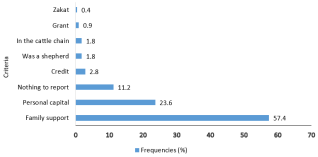
The relative data on the origin of the capital of livestock traders in the study population are shown in Figure 4. From these data, it appears that the main origins of the capitals of livestock traders come mainly from family help (57.2%), personal capital (23.5%), credits (2.8%), livestock chains, being a shepherd (1.8%), subsidy (0.9%), and ‘Zakat’ (0.4%).
Family assistance generally comes from the willingness of one or more people in a family to invest in financing the activities of one or more people in the family. Personal capital can come from some activities, such as agriculture. The loan can be a loan contracted with the bank or with an individual. With regard to those who have been shepherds, the capital results from salary savings, which can be monthly, quarterly, or annually. For traders who have found capital in the livestock chain, their capital generally comes from services provided during purchases, sales, and the transport of animals. As far as the subsidy is concerned, certain cattle exporters to Gabon and Equatorial Guinea subsidize the purchases of cattle from certain individuals on the basis of trust between the two parties.
Figure 4. Representation of the origins of livestock traders’ capital. Representation of the origins of livestock traders’ capital.
3.2.5. Treatment of Livestock During Transport
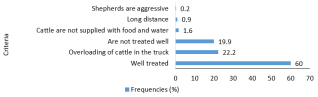
Data on the treatment of livestock during transport are shown in Figure 5. From these data, it appears that 60% of livestock traders treat livestock well, 22.1% overload livestock in trucks, 14% treat cattle badly, 1.6% do not supply cattle with water and food during transport, 0.9% travel long distances, and 0.2% are aggressive toward cattle.
The overloading of the animals in the truck, the lack of water and food for the cattle during transport, the travel over long distances, and the aggressiveness of the shepherds do not contribute to animal well-being, nor do they contribute to the quality of the meat after slaughter. This is due to the lack of adequate means of transport that respect animal welfare. When transporting cattle in trucks, the density of cattle per unit of space, the transport time, the distances to be covered, the physiological state of the animals, and conformity to transport rules are not taken into account. This raises the issue of animal welfare in general.
Figure 5. Representation of the treatment of livestock during transport. Representation of the treatment of livestock during transport.
3.3. Characteristics of Halal Slaughter Practices
3.3.1. Characteristics of the Slaughterhouses
Data on the characteristics of slaughterhouses in the study area are shown in Table 6. There is heterogeneity in the characteristics of slaughterhouses in the Vina Division according to the study districts, with a majority being traditional and artisanal (91.6%). The groups of animals slaughtered in these slaughterhouses are mainly cattle (83.3%) and sheep (16.6%). The employees of these slaughterhouses mostly work in the informal sector (91.6%) for a period of 2 to 4 hours daily service (58.3%). The data shows that 50% of these slaughterhouses slaughter 2 to 8 heads per day, 25% slaughter 10 to 15 heads per day, and 25% kill 50 to 80 heads per day. With regard to the veterinary certificate, only 1/3 are under veterinary supervision and can have a vertinary certificate issued.
Table 6. Characteristics of slaughterhouses in the Department of Vina. Characteristics of slaughterhouses in the Department of Vina. Characteristics of slaughterhouses in the Department of Vina.

Characteristic

Terms

Frequencies (%)

Types of slaughterhouses

Modern/industrial

8.3

Traditional

91.6

Group of animals

Cattle

83.3

Cattle/Sheep

16.6

Are employees regularly trained

No

75.0

Yes

25.0

Statut of employees

Formal

8.3

Informal

91.6

Number of working hours

[2-4]

58.3

[5-6]

41.6

Veterinary certificate

No

66.6

Yes

33.3

The number of animals slaughtered per day

[2-8]

50.0

[10-15]

25.0

[50-80]

25.0

The majority of slaughterhouses in the study area are traditional slaughterhouses except for the industrial slaughterhouse of Ngaounere I, which is modern and formalized and has a trained and skilled workforce.
3.3.2. Characteristics of Slaughter Practices
The determinants of the characteristics of slaughtering practices are shown in Table 7. These results illustrate a predominance of the manual slaughter process (91.6%), a clear homogeneity of these manual processes in the study districts, and a very low percentage of mechanical slaughterhouses (8.3%). According to these data, the individual slaughtering the cattle are all of the Muslim faith (100%), the spacing time between two slaughters is usually 5 min (45.4%), and 10 and 15 min for a small minority (9%). The majority of the slaughterhouses slaughter one animal before the next (91.6%). With regard to the marking of carcasses, a majority of personnel use badges (90.9%), and a small minority practice vigilance (9.0%). Meat stam were also used to stamp carcasses by 66.6% of the slaughterhouses surveyed. In regards to ‘halal’ certification, only 8.3% of these slaughterhouses have, while 91.6% do not.
The variations in the spacing time between slaughterings can be explained by the physiological state of the cattle, the nature of which differs from the breed slaughtered, namely, the Goudalis, the Akous, the M'bororos, etc. The principle of not slaughtering one cattle in the presnce of the next is respected only by a single slaughterhouse in the Vina Division, namely, the modern industrial slaughterhouse of Ngaoundere. This is because this slaughterhouse has a slaughter box that isolates the animal to be slaughtered from other animals. Regarding the inks to be used, the majority of slaughterhouses use the inks provided only by authorities to stamp the carcasses. These inks are food-grade in nature and have no impact on health. The use of signs to identify carcasses at the level of the artisanal slaughterhouses aims to avoid confusing the carcasses during transport and unloading at the level of the butchers. The signs used are generally the initial letter of the name of the owner of the carcass. This is due to the lack of a carcass packaging and labeling system. Only the industrial abattoir is authorised to grant ‘halal’ certification due to its adherence to ‘halal’ guidelines at every stage of the slaughter process.
Table 7. Characteristics of slaughter practices in the Department of Vina. Characteristics of slaughter practices in the Department of Vina. Characteristics of slaughter practices in the Department of Vina.

Characteristic

Terms

Workforce

Frequencies (%)

Slaughter process

Manual

11

91.6

Mechanical

1

8.3

Priests

Muslims

20

100

Others

0

0

Spacing time between felling (minutes)

5

5

45.4

10

1

9

15

1

9

Nothing to report

4

36.3

Slaughter of one animal in front of the next

Yes

11

91.6

No

1

8.3

After slaughter is the carcass kept for maturation

Yes

1

8.3

No

11

91.6

Washing

With borehole water

2

18.1

With tap water

4

36.3

With lake water

5

45.4

Carcass marking

With the badges

10

90.9

Aut of vigilance

1

9

Ink

Yes

8

66.6

No

4

33.3

Do you have halal certification

No

11

91.6

Yes

1

8.3

3.3.3. Checklist for ‘Halal’ Certification (HCCP)
Table 8 shows the ‘halal’ critical control points (HCCP). The animals in all the researched areas that are slaughtered in compliance with ‘halal’ standards are those that are slaughtered in ‘halal’ slaughterhouses, according to the checklist for halal certification from this table. Certain slaughterhouses also have ‘halal’ animals (83.3% of the slaughterhouses of the Vina Division), as do other cattle and sheep slaughterhouses (16.6% of the slaughterhouses). With regard to animal protection at the level of farming, some shortcomings are;
-the animals do not eat and drink at will,
-the accommodations are not uniform,
-there is a lack of accommodation hygiene,
-the monitoring of animal health is not sufficient,
-the vaccination schedule for livestock is not always up to date,
-and some shepherds are aggressive.
For the slaughter process;
-slaughter is performed without stunning the cattle. The imams are Muslims of sufficient age and skill who are in possession of their mental faculties. Bleeding is performed with a sharp blade (stainless steel in some slaughterhouses). The blood is shed in the name of Allah.
For the slaughter process, the cattle are laid on their left side in the slaughterhouses and standing in a slaughter box immobilized for the modern industrial slaughterhouse of Ngaoundere.
Bleeding is performed in the direction of the ‘ka'’ba’. The sacrificer bleeds the animal by invoking the names of God: "Bismillah" and "Allahu Akbar." For God says, "Touch not the meats on which the name of God has not been pronounced; that would defy the Lord” (6:121).” The Prophet (May peace and salvation be upon him) said: Eat what you slaughter by invoking the name of God (5:3). Bleeding is induced by cutting the throat, esophagus, trachea, carotids and jugulars.
Table 8. Checkpoint for halal certification (HCCP). Checkpoint for halal certification (HCCP). Checkpoint for halal certification (HCCP).

Checkpoint

Municipalities of the department of Vina

Ngaoundere I

Ngaoundere II

Ngaoundere II (Djalingo)

Ngaoundere III (Manwi)

Ngaoundere III (Dang)

Ngaoundere III (Tchabal)

Nyambaka

Nyambaka (Dibi)

Nyambaka (Galdi)

Belel (Tello)

Martap (Likok)

Species

Pet allowed

Yes

No

Yes

No

Yes

No

Yes

No

Yes

No

Yes

No

Yes

No

Yes

No

Yes

No

Yes

No

Yes

No

×

×

×

×

×

×

×

×

×

×

×

Breeding

Animal protection

Yes

No

Yes

No

Yes

No

Yes

No

Yes

No

Yes

No

Yes

No

Yes

No

Yes

No

Yes

No

Yes

No

×

×

×

×

×

×

×

×

×

×

×

Slaughter process

Stunning

Yes

No

Yes

No

Yes

No

Yes

No

Yes

No

Yes

No

Yes

No

Yes

No

Yes

No

Yes

No

Yes

No

×

×

×

×

×

×

×

×

×

×

×

Blade

C

I

C

I

C

I

C

I

C

I

C

I

C

I

C

I

C

I

C

I

C

I

×

×

×

×

×

×

×

×

×

×

×

Priest

C

I

C

I

C

I

C

I

C

I

C

I

C

I

C

I

C

I

C

I

C

I

×

×

×

×

×

×

×

×

×

×

×

Bleeding method

C

I

C

I

C

I

C

I

C

I

C

I

C

I

C

I

C

I

C

I

C

I

×

×

×

×

×

×

×

×

×

×

×

Invocation of God

Yes

No

Yes

No

Yes

No

Yes

No

Yes

No

Yes

No

Yes

No

Yes

No

Yes

No

Yes

No

Yes

No

×

×

×

×

×

×

×

×

×

×

×

3.3.4. Postharvest Waste Management in the Vina Division
After slaughter, the vast majority of slaughterhouses in the Vina dispose of their waste in nature (80%), as shown in Figure 6. Some of these slaughterhouses store this waste for sale (20%).
‘Halal’ practices take into account the hygienic quality of the site and waste management (blood, hair, hooves, feces, etc.). With the exception of the Ngaoundere I industrial slaughterhouse, which has a system for cleaning and disinfection of the site, waste treatment, and disposal of waste water obtained after slaughter, all the other sites discharge waste water and waste into nature and have no site cleaning and disinfection system. For this reason, the Vina Division has just one slaughterhouse—the contemporary, industrial Ngaoundere I that is certified to kill cattle in accordance with ‘halal’ law. It is therefore worth pondering the causes and challenges faced on a daily basis for the start of a potential method towards certification.
In general, the reasons mentioned are closely related to those mentioned previously by the dignitaries and are mainly based on three points: administrative (through subsidies), technical (acquisition and disposal of adequate ‘halal’ slaughter devices and equipment with quality and commonly recycled materials), and finally religious (mastered Islamic precepts in terms of halal slaughter) rules.
3.4. Characterization of the Beef Sector by Dignitaries from the Vina
3.4.1. Level of Satisfaction with the Religious Concepts of Dignitaries
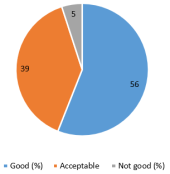
To obtain an idea of the level of acceptability of halal quality in the Vina division, the dignitaries were asked about the different stages of the cattle chain. In general, opinions were not shared by the dignitaries, with a majority having a good appreciation of the ‘halal’ quality of farming, marketing, and slaughtering practices (56%). On the other hand, 39% of dignitaries said the process was fairly good, and a small minority (5%) said the process was not at all good, as shown in Figure 6.
In view of the various issues arising (hygiene, health, religion, culture, and economics), such percentages (39% ) should be taken into consideration while looking for the various flaws during the major stages of the transformation of meat in the Vina division.
Figure 6. Level of satisfaction with dignitaries' religious concepts. Level of satisfaction with dignitaries' religious concepts.
3.4.2. Major stages of Nonconformities in the Bovine chain, According to Dignitaries
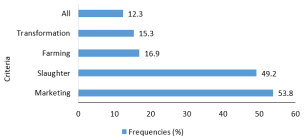
To obtain an idea of the practices that are not at all appreciated, the dignitaries were confronted with the different stages of the chain, as shown in Figure 7. It shows that all the stages that are integral parts of the chain of the meat sector present a problem relating to Islamic recommendations and precepts, with a majority expressing concern for the marketing stage (54%), followed by the slaughtering (49%) and farming (17%) stages.
Figure 7. Breakdown of major stages of non-compliance in the beef chain, according to dignitaries. Breakdown of major stages of non-compliance in the beef chain, according to dignitaries.
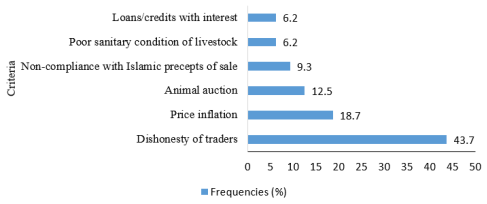
3.4.3. Nonconformities Related to Marketing, in the Bovine Processing Chain Relevant to the Halal Standard in the Study Area
The livestock marketing stage is an important stage in beef processing. The stakeholders are farmers, livestock traders, marketers, and buyers. The nonconformities related to the ‘halal’ standard at this stage are shown in Figure 8. This mainly concerns the problem of dishonesty by traders toward shepherds and butchers or external buyers (43.7%), followed by the inflation of cattle prices (18.8%), the auctioning of cattle (12.5%), noncompliance with Islamic precepts of sale (12.5%), the problems of poor sanitary conditions of livestock (6.3%), and loans or credits with interest (6.3%).
This dishonesty of traders was also observed by Duverge (2006) , where livestock trade professionals have vague roles and confuse the shepherd and the buyer in the region of Tambacounda in Senegal. Monopolization of information by merchants makes buyers vulnerable. Indeed, the positions of intermediaries and their dominance of the markets make other buyers even more vulnerable, as they are forced to go through them and have no control over the course of trade . According to the Prophet Muhammad (May peace and salvation be upon him), it is forbidden for the city dweller to mediate to sell the goods of the Bedouin (Bukhari and Muslim). The Bedouin arrives in town to stock up cloth and like and to sell goods he produces in the countryside, such as wool and grain. The city dweller intervenes as an intermediary and does the brokerage for the Bedouin. The Prophet (May peace and salvation be upon him) forbade this brokerage (Abou Bkr Jaber, 2012). Moreover, the nonvisibility of prices on the markets by external players gives traders a monopoly of control . In the Vina Division, it is mainly the ‘Takaïnas’ who ensure this monopoly and sell the cattle at a price that suits them. According to Abou Bkr Djaber (2012), the Muslim does not have the right to offer a price for a commodity that he does not intend to acquire but only to stimulate inflation and deceive the buyer. This practice is forbidden by Islam because, according to the Hadith reported by Bukhari, the Prophet (May peace and salvation be upon him) said: "Do not outbid each other." By fulfilling the illicit agreements, Imam Ahmat affirms: "The Muslims are on their agreement except for the agreement that prohibits what is halal or makes lawful what is illicit." The sale of sick cattle is due to a lack of control points, which makes it difficult to assess flows [9, 10]. According to Ahmat and Ibn Maja, the Prophet (May peace and salvation be upon him) said: It is forbidden for a Muslim to sell defective goods to his brother without notifying him of the defect. Compared to loans or credits with interest, this attitude was also observed in the work of Ancey (2016), who underlined the role of credit in the livestock chain: due to the lack of liquidity of traders, credit transactions and their multiplication effects contribute to increasing the price of animals traded, creating tensions between the different actors. From the Islamic point of view, usury is forbidden by God, who says: "God has permitted the sale and forbids usury" (2:276). Usury is added to certain kinds of definite goods. Usury is encountered either in the unequal exchange of a few species of food or metals or in the loaning with interest (Abou Bkr Djaber 2012).
Figure 8. Breakdown of non-conformities related to marketing in the bovine processing chain in relation to the halal standard in the Department of Vina. Breakdown of non-conformities related to marketing in the bovine processing chain in relation to the halal standard in the Department of Vina.
3.4.4. Nonconformities Related to Slaughter in the Bovine Processing Chain in Relation to the Halal Standard
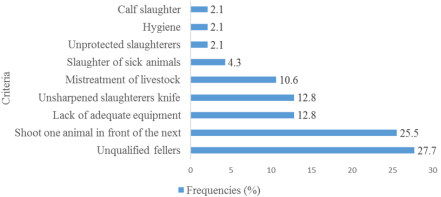
The various nonconformities encountered during the slaughtering stages were identified and are shown in Figure 9. The problems are mainly at the level of the slaughterers personnel who are not qualified (27.7%), followed by the fact that the cattle were slaughtered in the presence of other cattle (25.5%), the lack of adequate equipment (12.8%), the fact that the slaughterers' knives are not very sharp (12.8%), the animal abuse and slaughter of sick animals (4.3%), and the slaughterers who are not protected in the event of poor slaughter, hygiene, and slaughter wishes (2.1%).
According to Islamic requirements, the priest be skilled in performing slaughter (Abou Bkr Djaber 2012). With the exception of the modern industrial slaughterhouse of Ngaoundere I, the slaughterhouses surveyed in Vina do not have adequate working equipment. The tools used are increasingly rudimentary. They include, for example, the artisanal axe, cans of waste oil transformed into buckets to draw water, stones to sharpen the knives of the slaughterers, and unsuitable transport vehicles (tricycles).
According to the words of Abou Bkr Djaber (2012), one of the slaughter requirements is that the tool be sharp and capable of causing a flow of blood. The Prophet (May peace and salvation be upon him) said: "Eat what you cut the throat with a tool that makes blood flow by invoking the name of God." (6:145): Avoid what is killed with a bone or fingernails. Regarding what constitutes mistreatment, it is the aggressiveness of the operators. In Islam, mercy extends to all creatures, including animals. Thus, animals should be treated with benevolence, considering them to be equivalent to human beings. According to the sura (6:38), God says: "No beast walks on the earth; no bird flies with its wings," which is not like you in the community. Therefore, the upright man spared them the heavy burdens that made their lives exceedingly burdensome. Sick animals are animals that should not be eaten or used because of their ‘illnesses’. According to Sheikh Muhammad ibn al-Uthaymeen (d.131 AH), this animal has the same status as an animal forbidden for consumption. It is therefore permissible to destroy it, either by cutting its throat or by shooting it gently, in accordance with the words of the Prophet (May peace and salvation be upon him), who said: "When you kill, do good." When you cut the throat, do it well; sharpen the blade so that the victim quickly rests. Slaughterers who are not protected in the event of an improper slaughter operation will not be able to report a haram carcass because the latter risks taking responsibility. Regarding hygiene, the Prophet (May peace and salvation be upon him) says: "Purification is half of faith."
Figure 9. Breakdown of non-conformities linked to slaughter in the bovine processing chain in relation to the halal standard in the Department of Vina. Breakdown of non-conformities linked to slaughter in the bovine processing chain in relation to the halal standard in the Department of Vina.
3.4.5. Noncompliance related to farming in the bovine processing chain in relation to the halal standard
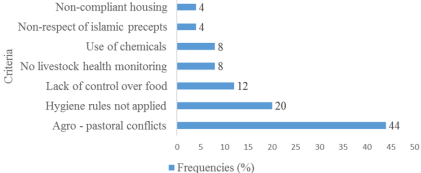
As far as livestock is concerned, the nonconformities mainly come from the fact that some farmers let their livestock devastate the fields of farmers whose sites they share, particularly in the dry season. This generates agro-passerine conflicts (44%). Other nonconformities include the absence of hygiene measures for livestock and habitats (20%) and the lack of control over food (12%), as shown in Figure 10.
The findings of this study demonstrate a congruence with the results of the FAO study conducted in 2003 in Adamawa, within the region of Tambacounda in Senegal. This is evidenced by the presence of problems between crop farmers and cattle farmers, as well as contamination between herds, which are attributable to the deviation of animals in the fields. This is evidenced by the condition of livestock and habitat, which are poorly maintained. The absence of habitat hygiene measures contributes to the soiling of cattle.
The poor feeding of livestock is because breeders lack knowledge on the formulation of feed for livestock. According to Seignobos (1991) , it is necessary to know the botanical composition of a pasture in some detail to better control food formulation.
Figure 10. Breakdown of non-conformities related to farming in the bovine processing chain in relation to the halal standard in Department of Vina. Breakdown of non-conformities related to farming in the bovine processing chain in relation to the halal standard in Department of Vina.
3.5. Constraints Related to Poor Farming, Marketing, and Slaughtering Practices
3.5.1. Constraints Related to Poor Livestock Practices
Constraints associated with actors' poor husbandry practices are shown in Table 9. From this table, it appears that the main constraint at the level of breeding is due to a lack of water (40.9%), followed by the inflation of feed prices for livestock (27.2%), the lack of veterinary monitoring (13.6%), and the problem of logistics (9.0%).
The lack of water is due to the remoteness of watercourses from pastures and the high price of access to the watercourses in the dry season. Food price inflation is due to increased demand, especially in the dry season. The lack of health monitoring is caused by the nonavailability of veterinarians, who increasingly reside in the city center. The logistical problem is due to the absence of roads and means of transport to transport the cattle to the places of sale and the slaughterhouses. According to Mfewou (2016) , the movement of animals is increasingly difficult, which takes little account of traditional pasture areas and cattle tracks. The animals are malnourished due to a lack of biomass and the invasion of the bush by weeds (Tithonia diversifolia and Mimosa invisa). Mfewou (2016) have shown that the factors that cause undernourishment in the north are the lack of fodder in the overburdened and degraded areas but also, followed by the destruction of biomass by bush fires, the lack of water, which is manifested by the difficulties of accessing water points, and unbalanced diets (absence of proteins).
Table 9. Constraints related to bad farming, marketing, and slaughtering practices in the Department of Vina. Constraints related to bad farming, marketing, and slaughtering practices in the Department of Vina. Constraints related to bad farming, marketing, and slaughtering practices in the Department of Vina.

Constraints related to bad farming practices

Frequencies (%)

Lack of water

40.9

Feed price inflation

27.2

Lack of veterinary follow-up

18.1

Logistics

9.

Malnourished animals

4.5

Constraints related to poor livestock trade practices

Lack of halal credit

21.7

Rising animal prices

17.3

Sale of sick animals

17.3

Non-compliance with islamic precepts of sale

17.3

Dishonesty of traders

17.3

Informal sector

8.7

Constraints associated with poor slaughtering practices

Lack of trained/qualified fellers

47.6

Lack of adequate materials

19

Lack of slaughterhouse

14.2

Animal aggression

9.5

Failure to monitor slaughteres/process

4.7

Animal health surveillance

4.7

3.5.2. Constraints Related to Poor Livestock Trade Practices
In the marketing of livestock, the main constraints of the halal process are the absence of halal bank loans (21.7%), followed by the rise in the price of animals (17.3%), the sale of sick animals (17.3%), noncompliance with Islamic perceptions of sale (17.3%), dishonesty of traders, and the fact that the sector is informal (17.3%), as shown in Table 9.
The absence of halal credit forces actors in bad faith to turn to bank loans with interest. According to Bkr. Djaber (2012), Muslims are prohibited from using bank credit with interest, except in cases of extreme necessity, such as transferring money from one country to another. Accordingly, it is the duty of Muslims to have a purely Islamic bank, free from all kinds of usury and related operations. To keep deposits free of charge, to grant loans without interest in proportion to income or wealth, to participate in the fields of agriculture, commerce, construction, and industry and to take part in any profitable activity, it must transfer free funds from one country to another where it would have a branch, draw up its balance sheet at the beginning of each year, and distribute the profits in proportion to the shares (Bkr Jaber; 2012). The rise in livestock prices is due to the large number of intermediaries involved in livestock markets . This is what makes the cattle owner more vulnerable. The sale of sick animals is due to the lack of inspections and controls on animals entering the various livestock markets . The lack of respect for Islamic principles is due to a lack of knowledge about Islam and the bad faith of the actors. The dishonesty of traders is manifested by fraud in administering drugs to cattle and the concealment of defects in cattle when selling. The sector is informal because the majority of livestock traders are not registered at the level of the ministerial service in charge of trade and livestock .
3.5.3. Constraints Associated with Bad Practices at the Level of Slaughter in the Vina Division, According to ‘Halal’ Percepts
Constraints associated with poor practices by actors at the slaughter level are shown in Table 9. From this table, it appears that the main constraint in terms of slaughtering for the outcome of halal meat is the lack of qualified slaughter personnel (47.6%), followed by a lack of equipment (19.0%), a lack of a slaughterhouse (14.2%), animal aggressiveness (9.5%), and the end of non-monitoring of slaughterers and processes, monitoring animal health (4.7%).
The lack of qualified slaughterers is due to the absence of a training unit for slaughterers. The lack of adequate equipment is due to a lack of funding and subsidies to equip slaughterhouses with compliant work tools. The lack of slaughterhouses is explained by the fact that in the entire Vina Division, as well as the entire Adamawa region, there is only one industrial slaughterhouse. The aggressiveness of the animal is because the infrastructure of the slaughter chain is not compartmentalized. Staff are not trained in good animal behavior practices. The non-monitoring of slaughterers and processes is due to the absence of supervisors to verify the slaughtering processes. Sanitary surveillance of animals is not respected due to the absence of an ante-mortem inspection of cattle. This is what causes sick animals to end up on the slaughter line.
3.6. Solutions to the Problems Encountered in the Beef Sector in Relation to the ‘Halal’ Standard
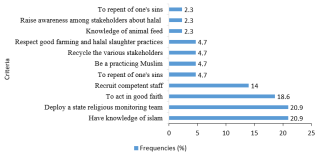
The improvement proposals according to the dignitaries' opinions are presented in Figure 11. According to the dignitaries, the main improvement proposals involve increasing knowledge of Islam (20.9%) of the actors in the sector, the deployment of a religious/state monitoring team (20.9%), acting in good faith (18.6%), and the recruitment of qualified personnel (14.0%).
Islam calls for the study of all useful scientific disciplines. According to the Qur'an (35:28), among his servants, only the learned fear Allah. However, Islam urges us to increase our knowledge. The Prophet (May peace and salvation be upon him) made it an individual obligation. Faith is the basis of a Muslim's belief. According to the Prophet (May peace and salvation be upon him), the most complete believer in faith is the best in behavior.
Figure 11. Breakdown of improvement proposals according to religious dignitaries in the Department of Vina. Breakdown of improvement proposals according to religious dignitaries in the Department of Vina.
4. Conclusions
The main constraints to achieving ‘halal’ meat are due to the lack of qualified slaughter personnel and slaughterhouses. The lack of training and adequate equipment hampers the application of good halal farming and slaughtering practices. The non-conformities were mainly agropasserine conflicts (44%) and the absence of hygiene measures for livestock and habitats (20%) with regard to raising cattle in the Vina Division.
Abbreviations

HCCP

Halal Critical Control Point

Author Contributions
Mohamadou Awal: Conceptualisation, Methodology, Visualization, Writing – review & editing
Mohamadou Bello: Formal Analysis, Investigation, Methodology, Resources, Visualization, Writing – original draft
Panyo’o Akdowa Emmanuel: Formal Analysis, Methodology, Visualization, writing.
Djakaou Iya-sou: Formal Analysis, Methodology, Visualization
Edima Helene Carole: Methodology, Project administration, Supervision, Writing – review & editing
Data Availability Statement
The data supporting the outcome of this research work has been reported in this manuscript.
Conflicts of Interest
The authors declare no conflicts of interest.
References
[1] Lugo L., A. Cooperman, E. O’Connell, S. Stencel, (2011). The future of the global Muslim population, Pew Research Center, USA.
[2] Regenstein J. M., M. M. Chaudry, C. E. Regenstein, (2003). The kosher and halal food laws, Comprehensive Reviews in Food Science and Food Safety 2 111-127.
[3] Bohari A. M., W. H. Cheng, N. Fuad, (2013). An analysis on the competitiveness of halal food industry in Malaysia: an approach of SWOT and ICT strategy, Malaysia Journal of Society and Space 9 1–11.
[4] Farouk M. M., H. M. Al-Mazeedi, A. B. Sabow, A. E. D. Bekhit, K. D. Adeyemi, A. Q. Sazili, A. Ghani, (2014). Halal and kosher slaughter methods and meat quality: A review, Meat Science 98 505–519.
[5] Nakyinsige K., Y. Che Man, A. Sazili, I. Zulkifli, A. Fatimah (2012), Halal meat: A niche product in the food market, 2nd International Conference on Economics, Trade and Development IPEDR vol.36 (2012) © (2012) IACSIT Press, Singapore.
[6] Muñoz J.-M., (2014) A Breeding ground for revenue reliability? Cameroonian veterinary agents and tax officials in the face of reform, in: States at Work, Brill,: pp. 301–328.
[7] Bayemi P., E. Webb, (2009). An integrated method for improving the dairy production sector in developing countries: the case of Cameroon, Tropical Animal Health and Production 41 525–534.
[8] Chan D., P. Houessionon, F. Sow, L. Perin, A. Krendelsberger, I. Seck, A. Wane, A. M. Whitbread, N. Worou, (2022). Beef and dairy value chains in Senegal: Problems and Opportunities.
[9] Duverge A. (2006). What is the future of Senegal's beef industry? A study of a long supply chain from Tambacounda to Dakar. Cergy-Pointoise: Istom. 105 p.
[10] Kamisah, S., Mokhtar, A. and Hafsah, A. (2018). Halal practices integrity and halal supply chain trust in Malaysian halal food supply chain. International Food Research Journal 25(Suppl. 1): S57-S62.
[11] Seignobos C. (1991). Livestock production and Sahelian rangelands potential. Cartographic synthesis. North-Cameroon. CIRAD-IEMVT. Wageningen: CTA-CIRAD-IEMVT, 13-14.
[12] Abdoulaye M., P. Youchahou, B. Jean (2016). Dynamics and obstacles to the development of the Ticket-Foumban livestock market in Western Cameroon. Canadian Journal of Tropical Geography.
[13] Mafimisebi T. E., Bobola O. M. & Mafimisebi, O. E. (2013). Fundamentals of cattle marketing in southwest, Nigeria: Analyzing market intermediaries, price formation and yield performance. AgEcon Search.
[14] Alexander K., Takesure T., Golam S., Ashley F. R. K., Marie M., Dianne E. M., Jonathan R., Dustin L. P., and Thomas L. M. (2023). Livestock health and disease economics: a scoping review of selected literature. Frontiers in Veterinary Science.
[15] Majiwa H., Bukachi S A., Omia D and Fèvre E. M. (2024). Knowledge, perceptions, and practices around zoonotic diseases among actors in the livestock trade in the Lake Victoria crescent ecosystem in East Africa. Frontiers in Public Health 11: 1199664.
Cite This Article
  • APA Style

    Awal, M., Bello, M., Emmanuel, P. A., Iya-sou, D., Carole, E. H. (2026). Evaluation of Good Cattle Farming and Slaughtering Practices According to the "Halal" Standard in the Vina Division (Cameroon). International Journal of Food Science and Biotechnology, 11(1), 29-46. https://doi.org/10.11648/j.ijfsb.20261101.14

    Copy | Download

    ACS Style

    Awal, M.; Bello, M.; Emmanuel, P. A.; Iya-sou, D.; Carole, E. H. Evaluation of Good Cattle Farming and Slaughtering Practices According to the "Halal" Standard in the Vina Division (Cameroon). Int. J. Food Sci. Biotechnol. 2026, 11(1), 29-46. doi: 10.11648/j.ijfsb.20261101.14

    Copy | Download

    AMA Style

    Awal M, Bello M, Emmanuel PA, Iya-sou D, Carole EH. Evaluation of Good Cattle Farming and Slaughtering Practices According to the "Halal" Standard in the Vina Division (Cameroon). Int J Food Sci Biotechnol. 2026;11(1):29-46. doi: 10.11648/j.ijfsb.20261101.14

    Copy | Download

  • @article{10.11648/j.ijfsb.20261101.14,
      author = {Mohamadou Awal and Mohamadou Bello and Panyoo Akdowa Emmanuel and Djakaou Iya-sou and Edima Helene Carole},
      title = {Evaluation of Good Cattle Farming and Slaughtering Practices According to the "Halal" Standard in the Vina Division (Cameroon)},
      journal = {International Journal of Food Science and Biotechnology},
      volume = {11},
      number = {1},
      pages = {29-46},
      doi = {10.11648/j.ijfsb.20261101.14},
      url = {https://doi.org/10.11648/j.ijfsb.20261101.14},
      eprint = {https://article.sciencepublishinggroup.com/pdf/10.11648.j.ijfsb.20261101.14},
      abstract = {The market for halal products is constantly growing. It is estimated to be worth approximately 2.3 million USD. With an estimated annual growth rate of 20%, the sector is expected to be valued at approximately 560 billion USD per year in 2030. The principal objective of this study was to evaluate the constraints associated with the implementation of optimal farming and slaughtering practices in accordance with the halal standard within the Vina Division of Cameroon. The study was conducted in the six largest agro-pastoral district municipalities of Vina. Interviews were conducted with religious leaders, farmers, livestock traders, and personnel involved in the slaughtering process. The results demonstrate that the majority of farmers in the Nyambaka district possess the majority of Islamic knowledge related to farming (82.9%) and are of the Fulani ethnicity (71.7%). The primary constraints to the marketing of livestock are the lack of halal bank loans (21.7%) and the inflation of feed prices for livestock (27.2%). The majority of the slaughtering process is carried out manually (91.6%), and the absence of effective hygiene measures at the livestock level (20%) was observed. At the marketing level, over half of the traders have a non-Islamic bank account (68.2%). The primary constraints to the implementation of 'halal' practices are the lack of qualified slaughterhouse personnel (47.6%) and the limited number of slaughterhouses (14.2%).},
     year = {2026}
    }
    

    Copy | Download

  • TY  - JOUR
    T1  - Evaluation of Good Cattle Farming and Slaughtering Practices According to the "Halal" Standard in the Vina Division (Cameroon)
    AU  - Mohamadou Awal
    AU  - Mohamadou Bello
    AU  - Panyoo Akdowa Emmanuel
    AU  - Djakaou Iya-sou
    AU  - Edima Helene Carole
    Y1  - 2026/01/20
    PY  - 2026
    N1  - https://doi.org/10.11648/j.ijfsb.20261101.14
    DO  - 10.11648/j.ijfsb.20261101.14
    T2  - International Journal of Food Science and Biotechnology
    JF  - International Journal of Food Science and Biotechnology
    JO  - International Journal of Food Science and Biotechnology
    SP  - 29
    EP  - 46
    PB  - Science Publishing Group
    SN  - 2578-9643
    UR  - https://doi.org/10.11648/j.ijfsb.20261101.14
    AB  - The market for halal products is constantly growing. It is estimated to be worth approximately 2.3 million USD. With an estimated annual growth rate of 20%, the sector is expected to be valued at approximately 560 billion USD per year in 2030. The principal objective of this study was to evaluate the constraints associated with the implementation of optimal farming and slaughtering practices in accordance with the halal standard within the Vina Division of Cameroon. The study was conducted in the six largest agro-pastoral district municipalities of Vina. Interviews were conducted with religious leaders, farmers, livestock traders, and personnel involved in the slaughtering process. The results demonstrate that the majority of farmers in the Nyambaka district possess the majority of Islamic knowledge related to farming (82.9%) and are of the Fulani ethnicity (71.7%). The primary constraints to the marketing of livestock are the lack of halal bank loans (21.7%) and the inflation of feed prices for livestock (27.2%). The majority of the slaughtering process is carried out manually (91.6%), and the absence of effective hygiene measures at the livestock level (20%) was observed. At the marketing level, over half of the traders have a non-Islamic bank account (68.2%). The primary constraints to the implementation of 'halal' practices are the lack of qualified slaughterhouse personnel (47.6%) and the limited number of slaughterhouses (14.2%).
    VL  - 11
    IS  - 1
    ER  - 

    Copy | Download

Author Information
  • Department of Food Sciences and Nutrition, University of Ngaoundere, Ngaoundere, Cameroon;Direction de la cooperation des etudes et de la prospective, Standards and Quality Agency (ANOR), Yaounde, Cameroon

    Research Fields: Food microbiology, halal expert, food hygiene.

  • Department of Food Sciences and Nutrition, University of Ngaoundere, Ngaoundere, Cameroon

    Research Fields: Food microbiology.

  • Department of Food Sciences and Nutrition, University of Ngaoundere, Ngaoundere, Cameroon

  • Department of Chemical Engineering, University of Ngaoundere, Ngaoundere, Cameroon

    Research Fields: Food chemistry.

  • Department of Food Sciences and Nutrition, University of Ngaoundere, Ngaoundere, Cameroon;Faculty of Sciences, University of Ebolowa, Ebolowa, Cameroon

    Research Fields: Food microbiology, food hygiene.
  • Abstract
  • Keywords
  • Document Sections

    1. 1. Introduction
    2. 2. Materials and Methods
    3. 3. Results and Discussion
    4. 4. Conclusions
    Show Full Outline
  • Abbreviations
  • Author Contributions
  • Data Availability Statement
  • Conflicts of Interest
  • References
  • Cite This Article
  • Author Information
  • Figure 1

    Figure 1. Map of the study area.

  • Figure 2

    Figure 2. Major ingredients for the formulation of animal feed in the Department of Vina.
  • Figure 4

    Figure 4. Representation of the origins of livestock traders’ capital.
  • Figure 5

    Figure 5. Representation of the treatment of livestock during transport.
  • Figure 6

    Figure 6. Level of satisfaction with dignitaries' religious concepts.
  • Figure 7

    Figure 7. Breakdown of major stages of non-compliance in the beef chain, according to dignitaries.
  • Figure 8

    Figure 8. Breakdown of non-conformities related to marketing in the bovine processing chain in relation to the halal standard in the Department of Vina.
  • Figure 9

    Figure 9. Breakdown of non-conformities linked to slaughter in the bovine processing chain in relation to the halal standard in the Department of Vina.
  • Figure 10

    Figure 10. Breakdown of non-conformities related to farming in the bovine processing chain in relation to the halal standard in Department of Vina.
  • Figure 11

    Figure 11. Breakdown of improvement proposals according to religious dignitaries in the Department of Vina.

  • Table 1

    Table 1. Characteristics of farmers in the Department of Vina. Characteristics of farmers in the Department of Vina.

  • Table 2

    Table 2. Livestock monitoring in the Department of Vina. Livestock monitoring in the Department of Vina.

  • Table 3

    Table 3. Characteristics of the sector of activity of livestock traders in the Department of Vina (n=428). Characteristics of the sector of activity of livestock traders in the Department of Vina (n=428).

  • Table 4

    Table 4. Association of the socio-demographic characteristics studied with the payment of Zakat. Association of the socio-demographic characteristics studied with the payment of Zakat.

  • Table 5

    Table 5. Association of socio-demographic characteristics studied with bank loands. Association of socio-demographic characteristics studied with bank loands.

  • Table 6

    Table 6. Characteristics of slaughterhouses in the Department of Vina. Characteristics of slaughterhouses in the Department of Vina.

  • Table 7

    Table 7. Characteristics of slaughter practices in the Department of Vina. Characteristics of slaughter practices in the Department of Vina.

  • Table 8

    Table 8. Checkpoint for halal certification (HCCP). Checkpoint for halal certification (HCCP).

  • Table 9

    Table 9. Constraints related to bad farming, marketing, and slaughtering practices in the Department of Vina. Constraints related to bad farming, marketing, and slaughtering practices in the Department of Vina.