Abstract
In the current context of growth in road infrastructure and their durability requirements, concrete pavements represent an interesting alternative to bituminous surfacing. They offer better resistance to heavy loads and climatic hazards, while requiring less long-term maintenance. Concrete is generally considered a material with low tensile strength. Consequently, rigid pavements may crack even under relatively low tensile stresses. The ultimate objective of this study is to contribute to the improvement of the mechanical properties of concrete by adding plant fibers (bamboo fibers). Four types of concrete were studied: a control concrete, formulated using the DREUX-GORISSE method, and three concretes reinforced with bamboo fibers, composed using the BARON-LESAGE method. The concretes were reinforced with bamboo fibers at rates of 0.5%, 1% and 1.5% of the total concrete volume. Tests were performed on fresh concrete (Abrams cone slump test and density determination). A decrease in concrete workability was observed regardless of the fiber dosage. A decrease in the density of the various concretes is reported due to the introduction of bamboo fibers. To evaluate the effects of incorporating bamboo fibers in concrete on the mechanical properties of hardened concrete, compressive and splitting tensile strength tests were performed in accordance with standards NF EN 12390-3 and NF EN 12390-6, respectively, at ages of 7, 14 and 28 days. The results indicate that the optimal composite material, with 1% bamboo fibers, shows a gain of 3.47% in compressive strength (at 28 days) and an increase of 27.33% in tensile strength (at 28 days), compared to the control concrete. The incorporation of bamboo fibers into the concrete matrix promotes not only mechanical resistance but also ductility, suggesting a potential for improving the mechanical properties of concrete, thus opening prospects for its application in rigid pavement, subject to validation by additional tests, particularly flexural strength tests.
Keywords
Concrete, Bamboo Fibers, Durability, Mechanical Properties, Rigid Pavements
1. Introduction
Transport infrastructure can be defined as a factor that guarantees a country's economic growth and development, due to its role in facilitating the movement of people and the exchange of goods and services. Inadequate transport infrastructure hinders a country's socio-economic development. The majority of roads built in Benin are paved with bituminous materials, which, while effective in meeting transport needs, face increasing challenges. These infrastructures must contend with factors such as climate change, increased road traffic, and the need to reduce construction and maintenance costs. The need for functional, stable, safe, usable, and durable pavements necessitates the construction of rigid pavement structures. Concrete is considered a material with low tensile strength. Consequently, when even low tensile stresses are applied, rigid pavements begin to crack easily. Repeated loads lead to crack formation. The propagation of these cracks causes progressive internal damage within the structure, ultimately resulting in pavement failure due to fatigue
. One method used to reduce cracking is the incorporation of fibers into the concrete pavement. Synthetic fiber-reinforced concrete structures have been widely adopted and have received considerable attention from researchers due to their excellent tensile and flexural strength performance. Environmental destruction, such as air and water pollution, occurs in some regions due to the rapid development and production of materials like iron, steel, glass, cement, and aluminum, which use limited mineral resources
| [2] | M. Terai and K. Minami, “Basic study on mechanical properties of bamboo fiber reinforced concrete,” Glob. Think. Struct. Eng. Recent Achiev., no. January 2012, 2012. |
[2]
. The use of natural fibers, and in particular plant fibers, as reinforcement in composite materials offers several advantages. First, plant fibers are a "local" resource, often available at a lower cost compared to synthetic or artificial fibers. Second, the use of these plant fibers in composite materials reduces environmental impacts compared to conventional composites because they are renewable, biodegradable raw materials with a neutral carbon footprint and require little energy for their production
| [3] | M. Bourgeois, “Agro-sourced fibers,” vol. 33, no. 0, 2011. |
[3]
. Several studies on the influence of natural fiber applications on the strength properties and structural behavior of concrete have reported that the properties of concrete are improved by the introduction of natural plant fibers and that fiber reinforcement of concrete gives it better resistance to crack propagation and increases its mechanical strength.
In recent years, numerous plant fibers have been studied for their potential to reinforce concrete, including jute fibers
| [4] | N. Dayananda, BS Keerthi Gowda, and GL Easwara Prasad, “A Study on Compressive Strength Attributes of Jute Fiber Reinforced Cement Concrete Composites,” IOP Conf. Ser. Mater. Sci. Eng., vol. 376, no. 1, 2018,
https://doi.org/10.1088/1757-899X/376/1/012069 |
| [5] | S. Tiwari, AK Sahu, and RP Pathak, “Mechanical Properties and Durability Study of Jute Fiber Reinforced Concrete,” IOP Conf. Ser. Mater. Sci. Eng., vol. 961, no. 1, 2020,
https://doi.org/10.1088/1757-899X/961/1/012009 |
| [6] | M. Zakaria, M. Ahmed, MM Hoque, and S. Islam, “Scope of using jute fiber for the reinforcement of concrete material,” Text. Cloth. Sustain., vol. 2, no. 1, 2017,
https://doi.org/10.1186/s40689-016-0022-5 |
[4-6]
, flax fibers
| [7] | M. Douai, “International Francophone Conference NoMaD 2015 Mines Douai DEVELOPMENT OF A PREVENTIVE TREATMENT AGAINST THE”, no. November, pp. 5–6, 2015. |
[7]
, sisal fibers
| [8] | H. Hashemifard, M. Mehranzadeh, and M. Chenari, “Mechanical and physical properties of Sugarloaf,” Adv. Approximately. Biol., vol. 6, no. 1, pp. 368–375, 2012. |
| [9] | RD Tolêdo Filho, K. Joseph, K. Ghavami, and GL England, “the Use of Sisal Fiber As Reinforcement in Cement Based Composites,” Rev. Arm. Eng. Agriculture and Ambient., vol. 3, no. 2, pp. 245–256, 1999,
https://doi.org/10.1590/1807-1929/agriambi.v3n2p245-256 |
[8, 9]
, coconut fibers
| [10] | J. Ahmad et al., “Mechanical and Durability Performance of Coconut Fiber Reinforced Concrete: A State-of-the-Art Review,” Materials (Basel)., vol. 15, no. 10, 2022,
https://doi.org/10.3390/ma15103601 |
| [11] | A. Varghese and S. Unnikrishnan, “Mechanical strength of coconut fiber reinforced concrete,” Mater. Today Proc., pp. 1–6, 2023, https://doi.org/10.1016/j.matpr.2023.05.637 |
[10, 11]
, and bamboo fibers
| [12] | C. Zhang, Z. Huang, and GW Chen, “Experimental research on bamboo fiber reinforced concrete,” Appl. Mech. Mater., vol. 357–360, pp. 1045–1048, 2013,
https://doi.org/10.4028/www.scientific.net/AMM.357-360.1045 |
| [13] | J. Ahmad, Z. Zhou, and AF Deifalla, “Structural properties of concrete reinforced with bamboo fibers: a review,” J. Mater. Res. Technol., vol. 24, pp. 844–865, 2023,
https://doi.org/10.1016/j.jmrt.2023.03.038 |
[12, 13]
. Recent work has confirmed that bamboo fiber dosages between 0.75% and 1% improve the compressive and tensile strength of concrete
| [14] | DM Gelanew, “Mechanical and Microstructural Properties of Bamboo Fiber-Reinforced Concrete Containing a Blend of Waste Marble Powder and Waste Glass Powder,” vol. 2023, 2023, https://doi.org/10.1155/2023/2725801 |
| [15] | F. Althoey, P. O. Awoyera, and K. Inyama, “Strength and microscale properties of bamboo fiber-reinforced concrete modified with natural rubber latex,” no. December, p. 1–14, 2022, https://doi.org/10.3389/fmats.2022.1064885 |
[14, 15]
, and that these fibers positively influence flexural behavior
| [16] | CM Bittner and V. Oettel, “Fiber Reinforced Concrete with Natural Plant Fibers — Investigations on the Application of Bamboo Fibers in Ultra-High Performance Concrete,” 2022. |
[16]
. However, these studies do not specifically target rigid pavement applications in an African context, which constitutes the research gap that the present study seeks to fill.
The fiber that caught our attention is bamboo fiber. Benin is a country rich in plant-based construction materials, including bamboo. According to INRAB (National Institute of Agricultural Research of Benin), the leading African bamboo producers are Ethiopia, Benin, and Burundi. In West Africa, Benin holds the top position in bamboo production, according to the same source. In this study, bamboo fibers were added to prevent the formation and propagation of cracks. The fundamental objective of this study is to evaluate the effect of incorporating bamboo fibers on the mechanical properties of concrete, with a view to its potential application in rigid pavements.
2. Materials Used
2.1. Cement
The cement used in the production of the various concrete mixes in our study is a Portland cement, CEM II/B-LL 42.5R, conforming to standard NF EN 197-1. The cement is manufactured by CIMBENIN SA and consists primarily of clinker with a rate of Limestone (16%) and Gypsum (4%).
The physico-chemical characteristics of the cement are given in
Table 1.
Table 1. Physical characteristics of cement.
Properties | Testing standards | Averages | Limit and standardized values |
Initial setting time | NF EN 196-3 | 209 min | 60 min |
Hot stability | NF EN 196-3 | 0.50 mm | 10 mm |
SO3 content | NF EN 196-2 | 2.29% | 3.50% |
Loss in Fire | NF EN 196-2 | 7.14% | - |
Insoluble residue | NF EN 196-2 | 1.34% | 5.00% |
Chloride content | NF EN 196-21 | 0.01% | 0.10% |
Magnesium content | ASTM | 1.45% | 5% |
2.2. Aggregates
Aggregates are materials of natural, artificial, or recycled origin used in construction. They form the structural framework of concrete. Choosing the right type of aggregate is an important step that requires considering the expected performance.
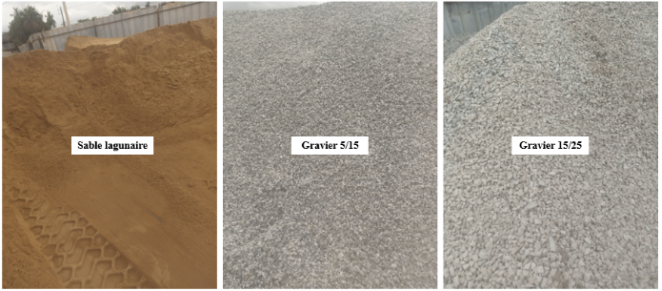
All aggregates (
Figure 1) used in this study comply with standards NF P18-545 and NF EN 12620. Three granular fractions are used in the concrete mix design: 0/4 lagoon sand from the BONOU quarry, and two crushed gravels, 5/15 and 15/25, from the Dan quarry. The physical and mechanical characteristics, as well as the particle size analysis, of the aggregates were determined at the Porteo BTP company laboratory during the SEME-PORTO-NOVO road widening project.
Figure 1. Granular fractions used in the formulation of the concretes studied.
Tables 2, 3 and 4 present the physical and mechanical properties of sand, 5/15 crushed gravel and 15/25 crushed gravel respectively.
Table 2. Physical properties of sand.
Physical properties | Lagoon sand |
Apparent density () | 1.46 |
Actual density () | 2.62 |
Finesse module | 2.39 |
Sand equivalent% | 85 |
Organic matter content | 0.2 |
Table 3. Physical and mechanical properties of crushed gravel 5/15.
Physical and mechanical properties | Crushed 5/15 | Specification (NF P18-545) |
Apparent density () | 1.43 | - |
Actual density () | 2.68 | - |
Flattening coefficient (%) | 7 | ≤20 |
Surface cleanliness of aggregates (%) | 1 | ≤1,5 |
Water absorption (%) | 0.4 | - |
Los Angeles (%) | 20 | ≤35 |
Micro-Deval water | 8 | ≤35 |
Table 4. Physical and mechanical properties of crushed gravel 15/25.
Physical Properties and Mechanics | Crushed 15/25 | Specification (NF P18-545) |
Apparent density () | 1.43 | - |
Actual density () | 2.7 | - |
Flattening coefficient (%) | 7 | ≤20 |
Surface cleanliness of aggregates (%) | 0.8 | ≤1,5 |
Water absorption (%) | 0.5 | - |
2.3. Bamboo Fibers
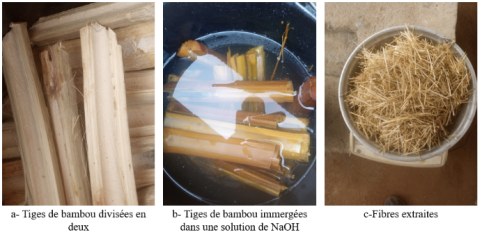
Figure 2. Extraction of bamboo fibers.
The fibers used in this study come from bamboo culms (3-4 years old), harvested in Benin, specifically in Vakon in the commune of Akpro-missérété.
2.4. Chemical Pretreatment of Bamboo Fibers
Before being incorporated into the mixture, the bamboo stems underwent chemical treatment by immersion in a 5% (w/w) sodium hydroxide (NaOH) solution (NaOH mass/total mass of solution ratio, w/w), prepared from distilled water, for 48 hours at room temperature (25°C). At this concentration, the alkaline treatment selectively removes the middle lamella (pectins, waxes, starch) without altering the intrinsic strength of the fibers
| [17] | J. Kaima, I. Preechawuttipong, R. Peyroux, and P. Jongchansitto, “Results in Engineering Experimental investigation of alkaline treatment processes (NaOH, KOH and ash) on tensile strength of the bamboo fiber bundle,” Results Eng., vol. 18, no. July 2022, p. 101186, 2023,
https://doi.org/10.1016/j.rineng.2023.101186 |
[17]
, thus facilitating their extraction. After treatment, the stems were thoroughly rinsed with distilled water to stop the chemical reaction. The fibers were then manually extracted from the treated stems and air-dried (25°C) for 7 days before being incorporated into the concrete. It should be noted that the water absorption capacity of bamboo fibers was not measured in this study. The mixing water content (200 L/m³) was kept constant for all mixes. This limitation may have influenced the effective water/cement ratio of the fiber-reinforced concretes and should be taken into account in future studies for better formulation control.
The properties of bamboo fibers are presented in
Table 5.
Table 5. Properties of bamboo fibers.
Length (cm) | 3 to 5 |
Diameter (cm) | 0.2 to 0.3 |
Elongation (%) | 16 |
Density (g⁄cm3) | 0.85 |
2.5. Water
SONEB drinking water was used for the preparation of the various concrete mixes studied.
3. Formulation of Different Types of Concrete
In the remainder of this document, the four mixtures studied are designated as follows: BT for the control concrete (0% fibers), BRFB 1 for concrete reinforced with 0.5% bamboo fibers, BRFB 2 for concrete reinforced with 1% bamboo fibers, and BRFB 3 for concrete reinforced with 1.5% bamboo fibers.
3.1. Control Concrete Formulation
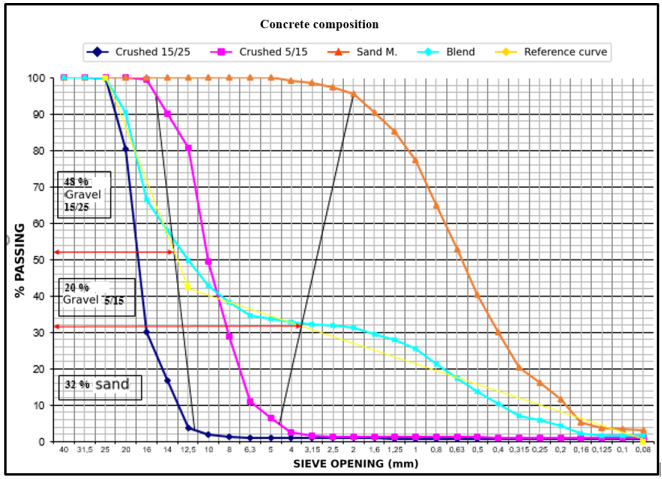
The composition of the control concrete was carried out using the DREUX-GORISSE method.
Figure 3. Determination of the proportions of aggregates used in the composition of the test concrete.
The results of the calculation of the absolute volumes and masses of the constituents are shown in
Table 6.
Table 6. Theoretical composition of the control concrete.
Components | % by absolute volume | Absolute volume (L) | Mass of the material |
Cement | - | 129.03 | 400 |
Lagoon sand | 32 | 220.15 | 576.76 |
Crushed 5/15 | 20 | 137.59 | 368.74 |
Crushed 15/25 | 48 | 330.22 | 891.59 |
Mixing water | - | 200.00 | 200.00 |
Actual density | 2437.13 |
The control concrete thus formulated has a characteristic compressive strength of 37.50 MPa at 28 days, which classifies it in category C35/45 according to standard NF EN 206+A2.
3.2. Formulation of Fiber-reinforced Concrete
The BARON-LESAGE method
| [18] | J. Baron and R. Lesage, “The Composition of Hydraulic Concrete from the Laboratory to the Construction Site.,” Lab Cent Ponts Chaussees Rapp Rech, no. 64, 1976. |
[18]
developed at the Paris (France) laboratory for the optimization of the final composition of a fiber-reinforced concrete, was used for the formulation of the different fiber-reinforced concretes studied.
Bamboo fibers were incorporated into the concrete as a partial volume substitute for aggregates. Thus, for each fiber dosage (0.5%, 1% and 1.5% of the total concrete volume), the volume of crushed aggregates was reduced proportionally, so as to keep the total concrete volume constant.
Fiber dosages of 0.5%, 1% and 1.5% of the total concrete volume were chosen based on previous work on natural fiber-reinforced concretes, which indicate that dosages between 0.5% and 2% constitute a commonly studied range
| [17] | J. Kaima, I. Preechawuttipong, R. Peyroux, and P. Jongchansitto, “Results in Engineering Experimental investigation of alkaline treatment processes (NaOH, KOH and ash) on tensile strength of the bamboo fiber bundle,” Results Eng., vol. 18, no. July 2022, p. 101186, 2023,
https://doi.org/10.1016/j.rineng.2023.101186 |
| [19] | C. Series, “The Influence of Bamboo Fibers as Additive on the Mechanical Properties of High Strength Concrete The Influence of Bamboo Fibers as Additive on the Mechanical Properties of High Strength Concrete,” 2020,
https://doi.org/10.1088/1742-6596/1625/1/012013 |
[17, 19]
.
Table 7 shows the composition of the four concretes prepared as part of this study.
Table 7. Composition of different types of concrete.
Components | BT | BRFB 1 | BRFB 2 | BRFB 3 |
Cement (kg) | 400.00 | 400.00 | 400.00 | 400.00 |
Mixing water (L) | 200.00 | 200.00 | 200.00 | 200.00 |
Lagoon sand (kg) | 576.79 | 576.79 | 576.79 | 576.79 |
Crushed 5/15 (kg) | 368.74 | 364.73 | 360.72 | 356.72 |
Crushed 15/25 (kg) | 891.59 | 881.9 | 872.21 | 862.52 |
Bamboo fibers (kg) | 0.00 | 4.32 | 8.64 | 12.97 |
Actual density (kg/m3) | 2437.13 | 2427.74 | 2418.36 | 2409.00 |
4. Results and Interpretation of Fresh Concrete Tests
Table 8. Densities and slumps of the tested concretes.
Type of concrete | BT | BRFB 1 | BRFB 2 | BRFB 3 |
Density | 2.44 | 2.43 | 2.42 | 2.41 |
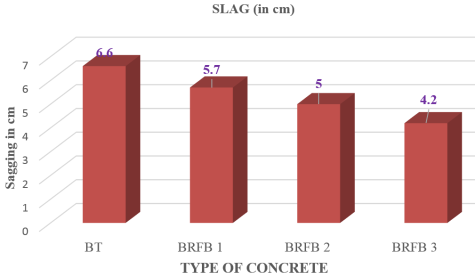
slump (cm) | 6.6 | 5.7 | 5 | 4.2 |
The experimental results concerning the determination of the density of the different concretes in the fresh state and their slump in the Abrams cone are presented in
Table 8.
4.1. Effect of Fiber Dosage on the Density of Fresh Concrete
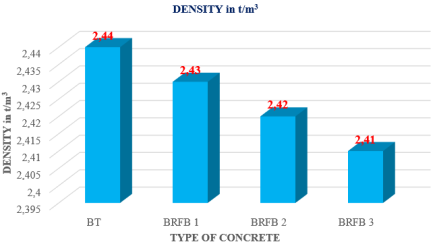
The density of fresh concrete is directly related to the density of its constituent materials and their proportions. Incorporating bamboo fibers as a volumetric replacement for a portion of the aggregates can affect the density. The results of the influence of fiber content on the density of different mixes are given in
Table 8 and illustrated in
Figure 4.
Figure 4. Variation of density as a function of fiber dosage.
According to
Figure 4, we can conclude that a decrease in the density of the different concrete mixes is observed due to the introduction of bamboo fibers. This decrease is more pronounced with increasing fiber dosage, due to the low density of bamboo fibers compared to that of the other constituents.
4.2. Effect of Fiber Dosage on Handling
The introduction of fibers significantly affects workability, and therefore, studying the influence of bamboo fibers is essential. The results of the influence of fiber dosage on the workability of the different concretes tested are recorded in
Table 8 and illustrated in
Figure 5.
Figure 5 shows a decrease in the workability of the concrete, regardless of the fiber content. This decrease is attributed to the cohesion provided by the introduction of the fibers. This decrease is minimal for low fiber content, while it is significant for higher fiber content.
This loss of workability is due to the increased interlocking and friction between the fibers and the aggregates; this is explained by the fact that the fibers improve the cohesion of the mixtures.
Figure 5. Variation in slump as a function of bamboo fiber dosage.
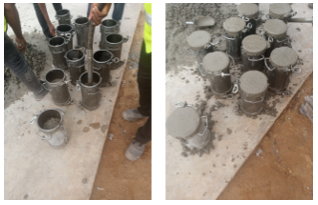
After conducting characterization tests on the fresh concrete (slump test using the Abrams cone and density), the prepared mix is poured and vibrated into molds, in accordance with the requirements of standard NF P 18-442. Cylindrical molds with a diameter d = 15 cm and a height h = 30 cm were used for compression and tensile splitting tests. The molds are pre-oiled to facilitate formwork removal. The reduced workability observed with increasing fiber content warrants particular attention regarding its influence on the quality of the hardened concrete. Indeed, a decrease in slump can lead to insufficient compaction, resulting in increased voids in the cementitious matrix and thus affecting the measured mechanical strengths. To mitigate this drawback, the vibration time with a needle vibrator was extended for fiber-reinforced concrete compared to the control concrete, so as to ensure equivalent compactness for all mixtures.
Figure 6. Preparation of test tubes.
5. Mechanical Properties of Hardened Concrete
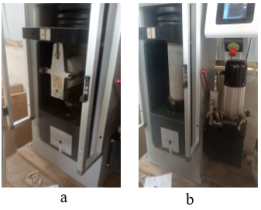
Figure 7. a- Splitting tensile test, b- Compression test.
Compression and tensile splitting tests were carried out on the cylindrical specimens.
Compression and splitting tensile tests are carried out in accordance with standards NF EN 12390-3 and NF EN 12390-6, respectively.
For each mixture and each test age, three cylindrical test specimens (n=3) were tested. The values presented are arithmetic means with standard deviations.
Table 9. Compressive Strength in MPa.
Blend | 7 days | 14 days | 28 days |
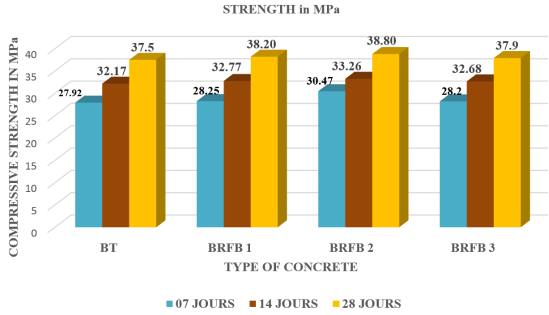
BT | 27.92±0.52 | 32.17±0.69 | 37.50±0.72 |
BRFB 1 | 28.25±0.54 | 32.77±0.58 | 38.20±0.18 |
BRFB 2 | 30.47±0.64 | 33.26±0.16 | 38.80±0.49 |
BRFB 3 | 28.20±0.28 | 32.67±0.45 | 37.90±0.14 |
Table 10. Tensile Strength in MPa.
Blend | 7 days | 14 days | 28 days |
BT | 2.52 ± 0.37 | 2.81±0.42 | 3.22 ± 0.30 |
BRFB 1 | 2.61±0.03 | 3.52 ± 0.15 | 3.83±0.08 |
BRFB 2 | 2.72 ± 0.17 | 3.63 ± 0.18 | 4.10±0.18 |
BRFB 3 | 2.50±0.12 | 3.30±0.07 | 3.60±0.35 |
Figures 8 and 9 show respectively the compressive strength and tensile strength of the concrete for different proportions of fibers (0%, 0.5%, 1% and 1.5%) after 7, 14 and 28 days.
Compared to conventional concrete, bamboo fiber reinforced concrete shows improved compressive strength and tensile strength with the addition of bamboo fibers to the concrete at proportions of 0.5% and 1%, but these strengths decrease for a proportion of 1.5% compared to other fiber ratios.
The incorporation of bamboo fibers into concrete at a proportion of 1% results in an increase in compressive strength and tensile strength at 28 days of 3.47% and 27.33%, respectively.
It is interesting to note that the addition of bamboo fibers to the concrete increased both compressive strength and tensile strength by splitting after 28 days of curing. As reported by researchers A. Yusra and al.
| [19] | C. Series, “The Influence of Bamboo Fibers as Additive on the Mechanical Properties of High Strength Concrete The Influence of Bamboo Fibers as Additive on the Mechanical Properties of High Strength Concrete,” 2020,
https://doi.org/10.1088/1742-6596/1625/1/012013 |
[19]
, SM Dewi and al.
| [20] | SM Dewi, MN Wijaya, and NC Remayanti, “The use of bamboo fiber in reinforced concrete beam to reduce crack,” AIP Conf. Proc., vol. 1887, 2017,
https://doi.org/10.1063/1.5003486 |
[20]
, these increases in strength could be due to the ability of the fibers to improve adhesion in the mixture and to absorb the energy released by the applied load, thus reducing the risk of cracking or delaying its occurrence.
Figure 8. Compression test results for the different mixtures.
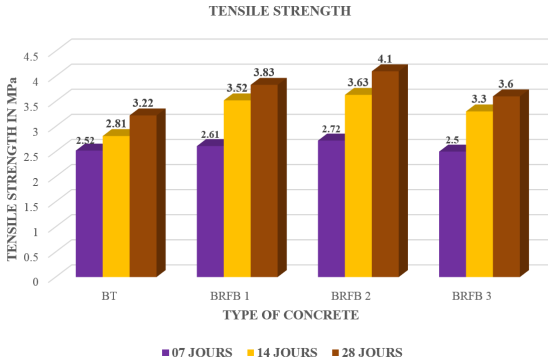
Figure 9. Results of tensile splitting tests for the different mixtures.

6. Conclusion
To reinforce conventional concrete, we focused particularly on bamboo fibers because, compared to synthetic fibers, their use saves energy, conserves limited resources, and protects the environment. For the formulation of conventional concrete, the Dreux- Gorisse method was used. By applying the Baron-Lesage method for the composition of bamboo fiber concrete, we obtained a composite concrete composition that is completely different from that of ordinary concrete, demonstrating that a fiber-reinforced composite is not obtained simply by introducing fibers into a given matrix. To understand the impact of introducing bamboo fibers on the properties of concrete in its fresh and hardened states, three concrete fiber dosages were used (0.5%, 1%, and 1.5% of the total concrete volume), resulting in three types of concrete that were compared to a control concrete (ordinary concrete).
To evaluate the effects of incorporating bamboo fibers into concrete on the mechanical properties of hardened concrete, we performed compression and splitting tensile tests, in accordance with standards NF EN 12390-3 and NF EN 12390-6, respectively, at ages of 7, 14, and 28 days. The compressive strengths at 28 days for the control concrete and the concrete reinforced with 0.5%, 1%, and 1.5% bamboo fibers were 37.5 MPa, 38.2 MPa, 38.8 MPa, and 37.9 MPa, respectively. Incorporating fibers into the concrete at proportions of 0.5% and 1% resulted in an increase in compressive strength at 28 days of 1.87% and 3.47%, respectively. However, with the addition of 1.5% fibers, the compressive strength began to decrease. The addition of bamboo fibers to the concrete mix increased tensile strength compared to the control concrete, particularly at fiber concentrations of 0.5% and 1%, with strength gains reaching up to 27.33% (1% concentration). However, the 1.5% concentration resulted in a decrease in tensile strength.
Fiber-reinforced concrete exhibits significantly improved mechanical behavior compared to fiber-free concrete. The introduction of fibers leads to improved tensile strength at splitting, compressive strength, and consequently, improved ductility. The addition of bamboo fibers has a favorable effect on cracking limits and post-cracking behavior due to the good adhesion of the bamboo fibers to the matrix. However, it should be noted that this study focused on short-term mechanical properties. Further studies on flexural strength, water absorption, permeability, and fatigue behavior under repeated loading would be necessary to confirm the potential of bamboo fibers in rigid pavement applications. Moreover, the alkaline treatment with 5% (w/w) NaOH applied to the fibers helps reduce their susceptibility to biological degradation, although their long-term behavior under aggressive stresses warrants further investigation.
Author Contributions
Yémalin Daniel Agossou: Conceptualization, Resources, Methodology, Writing – review & editing
Sessinou Ambroise Toviho: Writing – review & editing
Wilfrid Hode: Project administration, Visualization
Hubert Frédéric Gbaguidi: Supervision, Validation, Visualization
Conflicts of Interest
The authors declare no conflicts of interest.
References
| [1] |
SR Maitra, KS Reddy, and L. Ramachandra, “Numerical investigation of fatigue characteristics of concrete,” no. October, 2014,
https://doi.org/10.1007/s10704-014-9969-x
|
| [2] |
M. Terai and K. Minami, “Basic study on mechanical properties of bamboo fiber reinforced concrete,” Glob. Think. Struct. Eng. Recent Achiev., no. January 2012, 2012.
|
| [3] |
M. Bourgeois, “Agro-sourced fibers,” vol. 33, no. 0, 2011.
|
| [4] |
N. Dayananda, BS Keerthi Gowda, and GL Easwara Prasad, “A Study on Compressive Strength Attributes of Jute Fiber Reinforced Cement Concrete Composites,” IOP Conf. Ser. Mater. Sci. Eng., vol. 376, no. 1, 2018,
https://doi.org/10.1088/1757-899X/376/1/012069
|
| [5] |
S. Tiwari, AK Sahu, and RP Pathak, “Mechanical Properties and Durability Study of Jute Fiber Reinforced Concrete,” IOP Conf. Ser. Mater. Sci. Eng., vol. 961, no. 1, 2020,
https://doi.org/10.1088/1757-899X/961/1/012009
|
| [6] |
M. Zakaria, M. Ahmed, MM Hoque, and S. Islam, “Scope of using jute fiber for the reinforcement of concrete material,” Text. Cloth. Sustain., vol. 2, no. 1, 2017,
https://doi.org/10.1186/s40689-016-0022-5
|
| [7] |
M. Douai, “International Francophone Conference NoMaD 2015 Mines Douai DEVELOPMENT OF A PREVENTIVE TREATMENT AGAINST THE”, no. November, pp. 5–6, 2015.
|
| [8] |
H. Hashemifard, M. Mehranzadeh, and M. Chenari, “Mechanical and physical properties of Sugarloaf,” Adv. Approximately. Biol., vol. 6, no. 1, pp. 368–375, 2012.
|
| [9] |
RD Tolêdo Filho, K. Joseph, K. Ghavami, and GL England, “the Use of Sisal Fiber As Reinforcement in Cement Based Composites,” Rev. Arm. Eng. Agriculture and Ambient., vol. 3, no. 2, pp. 245–256, 1999,
https://doi.org/10.1590/1807-1929/agriambi.v3n2p245-256
|
| [10] |
J. Ahmad et al., “Mechanical and Durability Performance of Coconut Fiber Reinforced Concrete: A State-of-the-Art Review,” Materials (Basel)., vol. 15, no. 10, 2022,
https://doi.org/10.3390/ma15103601
|
| [11] |
A. Varghese and S. Unnikrishnan, “Mechanical strength of coconut fiber reinforced concrete,” Mater. Today Proc., pp. 1–6, 2023,
https://doi.org/10.1016/j.matpr.2023.05.637
|
| [12] |
C. Zhang, Z. Huang, and GW Chen, “Experimental research on bamboo fiber reinforced concrete,” Appl. Mech. Mater., vol. 357–360, pp. 1045–1048, 2013,
https://doi.org/10.4028/www.scientific.net/AMM.357-360.1045
|
| [13] |
J. Ahmad, Z. Zhou, and AF Deifalla, “Structural properties of concrete reinforced with bamboo fibers: a review,” J. Mater. Res. Technol., vol. 24, pp. 844–865, 2023,
https://doi.org/10.1016/j.jmrt.2023.03.038
|
| [14] |
DM Gelanew, “Mechanical and Microstructural Properties of Bamboo Fiber-Reinforced Concrete Containing a Blend of Waste Marble Powder and Waste Glass Powder,” vol. 2023, 2023,
https://doi.org/10.1155/2023/2725801
|
| [15] |
F. Althoey, P. O. Awoyera, and K. Inyama, “Strength and microscale properties of bamboo fiber-reinforced concrete modified with natural rubber latex,” no. December, p. 1–14, 2022,
https://doi.org/10.3389/fmats.2022.1064885
|
| [16] |
CM Bittner and V. Oettel, “Fiber Reinforced Concrete with Natural Plant Fibers — Investigations on the Application of Bamboo Fibers in Ultra-High Performance Concrete,” 2022.
|
| [17] |
J. Kaima, I. Preechawuttipong, R. Peyroux, and P. Jongchansitto, “Results in Engineering Experimental investigation of alkaline treatment processes (NaOH, KOH and ash) on tensile strength of the bamboo fiber bundle,” Results Eng., vol. 18, no. July 2022, p. 101186, 2023,
https://doi.org/10.1016/j.rineng.2023.101186
|
| [18] |
J. Baron and R. Lesage, “The Composition of Hydraulic Concrete from the Laboratory to the Construction Site.,” Lab Cent Ponts Chaussees Rapp Rech, no. 64, 1976.
|
| [19] |
C. Series, “The Influence of Bamboo Fibers as Additive on the Mechanical Properties of High Strength Concrete The Influence of Bamboo Fibers as Additive on the Mechanical Properties of High Strength Concrete,” 2020,
https://doi.org/10.1088/1742-6596/1625/1/012013
|
| [20] |
SM Dewi, MN Wijaya, and NC Remayanti, “The use of bamboo fiber in reinforced concrete beam to reduce crack,” AIP Conf. Proc., vol. 1887, 2017,
https://doi.org/10.1063/1.5003486
|
Cite This Article
-
APA Style
Agossou, Y. D., Toviho, S. A., Hode, W., Gbaguidi, H. F. (2026). Improvement of the Mechanical Properties of Concrete by Incorporating Bamboo Fibers: Prospects for Application in Rigid Pavement. International Journal of Materials Science and Applications, 15(4), 132-142. https://doi.org/10.11648/j.ijmsa.20261504.11
Copy
|
Download
ACS Style
Agossou, Y. D.; Toviho, S. A.; Hode, W.; Gbaguidi, H. F. Improvement of the Mechanical Properties of Concrete by Incorporating Bamboo Fibers: Prospects for Application in Rigid Pavement. Int. J. Mater. Sci. Appl. 2026, 15(4), 132-142. doi: 10.11648/j.ijmsa.20261504.11
Copy
|
Download
AMA Style
Agossou YD, Toviho SA, Hode W, Gbaguidi HF. Improvement of the Mechanical Properties of Concrete by Incorporating Bamboo Fibers: Prospects for Application in Rigid Pavement. Int J Mater Sci Appl. 2026;15(4):132-142. doi: 10.11648/j.ijmsa.20261504.11
Copy
|
Download
-
@article{10.11648/j.ijmsa.20261504.11,
author = {Yémalin Daniel Agossou and Sessinou Ambroise Toviho and Wilfrid Hode and Hubert Frédéric Gbaguidi},
title = {Improvement of the Mechanical Properties of Concrete by Incorporating Bamboo Fibers: Prospects for Application in Rigid Pavement},
journal = {International Journal of Materials Science and Applications},
volume = {15},
number = {4},
pages = {132-142},
doi = {10.11648/j.ijmsa.20261504.11},
url = {https://doi.org/10.11648/j.ijmsa.20261504.11},
eprint = {https://article.sciencepublishinggroup.com/pdf/10.11648.j.ijmsa.20261504.11},
abstract = {In the current context of growth in road infrastructure and their durability requirements, concrete pavements represent an interesting alternative to bituminous surfacing. They offer better resistance to heavy loads and climatic hazards, while requiring less long-term maintenance. Concrete is generally considered a material with low tensile strength. Consequently, rigid pavements may crack even under relatively low tensile stresses. The ultimate objective of this study is to contribute to the improvement of the mechanical properties of concrete by adding plant fibers (bamboo fibers). Four types of concrete were studied: a control concrete, formulated using the DREUX-GORISSE method, and three concretes reinforced with bamboo fibers, composed using the BARON-LESAGE method. The concretes were reinforced with bamboo fibers at rates of 0.5%, 1% and 1.5% of the total concrete volume. Tests were performed on fresh concrete (Abrams cone slump test and density determination). A decrease in concrete workability was observed regardless of the fiber dosage. A decrease in the density of the various concretes is reported due to the introduction of bamboo fibers. To evaluate the effects of incorporating bamboo fibers in concrete on the mechanical properties of hardened concrete, compressive and splitting tensile strength tests were performed in accordance with standards NF EN 12390-3 and NF EN 12390-6, respectively, at ages of 7, 14 and 28 days. The results indicate that the optimal composite material, with 1% bamboo fibers, shows a gain of 3.47% in compressive strength (at 28 days) and an increase of 27.33% in tensile strength (at 28 days), compared to the control concrete. The incorporation of bamboo fibers into the concrete matrix promotes not only mechanical resistance but also ductility, suggesting a potential for improving the mechanical properties of concrete, thus opening prospects for its application in rigid pavement, subject to validation by additional tests, particularly flexural strength tests.},
year = {2026}
}
Copy
|
Download
-
TY - JOUR
T1 - Improvement of the Mechanical Properties of Concrete by Incorporating Bamboo Fibers: Prospects for Application in Rigid Pavement
AU - Yémalin Daniel Agossou
AU - Sessinou Ambroise Toviho
AU - Wilfrid Hode
AU - Hubert Frédéric Gbaguidi
Y1 - 2026/07/08
PY - 2026
N1 - https://doi.org/10.11648/j.ijmsa.20261504.11
DO - 10.11648/j.ijmsa.20261504.11
T2 - International Journal of Materials Science and Applications
JF - International Journal of Materials Science and Applications
JO - International Journal of Materials Science and Applications
SP - 132
EP - 142
PB - Science Publishing Group
SN - 2327-2643
UR - https://doi.org/10.11648/j.ijmsa.20261504.11
AB - In the current context of growth in road infrastructure and their durability requirements, concrete pavements represent an interesting alternative to bituminous surfacing. They offer better resistance to heavy loads and climatic hazards, while requiring less long-term maintenance. Concrete is generally considered a material with low tensile strength. Consequently, rigid pavements may crack even under relatively low tensile stresses. The ultimate objective of this study is to contribute to the improvement of the mechanical properties of concrete by adding plant fibers (bamboo fibers). Four types of concrete were studied: a control concrete, formulated using the DREUX-GORISSE method, and three concretes reinforced with bamboo fibers, composed using the BARON-LESAGE method. The concretes were reinforced with bamboo fibers at rates of 0.5%, 1% and 1.5% of the total concrete volume. Tests were performed on fresh concrete (Abrams cone slump test and density determination). A decrease in concrete workability was observed regardless of the fiber dosage. A decrease in the density of the various concretes is reported due to the introduction of bamboo fibers. To evaluate the effects of incorporating bamboo fibers in concrete on the mechanical properties of hardened concrete, compressive and splitting tensile strength tests were performed in accordance with standards NF EN 12390-3 and NF EN 12390-6, respectively, at ages of 7, 14 and 28 days. The results indicate that the optimal composite material, with 1% bamboo fibers, shows a gain of 3.47% in compressive strength (at 28 days) and an increase of 27.33% in tensile strength (at 28 days), compared to the control concrete. The incorporation of bamboo fibers into the concrete matrix promotes not only mechanical resistance but also ductility, suggesting a potential for improving the mechanical properties of concrete, thus opening prospects for its application in rigid pavement, subject to validation by additional tests, particularly flexural strength tests.
VL - 15
IS - 4
ER -
Copy
|
Download