Abstract
Abattoir wastewater introduces organic matter, nutrients, suspended solids, microorganisms and potentially toxic metals into receiving rivers, producing complex water-quality responses that are difficult to interpret using single-parameter assessments. This study identified the critical variables and dominant pollution processes controlling water quality in the Effurun River, Delta State, Nigeria, using principal component analysis (PCA) and multivariate statistical analysis. Water samples were collected at an upstream control station, the abattoir-effluent discharge point and a downstream recovery station during rainy-season (June 2025) and dry-season (November 2025) campaigns on Days 1, 15 and 30, yielding 18 station-level observations. Physicochemical, nutrient, organic, heavy-metal and microbiological parameters were determined using standard laboratory procedures. Seasonal differences in the combined water-quality profile were assessed by multivariate analysis of variance, while PCA with varimax rotation was used for dimensionality reduction and identification of variables with absolute loadings of at least 0.70. Four retained principal components explained 92.62% of the total variance. After rotation, PC1 explained 49.12% and represented ionic-organic enrichment dominated by electrical conductivity, total dissolved solids, major ions, nutrients, chemical and biochemical oxygen demand, ammonium and heterotrophic bacteria. PC2 explained 25.48% and represented heavy-metal contamination, with high loadings for Pb, Zn, Cu, Fe, Cd, Mn and Cr. PC3 explained 12.15% and reflected suspended-solids, nutrient and microbial pollution, while PC4 explained 5.87% and represented oxygen-regime processes dominated by dissolved oxygen. The seasonal MANOVA was not statistically significant (Pillai's Trace = 0.667, F (14, 3) = 0.429, p = 0.881; partial eta squared = 0.667), indicating that the overall seasonal difference was not established at alpha = 0.05. The findings show that a relatively small group of highly loaded parameters can serve as priority indicators for routine monitoring and targeted pollution control in abattoir-impacted tropical rivers.
Keywords
Abattoir Effluent, Principal Component Analysis, Multivariate Analysis, Critical Water-quality Parameters, Heavy Metals, Effurun River, Pollution Source Identification
1. Introduction
Surface-water systems in rapidly urbanizing tropical environments receive multiple contaminant inputs from domestic wastewater, solid-waste disposal, storm runoff and small-scale industrial activities. Abattoirs are particularly important point sources because slaughtering and wash-down operations generate wastewater containing blood, animal tissue, fats, faecal matter, nutrients, suspended solids and microorganisms. When discharged without adequate treatment, these constituents increase oxygen demand, alter ionic composition and nutrient status, and may introduce toxic metals and pathogens into receiving waters
| [1] | Pola, B. J. Bacteriological and physicochemical assessment of abattoir wastewater and its contaminated soils in Adamawa State, Nigeria. African Journal of Sciences and Traditional Medicine, 2025). 2(2), 78–94.
https://doi.org/10.58578/ajstm.v2i2.5201 |
| [2] | Bate GB, Adeleye AO, Ijanu EM, Olalere EO, Amoo AO, Asaju CI, et al. Quality Assessment of Wastewater: Physicochemical and Bacteriological Evidence from Dutse Abattoir, North-West Nigeria. World J Environ Biosci. 2023; 12(3): 58-66. https://doi.org/10.51847/5xxrD8Fbka |
| [3] | T. Bakare-Abidola et al., "Environmental Impact Assessment of Abattoir Wastewater," Path of Science, vol. 11, no. 6, pp. 5001-5014, 2025.
https://doi.org/10.22178/pos.119-16 |
| [4] | Mohammed AA, Sule IO, Bate GC. Seasonal influence on surface water quality of rivers receiving untreated effluents in Nigeria. Journal of Water and Health. 2024; 22(1): 120-135. |
[1-4]
. Conventional water-quality assessment commonly evaluates individual variables against guideline values. Although necessary for regulatory interpretation, this approach can become difficult when many strongly correlated parameters are measured simultaneously.
Multivariate statistical methods provide a complementary framework by reducing redundancy, identifying correlated groups of variables and revealing the underlying processes responsible for observed water-quality variation
| [5] | Ezekwe IC, Edet AE, Nwankwoala HO. Evaluation of surface water quality using water quality index and multivariate techniques in a tropical river basin, Nigeria. Environmental Earth Sciences. 2021; 80(5): 1-14.
https://doi.org/10.1038/s41598-024-77534-z |
| [6] | Fatunsin OT, Ogundairo TO, Akinyemi OD. Application of water quality index and multivariate statistics for surface water quality assessment in southwestern Nigeria. Environmental Challenges. 2023; 12: 100705.
https://doi.org/10.1007/s42108-024-00317-9 |
| [7] | Nwachukwu MA, Ukoha PO. Human health risk assessment of heavy metals in surface waters of southern Nigeria. Environmental Geochemistry and Health. 2023; 45(4): 1-16. |
| [8] | Nwachukwu MA, Ukoha PO, Okoro BU. Heavy metal contamination and health risk assessment of surface waters in urban and peri-urban Nigeria. Journal of African Earth Sciences. 2023; 198: 104789. |
[5-8]
. Recent applications in Nigerian rivers and coastal waters have demonstrated the usefulness of principal component analysis (PCA) for identifying dominant pollutant groups, distinguishing hydrochemical processes and reducing complex water-quality datasets to a smaller number of diagnostically useful variables
| [17] | E. Ubuoh, F. Nwogu, E. Ossai-Abeh, J. Ikwuemesi, A. Oke, and J. Umoh, "Evaluation of hydro-chemical facies and surface water quality dynamics using multivariate statistical approaches in Southern Nigeria. Sci Rep 14, 31600," ed, 2024. https://doi.org/10.1038/s41598-024-77534-z |
| [18] | Ikebude CF, Udeh IE. Application of principal component analysis in establishing the dominant pollutants in the New Calabar River. International Journal of Research and Scientific Innovation. 2024; 11(8): 358–382.
https://doi.org/10.51244/IJRSI.2024.1108030 |
| [19] | Usang RO, Olu-Owolabi BI, Adebowale KO. Integrating principal component analysis, fuzzy inference systems, and advanced neural networks for enhanced estuarine water quality assessment. Journal of Hydrology: Regional Studies. 2025; 57: 102182. https://doi.org/10.1016/j.ejrh.2025.102182 |
[17-19]
. Principal component analysis (PCA), in particular, transforms a large set of interrelated variables into a smaller number of orthogonal components, thereby facilitating identification of critical indicators and potential pollution-source signatures. The Effurun River in Delta State, Nigeria, receives untreated wastewater from an abattoir located close to the river bank. The underlying project measured physicochemical, nutrient, organic, heavy-metal and microbiological characteristics at upstream, discharge-point and downstream stations in contrasting wet and dry seasons. Earlier project-level interpretation showed pronounced spatial and seasonal deterioration, but effective monitoring requires more than demonstrating that pollution exists; it requires determining which parameters carry the greatest diagnostic information and what dominant processes they represent.
Accordingly, this study aimed to identify the critical water-quality parameters controlling degradation of the Effurun River using PCA with varimax rotation and multivariate seasonal analysis. The objectives were to: (i) determine whether the combined water-quality profile differed between seasons; (ii) reduce the multidimensional dataset to a limited number of dominant principal components; (iii) classify high-loading variables according to the major pollution processes they represent; and (iv) derive a priority set of indicators for routine monitoring of abattoir-impacted river reaches.
2. Materials and Methods
2.1. Study Area and Abattoir Setting
The study was conducted on the Effurun River in Uvwie Local Government Area, Delta State, southern Nigeria. The river is situated in the Niger Delta and is exposed to residential, commercial and industrial pressures. The investigated abattoir is a small-scale slaughter facility with a concrete slaughter slab and perimeter drainage. Process water and blood-containing wash water are discharged through drainage channels into the river. The river supports domestic, agricultural and recreational activities in surrounding communities.
2.2. Sampling Design
A seasonal comparative design was adopted. Three georeferenced sampling stations were selected to represent background conditions, immediate effluent impact and downstream transport/recovery. Sampling was undertaken during the rainy season in June 2025 and the dry season in November 2025 on Days 1, 15 and 30 of each seasonal campaign. Samples were collected at all three stations on each occasion, producing 18 station-level observations, excluding analytical replicates and quality-control samples.
Table 1. Sampling stations used for the multivariate analysis.
Station | Functional description | Coordinates |
A | Upstream control/reference | 5.555282°N, 5.7864476°E |
B | Abattoir-effluent discharge/impact zone | 5.555384°N, 5.7864677°E |
C | Downstream recovery zone (~100 m) | 5.5552787°N, 5.786777°E |
Samples for physicochemical and microbiological analysis were collected in clean 1-L polyethylene bottles. Bacteriological bottles were sterilized before use, while bottles for physicochemical analysis were rinsed at the sampling site. Samples were labeled, cooled to approximately 4°C and transported for laboratory analysis. Field measurements were conducted within a standardized morning sampling window to improve comparability among stations and seasons.
2.3. Water-Quality Determinations and Quality Assurance
The analytical programme included pH, electrical conductivity (EC), turbidity, dissolved oxygen (DO), total dissolved solids (TDS), total suspended solids (TSS), biochemical oxygen demand (BOD), chemical oxygen demand (COD), major ions and nutrients, selected heavy metals and microbiological indicators. Heavy metals included Fe, Zn, Cu, Pb, Cd, Mn and Cr in the multivariate dataset. Microbial indicators included total heterotrophic bacterial count (THBC) and total coliforms. Standard analytical procedures were applied, with daily calibration of instruments, analytical blanks and duplicates, certified or standard solutions for metal analysis, and sterile procedures for microbiological testing
| [1] | Pola, B. J. Bacteriological and physicochemical assessment of abattoir wastewater and its contaminated soils in Adamawa State, Nigeria. African Journal of Sciences and Traditional Medicine, 2025). 2(2), 78–94.
https://doi.org/10.58578/ajstm.v2i2.5201 |
| [9] | World Health Organization. Guidelines for Drinking-water Quality. 4th ed. Geneva: WHO; 2022. |
[1, 9]
and
| [12] | M. F. Howladar et al., "The water quality and pollution sources assessment of Surma river, Bangladesh using, hydrochemical, multivariate statistical and water quality index methods," Groundwater for sustainable development, vol. 12, p. 100523, 2021,
https://doi.org/10.1016/j.gsd.2020.100523 |
| [13] | Owoyemi, F. B., Oteze, G. E. & Omonona, O. V. Spatial patterns, geochemical evolution and quality of groundwater in Delta State, Niger Delta, Nigeria: implication for groundwater management. Environ Monit Assess. 191, 617 (2019).
https://doi.org/10.1007/s10661-019-7788-2 |
| [14] | G. Ogboeli, "Impact of Abattoir Wastewater Discharge on Physicochemical, Microbial and Human Health Risks of Chokocho River, Rivers State, Nigeria," 2026,
https://doi.org/10.5281/zenodo.19548366 |
[12-14]
.
2.4. Multivariate Statistical Analysis
Descriptive statistics were first used to characterize seasonal variability. A multivariate analysis of variance (MANOVA) was then used to test whether the combined water-quality profile differed between dry- and rainy-season groups at alpha = 0.05. The project output reported Pillai's Trace, Wilks' Lambda, Hotelling's Trace and Roy's Largest Root. An internal consistency check of the reported seasonal statistics showed that F (14, 3) = 0.429 corresponds to p approximately 0.881. The calculated probability value is also consistent with the project-reported noncentrality parameter of 6.000 and observed power of 0.081. Therefore, p = 0.881 was used for the seasonal MANOVA interpretation, while partial eta squared = 0.667 was retained as reported.
PCA was applied to the standardized multivariate dataset and rotated using the varimax criterion to improve interpretability. Components with eigenvalues greater than 1 were retained in accordance with the Kaiser criterion used in the project analysis. Parameters with absolute rotated loadings of at least 0.70 were treated as critical variables for component interpretation. Communalities were examined to assess how effectively the retained component solution represented the original variables. Statistical analyses were performed using SPSS Version 27.0 and Microsoft Excel 2021.
3. Results
3.1. Multivariate Seasonal Effect
The multivariate test did not show a statistically significant seasonal difference in the combined water-quality profile. For the seasonal grouping effect, the project output reported Pillai's Trace = 0.667, Wilks' Lambda = 0.333, Hotelling's Trace = 2.000 and Roy's Largest Root = 2.000, with F (14, 3) = 0.429. The probability value corresponding to this F statistic and its degrees of freedom is p = 0.881; therefore, the null hypothesis of no overall seasonal difference is not rejected at alpha = 0.05. The reported partial eta squared of 0.667 is numerically large, but it should be interpreted cautiously because the analysis had only 3 error degrees of freedom and low observed power (0.081).
Table 2. Multivariate test statistics for the seasonal grouping effect.
Statistic | Value | F | Hypothesis df | Error df | p | Partial eta2 |
Pillai's Trace | 0.667 | 0.429 | 14 | 3 | 0.881 | 0.667 |
Wilks' Lambda | 0.333 | 0.429 | 14 | 3 | 0.881 | 0.667 |
Hotelling's Trace | 2.000 | 0.429 | 14 | 3 | 0.881 | 0.667 |
Roy's Largest Root | 2.000 | 0.429 | 14 | 3 | 0.881 | 0.667 |
3.2. PCA Dimensionality and Variance Explained
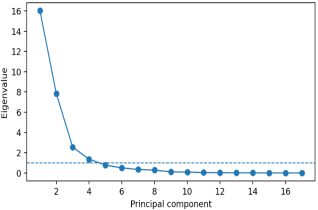
Four principal components had eigenvalues greater than one and together explained 92.62% of the total variance. Before rotation, PC1 had an eigenvalue of 16.027 and explained 53.42% of variance; PC2 had an eigenvalue of 7.846 and explained 26.15%. PC3 and PC4 explained 8.52% and 4.52%, respectively. Varimax rotation redistributed the explained variance to 49.12%, 25.48%, 12.15% and 5.87% for PC1-PC4 without changing the cumulative variance.
Table 3. Variance explained by the four retained principal components.
Component | Initial eigenvalue | Initial variance (%) | Rotated variance (%) | Cumulative rotated variance (%) |
PC1 | 16.027 | 53.422 | 49.115 | 49.115 |
PC2 | 7.846 | 26.152 | 25.481 | 74.597 |
PC3 | 2.557 | 8.523 | 12.146 | 86.743 |
PC4 | 1.356 | 4.518 | 5.873 | 92.616 |
Figure 1. Scree plot reconstructed from the eigenvalues reported in the project PCA output.
The scree profile showed a steep reduction after PC1 and PC2 and an elbow around PC4, supporting retention of four components. The large first eigenvalue demonstrates that the water-quality dataset was dominated by a strong common pollution/hydro chemical signal rather than many equally important independent processes.
3.3. Rotated Component Structure and Critical Parameters
The rotated component matrix revealed four interpretable pollution-process groups. PC1 was dominated by dissolved-ion, nutrient, organic-load and microbial variables; PC2 by heavy metals and acid-alkaline control; PC3 by suspended solids, nitrate and coliforms; and PC4 by dissolved oxygen. Using |loading| ≥ 0.70 as the project threshold, the most diagnostic variables are summarized in
Table 4.
Table 4. Classification of critical water-quality parameters based on rotated PCA loadings.
Component | Dominant interpretation | Rotated variance (%) | Critical parameters (|loading| ≥ 0.70) |
PC1 | Ionic-organic enrichment / mineralization and abattoir-related organic loading | 49.12 | EC, TDS, Na, SO4, Cl, HCO3, NO2, Mg, P, Ca, salinity, COD, BOD, K, NH4-N, THBC |
PC2 | Heavy-metal contamination and acid-alkaline control | 25.48 | Pb, Zn, Cu, Fe, Cd, Mn, Cr, pH (-), alkalinity (-) |
PC3 | Suspended-solids, nutrient and microbial pollution | 12.15 | Turbidity, TSS, NO₃, total coliforms |
PC4 | Oxygen regime and biochemical stabilization | 5.87 | DO |
Selected high rotated loadings illustrate the separation of the four factors: Na (0.987), COD (0.988), Ca (0.984), phosphate (0.979), Mg (0.972), NO2 (0.964) and Cl (0.953) loaded strongly on PC1; Zn (0.934), Mn (0.930), Pb (0.919), Cu (0.919), Cd (0.887), Fe (0.862) and Cr (0.804) loaded on PC2; TSS (0.907), turbidity (0.903) and total coliforms (0.850) loaded on PC3; and DO (0.804) dominated PC4.
The strongest PC1 loadings were observed for COD (0.988), Na (0.987), Ca (0.984), phosphate (0.979), Mg (0.972), K (0.968), NO2 (0.964), Cl (0.953), HCO3 (0.947), NH4-N (0.943), SO4 (0.935), TDS (0.903), EC (0.866), salinity (0.839), BOD (0.809) and THBC (0.703). This concentration of high loadings across dissolved ions, nutrients, organic-load indicators and microbial abundance supports interpretation of PC1 as a combined mineralization and organic-effluent factor. The result also shows why no single chemical variable is sufficient to characterize the pollution process: several parameter classes respond simultaneously to wastewater input and river-water chemistry.
For PC2, the strongest positive loadings were Zn (0.934), Mn (0.930), Pb (0.919), Cu (0.919), Cd (0.887), Fe (0.862) and Cr (0.804), while pH (-0.771) and alkalinity (-0.739) loaded negatively. This pattern indicates a distinct metal-control factor with an inverse acid-alkaline relationship. For PC3, TSS (0.907), turbidity (0.903) and total coliforms (0.850) were the clearest high-loading variables. The project classification table also lists nitrate under PC3, although its reported rotated loading is 0.627, below the stated |loading| >= 0.70 criterion; this discrepancy should be checked against the original SPSS output before submission. DO (0.804) dominated PC4 and therefore provided the most direct indicator of the oxygen-regime factor.
The loading pattern has practical monitoring value because it permits representative indicators to be selected from each factor. Where resources are limited, monitoring programmes may use one or more high-loading variables from each component as screening indicators, followed by full laboratory analysis when deterioration is detected. Such reduction should be treated as a surveillance strategy rather than a replacement for statutory compliance testing, especially where toxic metals or microbiological hazards are involved.
3.4. Critical-Parameter Monitoring Set
The PCA results indicate that routine monitoring can be made more diagnostic by prioritizing parameters that represent each major process rather than treating all measured variables as equally informative. A practical core set should include EC or TDS for ionic enrichment; COD and BOD for organic loading; NH₄-N or NO2 and phosphate for nutrient contamination; Pb and Cd as high-concern toxic metals together with a broader metal screen where resources permit; turbidity/TSS for particulate contamination; total coliforms or THBC for microbial pollution; and DO for ecological oxygen stress. This reduced set does not replace full regulatory monitoring, but it provides a statistically justified screening panel for detecting deterioration and triggering more comprehensive analysis.
4. Discussion
4.1. Dominant Ionic-Organic Pollution Factor
PC1 explained nearly half of the rotated variance, making ionic-organic enrichment the dominant process in the dataset. The simultaneous loading of EC, TDS, major cations and anions, nutrients, COD, BOD, ammonium and THBC indicates that mineralization and organic contamination were not independent phenomena. This pattern is consistent with wastewater containing dissolved salts, blood residues, proteins, fats, animal excreta and wash water. Such effluent increases dissolved ionic strength and oxygen demand while supporting microbial growth. Similar multidimensional deterioration has been reported in rivers receiving untreated slaughterhouse and mixed urban effluents
| [2] | Bate GB, Adeleye AO, Ijanu EM, Olalere EO, Amoo AO, Asaju CI, et al. Quality Assessment of Wastewater: Physicochemical and Bacteriological Evidence from Dutse Abattoir, North-West Nigeria. World J Environ Biosci. 2023; 12(3): 58-66. https://doi.org/10.51847/5xxrD8Fbka |
| [3] | T. Bakare-Abidola et al., "Environmental Impact Assessment of Abattoir Wastewater," Path of Science, vol. 11, no. 6, pp. 5001-5014, 2025.
https://doi.org/10.22178/pos.119-16 |
| [4] | Mohammed AA, Sule IO, Bate GC. Seasonal influence on surface water quality of rivers receiving untreated effluents in Nigeria. Journal of Water and Health. 2024; 22(1): 120-135. |
| [6] | Fatunsin OT, Ogundairo TO, Akinyemi OD. Application of water quality index and multivariate statistics for surface water quality assessment in southwestern Nigeria. Environmental Challenges. 2023; 12: 100705.
https://doi.org/10.1007/s42108-024-00317-9 |
[2-4, 6]
.
The strong loadings of COD and BOD are especially important because they directly characterize the oxygen demand imposed by oxidizable and biodegradable organic matter. Their association with ammonium, phosphate and THBC suggests a coupled organic-nutrient-microbial process rather than isolated exceedances. EC and TDS can therefore function as rapid field indicators of changes in the broader ionic component, but they should be interpreted alongside oxygen-demand and nutrient indicators to avoid attributing natural mineralization solely to abattoir activity.
4.2. Heavy-Metal Contamination Factor
The grouping of Pb, Zn, Cu, Fe, Cd, Mn and Cr in the present study is also consistent with recent investigations of pollution associated with abattoir activities in Nigeria. Elevated concentrations of several heavy metals have been reported in slaughterhouse-affected environments, although the magnitude and specific metal profiles vary among locations and receiving environments
| [16] | Akwuebub AN, et al. Evaluation of pollution potentials of slaughterhouse effluents on groundwater qualities in Ebonyi State, Southeast Nigeria. Environmental Forensics. 2025; 26(3): 309–323.
https://doi.org/10.1080/15275922.2024.2431322 |
| [20] | Ikuesan FA, Loto OO, Ikuesan MO. Assessment of bacterial community profile, quality impairment and human health risk of surface water receiving abattoir effluents: evidence from Yewa and Iju Streams, Ondo State, Nigeria. Archives of Current Research International. 2025; 25(5): 258–273.
https://doi.org/10.9734/acri/2025/v25i51207 |
[16, 20]
. These findings reinforce the importance of retaining selected metals as sentinel variables in monitoring programmes. The public-health significance of this component is substantial because Pb and Cd are toxic at low concentrations and may accumulate through prolonged exposure. Their high loadings justify inclusion in any targeted monitoring programme even when broader routine chemistry is reduced
| [7] | Nwachukwu MA, Ukoha PO. Human health risk assessment of heavy metals in surface waters of southern Nigeria. Environmental Geochemistry and Health. 2023; 45(4): 1-16. |
| [8] | Nwachukwu MA, Ukoha PO, Okoro BU. Heavy metal contamination and health risk assessment of surface waters in urban and peri-urban Nigeria. Journal of African Earth Sciences. 2023; 198: 104789. |
| [10] | National Environmental Standards and Regulations Enforcement Agency. National Environmental (Surface and Groundwater Quality Control) Regulations. Abuja: NESREA; 2011. |
[7, 8, 10]
.
4.3. Suspended-Solids, Nutrient and Microbial Factor
PC3 grouped turbidity, TSS, nitrate and total coliforms. The association of particulate material with microbial indicators suggests simultaneous transport of suspended organic matter and faecal contamination. In an abattoir setting, this pattern consists of animal waste, undigested feed, soil particles and contaminated wash water entering the river, particularly during rainfall and surface runoff. This component therefore represents both an operational waste-management problem and a catchment-runoff problem. Recent evidence from Nigerian streams receiving abattoir effluents also demonstrates the importance of microbial indicators in assessing receiving-water impairment.
| [15] | Ogundairo ES, Fatunsin OT, Akinyemi OD, et al. Impact of abattoirs and local textile (Adire and Kampala) effluents on Yemoja River in Abeokuta, Nigeria. Journal of Water and Health. 2024; 22(2): 385–400.
https://doi.org/10.2166/wh.2024.316 |
| [20] | Ikuesan FA, Loto OO, Ikuesan MO. Assessment of bacterial community profile, quality impairment and human health risk of surface water receiving abattoir effluents: evidence from Yewa and Iju Streams, Ondo State, Nigeria. Archives of Current Research International. 2025; 25(5): 258–273.
https://doi.org/10.9734/acri/2025/v25i51207 |
[15, 20]
reported substantial heterotrophic bacterial and coliform loads in Yewa and Iju streams receiving abattoir effluent, together with associated physicochemical and heavy-metal contamination.
4.4. Oxygen-Regime Factor and Seasonal Modulation
DO formed a distinct fourth component, reflecting the balance among oxygen consumption, reaeration, temperature, flow and photosynthetic activity. Its separation from the main organic-load component indicates that oxygen conditions were influenced by hydrological and ecological processes in addition to pollutant loading. Although descriptive seasonal contrasts were observed, the MANOVA did not establish a statistically significant overall seasonal effect (F(14, 3) = 0.429, p = 0.881). The numerically large partial eta squared (0.667) should be interpreted cautiously in view of the low observed power (0.081) and the small residual degrees of freedom. Seasonal flow conditions may nevertheless alter dilution, pollutant residence time, sediment suspension and catchment runoff, thereby changing individual water-quality variables even when the overall multivariate seasonal effect is not statistically significant
| [4] | Mohammed AA, Sule IO, Bate GC. Seasonal influence on surface water quality of rivers receiving untreated effluents in Nigeria. Journal of Water and Health. 2024; 22(1): 120-135. |
| [11] | G. Nwonumara and O. Okogwu, "Seasonal dynamics in water quality and phytoplankton of four tropical rivers in Ebonyi State, southeastern Nigeria," African Journal of Aquatic Science, vol. 46, no. 4, pp. 402-413, 2021,
https://doi.org/10.2989/16085914.2021.1924110 |
[4, 11]
.
4.5. Implications for Monitoring and Pollution Control
The main management value of the PCA is its ability to translate a large laboratory dataset into four interpretable process groups. For routine surveillance, the highest-loading variables provide a rational basis for selecting sentinel parameters. EC/TDS, COD/BOD, selected nutrients, Pb/Cd, turbidity/TSS, microbial indicators and DO collectively cover the dominant ionic, organic, metal, particulate, microbial and ecological dimensions identified by the analysis. Monitoring these indicators upstream, at the discharge point and downstream would provide a sensitive early-warning framework for detecting changes in abattoir-effluent impact. Pollution control should prioritize treatment at source. Screening and solids removal, separation of blood and fats, biological treatment for biodegradable organic matter, nutrient reduction and appropriate disinfection would directly address the major PCA factors. Because the heavy-metal component may include both abattoir-related and catchment sources, source control should be complemented by broader urban-runoff and waste-management interventions.
4.6. Study Limitations
The analysis is based on two intensive one-month seasonal campaigns with three sampling dates per season and three river stations, giving 18 station-level observations. It therefore characterizes seasonal contrasts but not continuous year-round dynamics. With 14 dependent variables in the reported seasonal MANOVA, only 3 error degrees of freedom remained, and the observed power was low (0.081); this limits the precision and sensitivity of the multivariate seasonal inference. The p = 0.002 value in the project table was internally inconsistent with F(14, 3) = 0.429 and was corrected to p = 0.881 for this manuscript. The project output available for this manuscript did not report Kaiser-Meyer-Olkin or Bartlett's sphericity statistics; these diagnostics should be added if available from the original SPSS analysis. Finally, PCA identifies correlation structure and likely common processes; it should not be interpreted as definitive proof that every variable within a component has a single pollution source.
5. Conclusions
Principal component and multivariate statistical analyses identified a compact set of processes controlling water-quality deterioration in the Effurun River. Four rotated components explained 92.62% of total variance. The dominant component (49.12%) represented ionic-organic enrichment and included EC, TDS, major ions, nutrients, COD, BOD, ammonium and heterotrophic bacteria. The second component (25.48%) represented a distinct heavy-metal factor dominated by Pb, Zn, Cu, Fe, Cd, Mn and Cr. The third component (12.15%) represented suspended-solids, nutrient and microbial pollution, while the fourth component (5.87%) represented oxygen-regime processes dominated by DO.
The multivariate seasonal analysis did not provide statistically significant evidence that the collective water-quality profile differed between rainy and dry seasons (Pillai's Trace = 0.667, F(14, 3) = 0.429, p = 0.881; partial eta squared = 0.667). Descriptive seasonal differences were nevertheless observed, but the low observed power (0.081) requires cautious interpretation of the seasonal MANOVA. Together with the PCA results, the findings demonstrate that abattoir-impacted river monitoring can be strengthened by focusing on high-loading sentinel variables that represent each dominant process. A priority monitoring panel comprising EC/TDS, COD/BOD, selected nutrients, Pb/Cd, turbidity/TSS, microbial indicators and DO would provide a practical screening framework, while full regulatory analysis should be retained for compliance and health-risk assessment.
Effective restoration requires source-level abattoir wastewater treatment combined with routine upstream-discharge-downstream monitoring and broader control of catchment runoff and waste disposal. Before journal submission, the original SPSS MANOVA output should be verified and KMO/Bartlett diagnostics should be added if available.
Abbreviations
PCA | Principal Component Analysis |
MANOVA | Multivariate Analysis of Variance |
PC | Principal Component |
EC | Electrical Conductivity |
TDS | Total Dissolved Solids |
TSS | Total Suspended Solids |
DO | Dissolved Oxygen |
BOD | Biochemical Oxygen Demand |
COD | Chemical Oxygen Demand |
THBC | Total Heterotrophic Bacterial Count |
SPSS | Statistical Package for the Social Sciences |
KMO | Kaiser–Meyer–Olkin |
APHA | American Public Health Association |
WHO | World Health Organization |
NESREA | National Environmental Standards and Regulations Enforcement Agency |
Acknowledgments
The author gratefully acknowledges Engr. Prof. Hilary Owamah for research supervision and scholarly guidance, and the laboratory personnel who provided technical support during the water-quality analyses
Author Contributions
Onyeka Edike: Conceptualisation, Data curation, Formal Analysis, Investigation, Methodology, Visualisation, Writing – original draft
Emmanuel Ebikabowei Enemugha: Writing – review & editing
Funding
The underlying postgraduate research was supported by the Tertiary Education Trust Fund (TETFund). A specific grant number was not stated in the project document.
Data Availability Statement
The data supporting the findings are contained in the underlying postgraduate research dataset and may be made available by the corresponding author subject to institutional and ethical requirements.
Conflicts of Interest
The author declares no conflicts of interest.
References
| [1] |
Pola, B. J. Bacteriological and physicochemical assessment of abattoir wastewater and its contaminated soils in Adamawa State, Nigeria. African Journal of Sciences and Traditional Medicine, 2025). 2(2), 78–94.
https://doi.org/10.58578/ajstm.v2i2.5201
|
| [2] |
Bate GB, Adeleye AO, Ijanu EM, Olalere EO, Amoo AO, Asaju CI, et al. Quality Assessment of Wastewater: Physicochemical and Bacteriological Evidence from Dutse Abattoir, North-West Nigeria. World J Environ Biosci. 2023; 12(3): 58-66.
https://doi.org/10.51847/5xxrD8Fbka
|
| [3] |
T. Bakare-Abidola et al., "Environmental Impact Assessment of Abattoir Wastewater," Path of Science, vol. 11, no. 6, pp. 5001-5014, 2025.
https://doi.org/10.22178/pos.119-16
|
| [4] |
Mohammed AA, Sule IO, Bate GC. Seasonal influence on surface water quality of rivers receiving untreated effluents in Nigeria. Journal of Water and Health. 2024; 22(1): 120-135.
|
| [5] |
Ezekwe IC, Edet AE, Nwankwoala HO. Evaluation of surface water quality using water quality index and multivariate techniques in a tropical river basin, Nigeria. Environmental Earth Sciences. 2021; 80(5): 1-14.
https://doi.org/10.1038/s41598-024-77534-z
|
| [6] |
Fatunsin OT, Ogundairo TO, Akinyemi OD. Application of water quality index and multivariate statistics for surface water quality assessment in southwestern Nigeria. Environmental Challenges. 2023; 12: 100705.
https://doi.org/10.1007/s42108-024-00317-9
|
| [7] |
Nwachukwu MA, Ukoha PO. Human health risk assessment of heavy metals in surface waters of southern Nigeria. Environmental Geochemistry and Health. 2023; 45(4): 1-16.
|
| [8] |
Nwachukwu MA, Ukoha PO, Okoro BU. Heavy metal contamination and health risk assessment of surface waters in urban and peri-urban Nigeria. Journal of African Earth Sciences. 2023; 198: 104789.
|
| [9] |
World Health Organization. Guidelines for Drinking-water Quality. 4th ed. Geneva: WHO; 2022.
|
| [10] |
National Environmental Standards and Regulations Enforcement Agency. National Environmental (Surface and Groundwater Quality Control) Regulations. Abuja: NESREA; 2011.
|
| [11] |
G. Nwonumara and O. Okogwu, "Seasonal dynamics in water quality and phytoplankton of four tropical rivers in Ebonyi State, southeastern Nigeria," African Journal of Aquatic Science, vol. 46, no. 4, pp. 402-413, 2021,
https://doi.org/10.2989/16085914.2021.1924110
|
| [12] |
M. F. Howladar et al., "The water quality and pollution sources assessment of Surma river, Bangladesh using, hydrochemical, multivariate statistical and water quality index methods," Groundwater for sustainable development, vol. 12, p. 100523, 2021,
https://doi.org/10.1016/j.gsd.2020.100523
|
| [13] |
Owoyemi, F. B., Oteze, G. E. & Omonona, O. V. Spatial patterns, geochemical evolution and quality of groundwater in Delta State, Niger Delta, Nigeria: implication for groundwater management. Environ Monit Assess. 191, 617 (2019).
https://doi.org/10.1007/s10661-019-7788-2
|
| [14] |
G. Ogboeli, "Impact of Abattoir Wastewater Discharge on Physicochemical, Microbial and Human Health Risks of Chokocho River, Rivers State, Nigeria," 2026,
https://doi.org/10.5281/zenodo.19548366
|
| [15] |
Ogundairo ES, Fatunsin OT, Akinyemi OD, et al. Impact of abattoirs and local textile (Adire and Kampala) effluents on Yemoja River in Abeokuta, Nigeria. Journal of Water and Health. 2024; 22(2): 385–400.
https://doi.org/10.2166/wh.2024.316
|
| [16] |
Akwuebub AN, et al. Evaluation of pollution potentials of slaughterhouse effluents on groundwater qualities in Ebonyi State, Southeast Nigeria. Environmental Forensics. 2025; 26(3): 309–323.
https://doi.org/10.1080/15275922.2024.2431322
|
| [17] |
E. Ubuoh, F. Nwogu, E. Ossai-Abeh, J. Ikwuemesi, A. Oke, and J. Umoh, "Evaluation of hydro-chemical facies and surface water quality dynamics using multivariate statistical approaches in Southern Nigeria. Sci Rep 14, 31600," ed, 2024.
https://doi.org/10.1038/s41598-024-77534-z
|
| [18] |
Ikebude CF, Udeh IE. Application of principal component analysis in establishing the dominant pollutants in the New Calabar River. International Journal of Research and Scientific Innovation. 2024; 11(8): 358–382.
https://doi.org/10.51244/IJRSI.2024.1108030
|
| [19] |
Usang RO, Olu-Owolabi BI, Adebowale KO. Integrating principal component analysis, fuzzy inference systems, and advanced neural networks for enhanced estuarine water quality assessment. Journal of Hydrology: Regional Studies. 2025; 57: 102182.
https://doi.org/10.1016/j.ejrh.2025.102182
|
| [20] |
Ikuesan FA, Loto OO, Ikuesan MO. Assessment of bacterial community profile, quality impairment and human health risk of surface water receiving abattoir effluents: evidence from Yewa and Iju Streams, Ondo State, Nigeria. Archives of Current Research International. 2025; 25(5): 258–273.
https://doi.org/10.9734/acri/2025/v25i51207
|
Cite This Article
-
APA Style
Edike, O., Enemugha, E. E. (2026). Identification of Critical Water-Quality Parameters in an Abattoir-Impacted River Using Principal Component and Multivariate Statistical Analyses. International Journal of Safety Research, 1(3), 125-132. https://doi.org/10.11648/j.ijsr.20260103.13
 Copy
|
Copy
|
 Download
ACS Style
Edike, O.; Enemugha, E. E. Identification of Critical Water-Quality Parameters in an Abattoir-Impacted River Using Principal Component and Multivariate Statistical Analyses. Int. J. Saf. Res. 2026, 1(3), 125-132. doi: 10.11648/j.ijsr.20260103.13
Copy
|
Download
AMA Style
Edike O, Enemugha EE. Identification of Critical Water-Quality Parameters in an Abattoir-Impacted River Using Principal Component and Multivariate Statistical Analyses. Int J Saf Res. 2026;1(3):125-132. doi: 10.11648/j.ijsr.20260103.13
Copy
|
Download
-
@article{10.11648/j.ijsr.20260103.13,
  author = {Onyeka Edike and Emmanuel Ebikabowei Enemugha},
  title = {Identification of Critical Water-Quality Parameters in an Abattoir-Impacted River Using Principal Component and Multivariate Statistical Analyses},
  journal = {International Journal of Safety Research},
  volume = {1},
  number = {3},
  pages = {125-132},
  doi = {10.11648/j.ijsr.20260103.13},
  url = {https://doi.org/10.11648/j.ijsr.20260103.13},
  eprint = {https://article.sciencepublishinggroup.com/pdf/10.11648.j.ijsr.20260103.13},
  abstract = {Abattoir wastewater introduces organic matter, nutrients, suspended solids, microorganisms and potentially toxic metals into receiving rivers, producing complex water-quality responses that are difficult to interpret using single-parameter assessments. This study identified the critical variables and dominant pollution processes controlling water quality in the Effurun River, Delta State, Nigeria, using principal component analysis (PCA) and multivariate statistical analysis. Water samples were collected at an upstream control station, the abattoir-effluent discharge point and a downstream recovery station during rainy-season (June 2025) and dry-season (November 2025) campaigns on Days 1, 15 and 30, yielding 18 station-level observations. Physicochemical, nutrient, organic, heavy-metal and microbiological parameters were determined using standard laboratory procedures. Seasonal differences in the combined water-quality profile were assessed by multivariate analysis of variance, while PCA with varimax rotation was used for dimensionality reduction and identification of variables with absolute loadings of at least 0.70. Four retained principal components explained 92.62% of the total variance. After rotation, PC1 explained 49.12% and represented ionic-organic enrichment dominated by electrical conductivity, total dissolved solids, major ions, nutrients, chemical and biochemical oxygen demand, ammonium and heterotrophic bacteria. PC2 explained 25.48% and represented heavy-metal contamination, with high loadings for Pb, Zn, Cu, Fe, Cd, Mn and Cr. PC3 explained 12.15% and reflected suspended-solids, nutrient and microbial pollution, while PC4 explained 5.87% and represented oxygen-regime processes dominated by dissolved oxygen. The seasonal MANOVA was not statistically significant (Pillai's Trace = 0.667, F (14, 3) = 0.429, p = 0.881; partial eta squared = 0.667), indicating that the overall seasonal difference was not established at alpha = 0.05. The findings show that a relatively small group of highly loaded parameters can serve as priority indicators for routine monitoring and targeted pollution control in abattoir-impacted tropical rivers.},
 year = {2026}
}
Copy
|
Download
-
TY  - JOUR
T1  - Identification of Critical Water-Quality Parameters in an Abattoir-Impacted River Using Principal Component and Multivariate Statistical Analyses
AU  - Onyeka Edike
AU  - Emmanuel Ebikabowei Enemugha
Y1  - 2026/09/30
PY  - 2026
N1  - https://doi.org/10.11648/j.ijsr.20260103.13
DO  - 10.11648/j.ijsr.20260103.13
T2  - International Journal of Safety Research
JF  - International Journal of Safety Research
JO  - International Journal of Safety Research
SP  - 125
EP  - 132
PB  - Science Publishing Group
SN  - 3071-4974
UR  - https://doi.org/10.11648/j.ijsr.20260103.13
AB  - Abattoir wastewater introduces organic matter, nutrients, suspended solids, microorganisms and potentially toxic metals into receiving rivers, producing complex water-quality responses that are difficult to interpret using single-parameter assessments. This study identified the critical variables and dominant pollution processes controlling water quality in the Effurun River, Delta State, Nigeria, using principal component analysis (PCA) and multivariate statistical analysis. Water samples were collected at an upstream control station, the abattoir-effluent discharge point and a downstream recovery station during rainy-season (June 2025) and dry-season (November 2025) campaigns on Days 1, 15 and 30, yielding 18 station-level observations. Physicochemical, nutrient, organic, heavy-metal and microbiological parameters were determined using standard laboratory procedures. Seasonal differences in the combined water-quality profile were assessed by multivariate analysis of variance, while PCA with varimax rotation was used for dimensionality reduction and identification of variables with absolute loadings of at least 0.70. Four retained principal components explained 92.62% of the total variance. After rotation, PC1 explained 49.12% and represented ionic-organic enrichment dominated by electrical conductivity, total dissolved solids, major ions, nutrients, chemical and biochemical oxygen demand, ammonium and heterotrophic bacteria. PC2 explained 25.48% and represented heavy-metal contamination, with high loadings for Pb, Zn, Cu, Fe, Cd, Mn and Cr. PC3 explained 12.15% and reflected suspended-solids, nutrient and microbial pollution, while PC4 explained 5.87% and represented oxygen-regime processes dominated by dissolved oxygen. The seasonal MANOVA was not statistically significant (Pillai's Trace = 0.667, F (14, 3) = 0.429, p = 0.881; partial eta squared = 0.667), indicating that the overall seasonal difference was not established at alpha = 0.05. The findings show that a relatively small group of highly loaded parameters can serve as priority indicators for routine monitoring and targeted pollution control in abattoir-impacted tropical rivers.
VL  - 1
IS  - 3
ER  -
Copy
|
Download






 Share This Article
 Twitter
 Linked In
 Facebook