
This study examines the role of Uganda People’s Defence Forces (UPDF) in disaster management and response. The study is necessary to address gaps in national government crisis and disaster response and coordination mechanisms. The specific objectives were to examine types, causes, and impacts of disasters in Uganda, assess role of UPDF and identify strategies for strengthening national crises response mechanisms by government. The research adopted mixed methods approaches, utilizing both qualitative and quantitative methods. The study using Yamane sample size formula, applied stratified simple sampling to identify 384 respondents from 5 million target population frequently affected by disasters in Uganda. The study areas were West Nile sub-region, (drought and refugee influx), Bududa District (landslides), and Kasese District (flooding of River Nyamwamba). Data was quantitatively analysed using SPSS through nonparametric descriptive statistics generating tables, pie-charts, and bar graphs. The study found that floods and droughts are the most prevalent disasters in Uganda, largely driven by climate variability, deforestation, unplanned urbanization, population pressure and weak institutional policies. The study recommends strengthening Office of the Prime Minister, Disaster Preparedness and Management and UPDF response capabilities with specialised surveillance infrastructure, equipment, training of technical personnel, acquisition of early warning AI driven technology and sufficient budgetary allocations for proactive planning, responses, control and management. Civil-Military coordination with humanitarian agencies for efficiency and effectiveness. The Uganda government should also establish permanent communication channels in areas prone to disasters for flowless communication, reporting, coordination, response and management as part of overall national development, defence and security strategy.
| Published in | Journal of Political Science and International Relations (Volume 9, Issue 3) |
| DOI | 10.11648/j.jpsir.20260903.14 |
| Page(s) | 161-174 |
| Creative Commons |
This is an Open Access article, distributed under the terms of the Creative Commons Attribution 4.0 International License (http://creativecommons.org/licenses/by/4.0/), which permits unrestricted use, distribution and reproduction in any medium or format, provided the original work is properly cited. |
| Copyright |
Copyright © The Author(s), 2026. Published by Science Publishing Group |
Civil Military Relations, Disaster Response, National Crises, Securitization, Uganda People Defence Forces
Sno | Category | Frequency | Percentage (%) |
|---|---|---|---|
1 | Pilot Questionnaires | 10 | 100 |
2 | Distributed Questionnaires | 381 | 100 |
3 | Questionnaires Returned | 261 | 68.5 |
4 | Questionnaires Not Returned | 128 | 33.6 |
5 | Cleaned & Valid Questionnaires | 253 | 66.4 |
Frequency | Percentage% | |
|---|---|---|
Male | 159 | 62.8 |
Women | 94 | 37.2 |
Total | 253 | 100.0 |
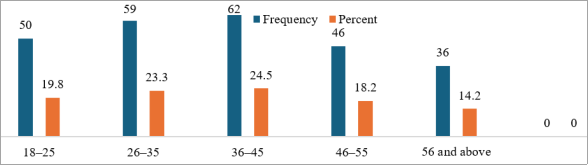
Age | Frequency | Percentage% |
|---|---|---|
18-25 | 50 | 19.8 |
26-35 | 59 | 23.3 |
36-45 | 62 | 24.5 |
46-55 | 46 | 18.2 |
56 and above | 36 | 14.2 |
Total | 253 | 100.0 |
Education | Frequency | Percentage% |
|---|---|---|
Primary | 26 | 10.3 |
Secondary | 62 | 24.5 |
Tertiary | 78 | 30.8 |
University | 87 | 34.4 |
Total | 253 | 100.0 |
Category of respondents | Frequency | Percentage% |
|---|---|---|
Government | 40 | 16 |
UPDF | 35 | 14 |
Community | 164 | 65 |
humanitarian organizations | 13 | 5 |
Total | 253 | 100.0 |
CIMIC | Civil Military Cooperation |
COVID-19 | Corona Virus Disease |
DRU | Disaster Response Unit |
GDP | Gross Domestic Product |
KDF | Kenya Defence Forces |
NACOSTI | National Commission for Science & Technology |
NDUK | National Defence University-Kenya |
UPDF | Uganda Peoples Defence Forces |
USD | United States Dollars |
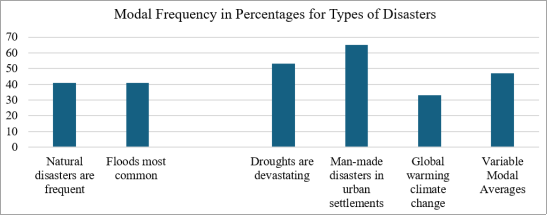
Types of Disasters | 1 | 2 | 3 | 4 | 5 | N | Mode% |
|---|---|---|---|---|---|---|---|
Natural disasters such as floods, landslides, droughts, and earthquakes frequently occur in my area. | 28 | 14 | 32 | 103 | 76 | 253 | 103/253*100 =40.71%% (Agree) |
Floods are the most common and destructive natural disasters affecting lives, property, and livelihoods in Uganda. | 19 | 31 | 35 | 104 | 64 | 253 | 104/253*100= 41.11% (Agree) |
Droughts frequently lead to crop failure, food shortages, and livestock deaths in my community. | 32 | 40 | 33 | 134 | 14 | 253 | 134/253*100=52.96% (Agree) |
Man-made disasters such as road accidents, industrial explosions, and urban fires are also common. | 32 | 0 | 45 | 165 | 11 | 253 | 165/253*100= 65.22% (Agree) |
Climate change has increased the frequency and intensity of floods, droughts, and landslides. | 25 | 21 | 44 | 84 | 79 | 253 | 84/253*100= 33.20% (Agree) |
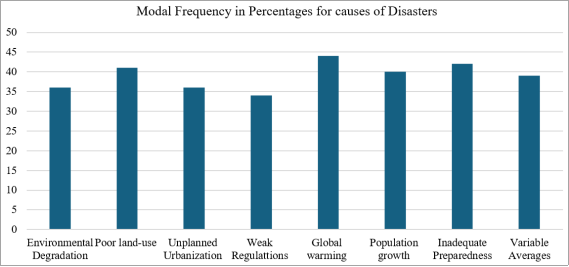
Causes of Disasters | 1 | 2 | 3 | 4 | 5 | N | Mode% |
|---|---|---|---|---|---|---|---|
Deforestation and environmental degradation have increased the risk of floods and landslides. | 26 | 14 | 47 | 91 | 75 | 253 | 91/253*100= 35.96% (Agree) |
Poor land-use practices and cultivation on steep slopes make communities more prone to disasters. | 21 | 4 | 40 | 104 | 84 | 253 | 104/253*100= 41.11% (Agree) |
Rapid and unplanned urbanization has worsened flooding in towns such as Kampala. | 30 | 41 | 8 | 83 | 91 | 253 | 91/253*100=35.96% (strongly Agree) |
Weak enforcement of environmental and safety regulations contributes to man-made disasters. | 25 | 27 | 50 | 64 | 87 | 253 | 87/253*100=34.39% (strongly Agree) |
Climate variability and global warming have made weather patterns more unpredictable. | 19 | 6 | 28 | 90 | 110 | 253 | 110/253*100=43.48% (strongly Agree) |
Population growth and encroachment on wetlands and riverbanks increase disaster vulnerability. | 28 | 12 | 38 | 100 | 75 | 253 | 100 /253*100=39.53% (Agree) |
Poor institutional coordination and inadequate disaster Preparedness systems worsen disaster impacts. | 7 | 7 | 40 | 94 | 105 | 253 | 105/253*100=41.50% (Agree) |
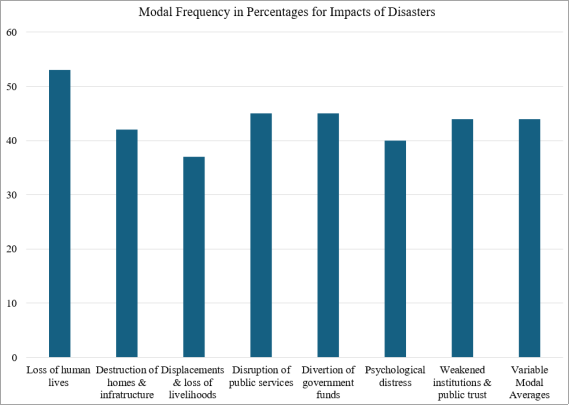
Impacts of Disasters | 1 | 2 | 3 | 4 | 5 | N | Mode % |
|---|---|---|---|---|---|---|---|
Disasters in my community have destroyed homes, schools, and public infrastructure such as roads and bridges. | 7 | 0 | 40 | 100 | 106 | 253 | 106/253*100= 41.90%(strongly Agree) |
Disasters often cause displacement and loss of livelihoods among community members. | 18 | 21 | 58 | 118 | 38 | 253 | 118/253*100= 46.64% (Agree) |
Disasters have led to loss of human lives and livestock, reducing household income and food security. | 11 | 7 | 43 | 134 | 58 | 253 | 134/253*100= 52.96% (Agree) |
Floods and landslides have disrupted access to healthcare, education, and markets. | 0 | 30 | 51 | 94 | 78 | 253 | 94/253*100= 37.15% (Agree) |
Disasters have long-term economic impacts by diverting government funds from development to relief operations. | 7 | 0 | 33 | 114 | 99 | 253 | 114/253*100= 45.06% (Agree) |
People affected by disasters often suffer psychological distress such as trauma, anxiety, and depression. | 12 | 58 | 83 | 100 | 253 | 100/253*100=39.53% (Strongly Agree) | |
Institutional weaknesses delay disaster response and prolong community recovery. | 18 | 5 | 46 | 72 | 112 | 253 | 112/253*100=44.27% (Strongly Agree) |
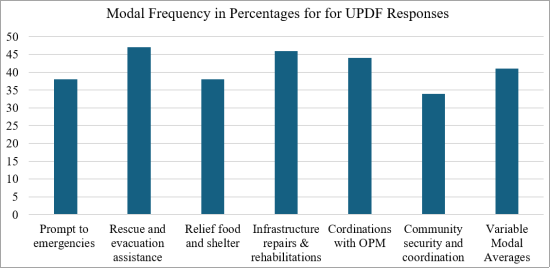
Statement | 1 | 2 | 3 | 4 | 5 | N | Mode% |
|---|---|---|---|---|---|---|---|
The UPDF responds promptly to disasters in my community. | 7 | 29 | 36 | 86 | 95 | 253 | 95/253*100= 37.53% (Strongly Agree) |
UPDF officers have provided rescue and evacuation assistance during emergencies. | 21 | 5 | 43 | 118 | 66 | 253 | Agree 118/253*100= 46.64% (Agree) |
The UPDF distributes relief items such as food, shelter, and medical supplies to affected persons. | 28 | 7 | 35 | 86 | 97 | 253 | 97/253*100= 38.34% (Strongly Agree) |
UPDF engineers assist in rebuilding roads, bridges, and public infrastructure after disasters. | 4 | 4 | 75 | 53 | 117 | 253 | 117/253*100= 46.25% (Strongly Agree) |
The UPDF works well with the Office of the Prime Minister (OPM) and humanitarian agencies during disaster response. | 7 | 25 | 51 | 86 | 84 | 253 | 86/253*100= 33.99% (Agree) |
The presence of the UPDF during disasters enhances community security and coordination. | 12 | 15 | 56 | 86 | 84 | 253 | 86/253*100= 33.99% (Agree) |
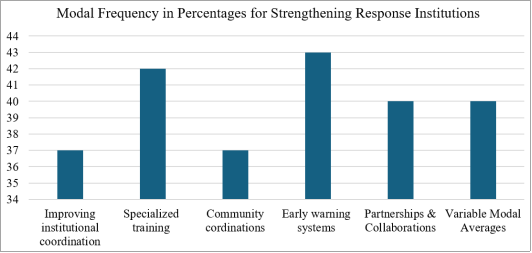
Statement | 1 | 2 | 3 | 4 | 5 | N | Mode% |
|---|---|---|---|---|---|---|---|
Disaster response in Uganda can be improved through better coordination among institutions. | 14 | 6 | 58 | 93 | 82 | 253 | 93/253*100= 36.76% (Agree) |
UPDF officers should receive specialized training in disaster management. | 39 | 25 | 53 | 107 | 29 | 253 | 107/253*100= 42.29% (Agree) |
Community-based disaster preparedness programs are essential for resilience. | 28 | 0 | 47 | 93 | 85 | 253 | 93/253*100= 36.76% (Agree) |
The government should establish early warning systems in all high-risk districts. | 28 | 21 | 6 | 89 | 109 | 253 | 109/253*100= 43.08% (Strongly Agree) |
Partnerships between UPDF, NGOs, and local authorities can enhance effective response. | 21 | 26 | 49 | 56 | 101 | 253 | 101/253*100= 39.92% (Strongly Agree) |
| [1] | Aon. (2023). Global catastrophe recap: First half of 2023. |
| [2] | Athukorala, P., & Resosudarmo, B. P. (2016). The Indian Ocean tsunami: Economic impact, disaster management, and lessons. Asian Economic Papers, 15(1), 1-35. |
| [3] | Ayal, D., & Adugna, E. (2018). Institutional coordination and climate early warning in the Horn of Africa. Journal of Climate Services, 12(3), 45-57. |
| [4] | Ayal, D., & Adugna, S. (2018). The dynamics of early warning systems in the Horn of Africa: Achievements and challenges. International Journal of Disaster Risk Reduction, 31, 712-720. |
| [5] | Baras, R., Kim, J., & Atwine, G. (2022). Climate change and disaster risk trends in East Africa: The case of Uganda. Journal of Environmental Studies, 45(3), 220-236. |
| [6] | Barasa, B., Nakileza, B., Mugagga, F., Nseka, D., Opedes, H., Makoba Gudoyi, P., & Ssentongo, B. (2022). Natural hazards magnitude, vulnerability, and recovery strategies in the rwenzori mountains, southwestern Uganda. In Remote sensing of African mountains: Geospatial tools toward sustainability (pp. 83-116). Cham: Springer International Publishing. |
| [7] | Barasa, L. (2020). Disaster preparedness and institutional response in Uganda: Policy and practice gaps. Journal of African Disaster Studies, 12(2), 45-60. |
| [8] | Barasa, L. (2020). Policy frameworks for disaster management in Uganda: Gaps and lessons. African Policy Review, 7(2), 87-104. |
| [9] | Basher, R. (2020). Global early warning systems for natural hazards: Systematic and people centered. International Journal of Disaster Risk Science, 11(4), 495-507. |
| [10] | Bricknell, M., Heinecken, L., & Leuprecht, C. (2025). Comparative Perspectives on Domestic Emergencies, Pandemic Response, and Civil-Military Relations. Military Operations in Response to Domestic Emergencies and Global Pandemics, 471. |
| [11] | Center for Research on the Epidemiology of Disasters (CRED). (2021). EM-DAT: The international disaster database. |
| [12] | Chen, W. (2021). China’s military builds emergency hospitals in Wuhan amid COVID-19 outbreak. Beijing: People’s Daily. |
| [13] | Climate. gov. (2023). 2023 historic year: US billion-dollar weather and climate disasters. |
| [14] | CRED. (2021). Annual disaster statistical review 2021: The numbers and trends. Brussels: Centre for Research on the Epidemiology of Disasters. |
| [15] | CRED. (2021). EM-DAT: The International Disaster Database. Centre for Research on the Epidemiology of Disasters. |
| [16] | ECHO. (2024). Uganda: Floods and landslides - situation report No. 2, September 2024. European Civil Protection and Humanitarian Aid Operations. |
| [17] | Egnell, R. (2016). Military involvement in humanitarian assistance: Reflections on NATO’s evolving role. Journal of International Peacekeeping, 20(3-4), 223-240. |
| [18] | Elapata, D., & De Silva, L. (2021). Human factors in disaster causation and response capacity in Sub-Saharan Africa. African Journal of Disaster Management, 12(2), 101-118. |
| [19] | Elapata, M. S., & De Silva, D. A. M. (2021). Natural Versus Manmade Disasters: Impact of Disasters on Small Holder Agricultural Systems in Gem Mining Areas of Sri Lanka. In Multi-Hazard Early Warning and Disaster Risks (pp. 197-210). Cham: Springer International Publishing. |
| [20] | Escobar, H. (2019). Brazil’s military joins fight against Amazon fires. Science, 365(6456), 853. |
| [21] | European Commission. (2025). EU Civil Protection Mechanism: Annual operations report 2024-2025. Brussels: European Union Publications. |
| [22] | European Environment Agency. (2021). Climate change impacts in Europe. |
| [23] | Gaillard, J. C., & Mercer, J. (2019). From knowledge to action: Bridging gaps in disaster risk reduction. Progress in Human Geography, 43(3), 415-434. |
| [24] | Hillman, A. J., Withers, M. C., & Collins, B. J. (2009). Resource dependence theory: A review. Journal of Management, 35(6), 1404-1427. |
| [25] | Hoeppe, P. (2016). Trends in weather-related disasters: Consequences for insurers and society. Weather and Climate Extremes, 11(1), 70-79. |
| [26] | IFRC. (2024). Uganda: Floods and landslides emergency report - November 2024. International Federation of Red Cross and Red Crescent Societies. |
| [27] | Intergovernmental Panel on Climate Change (IPCC). (2022). Climate change 2022: Impacts, adaptation and vulnerability. |
| [28] | International Federation of Red Cross and Red Crescent Societies. (2024). Uganda: Floods and landslides situation report. IFRC. |
| [29] | Kabunga, A., Okalo, P., & Nalwoga, S. (2022). Prevalence and correlates of post-traumatic stress disorder among survivors of landslides in Bududa district, Uganda. BMC Psychology, 10(1), 1-12. |
| [30] | Kabunga, N., Aluma, C., & Nanyonga, R. (2022). Psychological impacts of natural disasters: The case of Bududa landslide survivors in Uganda. Journal of Trauma and Mental Health, 15(2), 88-103. |
| [31] | Kagoya, M., & Bongo, A. (2020). Climate change, disasters, and governance in Uganda: Strengthening local capacity for resilience. African Journal of Public Policy, 6(2), 55-73. |
| [32] | Kagoya, S., & Bongo, G. (2020). Community resilience and early warning systems in Uganda’s disaster management framework. African Journal of Policy and Governance, 7(1), 54-69. |
| [33] | Khanakwa, P. (2023). Environmental risk management from below: living with landslides in Bududa, eastern Uganda. Journal of Eastern African Studies, 17(3), 384-403. |
| [34] | Kiggundu, A., & Nanfuka, P. (2022). Civil-military cooperation in pandemic response: Uganda’s experience during COVID-19. African Journal of Governance and Development, 11(1), 55-72. |
| [35] | Komutunga, E., Mugisha, J., & Owor, M. (2019). Community perceptions and military involvement in disaster response: A case of the Bududa landslides. African Journal of Disaster Studies, 13(2), 45-59. |
| [36] | Kusiima, J., & Tamale, S. (2024). Women’s knowledge and perception of flood disasters in Butaleja District, Uganda. Progress in Disaster Science, 25, 100399. |
| [37] | Kyetume, A., Nankunda, F., & Opio, J. (2020). Challenges of military-led disaster management in East Africa. Journal of African Security Studies, 8(1), 73-88. |
| [38] | L. Von Bertalanffy, JW Sutherland, General Systems Theory: Foundations, developments and applications, IEEE Transactions on systems, Man, and Cybernetics, 592-612, 1974. |
| [39] | Meyer, J. W., & Rowan, B. (1977). Institutionalized organizations: Formal structure as myth and ceremony. American Journal of Sociology, 83(2), 340-363. |
| [40] | Ministry of Defence and Veteran Affairs. (2023). FAQs. Government of Uganda. Retrieved from |
| [41] | Mugenda, M. O and Mugenda, A. G (2003). Research Methods: Quantitative, Qualitative and Mixed Methods Approaches. ACT Press Nairobi. |
| [42] | Mugisha, J., Mutyaba, E., & Kasozi, A. (2021). Assessing interoperability in Uganda’s disaster management system: Implications for coordination and response. Journal of Disaster Risk Studies, 13(1), a956. |
| [43] | Mugisha, P., Owor, M., & Kamya, D. (2021). Institutional coordination and disaster risk management in Uganda: Challenges and opportunities. Journal of African Public Policy, 9(3), 212-228. |
| [44] | Mugisha, R., & Nanfuka, P. (2021). Military logistics and humanitarian operations in Uganda: The role of UPDF in natural disaster management. Defence and Security Review, 12(3), 90-108. |
| [45] | Mugume, H. (2023). Civil-military coordination in disaster response in Uganda: Emerging lessons and policy gaps. Makerere Policy Review Journal, 15(1), 33-51. |
| [46] | Musinguzi, D., & Smith, L. (2021). Financial inclusion and resilience to natural disasters in rural Uganda. Sustainability, 13(9), 5055. |
| [47] | Mwesigye, F., & Matsumoto, T. (2016). The effect of population pressure on land use and disaster vulnerability in Uganda. African Development Review, 28(1), 63-75. |
| [48] | Nabwire, D., & Owor, J. (2023). Community-based rehabilitation and relocation outcomes in Bulambuli District. East African Journal of Social Studies, 9(1), 112-130. |
| [49] | Nakiyemba, J. (2022). Government and military coordination in emergency food relief during COVID-19 lockdowns: Uganda’s case study. Journal of Social Policy and Administration, 56(4), 102-119. |
| [50] | National Emergency Coordination and Operations Centre (NECOC). (2020). Annual state of disaster report 2020. Office of the Prime Minister, Government of Uganda. Retrieved from |
| [51] | NDRR. (2020). Global Assessment Report on Disaster Risk Reduction. United Nations Office for Disaster Risk Reduction. |
| [52] | Njiru, B. (2018). Community early warning systems and resilience in Kenya: Linking climate adaptation to disaster risk reduction. African Journal of Environmental Science and Technology, 12(4), 155-163. |
| [53] | Office of the Prime Minister (OPM). (2021). Annual disaster preparedness and response report 2020/2021. Government of Uganda. |
| [54] | Office of the Prime Minister (OPM). (2021). Bududa Landslide Disaster Report 2018. Government of Uganda. |
| [55] | Office of the Prime Minister. (2022). National report on disaster preparedness and response 2021-2022. Government of Uganda. |
| [56] | Phillips, B. D., & Mincin, J. (2023). Disaster recovery. Routledge. |
| [57] | Shauri, H. S., Mutubwa, H. M., & Musa, T. M. (2020). The perception of peace actors regarding the nexus between criminal gangs and violent extremism in the Coast of Kenya. Journal of African Conflicts and Peace Studies, 1(1), 1-19. |
| [58] | Spiridonov, P., Ćurić, M., & Novkovski, T. (2025). Natural hazards and risk assessment in the global context. International Journal of Environmental Research, 18(1), 33-49. |
| [59] | Spiridonov, V., Ćurić, M., & Novkovski, N. (2025). Exploring Natural Hazards: From Earthquakes, Floods, and Beyond. In Atmospheric Perspectives: Unveiling Earth's Environmental Challenges (pp. 271-306). Cham: Springer Nature Switzerland. |
| [60] | Ssentongo, J., Mugume, A., & Nsubuga, L. (2020). Floods, landslides, and rural livelihoods in Uganda: Evidence from Eastern Uganda. Environmental Economics and Policy Studies, 22(2), 233-249. |
| [61] | Ssentongo, P., Tugume, S., & Nakalema, R. (2020). Agricultural productivity and natural disasters: Evidence from flood-prone regions in Eastern Uganda. African Journal of Agricultural Research, 15(7), 1025-1035. |
| [62] | Uganda National Meteorological Authority [UNMA]. (2019). State of the climate in Uganda 2019. Kampala: Government of Uganda. |
| [63] | Uganda Police Force. (2014). Annual crime and safety report 2014. Kampala: Government of Uganda. |
| [64] | UNDRR. (2020). Disaster risk reduction in Africa: Uganda country profile 2020. Geneva: United Nations Office for Disaster Risk Reduction. |
| [65] | UNICEF. (2024). Almost 1 million people in Kenya, Burundi, Tanzania, and Somalia affected by unprecedented flooding. |
| [66] | UNICEF. (2024). Uganda humanitarian situation report: Floods and displacement. Kampala: United Nations Children’s Fund. |
| [67] | United Nations Office for Disaster Risk Reduction. (2022). Country profile: Uganda - Strengthening institutional capacity for disaster management. UNDRR. |
| [68] | United Nations Office for Disaster Risk Reduction. (2023). Global Assessment Report on Disaster Risk Reduction 2023: A safer world for everyone. UNDRR. |
| [69] | United Nations Office for the Coordination of Humanitarian Affairs (UNOCHA). (2020). The role of armed forces in disaster response: Guidelines for effective coordination. United Nations. |
| [70] | World Health Organization. (2021). Uganda emergency health response capacity assessment. WHO Africa Regional Office. |
| [71] | World Meteorological Organization (WMO). (2018). Multi-hazard early warning systems: A checklist. Geneva: WMO. |
| [72] | World Meteorological Organization (WMO). (2021). State of the global climate 2020. |
| [73] | Yamane, T. (1967). Statistics: An introductory analysis (2nd ed.). New York, NY: Harper & Row. |
| [74] | Zhou, Y., Wang, J., & Wang, H. (2019). Risk assessment models for infrastructure resilience under natural disasters. Safety Science, 118, 349-356. |
| [75] | Time. (2017, September 5). Hurricane Harvey: How the U.S. military mobilized for one of the largest relief efforts in history. Time Magazine. |
| [76] | The Conversation. (2019, March 27). Cyclone Idai: How the military is helping flood victims in Mozambique, Malawi, and Zimbabwe. The Conversation. |
| [77] | Daily Monitor. (2019, June 7). UPDF deployed in Bududa landslide rescue operations. Daily Monitor. |
| [78] | African Centre for Strategic Studies. (2021, March 15). African militaries’ role in pandemic response. |
| [79] | Human Rights Watch. (2021, April 21). Uganda: Respect rights in COVID-19 response. Human Rights Watch. |
| [80] | Ahimbisibwe, P. (2021, May 5). UPDF takes lead in enforcing COVID-19 lockdown. Daily Monitor. |
| [81] | International Crisis Group. (2021, June 24). The climate-security nexus in the Sahel. Brussels: International Crisis Group. |
| [82] | OCHA. (2022, August 30). Sierra Leone floods: Situation report. United Nations Office for the Coordination of Humanitarian Affairs. |
| [83] | World Health Organization. (2022, October 9). Cholera outbreak - Tanzania. World Health Organization. |
| [84] | New Vision. (2022, October 14). UPDF engineers repair roads, bridges destroyed by floods in Eastern Uganda. New Vision. |
| [85] | United Nations High Commissioner for Refugees (UNHCR). (2023, February). Uganda country refugee response plan 2022-2023. UNHCR. |
| [86] | Economic Times. (2024, February 29). Exercise Raahat: Army, NDRF join forces for disaster relief excellence in Nagaland. |
| [87] | ECHO. (2024, September 10). Uganda - Floods in Kasese District (DG ECHO Daily Flash). European Civil Protection and Humanitarian Aid Operations. |
| [88] | IFRC. (2024, December 18). Uganda: Floods and Landslides - Emergency Appeal No. MDRUG046. International Federation of Red Cross and Red Crescent Societies. |
| [89] | Times of India. (2025, July 18). Army deploys drones and cableways to rescue villagers hit by Arunachal floods. The Times of India. |
APA Style
Shillingi, C. K., Ohndyl, C. O. G. (2026). Uganda People's Defence Forces Roles in Disaster Management. Journal of Political Science and International Relations, 9(3), 161-174. https://doi.org/10.11648/j.jpsir.20260903.14
ACS Style
Shillingi, C. K.; Ohndyl, C. O. G. Uganda People's Defence Forces Roles in Disaster Management. J. Polit. Sci. Int. Relat. 2026, 9(3), 161-174. doi: 10.11648/j.jpsir.20260903.14
@article{10.11648/j.jpsir.20260903.14,
  author = {Colonel Kenneth Shillingi and Colonel Otieno Godfred Ohndyl},
  title = {Uganda People's Defence Forces Roles in Disaster Management},
  journal = {Journal of Political Science and International Relations},
  volume = {9},
  number = {3},
  pages = {161-174},
  doi = {10.11648/j.jpsir.20260903.14},
  url = {https://doi.org/10.11648/j.jpsir.20260903.14},
  eprint = {https://article.sciencepublishinggroup.com/pdf/10.11648.j.jpsir.20260903.14},
  abstract = {This study examines the role of Uganda People’s Defence Forces (UPDF) in disaster management and response. The study is necessary to address gaps in national government crisis and disaster response and coordination mechanisms. The specific objectives were to examine types, causes, and impacts of disasters in Uganda, assess role of UPDF and identify strategies for strengthening national crises response mechanisms by government. The research adopted mixed methods approaches, utilizing both qualitative and quantitative methods. The study using Yamane sample size formula, applied stratified simple sampling to identify 384 respondents from 5 million target population frequently affected by disasters in Uganda. The study areas were West Nile sub-region, (drought and refugee influx), Bududa District (landslides), and Kasese District (flooding of River Nyamwamba). Data was quantitatively analysed using SPSS through nonparametric descriptive statistics generating tables, pie-charts, and bar graphs. The study found that floods and droughts are the most prevalent disasters in Uganda, largely driven by climate variability, deforestation, unplanned urbanization, population pressure and weak institutional policies. The study recommends strengthening Office of the Prime Minister, Disaster Preparedness and Management and UPDF response capabilities with specialised surveillance infrastructure, equipment, training of technical personnel, acquisition of early warning AI driven technology and sufficient budgetary allocations for proactive planning, responses, control and management. Civil-Military coordination with humanitarian agencies for efficiency and effectiveness. The Uganda government should also establish permanent communication channels in areas prone to disasters for flowless communication, reporting, coordination, response and management as part of overall national development, defence and security strategy.},
 year = {2026}
}
TY  - JOUR
T1  - Uganda People's Defence Forces Roles in Disaster Management
AU  - Colonel Kenneth Shillingi
AU  - Colonel Otieno Godfred Ohndyl
Y1  - 2026/07/30
PY  - 2026
N1  - https://doi.org/10.11648/j.jpsir.20260903.14
DO  - 10.11648/j.jpsir.20260903.14
T2  - Journal of Political Science and International Relations
JF  - Journal of Political Science and International Relations
JO  - Journal of Political Science and International Relations
SP  - 161
EP  - 174
PB  - Science Publishing Group
SN  - 2640-2785
UR  - https://doi.org/10.11648/j.jpsir.20260903.14
AB  - This study examines the role of Uganda People’s Defence Forces (UPDF) in disaster management and response. The study is necessary to address gaps in national government crisis and disaster response and coordination mechanisms. The specific objectives were to examine types, causes, and impacts of disasters in Uganda, assess role of UPDF and identify strategies for strengthening national crises response mechanisms by government. The research adopted mixed methods approaches, utilizing both qualitative and quantitative methods. The study using Yamane sample size formula, applied stratified simple sampling to identify 384 respondents from 5 million target population frequently affected by disasters in Uganda. The study areas were West Nile sub-region, (drought and refugee influx), Bududa District (landslides), and Kasese District (flooding of River Nyamwamba). Data was quantitatively analysed using SPSS through nonparametric descriptive statistics generating tables, pie-charts, and bar graphs. The study found that floods and droughts are the most prevalent disasters in Uganda, largely driven by climate variability, deforestation, unplanned urbanization, population pressure and weak institutional policies. The study recommends strengthening Office of the Prime Minister, Disaster Preparedness and Management and UPDF response capabilities with specialised surveillance infrastructure, equipment, training of technical personnel, acquisition of early warning AI driven technology and sufficient budgetary allocations for proactive planning, responses, control and management. Civil-Military coordination with humanitarian agencies for efficiency and effectiveness. The Uganda government should also establish permanent communication channels in areas prone to disasters for flowless communication, reporting, coordination, response and management as part of overall national development, defence and security strategy.
VL  - 9
IS  - 3
ER  -
Infantry Unit, Uganda Peoples Defence Forces, Kampala, Uganda
Biography: Colonel Kenneth Shillingi is a senior officer of the Uganda Peoples Defence Forces, the senior officer was a participant of National Defence College-Kenya, NDC Course No 28 - 2025/2026 pursuing higher studies in National Defence, security and strategy at National Defence University-Kenya. He has a wealth of security and operational experience in Command, training, operations and Administration of over 28 years. He has served in security and national stabilization support operations to civil-military operations including support to humanitarian agencies in vast geographic spaces within Uganda and deployments outside Uganda to include DRC, UNMIS Sudan and Somalia. He holds a Bachelor of Business Administration from Makerere University Business School (MUBS), Kampala, Uganda graduate of War College, National Defence College- Kenya.

Research, Innovation & Security Studies, National Defence University-Kenya, Nakuru, Kenya
Biography: Colonel Otieno Godfred Ohndyl is a Research Fellow at National Defence University-Kenya (NDU-K), Division of Research, Innovation & Security Studies. Currently a PhD finalist student in International Studies at Kenyatta University, Kenya. He holds Bachelor of Commerce-Finance, University of Nairobi, master’s in strategic planning, Jomo Kenyatta University of Agriculture and Technology, Masters in Defence & Security, Cranfield University-United Kingdom, Masters in National Security & Strategy, NDU-K, Postgraduate Diploma in Strategic Studies, UoN, Diplomas in Management and supply and a member of the Kenya Institute of Management. Has over 33 years of military service, international peacekeeping experiences, has taught several cohorts of UN Planning, peacekeeping and pre-deployment courses at the International Peace Support Training Centre (IPSTC), Karen-Nairobi and worked with, Eastern Africa Standby Force, United Nations and African Union Peacekeeping missions

Information



 Share This Article
 Twitter
 Linked In
 Facebook
 Copy
Copy Download