Research Article | | Peer-Reviewed

Shadows of Influence: Money Laundering, Corruption, Black Market and Socio-economic Development Worldwide: A PLS-SEM Analysis

Received: 19 August 2025     Accepted: 3 September 2025     Published: 9 March 2026
Views:       Downloads:
Abstract

The intricacies surrounding the measurement and modelling of money laundering (ML), corruption (COR), and black-market prevalence (BMP), as well as their effects on socio-economic development (SD), introduce significant challenges to accurately capturing and understanding these phenomena. There is a plethora of theories on individual measurements of each concept, but regrettably, they are not immune to criticism, and no such explicit approach is available to study the nexus between these complex concepts. The current study employs the multiple indicator approach to measure ML, COR, and SD, and utilizes the PLS-SEM approach to explore the relationships between these complex concepts, with a focus on the mediating role of the BMP. The per capita investment (PCI) expenditures, modelled through the multiple indicator approach, have been used as the control variables. The study has adopted a data-driven approach to conduct pre- and post-estimation analysis for the constructs and validate the results for a cross-section of 198 countries in 2022. The results indicate that the impact of corruption on socio-economic development is negative and statistically significant. The black market has a direct, negative, and significant impact on socio-economic development; similarly, the BMP has a positive and significant effect on ML. In addition to the direct impact on socio-economic development, BMP also indirectly affects SED through the ML. The direct effects of ML on SED are adverse, while it has an indirect positive impact on SED through its significant multiplier effect on per capita investment. These findings have implications for anti-money laundering and anti-corruption policies worldwide.

Published in Research & Development (Volume 7, Issue 1)
DOI 10.11648/j.rd.20260701.11
Page(s) 1-23
Creative Commons

This is an Open Access article, distributed under the terms of the Creative Commons Attribution 4.0 International License (http://creativecommons.org/licenses/by/4.0/), which permits unrestricted use, distribution and reproduction in any medium or format, provided the original work is properly cited.

Copyright

Copyright © The Author(s), 2026. Published by Science Publishing Group

Keywords

PLS-SEM, Money Laundering, Black Market, Socio-economic Development, Corruption

1. Introduction
Money laundering, a ubiquitous global predicament, transcends geographical confines, infiltrating the networks of international finance. In an epoch where capital flows seamlessly across borders, the covert act of money laundering has emerged as a formidable challenge to the sanctity of financial systems on a global scale. Employing ever-shifting stratagems, money launderers deftly exploit the intricacies of contemporary economies, navigating through the cavities in regulatory frameworks and capitalizing on technological advancements. This illicit process involves obscuring the origins of unlawfully acquired gains, cloaking them in an aura of legitimacy through a labyrinthine tapestry of transactions. The repercussions of money laundering extend far beyond economic distortions, acting as a catalyst for corruption, bankrolling organized crime, and eroding the bedrock of trust within societies. As nations grapple with the convoluted terrain of financial malfeasance, comprehending the dynamics and worldwide dimensions of money laundering becomes imperative. Such understanding is crucial for formulating efficacious countermeasures and fostering international collaboration to uphold the integrity of the global financial ecosystem.
The International Monetary Fund (IMF) report on the statistics of money laundering around the globe indicates that the estimated amount of money laundered globally in one year is 2% – 5% of global GDP, or equal to an amount of approximately $1.6 to $ 4 trillion based on the global GDP figures. “The United Nations Office on Drugs and Crime has reported that the amount of illicit money that flows around the globe is estimated to be 2% – 5% of the global GDP, or equivalent to $800 billion - $ 2 trillion in current US$. The amount of money laundered is difficult to estimate due to the clandestine nature of the money laundering . The Global Financial Integrity report on money laundering (ML) has revealed that from 2005 to 2016, the potential illicit inflows in and out of the developing world were reported between 20 to 30 percent of the trade between the developing countries. These figures, despite a rough approximation of the size of ML, highlight that money laundering is not a unidirectional play but has multiple facets. This characterization aligns with the reality that money laundering is a dynamic and evolving challenge that perpetrators approach from different angles, exploiting vulnerabilities in financial systems, regulatory frameworks, and international cooperation. The other intervening factors for the ML include the black markets, corruption, and/ or shadow economy .
The complex interaction between money laundering, corruption, and the black market presents a formidable challenge to socio-economic development globally. Corruption, acting as a catalyst, facilitates and actively nurtures an environment conducive to money laundering and black-market activities. In this symbiotic relationship, the black market becomes a haven for integrating illicit funds generated through corrupt practices (UNODC), perpetuating a cycle of illegal wealth accumulation. This collusion erodes governance structures, compromises regulatory frameworks, and undermines the rule of law. The impact reverberates across the economic landscape, hindering legitimate businesses, diverting resources from essential public services, and exacerbating socio-economic disparities . The consequences extend to weakened institutions, increased social inequality, and global economic repercussions. The tapestry woven by the clandestine activities of money laundering, corruption, and black markets unfurls as a sophisticated tableau of illicit financial dealings, posing formidable challenges for empirical quantification. Money laundering, in its essence, entails the surreptitious concealment of the nefarious origins of funds procured through criminal enterprises. This illicit wealth is discretely maneuvered through the complex series of transactions, finding refuge in the shadows of legal channels. Simultaneously, the black-market acts as a covert agora where illicit exchanges of goods and services transpire, often capitalizing on corrupt alliances to ensure the unimpeded flow of operations. Measuring the empirical interrelations within this convoluted network demands a paradigm, considering these phenomena' surreptitious and ever-evolving nature.
A vast body of literature on modelling money laundering was the first serious attempt to quantify money laundering worldwide. Similarly, used the Walker model to estimate money laundering in the case of the Netherlands and the gravity model used by and Tanzi from the IMF used the proxy variable (difference between the money supply and money circulating in the economy) to measure money laundering. Other approaches were to use the dynamic multiple indicator and multiple causes models (MIMIC) from the shadows economy to measure money laundering. Similarly, various methods of measurement of corruption are known in the literature.
Corruption is commonly defined as the “abuse of public office for private gain” . Substantial scholarly research has explored the various impacts of corruption on socioeconomic systems . Since the late ninety’s the empirical economics literature has seen a significant expansion due to the improved quality and accessibility of data related to (perceived) corruption. This body of literature raises three primary criticisms. The initial concern revolves around the reliability of indexes on (perceived) corruption used to gauge the extent of corrupt practices. Recent critical perspectives cast doubt on whether perception-based indicators can serve as dependable proxies for actual corruption . For example, Treisman suggests variations in countries' perceived corruption scores are largely associated with national cultural stereotypes or extensive media coverage of corruption scandals rather than reflecting the true extent of corrupt activities.
A secondary critique revolves around the tendency to perceive "corruption as unidimensional and synonymous with bribery ”. argues that other manifestations of corruption (e.g., favouritism, improper interference, conflicts of interest), more prevalent in developed nations, are inadequately addressed by conventional corruption-perception indexes, which predominantly focus on bribery. A burgeoning body of literature highlights recognizing diverse "forms" of corruption. For example, Dincer and Johnston delineate between legal and illegal corruption based on the nature of gains acquired by public officials in exchange for providing specific benefits to private entities. Illegal corruption transpires when public office is exploited for personal gains through cash or gifts to a government official.
Conversely, legal corruption unfolds when the misuse of power aims for political gains, such as campaign contributions or endorsements by a government official, often associated with lobbying activities. An alternative classification of corruption introduces the dichotomy of "High level" or "Grand" corruption versus "Low level" or "Petty" corruption . "Grand" corruption denotes misconduct at the upper echelons involving leading politicians, encompassing illegal and legal corrupt practices. In contrast, "Petty" corruption entails covert payments to expedite administrative processes, such as bribes to evade fines or hasten waiting lists for public services, typically involving administrators and bureaucrats. Considering the variability in the extent to which bribery can serve as a representative measure for overall corruption, contingent upon the political system's nature and the level of economic development, Andersson concludes that in well-established democracies with highly developed economies and minimal corruption, conventional perceived-corruption indexes may exhibit inadequacy. The third objection centres on the observation that earlier and more recent inquiries into corruption often manifest conflicting outcomes, instigating uncertainties regarding the trustworthiness of estimated corruption indices due to statistical disparities. The prevailing interpretation of these divergent findings suggests that, at least partially, the inconsistencies arise from adopting more sophisticated econometric methodologies, expanded datasets, or a fusion of both, which are accessible for recent analyses .
Similarly, the black economies are again a difficult task to model. This is normally reported in the form of an informal economy. Assessing the dimensions of the Unofficial Economy (UE) holds significance within the economic domain, as data about the UE facilitates the dissection of economic growth into formal and informal origins. This breakdown proves crucial when devising policies to address economic fluctuations and structural concerns . The impact of the UE reverberates through various channels, exerting notable repercussions on diverse facets of a country's economic and social fabric. On the one hand, it introduces inefficiencies in goods and labor markets, exacerbates challenges within economic and social institutions, diminishes tax revenues, and curtails potential investments in critical public sectors such as infrastructure, education, research, and health.
Conversely, the UE generates supplementary value that can be infused into the official economy. Particularly in less developed economies or nations grappling with elevated unemployment rates, the UE often serves as a societal safety net, providing job opportunities for those with lower skill sets and financial constraints. The magnitude of the UE also exerts indirect effects on society. For instance, views informal activities as efficient market responses that arise due to excessive regulation and governmental constraints . Consequently, the UE can be construed as a "signal" to policymakers, indicating burdensome regulation, taxation, and other distortions induced by the government. Given the multifaceted impacts of informality on economic growth and income distribution, understanding the scale of the UE transcends the realm of econometric analysis; it stands as a pivotal subject within the field of economics.
Broadly, the literature on the Informal Economy (IE) typically revolves around three primary subjects. Firstly, there is a concern regarding definition—essentially, what constitutes "informal." Secondly, there is an issue related to measurement—how one gauges its extent. Lastly, there's the exploration of theoretical explanations surrounding the concept of "informality."
Despite the measurement and methodological inaccuracies, much of the focus of the researchers has been on the individual measurement of money laundering (ML), corruption (C), and unofficial economies (UE) or black markets. Limited literature exists on the discernible relationship between money laundering, corruption, and socio-economic development. The available literature is divided into two extremes: the economic and non-economic consequences of money laundering . In line with existing research, money laundering (ML) exhibits two conflicting impacts on a country's socioeconomic development. First, ML obstructs economic progress due to a trio of interconnected primary factors. Initially, individuals investing in illicit gains prioritize laundering over profit maximization. Consequently, ML engenders an unjust competitive landscape, pitting laundering-centric criminals against profit-focused legal entities when operating within the same market. This results in a diminution of the market's capacity for efficient resource allocation. Secondly, ML redirects resources from sectors with limited capabilities for laundering illicit funds to sectors with heightened turnover or increased reliance on untraceable transactions, such as cash transactions. This reallocation induces a misallocation of resources, diminishing marginal profits in cash-intensive sectors due to excessive investments. Hence, within these sectors, the stabilizing price might be set at a point where it produces unfavourable marginal profits. This scenario poses challenges, making it arduous, if not impracticable, for lawful enterprises to compete with front companies benefiting from subsidized funding. Such a circumstance has the potential to lead to the displacement of private-sector businesses by criminal organizations, as articulated by . As outlined, these adverse allocative effects predominantly impact international trade and capital investments, particularly within the real estate domain.
In Australia's case, Tanzi, V estimated that one million dollars of laundered money decreased the output by 1.2 million dollars because criminals spend and invest less productively. The general findings in the Walker model for Australia case were that the criminal organizations over-invest illegal earnings in sectors where the dirty money is washed away easily. The ML may hinder economic development in several other ways. It may weaken the financial sector due to the entry of illegal money . It may increase the risk of bankruptcy and financial crisis by threatening the financial markets . When taking the role of corruption, found that corruption is positively associated with money laundering. Similarly, findings were suggested by the .
Money laundering (ML) may positively influence economic growth, particularly in developing economies, owing to the reinvestment of laundered illegal funds in the formal economy This assertion finds empirical support in studies by and . examined the multiplier effects of ML in the Dutch economy, concluding that an additional billion in money laundering corresponds to approximately 0.1% additional growth. They discern between short-term effects, where ML appears as a strategic move for rich countries to attract capital inflows, enhance government revenues, and stimulate employment and growth, and long-run effects. However, caution arises as criminal money, as described by , is deemed a ticking bomb due to its potential to attract crime. In the Netherlands, their estimates revealed that one million laundered illegal proceeds, when partially reinvested in further illegal activities, can escalate related crime's money laundering by 10% to 20%, resulting in €1.1 to 1.2 million.
Recent analyses by focusing on Mexican local economies shed light on the dual impact of ML. In the short term, ML, by increasing the investment of illicit funds in legal local businesses such as hotels, villas, malls, and restaurants, leads to improvements in regional economies. Despite raising revenues, expenses, and employment, this windfall attracts additional criminal organizations, resulting in an endogenous increase in violence. Consequently, concludes that these short-term gains are overshadowed by the subsequent rise in criminal violence. Henry and Moses contributed to the literature by investigating the relationship between ML and economic growth in Trinidad and Tobago. Using fraud and narcotics offenses as proxies for ML, their results present a mixed picture, emphasizing the relevance of measurement errors in economic analyses of ML. They find that ML influences economic growth in both the short and long run, with effects that can be both positive and negative depending on the chosen proxy and period.
Lambsdroff et al [47] adopted an overlapping-generations growth model, considering both licit and illicit activities, to analyse the effects of ML. Their findings align with the perspective by calibrating the model to the Colombian economy and simulating estimates of laundered assets. Like . discover that the effects of asset laundering on savings and social welfare are ambiguous, emphasizing the complexity of the relationship between ML and economic indicators. The source of asset laundering plays a pivotal role in determining its impact on aggregate savings and social welfare within an economy. Specifically, if the origins of asset laundering are primarily rooted in drug trafficking, the overall effect tends to be positive.
Conversely, the effect is decidedly negative when asset laundering stems from common crimes. In essence, the fundamental premise underlying this hypothesis is that, in the short term, money laundering (ML) operates as a multiplier, fostering employment and production through the reinvestment of criminal proceeds. It is crucial to note that these studies do not assert that the overall net effect of ML is advantageous for the economy. Instead, they posit that ML contributes to mitigating the adverse externalities spawned by criminal activities, at least in the short run, thereby alleviating their negative impact on economic growth.
It's essential to avoid misconceptions by understanding that this hypothesis posits ML as a multiplier not solely for Gross Domestic Product (GDP) but also for crime, corruption, and terrorism . The surge in these phenomena threatens democratic institutions, incurring a substantial societal cost in the long run. The incongruity between the short- and long-term effects of ML primarily centres on the pivotal role of institutions in the context of economic development. According to , “the main determinant of differences in prosperity across countries is differences in economic institutions,” but changing “the rules of the game in a society” is a complex and slow process that requires several years.
Conversely, a downturn in money laundering (ML) activities promptly triggers adverse effects on economic growth through the ML multiplier. For example, posit that corruption and inefficient institutions influence ML, particularly in developing nations. They specifically highlight the positive correlation between a feeble institutional framework and corruption, emphasizing the often-indispensable role of corruption in the success of an ML process. Implementing anti-money laundering (AML) policies by discouraging corruption and illicit activities improves political and economic institutions in such a scenario. In the long term, this fortification fosters socio-economic development . However, in the interim, AML policies curtail the reinvestment of criminal proceeds in the formal economy or redirect these unlawful gains abroad, thereby diminishing economic growth rates.
In a recent study, investigated the effects of money laundering (ML) and corruption on the socio-economic development in IRAN as a case study for developing countries. They exploited the PLS-SEM approach to draw conclusions regarding the implications of the nexus between ML, Corruption, and socio-economic development (SD). The results showed that ML has a positive overall effect on economic growth in the short run. Further, they argued that this positive effect is due to the multiplicative effect of ML on economic development. The intricacies surrounding measuring and modeling money laundering (ML), corruption, and black-market prevalence introduce significant challenges to accurately capturing and understanding these phenomena. Measurement inaccuracies arise from illicit activities' clandestine and covert nature, making obtaining comprehensive and reliable data difficult. The underreporting of such activities, intentional misrepresentation, and the absence of standardized metrics further compound the issue. Moreover, the dynamic and adaptive nature of ML, corruption, and black-market activities implies that traditional measurement models may struggle to keep pace with evolving tactics. Model inaccuracies stem from the complex relationship of various factors influencing these illicit practices.
This study diverges from the prevailing literature, primarily employing a distinctive methodology. Firstly, it endeavours to construct a latent construct of corruption through the Partial Least Squares Structural Equation Modeling (PLS-SEM) approach, deriving it from observed indicator variables. This choice is prompted by methodological challenges inherent in corruption perception indices and other models, as expounded in the preceding section. Secondly, the study strives to formulate a money laundering index by leveraging available information and the PLS-SEM approach, utilizing composites for enhanced precision. Thirdly, without a well-defined empirical model for measuring black markets or underground economies, the present study adopts a formative measurement approach to articulate a latent variable for the black market, deploying it for comprehensive analysis.
The paramount implication of this study lies in empirically scrutinizing the causal interconnections among money laundering, corruption, and socio-economic development within the context of black markets or underground economies. Methodologically, this study pioneers the application of a multiple indicators approach. At the same time, theoretically, it endeavours to unravel the implicit relationships between money laundering, corruption, socio-economic development, and the mediating influence of the black market. Recognizing the structural relationships posited by the literature, this study adopts PLS-SEM as its analytical framework. With its flexibility and aptitude for handling complex models, PLS-SEM is chosen to provide a clear understanding of the nexus among these critical issues, offering valuable insights into their dynamics.
2. Empirical Method (PLS-SEM)
The Partial Least Squares Structural Equation Modeling (PLS-SEM) approach is employed to empirically analyse the relationships among money laundering, corruption, socioeconomic development. PLS-SEM was chosen for its versatility and suitability in handling complex models, particularly in limited sample sizes or formative constructs. This approach enables the simultaneous examination of reflective and formative measurement models, accommodating the nature of variables such as corruption perception indices and black-market prevalence. By incorporating latent constructs derived from observed indicators, PLS-SEM facilitates a comprehensive understanding of the specified model's causal interconnections and mediation effects The flexibility and robustness of PLS-SEM make it an ideal choice for unravelling the dynamics of these critical socio-economic issues, providing valuable insights into the complexities of the relationships under investigation The PLS-SEM consists of simultaneously measuring the Measurement and Structural models. The PLS-SEM algorithm consists of four iterative steps discussed as under:
Let us assume that we have a sample of size n with the k indicator variables, the k indicator variables are stacked in a data matrix X of the dimension N×K. The kj indicators belonging to one common factor or the composite ηj are grouped to form block j with the j=1,2,3, J. The observations of the block j are stacked in a data matrix Xj of the dimension N×Kj) with the condition that j=1jKj=K. As we know that in PLS-SEM framework the indicators are standardized therefore, the variance covariance matrix presents the sample correlation matrix S.
In the first step of the PLS algorithm the outer weights ŵj0́ (kj×1) of the block j are chosen in such a way that ŵj(0)'Sjjŵj(0)=1, where Sjj is the sample correlation matrix. This condition holds true for all the outer weights. The second step of the PLS algorithm starts with the step one the outer estimation of the ηj is as follows:
η̂j(h)=Xjŵj(h) with ŵj(h)'Sjjŵj(h)=1,  j=1,2,3,,J(1)
Where, η̂j(h) is an (N×1) vector of the outer estimates and ŵj(h) is (kj×1) estimated vector of weights. Since the outer weight are scaled, the outer estimates are also scaled. The superscript in the equation above indicates the hth iteration step.
In the second step the inner proxy of the ηj is calculated as a linear combination of the inner weights and outer proxies of ηj. Thus we have following equation:
η̃j(h) = i=1jeji(h)η̂i(h)(2)
The inner estimates of the latent variables are calculated according to the inner weighting schemes. This defines how the inner proxy of the latent variables is generated. Commonly used weighting schemes are centroid weighting schemes path weighting scheme and factorial weighting scheme Whatever schemes are used they usually give the same results . Hence, if we just consider the path weighting scheme. The inner weights are chosen according to the sign of the correlation between the outer proxies.
eji(h)=sign(ŵj(h)'Sjiŵjh)(3)
eji(h)=sign(ŵj(h)'Sjiŵjh)0, otherwise,for ij, and iff i and j are adjacent(4)
Here, the adjacent refers to the constructs i and j are directly connected by the structural model. The last step of the iterative part is to estimate the outer weights. This is done based on the inner approximation of the latent variables scores. The outer weights are determined based on the type of modes used in the model. The third step is thus to estimate the relationships defined by the mode A or the mode B. the mode A is estimated by the multivariate regression from the construct to its inner proxies, due to the standardization the new estimated outer weights are now the correlation between the inner proxy and its related indicator. Given by the following equation.
ŵj(h+1)i=1jeji(h)Sijŵihwith,ŵjh+1`Sjjŵjh+1=1(5)
For MODE B the outer weights are the regression coefficient of the inner proxy on the connected indicators. For mode B in the partial least squares regression the following regression holds true as in the multiple regression estimation.
ŵj(h+1)=(Xj'Xj)-1Xj'ηj(6)
(Xj'Xj), is a var-covariance matrix of the indicator’s variable. Since the ŵj(h) is standardized therefore, variance covariance matrix is correlation matrix. Using the notation as in the mode A. We have a proportional relationship to the equation.
ŵj(h+1)(Sjj)-1j'=1jSjj'ŵj'hej'i(h)with,ŵjh`Sjjŵjh=1(7)
As we know, when the constructs are modelled as both the composite way and the reflective way then there is some discrepancy in the true population var-cov matrix and the empirical variance covariance matrix. As a result, the estimated coefficient of the outer model is biased upward while the inner model is downward biased. This is corrected by using the PLSc approach by the . They have proposed a proportional constant known as the squared distortion of the population weights to the population loadings given by the following relationship.
ĉj2=ŵj'(Sjj-diagSjj)ŵjŵj'(ŵjŵj'-diagŵjŵj')ŵj'(8)
In the Final step of the PLS-Sem algorithm the ordinary least squares regression is used to estimate the path coefficient between the latent variables.
β̂c=(RX)-1.rxy(9)
This is the standard result of the least squares regression in matrix form. βc now, represents the consistent path coefficients and (RX) is the correlation matrix for the independent variables of the structural models and rxy is the vector of the correlation between the independent and dependent variables.
2.1. The PLS-SEM Specification: Causes, Consequences, and Indicator Variables
The partial least squares structural equation modeling consists of formulating the structural and measurement models connected by the networks of the manifest variables. Keeping in view the potential multi-dimensional causes and consequences of the variables of interest. The present study has formulated the outer model in two ways. The formative measurement model (mode B) and reflective measurement model (mode A). The key variables corruption and socio-economic development have been modelled as mode A, and money laundering black market premium as the formative way. Two control variables, private per capita expenditure and agriculture GDP are measured in a composite way. The relationship between the latent constructs, "how the latent variables are related to each other,” is represented in PLS-SEM terminology by the Structural or inner models. The next section describes the theoretical background and potential reasons for modeling specific constructs reflectively or formatively. The detailed definition and sources of variables are presented in Annex I.
2.2. The Measurement Model
This section briefly describes the measurement model. As per the measurement theory, the constructs are modelled reflectively or formatively. The latent variable may be the effect or may be defined by the causal indicators. So, keeping in view the complex structure and nature of the variables of interest. It is imperative to clearly explain how these variables are defined theoretically and their cause-and-effect relationship.
The latent variable corruption, being inherently elusive to direct measurement, has prompted the development of corruption perceptions indices by various organizations in recent years (notably CPI, first time published by . The global perception barometer GCB published by . World Governance Indicators (WGI) by the World banks; Index of Policy Integrity by the Global Integrity, Trace matrix by the Trace International, Global Integrity published by the centre for public integrity and so on). All these indices originated in the early twenties. Most recently developed indices include the Bayesian Corruption Index and the Sentiment Enhanced Corruption Perception Index by . Several empirical studies have also been conducted by various political and economic advocates using advanced econometrics techniques to gauge the level of corruption around the globe.
The most notable studies include . These indices, spanning a broad spectrum of countries, serve to qualitatively evaluate the prevalence of corruption. In econometric studies, these indices assume roles as dependent variables when scrutinizing corruption's root causes, explanatory variables when exploring its ramifications, or causal indicators in many structural equation modelling applications . So, it is also true that these indices were developed at different times and for other countries' coverage. The present measurement model thus assumes that the maximum available information on corruption can be utilized to construct latent constructs of bribery. As this study consists of a cross-section of the countries, the maximum number of countries must have maximum information on these indices. Based on this assumption. The latent construct of corruption has been measured in a reflective way using four observable proxies.
i. The Bayesian corruption index (BCI) is a composite index of the perceived overall level of corruption proposed by . It lies between 0 and 100, with an increase in the index value indicating the increased level of corruption.
ii. Control of Corruption (CC): Published by the WBG and maintained . This measure of the Control of Corruption captures perceptions of the extent to which public power is exercised for private gain, including petty and grand forms of corruption and the "capture" of the state by elites and private interests.
iii. The political corruption index (pol_corr) is equal to the average of the public sector corruption index as estimated .
iv. Public sector corruption (Pubs_corr): Transparency, accountability, and corruption in the public sector rating (1=low to 6=high), World Bank Group (WBG) CPIA database.
Four formative indicators have measured the latent variable of money laundering (ML). Various attempts have been made to measure the money laundering. The initial effort to quantify global money laundering, known as the "Walker Model" , marked a significant milestone. The prototype model proposed that a staggering 2.85 trillion US dollars were laundered worldwide. applied a comparable methodology to forecast global drug money flows . Subsequently, employed the Walker Model to gauge money laundering in the Netherlands. Money laundering can also be estimated using proxy variables. Like in the case of the United States of America, from the IMF used the difference between the money supply and money circulating in the economy as a proxy for the measurement of money laundering. Another approach commonly cited in the literature is the dynamic multiple indicator multiple causes (DYMIMIC) approach. This approach links two sets of observed variables to unobserved variables. used this approach to measure the shadow economy. Then, the same method was applied to measure money laundering From a methodological perspective, with its modifications, the Walker model is still in practice in measuring money laundering. There has not been much development in the literature on the methodology development of the money laundering measurement. The four formative indicator variables have measured the money laundering variable in this research. Given that maximum information is available in a maximum number of countries. The following indicator variables define a latent construct of money laundering (ML).
i. Drugs trafficking: which is the number of drugs (in kilogram) discovered per 100,000 per person.
ii. Political stability and terrorism; Political Stability and Absence of Violence/Terrorism measures perceptions of the likelihood of political instability and/or politically motivated violence, including terrorism. Estimate gives the country's score on the aggregate indicator in units of standard normal distribution, i.e., ranging from approximately -2.5 to 2.5. This indicator variable is proportional to the conflict variable used in .
iii. Size of the informal economy (infecosiz); The World Bank database of the informal economy. The MIMIC-based estimates of the informal output (% official GDP).
iv. Financial Secrecy Index (FSI): The Financial Secrecy Index ranks jurisdictions most complicit in helping individuals hide their finances from the rule of law. This indicator variable is again in line with the walker model.
The third latent variable is the multi-dimensional construct of socio-economic development (SED) measured by the reflective indicator variables. Specifically, this is divided into education, social, technological, and economic development, details as follows:
i. Human Capital Index (HCI); The Human Capital Index (HCI) combines health and education indicators into a measure of the human capital a child born today can expect to obtain by their 18th birthday, on a scale from 0 to 1. Higher values indicate higher expected human capital, as the World Bank measures.
ii. The ratio of students enrolled in tertiary education to those over ten years of age (tert_edu) is calculated from the WDI.
iii. Human Development Index (HDI); Extracted from the World Bank database as an overall proxy for development in three dimensions (health, education, and standard of living).
iv. Life expectancy at birth in years (lifexp); calculated from the world development database.
v. The percentage of the population with access to electricity (acc_el_pop) is based on national surveys and the World Bank's data on electrification. The electrification data are collected from industry, national surveys, and international sources. This is included to account for the technological development and the standard of living of rural households.
vi. Gross domestic product per capita (GDP_capita) accounts for economic development in the real term.
vii. The ratio of female to male labor force participation rate (lb_fem_m) is calculated from the World Development Indicator Database of the World Bank.
The fourth latent variable is private expenditure, which accounts for the theoretical hypothesis that money laundering may also positively affect economic development by increasing private expenditure to launder dirty money . This hypothesis is tested empirically by incorporating a latent construct equal to the sum of real aggregate private consumption and investment per capita. This allows for incorporating an observed variable in the inner model .
The sixth latent variable is the black-market prevalence (BMP) measured by the seven manifest indicator variables. This key variable mediates the relationship between corruption, money laundering, and socio-economic development. Extensive literature, including a comprehensive survey by has been dedicated to various hidden or shadow economy facets. Despite this, the subject remains quite contentious, marked by disagreements surrounding the definition of shadow economy activities, the methodologies employed for estimation, and the application of these estimates in economic analysis and policy considerations.
Estimating the size of the shadow economy is a complex undertaking, given its inherently concealed nature. The literature reflects a variety of methods employed for this estimation, each with strengths and weaknesses. The elusive characteristics of the phenomenon pose challenges to measurement, making it a difficult task. Given the complex nature of the problem, there is not much literature on methodological development. A few methods are available in the literature: direct, indirect, model-based, and ad-hoc approaches.
The direct method consists of again survey-based estimates and tax audit-based methods. Before twenty’s, there was a noticeable scarcity of studies focusing on estimates of the shadow economy utilizing the survey method. Historically, most direct surveys were characterized by their small-scale and intensive nature, often limited to specific localities . This trend shifted in when Collin C. Williams conducted the first direct survey focused on business perceptions of the shadow economy.
This landmark survey, conducted at the national level in the UK, provided insights into the perspectives of enterprise management regarding the extent of the shadow economy within their respective sectors. Similarly, the US Internal Revenue Department first used the tax audit-based method in America. The indirect methods mainly include the discrepancy between the national expenditures and income statistics . Other approaches also remained in practice parallel to this like, Estimating the shadow economy using employment statistics . The currency demand and currency transaction approach . The physical input approach is based on the consumption of electricity when quantifying the size of the shadow economy .
Frey et al used the MIMIC approach to estimate the size of the informal economy. They introduced various variables instead of the unidirectional nature of money laundering. The shadow economy can be measured by variables such as the tax burden, the perception of the tax burden, the number of laws, the unemployment rate, tax morale, the per capita income, while on the other hand, the traces of the shadow economy can be considered some indicators such as the labor force participation rate of the male population and number of hours weekly worked, or the growth of GNP. A remarkable contribution to the MIMIC approach to model the shadow economy is by . It must be noted that different studies using the MIMIC approach have used different variables as causes and indicators. A comprehensive review of the methods of estimation of the shadow economy is presented by . Given the wide range of manifest variables and the complex nature of the underground economy. Considering the above estimation methods and indicator variables used to estimate the informal economy. The following indicator variables measure the Prevalence of Black Market (BMP). The Manifest variables of the BMP are as defined below:
i. Inflation (inf); Measured by the GDP deflator (%) from the world development indicators.
ii. Financial Market Efficiency Index (fmei): IMF Database with the indicator code FD_FME_IX.
iii. External Debt (Exdebt): Total external debt as a percentage of GDP.
iv. Remittances (remit) are calculated by the remittances received as a percentage of GDP.
v. Real effective exchange rate (reef); Real effective exchange rate is the nominal effective exchange rate (a measure of the value of a currency against a weighted average of several foreign currencies) divided by a price deflator or index of costs.
vi. Foreign exchange reserves (forex): the total reserves percentage of total external debt obtained from the WDI against the data code of FI.RES.TOTL.DT.ZS.
vii. Broad Money percentage of GDP (M_Policy); Broad money (IFS line 35L..ZK) is the sum of currency outside banks; demand deposits other than those of the central government; the time, savings, and foreign currency deposits of resident sectors other than the central government; bank and traveller’s checks; and other securities such as certificates of deposit and commercial paper.
After formulating the measurement models and their respective cause-and-effect relationships, the next concern about the measurement structures arises. As we know, measurement theory is highly dependent on the type of construct and the modelled cause-and-effect relationship. It is, therefore, mandatory that cause-and-effect relationships be carefully defined . Therefore, empirically testing and validating the type of constructs is reflective or formative. Confirmatory tetrad analysis has been proposed in the literature .
2.3. The Structural Model
The structural model is highly reliant on the structural theory. The partial least squares structural equation modelling (PLS-SEM) is only a second-generation technique till data is more developed and applied for exploratory analysis . This means that applying PLS-SEM is more suitable when there is no clear-cut relationship between the modelled variables defined or little or no knowledge of the theory available. Given the problem of money laundering, corruption, black market and its impact on socio-economic development, there are large conflicting arguments related to socio-economic development . Similarly, in the case of corruption, diverse views of scholars are available in the literature on the modeling and consequences of corruption on economics and social development .
The black market also plays an ambiguous role in the existing body of literature. So, determining the sequence of the structural relationships is difficult when no evidence of relationships or conflicting views is available . One possibility in this situation would be to empirically deploy an alternative model and check for its statistical significance. Another approach is the parsimony approach , and everything is predictive of everything else is a most unrestrictive statement . So, a parsimony approach to theoretical specification is far more powerful than the broad application of a shotgun . Given the limitations of the theoretical relationships and lack of clear evidence of the relationships between the latent variables. The following structural equations are used to empirically test the model's hypothesis.
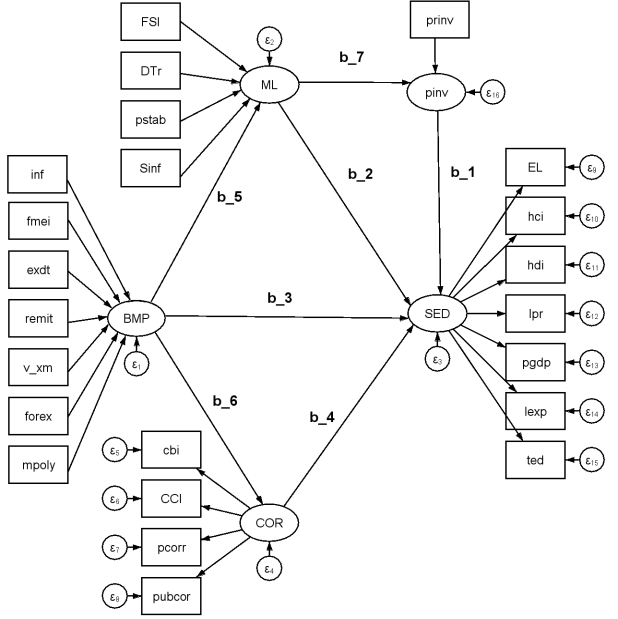
SED= β0+β2.ML+β3.BMP+β4.Cor+β1.prinv+ξ1(10)
The equation (10) above analytically constitutes the direct effects of money laundering, Underground economy and corruption, private expenditures per capita.
Figure 1. PLS Path model for money laundering, corruption, black market and socio-economic Development.
There are few indirect effects which operate through the BMP to ML and then it affects the socio-economic development. Particularly, b5.b2+b3 is the total effect of BMP and ML on the SED. In addition, there is another channel which affects socio-economic development, running through BMP, ML and investment per capita. In this situation, b5.b7.b1is the indirect effect of ML on the SED coupled with the direct effect measured by the b2. Similarly, BMP has the indirect channel of b6.b4 which may affect the socio-economic development other than the direct channel of b3. The total effect therefore would be indirect effect times the direct effect.
2.4. Hypothesis of the Model
This section describes the hypothesized relationships among money laundering, corruption, and socio-economic development. It briefly describes two types of relationships and their hypothesis. First is the hypothesis related to the relationships among ML, Corruption, and Socioeconomic development; second set of hypotheses is about the mediation role of the black market. These are described below.
2.5. Hypothesis on the Direct and Indirect Relationship of Money Laundering, Corruption, Black Market and Socio-economic Development
Given the obscure nature of money laundering (ML) and the ambiguous consequences in the literature. The current study assumes the following hypotheses.
Hypotheses 1: Higher money laundering is associated with higher indirect socio-economic development because of the multiplier effect of the ML (higher expenditures come from illegal earnings in the legal economy), keeping other things constant. Therefore, (β1. β7 >0).
Hypothesis 2: Higher money laundering ML hurts socio-economic development by attracting criminal activities and reducing allocative efficiencies. So, β2<0 in the equation 10, ceteris peribus.
As far as the relationship between corruption and socioeconomic development is concerned, a vast body of literature addresses this issue and underlines its consequences for economic and socio-economic reasons . Therefore, in the structural model further defines the role of corruption in money laundering and socio-economic development.
Hypothesis 3: Corruption is negatively related to socioeconomic development; in this case β4<0 and significant, keeping all others constant.
It is hypothesized that black market has a direct and indirect channel for money laundering and socio-economic development. So, the direct and the indirect effects are assumed to significant impact. The total direct impact of money laundering is β3 and the total indirect effect operated through the BMP is (β2.β5).
Hypotheses 5: The indirect effect of BMP on SED is positive and significant for this case. The path coefficient (β5.β2>0) and significant.
Hypotheses 6: The effect of BMP on ML is positive and significant. As a result, the path coefficient (β5>0) and significant.
Hypotheses 7: The direct effect of BMP on SED is positive and significant. As a result, the path coefficient (β3>0) and significant and the total indirect effect (β4.β6.>0) and significant.
The next step in PLS-SEM analysis of the path models, as given in the main diagram, model 1, is to empirically estimate, analyse, and conclude the results of both the inner and outer models. The analysis has been conducted in the freely available R environment .
3. Empirical Results and Analysis
This section reports the empirical findings of the problem of money laundering, corruption, and socio-economic development worldwide. The estimation has been done using the SEMinR package and cSEM . Given the nature of the PLS-SEM, a single goodness-of-fit criterion is not available to empirically judge the goodness of the models. Therefore, a bootstrapped criterion is used to establish the confidence intervals and other tests empirically. It is also customary to assess the goodness of fit of the inner and outer models using the same bootstrapped procedures. The first step in evaluating the PLS-SEM results includes assessing the outer model . Suppose the outer model does not meet the minimum requirement for the goodness of fit. In that case, the structural models are not reliable. Therefore, it is necessary that before going to structural models, the outer models must be assessed using the criterion that is different for the reflective models and formative models. The assessment of the reflective measurement model includes the composite reliability to evaluate the internal consistency, the indicator’s individual reliability, and the average variance extracted (AVE) to assess the convergent validity. In addition, the Farnel-Larker criterion and cross-loadings are used to evaluate the discriminant validity.
To establish the indicator’s reliability, we must calculate the relationship between the reflectively measured constructs and their indicator (i.e., loadings). The indicator’s reliability can be calculated by squaring the loadings. The indicator’s reliability is evaluated as the indicator’s loadings above 0.70 are recommended. Indicators with loadings between 0.40 and 0.70 should be considered for removal, and the indicators with very low loadings that are below 0.40 should be removed. Internal consistency reliability is the extent to which indicators measuring the same construct are associated. There are many indicators to measure the internal consistency reliability; Cronbach’s alpha is the composite reliability's lower bound .
Therefore, the exact or consistent reliability coefficient usually lies between these bounds and may represent a construct’s consistency reliability . Thus, the recommended values for acceptance of an indicator’s consistency reliability are 0.80 to 0.90, and the minimum values for exploratory research should be between 0.60 and 0.70. the maximum value of 0.95 must be avoided for indicator redundancy . Convergent validity is the extent to which the construct converges to explain the variance of its indicator. The average variance accounted for (AVE) is a common measure to establish convergent validity. The minimum acceptable AVE is 0.50 or higher .
Discriminant validity is the extent to which a construct is truly different from the other construct on the empirical standards. Establishing discriminant validity implies that each construct is unique and captures the phenomenon not captured by the other construct. The cross-loading scheme, the Farner larcker criterion, and the HTMT ratio method are three methods to check for discriminant validity. However, the last two methods are the most widely used in the literature. According to , the square root of the AVE of each construct should be higher than the construct’s highest correlation with any other construct in the model. The HTMT is the mean value of the indicator’s correlation across the constructs . The discriminant validity problems are present when HTMT values exceed 0.90 for the constructs that are conceptually very similar and exceed 0.85 for the constructs that are conceptually more distinct. The bootstrapped procedure is used to test for the statistical significance of the HTMT against the null hypothesis of HTMT exactly equal to 1 . for assessing the formative measurement models. Three tests are applied .
These tests are indicator collinearity (the VIF values must be lower than 5), the significance of the indicator’s weights (P-value must be less than 0.05), and the relevance of the indicator with a non-significant weight by checking if the outer loadings are larger than 0.50. Another test for assessing the formative measurement models is also available, known as the redundancy analysis . This test measures whether the formatively measured construct is highly correlated with the reflective measure of the same construct. However, because of the macroeconomic nature of the variables involved in the study, this test cannot be performed, as the reflective measure of the same construct needs to be designed in the data collection phase. Such alternative measures are not available for the variables involved in the study . Table 1 reports the results of the assessment of the reflective measurement model below.
3.1. Evaluation of the Reflective Measurement Models
Table 1. Indicators of Reliability of the Reflective Measurement Model.

BMP

COR

SED

ML

NR

pinv

bmp_1

0.756

bmp_2

0.634

bmp_3

0.625

bmp_4

0.786

bmp_5

0.698

bmp_6

0.763

bmp_7

0.612

cor_1

0.754

cor_2

0.783

cor_3

0.658

cor_4

0.693

sed_1

0.698

sed_2

0.664

sed_3

0.711

sed_4

0.738

sed_5

0.692

sed_6

0.778

sed_7

0.891

ml_1

0.758

ml_2

0.772

ml_3

0.823

ml_4

0.730

pinv

1.000

This implies that the indicators exhibit strong internal consistency when measuring the underlying constructs. Consequently, all the indicators are deemed valid for the intended measurement purposes, providing a robust foundation for the subsequent analysis or interpretation within the study or model.
Table 2. Internal Consistency Reliability and Convergent Validity.

alpha

rhoC

AVE

rhoA

COR

0.884

0.784

0.794

0.686

BMP

0.794

0.841

0.885

0.586

ML

0.858

0.892

0.698

0.754

pinv

1

1

1

1

SED

0.771

0.882

0.893

0.722

The table presents the results of internal consistency measures, including Cronbach's alpha (α), composite reliability (ρc), average variance extracted (AVE), and the maximal reliability (ρA) for the constructs, COR (Corruption), BMP (Black Market Prevalence), ML (Money Laundering), NR (Natural Resource), pcapinv (Per capita investment), and SED (Socio-Economic Development). For the COR construct, the results indicate a high level of internal consistency, with a Cronbach's alpha of 0.884, a composite reliability of 0.784, an AVE of 0.795, and a maximal reliability of 0.687. These values suggest that the items measuring corruption form a reliable and internally consistent scale.
Similarly, the BMP construct shows strong internal consistency, with a Cronbach's alpha of 0.794, a composite reliability of 0.842, an AVE of 0.886, and a maximal reliability of 0.587. These results indicate that the items assessing the black-market exhibit good internal consistency. The ML construct demonstrates high internal consistency, with a Cronbach's alpha of 0.859, a composite reliability of 0.892, an AVE of 0.699, and a maximal reliability of 0.755. These findings suggest that the items measuring money laundering are internally consistent and reliable. The internal consistency of a single-item construct is 1 because only one item contributes to the construct's measurement. In such cases, the construct's internal consistency coefficient, often represented by Cronbach's alpha, equals 1 because there are no other items to calculate the correlations.
Finally, the SED construct shows good internal consistency, with a Cronbach's alpha of 0.772, a composite reliability of 0.882, an AVE of 0.894, and a maximal reliability of 0.722. These findings indicate that the socio-economic development items also form a reliable and internally consistent scale. In summary, the results suggest that the constructs being measured in this study demonstrate varying degrees of internal consistency, with most constructs showing strong reliability. These findings provide confidence in measuring these constructs and support their use in further analyses or interpretations.
A high AVE value (typically above 0.5) suggests the construct has good convergent validity, meaning that the items are sufficiently related and measure the same underlying concept . The AVE for the COR construct is 0.794, indicating that 79.4% of the item variance is due to the construct, suggesting good convergent validity. In the BMP construct, the AVE is 0.885, indicating that 88.5% of the variance in the items is due to the construct, demonstrating strong convergent validity. The ML construct has an AVE of 0.698, suggesting that 69.8% of the item variance is due to the construct, indicating acceptable convergent validity. Finally, the AVE for the SED construct is 0.893, indicating that 89.3% of the variance in the items is due to the construct, showing strong convergent validity. Based on the AVE values, the constructs in this study generally demonstrate good to excellent convergent validity, suggesting that the items within each construct are indeed measuring the intended underlying concepts.
Table 3. Farner- Larcker Criterion to Assess the Discriminant Validity.

COR

BMP

ML

NR

pinv

SED

COR

0.891

BMP

0.635

0.941

ML

0.737

0.650

0.835

pinv

0.599

0.651

0.647

0.492

1

SED

0.621

0.679

0.759

0.505

0.684

0.945

The table presents the results of the Fornell-Larcker , criterion for assessing discriminant validity. This criterion compares the square root of the Average Variance Extracted (AVE) values, shown on the diagonal, with the correlations between constructs, shown off-diagonal. The purpose is to determine if each construct's AVE is greater than its correlations with other constructs, which indicates discriminant validity.
We apply another test to determine the discriminant validity of the constructs. The recommended criterion in this case is the hetertrait-monotrait (HTMT) of the correlations to assess the discriminant validity .
Table 4. HTMT Ratios to Assess the Discriminant Validity of Reflective Measurement Model.

Original Est.

Bootstrap Mean

Bootstrap SD

T Stat.

2.5% CI

97.5%CI

COR -> SED

0.7846

0.7818

0.1764

4.4481

1.1275

0.4361

BMP -> ML

0.8502

0.8539

0.2494

5.4148

1.3426

0.3652

BMP -> Cor

0.7174

0.7195

0.0979

3.2017

0.9114

0.5276

BMP -> ML

0.9223

0.9281

0.0998

3.0709

1.1237

0.7324

BMP -> SED

0.9084

0.9034

0.1179

7.7016

1.1346

0.6722

ML -> pinv

0.9080

0.9100

0.1824

2.7858

1.2674

0.5526

ML -> SED

0.9368

0.9319

0.2429

4.2680

1.4080

0.4558

pinv -> SED

0.8782

0.8108

0.0918

3.0302

0.9907

0.6308

The essence of the HTMT ratio is to test whether the HTMT values are significantly different from 1 or lower threshold level such as 0.85 or 0.90 based on the study context . The HTMT analysis requires computing a bootstrapped confidence interval. For this, the bootstrapped routine was used in the SEMinR library using the (α=0.05); in this way, we obtain the 95% two-sided bootstrapped CI for the HTMT values. The table presents the results of the Heterotrait-Monotrait (HTMT) ratios after a bootstrapped procedure, which is used to assess discriminant validity in Partial Least Squares Structural Equation Modeling (PLS-SEM).
The findings suggest that the constructs in this study demonstrate discriminant validity. This means that each construct effectively measures a distinct and unique underlying concept compared to the other constructs included in the analysis.
3.2. Evaluation of the Formative Measurement Models
The formative indicators are checked for multicollinearity issues; for this, the VIF at the indicator level is checked for the possible presence of multicollinearity. The item level VIF is given in the table below.
Table 5. Multicollinearity Diagnostics for Measurement Model.

LV

Indicator

VIF

LV

Indicator

VIF

COR

Cor_1

1.019

ML

ml_1

1.020

Cor_2

1.020

ml_2

1.007

Cor_3

1.025

ml_3

1.004

Cor_4

1.026

ml_4

1.021

BMP

bmp_1

1.031

SED

Sed_1

1.080

bmp_2

1.054

Sed_2

1.060

bmp_3

1.032

Sed_3

1.049

bmp_4

1.031

Sed_4

1.076

bmp_5

1.022

Sed_5

1.048

bmp_6

1.037

Sed_6

1.028

bmp_7

1.024

Sed_7

1.050

The VIF values of 5 or above are indicative of collinearity issues. However, the VIF values of 3 or above also indicate potential multicollinearity problems in some cases.
The VIF values range from approximately 1.004 to 1.080, well below the threshold of 5. The results of the importance and relevance are given below.
Table 6. Significance and Relevance of Indicator’s Weights.

Original Est.

Bootstrap Mean

Bootstrap SD

T Stat.

2.5% CI

97.5% CI

bmp_1 -> BMP

0.209

0.198

0.062

3.210

0.163

0.840

bmp_2 -> BMP

0.063

0.067

0.020

3.384

0.692

0.048

bmp_3 -> BMP

0.151

0.150

0.035

4.282

0.445

0.017

bmp_4 -> BMP

0.006

0.005

0.001

3.230

0.001

0.770

bmp_5 -> BMP

0.151

0.150

0.044

3.440

0.102

0.812

bmp_6 -> BMP

0.345

0.344

0.279

1.234

-0.492

0.568

bmp_7 -> BMP

0.123

0.122

0.031

3.919

0.677

0.109

cor_1 -> COR

0.442

0.441

0.097

4.567

0.440

0.932

cor_2 -> COR

0.149

0.148

0.035

4.196

0.107

0.845

cor_3 -> COR

0.349

0.348

0.082

4.265

0.340

0.886

cor_4 -> COR

0.194

0.193

0.036

5.280

0.431

0.009

sed_1 -> SED

0.342

0.341

0.033

10.404

0.508

0.031

sed_2 -> SED

0.486

0.485

0.266

1.822

-0.336

0.636

sed_3 -> SED

0.084

0.083

0.263

0.314

-0.441

0.532

sed_4 -> SED

0.463

0.462

0.284

1.625

-0.457

0.602

sed_5 -> SED

0.460

0.459

0.044

10.333

0.751

0.107

sed_6 -> SED

0.638

0.637

0.100

6.374

0.568

0.608

sed_7 -> SED

0.437

0.436

0.100

4.377

0.463

0.016

ml_1 -> ML

0.356

0.355

0.075

4.738

0.719

0.327

ml_2 -> ML

0.383

0.382

0.441

0.867

-0.642

0.932

ml_3 -> ML

0.412

0.411

0.099

4.142

0.447

0.011

ml_4 -> ML

0.330

0.329

0.049

6.774

0.716

0.100

pinv -> pinv

1

1

-

-

-

-

These results provide insights into the significance of the relationships between the constructs and their indicators measured formatively. The consistent estimates across the original and bootstrapped values indicate the stability of these relationships. At the same time, the t-statistics and confidence intervals measure their statistical significance. It is worth noting here that few weights are insignificant. By rule, the insignificant weights must be removed from the analysis. Still, there is a technical hint: the indicator must be retained if the indicator loading is at least 0.5, which suggests that the indicator makes a sufficient absolute contribution to forming the construct . The loadings on these insignificant indicators are all above 0.5; therefore, these must be retained as per guidelines on the significance and relevance of the indicator’s weights. The statistical analysis of the outer and inner models has demonstrated their viability for further investigation within the structural model. The results indicate strong and significant relationships between the latent variables and their respective indicators. This suggests that the models are reliable representations of the underlying constructs. Consequently, these findings provide a solid basis for advancing to the structural model, where the relationship between these constructs can be more thoroughly explored.
3.3. Evaluation of the Structural Model
After confirming the reliability and validity of construct measurements, the next step involves assessing the results of the structural model. It is essential to scrutinize the structural model for potential collinearity issues. This is because the estimation of path coefficients in structural models relies on ordinary least squares (OLS) regressions of each endogenous construct on its corresponding predictor constructs. Like OLS regressions, the path coefficients may be biased if there is substantial collinearity among predictor constructs (which is also the main point of this study). Once it is established that collinearity is not an issue, the significance and relevance of the structural model relationships (i.e., the path coefficients) and the model's explanatory power are evaluated. The table below describes the results of the VIF of the structural relationships.
Table 7. Assessment of Non-Orthogonality of the Latent Constructs in Structural Model.

Endo-Latent <-

Exo- Latent

VIF

SED <-

<- COR

3.038

<- ML

5.102

<- NR

4.027

<-PINV

1.075

ML<-

<- COR

1.001

<- BMP

1.001

As per the guidelines on the assessment of latent variables for the non-orthogonality issues, the VIF values above 5 or, in some cases, above 3 are indicative of the potential problem of non-orthogonal latent variables, and it has implications for the structural model relationships . The latent constructs COR, ML, and NR have values of 3.08, 5.102, and 4.027, respectively. The ML has a VIF value above the threshold of 5, while COR and NR have a VIF above the threshold of 3. It is also imperative to note that in which case the thresholds 5 or 3 should not be clear in the literature in the case of PLS-SEM. So, in these instances, certain suggestions may be incorporated.
The Next step is to assess the significance and relevance of the path coefficients. This assessment is based on the bootstrapping standard errors as a basis for calculating the t values of the path coefficients or, alternatively, the confidence intervals. A path coefficient is significant at the 5% level if the value zero does not fall into the 95% confidence interval. Generally, the percentile method should be used to construct the confidence intervals. The results of the path coefficients estimated through the base model are presented below.
Table 8. Path Coefficients for the Corruption, Money Laundering and Socio-Economic Development Model.

Original Est.

Bootstrap Mean

Bootstrap SD

T Stat.

2.5% CI

97.5% CI

COR -> SED

-0.297

-0.297

0.218

-1.362

-0.404

0.365

BMP -> ML

0.255

0.256

0.109

2.336

0.503

0.544

ML -> pinv

0.247

0.248

0.087

2.831

0.195

0.459

ML -> SED

-0.097

-0.097

0.022

-4.306

0.399

0.376

BM -> COR

0.100

0.100

0.035

2.857

0.237

0.270

BM -> SED

0.087

0.087

0.034

2.521

0.301

0.241

pinv -> SED

0.165

0.165

0.063

2.621

0.240

0.394

Direct effect estimates, significance, and confidence intervals of the bootstrapped model
Table 8 above represents the direct effects of the exogenous constructs on the endogenous. Let us consider the original estimates (column ‘Original Estimates’). We find that corruption has a negative impact on SED, Similarly, BMP has a direct positive effect on Money laundering. Money laundering also has a positive impact on both private per capita investment and Socioeconomic development. These were the results obtained from direct estimation. From a statistical significance perspective, the current method uses bootstrapping with a 95% confidence interval to compute t-statistics and the percentile method to compute confidence intervals .
The direct effect of money laundering on the socio-economic development is negative and significant. This also validates hypothesis 2 of the impact of money laundering on socio-economic development. Higher money laundering ML has a negative effect on socio-economic development because it attracts criminal activities and reduces allocative efficiencies. Money laundering also positively and significantly impacts private per capita expenditures. This aligns with the hypothesis that Money laundering often involves injecting illegally obtained funds into the economy. These funds can stimulate economic activity, increasing overall spending per capita . Although this effect is positive and significant, it may be the short-run phenomenon caused by the multiplier effect of money laundering .
The third hypothesis is about the negative role of corruption on SED. The estimated coefficient is negative and significant. This also validates the hypothesis 3. Hypothesis 4, which states that corruption has a negative and significant direct impact on socio-economic development, is invalid. Although the coefficient has a negative statistical sign, it is not substantial. Hypothesis 5 of the direct effect of BMP on COR and ML is also validated. It has a standardized coefficient value of 0.436 with a t-statistic of 3.46. the impact of BMP on money laundering is also positive and significant, and this validates hypothesis 6 of the direct effect of the black market on SED.
It is important to note that the hypothesis related to the direct effects of the exogenous constructs on the outcome constructs has been considered so far. However, there are many indirect effects operational in the model. Therefore, the total effects table is given below to better understand the exogenous constructs on the outcome constructs.
Table 9. Total effects coefficients for the Corruption, Money Laundering, and Socio-Economic Development Model.

Original Est.

Bootstrap Mean

Bootstrap SD

T Stat.

2.5% CI

97.5% CI

COR -> SED

-0.2967

0.2966

0.2181

1.3623

-0.4121

0.3641

BMP -> ML

0.2554

0.2553

0.0594

4.2978

0.5027

0.5442

BMP -> pinv

0.0632

0.0631

0.0108

5.8454

0.1350

0.1393

BMP -> SED

0.0105

0.0104

0.0770

0.1344

-0.1340

0.1480

ML -> pinv

0.2474

0.2473

0.0874

2.8290

0.1953

0.4592

ML -> SED

-0.0966

-0.0965

0.0234

-4.1282

0.3916

0.3863

ML -> SED

0.0364

0.0363

0.0102

3.6301

0.0325

0.3284

pinv -> SED

0.1654

0.1653

0.0531

3.1101

0.2396

0.3937

Total effect estimates, significance, and confidence intervals of the bootstrapped model
The indirect effect of corruption on per capita private investment is (β2.β6>0), which is statistically positive and significant. This significant and positive standardized indirect impact of corruption through money laundering on private per capita expenditure can be explained by several factors. Initially, corruption often entails diverting public funds for personal benefit, resulting in the accumulation of wealth among corrupt individuals or entities. When this illicitly acquired wealth is laundered and reintroduced into the economy, it can lead to heightened spending in the private sector, thereby increasing private per capita expenditure. Additionally, money laundering allows corrupt individuals to obscure the origins of their illicit wealth, enabling them to spend it without raising suspicion. This untraceable influx of funds into the private sector can artificially inflate private spending levels, contributing to higher per capita expenditure. Moreover, the networks involved in money laundering can facilitate the movement of funds across borders and into various economic sectors, further stimulating private expenditure. Nevertheless, it is crucial to recognize that while this may seem to stimulate economic activity in the short term, the long-term repercussions of corruption and money laundering, such as weakened institutions, diminished trust in the financial system, and distorted economic incentives, can have adverse effects on overall economic growth and stability and this is evident from the negative direct effect of money laundering and corruption on the socio-economic development.
The indirect effect of BMP on socio-economic development is [.β5.β7=0.0105) >0], but statistically insignificant. The indirect effect of the black market on per capita private investment is [β3.β6.=0.0632) >0], positive and significant. The indirect effect of money laundering on SED is ([.β7=0.036) >0] and statistically significant. This validates hypothesis 1 on the indirect effect of money laundering on the SED due to the multiplier effect of the money laundering. Similarly, the indirect on ML is [β2.β9=0.0348) >0].
4. Conclusion
This study has examined the direct and indirect effects of money laundering and corruption on the socio-economic development in the developing world. From the methodological perspective, this is the first application of Partial Least Squares Structural Equation Modelling (PLS-SEM) to estimate this phenomenon. This statistical method has two main advantages over the other econometrics approaches. First, it can cope with the unobservable and multi-dimensional concepts simultaneously. In contrast to the multiple linear regression model, it is also possible to include both the latent and observable in the structural model to account for the confounding factors.
The present study has used the pre-estimation analysis to ensure the validity and reliability of the outer models and concluded that all the indicator variables used to measure the latent constructs are valid and to endure the unbiasedness of the parameter estimates in case of non-orthogonal latent constructs, The study consists of 198 countries, of which 151 are developing. This study has proposed path model based on the literature to investigate the relationships between the complex phenomenon of money laundering, corruption, and socio-economic development and the mediating role of the black market and per capita investment expenditures. Model 1 is the more general model in which two confounding variables have been used in the structural part to account for their direct and indirect effects. This study has tested seven hypotheses related to the direct and indirect effects and relationships between cash, corruption, socioeconomic development, and the roles of mediation.
From an empirical perspective, it has been found that the direct effect of money laundering on socio-economic development is negative and statistically significant; this relates to hypothesis 1, while the indirect effect through the per capita socio-economic development is positive and important. This is hypothesis 2 of the current study; these findings in the case of the indirect effects are in line with the literature that money laundering reduces the negative impact of crime by reinvesting the illegal earnings into the formal economy . However, when controlling for increased per capita investment, the direct effect is negative is the only study that has empirically found the significant impact of money laundering on economic growth. But he believes that its effects may be positive and negative as well. Therefore, this finding is novel in the literature and explicitly accounts for the impact of money laundering on socio-economic development.
The effect of corruption on socio-economic development is negative but insignificant in the PLSc output, which is against the earlier literature on the relationship between corruption and socio-economic development . Although this is a crucial hypothesis in the study, its insignificance may be attributed to the measurement error correlation in the structural model. The VIF of the modeled construct is greater than the upper threshold of 5, which inflated the standard errors due to the shared variance; despite the negative, it became insignificant.
Similarly, the BMP has a positive and significant effect on money laundering. Therefore, the hypotheses 5 & 6 are equally valid. In addition to the direct effect, BMP also indirectly affects money laundering. In this case, the indirect effect is 𝛽1. 𝛽3, which is statistically significant and positive. In addition, several other indirect effects are also positive and significant; that is, the total effect of BOP on private investment per capita through money laundering is also positive and significant; this again reinstates the earlier findings of reinvestment of illicit funds in the official economy increases the investment in the developing countries. The total effect of the black market on private per capita investment through money laundering is also positive and significant. Where the total insignificant effect of the black market on socio-economic development was observed. There are two direct effects of natural resource dependence; the direct effect of natural resource dependence on socio-economic development is positive and significant, whereas the direct effect of natural resource dependence on corruption is also positive and significant. This validates the hypothesis of the resource curse or Dutch disease. Whereas the indirect effects of the natural resource dependence include the indirect effect of natural resource dependence on BMP is [𝛽1. 𝛽9 = 0.0437] > 0), which is statistically significant, indirectly validating the resource curse hypothesis, the natural resources have an insignificant impact on the money laundering. Overall, the private investment is also positively associated with the socio-economic development.
In conclusion, the empirical findings highlight the importance of carefully designing anti-money laundering (AML) policies due to their significant indirect effects on per capita private investment expenditures and socioeconomic development. While preventing illicit financial flows is crucial, increased public spending on investment is equally vital to counterbalance the negative impact of laundered funds' reinvestment. This underscores the multifaceted nature of money laundering, where positive effects on private investment may negatively impact per capita income and overall development. The direct effect of corruption on money laundering emphasizes the need for enhanced anti-corruption measures to promote transparency and accountability. Addressing natural resource dependence requires transparency in resource management, diversification of the economy, and international cooperation. The mediating role of the black market in corruption and money laundering calls for policies promoting formal economic participation, law enforcement, and financial inclusion. A holistic approach is needed to address these interconnected challenges and promote sustainable development globally.
5. Limitations
While the analysis provides valuable insights, several limitations should be considered. Firstly, the study's reliance on secondary data sources may introduce biases or inaccuracies inherent in the original data collection. Additionally, using a global perspective may oversimplify the dynamics of money laundering, corruption, and black-market activities, which can vary significantly across regions and countries. The study's focus on macro-level relationships may obscure the micro-level intricacies that drive these phenomena. Moreover, the analysis might not fully account for the complex relationship of socio-economic, political, and cultural factors that influence the observed relationships. Finally, While Partial Least Squares Structural Equation Modeling (PLS-SEM) is a variance-based method commonly used in causal Modelling, it's essential to interpret its results cautiously. PLS-SEM may depict modeled variables as causal factors for underlying phenomena. Still, this representation can be sensitive to changes in how latent constructs are modelled or the inclusion of additional indicators. As a result, conclusions drawn from PLS-SEM analyses should be made with an awareness of the potential impact of model specifications and the need for robustness checks to ensure the stability of the findings. Future research could benefit from more nuanced data collection methods, including qualitative research and case studies, to provide a more comprehensive understanding of these complex issues.
Abbreviations

PLS-SEM

Partial Least Squares Structural Equation Modelling

AML

Anti Money Laundering

SED

Socio-Economic Development

BMP

Black Market Prevalence

ML

Money Laundering

Corr

Corruption

CI

Confidence Interval

HTMT

Hetero-Trait-Mono-Trait

AVE

Average Variance Extracted

VIF

Variance Inflating Factor

cSEM

Covariance Based Structural Equation Modeling

SEMinR

Structural Equation Modeling Using R

WBG

World Bank Group

Conflicts of Interest
The authors declare no conflicts of interest.
Appendix
Table 10. Latent variables, indicator names, Definition, and Data Sources.

Sr#

LV

indicator Name

Label

Definition

Source

1

Corruption (Corr)

Bayesian Corruption Index

BCI

The BCI is an index of the perception of overall corruption (abuse of public power for private gain) within a country. It is constructed from the methodological skeleton of the WBGI and CPI, using 17 different surveys of countries' inhabitants, business executives, and governments.

Quality of Government Datasets bci_bci

2

Control of Corruption Index

CC

Published by the WBG and maintained by Daniel Kaufman, the team updated it in 2023. This measure of the Control of Corruption captures perceptions of the extent to which public power is exercised for private gain, including petty and grand forms of corruption and the "capture" of the state by elites and private interests.

World bank

3

Political corruption Index

Pol_corr

How pervasive is political corruption

Quality of Government Datasets (QoG)

4

Public sector corruption

Pubs_corr

Transparency, accountability, and corruption in the public sector rating (1=low to 6=high), World Bank Group (WBG) CPIA database.

WBG CPIA database

5

Money Laundering (ML)

Drugs trafficking

Drugs

the amount of drug (in kilogram) discovered per 100,000 people

UNODC

6

Political Stability and Terrorism

polst

Political Stability and Absence of Violence/Terrorism measures perceptions of the likelihood of political instability and/or politically motivated violence, including terrorism. Estimate gives the country's score on the aggregate indicator in units of standard normal distribution, i.e., ranging from approximately -2.5 to 2.5.

WDI

7

size of the informal economy

infesize

The World Bank database of the informal economy. The MIMIC-based estimates of the informal output (% official GDP).

WBG datasets

8

Financial secrecy index

FSI

The Financial Secrecy Index ranks the jurisdictions most complicit in helping individuals hide their finances from the rule of law.

justice network & global policy organization

9

Socio-economic Development (SED)

Human Capital Index

(HCI)

The Human Capital Index (HCI) combines health and education indicators into a measure of the human capital that a child born today can expect to obtain by their 18th birthday on a scale from 0 to 1. Higher values indicate higher expected human capital measured by the World Bank.

WDI/ WBG

10

tertiary education/students enrolled over ten years

tert_edu

The ratio of students enrolled in tertiary education to the population over ten years of age (tert_edu) is calculated from the WDI.

WDI/ WBG

11

Human Development Index

(HDI)

Extracted from the World Bank database as an overall proxy for the development in three dimensions of development (health, education, and standard of living).

UNDP/ WDI

12

life expectancy

lifexp

Life expectancy at birth in years was calculated from the World Development database.

WDI

13

% pop Access to electricity

acc_elec

This is based on national surveys and the World Bank's electrification database. The electrification data are collected from industry, national surveys, and international sources. This is included to account for the technological development and the standard of living of rural households.

Industries. National surveys

14

Per capita GDP

GDP_cap

Gross domestic product per capita (GDP_capita) accounts for economic development in the real term.

WDI

15

fem/male labor force participation rate

lb_fem_m

ratio of female to male labor force participation

WDI

16

Private Expenditures per capita

per capita private expenditures

(Prexcap)

this is the sum of final consumption expenditures plus the private investment divided by the total population

WDI

17

Natural resource dependence

Average of oil rents % GDP and Agriculture, forestry, and fishing, value added (% of GDP)

c_aggdp

½ [share of oil rents % gdp+ Agriculture, forestry, and fishing, value added (% of GDP)]

WDI

18

Black Market Prevalence BMP

inflation

inf

Measured by the CPI Annual % age from the world development indicators.

WDI

19

Financial markets efficiency index

FMEI

percentage gap between official and black-market exchange rate

IMF Database with the indicator code FD_FME_IX

20

External Debt

edt

total external debt as a percentage of GDP

WDI

21

remittances

remit

remittances received as a percentage of GDP

WDI

22

Real effective exchange rate

v_xm

The real effective exchange rate is the nominal effective exchange rate (a measure of the value of a currency against a weighted average of several foreign currencies) divided by a price deflator or index of costs.

WDI

23

Foreign Exchange Reserves

Forex

Total reserves are a percentage of total external debt. The data is obtained from the WDI against the FI data code.RES.TOTL.DT.ZS.

WDI

24

Broad Money (%GDP)

M_Policy

Broad money (IFS line 35L..ZK) is the sum of currency outside banks; demand deposits other than those of the central government; the time, savings, and foreign currency deposits of resident sectors other than the central government; bank and traveler’s checks; and other securities such as certificates of deposit and commercial paper.

IFS

References
[1] Acemoglu, D., & Robinson, J. A. (2010). Why is Africa poor? Economic history of developing regions, 25(1), 21-50.
[2] Aidt, T. S. (2003). Economic analysis of corruption: a survey. The Economic Journal, 113(491), F632-F652.
[3] Aidt, T., Dutta, J., & Sena, V. (2008). Governance regimes, corruption, and growth: Theory and evidence. Journal of Comparative Economics, 36(2), 195-220.
[4] Alesina, A., & Weder, B. (2002). Do corrupt governments receive less foreign aid?. American Economic Review, 92(4), 1126-1137.
[5] Andersson S. (2017). Beyond Unidimensional Measurement of Corruption. Public Integrity, 19(1): 58- 76.
[6] Bartlett, B. L. (2002). The negative effects of money laundering on economic development. Platypus Magazine, (77), 18-23.
[7] Biles, J. J. (2009). Informal work in Latin America: Competing perspectives and recent debates. Geography Compass, 3(1), 214-236.
[8] Boeschoten, W. C. and M. M. G. Fase (1984), The Volume of Payments and the Informal Economy in the Netherlands 1965–1982. M. Nijhoff, Dordrecht.
[9] Bollen, K. A. (1989). Structural equations with latent variables (Vol. 210). John Wiley & Sons.
[10] Bollen, K., & Lennox, R. (1991). Conventional wisdom on measurement: A structural equation perspective. Psychological bulletin, 110(2), 305.
[11] Cao, Y., Fan, M. Y., Hlatshwayo, S., Petrescu, M., & Zhan, Z. (2021). A sentiment-enhanced corruption perception index. International Monetary Fund.
[12] Chang, C. P., & Hao, Y. (2017). Environmental performance, corruption, and economic growth: global evidence using a new data set. Applied Economics, 49(5), 498-514.
[13] Cieślik, A., & Goczek, Ł. (2018). Control of corruption, international investment, and economic growth–Evidence from panel data. World Development, 103, 323-335.
[14] Contini, B. (1981), Labor market segmentation and the development of the parallel economy: the Italian experience, Oxford Economic Papers, 33, pp. 401–412.
[15] D'Agostino, G., Dunne, J. P., & Pieroni, L. (2016). Corruption and growth in Africa. European Journal of Political Economy, 43, 71-88.
[16] Daniel, J. (2016). Advisory Statement for Effective International Practice: Combatting Corruption and Enhancing Integrity: A Contemporary Challenge for the Quality and Credibility of Higher Education. Council for Higher Education Accreditation.
[17] Del Boca, D., & Forte, F. (1982). Recent empirical surveys and theoretical interpretations of the parallel economy in Italy. The underground economy in the United States and abroad, Lexington (Mass.), Lexington, 160- 178.
[18] Dell’Anno R (2020a) Corruption worldwide: an analysis by partial least squares structural equation modeling. Public Choice 184(3): 327–350.
[19] Dell’Anno, R., & Maddah, M. (2023). Money laundering, corruption, and socioeconomic development in Iran: an analysis by structural equation modeling. International Review of Economics, 70(3), 395-417.
[20] Dijkstra, T. K., & Henseler, J. (2015a). Consistent and asymptotically normal PLS estimators for linear structural equations. Computational Statistics & Data Analysis, 81, 10–23.
[21] Dijkstra, T. K., & Henseler, J. (2015b). Consistent partial least squares path modeling. MIS Quarterly, 39(2), 297–316.
[22] Dimant, E., & Tosato, G. (2018). Causes and effects of corruption: what has the past decade's empirical research taught us? A survey. Journal of economic surveys, 32(2), 335-356.
[23] Dincer, O., & Johnston, M. (2019). Black and (thin) blue (line): Corruption and other political determinants of police killings in America. Governance, 36(1), 167-186.
[24] Donchev, D., & Ujhelyi, G. (2014). What Do Corruption Indices Measure? Economics & Politics, 26(2), 309–331.
[25] Enste, D., & Heldman, C. (2017). Causes and consequences of corruption: An overview of empirical results.
[26] Farzanegan, M. R., & Witthuhn, S. (2017). Corruption and political stability: Does the youth bulge matter?. European Journal of Political Economy, 49, 47-70.
[27] Feige, E. L. (1996). Overseas holdings of US currency and the underground economy. Exploring the Underground Economy. Kalamazoo, Michigan, 5-62.
[28] Feige, E. L. (2016). Professor Schneider's shadow economy: what do we really know? A rejoinder. Forthcoming in the Journal of Tax Administration, 2(2).
[29] Feige, E. L. (2016). Reflections on the Meaning and Measurement of Unobserved Economics.
[30] Fornell, C., Bookstein, F. L.:(1982). Two structural equation models, LISREL and PLS, applied to consumer choice theory. J. Mark. Res. 19(4), 440–452 (1982).
[31] Fortin, B., Garneau, G., Lacroix, G., Lemieux, T. and Montmarquette, C. (1996), L’Economie Souterraine au Quebec: mythes et realites, Presses de l’Universite Laval, Laval.
[32] Frey, B. S. and H. Weck (1983a), Bureaucracy and the shadow economy: a macro-approach, in Hanusch, H. (ed.), Anatomy of Government Deficiencies, Springer, Berlin, pp. 89–109.
[33] Frey, B. S. and H. Weck-Hannemann (1984), The hidden economy as an “unobserved” variable, European Economic Review, 26, pp. 33–53.
[34] Global Financial Integrity (2019), Illicit Financial Flows to and from Developing Countries, 2006-2015, Washington, DC: April.
[35] Gnutzmann, H., McCarthy, K. J., & Unger, B. (2010). Dancing with the devil, Country size, and the incentive to tolerate money laundering. International Review of Law and Economics, 30(3), 244-252.
[36] Goel, R. K., & Nelson, M. A. (2010). Causes of corruption: History, geography, and government. Journal of Policy Modeling, 32(4), 433-447.
[37] Gründler, K., & Potrafke, N. (2019). Corruption and economic growth: New empirical evidence. European Journal of Political Economy, 60, 101810.
[38] Habib, M., & Zurawicki, L. (2002). Corruption and foreign direct investment. Journal of International.
[39] Havranek, T., Horvath, R., & Zeynalov, A. (2016). Natural resources and economic growth: A meta-analysis. World Development, 88, 134-151.
[40] Henry, L., & Moses, S. (2020). The impact of money laundering in beautiful places: The case of Trinidad and Tobago. Journal of Economics and International Finance, 12(1), 39-47.
[41] Huang, C. J. (2016). Is corruption bad for economic growth? Evidence from Asia-Pacific countries. The North American Journal of Economics and Finance, 35, 247-256.
[42] Hua, G. B. (2005). IT barometer 2003: Survey of the Singapore construction industry and a comparison of results. J. Inf. Technol. Constr., 10, 1-13.
[43] Johnson, S., Kaufmann D. and P. Zoido-Lobatón (1998b), Corruption, Public Finances and the Unofficial Economy, World Bank Policy Research Working Paper Series No. 2169, The World Bank, Washington, D.C.
[44] Hair, J. F., Astrachan, C. B., Moisescu, O. I., Radomir, L., Sarstedt, M., Vaithilingam, S., & Ringle, C. M. (2021). Executing and interpreting applications of PLS-SEM: Updates for family business researchers. Journal of Family Business Strategy, 12(3), 100392.
[45] Kalioberda, A., & Kaufmann, D. (1996). Integrating the unofficial economy into the dynamics of post-socialist economies: A framework of analysis and evidence. The World Bank. 015 p 5.
[46] La Porta, R., Lopez-de-Silanes, F., Shleifer, A., & Vishny, R. (1999). The quality of government. Journal of Law, Economics, and Organization, 15(1), 222-279.
[47] Lambsdroff, J. G. (2007). The institutional economics of corruption and reform: Theory, evidence, and policy. Cambridge University Press.
[48] Leonard, M. (2000). Coping strategies in developed and developing societies: the workings of the informal economy. Journal of International Development: The Journal of the Development Studies Association, 12(8), 1069-1085.
[49] Loayza, N., Villa, E., & Misas, M. (2019). Illicit activity and money laundering from an economic growth perspective: A model and an application to Colombia. Journal of Economic Behavior & Organization, 159, 442-487.
[50] Lohmöller, J. B. (2013). Latent variable path modeling with partial least squares. Springer Science & Business Media.
[51] Markovska, A., & Adams, N. (2015). Political corruption and money laundering: lessons from Nigeria. Journal of Money Laundering Control, 18(2), 169-181.
[52] Masciandaro, D. (1999). Money laundering: the economics of regulation. European Journal of Law and Economics, 7, 225-240.
[53] Masciandaro, D. (2007). Economics of money laundering: A primer. Paolo Baffi Centre Bocconi University Working Paper, (171).
[54] McCrohan, K., Smith, J. D. and Adams, T. K. (1991), “Consumer purchases in informal markets: estimates for the 1980s, prospects for the 1990s”, Journal of Retailing, Vol. 67 No. 1, pp. 22-50.
[55] McDowell, J., & Novis, G. (2001). The consequences of money laundering and financial crime. Economic Perspectives, 6(2), 6-10.
[56] Medina, L. & Schneider, F., (2018). Shadow economies worldwide: what did we learn over the last 20 years? International Monetary Fund working papers. African Department, Washington, DC
[57] Medina, L., & Schneider, F. (2019). Shedding light on the shadow economy: A global database and the interaction with the official one.
[58] Meon, P. G., & Sekkat, K. (2005). Does corruption grease or sand the wheels of growth?. Public choice, 122, 69-97.
[59] Miller, M. B. (1995). Coefficient alpha: A basic introduction from the perspectives of classical test theory and structural equation modeling.
[60] Ning H. (2016). Rethinking the Causes of Corruption: Perceived Corruption, Measurement Bias, and Cultural Illusion. Chinese Political Science Review 1(2): 268-302.
[61] Higgins, M. (1989), Assessing the underground economy in the United Kingdom, in Feige, E. L. (ed.), The Underground Economies.
[62] Neill, D. M. (1989), Growth of the underground economy 1950–81: some evidence from the current population survey, Study for the Joint Economic Committee, U.S. Congress Joint Committee Print, U.S. Gov. Printing Office, Washington, DC, pp. 98–122.
[63] OECD. (2002). Measuring the Non-Observed Economy.
[64] Ospina‐Velasco, J. (2003). Combating money laundering and smuggling in Colombia. Journal of Financial Crime, 10(2), 153-156.
[65] Pahl, R. E. (2015). From ‘informal economy to ‘forms of work': cross-national patterns and trends. Industrial Societies (Routledge Revivals): Crisis and Division in Western Capitalism, 90.
[66] Park, T. (1979), Reconciliation Between Personal Income and Taxable Income, Bureau of Economic Analysis, Washington, DC, pp. 1947–1977.
[67] Pellegrini, L., & Gerlagh, R. (2004). Corruption's effect on growth and its transmission channels. Kyklos, 57(3), 429-456.
[68] Peterson, H. G. (1982), Size of the public sector, economic growth, and the informal economy: development trends in the Federal Republic of Germany, Review of Income and Wealth, 28, pp. 191–215.
[69] Philp M. (2015). The definition of political corruption. In P. M. Heywood (Ed.), Routledge handbook of political corruption (pp. 17–29). Abingdon, UK: Routledge.
[70] Postea, M. M., & Achim, M. V. (2023). Estimation methods for the shadow economy. A systematic literature review: Métodos de estimativa para a economia subterrânea. Uma revisão sistemática da literatura. Brazilian Journal of Business, 5(3), 1574-1594.
[71] Pellegata, A. (2013). Constraining political corruption: an empirical analysis of the impact of democracy. Democratization, 20(7), 1195-1218.
[72] Psychoyios, D., Missiou, O., & Dergiades, T. (2021). Energy-based estimation of the shadow economy: The role of governance quality. The Quarterly Review of Economics and Finance, 80, 797-808.
[73] Quiros-Romero, M. G., Alexander, M. T. F., & Ribarsky, M. J. (2021). Measuring the informal economy. International Monetary Fund.
[74] Razafindrakoto M., Roubaud F. (2010). Are International Databases on Corruption Reliable? A Comparison of Expert Opinion Surveys and Household Surveys in Sub-Saharan Africa. World Development, 38(8): 1057-1069.
[75] R Core Team (2017). R: A Language and Environment for Statistical Computing. R Foundation for Statistical Computing, Vienna.
[76] Romero, V. (2022). Bloody investment: misaligned incentives, money laundering, and violence. Trends in Organized Crime, 25(1), 8-36.
[77] Rigdon, E. E., Ringle, C. M., & Sarstedt, M. (2010). Structural modeling of heterogeneous data with partial least squares. Review of marketing research, 255-296.
[78] Rose-Ackerman, S. (1999). Political corruption and democracy. Conn. J. Int'l L., 14, 363.
[79] Sabir S, Rafque A, Abbas K (2019) Institutions and FDI: evidence from developed and developing countries. Financ Innov 5(8): 1–20.
[80] Sachs, J. D., & Warner, A. M. (1997). Sources of slow growth in African economies. Journal of African Economies, 6(3), 335-376.
[81] Sivona, E. U., & Riccardi, M. (2017). Assessing the risk of money laundering in Europe. Final report of project IARM.
[82] Schneider, F. (2015). Size and development of the shadow economy of 31 European and 5 other OECD countries from 2003 to 2014: different developments? Journal of Self-Governance and Management Economics, 3(4), 7-29.
[83] Schneider, F. (2019). Size of the shadow economies of 28 European Union countries from 2003 to 2018. In European Union (pp. 111-121).
[84] Schneider, F., & Enste, D. H. (2000). Shadow economies: Size, causes, and consequences. Journal of Economic Literature, 38(1), 77-114.
[85] Schneider, F., Buehn, A., & Montenegro, C. E. (2010). New estimates for shadow economies all over the world. Int. Econ. J. 24(4), 443–461.
[86] Schneider, F., Raczkowski K., Mróz, B., (2015), "Shadow economy and tax evasion in the EU," Journal of Money Laundering Control, Vol. 181 pp. 34-51.
[87] Seligson M. A. (2006). The measurement and impact of corruption victimization: survey evidence from Latin America. World Development, 34(2): 381–404.
[88] Serra, D. (2006). Empirical determinants of corruption: A sensitivity analysis. Public Choice, 126(1-2), 225-256.
[89] Schuberth, F., Rademaker, M. E., & Henseler, J. (2023). Assessing the overall fit of composite models estimated by partial least squares path modeling. European Journal of Marketing, 57(6), 1678-1702.
[90] Slama, M. B., & Gueddari, A. (2022). The relationship between money laundering and economic growth in the MENA region—a simultaneous equation model. In Key Challenges and Policy Reforms in the MENA Region: An Economic Perspective (pp. 123-141). Cham: Springer International Publishing.
[91] Smith, P. (1994), Assessing the size of the underground economy: the Canadian statistical perspectives, Canadian Economic Observer, 11, pp. 16–33.
[92] Stancu, I., & Rece, D. (2009). The Relationship between Economic Growth and Money Laundering--a Linear Regression Model. Theoretical & Applied Economics, 16(9).
[93] Standaert, S. (2015). Divining the level of corruption: a Bayesian state-space approach. Journal of Comparative Economics, 43(3), 782-803.
[94] Svensson, J. (2005). Eight questions about corruption. Journal of economic perspectives, 19(3), 19-42.
[95] Tanzi, V. (1980), The underground economy in the United States: estimates and implications, Banca Nazionale del Lavoro, 135, pp. 427–453.
[96] Tanzi, V. (1983), The underground economy in the United States: annual estimates, 1930–1980, IMF Staff Papers, 30, pp. 283–305.
[97] Tanzi, V. (1998). Corruption around the world: Causes, consequences, scope, and cures. Staff papers, 45(4), 559-594.
[98] Tanzi, V. 1997. “Macroeconomic Implications of Money Laundering,” in Responding to Money Laundering, International Perspectives, 91-104. Amsterdam: Harwood Academic Publishers.
[99] The IMF and the Fight against money laundering and terrorism. (2023). Triesman, D. (2000). The causes of corruption: a cross-national study. Journal of Public Economics, 76(3), 399-457.
[100] Uberti, L. J. (2022). Corruption and growth: Historical evidence, 1790–2010. Journal of Comparative Economics, 50(2), 321-349.
[101] Lambsdorff, J. G. (1999). The Transparency International corruption perceptions index 1999: Framework document. Transparency International, Berlin.
[102] Unger B (2007). Black Finance. The Economics of Money Laundering. Cheltenham, UK: Edward Elgar.
[103] Unger B, Siegel M, Ferwerda J, de Kruijf W, Busuioic M, Wokke K, Rawlings G (2006) The amounts and the effects of money laundering. Report for the Ministry of Finance, 16. Utrecht School of Economics, Netherlands.
[104] Usakli, A., & Rasoolimanesh, S. M. (2023). Which SEM to use and what to report? A comparison of CB-SEM and PLS-SEM. In Cutting edge research methods in hospitality and tourism (pp. 5-28). Emerald Publishing Limited.
[105] Walker J (1995). Estimates of the Extent of Money Laundering in and through Australia. Paper prepared for Australian Transaction Reports and Analysis Centre (ATRAC), September by John Walker Consulting Services.
[106] Walker J (1999). “How Big is Global Money Laundering?” 3(1) Journal of Money Laundering Control 25-37.
[107] Walker J (2002). “Just How Big is Global Money Laundering?”, a seminar presented at the Australian Institute of Criminology, Sydney.
[108] Walker J (2003a). The Profits & Losses of Global Crime. Ontario: de Sitter Publications.
[109] Walker J (2003b). “The Global Response to Money Laundering,” Lecture in Bangkok, Thailand.
[110] Warde, I. (2007). The war on terror, crime, and the shadow economy in the MENA countries. Mediterranean Politics, 12(2), 233-248.
[111] Williams, C., & Windebank, J. (2001). Reconceptualizing paid informal exchange: some lessons from English cities. Environment and Planning A, 33(1), 121-140.
[112] Williams, L. J., Edwards, J. R., & Vandenberg, R. J. (2003). Recent advances in causal modeling methods for organizational and management research. Journal of Management, 29(6), 903-936.
[113] Wold, H.: Soft modeling: The basic design and some extensions. In: Joreskog, K. G., Wold, H. (eds.) Systems Under Indirect Observations, Part II, Chapter I, pp. 1–54. North Holland, Amsterdam (1982).
[114] World Bank. (1997a). Helping countries combat corruption: The role of the World Bank. Washington D.C.
[115] Yoo, T., & Hyun, J. K. (1998). International comparison of the black economy: Empirical evidence using micro-level data. Paper Presented at 1998 Congress of Int. Institute Public Finance.
[116] Zhao, X., Lynch Jr, J. G., & Chen, Q. (2010). Reconsidering Baron and Kenny: Myths and truths about mediation analysis. Journal of Consumer Research, 37(2), 197-206.
Cite This Article
  • APA Style

    Ahmad, R., Nauman, M. (2026). Shadows of Influence: Money Laundering, Corruption, Black Market and Socio-economic Development Worldwide: A PLS-SEM Analysis. Research & Development, 7(1), 1-23. https://doi.org/10.11648/j.rd.20260701.11

    Copy | Download

    ACS Style

    Ahmad, R.; Nauman, M. Shadows of Influence: Money Laundering, Corruption, Black Market and Socio-economic Development Worldwide: A PLS-SEM Analysis. Res. Dev. 2026, 7(1), 1-23. doi: 10.11648/j.rd.20260701.11

    Copy | Download

    AMA Style

    Ahmad R, Nauman M. Shadows of Influence: Money Laundering, Corruption, Black Market and Socio-economic Development Worldwide: A PLS-SEM Analysis. Res Dev. 2026;7(1):1-23. doi: 10.11648/j.rd.20260701.11

    Copy | Download

  • @article{10.11648/j.rd.20260701.11,
      author = {Rizwan Ahmad and Muhammad Nauman},
      title = {Shadows of Influence: Money Laundering, Corruption, Black Market and Socio-economic Development Worldwide: A PLS-SEM Analysis},
      journal = {Research & Development},
      volume = {7},
      number = {1},
      pages = {1-23},
      doi = {10.11648/j.rd.20260701.11},
      url = {https://doi.org/10.11648/j.rd.20260701.11},
      eprint = {https://article.sciencepublishinggroup.com/pdf/10.11648.j.rd.20260701.11},
      abstract = {The intricacies surrounding the measurement and modelling of money laundering (ML), corruption (COR), and black-market prevalence (BMP), as well as their effects on socio-economic development (SD), introduce significant challenges to accurately capturing and understanding these phenomena. There is a plethora of theories on individual measurements of each concept, but regrettably, they are not immune to criticism, and no such explicit approach is available to study the nexus between these complex concepts. The current study employs the multiple indicator approach to measure ML, COR, and SD, and utilizes the PLS-SEM approach to explore the relationships between these complex concepts, with a focus on the mediating role of the BMP. The per capita investment (PCI) expenditures, modelled through the multiple indicator approach, have been used as the control variables. The study has adopted a data-driven approach to conduct pre- and post-estimation analysis for the constructs and validate the results for a cross-section of 198 countries in 2022. The results indicate that the impact of corruption on socio-economic development is negative and statistically significant. The black market has a direct, negative, and significant impact on socio-economic development; similarly, the BMP has a positive and significant effect on ML. In addition to the direct impact on socio-economic development, BMP also indirectly affects SED through the ML. The direct effects of ML on SED are adverse, while it has an indirect positive impact on SED through its significant multiplier effect on per capita investment. These findings have implications for anti-money laundering and anti-corruption policies worldwide.},
     year = {2026}
    }
    

    Copy | Download

  • TY  - JOUR
    T1  - Shadows of Influence: Money Laundering, Corruption, Black Market and Socio-economic Development Worldwide: A PLS-SEM Analysis
    AU  - Rizwan Ahmad
    AU  - Muhammad Nauman
    Y1  - 2026/03/09
    PY  - 2026
    N1  - https://doi.org/10.11648/j.rd.20260701.11
    DO  - 10.11648/j.rd.20260701.11
    T2  - Research & Development
    JF  - Research & Development
    JO  - Research & Development
    SP  - 1
    EP  - 23
    PB  - Science Publishing Group
    SN  - 2994-7057
    UR  - https://doi.org/10.11648/j.rd.20260701.11
    AB  - The intricacies surrounding the measurement and modelling of money laundering (ML), corruption (COR), and black-market prevalence (BMP), as well as their effects on socio-economic development (SD), introduce significant challenges to accurately capturing and understanding these phenomena. There is a plethora of theories on individual measurements of each concept, but regrettably, they are not immune to criticism, and no such explicit approach is available to study the nexus between these complex concepts. The current study employs the multiple indicator approach to measure ML, COR, and SD, and utilizes the PLS-SEM approach to explore the relationships between these complex concepts, with a focus on the mediating role of the BMP. The per capita investment (PCI) expenditures, modelled through the multiple indicator approach, have been used as the control variables. The study has adopted a data-driven approach to conduct pre- and post-estimation analysis for the constructs and validate the results for a cross-section of 198 countries in 2022. The results indicate that the impact of corruption on socio-economic development is negative and statistically significant. The black market has a direct, negative, and significant impact on socio-economic development; similarly, the BMP has a positive and significant effect on ML. In addition to the direct impact on socio-economic development, BMP also indirectly affects SED through the ML. The direct effects of ML on SED are adverse, while it has an indirect positive impact on SED through its significant multiplier effect on per capita investment. These findings have implications for anti-money laundering and anti-corruption policies worldwide.
    VL  - 7
    IS  - 1
    ER  - 

    Copy | Download

Author Information
  • Abstract
  • Keywords
  • Document Sections

    1. 1. Introduction
    2. 2. Empirical Method (PLS-SEM)
    3. 3. Empirical Results and Analysis
    4. 4. Conclusion
    5. 5. Limitations
    Show Full Outline
  • Abbreviations
  • Conflicts of Interest
  • Appendix
  • References
  • Cite This Article
  • Author Information