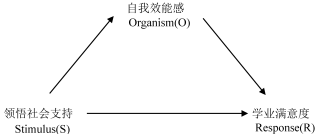
Academic satisfaction is a core indicator for evaluating the quality of higher education and students’ learning experience. Based on the M-R (S-O-R) model, this study takes perceived social support as the environmental stimulus (S), academic self-efficacy as the organism response (O), and academic satisfaction as the behavioral response (R), to explore the interaction mechanism among the three variables. Taking 205 college students as research subjects, this research adopts methods of literature review, questionnaire survey and statistical analysis, and uses SPSS to conduct reliability and validity analysis, correlation analysis, regression analysis and mediating effect test. The results show that: (1) Perceived social support, academic self-efficacy and academic satisfaction are significantly positively correlated; (2) Perceived social support can directly and positively predict academic satisfaction; (3) Academic self-efficacy plays a partial mediating role between perceived social support and academic satisfaction, with the mediating effect size of 23.4%; (4) The M-R model is applicable to the study of college students’ academic psychology. The research indicates that improving college students’ academic satisfaction can be achieved not only by strengthening external social support from family, school and peers, but also indirectly by cultivating academic self-efficacy. The findings enrich the research on the influencing mechanism of academic satisfaction, and provide empirical evidence and practical references for colleges to carry out academic guidance, optimize education services and enhance students’ learning experience.
This is an Open Access article, distributed under the terms of the Creative Commons Attribution 4.0 International License (http://creativecommons.org/licenses/by/4.0/), which permits unrestricted use, distribution and reproduction in any medium or format, provided the original work is properly cited.
Huang, Y., Xie, T. (2026). Investigation and Analysis on Influencing Factors of College Students' Academic Satisfaction. Science Innovation, 14(5), 160-169. https://doi.org/10.11648/j.si.20261405.12
Huang, Y.; Xie, T. Investigation and Analysis on Influencing Factors of College Students' Academic Satisfaction. Sci. Innov.2026, 14(5), 160-169. doi: 10.11648/j.si.20261405.12
Huang Y, Xie T. Investigation and Analysis on Influencing Factors of College Students' Academic Satisfaction. Sci Innov. 2026;14(5):160-169. doi: 10.11648/j.si.20261405.12
@article{10.11648/j.si.20261405.12,
  author = {Yafen Huang and Tong Xie},
  title = {Investigation and Analysis on Influencing Factors of College Students' Academic Satisfaction},
  journal = {Science Innovation},
  volume = {14},
  number = {5},
  pages = {160-169},
  doi = {10.11648/j.si.20261405.12},
  url = {https://doi.org/10.11648/j.si.20261405.12},
  eprint = {https://article.sciencepublishinggroup.com/pdf/10.11648.j.si.20261405.12},
  abstract = {Academic satisfaction is a core indicator for evaluating the quality of higher education and students’ learning experience. Based on the M-R (S-O-R) model, this study takes perceived social support as the environmental stimulus (S), academic self-efficacy as the organism response (O), and academic satisfaction as the behavioral response (R), to explore the interaction mechanism among the three variables. Taking 205 college students as research subjects, this research adopts methods of literature review, questionnaire survey and statistical analysis, and uses SPSS to conduct reliability and validity analysis, correlation analysis, regression analysis and mediating effect test. The results show that: (1) Perceived social support, academic self-efficacy and academic satisfaction are significantly positively correlated; (2) Perceived social support can directly and positively predict academic satisfaction; (3) Academic self-efficacy plays a partial mediating role between perceived social support and academic satisfaction, with the mediating effect size of 23.4%; (4) The M-R model is applicable to the study of college students’ academic psychology. The research indicates that improving college students’ academic satisfaction can be achieved not only by strengthening external social support from family, school and peers, but also indirectly by cultivating academic self-efficacy. The findings enrich the research on the influencing mechanism of academic satisfaction, and provide empirical evidence and practical references for colleges to carry out academic guidance, optimize education services and enhance students’ learning experience.},
 year = {2026}
}
TY  - JOUR
T1  - Investigation and Analysis on Influencing Factors of College Students' Academic Satisfaction
AU  - Yafen Huang
AU  - Tong Xie
Y1  - 2026/09/02
PY  - 2026
N1  - https://doi.org/10.11648/j.si.20261405.12
DO  - 10.11648/j.si.20261405.12
T2  - Science Innovation
JF  - Science Innovation
JO  - Science Innovation
SP  - 160
EP  - 169
PB  - Science Publishing Group
SN  - 2328-787X
UR  - https://doi.org/10.11648/j.si.20261405.12
AB  - Academic satisfaction is a core indicator for evaluating the quality of higher education and students’ learning experience. Based on the M-R (S-O-R) model, this study takes perceived social support as the environmental stimulus (S), academic self-efficacy as the organism response (O), and academic satisfaction as the behavioral response (R), to explore the interaction mechanism among the three variables. Taking 205 college students as research subjects, this research adopts methods of literature review, questionnaire survey and statistical analysis, and uses SPSS to conduct reliability and validity analysis, correlation analysis, regression analysis and mediating effect test. The results show that: (1) Perceived social support, academic self-efficacy and academic satisfaction are significantly positively correlated; (2) Perceived social support can directly and positively predict academic satisfaction; (3) Academic self-efficacy plays a partial mediating role between perceived social support and academic satisfaction, with the mediating effect size of 23.4%; (4) The M-R model is applicable to the study of college students’ academic psychology. The research indicates that improving college students’ academic satisfaction can be achieved not only by strengthening external social support from family, school and peers, but also indirectly by cultivating academic self-efficacy. The findings enrich the research on the influencing mechanism of academic satisfaction, and provide empirical evidence and practical references for colleges to carry out academic guidance, optimize education services and enhance students’ learning experience.
VL  - 14
IS  - 5
ER  -
Huang, Y., Xie, T. (2026). Investigation and Analysis on Influencing Factors of College Students' Academic Satisfaction. Science Innovation, 14(5), 160-169. https://doi.org/10.11648/j.si.20261405.12
Huang, Y.; Xie, T. Investigation and Analysis on Influencing Factors of College Students' Academic Satisfaction. Sci. Innov.2026, 14(5), 160-169. doi: 10.11648/j.si.20261405.12
Huang Y, Xie T. Investigation and Analysis on Influencing Factors of College Students' Academic Satisfaction. Sci Innov. 2026;14(5):160-169. doi: 10.11648/j.si.20261405.12
@article{10.11648/j.si.20261405.12,
  author = {Yafen Huang and Tong Xie},
  title = {Investigation and Analysis on Influencing Factors of College Students' Academic Satisfaction},
  journal = {Science Innovation},
  volume = {14},
  number = {5},
  pages = {160-169},
  doi = {10.11648/j.si.20261405.12},
  url = {https://doi.org/10.11648/j.si.20261405.12},
  eprint = {https://article.sciencepublishinggroup.com/pdf/10.11648.j.si.20261405.12},
  abstract = {Academic satisfaction is a core indicator for evaluating the quality of higher education and students’ learning experience. Based on the M-R (S-O-R) model, this study takes perceived social support as the environmental stimulus (S), academic self-efficacy as the organism response (O), and academic satisfaction as the behavioral response (R), to explore the interaction mechanism among the three variables. Taking 205 college students as research subjects, this research adopts methods of literature review, questionnaire survey and statistical analysis, and uses SPSS to conduct reliability and validity analysis, correlation analysis, regression analysis and mediating effect test. The results show that: (1) Perceived social support, academic self-efficacy and academic satisfaction are significantly positively correlated; (2) Perceived social support can directly and positively predict academic satisfaction; (3) Academic self-efficacy plays a partial mediating role between perceived social support and academic satisfaction, with the mediating effect size of 23.4%; (4) The M-R model is applicable to the study of college students’ academic psychology. The research indicates that improving college students’ academic satisfaction can be achieved not only by strengthening external social support from family, school and peers, but also indirectly by cultivating academic self-efficacy. The findings enrich the research on the influencing mechanism of academic satisfaction, and provide empirical evidence and practical references for colleges to carry out academic guidance, optimize education services and enhance students’ learning experience.},
 year = {2026}
}
TY  - JOUR
T1  - Investigation and Analysis on Influencing Factors of College Students' Academic Satisfaction
AU  - Yafen Huang
AU  - Tong Xie
Y1  - 2026/09/02
PY  - 2026
N1  - https://doi.org/10.11648/j.si.20261405.12
DO  - 10.11648/j.si.20261405.12
T2  - Science Innovation
JF  - Science Innovation
JO  - Science Innovation
SP  - 160
EP  - 169
PB  - Science Publishing Group
SN  - 2328-787X
UR  - https://doi.org/10.11648/j.si.20261405.12
AB  - Academic satisfaction is a core indicator for evaluating the quality of higher education and students’ learning experience. Based on the M-R (S-O-R) model, this study takes perceived social support as the environmental stimulus (S), academic self-efficacy as the organism response (O), and academic satisfaction as the behavioral response (R), to explore the interaction mechanism among the three variables. Taking 205 college students as research subjects, this research adopts methods of literature review, questionnaire survey and statistical analysis, and uses SPSS to conduct reliability and validity analysis, correlation analysis, regression analysis and mediating effect test. The results show that: (1) Perceived social support, academic self-efficacy and academic satisfaction are significantly positively correlated; (2) Perceived social support can directly and positively predict academic satisfaction; (3) Academic self-efficacy plays a partial mediating role between perceived social support and academic satisfaction, with the mediating effect size of 23.4%; (4) The M-R model is applicable to the study of college students’ academic psychology. The research indicates that improving college students’ academic satisfaction can be achieved not only by strengthening external social support from family, school and peers, but also indirectly by cultivating academic self-efficacy. The findings enrich the research on the influencing mechanism of academic satisfaction, and provide empirical evidence and practical references for colleges to carry out academic guidance, optimize education services and enhance students’ learning experience.
VL  - 14
IS  - 5
ER  -




 Share This Article
 Twitter
 Linked In
 Facebook
 Copy
Copy Download