Research Article | | Peer-Reviewed

Ethiopia Coffee Variety Development for Modern Coffee Production (Review)

Received: 12 May 2026     Accepted: 29 May 2026     Published: 22 July 2026
Views:       Downloads:
Abstract

Coffee plays a significant role in the world economy next to oil. More than 80 countries produce coffee but only 60 developing country including Ethiopia depend on coffee as s major source of their foreign currency earnings. Ethiopia is African’s leading coffee producer and 5th major coffee producing country in the world. However, the production and productivity of coffee are low compared with the major coffee producing countries, this is due to inadequate extension service, limited improved coffee variety and traditional farming practices. Therefore, strategically development and applying coffee breeding principles are significant effects to improve the productivity, quality attribute and disease- pest resistance. However, the breeding methods and their principles are varied from country to country depending on the amount of genetic variability available, ecological conditions and prevailing problems. Even though, well organized documents and data on breeding methods, improved coffee varieties and adaptability of release coffee varieties information’s are limited in Ethiopia. Therefore, the main objective of this review paper is, systematically assesses coffee production system, total improved coffee varieties in Ethiopia through pure line and hybrid breeding methods and their agroecological suitability. The ultimate goal of arabica coffee breeding program in Ethiopia is, to develop new and high yielder, best quality, disease - pest resistance, and adaptable on different agroecology of coffee growing area of the country. Then, coffee berry disease resistance, low and midland targeted, hybrid, highland and landrace are 16, 5, 4, 4 and 12 in number respectively total 41 improved coffee varieties were released. The unique features of these released coffee varieties are high yielder, best quality, disease - pest resistance and adaptable. However, multiplication and distribution of the improved coffee variety to coffee growers are limited because of limited extension service, inadequate infrastructure and limited seed enterprise. In general, Ethiopia is not only the center and origin of coffee arabica but also indispensable coffee genetic reservoir. So, it’s better to develop strategic planning and integration with global breeding for sustainable coffee production, enhance productivity associated with quality, disease resistance and adaptability.

Published in World Journal of Agricultural Science and Technology (Volume 4, Issue 3)
DOI 10.11648/j.wjast.20260403.13
Page(s) 61-72
Creative Commons

This is an Open Access article, distributed under the terms of the Creative Commons Attribution 4.0 International License (http://creativecommons.org/licenses/by/4.0/), which permits unrestricted use, distribution and reproduction in any medium or format, provided the original work is properly cited.

Copyright

Copyright © The Author(s), 2026. Published by Science Publishing Group

Keywords

Adaptable, Breeding, Coffee, Genetic Resource, Variety Development

1. Introduction
Coffee is most important and popular traded commodity in the world market next to oil . The genius coffee belongs to the rubiaceous family and around 125 species are identified in the world wide . Among them, based on the economic significant, Coffea arabica and Coffea canephore species largely produced in global level . To this end, based on ICO (2024) report showed that, the total share of green coffee bean of Arabica and Robusta 62.7 and 35.7% respectively. Even though, 1-2% of Coffea liberica is also cultivated on a small scale to satisfy local consumption . More than 80 countries produce coffee but only 60 developing country including Ethiopia depend on coffee as s major source of their foreign currency earnings, create job opportunity and livelihood for a million of people .
Additionally, it is estimated that 125 million of people in the coffee growing areas of the world derive their income directly or indirectly from the coffee industry through growing, processing, trading, transportation and marketing . In generally, coffee industry have been a great roles and generate USD 220 billion each year to provides a livelihood for more than 100 million people around the worldwide . Ethiopia is undoubtedly about the center of origin and diversity of Arabica coffee. Hence, studies indicated that, the country is well known not only being center and homeland of arabica coffee but also African’s leading and 5th major coffee producing country in the global level . Indeed, in Ethiopia, coffee industry is the corner stone and backbone to the country economy. It provides, approximately 30 -35% of the foreign currency exchange earnings, contributed about to 4-5% of country’s Gross Domestic Program (GDP) and create job opportunity to a million people in the country .
Similarly, the importance of coffee industry is not only economic sector but also a significant effect on social interventions. For instance, “Buna-enteta” program have been a great influential power on health sector outreach program specially to create awareness on mode of transmission, preventions and their consequence of HIV/AIDs campaigns for community . Therefore, coffee industry in Ethiopia is have been played a great role and the driving force on the country economy, socio-cultural intervention and spiritual life of the people. On the other hand, Ethiopia’s have favorable environmental conditions such as high altitude, optimal temperature, nutrient rich volcanic soils and offering vast genetic diversity on production of coffee .
Likewise, another important opportunity includes, high national and international demands towards the product, increasing of the private sector with high investment potential and supported of both regional and federal government . Then, the combination of the above highlighted factors is strongly contributed and a great influence to enhance production, productivity and best quality of coffee in the country. Studies finding showed that average production capacity of green coffee yield per hectare in coffee year of 2020 is 0.7 t/ha which is very far compared with 0.8 and 1.3 t/ha of world average and Brazil respectively . The bottle neck problems that observed in production, productivity and high quality of coffee bean in the country is inadequate extension service, lack of improved coffee variety, poor field management and post-harvesting practice, environmental conditions and infertile of soil . Among them, coffee breeding development programs are the most important challenges because, anchored within national research institutes mandate by the state to conduct research and provide improved variety to small holder farm with specific solution .
However, the institution has faced a lot of challenged such as inadequate funding, lack of specialized facilities, expertise and field trial sites across multiple locations, limited accesses to diverse genetic resource, modern breeding technologies, lack of cross border collaboration with other regional and international coffee industry . Therefore, strategically development and applying coffee breeding principles are significant effects to improve the productivity, quality attribute and disease- pest resistance. However, the breeding methods and their principles are varied from country to country depending on the amount of genetic variability available, ecological conditions and prevailing problems. Even though, well organized documents and data on breeding methods, improved coffee varieties and adaptability of release coffee variety information’s are limited in Ethiopia. Therefore, the main objective of this review paper is, systematically assesses coffee production system, total improved coffee varieties in Ethiopia through pure line and hybrid breeding methods and their agroecological suitability.
2. Methodology
To organize and documented of this systematic review articles only publication research articles, review articles and proceeding papers that directly related with coffee production system, breeding methods, improved coffee varieties procedure and future strategies on modern coffee production system in Ethiopia were collected from google scholar, web of science and Scopus. In addition, get recent published research articles the following words were regularly used in google scholar: coffee production system, breeding methods in Ethiopia, improved coffee variety, pure line and hybridization breeding methods in Ethiopia.
3. Coffee Production System in Ethiopia
In Ethiopia coffee cultivated at various altitudes, ranged from 550 – 2750 meter above the sea level. However, studies finding data indicated that, 1300 – 1800 masl of altitude, 15 and 30 oC of ideal minimum and maximum temperature and 1500 to 2500 mm of annual rainfalls are most preferable and suitable environmental conditions for cultivations of arabica coffee in Ethiopia . Based on the level of management practice, vegetation, structural complexity and agronomic approaches, coffee production system in Ethiopia can be categorized into forest, semi-forest, garden and plantation coffee. Among them, the three production systems (forest, semi-forest and garden coffee) practices are familiar and traditional production systems which are managed and dominated by small holder farmers whereas, plantation production systems are uses improved technology .
To briefly described each production system, forest coffee is coffee grows naturally under the canopy of undisturbed primary forests, the level of management and human interventions are very limited compared with others coffee production systems . It was reported that, forest (wild) coffee productions accounts 10% of the total coffee production in the country . Similarly, semi-forest coffee, the level of management and intervention of human activity is high compared with forest coffee production practice. In line to this, semi-forest production system includes farmers selectively thin the forest canopy, clear undergrowth and introduce new coffee seedlings from nearby wild trees . Additionally, farmers usually do not plant coffee cultivars but transplant semi-wild coffee plants that regenerate spontaneously inside the forest to fill open spaces in semi-forest coffee production system . In garden coffee production in Ethiopia is, conducted by small holder farmer typically around the homes, mostly the production systems are intercropped with other plants which is contribution for food security and biodiversity . One of the unique features of planation coffee production system is the level of management is to extremely high and used all improved technology such as used disease resistance and improved coffee varieties seed, effectively shade management practice, external input farm includes fertilizer, pesticides, weed and pest control fully implemented .
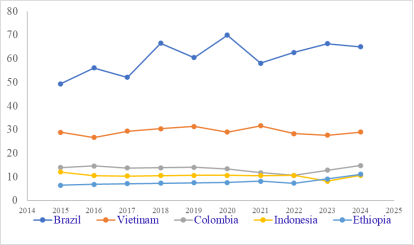
In their study emphasized that, Ethiopia is leading arabica coffee producer and exporter in Africa and ranked fifth in major coffee producer next to Brazil, Vietnam, Colombia and Indonesia . Indeed, according to (USDA, 2024) report showed that 175.32 million bags (60 kg) of coffee was produced in marketing year of 2024/25. Among them, 65, 29, 14.8, 10.7 and 11.5 million bags of 60 kg were obtained from the five top coffee producing country of Brazil, Vietnam, Colombia, Indonesia and Ethiopia respectively . The ten consecutive marketing year of the total coffee production data of the top ten country in millions of bags were described in Table 1 below. Thus, in marketing year of 2024/25 the total exported arabica coffee bean to the world market from Ethiopia is 11.1 million bags of 60 kg which is greater than even the fourth ranked of Indonesia country (Figure 1 and Table 1).
However, in marketing year of 2022/23 the total coffee production that produced and supplied to world market from Ethiopia is 7.3 million of bags (60 kg) which is decreased by 10.97% compared with cropping season of 2021/22 (Table 1). In other study, the estimated productivity in forest and semi-forest coffee production system in Ethiopia is 200 and 600 Kg ha-1 respectively which is very low compared with 2443 Kg ha-1 yield obtained by Brazil . The common factors that hinder to enhance of coffee production and productivity associated with best quality of coffee bean in Ethiopia is lack of improved coffee varieties, disease resistance, poor post-harvesting handling (storage and processing), climate change, land degradation, poor soil fertility, inadequate extension service, lack of infrastructure and limited access of market .
Therefore, adequate extension service, properly storage condition, effectively field management practice, farm input, disease resistance and tolerable pest coffee variety seed, properly pruning and suitable environmental condition is had been played a great role on mitigation of the above-described challenges and significant contribution on its production .
Table 1. Top ten coffee producing country around global level in million bags (60 kg).

Market Year

Brazil

Vietnam

Colombia

Indonesia

Ethiopia

Honduras

India

Uganda

Peru

Mexico

2015

49.4

28.9

14

12.1

6.5

5.3

5.8

3.5

3.5

2.5

2016

56.1

26.7

14.6

10.6

6.9

7.5

5.2

4.9

4.2

3.3

2017

52.1

29.3

13.8

10.4

7.1

7.6

5.3

4.6

4.4

4

2018

66.5

30.4

13.9

10.6

7.3

7.1

5.3

4.7

4.4

3.5

2019

60.5

31.3

14.1

10.7

7.5

5.2

5

5.5

3.9

3.7

2020

69.9

29

13.4

10.7

7.6

6.5

5.6

6.6

3.4

3.5

2021

58.1

31.6

11.8

10.6

8.2

4.8

5.7

6

4.2

3.7

2022

62.6

28.3

10.7

10.7

7.3

5.7

5.9

6.6

3.5

3.5

2023

66.3

27.6

12.8

8.2

9.1

5

6.6

6.4

3.9

3.9

2024

65

29

14.8

10.7

11.1

5

6.2

6.7

3.7

3.9

Source: USDA Foreign Agricultural Service and International Coffee Organization
Figure 1. Top five coffee producing country in millions of bags (60 kg).
4. Coffee Breeding Methods in Ethiopia
Coffee breeding methods across the worldwide are centers around three fundamental pillars such as improved productivity, disease resistance and adaptability. These three pillars collectively served as a corner stone and strongly influence on productivity, quality, disease resistance and sustainability of coffee production systems in global level. However, the way of breeding approaches and application techniques are varied from country to country through genetic variability, agroecological conditions, the objective of breeding and the dominate production issue . In their study emphasized that, the general breeding methods that applied for coffee producing area across the worldwide includes of Ethiopia is uses, pure line selection, intra specific hybridization F1, pedigree selection after hybridization and intraspecific hybridization (Arabica x Robusta) . Among them, pure line and intraspecific hybridization of coffee breeding methods are commonly used in Ethiopia. However, the primary goal coffee breeding methods in Ethiopia is conserve its immense genetic resource while developing improved cultivars that address biotic (disease /pest) and abiotic (drought, climate change) stress all without compromising the unique and prized cup quality for which Ethiopia coffee is famous . Therefore, once the release of coffee berry disease resistance, coffee variety followed and focused on genetics studies, yield improvement through development of varieties that combine high yield and high quality Hence, pure-line selection and intra-specific hybridization methods of breeding approach methods are described as follow.
4.1. Pure Line of Coffee Varieties Development in Ethiopia
Pure-line selection of breeding development program is followed the following procedures such as properly selection of mother tree with desirable traits from the forest coffee, followed evaluation of mother trees, seedling transplanting, and field management . Then replicated yield trials with the remaining lines, especially comparing them with established commercial varieties then after multilocation trials for many years (seasons), usually at 3–5 locations for 3–5 years and finally variety release, seed multiplication, and distribution . However, in Ethiopia, pure-line variety development breeding techniques are followed, screening, adaptation trial on the ecology verification of promising selection, variety release and seed multiplication until in 1994 .
The varieties were collected under the National and International coffee collection program were rigorously evaluated for a different number of years at each breeding stage . After the release of CBD resistance variety, pure line variety development breeding program was primely focused on releasing of varieties adaptable different agroecological condition of coffee growing area. For instance, as described in Table 1, from 1978 - 2006 a total of 23 varieties including CBD resistant varieties developed during the crash breeding program have been released and distributed for production at low to high altitude areas where coffee is predominantly produced in Ethiopia . Recently research finding showed that Ethiopia has 23 pure lines, 15 specialty coffee varieties and 3 hybrids totally 41 improved varieties were released, which are high yielding, disease-pest resistance especially (coffee berry disease), have a unique quality attribute of different locality . In other study, from the year 1978 up to 2028 totally 41 purebred coffee variety including of coffee berry disease resistance was released under the crash plant breeding program that described in Table 2 were distributed on the different agroecological conditions of coffee growing area .
Although, the mass of multiplication and distribution of improved and promising specialty coffee varieties to coffee growers are underway at their respective locations and the technologies are not reached all potential coffee producing areas is the main constraints and challenges were observed in Ethiopia coffee variety development program . Additionally, incognizant of the long time required to develop improved varieties through the conventional breeding approach and the ever-increasing demand for quality and traceability, the coffee breeding program was focused on developing improved varieties for producing coffee with a unique flavor . In generally, pure line selection methods have their own unique features and footprint on coffee production system compared with other types of breeding methods. For instance, produce highly uniform, stable varieties, high intensity, easy to maintain, identify seed certification and full sun farming . Even though, there is some limitations such as there is no create new gens, long development time (25 -35%), limited to the genetic variation existing in the population and narrow genetic base make them more prone to new disease .
Table 2. Pure-line coffee varieties released from coffee breeding program in Ethiopia.

Year of release

Number of varieties

Clean coffee yield (Kg/ha)

Area of recommendation

1978 -1981

13

1220 – 1970

Low to High

1997

3

1660 – 1940

Low to High

2002

2

2140 – 2540

Low to Medium

2006

5

1540 – 2350

Medium to High

2010

11

1190 – 2120

Medium to High

Total

34

Source .
Table 3. Released coffee varieties in Ethiopia.

Variety group

Number of varieties

Year of release

Yield range (q/ha)

On station

On farm

CBD Resistance

16

1978 – 2018

12.2 – 23.8

6.0 – 10.0

Low and Midland

5

1997 – 2002

16.6 – 23.4

9.0 – 20.0

Hybrid

4

1997 – 2018

24.0 – 26.0

13.0 – 20.0

Highland

4

2006

16.4 – 23.5

15.2 – 16.2

Landrace

12

2006, 2010

11.9 – 20.4

7.2 – 16.2

Total

41

Source .
4.2. Hybridization of Coffee Variety Development in Ethiopia
The hybridization of coffee variety breeding method was started in 1978 in Ethiopia. The primary objective of hybridization of coffee variety development program in Ethiopia is yield and quality improvement, disease resistance, utilizing heterosis, environmental adaptation and combining ability . Moreover, it’s compared with pure line selection, hybridization of coffee breeding method is highly significant effects and great influential powers on coffee production system in the country. For instance, enhanced disease and pest resistance, high yield potential and heterosis, superior adaptation and stability, utilization of genetic diversity and fast improvement in quality . However, the methods are required a more complex, expensive and technical breeding programs.
On the other hand, few studies were conducted on hybridization of coffee variety development program in Ethiopia. For example, hybrid coffee variety that releases in the year of 1997 and 2002 reported showed that, the first three hybrid varieties are a significant effect on high yield, moderate resistance to diseases such as CBD & CLR, acceptable quality for production at medium altitude coffee growing areas of the country . In addition, the F1 hybrid coffee varieties finding underlined that the highest and lowest average mean value of green coffee yield is 2610 and 2168 Kg ha-1 was recorded in varieties name of ETAR50-CH and Awarda HBA respectively (Table 4). In this study, from the total nine F1 hybrid coffee varieties around 89% of released coffee varieties are more adapted on Southwest except rorri variety that adapted in South (sidama). Likewise, as described in Table 5 from the totally released hybrid coffee varieties almost all varieties adapted mid-altitude (1500 to 1750 masl) agroecological conditions but some of the varieties like EIAR50/-CH, Melko Ibsitu and Gera -CHI coffee varieties are adapted both mid and low altitude environmental conditions.
Table 4. List of F1 hybrid coffee verities released from coffee breeding program in Ethiopia.

Name of varieties

Year of release

Green bean Yield (Kg/ha)

Altitude

Recommended coffee growing area

Ababuna

1997

2380

1500-1752

Southwest

Melko CH2

1997

2400

1500-1752

Southwest

Gawe

2002

2610

1500-1752

Southwest

EIAR50-CH

2016

2650

1000-2000

Southwest (Tepi, Bebeka)

Melko Ibsitu

2016

2490

1000-1752

Southwest (Tepi, Bebeka)

Tepi-CH5

2016

2340

1000-1752

Southwest (Tepi, Bebeka)

Gera-CH1

2018

2300

1940-2000

Southwest

Rorri

2022

2464

1600-1850

South (Sidama)

AwadaHB1

2022

2168

1600-1850

Southwest

Source .
Table 5. List of F1 hybrid coffee varieties that suitable altitude coffee producing area.

Name of varieties

Suitable altitude for coffee growing area

High-altitude >1750 m.a.s.l

Mid-altitude (1500 -1750) m.a.s.l

Low -altitude (1000 -1500) m.a.s.l

Ababuna

Melko CH2

Gawe

EIAR50-CH

Melko Ibsitu

Tepi-CH5

Gera-CH1

Rorri

AwadaHB1

Indicate adaptability area of the varieties, Source .
4.3. Breeding for Disease Resistance (BDR)
Coffee products are strongly affected through the different fungi pathogens. Among them, coffee berry disease (CBD), coffee wilt disease (CWD) and coffee leaf rust (CLR) have been played a great impact on coffee production and quality in global level . The common fungi pathogens are Colletorichum kahawae, Gibberella xylarioides and Hemilaia vastarix species are leads coffee berry, coffee wilt and coffee leaf rust respectively . These described diseases are directly affected the yield and quality . Studies finding showed that, coffee berry disease (CBD) is affect the coffee production from range of 25 to 30% but in the presence of favorable environmental conditions they can be damage up to 100% . The outbreak of the disease in Ethiopia was first established and reported in 1971 in Sidama, Illubabur and Kaffa but latter by 1978 the disease was spread in almost all coffee growing region of the country .
The disease is widely spread in major coffee growing area and severity of CBD that observed in Bedeno and Yirgachefe of Oromia and South Nation Nationality and People of Religion is 51.1 and 48.8% respectively . Similar, the incidence of CBD severity in West Hararge was ranged from 8.0 to 84.0% with an average of 49.7% which is indicated its great impacts on coffee production system in Ethiopia . Likewise, Coffee leaf rust (CLR) is also the most dangerous coffee disease in the worldwide and has a great economic impact on coffee sector. For instance, it causes losses of one to two billion USD annually of arabica coffee production in worldwide . Moreover, three -fourth of the coffee cultivated in the world is susceptible to the majority of physiologic pathogenic races .
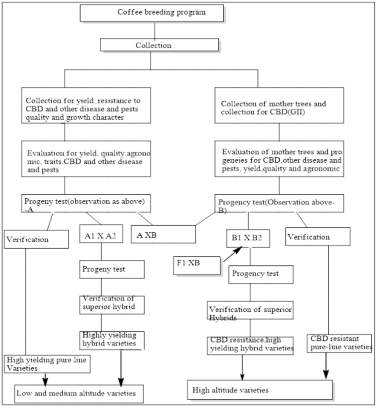
Hence, Ethiopia plays a uniquely critical role in the global fight against CBD, both as a country severely impacted by the disease and as the primary source of genetic resistance for international breeding programs. Then, coffee berry disease (CBD) was first reported in Ethiopia in 1971 and it spreads in all coffee-producing areas in which it has been favored by favorable environmental conditions . Therefore, breeding program was started before 30 years and the applications are more effective and succeeded in developing new cultivars with long term CBD resistance . To this end, different types of breeding systems that applied for selection of disease resistance coffee variety such as pure-line selection, hybridization (intra-specific), interspecific hybridization, molecular breeding and tissue culture methods . Molecular breeding techniques such as marker assisted selection (MAS) and the use of DNA markers are more advanced and fast breeding techniques by enabling the early and efficient identification of resistance genes in seedlings or progenies . Whereas biotechnology approach through tissue culture breeding method is more essential and effective for rapid and mass propagation of promising F1 hybrids or selected resistant genotypes however, cannot be propagated through convectional seed due to the need to maintain a true type genetic makeup . But pure line selection method is individually identifying and selection of the best mother tree with desirable traits such as naturally resistance to CBD from existing wild/local landrace . According to reported that, farmers’ acceptance of CBD resistant hybrid varieties such as Ababuna is higher than the earlier released lines, because of better agronomic performance. Over all, generalized outline of the breeding systems that was proposed for arabica coffee breeding program in Ethiopia was described in Figure 2 below.
Figure 2. A generalized outline the breeding scheme proposed for arabica coffee .
4.4. Future Strategies of Coffee Breeding System on Modern Coffee Production
The ultimate goal and key characteristics of coffee breeding method in Ethiopia is to develop productivity associated with producing of best quality of coffee bean, disease-pest resistance and adaptable on local agroecological condition. Then, to achieve this primary breeding objective, it should develop the key breeding strategies such as, climate smart agricultural practice aligned with varieties, applying of different breeding technology (biotechnology application), interspecific hybridization, and conservation genetic resource. Hence, to enhance production and productivity of arabica coffee in Ethiopia, its’ better to search more effective, economical visible and less labor-intensive breeding methods. For example, integrated biotechnology approaches are a significant effect on scaling up productivity, largely propagation and less labor intensive.
According to and emphasized that, tissue culture techniques could provide a best alternative coffee propagation as it allowed the production of relatively uniform plantlets on a large scale within a shorter period. Similarly, Somatic embryogenesis (SE) is also another important and powerful biotechnology applications that highly contributed for mass propagation, reducing labor intensive, enabling the scaling up productivity, conservation of genetic and sustainable of arabica coffee cultivars . However, these approaches are required skilled manpower, highly sensitive and advanced laboratory with well-equipped laboratory facilities and adequate budget. Therefore, established modern coffee varieties breeding program in Ethiopia, it’s required collaborative research work with national and international levels, adequate budget to facilitate modern laboratory technology and others.
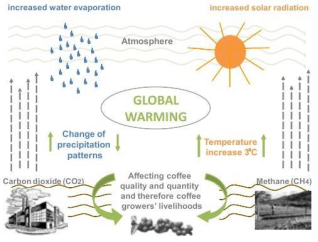
On the other hand, climate change is recently the burning issue and gain the attention of worldwide that required urgent need of global action to mitigate its effects. For instance, climate change strongly affects and leads a negative impact on agricultural commodity including of coffee through variation of rainfall and temperature . Furthermore, smallholder farmers are highly vulnerable and affects by climate change due to the lack of modern agricultural technology and their efforts to mitigate is still limited . Then, several studies were conducted and finding underlined that, coffee sector was faced several challenges through climate changes includes, reducing of coffee quality, yield, household income, food insecurity, export earnings and leads economic contraction . Moreover, it was reported that, twelve thousands of coffee germplasm was collected by Jimma Agricultural Research Center (JARC), among them around 15.35% of coffee accessions were died by the climate change factors . Moreover, overview of the impacts of climate change on production, productivity and quality of coffee is described in Figure 3 below.
Figure 3. The impacts of climate change on coffee [68].
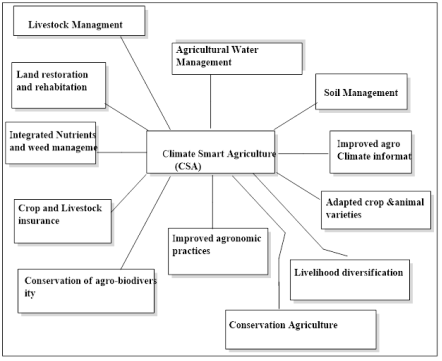
To this end, as described in Figure 4, climate smart agricultural practices are the pillar and very important tackling approaches to mitigating of climate change to sustainable of agricultural crops and coffee sector through the intervention such as, the use of improved coffee varieties, shade tree management, intercropping, soil and water conservation, mulching and integrated pest management. Indeed, finding indicated that, climate smart agricultural practices are strongly contributions the coffee industry and result revealed that, 89.9%, 89.1%, 83.8%, 82.8%, and 79.2% of weed control, intercropping coffee, shade tree management, stumping and use of improved varieties respectively was adopted on climate smart farming practices .
Similar, study was conducted on farmers adaptation strategies to climate change and variability in Dara Woreda, South Ethiopia. The result showed that 10.41%, 16.10%, 15.76%, 25.14% and 14.24% of off-farm employment, mixed farming, improved coffee variety, soil and water conservation and small-scale irrigation respectively was recorded on the farmers adopted strategies on climate change . Likewise, the development of environmentally friendly, dependable and drought resistant coffee varieties is a fundamental effort to meet the difficulties of climate change, even though integrated techniques may be more appropriate given the complexity of the trait .
Figure 4. The effects of Climate Smart Agriculture Practice.
5. Conclusion
Coffee is one of the most popular traded commodities in the world market and its main source of foreign currency earnings, create job opportunity and livelihood to more than one hundred million people in global level. In Ethiopia, coffee industry is backbone of the country economy and it provides 25-30% foreign currency earnings, 10% of total government revenue and source of income generation to more than 15 million of population. Ethiopia is not only center of origin and genetic diversity of arabica coffee but also leading exporter and producer from Africa and ranked fifth next to Brazil, Vietnam, Colombia and Indonesia in global level. However, due to several factors such as climate change, agricultural practice, inadequate post- harvest processing and extension service, availability of improved coffee varieties, weak of infrastructure, lack of well-equipped and organized modern laboratory to release improved coffee varieties and others bottle neck problems the production level is low compared with major coffee producing country.
On the other hand, coffee production system in Ethiopia, based on the level of management, vegetation, structural complexity and agronomic approaches, can be categorized as forest, semi-forest, garden and plantation. Among them, forest, semi-forest and garden coffee production systems are largely dominated and grown by smallholder farmers which is cultivated less than of two hectares while plantation production system is followed modern technology and contributed 10 -15% on total coffee production system of the country.
The principles and primary ultimate goal of arabica coffee breeding program in Ethiopia is, to develop new and high yielder, good quality, disease - pest resistance, increase plant density and adaptability of coffee growing area of the country. So, based on the pure line and hybridization breeding methods, totally 41 improved coffee varieties were released. However, multiplication and distribution of the improved coffee variety to coffee growers are limited. The common factors include limited research center, inadequate infrastructure for breeding and availability of coffee seed. Hence, to achieve breeding objective and to improve coffee production system in the country, it should develop the key breeding strategies such as, climate smart varieties, biotechnology application, interspecific hybridization, and conservation genetic resource. The reason why, tissue culture and Somatic embryogenesis (SE) methods are a powerful biotechnology technique that significantly used large number propagation, reducing labor intensive, enabling the scaling up productivity, conservation of genetic and sustainable of arabica coffee cultivars.
Likewise, climate change is also another important factors and leads great impacts on agricultural sector particularly on coffee product. Therefore, implementing of climate smart agricultural practice and collaborative research with global level on the modern coffee breeding methods are highly essential for largely propagation of the coffee varieties within a short period of time with low cost.
Abbreviations

CBD

Coffee Berry Disease

CLR

Coffee Leaf Rust

CWD

Coffee Wilt Disease

CSA

Climate Smart Agriculture

EIAR

Ethiopia Institution Agricultural Research

ICO

International Coffee Organization

JARC

Jimma Agricultural Research Center

Author Contributions
Salasib Atumo: Conceptualization, Writing – review & editing
Conflicts of Interest
There is no any conflicts of the interest.
References
[1] Seid, H (2022). Strategies to improve the quantity and quality of export coffee in Ethiopia, a look at multiple opportunities. Journal of Agriculture and Food Research,
[2] Zainuri, D.; Nyoman, A.; Amira, F.; and Rini, N (2023). The Chemical Characteristics of Arabica and Robusta green coffee beans from Geopark Rinjani, Indonesia, Biotrophic, 30(3): 318 – 328.
[3] Addisu, H.; and Kedir, W (2025). Analysis of Arabica Coffee Production Trend and Major Production Constraints in East and West Hararghe Zones, Ethiopia. Journal of coffee and sustainability, 1(3): 129 – 145
[4] International Coffee Organization (2024). Coffee production, consumption and Export.
[5] Charrier, A. and Berthaud, J (1985). Botanical classification of coffee. In Coffee Botany, Biochemistry and Production of Beans and Beverage; Croom Helm: London, 13–47.
[6] Gole, T. (2015). Coffee: Ethiopia’s gift to the world and the traditional production systems as living examples of crop domestication, and sustainable production and an assessment of different certification schemes. Environment and Coffee Forest, Addis Ababa.
[7] Mohammed, W (2023). Production, productivity, quality and chemical composition of Ethiopian coffee. Cogent food& agricultu
[8] Jorge, A.; Cardona, P.; Luis, F and Maldonado, M. (2024). Effect of demucilagination and soaking in water with organic acids on the microbial, chemical, and sensory characteristics of coffee (Coffea arabica) Coffee Science, e192191,
[9] Mohammedsani, A (2017). Influence of harvesting and postharvest processing methods on the quality of Arabica coffee (Coffea arabica L.) in Eastern Ethiopia. Journal of food and Agriculture Science, 7(1): 1-9.
[10] Bewketu, M.; Mesfin, R.; Bhagwan, S; and Minaleshewa, A. (2016). Profiling of phenolic compounds using UPLC–MS for determining the geographical origin of green coffee beans from Ethiopia, Journal of Food composition and Analysis
[11] Tefera, A.; & Bickford, R. (2021). Coffee annual report, Global Agricultural Information Network (GAIN), report number: ET2021-0013.
[12] Misgana B,; and Tegene A. (2024) Physicochemical and cup quality of coffee as affected by processing methods and growing locations.
[13] Esayas, M.; Gezahegn, B.; Getachew, W.; Kifle, B and Taye, K (2019). ECSS: Proceedings of the Ethiopian Coffee Science Society (ECSS): Enhancing Coffee Science and Technology for Sustainable Development in Ethiopia. Inaugural Conference Held on 7 &.
[14] Lola, R.; and Gregorian, J (2025). Competitiveness of major producing countries in world coffee trade. Website: jurnal.umj.ac.id/index.php/icecream
[15] Berihun, T.; Habtemariam, K.; and Tigest, Z (2025). Analysis of Ethiopian Coffee Value Chain for Compliance with European Union Deforestation Regulation. Trees, Forests and People,:
[16] Adugna, T (2021). Review on coffee production and quality in Ethiopia.
[17] Tesfaye, T.; Bizuayehu, T.; and Girma, A (2020) Coffee production constraints and opportunities at major growing districts of southern Ethiopia, Cogent Food & Agriculture, 6: 1, 1741982,
[18] Bealu, G (2017). Factors Affecting Coffee (Coffea Arabica L.) Quality in Ethiopia: A Review. American Journal of Agriculture and Forestry, 9(5): 288 – 296.
[19] Godfrey, M.; and Kazuo, N (2024). Coffee sustainability: Leveraging collaborative breeding for variety improvement.
[20] MOA (Ministry of Agriculture) (2013). Plant variety release, protection and seed quality control director, Crop varieties register, (16), 330. Addis Ababa, Ethiopia.
[21] Addis, A.; Tassew, G.; Berecha, Y.; and Adugna, D (2022). Location, production systems, and processing method effects on qualities of Kafa Biosphere Reserve coffees. Agrosyst Geosci Environ.
[22] Regassa,, F.; Genene, G.; Bayush, T.; andKassahun, T. (2013). Community management of forest coffee landscapes in Ethiopia.
[23] Befikadu, M (2020). Coffee: The driver of economic development and socio-cultural Integration in Ethiopia. Journal of Culture, Society and Development. 61: 1 10.
[24] Befikadu, M.; and Kifle, B (2018). Forest Coffee Production in Ethiopia: The Case of Gimbo District, Kaffa Zone, Southwest Ethiopia. Journal of natural science research, 8(12): 42 – 49.
[25] Raf, A., Kitessa, H., Gezahegn, B., and Pieter, G (2011). Semi-forest coffee cultivation and the conservation of Ethiopian Afromontane rainforest fragments. Forest Ecology and Management.
[26] Labouisse, J., Bellachew, B., Kotecha, S and Bertrand, B (2008). Current status of coffee (Coffea arabica L.) genetic resources in Ethiopia: implications for conservation. Genet. Res. Crop Evol. 55, 1079–1093.
[27] International Coffee Organization (2017). Coffee Market price ends.
[28] United State Department of America (USDA)(2024). Foreign Agricultural Service and International Coffee Organization.
[29] Abebaw, Y., Tobiaw, D., Abate, B., and Tesfaye, K (2021). Plant Tissue Culture Research and Development in Ethiopia: A Case Study on Current Status, Opportunities, and Challenges. Adv. Agric.
[30] Bayetta, B and Pierre, J (2006). Arabica coffee (Coffea arabica L.) Landrace Variety Development Strategy in Its Center of Origin and Diversity. In Proceedings of the 21th International Scientific Colloquium on Coffee, Montpelier, France,
[31] Bayetta, B (2001). Arabica coffee breeding yield and resistance of coffee berry disease (Colletorichum kahawae sp), PhD thesis, University of London, UK.
[32] Yebirzaf, Y. and Semagn A (2021). Coffee (Coffea arabica L.): Methods, Objectives, and Future Strategies of Breeding in Ethiopia: Review. Sustainability, 13,
[33] Dadi, T and Habtamu, G (2021). Impact of Climate Change on East African Coffee Production and Its Mitigation Strategies, World Journal of Agricultural Sciences 17(2): 81-89, 2021.
[34] Ayele, A.; Worku, M.; and Bekele, Y (2021). Trend, instability and decomposition analysis of coffee production in Ethiopia,
[35] Aerts, R.; Gazahegni, B.; Gijbels, P.; Kittessa, H and Glabeke, S (2013). Genetic Variation and Risks of Introgression in the Wild Coffea arabica gene pool in South-Western Ethiopian Montane Rain Rorests. Evol, 6, 243–252.
[36] Habtamu, G.; Gizachew, A.; Meseret, D and Ashenafi, A (2018). Arabica Coffee (Coffea arabica L.) Hybrid Genotypes evaluation for Growth Characteristics and Yield Performance under Southern Ethiopian Growing Condition. Acad. Res. J. Agri. Sci. Res, 6: 89–96.
[37] Clarke, R.; Vitzthum, O (2008). Coffee: Recent Developments; John Wiley and Sons: Hoboken, NJ, USA.
[38] EIAR. Research on Coffee and Tea (2020).
[39] Ethiopian Institute of Agricultural Research (EIAR)(2022). Various annual reports and technical bulletins from the Jimma Agricultural Research Center (JARC). (Primary source for released varieties.
[40] Meseret, D (2024). Over View of Coffee (Arabica Coffee) Breeding in Ethiopia. International journal of genetics and genomics, 12(1): 8 – 12
[41] Tadesse, B (2017). Progress in Arabica Coffee Breeding in Ethiopia: Achievements, Challenges and Prospects, International Journal of Sciences: 33(2): 15 -25.
[42] Desalegn, A.; Tadesse, B.; Lemi, D and Merga, A (2023). The Exploration and Utilization of Coffee (Coffea arabica L.) Genetic Resource in Its Center of Origin. Journal of Global Agriculture and Ecology, 15(2): 45 – 57.
[43] Degife. Z.; Seifu, F and Sabura, S (2022). Evaluation of agronomic performance of coffee (Coffea arabica L.) cultivars in Gamo and Gofa, southern Ethiopia.
[44] Behailu, A.; Bayetta, B.; Fikadu, T.; Melaku, A and Tadesse, B (2008). Developing Coffee Hybrid Varieties, 99-105.
[45] Girma, A.; Bayetta, B.; Tesfaye, S; and Endale, T (2007). Coffee Diversity and Knowledge. Proceedings of a National Workshop Four Decades of Coffee Research and Development in Ethiopia, 14-17 Addis Ababa, Ethiopia.
[46] Geneti, D (2019). Progress of Coffee (Coffea arabica L) Hybridization Development Study in Ethiopia: A Review. Food Sci. Qual. Manag. 92, 22–28.
[47] Adugna G.; Jafuka, C.; Zeru. A; and Tessfaye, A (2009). Advances in coffee diseases research in Ethiopia: Increasing crop production through improved plant protection. Volume II Proceeding of the 14th annual conference of the plant protection society of Ethiopia (PPSE); Addis Ababa, Ethiopia; 540: 275–303.
[48] Yitagesu, T,; Dereje, A. and Asela, K (2021). Coffee Leaf Rust Disease and Climate Change. World Journal of Agricultural Sciences 17(5): 418-429.
[49] Kumlachew, A.; Girma, A.; Fikre, L and Diriba, M (2017). Current status of coffee berry disease (Colletotrichum kahawae) in Ethiopia. Archives of phytopathology and plant protection, 49(17): 421 – 433
[50] Kumlachew, A (2025). Coffee berry disease: a threat to Arabica coffee production in Ethiopia. Discover Life, 55: 12 |
[51] Adem A, Amin M and Mamo M (2020). Assessment of coffee berry disease in West Hararge Zone, Eastern Ethiopia. Int J Food Sci Agric, 4(4): 465–9.
[52] Dadi, T and Damtew, A (2021). Review on Integrated Pest Management of Coffee Berry Disease and Coffee Berry Borer. International Journal of Plant Breeding and Crop Science 8(1): 1001-1008,
[53] Guzzo, S (2004). Molecular biochemical aspects of systemic acquired resistance. International Jornal of rezurce agricultura, 7, 32.
[54] Gichuru, E.; Agwanda, M.; Combes, E. and Ngugic, B (2008). Blackwell Publishing Ltd Identification of molecular markers linked to a gene conferring resistance to coffee berry disease (Colletotrichum kahawae) in Coffea arabica. Plant Pathology, 57, 1117–1124.
[55] Adane, A (2009). Agricultural biotechnology research and development in Ethiopia. Afr. J. Biotechnol 8, 7196–7204.
[56] Lashermes, P.; Trouslot, P.; Anthony, F and Combes, M (1996). Genetic Diversity for RAPD Markers between Cultivated and Wild Accessions of (Coffea arabica). Euphytica, 87, 59–64.
[57] Emilly, R., Eveline, T., Tilago, V and Felipe, L. Designing the best breeding strategy for Coffea canphora: Genetic evaluation of pure and hybrid individuals aiming to select for productivity and disease resistance traits. PloS ONE. 2021, 1 -17.
[58] Elias, G. In Vitro propagation of Coffea arabicacv. MCH2 using Nodal Explants. Journal of Natural Science Research. 2017, 7(1): 17 – 21.
[59] Elyas, G. (2024). Hybrid Coffee (Coffea arabica L) Plantlet Production via Indirect Somatic Embryogenesis in Ethiopia: Current Statue and Future Direction. Plant, 12(4): 87 – 94
[60] Kumar, V., Naidu, M. and Ravishankar, G (2006). Developments in coffee biotechnology in vitro plant propagation and crop improvement. Plant Cell Tiss Organ Cult 87, 49–65.
[61] Smertenko, A., and Bozhkov, P (2013). Somatic embryogenesis: life and death processes during apical–basal patterning. Journal of Experimental Botany, 65(5): 1343–1360.
[62] Heringer., A., Santa, Cand Silveira, V (2018). Insights from proteomic studies into plant somatic embryogenesis. Prote omics, 18, 5-6.
[63] Guta, R., Adugna, E and Weyessa, G (2025). Impact of climate change on Ethiopian Arabica coffee production and current challenges it poses to coffee value chain.
[64] Akinyi, D., Ng’ang’a, K and Ngigi, M. (2022). Cost-benefit analysis of prioritized climate-smart agricultural practices among smallholder farmers: evidence from selected value chains across sub-Saharan Africa,
[65] Berhanu, Z. BAyele, D. C. Dagnew, A. B. Fenta, K. E (2024). Smallholder farmers’ coping strategies to climate change and variability: evidence from Ethiopia, Clim. Serv.
[66] Hirons, E., Beauchamp, S., Whitfield, D. and Conway, R. (2020). Resilience to climate shocks in the tropics, Env. Res.
[67] Abidoye, A. and Odusola, F (2015). Climate change and economic growth in Africa: an econometric analysis, J. Afr. Econ. 24: 277–301.
[68] Rezai, L., Taylor, D., and Foley (2018). Economic growth, income distribution, and climate change, Ecol. Econ. 146: 164–172,
[69] Supriandi H (2014). Coffee Cultivation for Climate Change Adaptation and Mitigation IOP Publishing 13 35–52
[70] Aneteneh, S., and Demelash, K (2025). Effects of Climate Change and Variability on Coffee Production and Adaptation Mechanisms: The Case of Small-Holder Farmers at Dara Woreda, South Ethiopia. Journal of Environment and Earth Science, 15(4):
[71] Meseret, D (2024). Production of Climate Smart Coffee (Coffea Arabica). American Journal of Enviromental and Resource Economics, 9(1): 1- 16
Cite This Article
  • APA Style

    Atumo, S. (2026). Ethiopia Coffee Variety Development for Modern Coffee Production (Review). World Journal of Agricultural Science and Technology, 4(3), 61-72. https://doi.org/10.11648/j.wjast.20260403.13

    Copy | Download

    ACS Style

    Atumo, S. Ethiopia Coffee Variety Development for Modern Coffee Production (Review). World J. Agric. Sci. Technol. 2026, 4(3), 61-72. doi: 10.11648/j.wjast.20260403.13

    Copy | Download

    AMA Style

    Atumo S. Ethiopia Coffee Variety Development for Modern Coffee Production (Review). World J Agric Sci Technol. 2026;4(3):61-72. doi: 10.11648/j.wjast.20260403.13

    Copy | Download

  • @article{10.11648/j.wjast.20260403.13,
      author = {Salasib Atumo},
      title = {Ethiopia Coffee Variety Development for Modern Coffee Production (Review)},
      journal = {World Journal of Agricultural Science and Technology},
      volume = {4},
      number = {3},
      pages = {61-72},
      doi = {10.11648/j.wjast.20260403.13},
      url = {https://doi.org/10.11648/j.wjast.20260403.13},
      eprint = {https://article.sciencepublishinggroup.com/pdf/10.11648.j.wjast.20260403.13},
      abstract = {Coffee plays a significant role in the world economy next to oil. More than 80 countries produce coffee but only 60 developing country including Ethiopia depend on coffee as s major source of their foreign currency earnings. Ethiopia is African’s leading coffee producer and 5th major coffee producing country in the world. However, the production and productivity of coffee are low compared with the major coffee producing countries, this is due to inadequate extension service, limited improved coffee variety and traditional farming practices. Therefore, strategically development and applying coffee breeding principles are significant effects to improve the productivity, quality attribute and disease- pest resistance. However, the breeding methods and their principles are varied from country to country depending on the amount of genetic variability available, ecological conditions and prevailing problems. Even though, well organized documents and data on breeding methods, improved coffee varieties and adaptability of release coffee varieties information’s are limited in Ethiopia. Therefore, the main objective of this review paper is, systematically assesses coffee production system, total improved coffee varieties in Ethiopia through pure line and hybrid breeding methods and their agroecological suitability. The ultimate goal of arabica coffee breeding program in Ethiopia is, to develop new and high yielder, best quality, disease - pest resistance, and adaptable on different agroecology of coffee growing area of the country. Then, coffee berry disease resistance, low and midland targeted, hybrid, highland and landrace are 16, 5, 4, 4 and 12 in number respectively total 41 improved coffee varieties were released. The unique features of these released coffee varieties are high yielder, best quality, disease - pest resistance and adaptable. However, multiplication and distribution of the improved coffee variety to coffee growers are limited because of limited extension service, inadequate infrastructure and limited seed enterprise. In general, Ethiopia is not only the center and origin of coffee arabica but also indispensable coffee genetic reservoir. So, it’s better to develop strategic planning and integration with global breeding for sustainable coffee production, enhance productivity associated with quality, disease resistance and adaptability.},
     year = {2026}
    }
    

    Copy | Download

  • TY  - JOUR
    T1  - Ethiopia Coffee Variety Development for Modern Coffee Production (Review)
    AU  - Salasib Atumo
    Y1  - 2026/07/22
    PY  - 2026
    N1  - https://doi.org/10.11648/j.wjast.20260403.13
    DO  - 10.11648/j.wjast.20260403.13
    T2  - World Journal of Agricultural Science and Technology
    JF  - World Journal of Agricultural Science and Technology
    JO  - World Journal of Agricultural Science and Technology
    SP  - 61
    EP  - 72
    PB  - Science Publishing Group
    SN  - 2994-7332
    UR  - https://doi.org/10.11648/j.wjast.20260403.13
    AB  - Coffee plays a significant role in the world economy next to oil. More than 80 countries produce coffee but only 60 developing country including Ethiopia depend on coffee as s major source of their foreign currency earnings. Ethiopia is African’s leading coffee producer and 5th major coffee producing country in the world. However, the production and productivity of coffee are low compared with the major coffee producing countries, this is due to inadequate extension service, limited improved coffee variety and traditional farming practices. Therefore, strategically development and applying coffee breeding principles are significant effects to improve the productivity, quality attribute and disease- pest resistance. However, the breeding methods and their principles are varied from country to country depending on the amount of genetic variability available, ecological conditions and prevailing problems. Even though, well organized documents and data on breeding methods, improved coffee varieties and adaptability of release coffee varieties information’s are limited in Ethiopia. Therefore, the main objective of this review paper is, systematically assesses coffee production system, total improved coffee varieties in Ethiopia through pure line and hybrid breeding methods and their agroecological suitability. The ultimate goal of arabica coffee breeding program in Ethiopia is, to develop new and high yielder, best quality, disease - pest resistance, and adaptable on different agroecology of coffee growing area of the country. Then, coffee berry disease resistance, low and midland targeted, hybrid, highland and landrace are 16, 5, 4, 4 and 12 in number respectively total 41 improved coffee varieties were released. The unique features of these released coffee varieties are high yielder, best quality, disease - pest resistance and adaptable. However, multiplication and distribution of the improved coffee variety to coffee growers are limited because of limited extension service, inadequate infrastructure and limited seed enterprise. In general, Ethiopia is not only the center and origin of coffee arabica but also indispensable coffee genetic reservoir. So, it’s better to develop strategic planning and integration with global breeding for sustainable coffee production, enhance productivity associated with quality, disease resistance and adaptability.
    VL  - 4
    IS  - 3
    ER  - 

    Copy | Download

Author Information