Salmonella Typhimurium in ready-to-eat leafy salads is a well-known threat in food production. The aim of this study was to design an approximation multi-layer perceptron model (MLP) in order to predict the final population of S. Typhimurium in dual-species biofilms. Previously collected data (n=48; log CFU/cm2) of various isolates from either rocket or spinach salads, which grew together with S. Typhimurium to form biofilms, were used as attributes for the development of the two models. The target (output) variable was the final population of S. Typhimurium in both models of the rocket and spinach datasets. For the rocket isolates, the highest efficiency (learning epoch=1000, learning rate=0.001, and momentum value=0.1) was achieved with a shallow MLP with one hidden layer of 3 neurons, and a correlation coefficient 75% (RMSE<0.23). For the spinach isolates, similar results were found (correlation coefficient 76%), although with higher error (RMSE <0.35), and a hidden layer with 4 neurons, which might indicate more complex microbial interactions in this leafy vegetable. Further research is needed to train a model with a large data set of dual-species biofilms along with more input variables. Such neural networks could be helpful in efforts to control Salmonella diseases linked to the consumption of contaminated fresh salads.
This is an Open Access article, distributed under the terms of the Creative Commons Attribution 4.0 International License (http://creativecommons.org/licenses/by/4.0/), which permits unrestricted use, distribution and reproduction in any medium or format, provided the original work is properly cited.
Rocket; Spinach; Salmonella Typhimurium; Dual-Species Biofilm; Neural Network; Model
1. Introduction
The ability of Salmonella Typhimurium (ST) to attach to rocket and spinach leaves has been well-documented for over a decade now
[1]
Berger C, Shaw R, Brown D, Mather H, Clare S, Dougan G, Pallen M, and Frankel G. Interaction of Salmonella enterica with basil and other salad leaves. The ISME Journal, 2009; 3: 261–265.
Doulgeraki A, Papaioannou M and Nychas G. Targeted gene expression study of Salmonellaenterica during biofilm formation on rocket leaves. LWT 2016; 65: 254-260.
Faria D, Ulsen C, Maffei D and de Melo Franco B. Role of post-harvest abiotic factors on interactions of Salmonella Typhimurium with lettuce leaves (Lactuca sativa L. var crispa). Food Microbiology, 2025; 128.
. ST can form biofilms along with the native biota of leafy vegetables, enhancing its survival through the processing of leafy greens, and making it hard to eradicate. Mixed culture biofilms have been shown to be more resistant to common disinfectants
[4]
Jahid I, Han N, Zhang C and Ha S. Mixed culture biofilms of Salmonella Typhimurium and cultivable indigenous microorganisms on lettuce show enhanced resistance of their sessile cells to cold oxygen plasma. Food Microbiology 2015; 46: 383-394.
Giaouris E, Chorianopoulos N, Doulgeraki A and Nychas G. Co-Culture with Listeriamonocytogenes within a Dual-Species Biofilm Community Strongly Increases Resistance of PseudomonasPutida to Benzalkonium Chloride. PLoS ONE 2013; 8: e77276.
Giaouris E, Chorianopoulos N, Skandamis P and Nychas G. Attachment and biofilm formation by Salmonella in food processing environments. In: Mahmoud BSM (ed.). Salmonella—A Dangerous Foodborne Pathogen. Croatia, Rijeka: Intech, 2012, 157–180.
Doulgeraki A, Kamarinou C, Nychas G, Argyri A, Tassou C, Moulas G, Chorianopoulos N. Role of Microbial Interactions across Food-Related Bacteria on Biofilm Population and Biofilm Decontamination by a TiO2-Nanoparticle-Based Surfactant. Pathogens 2023; 12: 573.
, thus posing a food safety hazard, especially in the ready-to-eat (RTE) food category.
Biofilm data are usually composed of a mix of continuous (log CFU/cm2 - gr) data, such as those of microbial growth of strains, or discrete (data for the number of biological repeats, type of substrate used in the study, etc. These kinds of datasets are usually analyzed using ANOVA (analysis of variance) to identify significant differences in the continuous variables, followed by a series of pair-wise comparisons (i.e., Tukey’s test) to identify the specific groups of data where the significant differences are found. This type of analysis requires that the dataset be normally distributed.
Neural networks used in food microbiology were found to perform reasonably well and be suitable for practical applications, such as predicting growth kinetic parameters of foodborne pathogens
[8]
Huang Y, Kangas L and Rasco B. Applications of Artificial Neural Networks (ANNs) in Food Science. Critical Reviews in Food Science and Nutrition 2007; 47: 113–126.
. To develop a useful formula for predictions, once the artificial neural network (ANN) is trained for a particular dataset to find optimal weights, by estimating several input and output parameters. Furthermore, ANNs can be constructed without any assumptions about the relationship between the input and output. Unlike analytical approaches, ANNs require no explicit mathematical equation and no limiting assumptions of normality or linearity of data
[9]
Gago J, Martínez-Núñez L, Landín M, Gallego PP. Artificial neural networks as an alternative to the traditional statistical methodology in plant research. J Plant Physiol. 2010 Jan 1; 167(1): 23-7.
Calculating a specific microorganism’s population in a dual-species biofilm is a daunting procedure and experimentally challenging. The exploratory process described here, used a neural network to predict the final population of S. Typhimuriumin dual-species biofilms. Data consisted of various isolates recovered from either rocket or spinach salads and cultured together with S. Typhimurium to form dual-species biofilms on stainless steel coupons at 20°C, immersed in rocket or spinach extract. These data were used to train a simplified multi-layer perceptron model with the software package Neural Designer v.7
[10]
Neural Designer, Neural Designer: Machine Learning Software [software], v. 7.0, Neural Designer S. L., Seville, Spain, 2026,
Among the available workflows in Neural Designer, approximation modeling was selected, as the objective was to estimate the value of y given the value of x—that is, to address a regression problem. The neural network learns from the patterns represented in the given dataset, consisting of instances (different rocket and spinach isolates) of input variables.
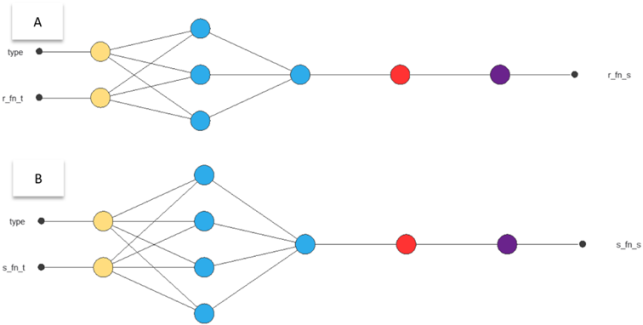
The input layer represents the independent input variables (predictors) of the approximation model. In this analysis, 5 inputs were used - the inoculum population of native isolate (in - log CFU/ml), type of extract (r - rocket / s - spinach), final population of native biota (t) and S. Typhimurium (s) in dual-species broth biofilms (b_fn_t / b_fn_s - log CFU/ cm2), and final population of native biota in dual-species biofilms formed on stainless steel immerged in rocket or spinach extract (r_fn_t or s_fn_t - log CFU/cm2), respectively. The hidden layer is where the relationships between the input and output layers are mathematically explored and eventually optimized for a specific model. The output layer represents the dependent target variable, the final ST population in either rocket or spinach extract biofilms (r_fn_s or s_fn_s - log CFU/cm2). A separate model was built for each broth extract, considering the final ST population in dual-species biofilms as the response variable to the same input variables (n=48). The raw data used to build the model were retrieved from Doulgeraki et al. 2014
[11]
Doulgeraki A, Vorgias A, Lazarou M, Giaouris E and Nychas G. Interactions encountered inside dual-species biofilms formed by Salmonella Typhimurium and autochthonous microbiota recovered from leafy salads on stainless steel. Joint CONFERENCE PROMISE and BacFood Net “Persistent lifestyles of food-borne pathogens and its consequences” 2014; 17-19 November, Vienna, Austria.
[11]
. Table 1 shows the descriptive statistics of all input and target variables of this analysis.
Supervised learning with the implementation of the backpropagation algorithm was applied since a target variable was used, and this is one of the most common MLP training methods
[12]
Haykin S. Network Architectures. In: Neural Networks and Learning Machines. McMaster University, Canada, Ontario, Hamilton: Pearson Education, Inc. 2009, 1 – 45.
. A complete dataset of 48 values was randomly split to generate the training (62.5%), the selection (19%), and testing (19%) subsets. The training occurs in two stages: the forward and the backward. In the forward stage, the predictive weights of the model input variables are calculated and transmitted through the layers until they reach the output layer.
In the backward stage, an error signal is calculated after comparing the output of the model values to the expected ones. The learning rate of 0.001 (the change in the value of weights in each iteration) and the momentum of 0.1 (speed of the learning process) were used by default, in 1000 learning epochs. The training phase of the model is an iterative process, each time optimizing the previously calculated weights, minimizing the error until a level of precision is accomplished.
Table 1. Descriptive statistics of independent (input) and dependent (target) variables.
Parameter ID
Mean
Deviation
Minimum
Maximum
in_native
5.87
0.54
4.38
6.83
in_ST
NA
NA
5.83
5.89
*b_fn_t
6.15
0.51
5.0
7.22
*b_fn_s
4.60
0.52
2.69
5.10
r_fn_t
6.25
0.57
5.02
7.40
s_fn_t
7.07
0.39
5.61
7.55
r_fn_s
5.77
0.68
4.13
7.04
s_fn_s
6.71
0.74
4.19
7.55
*Variables not selected for the final model configuration
Figure 1. Neural network models generated with rocket (A) and spinach (B) dual-species biofilm growth data.
3. Results and Discussion
The optimized models (Figure 1) generated an R2 coefficient of predicted versus real data, equal to 0.75 and 0.76, for rocket and spinach data, respectively, which are within the expected, though lower limits (≥ 75%) of ANN structure [13]. The model’s mean squared errors ranged from 0.10 to 0.23, and from 0.11 to 0.35 for rocket and spinach, respectively.
In the initial data collection, there were more rocket isolates tested in biofilm growth, thus more data points for the ANN model, as compared to the spinach extract, and this could partially explain the lower training errors obtained in the rocket model. Overall, the growth of rocket isolates was strongly correlated with ST growth (R2 = 0.79) in spinach and rocket extract (R2 = 0.92), whereas the spinach isolates’ growth showed poor correlation with ST growth in both extracts (R2 < 0.2).
In both MLP models, the two most important inputs were the final populations of native biota in dual-species biofilms and the type of extract. These variables were included in the final model design, in contrast to native or ST populations in biofilms formed in broth, which were not found to be important for the regression analysis. This finding is consistent with microbiological principles, since a nutrient broth environment is considered to be very different than a food-derived broth extract
[2]
Doulgeraki A, Papaioannou M and Nychas G. Targeted gene expression study of Salmonellaenterica during biofilm formation on rocket leaves. LWT 2016; 65: 254-260.
. The influence of specific elements found in spinach, such as zinc, on biofilm formation has been shown earlier
[14]
Ammendola S, D’Amico Y, Chirullo B, Drumo R, Civardelli D, Pasquali P and Battistoni A. Zinc is required to ensure the expression of flagella and the ability to form biofilms in Salmonella enterica sv Typhimurium. Metallomics 2016; 8: 1131–1140.
Overall, this exploratory analysis of biofilm growth data and simple MLP models seems promising for predicting the Salmonella Typhimurium population when knowing the total microbiota population in a mixed culture biofilm. An approximation model performed adequately well and solved the prediction of a pathogen’s growth as a regression-like problem. It is important to mention that the inoculum level of both isolates and ST was about 5 log cfu/cm2, which sets the operational limits of this MLP model.
Further analysis is needed with larger datasets to configure the current model’s parameters. Although we assumed linear relationships between input and output, this model is not representative of the implicit relationships among native and pathogenic biota. A larger dataset could dramatically change the number of hidden layers and the neurons in each layer, leading to deeper models, but at the same time, would minimize the risk of underfitting the data. As a result, capturing the problem’s complexity with a higher number of input variables would help us develop better predictive models that would support food safety researchers and producers.
Abbreviations
ST
Salmonella Typhimurium
RTE
Ready to Eat
ANN
Artificial Neural Network
Acknowledgments
The authors would like to thank Professor Nychas, who kindly shared the raw data.
Author Contributions
Kyriaki Chatzikyriakidou: Data Curation, Methodology, Software, Visualization, Writing – original draft
Christina Kamarinou: Investigation, Writing – review & editing
This work was funded by the projects: AMBROSIA which has received funding from the European Union's Horizon Europe research and innovation programme under Grant Agreement No. 101181300, and RUSTLE - “Depicting the prevalence and assessment of colonization of Salmonella in fresh produce”, which is implemented in the framework of H.F.R.I call “3 rd Call for H.F.R.I. s Research Projects to Support Faculty Members & Researchers” (H.F.R.I. Project Number: 23271).
Conflicts of Interest
The authors declare no conflicts of interest.
References
[1]
Berger C, Shaw R, Brown D, Mather H, Clare S, Dougan G, Pallen M, and Frankel G. Interaction of Salmonella enterica with basil and other salad leaves. The ISME Journal, 2009; 3: 261–265.
Doulgeraki A, Papaioannou M and Nychas G. Targeted gene expression study of Salmonellaenterica during biofilm formation on rocket leaves. LWT 2016; 65: 254-260.
Faria D, Ulsen C, Maffei D and de Melo Franco B. Role of post-harvest abiotic factors on interactions of Salmonella Typhimurium with lettuce leaves (Lactuca sativa L. var crispa). Food Microbiology, 2025; 128.
Jahid I, Han N, Zhang C and Ha S. Mixed culture biofilms of Salmonella Typhimurium and cultivable indigenous microorganisms on lettuce show enhanced resistance of their sessile cells to cold oxygen plasma. Food Microbiology 2015; 46: 383-394.
Giaouris E, Chorianopoulos N, Doulgeraki A and Nychas G. Co-Culture with Listeriamonocytogenes within a Dual-Species Biofilm Community Strongly Increases Resistance of PseudomonasPutida to Benzalkonium Chloride. PLoS ONE 2013; 8: e77276.
Giaouris E, Chorianopoulos N, Skandamis P and Nychas G. Attachment and biofilm formation by Salmonella in food processing environments. In: Mahmoud BSM (ed.). Salmonella—A Dangerous Foodborne Pathogen. Croatia, Rijeka: Intech, 2012, 157–180.
Doulgeraki A, Kamarinou C, Nychas G, Argyri A, Tassou C, Moulas G, Chorianopoulos N. Role of Microbial Interactions across Food-Related Bacteria on Biofilm Population and Biofilm Decontamination by a TiO2-Nanoparticle-Based Surfactant. Pathogens 2023; 12: 573.
Huang Y, Kangas L and Rasco B. Applications of Artificial Neural Networks (ANNs) in Food Science. Critical Reviews in Food Science and Nutrition 2007; 47: 113–126.
Gago J, Martínez-Núñez L, Landín M, Gallego PP. Artificial neural networks as an alternative to the traditional statistical methodology in plant research. J Plant Physiol. 2010 Jan 1; 167(1): 23-7.
Doulgeraki A, Vorgias A, Lazarou M, Giaouris E and Nychas G. Interactions encountered inside dual-species biofilms formed by Salmonella Typhimurium and autochthonous microbiota recovered from leafy salads on stainless steel. Joint CONFERENCE PROMISE and BacFood Net “Persistent lifestyles of food-borne pathogens and its consequences” 2014; 17-19 November, Vienna, Austria.
[12]
Haykin S. Network Architectures. In: Neural Networks and Learning Machines. McMaster University, Canada, Ontario, Hamilton: Pearson Education, Inc. 2009, 1 – 45.
Shao Q, Rowe R and York P. Comparison of neurofuzzy logic and neural networks in modelling experimental data of an immediate release tablet formulation. European Journal of Pharmaceutical Sciences 2006; 28: 394-404.
Ammendola S, D’Amico Y, Chirullo B, Drumo R, Civardelli D, Pasquali P and Battistoni A. Zinc is required to ensure the expression of flagella and the ability to form biofilms in Salmonella enterica sv Typhimurium. Metallomics 2016; 8: 1131–1140.
Chatzikyriakidou, K., Kamarinou, C., Doulgeraki, A. (2026). Exploring a Multilayer Perceptron Model on Dual-Species Biofilm Growth Data. World Journal of Agricultural Science and Technology, 4(3), 73-76. https://doi.org/10.11648/j.wjast.20260403.14
Chatzikyriakidou, K.; Kamarinou, C.; Doulgeraki, A. Exploring a Multilayer Perceptron Model on Dual-Species Biofilm Growth Data. World J. Agric. Sci. Technol.2026, 4(3), 73-76. doi: 10.11648/j.wjast.20260403.14
Chatzikyriakidou K, Kamarinou C, Doulgeraki A. Exploring a Multilayer Perceptron Model on Dual-Species Biofilm Growth Data. World J Agric Sci Technol. 2026;4(3):73-76. doi: 10.11648/j.wjast.20260403.14
@article{10.11648/j.wjast.20260403.14,
  author = {Kyriaki Chatzikyriakidou and Christina Kamarinou and Agapi Doulgeraki},
  title = {Exploring a Multilayer Perceptron Model on Dual-Species Biofilm Growth Data},
  journal = {World Journal of Agricultural Science and Technology},
  volume = {4},
  number = {3},
  pages = {73-76},
  doi = {10.11648/j.wjast.20260403.14},
  url = {https://doi.org/10.11648/j.wjast.20260403.14},
  eprint = {https://article.sciencepublishinggroup.com/pdf/10.11648.j.wjast.20260403.14},
  abstract = {Salmonella Typhimurium in ready-to-eat leafy salads is a well-known threat in food production. The aim of this study was to design an approximation multi-layer perceptron model (MLP) in order to predict the final population of S. Typhimurium in dual-species biofilms. Previously collected data (n=48; log CFU/cm2) of various isolates from either rocket or spinach salads, which grew together with S. Typhimurium to form biofilms, were used as attributes for the development of the two models. The target (output) variable was the final population of S. Typhimurium in both models of the rocket and spinach datasets. For the rocket isolates, the highest efficiency (learning epoch=1000, learning rate=0.001, and momentum value=0.1) was achieved with a shallow MLP with one hidden layer of 3 neurons, and a correlation coefficient 75% (RMSESalmonella diseases linked to the consumption of contaminated fresh salads.},
 year = {2026}
}
TY  - JOUR
T1  - Exploring a Multilayer Perceptron Model on Dual-Species Biofilm Growth Data
AU  - Kyriaki Chatzikyriakidou
AU  - Christina Kamarinou
AU  - Agapi Doulgeraki
Y1  - 2026/07/30
PY  - 2026
N1  - https://doi.org/10.11648/j.wjast.20260403.14
DO  - 10.11648/j.wjast.20260403.14
T2  - World Journal of Agricultural Science and Technology
JF  - World Journal of Agricultural Science and Technology
JO  - World Journal of Agricultural Science and Technology
SP  - 73
EP  - 76
PB  - Science Publishing Group
SN  - 2994-7332
UR  - https://doi.org/10.11648/j.wjast.20260403.14
AB  - Salmonella Typhimurium in ready-to-eat leafy salads is a well-known threat in food production. The aim of this study was to design an approximation multi-layer perceptron model (MLP) in order to predict the final population of S. Typhimurium in dual-species biofilms. Previously collected data (n=48; log CFU/cm2) of various isolates from either rocket or spinach salads, which grew together with S. Typhimurium to form biofilms, were used as attributes for the development of the two models. The target (output) variable was the final population of S. Typhimurium in both models of the rocket and spinach datasets. For the rocket isolates, the highest efficiency (learning epoch=1000, learning rate=0.001, and momentum value=0.1) was achieved with a shallow MLP with one hidden layer of 3 neurons, and a correlation coefficient 75% (RMSESalmonella diseases linked to the consumption of contaminated fresh salads.
VL  - 4
IS  - 3
ER  -
Chatzikyriakidou, K., Kamarinou, C., Doulgeraki, A. (2026). Exploring a Multilayer Perceptron Model on Dual-Species Biofilm Growth Data. World Journal of Agricultural Science and Technology, 4(3), 73-76. https://doi.org/10.11648/j.wjast.20260403.14
Chatzikyriakidou, K.; Kamarinou, C.; Doulgeraki, A. Exploring a Multilayer Perceptron Model on Dual-Species Biofilm Growth Data. World J. Agric. Sci. Technol.2026, 4(3), 73-76. doi: 10.11648/j.wjast.20260403.14
Chatzikyriakidou K, Kamarinou C, Doulgeraki A. Exploring a Multilayer Perceptron Model on Dual-Species Biofilm Growth Data. World J Agric Sci Technol. 2026;4(3):73-76. doi: 10.11648/j.wjast.20260403.14
@article{10.11648/j.wjast.20260403.14,
  author = {Kyriaki Chatzikyriakidou and Christina Kamarinou and Agapi Doulgeraki},
  title = {Exploring a Multilayer Perceptron Model on Dual-Species Biofilm Growth Data},
  journal = {World Journal of Agricultural Science and Technology},
  volume = {4},
  number = {3},
  pages = {73-76},
  doi = {10.11648/j.wjast.20260403.14},
  url = {https://doi.org/10.11648/j.wjast.20260403.14},
  eprint = {https://article.sciencepublishinggroup.com/pdf/10.11648.j.wjast.20260403.14},
  abstract = {Salmonella Typhimurium in ready-to-eat leafy salads is a well-known threat in food production. The aim of this study was to design an approximation multi-layer perceptron model (MLP) in order to predict the final population of S. Typhimurium in dual-species biofilms. Previously collected data (n=48; log CFU/cm2) of various isolates from either rocket or spinach salads, which grew together with S. Typhimurium to form biofilms, were used as attributes for the development of the two models. The target (output) variable was the final population of S. Typhimurium in both models of the rocket and spinach datasets. For the rocket isolates, the highest efficiency (learning epoch=1000, learning rate=0.001, and momentum value=0.1) was achieved with a shallow MLP with one hidden layer of 3 neurons, and a correlation coefficient 75% (RMSESalmonella diseases linked to the consumption of contaminated fresh salads.},
 year = {2026}
}
TY  - JOUR
T1  - Exploring a Multilayer Perceptron Model on Dual-Species Biofilm Growth Data
AU  - Kyriaki Chatzikyriakidou
AU  - Christina Kamarinou
AU  - Agapi Doulgeraki
Y1  - 2026/07/30
PY  - 2026
N1  - https://doi.org/10.11648/j.wjast.20260403.14
DO  - 10.11648/j.wjast.20260403.14
T2  - World Journal of Agricultural Science and Technology
JF  - World Journal of Agricultural Science and Technology
JO  - World Journal of Agricultural Science and Technology
SP  - 73
EP  - 76
PB  - Science Publishing Group
SN  - 2994-7332
UR  - https://doi.org/10.11648/j.wjast.20260403.14
AB  - Salmonella Typhimurium in ready-to-eat leafy salads is a well-known threat in food production. The aim of this study was to design an approximation multi-layer perceptron model (MLP) in order to predict the final population of S. Typhimurium in dual-species biofilms. Previously collected data (n=48; log CFU/cm2) of various isolates from either rocket or spinach salads, which grew together with S. Typhimurium to form biofilms, were used as attributes for the development of the two models. The target (output) variable was the final population of S. Typhimurium in both models of the rocket and spinach datasets. For the rocket isolates, the highest efficiency (learning epoch=1000, learning rate=0.001, and momentum value=0.1) was achieved with a shallow MLP with one hidden layer of 3 neurons, and a correlation coefficient 75% (RMSESalmonella diseases linked to the consumption of contaminated fresh salads.
VL  - 4
IS  - 3
ER  -





 Share This Article
 Twitter
 Linked In
 Facebook
 Copy
Copy Download