Abstract
Heavy metal contamination in irrigated agroecosystems is an emerging food safety concern; however, baseline data from low-impact systems in Ethiopia remain limited. This study assessed the concentrations of Cu, Mn, Fe, Pb, Cd, Cr, and Zn in irrigated soils and potato (Solanum tuberosum L.) tubers in Gida Ayana District, western Ethiopia, and evaluated associated non-carcinogenic health risks. Composite soil and potato samples collected from six irrigated sites were analyzed using flame atomic absorption spectrometry (FAAS) following acid digestion. Fe exhibited the highest concentrations in soil (71.01 mg/kg) and potato (6.06 mg/kg, dry weight), while Cd showed the lowest levels. For the metals with established guideline values, all measured concentrations were below the reference limits used. Transfer factor values ranged from 0.07 to 0.58, indicating limited soil–plant transfer, although Pb and Cd showed comparatively higher transfer. Target hazard quotients (THQ) of individual metals were below unity for all population groups. Hazard index (HI) values, calculated on a fresh-weight basis (assuming 80% tuber moisture), were 0.19 for adults, 0.60 for children, and 0.19 for women, indicating no appreciable non-carcinogenic risk under the stated assumptions; Cr (conservatively evaluated as Cr (VI)) contributed most of the HI. The results are consistent with a low-contamination system and provide a baseline for future monitoring in similar irrigation environments.
|
Published in
|
World Journal of Food Science and Technology (Volume 10, Issue 4)
|
|
DOI
|
10.11648/j.wjfst.20261004.11
|
|
Page(s)
|
88-97 |
|
Creative Commons
|

This is an Open Access article, distributed under the terms of the Creative Commons Attribution 4.0 International License (http://creativecommons.org/licenses/by/4.0/), which permits unrestricted use, distribution and reproduction in any medium or format, provided the original work is properly cited.
|
|
Copyright
|
Copyright © The Author(s), 2026. Published by Science Publishing Group
|
Keywords
Heavy Metals, Soil–plant Transfer, Potato, FAAS, Health Risk Assessment, Ethiopia
1. Introduction
The accumulation of heavy metals in agricultural soils is a major environmental concern because of their persistence, non-biodegradability, and potential entry into the food chain
| [1] | Tchounwou, P. B., Yedjou, C. G., Patlolla, A. K., & Sutton, D. J. (2012). Heavy metal toxicity and the environment. In A. Luch (Ed.), Molecular, Clinical and Environmental Toxicology (Experientia Supplementum, Vol. 101, pp. 133–164). Springer. https://doi.org/10.1007/978-3-7643-8340-4_6 |
| [2] | Adriano, D. C. (2001). Trace elements in terrestrial environments: Biogeochemistry, bioavailability, and risks of metals (2nd ed.). Springer.
https://doi.org/10.1007/978-0-387-21510-5 |
[1, 2]
. Heavy metals may originate from both natural geogenic processes and anthropogenic activities such as irrigation, fertilizer application, industrial emissions, and waste disposal
| [1] | Tchounwou, P. B., Yedjou, C. G., Patlolla, A. K., & Sutton, D. J. (2012). Heavy metal toxicity and the environment. In A. Luch (Ed.), Molecular, Clinical and Environmental Toxicology (Experientia Supplementum, Vol. 101, pp. 133–164). Springer. https://doi.org/10.1007/978-3-7643-8340-4_6 |
| [2] | Adriano, D. C. (2001). Trace elements in terrestrial environments: Biogeochemistry, bioavailability, and risks of metals (2nd ed.). Springer.
https://doi.org/10.1007/978-0-387-21510-5 |
[1, 2]
. Their mobility and bioavailability are strongly influenced by soil physicochemical properties including pH, organic matter content, texture, and cation exchange capacity
| [2] | Adriano, D. C. (2001). Trace elements in terrestrial environments: Biogeochemistry, bioavailability, and risks of metals (2nd ed.). Springer.
https://doi.org/10.1007/978-0-387-21510-5 |
| [3] | Violante, A., Cozzolino, V., Perelomov, L., Caporale, A. G., & Pigna, M. (2010). Mobility and bioavailability of heavy metals and metalloids in soil environments. Journal of Soil Science and Plant Nutrition, 10(3), 268–292.
https://doi.org/10.4067/S0718-95162010000100005 |
[2, 3]
. In many developing countries, irrigation-based agriculture plays an important role in sustaining crop production under conditions of climate variability and unreliable rainfall
| [4] | Hailu, E. K., Agumassie, T. A., Gebrehiwot, S. G., Chukalla, A. D., & Charles, K. J. (2025). Spatial and seasonal water quality and heavy metal pollution for irrigation use in Awash River, Ethiopia. Water, 17(5), 757.
https://doi.org/10.3390/w17050757 |
| [5] | Woldetsadik, D., Drechsel, P., Keraita, B., Itanna, F., & Gebrekidan, H. (2017). Heavy metal accumulation and health risk assessment in wastewater-irrigated urban vegetable farming sites of Addis Ababa, Ethiopia. International Journal of Food Contamination, 4, 9. https://doi.org/10.1186/s40550-017-0053-y |
[4, 5]
. In Ethiopia, surface-water irrigation is widely practiced during dry seasons; however, prolonged irrigation may introduce trace metals into agricultural soils, particularly in areas influenced by upstream anthropogenic activities
| [4] | Hailu, E. K., Agumassie, T. A., Gebrehiwot, S. G., Chukalla, A. D., & Charles, K. J. (2025). Spatial and seasonal water quality and heavy metal pollution for irrigation use in Awash River, Ethiopia. Water, 17(5), 757.
https://doi.org/10.3390/w17050757 |
| [5] | Woldetsadik, D., Drechsel, P., Keraita, B., Itanna, F., & Gebrekidan, H. (2017). Heavy metal accumulation and health risk assessment in wastewater-irrigated urban vegetable farming sites of Addis Ababa, Ethiopia. International Journal of Food Contamination, 4, 9. https://doi.org/10.1186/s40550-017-0053-y |
[4, 5]
. Despite this potential risk, environmental monitoring data for relatively low-contamination irrigation systems remain limited
| [5] | Woldetsadik, D., Drechsel, P., Keraita, B., Itanna, F., & Gebrekidan, H. (2017). Heavy metal accumulation and health risk assessment in wastewater-irrigated urban vegetable farming sites of Addis Ababa, Ethiopia. International Journal of Food Contamination, 4, 9. https://doi.org/10.1186/s40550-017-0053-y |
| [6] | Gemechu, T., Legesse, A., Chandravanshi, B. S., & Megersa, N. (2025). Levels of selected metals in spices cultivated in Southwest Ethiopia: Occurrence and health risk assessment. European Journal of Chemistry, 16, 136–145. |
[5, 6]
.
Potato (
Solanum tuberosum L.) is one of the major staple crops in Ethiopia and serves as a useful bioindicator for evaluating soil-to-plant transfer of heavy metals because tubers develop in direct contact with soil
| [7] | Selim, T., Elkefafy, S. M., Berndtsson, R., Elkiki, M., & El-kharbotly, A. A. (2022). Can potato crop on sandy soil be safely irrigated with heavy metal polluted water? Water, 14(8), 1226. https://doi.org/10.3390/w14081226 |
[7]
. Assessment of heavy metal accumulation in potato-based agroecosystems is therefore important for understanding potential dietary exposure and associated human health risks
| [7] | Selim, T., Elkefafy, S. M., Berndtsson, R., Elkiki, M., & El-kharbotly, A. A. (2022). Can potato crop on sandy soil be safely irrigated with heavy metal polluted water? Water, 14(8), 1226. https://doi.org/10.3390/w14081226 |
| [8] | Khan, S., Cao, Q., Zheng, Y. M., Huang, Y. Z., & Zhu, Y. G. (2008). Health risks of heavy metals in contaminated soils and food crops irrigated with wastewater in Beijing, China. Environmental Pollution, 152(3), 686–692. |
[7, 8]
. Previous studies in Ethiopia and other African countries have mainly focused on heavily contaminated irrigation systems affected by wastewater, mining activities, or industrial effluents
| [9] | Gebeyehu, H. R., & Bayissa, L. D. (2020). Levels of heavy metals in soil and vegetables and associated health risks in Mojo area, Ethiopia. PLoS ONE, 15(1), e0227883.
https://doi.org/10.1371/journal.pone.0227883 |
| [10] | Bayissa, L. D., & Gebeyehu, H. R. (2021). Vegetables contamination by heavy metals and associated health risk to the population in Koka area of central Ethiopia. PLoS ONE, 16(7), e0254236. https://doi.org/10.1371/journal.pone.0254236 |
| [11] | Ali, A. S., Bayih, A. A., & Gari, S. R. (2022). Meta-analysis of public health risks of lead accumulation in wastewater, irrigated soil, and crops nexus. Frontiers in Public Health, 10, 977721. https://doi.org/10.3389/fpubh.2022.977721 |
[9-11]
. In contrast, comparatively little attention has been given to relatively low-contamination irrigation environments where natural geochemical processes primarily control metal distribution
| [5] | Woldetsadik, D., Drechsel, P., Keraita, B., Itanna, F., & Gebrekidan, H. (2017). Heavy metal accumulation and health risk assessment in wastewater-irrigated urban vegetable farming sites of Addis Ababa, Ethiopia. International Journal of Food Contamination, 4, 9. https://doi.org/10.1186/s40550-017-0053-y |
| [6] | Gemechu, T., Legesse, A., Chandravanshi, B. S., & Megersa, N. (2025). Levels of selected metals in spices cultivated in Southwest Ethiopia: Occurrence and health risk assessment. European Journal of Chemistry, 16, 136–145. |
[5, 6]
. Consequently, information regarding heavy metal distribution, soil–crop transfer, and associated health risks in such agroecosystems remains limited
| [5] | Woldetsadik, D., Drechsel, P., Keraita, B., Itanna, F., & Gebrekidan, H. (2017). Heavy metal accumulation and health risk assessment in wastewater-irrigated urban vegetable farming sites of Addis Ababa, Ethiopia. International Journal of Food Contamination, 4, 9. https://doi.org/10.1186/s40550-017-0053-y |
| [6] | Gemechu, T., Legesse, A., Chandravanshi, B. S., & Megersa, N. (2025). Levels of selected metals in spices cultivated in Southwest Ethiopia: Occurrence and health risk assessment. European Journal of Chemistry, 16, 136–145. |
[5, 6]
.
The present study aimed to (i) quantify selected heavy metals (Cu, Mn, Fe, Pb, Cd, Cr, and Zn) in irrigated soils and potato tubers, (ii) evaluate soil-to-plant transfer using transfer factor analysis, and (iii) assess potential non-carcinogenic health risks associated with potato consumption
| [8] | Khan, S., Cao, Q., Zheng, Y. M., Huang, Y. Z., & Zhu, Y. G. (2008). Health risks of heavy metals in contaminated soils and food crops irrigated with wastewater in Beijing, China. Environmental Pollution, 152(3), 686–692. |
| [12] | Mahmood, A., & Malik, R. N. (2014). Human health risk assessment of heavy metals via consumption of contaminated vegetables collected from different irrigation sources in Lahore, Pakistan. Arabian Journal of Chemistry, 7(1), 91–99.
https://doi.org/10.1016/j.arabjc.2013.07.002 |
| [13] | Singh, A., Sharma, R. K., Agrawal, M., & Marshall, F. M. (2010). Health risk assessment of heavy metals via dietary intake of foodstuffs from the wastewater irrigated site of a dry tropical area of India. Food and Chemical Toxicology, 48(2), 611–619. |
[8, 12, 13]
. By integrating soil chemistry, plant uptake assessment, and human exposure evaluation, the study provides an important environmental reference for future monitoring and sustainable irrigation management in western Ethiopia
| [4] | Hailu, E. K., Agumassie, T. A., Gebrehiwot, S. G., Chukalla, A. D., & Charles, K. J. (2025). Spatial and seasonal water quality and heavy metal pollution for irrigation use in Awash River, Ethiopia. Water, 17(5), 757.
https://doi.org/10.3390/w17050757 |
| [5] | Woldetsadik, D., Drechsel, P., Keraita, B., Itanna, F., & Gebrekidan, H. (2017). Heavy metal accumulation and health risk assessment in wastewater-irrigated urban vegetable farming sites of Addis Ababa, Ethiopia. International Journal of Food Contamination, 4, 9. https://doi.org/10.1186/s40550-017-0053-y |
[4, 5]
.
2. Study Area
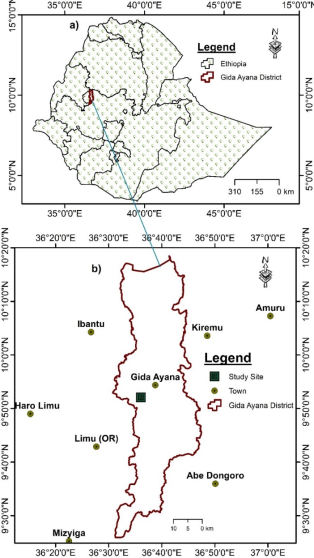
The study was conducted in Gida Ayana District, Oromia Region, Ethiopia, located approximately 444 km from Addis Ababa and 112 km from Nekemte. The district is characterized by a heterogeneous agroecological landscape comprising mid-altitude highlands (48%), highlands (2%), and lowlands (50%). The research specifically focused on the irrigated farmlands adjacent to the Labu River, located approximately 2 km east of Ayana Town at 9°52'40.47" N latitude and 36°37'13.97" E longitude (
Figure 1). The area receives a mean annual rainfall of 1281 mm and has an average annual temperature of 19.1°C. Irrigation is widely practiced to sustain crop production during dry seasons, with the Labu River serving as the principal irrigation water source. The study area was selected because of its irrigation-based agricultural activity and its suitability for evaluating baseline heavy metal distribution in a relatively low-impact agricultural system.
3. Materials and Methods
3.1. Sample Collection
Six irrigated sampling sites were selected based on irrigation intensity, accessibility, spatial distribution, and uniform potato cultivation practices. At each site, five subsamples were collected from representative points within the cultivated field and combined into one composite sample to minimize local heterogeneity and improve spatial representativeness. Soil samples were collected from the root-zone depth of cultivated potato fields, while mature potato tubers were collected from the corresponding sampling locations to ensure direct soil–crop comparability. All samples were labeled, transported in clean polyethylene bags, and preserved for subsequent laboratory preparation and analysis. A total of six composite soil samples and six corresponding potato samples were collected and analyzed. Each composite sample digest was analyzed in triplicate to assess analytical reproducibility.
3.2. Sample Preparation
Soil samples were air-dried at room temperature, ground, and sieved through a 2 mm mesh to remove stones and plant debris. Potato tubers were thoroughly washed with tap water followed by distilled water to remove surface soil residues. After peeling, the tubers were cut into small pieces, oven-dried at 105°C to constant weight, and ground into a fine powder. The dried samples were stored in sealed polyethylene containers until digestion.
3.3. Soil Physicochemical Properties
Selected soil physicochemical parameters, including pH, electrical conductivity (EC), and organic matter (OM), were determined because of their important role in regulating heavy metal mobility, bioavailability, and soil-to-plant transfer processes
| [2] | Adriano, D. C. (2001). Trace elements in terrestrial environments: Biogeochemistry, bioavailability, and risks of metals (2nd ed.). Springer.
https://doi.org/10.1007/978-0-387-21510-5 |
| [3] | Violante, A., Cozzolino, V., Perelomov, L., Caporale, A. G., & Pigna, M. (2010). Mobility and bioavailability of heavy metals and metalloids in soil environments. Journal of Soil Science and Plant Nutrition, 10(3), 268–292.
https://doi.org/10.4067/S0718-95162010000100005 |
[2, 3]
. Soil pH and EC were measured in a 1:2.5 soil-to-water suspension using calibrated digital pH and conductivity meters, respectively. Organic matter content was determined using the Walkley–Black wet oxidation method
| [14] | Walkley, A., & Black, I. A. (1934). An examination of the Degtjareff method for determining soil organic matter, and a proposed modification of the chromic acid titration method. Soil Science, 37(1), 29–38.
https://doi.org/10.1097/00010694-193401000-00003 |
[14]
.
The analyzed soils were slightly acidic (pH 6.42), with low electrical conductivity (0.31 dS/m) and moderate organic matter content (2.84%) (
Table 2). At a pH of about 6.4, soils lie above the range (pH < 5.5) in which the solubility and mobility of Cd, Zn, and Mn increase sharply, and Pb is strongly retained by organic matter and oxide surfaces; moderate organic matter further limits metal availability through complexation and surface binding. These conditions are consistent with restricted metal bioavailability and may have contributed to the low transfer factor (TF) values observed in potato tubers
| [2] | Adriano, D. C. (2001). Trace elements in terrestrial environments: Biogeochemistry, bioavailability, and risks of metals (2nd ed.). Springer.
https://doi.org/10.1007/978-0-387-21510-5 |
| [3] | Violante, A., Cozzolino, V., Perelomov, L., Caporale, A. G., & Pigna, M. (2010). Mobility and bioavailability of heavy metals and metalloids in soil environments. Journal of Soil Science and Plant Nutrition, 10(3), 268–292.
https://doi.org/10.4067/S0718-95162010000100005 |
[2, 3]
. This interpretation is based only on pH, EC, and OM; cation exchange capacity, texture, and extractable metal fractions were not measured.
3.4. Sample Digestion
A wet acid digestion procedure was used for the extraction of heavy metals from soil and potato samples
| [6] | Gemechu, T., Legesse, A., Chandravanshi, B. S., & Megersa, N. (2025). Levels of selected metals in spices cultivated in Southwest Ethiopia: Occurrence and health risk assessment. European Journal of Chemistry, 16, 136–145. |
[6]
. Approximately 0.5 g of each homogenized sample was accurately weighed. Potato samples were digested using a mixture of nitric acid (HNO₃) and hydrogen peroxide (H₂O₂) in an 8:2 (v/v) ratio at 115°C for 3 h until clear digests were obtained. Soil samples were digested using a mixture of hydrochloric acid (HCl), nitric acid (HNO₃), and hydrogen peroxide (H₂O₂) in a 9:3:3 (v/v/v) ratio at 120°C for 3.5 h. Because aqua regia does not completely dissolve silicate-bound metals, soil results represent pseudo-total rather than total concentrations. All digestions were performed in triplicate to ensure analytical reproducibility. Procedural blanks were included throughout the digestion process to assess potential contamination. After digestion, the solutions were cooled, filtered through Whatman filter paper, and diluted to 50 mL with deionized water prior to instrumental analysis
| [6] | Gemechu, T., Legesse, A., Chandravanshi, B. S., & Megersa, N. (2025). Levels of selected metals in spices cultivated in Southwest Ethiopia: Occurrence and health risk assessment. European Journal of Chemistry, 16, 136–145. |
[6]
.
3.5. Instrumental Analysis
Heavy metal concentrations were determined using flame atomic absorption spectrometry (FAAS)
| [6] | Gemechu, T., Legesse, A., Chandravanshi, B. S., & Megersa, N. (2025). Levels of selected metals in spices cultivated in Southwest Ethiopia: Occurrence and health risk assessment. European Journal of Chemistry, 16, 136–145. |
[6]
. Calibration curves were prepared using certified standard solutions, and all calibration curves showed excellent linearity (R
2 > 0.99). Samples were analyzed in triplicate, and results were expressed as mean ± standard deviation. Instrumental parameters, including wavelength, lamp current, slit width, and flame composition, were optimized for each element to ensure analytical accuracy and precision. Triplicate measurements represent analytical replicates performed on each composite sample digest rather than independent field replicates. This approach was used to evaluate instrumental precision and analytical reproducibility during heavy metal determination
| [6] | Gemechu, T., Legesse, A., Chandravanshi, B. S., & Megersa, N. (2025). Levels of selected metals in spices cultivated in Southwest Ethiopia: Occurrence and health risk assessment. European Journal of Chemistry, 16, 136–145. |
[6]
.
3.6. Method Detection Limits (LOD and LOQ)
Method performance was evaluated by determining the limits of detection (LOD) and quantification (LOQ), calculated as three and ten times, respectively (
Table 1). The standard deviation of blank measurements divided by the slope of the corresponding calibration curve and expressed on a sample basis (mg/kg) using the digested sample mass and final volume. Accuracy was assessed by spike recovery, and all samples were analyzed in triplicate.
Table 1. Analytical performance characteristics of the method.
Metal | LOD (mg/kg) | LOQ (mg/kg) | Amount Added (mg/kg) | Conc. Spiked (mean ± SD, mg/kg) | Recovery (%) | RSD (%) |
Cu | 0.01 | 0.03 | 30 | 29.32 ± 0.12 | 97.73 | 0.41 |
Fe | 0.02 | 0.06 | 10 | 9.68 ± 0.13 | 96.81 | 1.34 |
Mn | 0.05 | 0.15 | 50 | 49.52 ± 0.18 | 99.04 | 0.36 |
Pb | 0.005 | 0.015 | 20 | 19.09 ± 0.02 | 95.45 | 0.10 |
Cd | 0.002 | 0.006 | 5 | 4.85 ± 0.10 | 97.00 | 2.06 |
Cr | 0.01 | 0.03 | 10 | 9.62 ± 0.13 | 96.20 | 1.35 |
Zn | 0.02 | 0.06 | 25 | 24.30 ± 0.20 | 97.20 | 0.82 |
3.7. Quality Assurance and Quality Control (QA/QC)
Quality assurance and quality control procedures were maintained throughout the analytical process. All glassware was soaked in dilute acid solution and thoroughly rinsed with deionized water before use. Reagent blanks were analyzed to detect potential contamination, and calibration standards were periodically measured to verify instrument stability. Recovery tests were performed by spiking known concentrations of metal standards into pre-digested samples; these recoveries therefore reflect instrumental and matrix accuracy but not digestion efficiency, which would require pre-digestion spiking or a certified reference material (none was analyzed). Recoveries ranged from 95.45% to 99.04%, and precision was acceptable, with relative standard deviation (RSD) values below 3%. Calibration curves showed linearity (R
2 > 0.99). LOD and LOQ values are given in
Table 1.
3.8. Statistical Analysis
All statistical analyses were performed using SPSS version 26 at a 95% confidence level (p < 0.05). Prior to analysis, the normality and homogeneity of variance of the datasets were evaluated using the Shapiro–Wilk and Levene’s tests, respectively. One-way analysis of variance (ANOVA) was applied to determine significant differences in heavy metal concentrations among sampling sites and between soil and potato samples. Where statistically significant differences were observed, Tukey’s Honestly Significant Difference (HSD) post-hoc test was used for pairwise mean comparison.
Because each site was represented by a single composite sample analyzed in triplicate, the replicates are analytical rather than independent field replicates; among-site comparisons are therefore exploratory and cannot fully separate spatial from analytical variability. A soil–potato difference in concentration is expected from the concentration levels themselves and is not, on its own, evidence of selective uptake; transfer was evaluated through the TF. Pearson correlation analysis (n = 6) was used to explore inter-element relationships; with four degrees of freedom, the critical |r| is 0.811 at p = 0.05 and 0.917 at p = 0.01.
3.9. Transfer Factor (TF)
The transfer factor (TF) was used to evaluate the uptake of heavy metals from soil to potato tubers
| [15] | Cui, Y. J., Zhu, Y. G., Zhai, R. H., Chen, D. Y., Huang, Y. Z., Qiu, Y., & Liang, J. Z. (2004). Transfer of metals from soil to vegetables in an area near a smelter in Nanning, China. Environment International, 30(6), 785–791. |
| [16] | Rattan, R. K., Datta, S. P., Chhonkar, P. K., Suribabu, K., & Singh, A. K. (2005). Long-term impact of irrigation with sewage effluents on heavy metal content in soils, crops and groundwater—A case study. Agriculture, Ecosystems & Environment, 109(3–4), 310–322. |
[15, 16]
and was calculated using Eq. (
1).
where:
Cp = plant concentration
Cs = soil concentration
3.10. Health Risk Assessment
The potential human health risks associated with the consumption of potatoes were evaluated using three indices: Estimated Daily Intake (EDI), Target Hazard Quotient (THQ), and Hazard Index (HI)
| [8] | Khan, S., Cao, Q., Zheng, Y. M., Huang, Y. Z., & Zhu, Y. G. (2008). Health risks of heavy metals in contaminated soils and food crops irrigated with wastewater in Beijing, China. Environmental Pollution, 152(3), 686–692. |
| [12] | Mahmood, A., & Malik, R. N. (2014). Human health risk assessment of heavy metals via consumption of contaminated vegetables collected from different irrigation sources in Lahore, Pakistan. Arabian Journal of Chemistry, 7(1), 91–99.
https://doi.org/10.1016/j.arabjc.2013.07.002 |
| [13] | Singh, A., Sharma, R. K., Agrawal, M., & Marshall, F. M. (2010). Health risk assessment of heavy metals via dietary intake of foodstuffs from the wastewater irrigated site of a dry tropical area of India. Food and Chemical Toxicology, 48(2), 611–619. |
[8, 12, 13]
. These indices were calculated using the following equations
| [8] | Khan, S., Cao, Q., Zheng, Y. M., Huang, Y. Z., & Zhu, Y. G. (2008). Health risks of heavy metals in contaminated soils and food crops irrigated with wastewater in Beijing, China. Environmental Pollution, 152(3), 686–692. |
| [12] | Mahmood, A., & Malik, R. N. (2014). Human health risk assessment of heavy metals via consumption of contaminated vegetables collected from different irrigation sources in Lahore, Pakistan. Arabian Journal of Chemistry, 7(1), 91–99.
https://doi.org/10.1016/j.arabjc.2013.07.002 |
[8, 12]
: The estimated Daily Intake (EDI) was computed using Eq. (
2).
where:
C = concentration of heavy metals in potato samples (mg/kg)
IR = ingestion rate of potato consumption (kg/day)
BW = average body weight of the exposed population (kg)
Target Hazard Quotient (THQ) (Eq. (
3)):
where:
RfD = oral reference dose for each heavy metal (mg/kg/day)
Hazard Index (HI) (Eq. (
4))
where:
HI represents the cumulative non-carcinogenic risk resulting from exposure to multiple heavy metals.
These indices were calculated using standard exposure parameters for different population groups to assess potential non-carcinogenic health risks associated with potato consumption. Body weight, ingestion rate, exposure frequency, and exposure duration for each population group are given in
Table 6. Because ingestion rates refer to fresh tubers whereas concentrations were determined on oven-dried (105°C) material, dry-weight concentrations were converted to a fresh-weight basis assuming a tuber moisture content of 80% (fresh weight = dry weight × 0.20), which is within the typical range for potato; measured moisture content should replace this assumption. EDI = C × IR/BW assumes that EF × ED equals the averaging time (AT = ED × 365 days), and THQ = EDI/RfD. RfD values (mg/kg/day) were: Fe 0.7, Mn 0.14, Cu 0.04, Pb 0.0035, Cd 0.001, Cr 0.003, and Zn 0.3. Total Cr measured by FAAS was conservatively evaluated against the Cr (VI) RfD, although dietary Cr is predominantly Cr (III) (RfD 1.5 mg/kg/day). Pb has no USEPA RfD; the value used is derived from the withdrawn JECFA provisional tolerable weekly intake and is indicative only.
4. Results and Discussion
4.1. Heavy Metal Concentrations in Soil and Potato Tubers
The concentrations of Cu, Mn, Fe, Pb, Cd, Cr, and Zn in soil and potato (Solanum tuberosum L.) samples are presented in
Table 3, and selected soil physicochemical properties in
Table 2. For the metals with established guideline values, all measured concentrations were below the reference limits used (
Table 3). Iron exhibited the highest concentration in both soil (71.01 mg/kg) and potato (6.06 mg/kg, dry weight), whereas cadmium showed the lowest concentration in both matrices. Fe is among the most abundant elements in the Earth’s crust, so its predominance is expected and is consistent with a lithogenic origin. However, the soil Fe value is far lower than the total Fe contents typical of tropical highland soils (usually percent levels), which indicates that only a pseudo-total or labile fraction was recovered; these values should not be read as total concentrations. The comparatively low concentrations of Cd and Pb are consistent with limited anthropogenic input under the present irrigation conditions, although this cannot be confirmed without irrigation-water data and local geochemical background values.
Table 2. Selected physicochemical properties of irrigated soils.
Parameter | Mean ± SD |
pH | 6.42 ± 0.18 |
EC (dS/m) | 0.31 ± 0.05 |
Organic Matter (%) | 2.84 ± 0.21 |
Table 3. Heavy metal concentrations and transfer factors in soil and potato samples (mean ± SD).
Metal | Soil (mg/kg) | Potato (mg/kg) | Soil limit (mg/kg) | Plant limit (mg/kg) | Transfer Factor (TF) |
Cu | 8.87 ± 0.24 | 0.64 ± 0.05 | 100 | 10 | 0.07 |
Mn | 10.88 ± 0.03 | 0.76 ± 0.00 | 2000 | 500 | 0.07 |
Fe | 71.01 ± 0.01 | 6.06 ± 0.01 | - | - | 0.09 |
Pb | 0.19 ± 0.01 | 0.11 ± 0.03 | 100 | 0.1 | 0.58 |
Cd | 0.04 ± 0.003 | 0.02 ± 0.004 | 3 | 0.1 | 0.50 |
Cr | 2.04 ± 0.12 | 0.32 ± 0.03 | 100 | 2.3 | 0.16 |
Zn | 14.32 ± 0.85 | 1.31 ± 0.10 | 300 | 50 | 0.09 |
Guideline values were compiled from FAO/WHO and Codex Alimentarius standards for edible plant materials and from commonly used soil guideline values in the literature (FAO/WHO does not set soil limits). Plant limits refer to fresh weight, whereas tuber concentrations are reported on a dry-weight basis, so the comparison is conservative. For Pb and Cd in potato, Codex Alimentarius and EU Regulation 2021/1323 set a maximum level of 0.1 mg/kg fresh weight; tuber Pb (0.11 mg/kg dry weight, about 0.02 mg/kg fresh weight at 80% moisture) and Cd are below it.
The concentration pattern shows that metals were present at much higher concentrations in soil than in tubers, consistent with retention in the soil matrix and limited transfer to the edible tissue. Soil–tuber differences were statistically significant (p < 0.001 for all metals, recalculated from the summary statistics in
Table 3;
Table 4), whereas the among-site comparison reported no significant differences (p > 0.05). Because each site was represented by a single composite sample, the among-site result is exploratory and does not by itself demonstrate geochemical stability.
Table 4.
Summary of one-way ANOVA results for heavy metal concentrations in soil and potato samples (F recalculated from the means and SDs in Table 3, n = 6 per matrix; “>1000” where the reported SD is approximately zero). Metal | F (df1, df2) | p-value | Significance |
Cu | F (1,10) = 6762 | <0.001 | Significant |
Mn | F (1,10) > 1000 | <0.001 | Significant |
Fe | F (1,10) > 1000 | <0.001 | Significant |
Pb | F (1,10) = 38.4 | <0.001 | Significant |
Cd | F (1,10) = 96.0 | <0.001 | Significant |
Cr | F (1,10) = 1160 | <0.001 | Significant |
Zn | F (1,10) = 1386 | <0.001 | Significant |
4.2. Transfer Factor (TF)
Transfer factor values for all analyzed metals were below unity, indicating restricted transfer of metals from soil to potato tissues. The order of transfer was Pb > Cd > Cr > Zn > Fe > Cu > Mn. Pb (TF = 0.58) and Cd (TF = 0.50) showed the highest transfer. These values should be interpreted cautiously: TF generally decreases as soil concentration increases, so metals present at very low soil concentrations (here 0.19 and 0.04 mg/kg) tend to give higher ratios, and values near the quantification limits carry large relative uncertainty (for example, the SD of tuber Pb is 0.03 mg/kg).
4.3. Correlation Analysis
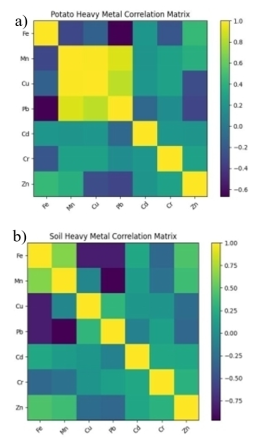
Pearson correlation analysis (n = 6 composite samples) showed both positive and negative associations among metals in potato samples (
Table 5). The strongest association was between Mn and Cu (r = 0.81, p ≈ 0.051), which is borderline; Mn–Pb (r = 0.74, p ≈ 0.09) and Zn–Cu (r = 0.63, p ≈ 0.18) were not statistically significant. With six observations the critical |r| at p = 0.05 is 0.811, so these coefficients are exploratory trends and not evidence of shared uptake pathways or a common origin.
Cd showed weak or negative correlations with the other metals (
Table 5), which may reflect different uptake and soil retention behavior. With n = 6, however, no inference on geogenic versus anthropogenic sources can be drawn from these coefficients.
Table 5. Pearson correlation coefficients (r) among heavy metals in potato samples.
Metal | Cu | Mn | Fe | Pb | Cd | Cr | Zn |
Cu | 1.00 | 0.81 | 0.42 | 0.55 | -0.18 | 0.37 | 0.63 |
Mn | 0.81 | 1.00 | 0.48 | 0.74 | -0.11 | 0.41 | 0.52 |
Fe | 0.42 | 0.48 | 1.00 | 0.29 | 0.06 | 0.58 | 0.47 |
Pb | 0.55 | 0.74 | 0.29 | 1.00 | -0.09 | 0.33 | 0.45 |
Cd | -0.18 | -0.11 | 0.06 | -0.09 | 1.00 | -0.14 | -0.05 |
Cr | 0.37 | 0.41 | 0.58 | 0.33 | -0.14 | 1.00 | 0.39 |
Zn | 0.63 | 0.52 | 0.47 | 0.45 | -0.05 | 0.39 | 1.00 |
No coefficient was significant at p < 0.05 (n = 6; critical |r| = 0.811, two-tailed, df = 4).
Figure 2. Pearson correlation matrix (a and b) illustrating interrelationships among heavy metals in potato samples.
Table 6. Exposure parameters used for the health risk assessment. Body weight, exposure frequency, and exposure duration are commonly used default values; ingestion rates are generic vegetable consumption rates, not potato-specific USEPA values, and probably exceed actual potato intake in the study area (conservative). Local dietary survey data should replace them.
Parameter | Adult | Children | Women | Unit |
Body weight (BW) | 70 | 15 | 60 | kg |
Ingestion rate (IR) | 0.345 | 0.232 | 0.300 | kg/day |
Exposure frequency (EF) | 365 | 365 | 365 | days/year |
Exposure duration (ED) | 70 | 6 | 70 | Years |
Table 7. Estimated daily intake (EDI) and target hazard quotient (THQ) of analyzed metals for adults (fresh-weight basis, 80% moisture assumed).
Metal | EDI (mg/kg/day) | Reference dose (RfD) | THQ | Health risk classification |
Fe | 0.00597 | 0.7 | 0.0085 | No significant risk |
Mn | 0.00075 | 0.14 | 0.0054 | No significant risk |
Cu | 0.00063 | 0.04 | 0.0158 | No significant risk |
Pb | 0.00011 | 0.0035 | 0.0310 | No significant risk |
Cd | 0.00002 | 0.001 | 0.0197 | No significant risk |
Cr | 0.00032 | 0.003 | 0.1051 | No significant risk |
Zn | 0.00129 | 0.3 | 0.0043 | No significant risk |
THQ values for all individual metals were below 1 for all population groups, and HI values were below 1 (
Table 8), indicating no appreciable non-carcinogenic risk from potato consumption under the stated assumptions. EDI is evaluated against the RfD through the THQ rather than against unity. Cr contributed the largest share of the HI (about 55%), mainly because total Cr was conservatively evaluated against the Cr (VI) RfD; the Cr risk is therefore probably overestimated.
Children had the highest HI, about three times that of adults and women, because of their higher intake-to-body-weight ratio (0.0155 versus 0.0049 and 0.0050 kg/kg/day). If dry-weight concentrations were applied directly to fresh-weight intake rates, the HI would be about 0.95 for adults, 2.98 for children, and 0.96 for women, so the conclusion for children depends on the moisture correction; moisture content should be measured. These findings highlight the importance of population-specific vulnerability in health risk assessment.
Group | HI Value | Interpretation |
Adult | 0.190 | No significant risk |
Children | 0.596 | No significant risk (highest HI) |
Women | 0.193 | No significant risk |
5. Discussion
The present study demonstrates clear differences between heavy metal concentrations in irrigated soils and corresponding potato tubers, indicating limited bioavailability and restricted soil–plant transfer. Such behavior is typical of low-contamination systems in which metal concentrations are close to natural levels
| [5] | Woldetsadik, D., Drechsel, P., Keraita, B., Itanna, F., & Gebrekidan, H. (2017). Heavy metal accumulation and health risk assessment in wastewater-irrigated urban vegetable farming sites of Addis Ababa, Ethiopia. International Journal of Food Contamination, 4, 9. https://doi.org/10.1186/s40550-017-0053-y |
| [6] | Gemechu, T., Legesse, A., Chandravanshi, B. S., & Megersa, N. (2025). Levels of selected metals in spices cultivated in Southwest Ethiopia: Occurrence and health risk assessment. European Journal of Chemistry, 16, 136–145. |
[5, 6]
.
The dominance of Fe in both soil and potato samples is consistent with its high crustal abundance and with previous findings from Ethiopian agroecosystems
| [6] | Gemechu, T., Legesse, A., Chandravanshi, B. S., & Megersa, N. (2025). Levels of selected metals in spices cultivated in Southwest Ethiopia: Occurrence and health risk assessment. European Journal of Chemistry, 16, 136–145. |
| [9] | Gebeyehu, H. R., & Bayissa, L. D. (2020). Levels of heavy metals in soil and vegetables and associated health risks in Mojo area, Ethiopia. PLoS ONE, 15(1), e0227883.
https://doi.org/10.1371/journal.pone.0227883 |
[6, 9]
, although the low absolute soil Fe values indicate that only part of the total Fe was determined. Similar dominance of Fe has been reported in baseline agricultural soils, where parent material largely governs elemental abundance
. In contrast, elevated levels of Cd and Pb reported in wastewater-irrigated systems—particularly in intensively farmed areas of the Awash River basin—are typically linked to industrial discharge, urban effluents, and agrochemical inputs
| [4] | Hailu, E. K., Agumassie, T. A., Gebrehiwot, S. G., Chukalla, A. D., & Charles, K. J. (2025). Spatial and seasonal water quality and heavy metal pollution for irrigation use in Awash River, Ethiopia. Water, 17(5), 757.
https://doi.org/10.3390/w17050757 |
| [9] | Gebeyehu, H. R., & Bayissa, L. D. (2020). Levels of heavy metals in soil and vegetables and associated health risks in Mojo area, Ethiopia. PLoS ONE, 15(1), e0227883.
https://doi.org/10.1371/journal.pone.0227883 |
| [11] | Ali, A. S., Bayih, A. A., & Gari, S. R. (2022). Meta-analysis of public health risks of lead accumulation in wastewater, irrigated soil, and crops nexus. Frontiers in Public Health, 10, 977721. https://doi.org/10.3389/fpubh.2022.977721 |
[4, 9, 11]
. The comparatively low concentrations observed in this study therefore suggest that the Gida Ayana irrigation system is not strongly affected by such pressures, although irrigation water and local background soil values were not analyzed. FAAS is less sensitive than graphite-furnace AAS or ICP-MS, particularly for Cd and Pb at the sub-mg/kg levels found here; these two metals should therefore be regarded as semi-quantitative, and confirmation by a more sensitive technique is recommended.
Transfer factor (TF) values below unity for all metals indicate limited transfer of metals from soil to potato tubers, suggesting strong retention of metals in the soil matrix
| [15] | Cui, Y. J., Zhu, Y. G., Zhai, R. H., Chen, D. Y., Huang, Y. Z., Qiu, Y., & Liang, J. Z. (2004). Transfer of metals from soil to vegetables in an area near a smelter in Nanning, China. Environment International, 30(6), 785–791. |
| [16] | Rattan, R. K., Datta, S. P., Chhonkar, P. K., Suribabu, K., & Singh, A. K. (2005). Long-term impact of irrigation with sewage effluents on heavy metal content in soils, crops and groundwater—A case study. Agriculture, Ecosystems & Environment, 109(3–4), 310–322. |
[15, 16]
. This pattern agrees with earlier studies on root and tuber crops, where metal uptake is often constrained by adsorption to soil particles and plant exclusion mechanisms at the root level
| [2] | Adriano, D. C. (2001). Trace elements in terrestrial environments: Biogeochemistry, bioavailability, and risks of metals (2nd ed.). Springer.
https://doi.org/10.1007/978-0-387-21510-5 |
| [3] | Violante, A., Cozzolino, V., Perelomov, L., Caporale, A. G., & Pigna, M. (2010). Mobility and bioavailability of heavy metals and metalloids in soil environments. Journal of Soil Science and Plant Nutrition, 10(3), 268–292.
https://doi.org/10.4067/S0718-95162010000100005 |
[2, 3]
. Although overall TF values were low, Pb (0.58) and Cd (0.50) showed relatively higher transfer than the other metals. Because TF tends to be higher where soil concentrations are very low, and because Pb is usually strongly retained in soils, these values should be interpreted cautiously and do not by themselves indicate high bioaccumulation potential
| [3] | Violante, A., Cozzolino, V., Perelomov, L., Caporale, A. G., & Pigna, M. (2010). Mobility and bioavailability of heavy metals and metalloids in soil environments. Journal of Soil Science and Plant Nutrition, 10(3), 268–292.
https://doi.org/10.4067/S0718-95162010000100005 |
| [15] | Cui, Y. J., Zhu, Y. G., Zhai, R. H., Chen, D. Y., Huang, Y. Z., Qiu, Y., & Liang, J. Z. (2004). Transfer of metals from soil to vegetables in an area near a smelter in Nanning, China. Environment International, 30(6), 785–791. |
[3, 15]
. The relatively low transfer factors observed in the present study may additionally be influenced by the measured soil physicochemical conditions. A pH of about 6.4, low salinity (EC), and moderate organic matter content generally limit heavy metal solubility and mobility through adsorption and complexation mechanisms
| [2] | Adriano, D. C. (2001). Trace elements in terrestrial environments: Biogeochemistry, bioavailability, and risks of metals (2nd ed.). Springer.
https://doi.org/10.1007/978-0-387-21510-5 |
| [3] | Violante, A., Cozzolino, V., Perelomov, L., Caporale, A. G., & Pigna, M. (2010). Mobility and bioavailability of heavy metals and metalloids in soil environments. Journal of Soil Science and Plant Nutrition, 10(3), 268–292.
https://doi.org/10.4067/S0718-95162010000100005 |
[2, 3]
. These soil conditions may have contributed to the restricted bioavailability and limited transfer of metals from soil to potato tubers observed in the investigated irrigation system.
Pearson correlation results should be interpreted cautiously because the relatively small sample size (n = 6 composite samples) may limit statistical robustness and influence correlation strength interpretation. Therefore, the observed inter-element relationships should be considered preliminary indicators of possible geochemical associations rather than definitive source attribution. Correlation analysis revealed heterogeneous relationships among metals, suggesting multiple controlling factors rather than a single contamination source. The Mn–Cu association (r = 0.81, p ≈ 0.051) was borderline, and the Mn–Pb and Zn–Cu associations were not significant with n = 6 (
Table 5). The correlation matrix therefore cannot be used to distinguish geogenic from anthropogenic sources. Health risk assessment indicated that THQ values for all metals and HI values for all groups were below unity (HI 0.19 for adults, 0.60 for children, and 0.19 for women), indicating no appreciable non-carcinogenic risk from potato consumption under current conditions and the stated assumptions
| [5] | Woldetsadik, D., Drechsel, P., Keraita, B., Itanna, F., & Gebrekidan, H. (2017). Heavy metal accumulation and health risk assessment in wastewater-irrigated urban vegetable farming sites of Addis Ababa, Ethiopia. International Journal of Food Contamination, 4, 9. https://doi.org/10.1186/s40550-017-0053-y |
| [8] | Khan, S., Cao, Q., Zheng, Y. M., Huang, Y. Z., & Zhu, Y. G. (2008). Health risks of heavy metals in contaminated soils and food crops irrigated with wastewater in Beijing, China. Environmental Pollution, 152(3), 686–692. |
| [12] | Mahmood, A., & Malik, R. N. (2014). Human health risk assessment of heavy metals via consumption of contaminated vegetables collected from different irrigation sources in Lahore, Pakistan. Arabian Journal of Chemistry, 7(1), 91–99.
https://doi.org/10.1016/j.arabjc.2013.07.002 |
[5, 8, 12]
. Chromium contributed the largest share of the HI (about 55%) because its Cr (VI) RfD (0.003 mg/kg/day) is low relative to its concentration; dietary Cr is predominantly Cr (III) (RfD 1.5 mg/kg/day), so the Cr risk is probably overestimated. Pb has no USEPA RfD, and its THQ is indicative only. The ingestion rates used are generic vegetable consumption values and probably exceed actual potato intake in the study area, which makes the estimates conservative. These findings align with reports from other low-impact irrigation systems in sub-Saharan Africa, where dietary exposure through staple crops generally remains within safe limits
| [5] | Woldetsadik, D., Drechsel, P., Keraita, B., Itanna, F., & Gebrekidan, H. (2017). Heavy metal accumulation and health risk assessment in wastewater-irrigated urban vegetable farming sites of Addis Ababa, Ethiopia. International Journal of Food Contamination, 4, 9. https://doi.org/10.1186/s40550-017-0053-y |
| [6] | Gemechu, T., Legesse, A., Chandravanshi, B. S., & Megersa, N. (2025). Levels of selected metals in spices cultivated in Southwest Ethiopia: Occurrence and health risk assessment. European Journal of Chemistry, 16, 136–145. |
[5, 6]
. In contrast, elevated THQ and HI values reported in wastewater-irrigated systems highlight the role of contaminated irrigation water in increasing human exposure risk. Although current contamination levels are low, baseline health risk assessment remains essential for early environmental surveillance and future comparison under changing agricultural practices and irrigation intensification
| [5] | Woldetsadik, D., Drechsel, P., Keraita, B., Itanna, F., & Gebrekidan, H. (2017). Heavy metal accumulation and health risk assessment in wastewater-irrigated urban vegetable farming sites of Addis Ababa, Ethiopia. International Journal of Food Contamination, 4, 9. https://doi.org/10.1186/s40550-017-0053-y |
| [9] | Gebeyehu, H. R., & Bayissa, L. D. (2020). Levels of heavy metals in soil and vegetables and associated health risks in Mojo area, Ethiopia. PLoS ONE, 15(1), e0227883.
https://doi.org/10.1371/journal.pone.0227883 |
| [10] | Bayissa, L. D., & Gebeyehu, H. R. (2021). Vegetables contamination by heavy metals and associated health risk to the population in Koka area of central Ethiopia. PLoS ONE, 16(7), e0254236. https://doi.org/10.1371/journal.pone.0254236 |
[5, 9, 10]
.
Despite the overall low risk, children had the highest exposure estimates (about three times those of adults and women) because of their higher intake-to-body-weight ratios, consistent with established toxicological principles. Without the moisture correction, the child HI would be about 3.0, which underlines the need for measured moisture content and age-specific exposure scenarios in risk assessments.
Key limitations of this study are as follows. Each site was represented by a single composite sample analyzed in triplicate (analytical replicates), so spatial variability is poorly resolved. FAAS has limited sensitivity for Cd and Pb at the concentrations found, and recovery was assessed on pre-digested samples without a certified reference material. Soil digestion gave pseudo-total concentrations, and the Fe values are far below typical total Fe contents of tropical soils. Tuber moisture content was not measured, and the 80% value used for the fresh-weight conversion is an assumption. Ingestion rates were generic vegetable values rather than local potato consumption data. Cation exchange capacity, soil texture, and seasonal variability were not assessed, and irrigation water was not analyzed, which limits the characterization of external metal inputs and the attribution of sources.
Overall, the results are consistent with a low-contamination agroecosystem with limited soil-to-crop transfer and no appreciable non-carcinogenic health risk under the stated assumptions; a geogenic origin was not tested directly. Nevertheless, continued monitoring is essential to detect potential changes linked to agricultural intensification and environmental variability.
6. Conclusions
This study establishes a baseline assessment of heavy metal distribution, soil–potato transfer, and associated human health risks in an irrigation system in Gida Ayana District, western Ethiopia. For the metals with established guideline values, concentrations of Cu, Mn, Fe, Pb, Cd, Cr, and Zn in soil and potato tubers were below the reference limits used. Transfer factor values (<1) indicated restricted transfer of metals from soil to edible tubers, with Pb and Cd showing relatively higher but still limited transfer. Health risk assessment indicated THQ and HI values below unity for all metals and population groups (HI 0.19 to 0.60, highest for children), indicating no appreciable non-carcinogenic risk from potato consumption under the stated assumptions. The results are consistent with a low-contamination agroecosystem and provide a baseline for future environmental monitoring, food safety evaluation, and sustainable irrigation management under increasing agricultural intensification.
Abbreviations
ANOVA | Analysis of Variance |
AT | Averaging Time |
BW | Body Weight |
Cp | Plant Concentration |
Cs | Soil Concentration |
EC | Electrical Conductivity |
ED | Exposure Duration |
EDI | Estimated Daily Intake |
EF | Exposure Frequency |
EU | European Union |
FAAS | Flame Atomic Absorption Spectrometry |
FAO | Food and Agriculture Organization of the United Nations |
HI | Hazard Index |
HSD | Honestly Significant Difference |
IR | Ingestion Rate |
JECFA | Joint FAO/WHO Expert Committee on Food Additives |
LOD | Limit of Detection |
LOQ | Limit of Quantification |
MoE | Ministry of Education |
OM | Organic Matter |
QA/QC | Quality Assurance and Quality Control |
RfD | Oral Reference Dose |
RSD | Relative Standard Deviation |
SD | Standard Deviation |
TF | Transfer Factor |
THQ | Target Hazard Quotient |
USEPA | United States Environmental Protection Agency |
WHO | World Health Organization |
Acknowledgments
The authors would like to express their sincere gratitude to Wollega University for supporting this study. They also gratefully acknowledge the Department of Chemistry, Wollega University, for providing the laboratory facilities necessary to carry out this research.
Author Contributions
Oliyad Beyene: Conceptualization, Data curation, Investigation, Methodology, Resources, Supervision, Validation
Diriba Makata: Data curation, Funding acquisition, Methodology, Validation, Visualization, Writing – original draft
Wadajo Gudisa: Methodology, Visualization, Writing – review & editing
Tariku Takele: Visualization, Writing – review & editing
Funding
This research was supported by the Wollega University, Ethiopia.
Data Availability Statement
The data is available from the corresponding author upon reasonable request.
Conflicts of Interest
The authors declare no conflicts of interest.
References
| [1] |
Tchounwou, P. B., Yedjou, C. G., Patlolla, A. K., & Sutton, D. J. (2012). Heavy metal toxicity and the environment. In A. Luch (Ed.), Molecular, Clinical and Environmental Toxicology (Experientia Supplementum, Vol. 101, pp. 133–164). Springer.
https://doi.org/10.1007/978-3-7643-8340-4_6
|
| [2] |
Adriano, D. C. (2001). Trace elements in terrestrial environments: Biogeochemistry, bioavailability, and risks of metals (2nd ed.). Springer.
https://doi.org/10.1007/978-0-387-21510-5
|
| [3] |
Violante, A., Cozzolino, V., Perelomov, L., Caporale, A. G., & Pigna, M. (2010). Mobility and bioavailability of heavy metals and metalloids in soil environments. Journal of Soil Science and Plant Nutrition, 10(3), 268–292.
https://doi.org/10.4067/S0718-95162010000100005
|
| [4] |
Hailu, E. K., Agumassie, T. A., Gebrehiwot, S. G., Chukalla, A. D., & Charles, K. J. (2025). Spatial and seasonal water quality and heavy metal pollution for irrigation use in Awash River, Ethiopia. Water, 17(5), 757.
https://doi.org/10.3390/w17050757
|
| [5] |
Woldetsadik, D., Drechsel, P., Keraita, B., Itanna, F., & Gebrekidan, H. (2017). Heavy metal accumulation and health risk assessment in wastewater-irrigated urban vegetable farming sites of Addis Ababa, Ethiopia. International Journal of Food Contamination, 4, 9.
https://doi.org/10.1186/s40550-017-0053-y
|
| [6] |
Gemechu, T., Legesse, A., Chandravanshi, B. S., & Megersa, N. (2025). Levels of selected metals in spices cultivated in Southwest Ethiopia: Occurrence and health risk assessment. European Journal of Chemistry, 16, 136–145.
|
| [7] |
Selim, T., Elkefafy, S. M., Berndtsson, R., Elkiki, M., & El-kharbotly, A. A. (2022). Can potato crop on sandy soil be safely irrigated with heavy metal polluted water? Water, 14(8), 1226.
https://doi.org/10.3390/w14081226
|
| [8] |
Khan, S., Cao, Q., Zheng, Y. M., Huang, Y. Z., & Zhu, Y. G. (2008). Health risks of heavy metals in contaminated soils and food crops irrigated with wastewater in Beijing, China. Environmental Pollution, 152(3), 686–692.
|
| [9] |
Gebeyehu, H. R., & Bayissa, L. D. (2020). Levels of heavy metals in soil and vegetables and associated health risks in Mojo area, Ethiopia. PLoS ONE, 15(1), e0227883.
https://doi.org/10.1371/journal.pone.0227883
|
| [10] |
Bayissa, L. D., & Gebeyehu, H. R. (2021). Vegetables contamination by heavy metals and associated health risk to the population in Koka area of central Ethiopia. PLoS ONE, 16(7), e0254236.
https://doi.org/10.1371/journal.pone.0254236
|
| [11] |
Ali, A. S., Bayih, A. A., & Gari, S. R. (2022). Meta-analysis of public health risks of lead accumulation in wastewater, irrigated soil, and crops nexus. Frontiers in Public Health, 10, 977721.
https://doi.org/10.3389/fpubh.2022.977721
|
| [12] |
Mahmood, A., & Malik, R. N. (2014). Human health risk assessment of heavy metals via consumption of contaminated vegetables collected from different irrigation sources in Lahore, Pakistan. Arabian Journal of Chemistry, 7(1), 91–99.
https://doi.org/10.1016/j.arabjc.2013.07.002
|
| [13] |
Singh, A., Sharma, R. K., Agrawal, M., & Marshall, F. M. (2010). Health risk assessment of heavy metals via dietary intake of foodstuffs from the wastewater irrigated site of a dry tropical area of India. Food and Chemical Toxicology, 48(2), 611–619.
|
| [14] |
Walkley, A., & Black, I. A. (1934). An examination of the Degtjareff method for determining soil organic matter, and a proposed modification of the chromic acid titration method. Soil Science, 37(1), 29–38.
https://doi.org/10.1097/00010694-193401000-00003
|
| [15] |
Cui, Y. J., Zhu, Y. G., Zhai, R. H., Chen, D. Y., Huang, Y. Z., Qiu, Y., & Liang, J. Z. (2004). Transfer of metals from soil to vegetables in an area near a smelter in Nanning, China. Environment International, 30(6), 785–791.
|
| [16] |
Rattan, R. K., Datta, S. P., Chhonkar, P. K., Suribabu, K., & Singh, A. K. (2005). Long-term impact of irrigation with sewage effluents on heavy metal content in soils, crops and groundwater—A case study. Agriculture, Ecosystems & Environment, 109(3–4), 310–322.
|
Cite This Article
-
APA Style
Beyene, O., Makata, D., Gudisa, W., Takele, T. (2026). Assessment of Heavy Metal Accumulation, Soil-to-Potato Transfer, and Human Health Risks in Gida Ayana District, Western Ethiopia. World Journal of Food Science and Technology, 10(4), 88-97. https://doi.org/10.11648/j.wjfst.20261004.11
 Copy
|
 Download
ACS Style
Beyene, O.; Makata, D.; Gudisa, W.; Takele, T. Assessment of Heavy Metal Accumulation, Soil-to-Potato Transfer, and Human Health Risks in Gida Ayana District, Western Ethiopia. World J. Food Sci. Technol. 2026, 10(4), 88-97. doi: 10.11648/j.wjfst.20261004.11
Copy
|
Download
AMA Style
Beyene O, Makata D, Gudisa W, Takele T. Assessment of Heavy Metal Accumulation, Soil-to-Potato Transfer, and Human Health Risks in Gida Ayana District, Western Ethiopia. World J Food Sci Technol. 2026;10(4):88-97. doi: 10.11648/j.wjfst.20261004.11
Copy
|
Download
-
@article{10.11648/j.wjfst.20261004.11,
  author = {Oliyad Beyene and Diriba Makata and Wadajo Gudisa and Tariku Takele},
  title = {Assessment of Heavy Metal Accumulation, Soil-to-Potato Transfer, and Human Health Risks in Gida Ayana District, Western Ethiopia},
  journal = {World Journal of Food Science and Technology},
  volume = {10},
  number = {4},
  pages = {88-97},
  doi = {10.11648/j.wjfst.20261004.11},
  url = {https://doi.org/10.11648/j.wjfst.20261004.11},
  eprint = {https://article.sciencepublishinggroup.com/pdf/10.11648.j.wjfst.20261004.11},
  abstract = {Heavy metal contamination in irrigated agroecosystems is an emerging food safety concern; however, baseline data from low-impact systems in Ethiopia remain limited. This study assessed the concentrations of Cu, Mn, Fe, Pb, Cd, Cr, and Zn in irrigated soils and potato (Solanum tuberosum L.) tubers in Gida Ayana District, western Ethiopia, and evaluated associated non-carcinogenic health risks. Composite soil and potato samples collected from six irrigated sites were analyzed using flame atomic absorption spectrometry (FAAS) following acid digestion. Fe exhibited the highest concentrations in soil (71.01 mg/kg) and potato (6.06 mg/kg, dry weight), while Cd showed the lowest levels. For the metals with established guideline values, all measured concentrations were below the reference limits used. Transfer factor values ranged from 0.07 to 0.58, indicating limited soil–plant transfer, although Pb and Cd showed comparatively higher transfer. Target hazard quotients (THQ) of individual metals were below unity for all population groups. Hazard index (HI) values, calculated on a fresh-weight basis (assuming 80% tuber moisture), were 0.19 for adults, 0.60 for children, and 0.19 for women, indicating no appreciable non-carcinogenic risk under the stated assumptions; Cr (conservatively evaluated as Cr (VI)) contributed most of the HI. The results are consistent with a low-contamination system and provide a baseline for future monitoring in similar irrigation environments.},
 year = {2026}
}
Copy
|
Download
-
TY  - JOUR
T1  - Assessment of Heavy Metal Accumulation, Soil-to-Potato Transfer, and Human Health Risks in Gida Ayana District, Western Ethiopia
AU  - Oliyad Beyene
AU  - Diriba Makata
AU  - Wadajo Gudisa
AU  - Tariku Takele
Y1  - 2026/11/16
PY  - 2026
N1  - https://doi.org/10.11648/j.wjfst.20261004.11
DO  - 10.11648/j.wjfst.20261004.11
T2  - World Journal of Food Science and Technology
JF  - World Journal of Food Science and Technology
JO  - World Journal of Food Science and Technology
SP  - 88
EP  - 97
PB  - Science Publishing Group
SN  - 2637-6024
UR  - https://doi.org/10.11648/j.wjfst.20261004.11
AB  - Heavy metal contamination in irrigated agroecosystems is an emerging food safety concern; however, baseline data from low-impact systems in Ethiopia remain limited. This study assessed the concentrations of Cu, Mn, Fe, Pb, Cd, Cr, and Zn in irrigated soils and potato (Solanum tuberosum L.) tubers in Gida Ayana District, western Ethiopia, and evaluated associated non-carcinogenic health risks. Composite soil and potato samples collected from six irrigated sites were analyzed using flame atomic absorption spectrometry (FAAS) following acid digestion. Fe exhibited the highest concentrations in soil (71.01 mg/kg) and potato (6.06 mg/kg, dry weight), while Cd showed the lowest levels. For the metals with established guideline values, all measured concentrations were below the reference limits used. Transfer factor values ranged from 0.07 to 0.58, indicating limited soil–plant transfer, although Pb and Cd showed comparatively higher transfer. Target hazard quotients (THQ) of individual metals were below unity for all population groups. Hazard index (HI) values, calculated on a fresh-weight basis (assuming 80% tuber moisture), were 0.19 for adults, 0.60 for children, and 0.19 for women, indicating no appreciable non-carcinogenic risk under the stated assumptions; Cr (conservatively evaluated as Cr (VI)) contributed most of the HI. The results are consistent with a low-contamination system and provide a baseline for future monitoring in similar irrigation environments.
VL  - 10
IS  - 4
ER  -
Copy
|
Download





 Share This Article
 Twitter
 Linked In
 Facebook