
White-fleshed sweet potato (Ipomoea batatas L.), grown in Burkina Faso, suffers from post-harvest losses despite its potential for food security and agri-food processing. The objective of this study was to characterize the physico-chemical and organoleptic properties of fresh and dried fermented couscous based on sweet potato and cassava developed. A total of six couscous formulations made from sweet potato and cassava were developed, comprising three dried formulations of the ‘gari’ type, named GP100, GP75M25 and GP50M50, and three fresh formulations of the ‘attieke’ type, named AP100, AP75M25 and AP50M50. The methodology involved determining the pH, acidity, particle size distribution, protein content, fat content and sensory characteristics using standardised methods. Carbohydrate content and energy value were calculated using a differential method and the Atwater coefficients, respectively. The results revealed that all samples had satisfactory physico-chemical, nutritional and organoleptic characteristics that were appreciated by the tasters. Also, the inclusion of sweet potato alters the nutritional profile of these products, with the energy value of gari ranging from 390.75 to 392.88 kcal and that of attieke from 395.73 to 396.45 kcal. A slight decrease in the scores for appearance and colour was observed for the 100 per cent potato formulations compared with those containing 75 per cent and 50 per cent. These new products would help to promote white-fleshed sweet potatoes.
| Published in | World Journal of Food Science and Technology (Volume 10, Issue 4) |
| DOI | 10.11648/j.wjfst.20261004.12 |
| Page(s) | 98-117 |
| Creative Commons |
This is an Open Access article, distributed under the terms of the Creative Commons Attribution 4.0 International License (http://creativecommons.org/licenses/by/4.0/), which permits unrestricted use, distribution and reproduction in any medium or format, provided the original work is properly cited. |
| Copyright |
Copyright © The Author(s), 2026. Published by Science Publishing Group |
White-fleshed Sweet Potato, Fermented Couscous, Physico-chemical, Nutritional and Organoleptic
Product | Formulation | WFSP rate (%) | Cassava rate (%) |
|---|---|---|---|
Dried fermented couscous (gari) | GP50M50 | 50 | 50 |
GP75M25 | 75 | 25 | |
GP100 | 100 | 0 | |
Fresh fermented couscous (attieke) | AP50M50 | 50 | 50 |
AP75M25 | 75 | 25 | |
AP100 | 100 | 0 |
Sensory descriptors | Gari type couscous parameter | Assigned grades |
|---|---|---|
Color | Bright white | 5 |
White | 4 | |
Dirty white | 3 | |
Grey | 2 | |
Dark gray | 1 | |
Appearance | Very beautiful | 5 |
Beautiful | 4 | |
Quite beautiful | 3 | |
Fairly beautiful | 2 | |
Not beautiful | 1 | |
Smell | Highly fermented | 5 |
Fermented | 4 | |
Quite fermented | 3 | |
Moderately fermented | 2 | |
Not fermented | 1 | |
Taste | Very pleasant | 5 |
Pleasant | 4 | |
Quite pleasant | 3 | |
Unpleasant | 2 | |
Very unpleasant | 1 | |
Acidity | Very acidic | 5 |
Acid | 4 | |
Quite acidic | 3 | |
Slightly acidic | 2 | |
Not acidic | 1 | |
Aftertaste | Not bitter | 5 |
A little bitter | 4 | |
Quite bitter | 3 | |
Bitter | 2 | |
Very bitter | 1 | |
Particle heterogeneity | Very heterogeneous | 5 |
Heterogeneous | 4 | |
Fairly homogeneous | 3 | |
Homogeneous | 2 | |
Very homogeneous | 1 | |
Particle size | Very coarse | 5 |
Coarse | 4 | |
Fairly coarse | 3 | |
Small | 2 | |
Very small | 1 | |
Sweet potato taste sensation | Very pronounced | 5 |
Pronounced | 4 | |
Quite pronounced | 3 | |
Slightly pronounced | 2 | |
Degree of drying | Very dry | 1 |
Dry | 5 | |
Quite dry | 4 | |
A little dry | 3 | |
Not dry | 2 | |
Sweet taste | Very sweet | 1 |
Sugar | 5 | |
Quite sweet | 4 | |
Slightly sweet | 3 | |
Not sweet | 2 | |
Absent | 1 | |
Hedonic | I like it very much | 5 |
I like | 4 | |
Indifferent | 3 | |
I like it a little | 2 | |
I don't like it at all | 1 | |
Ranking | Rank 1 | 1 |
Rank 2 | 2 | |
Rank 3 | 3 |
Sensory descriptors | Attieke type couscous parameter | Assigned grades |
|---|---|---|
Color | Bright white | 5 |
White | 4 | |
Dirty white | 3 | |
Grey | 2 | |
Dark gray | 1 | |
Appearance | Very beautiful | 5 |
Beautiful | 4 | |
Quite beautiful | 3 | |
Fairly beautiful | 2 | |
Not beautiful | 1 | |
Smell | Very good | 5 |
Good | 4 | |
Pretty good | 3 | |
Fairly good | 2 | |
Not good | 1 | |
Taste | Very pleasant | 5 |
Pleasant | 4 | |
Quite pleasant | 3 | |
Quite pleasant | 2 | |
Unpleasant | 1 | |
Acidity | Very acidic | 5 |
Acid | 4 | |
Quite acidic | 3 | |
Slightly acidic | 2 | |
Not acidic | 1 | |
Particle size | Very coarse | 5 |
Coarse | 4 | |
Fairly coarse | 3 | |
Small | 2 | |
Very small | 1 | |
Sweet potato taste sensation | Very pronounced | 5 |
Pronounced | 4 | |
Quite pronounced | 3 | |
Slightly pronounced | 2 | |
Absent | 1 | |
Hedonic | I like it very much | 5 |
I like | 4 | |
Indifferent | 3 | |
I like it a little | 2 | |
I don't like it at all | 1 | |
Ranking | Rank 1 | 1 |
Rank 2 | 2 | |
Rank 3 | 3 |
Physicochemical parameter | GP100 | GP50M50 | GP75M25 | Pr > F |
|---|---|---|---|---|
Moisture (g/100g FM) | 4.59 ± 0.02a | 9.20 ± 0.01d | 8.54 ± 0.05c | 0.0001 |
pH | 3.535 ± 0.01a | 4.04 ± 0.04c | 3.70 ± 0.07b | 0.0036 |
Titratable acidity (g lactic acid / 100 g FM) | 7.31 ± 0.43b | 3.98 ± 0.21a | 3.99 ± 0.22a | 0.0024 |
Ash (g/100g DM) | 2.18 ± 0.05a | 2.47 ± 0.32a | 2.01 ± 0.06a | 0.1941 |
Protein (g/100g DM) | 5.33 ± 0.09c | 3.17 ± 0.09a | 3.81 ± 0.13b | 0.0005 |
Fat (g/100g DM) | 0.12 ± 0.01a | 0.12 ± 0.00a | 0.18 ± 0.00b | 0.001 |
Carbohydrates (g/100g DM) | 92.36 ± 0.04a | 94.24 ± 0.41b | 94.01 ± 0.07b | 0.0082 |
Energy values (Kcal/100g DM) | 391.88 ± 0.16a | 390.75 ± 1.29a | 392.88 ± 0.22a | 0.1453 |
Sample | Grain diameter | Proportion (%) | Size |
|---|---|---|---|
GP50M50 | > 1.4 mm | 20 ± 6.36 | Large |
1.4mm > d > 1 mm | 31 ± 4.24 | Medium | |
1 mm > d > 450 µm | 48 ± 9.90 | Small | |
450 µm > d > 250 µm | 0.8 ± 0.57 | Very fine | |
< 250 µm | 0.2 ± 0.00 | Extra fine | |
GP75M25 | > 1.4 mm | 38.1 ± 1.27 | Large |
1.4mm > d > 1 mm | 35.7 ± 5.80 | Medium | |
1 mm > d > 450 µm | 26.4 ± 8.49 | Small | |
450 µm > d > 250 µm | 0.2 ± 0.00 | Very fine | |
< 250 µm | 0.1 ± 0.14 | Extra fine | |
GP100 | > 1.4 mm | 44.7 ± 4.95 | Large |
1.4mm > d > 1 mm | 36.3 ± 1.27 | Medium | |
1 mm > d > 450 µm | 18.6 ± 5.94 | Small | |
450 µm > d > 250 µm | 0.2 ± 0.28 | Very fine | |
< 250 µm | 0.2 ± 0.14 | Extra fine |
Sensory parameter | GP75M25 | GP50M50 | GP100 | Pr > F |
|---|---|---|---|---|
Appearance | 3.83 ± 1.03a | 2.79 ± 0.99b | 3.15 ± 0.99ab | 0.009 |
Colour | 3.06 ± 0.88a | 2.00 ± 1.06b | 2.40 ± 0.75ab | 0.003 |
Odour | 2.33 ± 1.03a | 2.21 ± 1.19a | 2.20 ± 1.11a | 0.921 |
Acidity | 2.44 ± 1.12b | 3.42 ± 1.10a | 2.65 ± 0.99ab | 0.018 |
Taste | 4.17 ± 0.50a | 3.63 ± 0.38b | 3.90 ± 0.55ab | 0.006 |
Aftertaste | 4.83 ± 0.84a | 4.58 ± 0.38a | 4.60 ± 0.60a | 0.411 |
heterogeneity | 3.28 ± 0.76a | 3.63 ± 0.83a | 3.05 ± 1.00a | 0.121 |
Particle size | 2.50 ± 0.60a | 2.84 ± 0.51a | 2.55 ± 0.69a | 0.185 |
Sweet-potato taste sensation | 2.22 ± 1.16a | 2.32 ± 1.11a | 1.80 ± 0.95a | 0.287 |
Degree of drying | 4.28 ± 0.85a | 4.21 ± 0.75a | 4.00 ± 0.79a | 0.537 |
Sweetness | 1.33 ± 0.77a | 1.42 ± 0.59a | 1.30 ± 0.66a | 0.849 |
Hedonic score) | 4.33 ± 1.02a | 3.47 ± 0.84b | 3.85 ± 1.04ab | 0.034 |
Physicochemical and nutritional parameter | AP50M50 | AP75M25 | AP100 | Pr > F |
|---|---|---|---|---|
pH | 3.90 ± 0.00a | 3.63 ± 0.00b | 3.62 ± 0.00b | 0.000 |
Acidity (g lactic acid / 100 g FM) | 2.23 ± 0.00a | 2.63 ± 0.01b | 2.63 ± 0.01b | 0.0353 |
Moisture (g/100g FM) | 51.19 ± 0.20c | 59.37 ± 0.26a | 56.83 ± 0.57b | 0.000 |
Ash (g/100g DM) | 1.21 ± 0.02a | 1.04 ± 0.00a | 1.05 ± 0.05a | 0.1510 |
Fat (g/100g DM) | 0.12 ± 0.00a | 0.10 ± 0.01a | 0.10 ± 0.02a | 0.5999 |
Protein (g/100g DM) | 2.92 ± 0.01a | 3.71 ± 0.02c | 3.49 ± 0.00b | 0.0006 |
Carbohydrates (g/100g DM) | 95.73 ± 0.01b | 95.13 ± 0.04a | 95.39 ± 0.16b | 0.0213 |
Energy values (Kcal/100g DM) | 395.73 ± 0.16a | 396.34 ± 0.05a | 396.45 ± 0.65a | 0.2839 |
Sample | Grain diameter | Proportion (%) | Size |
|---|---|---|---|
AP50M50 | > 1.4 mm | 39.2 ± 5.94 | Large |
1.4mm > d > 1 mm | 30 ± 0.85 | Medium | |
1 mm > d > 450 µm | 16.4 ± 3.68 | Small | |
450 µm > d > 250 µm | 7.2 ± 0.28 | Very fine | |
< 250 µm | 7.2 ± 0.00 | Extra fine | |
AP75M25 | > 1.4 mm | 37.6 ± 10.75 | Large |
1.4mm > d > 1 mm | 20.8 ± 3.68 | Medium | |
1 mm > d > 450 µm | 16.2 ± 0.28 | Small | |
450 µm > d > 250 µm | 13.2 ± 0.00 | Very fine | |
< 250 µm | 12.2 ± 0.00 | Extra fine | |
AP100 | > 1.4 mm | 59.3 ± 0.71 | Large |
1.4mm > d > 1 mm | 25.2 ± 0.85 | Medium | |
1 mm > d > 450 µm | 13.5 ± 0.14 | Small | |
450 µm > d > 250 µm | 2 ± 0.14 | Very fine | |
< 250 µm | 0 ± 0.00 | Extra fine |
Sensory parameter | AP50M50 | AP75M25 | AP100 | Pr > F |
|---|---|---|---|---|
Appearance | 3.96 ± 0.99a | 3.96 ± 0.66a | 3.00 ± 0.62b | 0.000 |
Colour | 3.46 ± 0.83a | 3.33 ± 0.93a | 2.54 ± 0.70b | 0.000 |
Odour | 3.50 ± 0.72ab | 3.75 ± 0.80a | 3.13 ± 0.79b | 0.023 |
Taste | 3.67 ± 0.64a | 3.58 ± 0.65a | 3.37 ± 0.83a | 0.347 |
Acidity | 3.46 ± 1.18a | 2.04 ± 1.2b | 3.29 ± 0.86a | 0.000 |
Texture | 3.08 ± 0.72a | 3.13 ± 0.70a | 2.83 ± 0.74a | 0.322 |
Perception of sweet-potato taste | 1.80 ± 0.95a | 1.83 ± 1.13a | 1.83 ± 1.09a | 0.988 |
Hedonic score | 3.46 ± 1.18a | 3.75 ± 1.30a | 3.04 ± 1.19a | 0.139 |
DM | Dry Matter |
WFSP | White-Fleshed Sweet Potato |
ISO | International Organisation for Standardisation |
| [1] |
Ndiaye, A « ‘Application of SPIR to quality control of sweet potatoes (Ipomoea batatas) in Vanuatu’ (Doctoral thesis, University of Bordeaux I), 2010. Accessed on August 19, 2026. [Online]. available on:
https://www.sidalc.net/search/Record/dig-cirad-fr-570419/Description |
| [2] | Low, J., Ball, A., Magezi, S., Njoku, J., Mwanga, R., Andrade, M., ... & Van Mourik, T., « Sweet potato development and delivery in sub-Saharan Africa », African Journal of Food, Agriculture, Nutrition and Development, vol. 17, no 2, p. 11955‑11972, avr. 2017, |
| [3] | Koussao, S., Gracen, V., Asante, I., Danquah, E. Y., Ouedraogo, J. T., Baptiste, T. J., & Vianney, T. M., « Diversity analysis of sweet potato (Ipomoea batatas [L.] Lam) germplasm from Burkina Faso using morphological and simple sequence repeats markers », Afr. J. Biotechnol., vol. 13, no 6, p. 729‑742, february. 2014, |
| [4] | Koussoube, S., Traore, F., Some, K., Binso-Dabire, C., & Sanon, A, « Perception paysanne des principales contraintes et pratiques culturales en production de patate douce au Burkina Faso », J. App. Bioscience., vol. 126, no 1, p. 12638, août 2018, |
| [5] | Tibiri, E. B., Pita, J. S., Tiendrebeogo, F., Bangratz, M., Neya, J. B., Brugidou, C., ...& Barro, N., « Characterization of virus species associated with sweetpotato virus diseases in Burkina Faso », Plant Pathology, vol. 69, no 6, p. 1003‑1017, 2020, |
| [6] | Ndangui, C. B., « Production et caractérisation de la farine de patate douce (Ipomoea batatas Lam): optimisation de la technologie de fabrication de la panification. Thèse de doctorat sur les procédés alimentaires et biotechnologies soutenue à l’Université de Lorraine et à l’Université de Marien Ngouabi, Brazzaville, Congo, 135 p, 2015. |
| [7] | Djinet A., Nana R., Tamini Z., etBadiel B., « Determination of the nutritional values of ten (10) varieties of sweet potato [Ipomea batatas (L.) Lam.] from Burkina Faso’ », Int. J. Bio. Chem. Sci, vol. 8, no 5, p. 2062, mars 2015, |
| [8] | Akomolafe S. F., « Nutritional composition of three varieties of sweet potato (Ipomea batata L.) based diet commonly consumed in Nigeria: a comparative study », Food Chemistry Advances, vol. 8, p. 101067, sept. 2025, |
| [9] | Nabot M., Garcia C., Seguin M., Ricci J., Brabet C., et Remize F., « Bioactive Compound Diversity in a Wide Panel of Sweet Potato (Ipomoea batatas L.) Cultivars: A Resource for Nutritional Food Development », Metabolites, vol. 14, no 10, p. 523, oct. 2024, |
| [10] | Savadogo A., Flibert G., etFrancois T., « Probiotic microorganisms involved in cassava fermentation for Garia and Attieke production », Biotechnol Adv, vol. 6, p. 858‑66, 2016. |
| [11] | Oumarou Haladou, I., De Falcis, E., Tietiambou, F. R. S., Grazioli, F., Borelli, T., Naino Jika, A. K., ... & Nouhou, B., « Characterisation of value chains and markets for neglected and under-utilised crops in western Niger: The case of sweet potato, cassava, moringa, okra, sorrel and voandzou’, April 2024, |
| [12] | Stupak M., Vanderschuren H., Gruissem W. & Zhang P, « Biotechnological approaches to cassava protein improvement », Trends in Food Science & Technology, vol. 17, no 12, p. 634‑641, dec. 2006, |
| [13] | CIAT. (2020). Patate douce—Ipomoea batatas (L.) Lam. Spreng. 16 - Recherche Google ». Accessed on: 19 August 2026. [En ligne]. Disponible sur: |
| [14] | Nadjiam D., Ayessou N. C., and Guisse A., « Physicochemical Characterization of Nine Cassava; Manihot esculenta Crantz) Cultivars from Chad », FNS, vol. 11, no 07, p. 741‑756, 2020, |
| [15] | Borku A. W., « Cassava (Manihot esculenta Crantz): its nutritional composition insights for future research and development in Ethiopia », Discov Sustain, vol. 6, no 1, p. 404, mai 2025, |
| [16] | Mpondo G. T., « Effects of refrigeration and storage duration on the sensory characteristics and processing of cassava roots’, *Cahiers Agricultures*, vol. 10, no. 6, pp. 401–404, Nov. 2001. |
| [17] | . Doussoh A. M,. Dangou J. S,. Houedjissin S. S, Assogba A. K., et Ahanhanzo C., « Analysis of endogenous knowledge and the determinants of sweet potato [Ipomoea batatas (L.)] production, a crop of high socio-cultural and economic value in Benin », Int. J. Bio. Chem. Sci, vol. 10, no 6, p. 2596, avr. 2017, |
| [18] | Njukwe, E., Onadipe, O., Thierno, D. A., Hanna, R., Kirscht, H., Maziya-Dixon, B., ... & Ngue-Bissa, T.., « Cassava processing among small-holder farmers in Cameroon: Opportunities and challenges ». International Journal of Agricultural Policy and Research Vol. 2 (4), pp. 113-124, April 2014. |
| [19] | Suzanne K. A., « The Sitarail railway station: a hub for the distribution of cassava-based products to Burkina Faso’. Journal of Applied Rural Geography and Development No. 03, Vol. 1, December 2021, pp. 79-90. |
| [20] | Lingani, A. K. H., Siedouba Georges, Y. E., & Sie, K. A. M., « Technical assessment of cassava processing units in the Comoé and Kenedougou provinces of Burkina Faso’ Afrique SCIENCE18(3), 61-73, 2021. |
| [21] | AOAC (Association des chimistes analytiques officiels, Washington), « OAC Official Methods of Analysis (18th ed.» 2005. |
| [22] | ISO 665, « Oilseeds - Determination of Moisture and Volatile Matter Content, from », 2020. [En ligne]. Disponible sur: |
| [23] | AOAC, « Official Methods of Analysis (13th edn). Association of Official Analytical Chemist »:, Washington, D C, 2000. |
| [24] |
Melcion J. P., « ‘Particle size distribution in feed: principles, measurement and determination’, INRAE Productions Animales, vol. 13, no. 2, pp. 81–97, April 2000,
https://doi.org/10.20870/productions-animales.2000.13.2.3770 |
| [25] | ISO 659, « Oilseeds – Determination of oil content (reference method). ISO »: Genève, Suisse, 2009. |
| [26] | ISO 2171, « Cereals, pulses and by-products. Determination of ash yield by incineration (ISO 2171:2023) which has withdrawn the MSZ EN ISO 2171:2010 », 2023. |
| [27] | ISO 1871: « Food and feed products. General guidelines for the determination of nitrogen by the kjeldahl method. International Organization for Standardization », Geneva Switzerland, 2009. |
| [28] | Egan, H., Kirk, R. S., & Sawyer, R., « Pearson’s Chemical Analyses of Foods; », London-UK. |
| [29] | Merrill A. L. and Watt B. K., Energy Value of Foods: Basis and Derivation. Human Nutrition Research Branch, Agricultural Research Service, U. S. Department of Agriculture, 1955. |
| [30] | Cochran W. G., « Analysis of Covariance: Its Nature and Uses », Biometrics, vol. 13, no 3, p. 261‑281, 1957, |
| [31] | Watts, B. M., Ylimaki, G. L., Jeffery, L. E., Elias, L. G. (1991). Basic Methods for the Sensory Evaluation of Food. IDRC, Ottawa, ON, CA, 159 pp. |
| [32] | Akely, P. M. T., Gnagne, E. H., To Lou, G. M.-L. T., Amani, G. N., « Varietal influence of cassava on chemical composition and consumer acceptability of gari », Int J Food Sci Tech, vol. 56, no 3, p. 1239‑1246, mars 2021, |
| [33] | FAO, « The Global Cassava Development Strategy and Implementation Plan »,. Vol. 1. In: Proceedings of the Validation Forum. Rome, 26-28 April 2000. Pp 70., 2001. |
| [34] | Ngoualem Kegah F. andNdjouenkeu R., « Gari, a Cassava (Manihot esculenta Crantz) Derived Product: Review on Its Quality and Their Determinants », Journal of Food Quality, vol. 2023, no 1, p. 7238309, 2023, |
| [35] |
Oduro, I., Ellis, W. O., Dziedzoave, N. T., Nimako-Yeboah, K., « Quality of gari from selected processing zones in Ghana », Food Control, vol. 11, no 4, p. 297‑303, 2000, Accessed on: 12 September 2025. [En ligne]. Disponible sur:
https://www.sciencedirect.com/science/article/pii/S0956713599001061 |
| [36] | Adedola, S. A., Adefunke, B., Oluwafemi, A. A., Damaris, C. O., Tajudeen, B. A., « Physicochemical, functional and sensory properties of tapioca with almond seed (Terminalia catappa) flour blends », Afr. J. Food Sci., vol. 13, no 8, p. 182‑190, août 2019, |
| [37] | Atuna, R. A., Achaglinkame, M. A., Accorley, T. A. S., & Amagloh, F. K., « Cassava Orange-Fleshed Sweetpotato Composite Gari: A Potential Source of Dietary Vitamin A », Front. Nutr., vol. 8, juin 2021, |
| [38] | Adepoju, O. T., Adekola, Y. G., Mustapha, S. O., & Ogunola, S. I., « Effect of processing methods on nutrient retention and contribution of cassava (Manihot spp) to nutrient intake of Nigerian consumers. », African Journal of Food, Agriculture, Nutrition & Development, vol. 10, no 2, p. 2099, 2010. |
| [39] | Ahouansou, R. H., Sèmassou, G. C., Toukourou, C. A., Ahohuendo, F., & Sanya, E. A, « Technical study of the », International Journal of Innovation and Applied Studies, vol. 24, no 3, p. 1071‑1080, oct. 2018. |
| [40] | Karim O. R., Adebanke B. M., Akintayo O. A., Awoyale W., « Physical, chemical and sensory properties of cassava (Manihot esculenta) - sweet potato (Ipomoea batatas) gari », UJFS, vol. 4, no 2, dec. 2016, |
| [41] | NBF 01-230, Burkinabe Standard Specification for l’attieke, 2020. |
| [42] | Dededji M. M., Ahouansou R., Hounhouigan D. J., « Evaluation of the technical performance of a mechanical granulator for the production of attieke (cassava couscous) in Benin’, Bulletin of Agricultural Research in Benin, vol. 61, p. 37, 2008. |
| [43] | Regina, K. E., Antoine, A. A., Fafadzi, E. A., Diawara, B., Sebastien, N. L., & Philippe, T. « Production of attieke (couscous made from fermented cassava) in the city of Abidjan’, 2015. European Scientific Journal, 11(15). |
| [44] | Regina, K. E., Antoine, A. A., Fafadzi, E. A., Nâ, A., Sebastien, N. L., Margo, C., ... & Peter, V. « Biochemical properties of three lactic acid bacteria strains isolated from traditional cassava starters used for attieke preparation », AJFS, vol. 10, no 11, p. 271‑277, nov. 2016, |
| [45] | Assunta A. A., Production and preservation of cassava semolina (attieke) in the town of Bouaké (Côte d’Ivoire)’, *Espace, Territoires, Sociétés et Santé* journal, vol. 3, no 5, p. 93, 2020. |
| [46] | Belem A., Tapsoba F., Songre-Ouattara L. T., Zongo C., Savadogo A., « A study of the organoleptic quality of three mango varieties – Amélie, Lippens and Brooks – dried during storage using the enzymatic browning technique involving peroxidases (POD) and polyphenol oxidases (PPO)’, Synthèse: Journal of Science and Technology, vol. 34, p. 38‑47, 2017. |
| [47] | Assanvo J. B., Agbo G. N., Coulin P., Heuberger C., Farah Z., « Comparative study of 3 traditional attieke and a commercial attieke (Garba): Survey on production methods and physicochemical characteristics of cassava inoculum and different finished products », International Journal of Innovation and Applied Studies, vol. 26, no 4, p. 1108‑1133, juill. 2019. |
| [48] | Zongo, A W, Savadogo A., Bassole IN., Zida/Ouedraogo K. 2014., « Trials in the production of fermented couscous made from orange-fleshed sweet potatoes (PDCO)’. Master’s degree, University of Ouagadougou. |
| [49] | Yeboue K. H., Amoikon K. E., Kouame K. G., Kati-Coulibaly S., « Nutritional value and organoleptic properties of attieke, attoukpou and placali, three cassava-based dishes commonly eaten in Côte d’Ivoire, Journal of Applied Biosciences, vol. 113, p. 11184‑11191, 2017. |
APA Style
Dabo, R., Douamba, Z., Oboulbiga, E. B., Ware, L. Y. (2026). Physicochemical, Nutritional and Sensory Characterization of Fresh and Dried Fermented Couscous Made from White-fleshed Sweet Potato and Cassava in Burkina Faso. World Journal of Food Science and Technology, 10(4), 98-117. https://doi.org/10.11648/j.wjfst.20261004.12
ACS Style
Dabo, R.; Douamba, Z.; Oboulbiga, E. B.; Ware, L. Y. Physicochemical, Nutritional and Sensory Characterization of Fresh and Dried Fermented Couscous Made from White-fleshed Sweet Potato and Cassava in Burkina Faso. World J. Food Sci. Technol. 2026, 10(4), 98-117. doi: 10.11648/j.wjfst.20261004.12
AMA Style
Dabo R, Douamba Z, Oboulbiga EB, Ware LY. Physicochemical, Nutritional and Sensory Characterization of Fresh and Dried Fermented Couscous Made from White-fleshed Sweet Potato and Cassava in Burkina Faso. World J Food Sci Technol. 2026;10(4):98-117. doi: 10.11648/j.wjfst.20261004.12
@article{10.11648/j.wjfst.20261004.12,
  author = {Rasmata Dabo and Zoenabo Douamba and Edwige Bahanla Oboulbiga and Larissa Yacine Ware},
  title = {Physicochemical, Nutritional and Sensory Characterization of Fresh and Dried Fermented Couscous Made from
White-fleshed Sweet Potato and Cassava in Burkina Faso},
  journal = {World Journal of Food Science and Technology},
  volume = {10},
  number = {4},
  pages = {98-117},
  doi = {10.11648/j.wjfst.20261004.12},
  url = {https://doi.org/10.11648/j.wjfst.20261004.12},
  eprint = {https://article.sciencepublishinggroup.com/pdf/10.11648.j.wjfst.20261004.12},
  abstract = {White-fleshed sweet potato (Ipomoea batatas L.), grown in Burkina Faso, suffers from post-harvest losses despite its potential for food security and agri-food processing. The objective of this study was to characterize the physico-chemical and organoleptic properties of fresh and dried fermented couscous based on sweet potato and cassava developed. A total of six couscous formulations made from sweet potato and cassava were developed, comprising three dried formulations of the ‘gari’ type, named GP100, GP75M25 and GP50M50, and three fresh formulations of the ‘attieke’ type, named AP100, AP75M25 and AP50M50. The methodology involved determining the pH, acidity, particle size distribution, protein content, fat content and sensory characteristics using standardised methods. Carbohydrate content and energy value were calculated using a differential method and the Atwater coefficients, respectively. The results revealed that all samples had satisfactory physico-chemical, nutritional and organoleptic characteristics that were appreciated by the tasters. Also, the inclusion of sweet potato alters the nutritional profile of these products, with the energy value of gari ranging from 390.75 to 392.88 kcal and that of attieke from 395.73 to 396.45 kcal. A slight decrease in the scores for appearance and colour was observed for the 100 per cent potato formulations compared with those containing 75 per cent and 50 per cent. These new products would help to promote white-fleshed sweet potatoes.},
 year = {2026}
}
TY  - JOUR
T1  - Physicochemical, Nutritional and Sensory Characterization of Fresh and Dried Fermented Couscous Made from
White-fleshed Sweet Potato and Cassava in Burkina Faso
AU  - Rasmata Dabo
AU  - Zoenabo Douamba
AU  - Edwige Bahanla Oboulbiga
AU  - Larissa Yacine Ware
Y1  - 2026/11/16
PY  - 2026
N1  - https://doi.org/10.11648/j.wjfst.20261004.12
DO  - 10.11648/j.wjfst.20261004.12
T2  - World Journal of Food Science and Technology
JF  - World Journal of Food Science and Technology
JO  - World Journal of Food Science and Technology
SP  - 98
EP  - 117
PB  - Science Publishing Group
SN  - 2637-6024
UR  - https://doi.org/10.11648/j.wjfst.20261004.12
AB  - White-fleshed sweet potato (Ipomoea batatas L.), grown in Burkina Faso, suffers from post-harvest losses despite its potential for food security and agri-food processing. The objective of this study was to characterize the physico-chemical and organoleptic properties of fresh and dried fermented couscous based on sweet potato and cassava developed. A total of six couscous formulations made from sweet potato and cassava were developed, comprising three dried formulations of the ‘gari’ type, named GP100, GP75M25 and GP50M50, and three fresh formulations of the ‘attieke’ type, named AP100, AP75M25 and AP50M50. The methodology involved determining the pH, acidity, particle size distribution, protein content, fat content and sensory characteristics using standardised methods. Carbohydrate content and energy value were calculated using a differential method and the Atwater coefficients, respectively. The results revealed that all samples had satisfactory physico-chemical, nutritional and organoleptic characteristics that were appreciated by the tasters. Also, the inclusion of sweet potato alters the nutritional profile of these products, with the energy value of gari ranging from 390.75 to 392.88 kcal and that of attieke from 395.73 to 396.45 kcal. A slight decrease in the scores for appearance and colour was observed for the 100 per cent potato formulations compared with those containing 75 per cent and 50 per cent. These new products would help to promote white-fleshed sweet potatoes.
VL  - 10
IS  - 4
ER  -
Department of Food Technology, Institute for Research in Applied Sciences and Technologies, Ouagadougou, Burkina Faso
Biography: Rasmata Dabo is a Research Fellow in the Food Technology Department at the Institute for Research in Applied Sciences and Technologies (IRSAT) at the National Centre for Scientific and Technological Research (CNRST) in Burkina Faso. She obtained her DESS in Agri-Food Industry in 2011, her Master II in Human Nutrition and Food Toxicology in 2019 and her PhD in Human Nutrition and Food Toxicology in 2024, all from the same university, Joseph Ki-Zerbo University (UJKZ) in Ouagadougou, Burkina Faso. She has been involved in the design and implementation of activities for several national and international research projects. She has presented papers at scientific conferences. She also contributes to the supervision of students.
Research Fields: Child and community nutrition, Agri-food processing, Food fortification, the nutritional, antioxidant and health properties of vegetable oils, particularly sesame oil, the development of the sweet potato, cassava and moringa sectors through the creation of new food product, the sensory acceptability of local cowpea varieties and complementary feeding practices for young children, the dietary typology of traditional dishes in different regions of Burkina Faso.

Department of Food Technology, Institute for Research in Applied Sciences and Technologies, Ouagadougou, Burkina Faso
Biography: Zoenabo Douamba is a senior research fellow in the Department of Food Technology at the Institute for Research in Applied Sciences and Technologies (IRSAT) in Burkina Faso. She obtained her DEA (postgraduate diploma) in Biochemistry and Molecular Biology in 2012 from the University of Ouagadougou (UO), her supplementary Master’s degree in Food Science in 2016 from the University of Louvain-la-Neuve in Belgium, and her PhD in Biochemistry and Molecular Biology in 2017 from the UO. She has been involved in the development and implementation of activities for several national and international research projects. She has chaired and reported on scientific meetings. She also contributes to the supervision of students.
Research Fields: grain processing technology, vegetable and legume processing technologies, non-wood forest products processing technology, root and tuber processing technology, microbiology of local fermented products, identification of dietary miRNA.

Department of Food Technology, Institute for Research in Applied Sciences and Technologies, Ouagadougou, Burkina Faso
Biography: Edwige Bahanla Oboulbiga is a Research Fellow in Nutrition and Food Science at the Department of Food Technology (DTA) of the Institute for Research in Applied Sciences and Technologies (IRSAT) at the National Centre for Scientific and Technological Research (CNRST) in Burkina Faso. She holds a PhD in life sciences, specialising in food biochemistry and human nutrition, which she obtained in 2020 from Joseph Ki-Zerbo University.
Research Fields: the nutritional, physicochemical and health characterisation of food, the optimisation of local food resources, processing and preservation technologies for agri-food products; and the nutritional quality and food safety of food, the processing of sesame, tomatoes and sweet potatoes to develop innovative food products and improve food and nutritional security.

Department of Food Technology, Institute for Research in Applied Sciences and Technologies, Ouagadougou, Burkina Faso
Biography: Larissa Yacine Ware is a research fellow in the Department of Food Technology at the National Centre for Scientific and Technological Research of Burkina Faso. She obtained her PhD in Biochemistry and Microbiology from Joseph Ki-Zerbo University in 2018, her Master’s II in Microbial and Cellular Biotechnology from the University of Ouagadougou in 2010, and her Master’s degree in Food Technology and Human Nutrition from the University of Ouagadougou in 2009. In recognition of her outstanding contributions, Dr WARE was awarded the title of Research Fellow in 2022 by the African and Malagasy Council for Higher Education. In recent years, she has co-authored several articles in scientific journals and presented numerous oral and poster presentations at conferences, covering topics such as food safety, mycotoxins and food processing practices. She has also participated in conferences as a moderator and rapporteur, contributing to discussions on scientific research and technological innovations.
Research Fields: technology and Food Safety, infant formulae and food supplements, microbiological and biochemical characterisation, Promotion of local produce.

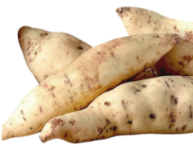
Figure 1. White-fleshed sweet potato tuber.
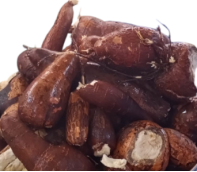
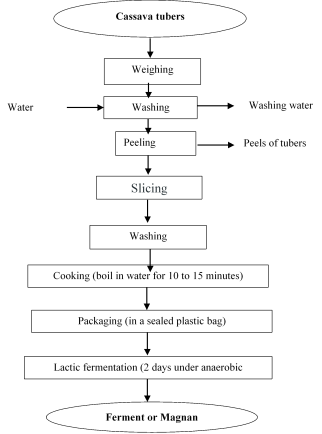
Figure 3. Diagram of magnan (starter) production [20].
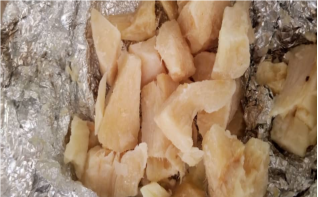
Figure 4. Cassava-based ferment.
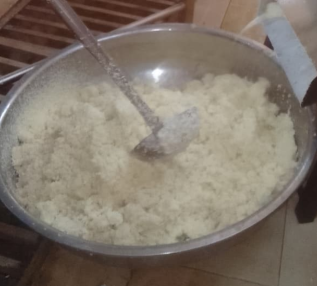
Figure 5. Tuber paste.
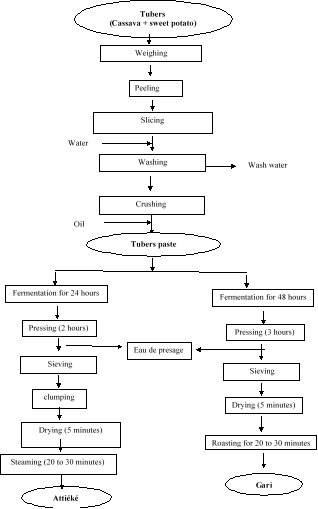
Figure 6. Diagram showing the production of tubers paste, attieke and gari at PDCB (Diagram adapted from Lingani and al. [20].
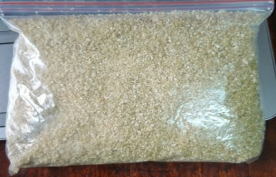
Figure 7.
Dried couscous, gari type.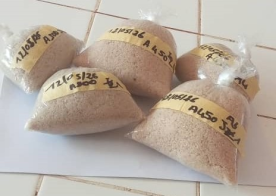
Figure 8. Fresh couscous, attieke type.
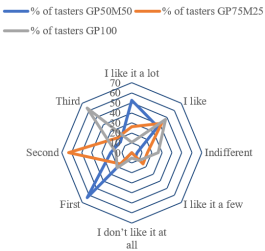
Figure 9.
Hedonic and ranking test of gari.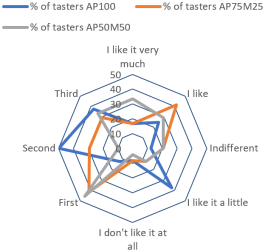
Figure 10.
Hedonic and ranking test of attieke.
Information



 Share This Article
 Twitter
 Linked In
 Facebook

 Copy
 Download