Abstract
Procurement policies of Government of India, primarily through the implementation of Minimum Support Price (MSP) and through the working of the Food Corporation of India (FCI), occupy a significant role in the food-grain markets in India. The important objectives of these policies are to ensuring price stability, food security, and economic welfare through reasonable payment to the farmers. However, these policies also have comprehensive effects for market prices, local production patterns, and fiscal sustainability. This study examines the dynamic relationship between Minimum Support Price (MSP), government procurement, buffer stock, and fluctuations in food-grain prices in India over the period of 1994 to 2023. The study uses the Autoregressive Distributed Lag (ARDL) model for the purpose. The analysis employs annual data on food grain price inflation, MSP, procurement quantity, and buffer stock levels for evaluating both short-run and long-run effects. The results confirm that there exist a stable long-run cointegrating relationship among these variables. Empirical findings show that increases in MSP significantly increase food grain inflation in both short and long runs, indicating a strong cost-push effect. Conversely, higher levels of procurement and buffer stock, particularly with lagged effects, show an inflation-dampening tendencies. The error correction term in the model is negative and statistically significant, showing a rapid adjustment toward long-run equilibrium. These results highlight the importance of a balanced policy management. Although, MSP plays an important role in ensuring farm income stability, unrestricted increases may intensify inflationary pressures. Strengthening procurement processes and well-organized buffer stock management are vital to justifying price volatility and ensuring food price stability in India.
|
Published in
|
Economics (Volume 15, Issue 1)
|
|
DOI
|
10.11648/j.eco.20261501.13
|
|
Page(s)
|
22-28 |
|
Creative Commons
|

This is an Open Access article, distributed under the terms of the Creative Commons Attribution 4.0 International License (http://creativecommons.org/licenses/by/4.0/), which permits unrestricted use, distribution and reproduction in any medium or format, provided the original work is properly cited.
|
|
Copyright
|
Copyright © The Author(s), 2026. Published by Science Publishing Group
|
Keywords
Food Grain Inflation, MSP, Buffer Stock, ARDL Model, Procurement
1. Introduction
Production of food rains is essential for a country’s food security, which is directly influencing the availability, and stability of staple food items such as rice, wheat etc. India occupies second position in the world food grain production which is accounting for about one fifth share in country’s total agricultural GDP
| [1] | Kumari, N. (2020). Foodgrains Production in India: Trend and Decompositions Analysis. Economic Affairs, 65.
https://doi.org/10.46852/0424-2513.3.2020.3 |
| [2] | Dev, K. (2023). Institutional Arrangements to Enforce the Minimum Support Price (MSP) Policy Effectively in India: A Case Study of Wheat and Paddy Production in Punjab. Advances in Research. https://doi.org/10.9734/air/2023/v24i5959 |
| [3] | Bhalla, G. S., & Singh, G. (n.d.). Economic liberalisation and Indian agriculture: A State-wise analysis. |
[1-3]
. And playing an important role in national food security and stability in the economy
| [4] | Birthal, P. S., Joshi, P. K., & Negi, D. S. (2015). Sources of growth in agriculture in India. National Centre for Agricultural Economics and Policy Research. |
| [5] | Chand, R. (2017). Doubling farmers’ income: Rationale, strategy, prospects and action plan. NITI Aayog. |
| [6] | Chand, R., Prasanna, P. A. L., & Singh, A. (2020). Changing structure of rural economy of India: Implications for employment and growth. NITI Aayog. |
| [7] | Dev, S. M., & Rao, N. C. (2004). Food security in India: Trends, patterns and policy issues. Centre for Economic and Social Studies. |
| [8] | Dr. Gandhimathi, S. (2020). Relationship between food grains production and import in India. International Journal of Recent Technology and Engineering, 40, 811–817. |
[4-8]
. To protect farmers from market fluctuations and also to ensure a stable supply of grains for the Public Distribution System (PDS), the Government of India has institutionalized procurement policies led by the Food Corporation of India (FCI). At the heart of these policies lies the Minimum Support Price (MSP) regime, which guarantees farmers a pre-announced price for certain staple crops, predominantly rice and wheat
| [2] | Dev, K. (2023). Institutional Arrangements to Enforce the Minimum Support Price (MSP) Policy Effectively in India: A Case Study of Wheat and Paddy Production in Punjab. Advances in Research. https://doi.org/10.9734/air/2023/v24i5959 |
[2]
.
Government procurement policies, particularly the Minimum Support Price (MSP) system and buffer stock operations, have been central to India's food security strategy. While these interventions aim to protect farmers and ensure stable food supplies, they can also influence market prices, potentially causing distortions. The expansion of procurement operations—especially in wheat and rice—has raised concerns about their effects on open market prices, private trade, and inflationary pressures. Despite the policy's significance, there is limited empirical analysis that quantifies how procurement volumes, MSP changes, and stockholding practices impact food grain prices at the wholesale and retail levels. This study addresses this gap by examining the relationship between government procurement policies and food grain prices in India over time.
This article explores the multifaceted impact of government procurement policies on food grain prices in India. It assesses how these policies contribute to price stabilization, the extent to which they influence market behaviour, and the broader implications for food security, fiscal management, and agricultural sustainability.
2. Literature Review
The relationship between agricultural policy instruments and food price dynamics has been widely studied in both global and Indian contexts. According to Timmer
| [9] | Timmer, P. (2008) Agriculture and Pro-Poor Growth: An Asian Perspective. Asian Journal of Agriculture and Development, Southeast Asian Regional Center for Graduate Study and Research in Agriculture, 5, 1-28.
http://dx.doi.org/10.2139/ssrn.1114155 |
[9]
, agricultural price stabilization policies are essential in developing economies where food markets are subject to high volatility. In India, Gaur and Tripathi
| [11] | Gaur, P., & Tripathi, A. (2012). Minimum support price policy and its impact on agricultural prices in India. Economic Affairs, 57(2), 123–134. |
[11]
noted that MSP policies, while protecting farmers, tend to have inflationary consequences when administered prices outpace productivity growth. Similarly, Chand
| [5] | Chand, R. (2017). Doubling farmers’ income: Rationale, strategy, prospects and action plan. NITI Aayog. |
[5]
argued that persistent increases in MSPs contribute to structural inflation in the food economy.
Empirical research has used econometric techniques such as cointegration, vector autoregression (VAR), and ARDL to explore these dynamics. Some studies have shown that procurement and buffer stock policies often help in stabilizing prices by moderating supply-side shocks
| [12] | Gulati, A., & Fan, S. (2008). The dragon and the elephant: Agricultural and rural reforms in China and India. Johns Hopkins University Press. |
| [13] | Gulati, A., & Saini, S. (2016). Buffer stocking policy in India: Examination of alternative approaches (ICRIER Working Paper No. 313). Indian Council for Research on International Economic Relations. |
| [17] | Radhakrishna, R., & Murty, K. N. (2010). Agricultural growth, employment and poverty in India: Emerging trends and perspectives. National Institute of Public Finance and Policy. |
| [18] | Radhakrishna, R., & Murty, K. N. (n.d.). Agricultural growth and rural poverty: The Indian experience. |
[12, 13, 17, 18]
. However, excessive accumulation of buffer stocks can lead to inefficiencies and fiscal burdens
| [14] | Kumar, P., Joshi, P. K., & Birthal, P. S. (2009). Demand and supply of cereals in India. Agricultural Economics Research Review, 22(1), 1–17. |
| [15] | Kumar, P., Joshi, P., & Birthal, P. (2020). Food policy reforms and implications for price stability in India. Journal of Policy Modeling, 42(5), 965–982.
https://doi.org/10.1016/j.jpolmod.2020.02.004 |
| [20] | Sekhar, C. S. C. (2012). Agricultural price policy, buffer stock operations and food security: An Indian perspective. Food Policy, 37 (3), 301–313.
https://doi.org/10.1016/j.foodpol.2012.02.002 |
[14, 15, 20]
. Recent analyses by RBI
| [19] | Reserve Bank of India (RBI). (2022). Report on currency and finance 2021–22. Reserve Bank of India. |
[19]
and FAO, 2023
| [10] | Food and Agriculture Organization (FAO). (2023). Food outlook: Global market analysis.FAO. |
[10]
emphasize the need for balanced agricultural price policies that simultaneously safeguard farmer income and contain inflationary risks.
MSP works best where it is backed by assured procurement, mainly rice and wheat in states such as Punjab, Haryana, Madhya Pradesh, Kerala and parts of Chhattisgarh and Odisha, where farmers get stable, often higher prices and strong protection from market volatility
| [2] | Dev, K. (2023). Institutional Arrangements to Enforce the Minimum Support Price (MSP) Policy Effectively in India: A Case Study of Wheat and Paddy Production in Punjab. Advances in Research. https://doi.org/10.9734/air/2023/v24i5959 |
| [23] | Roy, R. (2023). The Effectiveness, Accessibility, and Feasibility of Price Policy Mechanism in India: Evidence from the Situation Assessment Survey 2018–2019. Agrarian South: Journal of political Economy, 12, 352 - 389.
https://doi.org/10.1177/22779760231189342 |
| [24] | Kumar Basantaray, A. (2023). Is Minimum Support Price Effective in India? Evidence from State-wise Paddy Procurement. Asian Journal of Agricultural Extension, Economics & Sociology, 41(1), 53–65.
https://doi.org/10.9734/ajaees/2023/v41i11833 |
[2, 23, 24]
. Nationally, rising MSPs for cereals, pulses and oilseeds have supported production growth and food security, but also reflect rising input costs and political pressures rather than pure income gains
| [21] | Swaminathan, M. S. (2016). Revitalising Indian agriculture and boosting pulse production. Academic Foundation. |
| [25] | Reddy, A. (2021). Policy Implications of Minimum Support Price for Agriculture in India. Development Economics: Agriculture. https://doi.org/10.20935/al2406 |
[21, 25]
. Evidence from household surveys shows that farmers who sell to MSP/procurement agencies earn higher incomes than those forced to sell immediately in local markets, yet only a minority of farmers and a narrow set of crops benefit in this way
| [22] | Vaidyanathan, A. (2010). Agricultural growth in India: Role of technology, incentives, and institutions. Oxford University Press. |
| [23] | Roy, R. (2023). The Effectiveness, Accessibility, and Feasibility of Price Policy Mechanism in India: Evidence from the Situation Assessment Survey 2018–2019. Agrarian South: Journal of political Economy, 12, 352 - 389.
https://doi.org/10.1177/22779760231189342 |
| [24] | Kumar Basantaray, A. (2023). Is Minimum Support Price Effective in India? Evidence from State-wise Paddy Procurement. Asian Journal of Agricultural Extension, Economics & Sociology, 41(1), 53–65.
https://doi.org/10.9734/ajaees/2023/v41i11833 |
[22-24]
. For many foodgrains (especially pulses, oilseeds, and coarse cereals), MSP is often on paper only: procurement is thin or absent, so farmers remain exposed to low prices and import competition
| [25] | Reddy, A. (2021). Policy Implications of Minimum Support Price for Agriculture in India. Development Economics: Agriculture. https://doi.org/10.20935/al2406 |
| [26] | Balkrishna, A., Arya, V., & Singh, S. (2023). Minimum Support Price under the Aegis of Universal Basic Income: Understanding the Implications and Way Forward: A Review. Bhartiya Krishi Anusadhan Patrika. https://doi.org/10.18805/bkap640 |
[25, 26]
.
Theoretical and policy studies argue that MSP can raise production and farmer surplus but is fiscally costly, may not always increase net benefit, can distort cropping patterns, and should be complemented or partly replaced by cost subsidies, price deficiency payments, or direct income support, along with investments in irrigation, storage, and markets
| [26] | Balkrishna, A., Arya, V., & Singh, S. (2023). Minimum Support Price under the Aegis of Universal Basic Income: Understanding the Implications and Way Forward: A Review. Bhartiya Krishi Anusadhan Patrika. https://doi.org/10.18805/bkap640 |
| [27] | Das, R. (2021). Does Minimum Support Price Have Long-Run Associations and Short-Run Interplays with Yield Rates and Quantities of Outputs? A Study on Food and Non-food Grains in India. Review of Market Integration, 13, 42 - 65.
https://doi.org/10.1177/09749292211065192 |
| [28] | Chintapalli, P., & Tang, C. (2021). Crop minimum support price versus cost subsidy: Farmer and consumer welfare. Production and Operations Management, 31, 1753 - 1769.
https://doi.org/10.1111/poms.13642 |
[26-28]
.
Despite substantial work on MSP and food prices, relatively few studies have integrated procurement and buffer stock mechanisms within a unified econometric framework for India. While previous studies have discussed MSP, procurement, buffer stocking, and food price behaviour in India, there is limited empirical work that jointly examines food grain inflation, procurement, and buffer stock within a unified ARDL–ECM framework. Much of the earlier literature is descriptive or policy-based and does not distinguish clearly between short-run adjustments and long-run equilibrium effects. This study addresses that gap by using the ARDL bounds-testing approach to estimate the dynamic impact of government procurement policies on food grain inflation in India.
3. Methodology
This study uses secondary time-series data to analyse the relationship between government procurement policies and food grain prices. The focus is on wheat and rice; the two major crops procured under the MSP system in India. The main sources of data are MOSPI, RBI Handbook and FCI. The study uses annual time series data from 1994 to 2023. The details are given in
Table 1.
Table 1. Variables and Data Description.
Variable | Data description | Source |
Food Grain inflation | Annual percentage change in WPI food grains with a base year 2011-12 | Office of the Economic Adviser, GoI |
MSP | Minimum Support Price for food grains | RBI Handbook on Indian Economy |
Procurement | Government food grain procurement | RBI Handbook on Indian Economy |
Buffer Stock | Food grain stock held by government | RBI Handbook on Indian Economy |
Source: Compiled by the author from Office of the Economic Adviser, Government of India, and RBI Handbook of Statistics on Indian Economy.
The major variables taken here are Minimum Support Price, procurement quantity, buffer stock, and WPI for food grains. WPI food grain as the dependent variable and the variable like MSP, Procurement quantity, and Buffer stock as independent variables. All the variable are tested for unit roots using Augmented Dickey Fuller test. For making the variable stationary, the log transformation has been used here. OLS has been used to examine the trend of food grain prices over the period.
The Autoregressive Distributed Lag (ARDL) model, developed by Pesaran, Shin, and Smith
| [16] | Pesaran, M. H., Shin, Y., & Smith, R. J. (2001). Bounds testing approaches to the analysis of level relationships. Journal of Applied Econometrics, 16(3), 289–326.
https://doi.org/10.1002/jae.616 |
[16]
, was used due to its flexibility in handling variables integrated of order I(0) or I(1) and its suitability for small sample sizes. This study employs an Autoregressive Distributed Lag (ARDL) model to capture both short-run dynamics and long-run equilibrium relationships among MSP, procurement, buffer stock, and food grain inflation in India over the period 1994–2023. For all these purposes E-views software has been used.
4. Results and Discussions
Food grains play an important role in the food basket of each Indian. So, an increase in food grain prices may act as a burden on Common man. Therefore, it is important to examine the trend of food grain prices over time. The result of trend analysis is shown below.
Table 2. Trend of food grain prices.
Variable | Coefficient | Std. Error | t-Statistic | Prob. |
C | -114.0772 | 3.379916 | -33.75150 | 0.0000 |
YEAR | 0.059003 | 0.001683 | 35.06234 | 0.0000 |
Source: Authors’ calculation
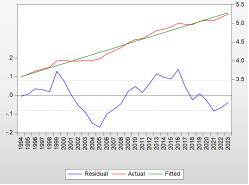
Figure 1. Trend line of food grain prices.
Here in the model, coefficient of time, t, is 0.059, which signifying that, on an average, the log of WPI for grains increases by 0.059 units per year. The result is showing a steady upward growth in food grain prices over the time as indicated in the figure also. Since the p-value which is 0.0000, is highly significant, the time trend variable has a statistically significant positive effect on the WPI of grains.
When applying Augmented Dickey fuller test, we can see that all the variables are stationary at first difference. So, we can apply ARDL model to the study to examine the short term and long-term effect of policies on food grain prices.
Table 3. Estimated Short-Run ARDL Results for Food Grain Inflation.
Variable | Coefficient | Std. Error | t-Statistic | Prob.* |
FOOD_GRAIN_INFLATION(-1) | -0.025807 | 0.198680 | -0.129890 | 0.8979 |
LN_MSP | 15.79848 | 5.913362 | 2.671659 | 0.0143 |
LN_PROCUREMENT | -16.27256 | 8.681751 | -1.874341 | 0.0749 |
LN_STOCK | -4.216822 | 6.621534 | -0.636835 | 0.5311 |
LN_STOCK(-1) | 8.542362 | 8.152048 | 1.047879 | 0.3066 |
LN_STOCK(-2) | -11.57512 | 5.468640 | -2.116636 | 0.0464 |
C | 42.15413 | 17.33635 | 2.431546 | 0.0241 |
R-squared | 0.338089 | Mean dependent var | 6.038334 |
Adjusted R-squared | 0.148971 | S.D. dependent var | 5.427886 |
S.E. of regression | 5.007291 | Akaike info criterion | 6.271985 |
Sum squared resid | 526.5322 | Schwarz criterion | 6.605036 |
Log likelihood | -80.80779 | Hannan-Quinn criter. | 6.373802 |
F-statistic | 1.787718 | Durbin-Watson stat | 2.007499 |
Prob(F-statistic) | 0.150398 | |
*Note: p-values and any subsequent tests do not account for model selection. |
Source: Estimated by the authors
The estimated ARDL (1,0,0,2) model examines the dynamic relationship between food grain inflation, Minimum Support Price (MSP), public procurement, and buffer stock levels in India over the period 1996–2023. The dependent variable, food grain inflation, captures the price movements in food grains, while MSP, procurement, and stock variables represent key government interventions in agricultural price management.
The results reveal that MSP has a strong positive and statistically significant impact on food grain inflation. Specifically, a one percent rise in the MSP is associated with an approximately 15.8 percent increase in food grain inflation, indicating that price support policies apply a substantial cost-push effect on food-grain prices. This outcome underlines the inflationary nature of successive hike in MSP, although it is beneficial for farmers’ incomes, tend to transmit upward pressures through the broader food price system.
Contrary, public procurement shows a negative and marginally significant effect on inflation, suggesting that higher procurement levels may stabilize market prices by ensuring adequate public supply and reducing open market volatility. This emphasizes the dual role of procurement—supporting farm prices through assured purchases while simultaneously moderating consumer prices through the Public Distribution System (PDS).
The buffer stock variable exhibits a delayed but meaningful influence on inflation. They act with a lag. The current buffer stock and one-year lagged buffer stock are statistically insignificant. But, the two-year lag of buffer stock is negative and statistically significant. This indicates that higher buffer stocks in the past contribute to future price stabilization, as surplus stocks released in later years help offset supply shocks and contain inflationary pressures.
Overall, the model explains about 34% of the variation in food grain inflation, with no evidence of autocorrelation as the Durbin Watson value is 2. The findings underscore that while MSP acts as the primary contributor to food grain price inflation, the timely procurement policies and adequate buffer stocks which serve as significant stabilizing mechanisms in India’s food grain prices. Policymakers should therefore aim to balance MSP increases with proactive stock management and efficient distribution to mitigate inflationary risks.
After estimating an ARDL model, it is necessary to test whether the variables in the model are cointegrated, i.e., whether they share a long-run equilibrium relationship despite being individually non-stationary. This is done using the Bounds Test for Cointegration, developed by Pesaran, Shin, and Smith (2001).
The main reason for applying the Bounds Test is that the ARDL framework can be used irrespective of whether variables are I(0) or I(1), but not I(2). The test helps verify if a statistically meaningful long-run relationship exists among the variables before interpreting long-run coefficients. Without establishing cointegration, any long-run interpretation from the ARDL model could be spurious.
Table 4. ARDL Long Run Form and Bounds Test.
Conditional Error Correction Regression |
Variable | Coefficient | Std. Error | t-Statistic | Prob. |
C | 42.15413 | 17.33635 | 2.431546 | 0.0241 |
FOODGRAIN_INFLATION(-1)* | -1.025807 | 0.198680 | -5.163114 | 0.0000 |
LN_MSP | 15.79848 | 5.913362 | 2.671659 | 0.0143 |
LN_PROCUREMENT | -16.27256 | 8.681751 | -1.874341 | 0.0749 |
LN_STOCK(-1) | -7.249579 | 4.723526 | -1.534781 | 0.1398 |
D(LN_STOCK) | -4.216822 | 6.621534 | -0.636835 | 0.5311 |
D(LN_STOCK(-1)) | 11.57512 | 5.468640 | 2.116636 | 0.0464 |
* p-value incompatible with t-Bounds distribution. |
Case 2: Restricted Constant and No Trend |
Variable | Coefficient | Std. Error | t-Statistic | Prob. |
LN_MSP | 15.40104 | 5.790402 | 2.659753 | 0.0147 |
LN_PROCUREMENT | -15.86319 | 8.081269 | -1.962958 | 0.0630 |
LN_STOCK | -7.067200 | 4.903092 | -1.441376 | 0.1642 |
C | 41.09365 | 16.33390 | 2.515851 | 0.0201 |
EC = FOOD_GRAIN_INFLATION - (15.4010*LN_MSP -15.8632 *LN_PROCUREMENT -7.0672*LN_STOCK + 41.0936) |
F-Bounds Test | Null Hypothesis: No levels relationship |
Test Statistic | Value | Signif. | I(0) | I(1) |
| | Asymptotic | n=1000: | |
F-statistic | 6.330114 | 10% | 2.37 | 3.2 |
k | 3 | 5% | 2.79 | 3.67 |
| | 2.5% | 3.15 | 4.08 |
| | 1% | 3.65 | 4.66 |
| | 10% | 2.618 | 3.532 |
| | 5% | 3.164 | 4.194 |
| | 1% | 4.428 | 5.816 |
| | | Finite Sample: | n=30 |
| | 10% | 2.676 | 3.586 |
| | 5% | 3.272 | 4.306 |
| | 1% | 4.614 | 5.966 |
Source: Authors’ Calculation
The ARDL (1,0,0,2) model for food-grain inflation was tested for cointegration using the Bounds Test. The calculated F-statistic is 6.33, which exceeds the upper bound critical value confirming the existence of a long-run cointegrating relationship among food grain inflation, MSP, public procurement, and buffer stock levels. This indicates that these policy variables and food grain inflation move together in the long run, despite short-term fluctuations.
The Error Correction Term is negative and statistically significant, ensuring adjustment toward the long-term equilibrium. Since the coefficient is slightly greater than unity in absolute value, the adjustment may involve mild over-correction in the short period, implying that convergence may occur through a slight oscillating path rather than a purely monotonous process.
The long-run coefficients show that MSP has a strong positive and significant impact on inflation, that is, a one percent rise in MSP leads to about a 15.4 percent increase in food grain inflation. In contrast, public procurement exhibits a negative and marginally significant effect, implying that larger procurement volumes tend to stabilize prices. The buffer stock variable also shows a negative sign, though statistically weaker, indicating a delayed inflation-moderating effect.
In the short-run dynamics, changes in MSP exert an immediate inflationary effect, while procurement and lagged stock adjustments act as short-term stabilizers. The positive short-run effect of lagged stock changes likely reflects temporary cost pressures from storage and procurement activities.
Overall, the results suggest that MSP serves as the primary inflationary driver, while procurement and buffer stock policies mitigate price pressures over time. The rapid error correction supports the conclusion that the inflationary process in the food grain sector is highly policy-responsive, with long-run stability maintained through coordinated government interventions.
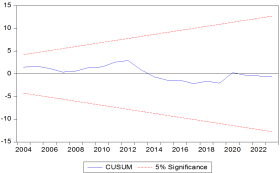
The parameter stability of the ARDL model is examined using the CUSUM test. The test is useful in identifying whether the regression coefficients remain stable throughout the study period. Ensuring parameter stability is essential for validating the robustness and reliability of the estimated model.
Figure 2. CUSUM Test for Parameter Stability of the ARDL Model.
The CUSUM test confirms the stability of the estimated ARDL model, as the cumulative sum of recursive residuals remains within the 5 per cent critical bounds throughout the study period. This suggests that the estimated coefficients are stable and that there is no evidence of structural instability in the model.
5. Policy Implications
The findings hold crucial implications for agricultural price policy in India. Indeed, the positive long-run impact of MSP on inflation underlines this trade-off between farmer income support and consumer price stability. Policymakers should calibrate hikes in MSP in line with productivity growth and fiscal sustainability. Overly aggressive increases can transmit cost-push pressures across the food economy.
Procurement operations emerge as an important tool for price stabilization. Broadening the geographical spread and efficiency of procurement operations could reduce market distortions and regional imbalances. Similarly, the maintenance of buffer stocks at optimal levels—neither too surplus nor too deficient—would improve price stability. There is also a scope for technological improvement in storage and real-time monitoring to improve stock management.
The study further argues that coordinated policy action involving MSP adjustments, procurement planning, and timely release of stocks is essential in minimizing inflationary risks while safeguarding farmers' welfare. Strengthening institutional capacity and ensuring data transparency will enhance the effectiveness of these interventions.
6. Conclusion
This paper presents empirical evidence that MSP, procurement, and buffer stock policies are the strong driving factors in food grain inflation in India. Employing the ARDL framework over the period 1994-2023, the analysis confirms a long-run equilibrium relationship among these variables. The results show that MSP has a strong inflationary impact, whereas procurement and buffer stock act to stabilize it. An error correction mechanism reveals rapid adjustment, underlining that policy influence on price behaviour is dynamic.
The results highlight the trade-off that there exists between income support to the farmers and control of inflation. Sustainable agricultural policy requires integrating pricing, procurement, and stock management within a coherent framework that meets the twin goals of food security and macroeconomic stability. Further research can extend this analysis to incorporate climatic and global price variables in evaluating external shocks to domestic food inflation.
Author Contributions
Prajisha P: Conceptualization, Data analysis
Rahul K: Methodology
Rajimol M S: Writing – review & editing
Funding
This research did not receive any funding.
Data Availability Statement
The data that support the findings of this study can be found at: https://rbi.org.in/Scripts/AnnualPublications.aspx?head=Handbook%20of%20Statistics%20on%20Indian%20Economy
The data is available from the corresponding author upon reasonable request.
Conflicts of Interest
The authors declare no conflicts of interest.
References
| [1] |
Kumari, N. (2020). Foodgrains Production in India: Trend and Decompositions Analysis. Economic Affairs, 65.
https://doi.org/10.46852/0424-2513.3.2020.3
|
| [2] |
Dev, K. (2023). Institutional Arrangements to Enforce the Minimum Support Price (MSP) Policy Effectively in India: A Case Study of Wheat and Paddy Production in Punjab. Advances in Research.
https://doi.org/10.9734/air/2023/v24i5959
|
| [3] |
Bhalla, G. S., & Singh, G. (n.d.). Economic liberalisation and Indian agriculture: A State-wise analysis.
|
| [4] |
Birthal, P. S., Joshi, P. K., & Negi, D. S. (2015). Sources of growth in agriculture in India. National Centre for Agricultural Economics and Policy Research.
|
| [5] |
Chand, R. (2017). Doubling farmers’ income: Rationale, strategy, prospects and action plan. NITI Aayog.
|
| [6] |
Chand, R., Prasanna, P. A. L., & Singh, A. (2020). Changing structure of rural economy of India: Implications for employment and growth. NITI Aayog.
|
| [7] |
Dev, S. M., & Rao, N. C. (2004). Food security in India: Trends, patterns and policy issues. Centre for Economic and Social Studies.
|
| [8] |
Dr. Gandhimathi, S. (2020). Relationship between food grains production and import in India. International Journal of Recent Technology and Engineering, 40, 811–817.
|
| [9] |
Timmer, P. (2008) Agriculture and Pro-Poor Growth: An Asian Perspective. Asian Journal of Agriculture and Development, Southeast Asian Regional Center for Graduate Study and Research in Agriculture, 5, 1-28.
http://dx.doi.org/10.2139/ssrn.1114155
|
| [10] |
Food and Agriculture Organization (FAO). (2023). Food outlook: Global market analysis.FAO.
|
| [11] |
Gaur, P., & Tripathi, A. (2012). Minimum support price policy and its impact on agricultural prices in India. Economic Affairs, 57(2), 123–134.
|
| [12] |
Gulati, A., & Fan, S. (2008). The dragon and the elephant: Agricultural and rural reforms in China and India. Johns Hopkins University Press.
|
| [13] |
Gulati, A., & Saini, S. (2016). Buffer stocking policy in India: Examination of alternative approaches (ICRIER Working Paper No. 313). Indian Council for Research on International Economic Relations.
|
| [14] |
Kumar, P., Joshi, P. K., & Birthal, P. S. (2009). Demand and supply of cereals in India. Agricultural Economics Research Review, 22(1), 1–17.
|
| [15] |
Kumar, P., Joshi, P., & Birthal, P. (2020). Food policy reforms and implications for price stability in India. Journal of Policy Modeling, 42(5), 965–982.
https://doi.org/10.1016/j.jpolmod.2020.02.004
|
| [16] |
Pesaran, M. H., Shin, Y., & Smith, R. J. (2001). Bounds testing approaches to the analysis of level relationships. Journal of Applied Econometrics, 16(3), 289–326.
https://doi.org/10.1002/jae.616
|
| [17] |
Radhakrishna, R., & Murty, K. N. (2010). Agricultural growth, employment and poverty in India: Emerging trends and perspectives. National Institute of Public Finance and Policy.
|
| [18] |
Radhakrishna, R., & Murty, K. N. (n.d.). Agricultural growth and rural poverty: The Indian experience.
|
| [19] |
Reserve Bank of India (RBI). (2022). Report on currency and finance 2021–22. Reserve Bank of India.
|
| [20] |
Sekhar, C. S. C. (2012). Agricultural price policy, buffer stock operations and food security: An Indian perspective. Food Policy, 37 (3), 301–313.
https://doi.org/10.1016/j.foodpol.2012.02.002
|
| [21] |
Swaminathan, M. S. (2016). Revitalising Indian agriculture and boosting pulse production. Academic Foundation.
|
| [22] |
Vaidyanathan, A. (2010). Agricultural growth in India: Role of technology, incentives, and institutions. Oxford University Press.
|
| [23] |
Roy, R. (2023). The Effectiveness, Accessibility, and Feasibility of Price Policy Mechanism in India: Evidence from the Situation Assessment Survey 2018–2019. Agrarian South: Journal of political Economy, 12, 352 - 389.
https://doi.org/10.1177/22779760231189342
|
| [24] |
Kumar Basantaray, A. (2023). Is Minimum Support Price Effective in India? Evidence from State-wise Paddy Procurement. Asian Journal of Agricultural Extension, Economics & Sociology, 41(1), 53–65.
https://doi.org/10.9734/ajaees/2023/v41i11833
|
| [25] |
Reddy, A. (2021). Policy Implications of Minimum Support Price for Agriculture in India. Development Economics: Agriculture.
https://doi.org/10.20935/al2406
|
| [26] |
Balkrishna, A., Arya, V., & Singh, S. (2023). Minimum Support Price under the Aegis of Universal Basic Income: Understanding the Implications and Way Forward: A Review. Bhartiya Krishi Anusadhan Patrika.
https://doi.org/10.18805/bkap640
|
| [27] |
Das, R. (2021). Does Minimum Support Price Have Long-Run Associations and Short-Run Interplays with Yield Rates and Quantities of Outputs? A Study on Food and Non-food Grains in India. Review of Market Integration, 13, 42 - 65.
https://doi.org/10.1177/09749292211065192
|
| [28] |
Chintapalli, P., & Tang, C. (2021). Crop minimum support price versus cost subsidy: Farmer and consumer welfare. Production and Operations Management, 31, 1753 - 1769.
https://doi.org/10.1111/poms.13642
|
Cite This Article
-
APA Style
P, P., K, R., S, R. M. (2026). Role of Government Procurement Policies on Food Grain Inflation in India: A Long-Term Analysis. Economics, 15(1), 22-28. https://doi.org/10.11648/j.eco.20261501.13
 Copy
|
Copy
|
 Download
ACS Style
P, P.; K, R.; S, R. M. Role of Government Procurement Policies on Food Grain Inflation in India: A Long-Term Analysis. Economics. 2026, 15(1), 22-28. doi: 10.11648/j.eco.20261501.13
Copy
|
Download
AMA Style
P P, K R, S RM. Role of Government Procurement Policies on Food Grain Inflation in India: A Long-Term Analysis. Economics. 2026;15(1):22-28. doi: 10.11648/j.eco.20261501.13
Copy
|
Download
-
@article{10.11648/j.eco.20261501.13,
  author = {Prajisha P and Rahul K and Rajimol M S},
  title = {Role of Government Procurement Policies on Food Grain Inflation in India: A Long-Term Analysis},
  journal = {Economics},
  volume = {15},
  number = {1},
  pages = {22-28},
  doi = {10.11648/j.eco.20261501.13},
  url = {https://doi.org/10.11648/j.eco.20261501.13},
  eprint = {https://article.sciencepublishinggroup.com/pdf/10.11648.j.eco.20261501.13},
  abstract = {Procurement policies of Government of India, primarily through the implementation of Minimum Support Price (MSP) and through the working of the Food Corporation of India (FCI), occupy a significant role in the food-grain markets in India. The important objectives of these policies are to ensuring price stability, food security, and economic welfare through reasonable payment to the farmers. However, these policies also have comprehensive effects for market prices, local production patterns, and fiscal sustainability. This study examines the dynamic relationship between Minimum Support Price (MSP), government procurement, buffer stock, and fluctuations in food-grain prices in India over the period of 1994 to 2023. The study uses the Autoregressive Distributed Lag (ARDL) model for the purpose. The analysis employs annual data on food grain price inflation, MSP, procurement quantity, and buffer stock levels for evaluating both short-run and long-run effects. The results confirm that there exist a stable long-run cointegrating relationship among these variables. Empirical findings show that increases in MSP significantly increase food grain inflation in both short and long runs, indicating a strong cost-push effect. Conversely, higher levels of procurement and buffer stock, particularly with lagged effects, show an inflation-dampening tendencies. The error correction term in the model is negative and statistically significant, showing a rapid adjustment toward long-run equilibrium. These results highlight the importance of a balanced policy management. Although, MSP plays an important role in ensuring farm income stability, unrestricted increases may intensify inflationary pressures. Strengthening procurement processes and well-organized buffer stock management are vital to justifying price volatility and ensuring food price stability in India.},
 year = {2026}
}
Copy
|
Download
-
TY  - JOUR
T1  - Role of Government Procurement Policies on Food Grain Inflation in India: A Long-Term Analysis
AU  - Prajisha P
AU  - Rahul K
AU  - Rajimol M S
Y1  - 2026/03/23
PY  - 2026
N1  - https://doi.org/10.11648/j.eco.20261501.13
DO  - 10.11648/j.eco.20261501.13
T2  - Economics
JF  - Economics
JO  - Economics
SP  - 22
EP  - 28
PB  - Science Publishing Group
SN  - 2376-6603
UR  - https://doi.org/10.11648/j.eco.20261501.13
AB  - Procurement policies of Government of India, primarily through the implementation of Minimum Support Price (MSP) and through the working of the Food Corporation of India (FCI), occupy a significant role in the food-grain markets in India. The important objectives of these policies are to ensuring price stability, food security, and economic welfare through reasonable payment to the farmers. However, these policies also have comprehensive effects for market prices, local production patterns, and fiscal sustainability. This study examines the dynamic relationship between Minimum Support Price (MSP), government procurement, buffer stock, and fluctuations in food-grain prices in India over the period of 1994 to 2023. The study uses the Autoregressive Distributed Lag (ARDL) model for the purpose. The analysis employs annual data on food grain price inflation, MSP, procurement quantity, and buffer stock levels for evaluating both short-run and long-run effects. The results confirm that there exist a stable long-run cointegrating relationship among these variables. Empirical findings show that increases in MSP significantly increase food grain inflation in both short and long runs, indicating a strong cost-push effect. Conversely, higher levels of procurement and buffer stock, particularly with lagged effects, show an inflation-dampening tendencies. The error correction term in the model is negative and statistically significant, showing a rapid adjustment toward long-run equilibrium. These results highlight the importance of a balanced policy management. Although, MSP plays an important role in ensuring farm income stability, unrestricted increases may intensify inflationary pressures. Strengthening procurement processes and well-organized buffer stock management are vital to justifying price volatility and ensuring food price stability in India.
VL  - 15
IS  - 1
ER  -
Copy
|
Download





 Share This Article
 Twitter
 Linked In
 Facebook